Overview
Weakening experimental reasoning is a critical skill tested extensively on the LSAT Logical Reasoning section. This question type challenges test-takers to identify flaws, alternative explanations, or overlooked factors that undermine the validity of an experimental conclusion. Experimental arguments on the LSAT typically present a study, trial, or controlled observation that draws a causal or correlational conclusion from the results. The test-taker must then select an answer choice that casts doubt on whether the experiment actually supports its stated conclusion.
Understanding how to weaken experimental reasoning requires mastery of scientific methodology, causal reasoning, and the ability to spot gaps between evidence and conclusions. These questions appear frequently in the Logical Reasoning sections, often accounting for 15-20% of all strengthen and weaken questions. Success on these questions directly impacts overall LSAT performance, as they test critical thinking skills that law schools value highly: the ability to scrutinize evidence, identify methodological flaws, and recognize when conclusions outpace their supporting data.
Within the broader landscape of LSAT Logical Reasoning, weakening experimental reasoning connects intimately with causal reasoning, necessary and sufficient conditions, and argument structure analysis. While strengthen questions ask test-takers to support experimental conclusions, weaken questions require the opposite skill—finding the Achilles' heel in the experimental design, execution, or interpretation. Mastering this topic provides a foundation for understanding how evidence relates to conclusions across all argument types, making it essential not just for weaken questions but for assumption, flaw, and evaluation questions as well.
Learning Objectives
- [ ] Identify how weakening experimental reasoning appears in LSAT questions
- [ ] Explain the reasoning pattern behind weakening experimental reasoning
- [ ] Apply weakening experimental reasoning to solve LSAT-style problems accurately
- [ ] Distinguish between different types of experimental flaws (sampling bias, confounding variables, measurement issues)
- [ ] Evaluate whether an answer choice genuinely weakens an experimental conclusion or merely introduces irrelevant information
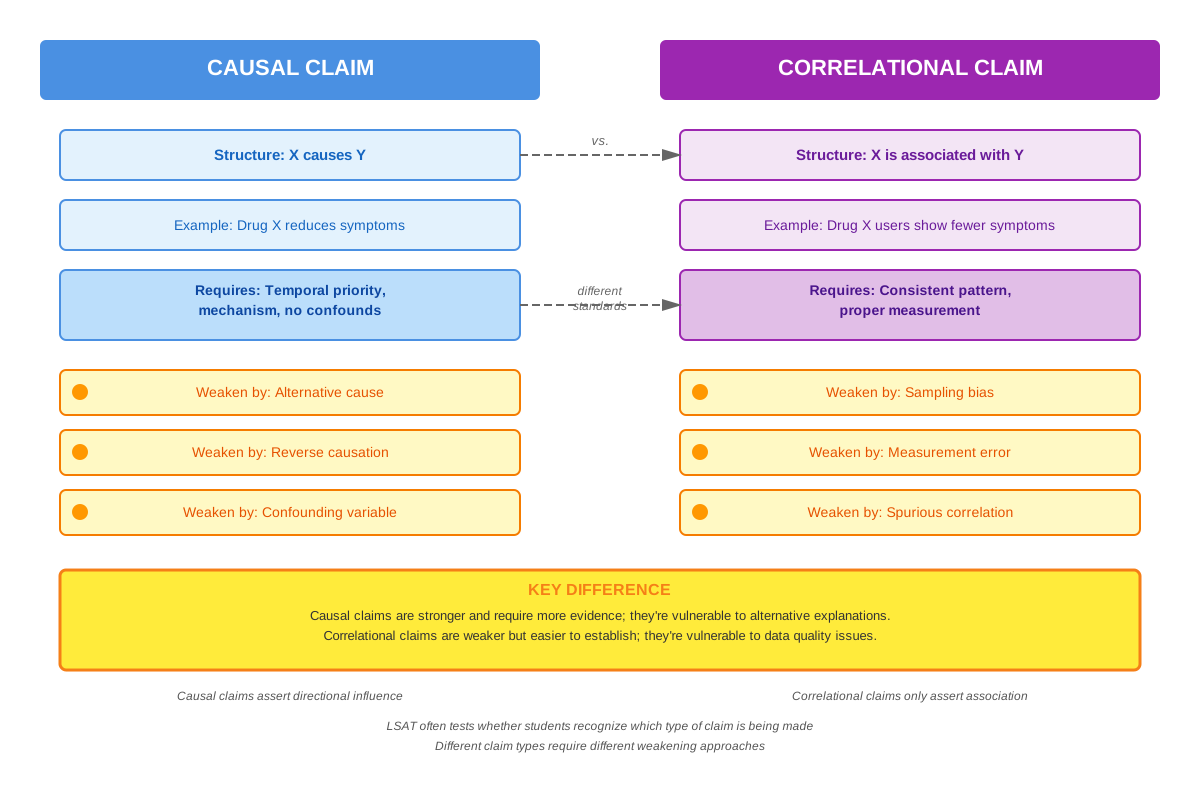
- [ ] Recognize the difference between weakening a causal claim versus weakening a correlational claim in experimental contexts
Prerequisites
- Basic argument structure: Understanding premises, conclusions, and how evidence supports claims is essential because experimental arguments follow this fundamental structure with added complexity.
- Causal reasoning fundamentals: Recognizing the difference between correlation and causation matters because experimental arguments typically make causal claims that can be weakened by showing alternative causes.
- Conditional logic basics: Understanding necessary and sufficient conditions helps because experimental conclusions often depend on certain conditions being met.
- Control group concepts: Familiarity with how experiments use control groups is relevant because many weakening strategies exploit flaws in experimental design or comparison groups.
Why This Topic Matters
Weakening experimental reasoning appears in virtually every LSAT administration, making it one of the highest-yield topics for test preparation. Research on recent LSAT exams shows that approximately 3-5 questions per test directly involve experimental or study-based arguments, with weaken questions being the most common question type for this argument structure. These questions test skills that extend far beyond the LSAT—the ability to critically evaluate scientific claims, identify methodological flaws, and recognize when conclusions exceed their evidentiary support.
In legal practice, attorneys constantly evaluate expert testimony, scientific evidence, and empirical studies. A lawyer might need to challenge a forensic expert's methodology, question the validity of a medical study presented as evidence, or identify flaws in economic data analysis. The skills tested in lsat weakening experimental reasoning questions directly translate to these professional competencies, which explains why law schools value this reasoning ability so highly.
On the LSAT, experimental reasoning arguments typically appear in several recognizable formats: comparative studies (Group A received treatment X while Group B received treatment Y), before-and-after studies (participants showed improvement after intervention), observational studies (researchers noticed a correlation between two variables), and survey-based arguments (polling data suggests a particular conclusion). Each format has characteristic vulnerabilities that skilled test-takers learn to exploit when selecting weakening answer choices.
Core Concepts
The Structure of Experimental Arguments
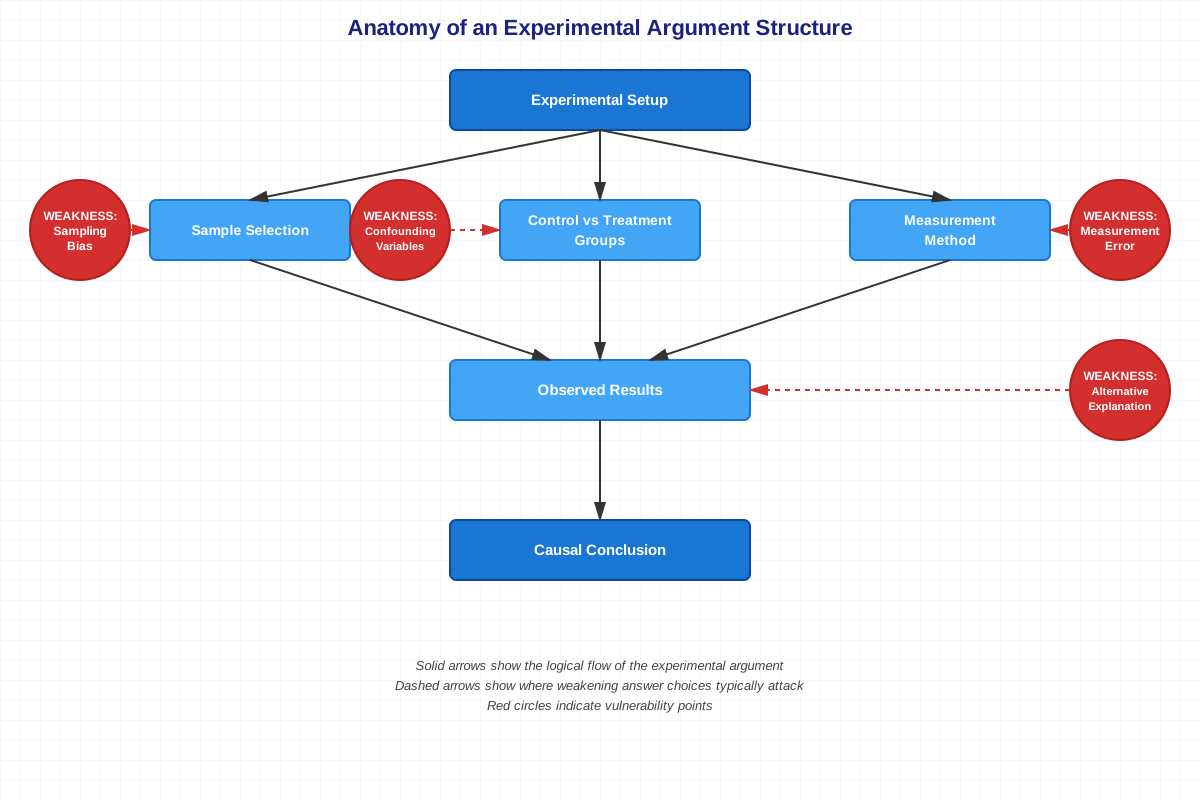
Experimental reasoning on the LSAT follows a predictable structure that test-takers must recognize instantly. The argument presents empirical evidence (data from a study, experiment, or observation), describes the methodology (how the data was collected), and draws a conclusion (typically causal or predictive). The conclusion almost always goes beyond what the evidence strictly proves, creating vulnerability to weakening attacks.
A typical experimental argument contains these elements:
- Background context: Establishes why the experiment was conducted
- Methodology description: Explains how subjects were selected, what interventions occurred, and how results were measured
- Results presentation: States what the experiment found
- Conclusion: Interprets what the results mean, often making a causal claim
The gap between results and conclusion creates the primary opportunity for weakening. While the results themselves may be accurate, the interpretation may overlook alternative explanations, confounding variables, or methodological limitations.
Types of Experimental Flaws
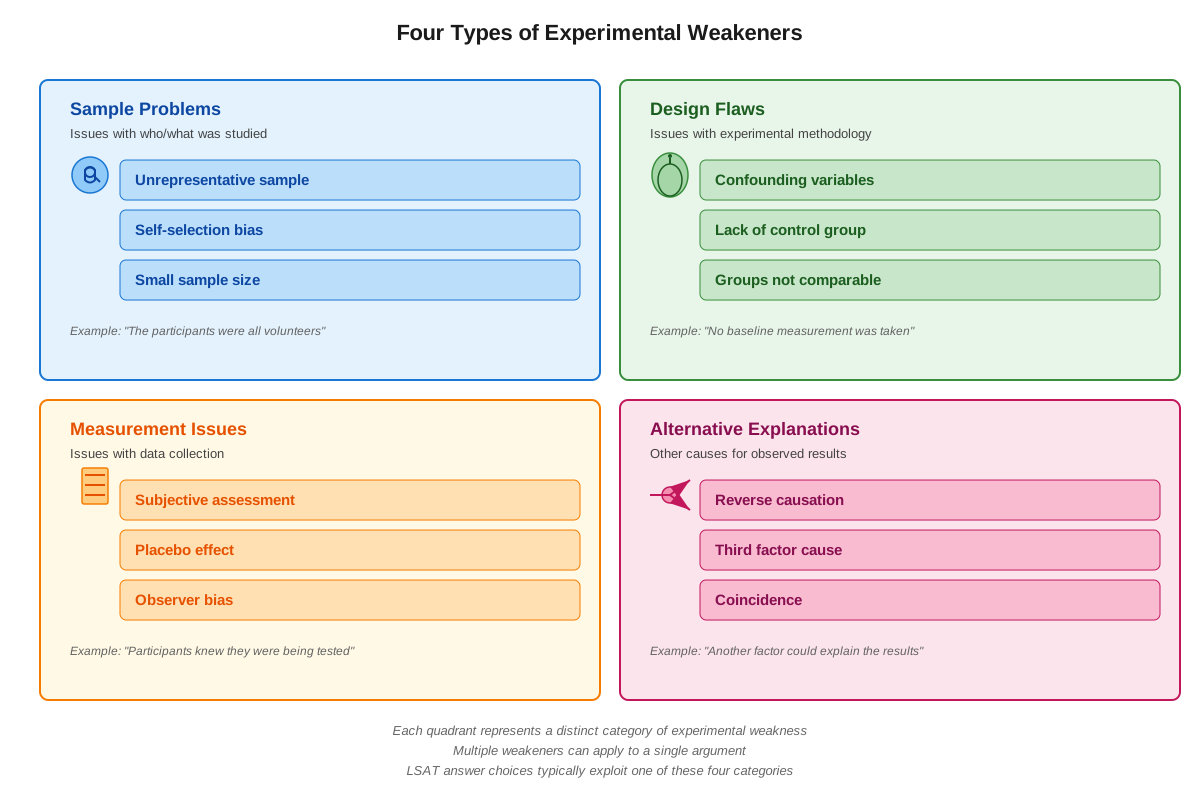
Understanding the categories of experimental flaws enables systematic analysis of weakening answer choices. The LSAT tests recognition of these recurring vulnerabilities:
| Flaw Type | Description | Weakening Strategy |
|---|---|---|
| Sampling bias | The experimental subjects don't represent the population about which conclusions are drawn | Show the sample is unrepresentative |
| Confounding variables | Factors other than the tested variable could explain the results | Identify alternative causes |
| Measurement problems | The way results were measured doesn't accurately capture what researchers claim | Question the validity of measurements |
| Temporal issues | The timing of the study affects interpretation | Show results may change over time |
| Comparison group flaws | Control groups differ from experimental groups in relevant ways | Highlight pre-existing differences |
| Generalization errors | Conclusions extend beyond what the data supports | Limit the scope of valid inference |
Confounding Variables and Alternative Explanations
The most common way to weaken experimental reasoning involves introducing a confounding variable—a factor that provides an alternative explanation for the observed results. When an experiment concludes that X causes Y, a confounding variable suggests that Z actually causes Y, and Z just happened to correlate with X in this particular study.
For example, if a study finds that students who take music lessons perform better academically and concludes that music lessons improve academic performance, a confounding variable might be that families who can afford music lessons also provide other educational advantages (tutoring, better schools, more books at home). The music lessons might not cause the academic improvement; instead, socioeconomic factors might cause both music lesson enrollment and academic success.
Effective weakening answer choices introduce confounding variables that are:
- Plausible and relevant to the experimental context
- Sufficient to explain the observed results without the proposed cause
- Not easily ruled out by the experimental design described
Sampling and Representativeness Issues
Sampling bias weakens experimental reasoning by showing that the subjects studied don't represent the population about which conclusions are drawn. The LSAT frequently tests whether test-takers recognize when experimental subjects differ systematically from the broader group to which conclusions are applied.
Consider an experiment testing a new teaching method on volunteer students at an elite private school, then concluding the method would work for all students nationwide. Weakening this argument requires recognizing that volunteers at elite schools may differ from typical students in motivation, prior preparation, resources, or other relevant characteristics.
Key sampling vulnerabilities include:
- Self-selection bias: Volunteers may differ from non-volunteers
- Demographic mismatch: Study subjects differ in age, background, or other relevant characteristics from the target population
- Attrition bias: Subjects who drop out of studies may differ systematically from those who complete them
- Convenience sampling: Studying easily accessible subjects rather than representative ones
Temporal and Causal Direction Issues
Experimental conclusions often assume a particular causal direction or temporal relationship that weakening answer choices can challenge. Just because A and B correlate, or A precedes B, doesn't prove A causes B. The LSAT tests whether students recognize these temporal vulnerabilities.
Reverse causation occurs when the supposed effect actually causes the supposed cause. If a study finds that people who exercise regularly report less stress and concludes that exercise reduces stress, reverse causation would suggest that less-stressed people have more energy and motivation to exercise regularly.
Common cause scenarios involve a third factor causing both observed variables. If researchers notice that ice cream sales and drowning deaths both increase in summer and conclude (absurdly) that ice cream causes drowning, the common cause (warm weather) explains both phenomena without a causal relationship between them.
Measurement and Operationalization Problems
How experiments measure their variables critically affects whether results support conclusions. Measurement validity questions whether the study actually measured what researchers claim. If a study measures "happiness" by asking people to rate their mood on a single day, this measurement may not capture genuine long-term happiness levels.
Operationalization refers to how abstract concepts get translated into measurable variables. When a study operationalizes "success" as "income level," this choice excludes other valid conceptions of success (job satisfaction, work-life balance, social contribution). Weakening answer choices often exploit the gap between the abstract concept in the conclusion and the specific measurement in the study.
The Scope Gap
Perhaps the most fundamental vulnerability in experimental reasoning involves the scope gap—the difference between what the experiment actually tested and what the conclusion claims. Experiments test specific subjects, in specific conditions, at specific times, measuring specific outcomes. Conclusions often generalize far beyond these specifics.
Effective weakening requires recognizing when conclusions:
- Extend from short-term results to long-term predictions
- Generalize from one population to another
- Apply findings from controlled settings to real-world conditions
- Assume results will persist despite changing circumstances
Concept Relationships
The concepts within weakening experimental reasoning form an interconnected system. Experimental argument structure provides the foundation—recognizing premises, evidence, and conclusions enables all other analysis. From this foundation, confounding variables and sampling issues represent the two primary attack vectors, with confounding variables challenging internal validity (whether the experiment proves what it claims about the subjects studied) and sampling issues challenging external validity (whether findings generalize beyond the study sample).
Temporal and causal direction issues connect directly to confounding variables, as reverse causation and common cause represent specific types of alternative explanations. Measurement problems link to the scope gap, as both involve mismatches between what experiments actually show and what conclusions claim.
The relationship map flows as follows:
Experimental Argument Structure → Identify Conclusion Type (causal vs. correlational) → Determine Primary Vulnerabilities → Evaluate Answer Choices Against Vulnerabilities → Select Strongest Weakener
This process connects to prerequisite knowledge of causal reasoning (distinguishing correlation from causation) and argument structure (identifying conclusions and evidence). It also relates to strengthen questions (which exploit the same vulnerabilities but in reverse) and assumption questions (which often ask what must be true for experimental conclusions to hold).
Quick check — test yourself on Weakening experimental reasoning so far.
Try Flashcards →High-Yield Facts
⭐ Confounding variables are the most common way to weaken experimental reasoning on the LSAT, appearing in approximately 40% of experimental weaken questions.
⭐ An answer choice weakens an argument by making the conclusion less likely to be true, not by proving it false—even a small decrease in probability counts as weakening.
⭐ Sampling bias weakens by showing the experimental subjects differ systematically from the population about which conclusions are drawn.
⭐ The correct weakening answer must be relevant to the specific conclusion drawn, not just to the general topic of the argument.
⭐ Reverse causation (the supposed effect actually causes the supposed cause) is a powerful weakening strategy for correlational studies.
- Experiments with no control group are vulnerable to the criticism that observed changes might have occurred anyway without the intervention.
- Temporal scope issues weaken when short-term experimental results are used to draw long-term conclusions.
- Measurement validity problems weaken by showing that what was measured doesn't actually capture what the conclusion discusses.
- Pre-existing differences between experimental and control groups undermine the conclusion that the intervention caused observed differences.
- Answer choices that merely suggest the conclusion might be wrong without providing a specific reason are typically incorrect—effective weakeners identify a particular flaw or alternative explanation.
Common Misconceptions
Misconception: Any answer choice that introduces doubt weakens the argument. → Correction: Only answer choices that make the conclusion less likely to follow from the premises weaken the argument. Irrelevant doubts or concerns about tangential issues don't weaken the specific reasoning presented.
Misconception: Weakening an argument means proving it wrong. → Correction: Weakening means making the conclusion less likely to be true or showing that the evidence provides less support than initially apparent. The conclusion might still be true even after being weakened.
Misconception: If an experiment has any flaw, all answer choices that identify flaws are equally good. → Correction: The correct answer identifies the flaw most relevant to the specific conclusion drawn. An experiment might have multiple flaws, but only one answer choice will most directly undermine the stated conclusion.
Misconception: Strengthening and weakening are symmetrical—whatever strengthens an argument, its opposite weakens it. → Correction: While this is sometimes true, arguments often have asymmetrical vulnerabilities. An argument might be vulnerable to a specific type of weakening attack that doesn't have a clear strengthening counterpart.
Misconception: Larger sample sizes automatically make experimental conclusions stronger and harder to weaken. → Correction: Sample size matters less than sample representativeness. A massive unrepresentative sample can be weaker than a small representative one. Weakening answer choices often exploit representativeness issues regardless of sample size.
Misconception: If the experimental results are accurately reported, the argument can't be weakened. → Correction: The results themselves might be accurate, but the interpretation or generalization from those results can still be flawed. Most weakening attacks target the gap between accurate results and overreaching conclusions.
Worked Examples
Example 1: Confounding Variable
Argument: A study found that employees who work from home three days per week report 25% higher job satisfaction than those who work in the office full-time. The researchers concluded that allowing remote work increases job satisfaction.
Question: Which of the following, if true, most weakens the researchers' conclusion?
Answer Choices:
(A) Some employees who work from home report feeling isolated from colleagues.
(B) The company allowed only its most productive employees to work from home.
(C) Job satisfaction surveys may not accurately capture all aspects of workplace happiness.
(D) Working from home reduces commuting time for most employees.
(E) The study included employees from various departments and job levels.
Analysis:
The conclusion makes a causal claim: remote work causes increased job satisfaction. To weaken this, we need to find an alternative explanation for why remote workers report higher satisfaction.
(A) introduces a downside of remote work but doesn't explain why remote workers still report higher satisfaction overall. This doesn't weaken the causal claim.
(B) CORRECT: This introduces a confounding variable. If only productive employees were allowed to work remotely, their higher satisfaction might result from being productive (or from whatever traits made them productive) rather than from working remotely. The company's selection process, not remote work itself, might explain the satisfaction difference.
(C) questions measurement validity but applies equally to both groups, so it doesn't explain the difference between them.
(D) actually supports the conclusion by providing a mechanism through which remote work might increase satisfaction.
(E) strengthens by suggesting the sample is diverse and representative.
Key Takeaway: The correct answer identifies a pre-existing difference between groups that could explain the results without the proposed causal relationship. This is a classic confounding variable attack.
Example 2: Sampling Bias
Argument: Researchers tested a new reading comprehension program by offering it free to any interested students at Lincoln Elementary School. Of the 50 students who volunteered, 45 showed significant improvement after completing the program. The researchers concluded that the program effectively improves reading comprehension in elementary students.
Question: Which of the following, if true, most seriously weakens the argument?
Answer Choices:
(A) The program requires students to read for 30 minutes daily outside of class.
(B) Students who volunteer for additional academic programs typically have more parental support for education than students who don't volunteer.
(C) Some elementary schools have reported success with different reading programs.
(D) The program was tested only at one school rather than at multiple schools.
(E) Reading comprehension naturally improves as students get older.
Analysis:
The conclusion generalizes from volunteer students at one school to "elementary students" broadly. We need to find why the sample might not represent the broader population.
(A) describes a program requirement but doesn't explain why the sample might be unrepresentative or why results might not generalize.
(B) CORRECT: This identifies sampling bias through self-selection. Volunteers differ systematically from typical students—they have more parental support. The improvement might result from parental support rather than the program itself, and the program might not work as well for students without such support (the broader population to which conclusions are drawn).
(C) is irrelevant to whether this particular program works for this particular population.
(D) points to limited geographic scope but doesn't explain why Lincoln Elementary students would differ from other elementary students in relevant ways.
(E) suggests a temporal confounding variable but doesn't address the sampling issue, and the argument doesn't specify how long the program lasted.
Key Takeaway: Self-selection bias is a powerful weakening strategy. When volunteers differ systematically from the general population, results from volunteers may not generalize.
Exam Strategy
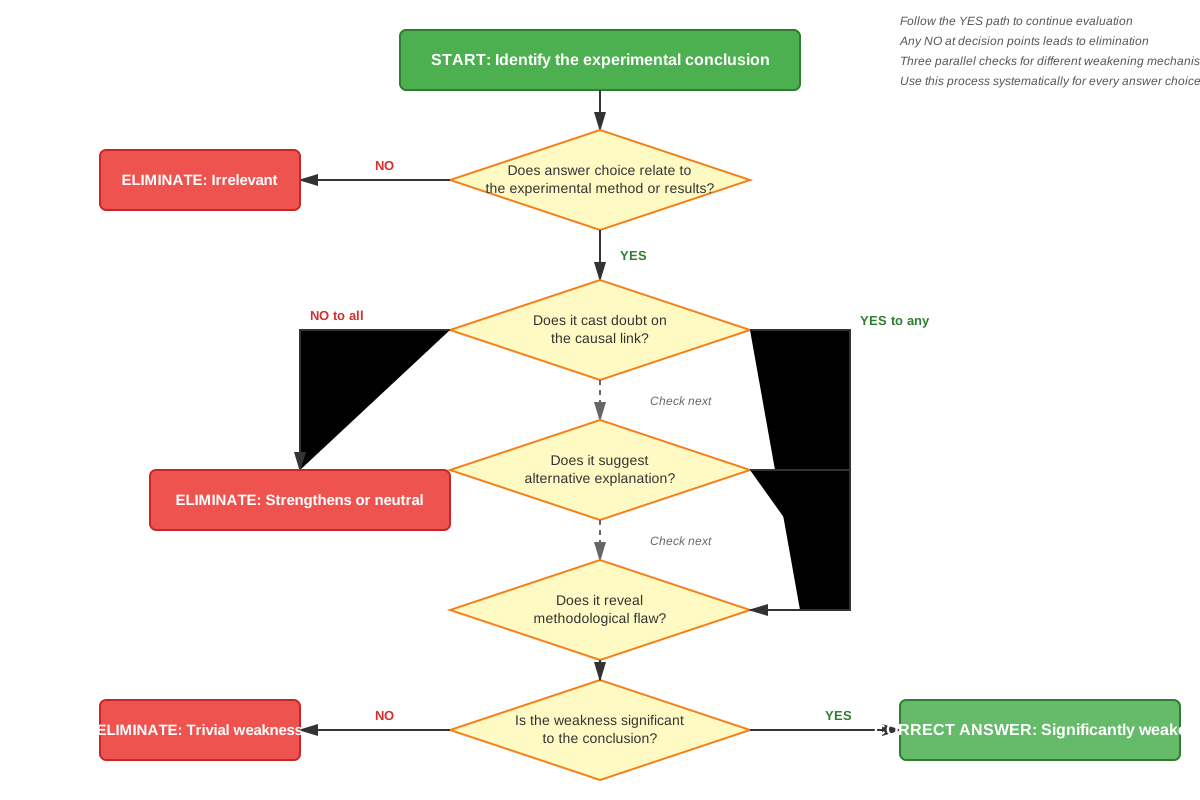
When approaching strengthen and weaken questions involving experimental reasoning, follow this systematic process:
- Identify the conclusion precisely: Underline or mentally note exactly what the experiment claims to prove. Is it a causal claim ("X causes Y"), a comparative claim ("X is more effective than Y"), or a predictive claim ("X will lead to Y")?
- Map the experimental design: Note who was studied, what intervention occurred, how results were measured, and whether control groups existed. This reveals potential vulnerabilities.
- Anticipate vulnerabilities before reading answer choices: Ask yourself: Could something else explain these results? Is the sample representative? Are there measurement issues? Does the conclusion overgeneralize?
- Watch for trigger phrases that signal experimental reasoning:
- "A study found that..."
- "Researchers concluded..."
- "An experiment showed..."
- "Survey results indicate..."
- "Participants who received X showed..."
- Eliminate answer choices systematically:
- Remove choices that strengthen rather than weaken
- Eliminate irrelevant information that doesn't affect the conclusion
- Discard choices that weaken a different conclusion than the one stated
- Rule out choices that are too weak or speculative
- Select the answer that most directly undermines the link between evidence and conclusion: The correct answer typically either introduces an alternative explanation, shows the sample is unrepresentative, reveals a measurement problem, or demonstrates that the conclusion overgeneralizes.
Time Management Tip: Spend 15-20 seconds understanding the experimental design before reading answer choices. This upfront investment pays dividends by enabling faster, more accurate answer choice evaluation.
Common Trap: Wrong answers often weaken a related but different conclusion. Always return to the exact wording of the stated conclusion before selecting your answer.
Memory Techniques
SCAM - Remember the four primary ways to weaken experimental reasoning:
- Sampling bias (unrepresentative subjects)
- Confounding variables (alternative explanations)
- Assumptions about measurement (validity issues)
- Mismatched scope (overgeneralization)
The "What Else?" Question: When reading an experimental conclusion, immediately ask "What else could explain these results?" This mental habit triggers recognition of confounding variables, the most common weakening strategy.
Visualize the Gap: Picture the experimental subjects as a small circle and the conclusion's scope as a large circle. If the small circle doesn't fill the large circle, there's a representativeness problem. This visualization helps identify sampling and generalization issues.
Reverse the Arrow: When you see "A causes B," mentally draw an arrow from A to B, then imagine reversing it. Could B cause A instead? This technique helps identify reverse causation vulnerabilities.
Summary
Weakening experimental reasoning requires recognizing the gap between what experiments actually demonstrate and what conclusions claim. The LSAT tests whether students can identify confounding variables, sampling biases, measurement problems, and scope mismatches that undermine experimental conclusions. Success demands understanding experimental argument structure, recognizing common vulnerabilities, and systematically evaluating answer choices against the specific conclusion drawn. The most effective weakening strategies introduce alternative explanations for experimental results, show that samples don't represent populations about which conclusions are drawn, or demonstrate that measurements don't capture what conclusions discuss. Mastering this topic requires practice identifying these patterns and distinguishing genuinely weakening information from irrelevant or tangential concerns. The skills tested—critical evaluation of empirical evidence, recognition of methodological flaws, and careful attention to the scope of valid inference—extend far beyond the LSAT into legal practice and analytical reasoning generally.
Key Takeaways
- Confounding variables (alternative explanations) are the most common and powerful way to weaken experimental reasoning on the LSAT
- Sampling bias weakens by showing experimental subjects don't represent the population about which conclusions are drawn
- The correct weakening answer must target the specific conclusion stated, not just introduce general doubts
- Weakening means making the conclusion less likely to be true, not proving it false
- Pre-existing differences between experimental and control groups undermine causal conclusions
- Measurement validity issues weaken when what was measured doesn't match what the conclusion discusses
- Scope gaps between narrow experimental conditions and broad conclusions create vulnerability to weakening attacks
Related Topics
Strengthening Experimental Reasoning: The mirror image of weakening, this topic covers how to support experimental conclusions by ruling out alternative explanations, establishing sample representativeness, and validating measurements. Mastering weakening makes strengthening more intuitive.
Causal Reasoning: A broader category that includes experimental reasoning but also covers non-experimental causal arguments. Understanding general causal reasoning principles enhances ability to evaluate experimental claims.
Necessary Assumptions in Experimental Arguments: These questions ask what must be true for experimental conclusions to hold, which directly relates to weakening—assumptions are often the vulnerabilities that weakening answer choices exploit.
Flaw Questions with Experimental Arguments: Instead of selecting information that weakens, these questions ask test-takers to describe the flaw in the experimental reasoning, requiring explicit articulation of the same vulnerabilities.
Practice CTA
Now that you understand the core principles of weakening experimental reasoning, it's time to apply these concepts to actual LSAT questions. The practice questions and flashcards will reinforce your ability to quickly identify experimental vulnerabilities and select correct weakening answer choices under timed conditions. Remember: recognizing patterns in experimental arguments becomes faster and more intuitive with deliberate practice. Each question you work through strengthens your ability to spot confounding variables, sampling issues, and scope gaps—skills that will serve you throughout the Logical Reasoning sections and beyond.
Sign up free to keep reading
Create a free AnvayaPrep account to finish this LSAT guide on Weakening experimental reasoning — plus flashcards and practice questions.