Overview
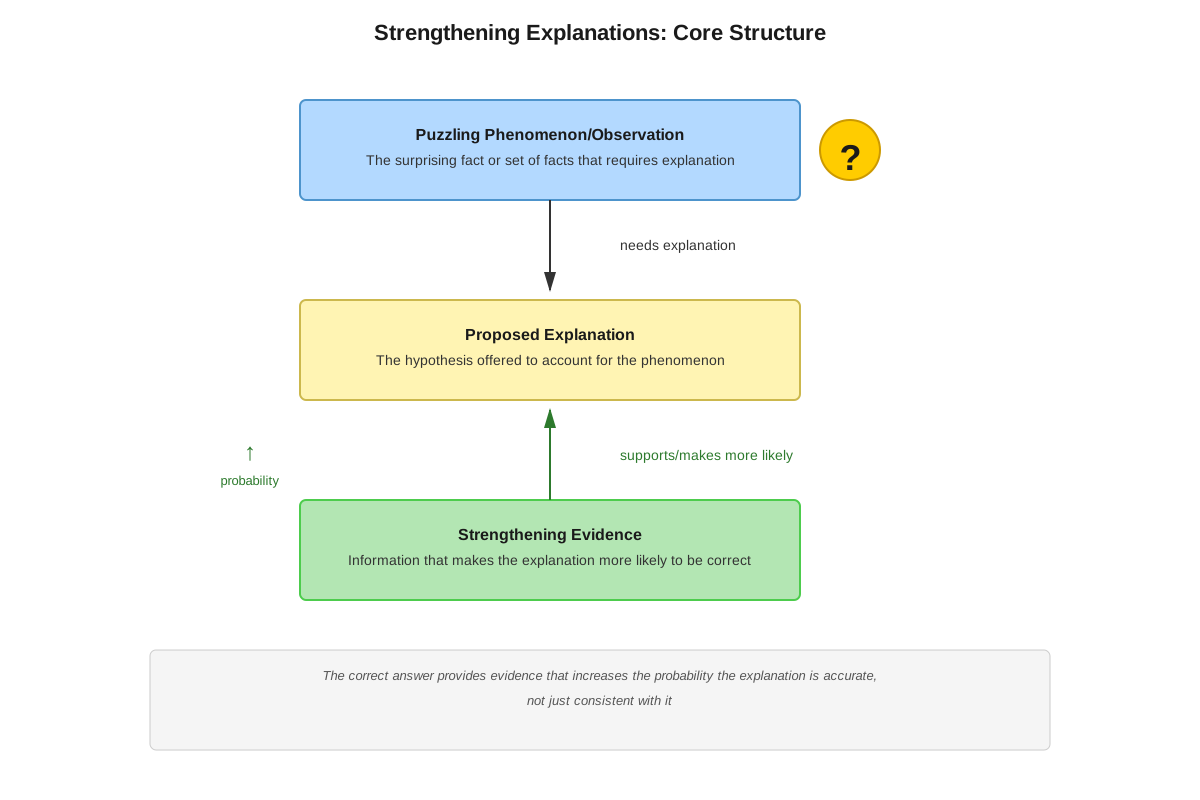
Strengthening explanations is a critical skill within LSAT Logical Reasoning that tests a student's ability to identify which answer choice best supports a proposed explanation for a phenomenon or set of facts. Unlike standard strengthen questions that ask students to bolster an argument's conclusion, strengthening explanation questions present a puzzling observation or surprising fact and then offer a hypothesis to explain it. The task is to find evidence that makes the proposed explanation more likely to be correct.
This question type appears regularly on the LSAT and represents a sophisticated reasoning challenge. Students must understand the difference between merely consistent information and genuinely supportive evidence. The LSAT tests whether examinees can distinguish between answer choices that are compatible with an explanation versus those that actively increase the probability that the explanation is accurate. Mastering this distinction is essential for achieving high scores on strengthen and weaken questions, one of the most frequently tested question families in Logical Reasoning sections.
Within the broader landscape of LSAT Logical Reasoning, strengthening explanations sits at the intersection of causal reasoning, hypothesis evaluation, and evidential support. This topic builds upon fundamental argument analysis skills while requiring students to think probabilistically about competing explanations. Success with these questions demonstrates sophisticated critical thinking abilities that law schools value highly, as legal reasoning frequently involves evaluating alternative explanations for events and determining which evidence best supports particular interpretations of facts.
Learning Objectives
- [ ] Identify how Strengthening explanations appears in LSAT questions
- [ ] Explain the reasoning pattern behind Strengthening explanations
- [ ] Apply Strengthening explanations to solve LSAT-style problems accurately
- [ ] Distinguish between evidence that strengthens an explanation versus evidence that is merely consistent with it
- [ ] Recognize common wrong answer patterns in strengthening explanation questions
- [ ] Evaluate competing explanations and determine which evidence discriminates between them
- [ ] Apply the "alternative explanation elimination" strategy to strengthen explanation arguments
Prerequisites
- Basic argument structure recognition: Understanding premises, conclusions, and how they relate is essential because strengthening explanation questions require identifying what needs support
- Causal reasoning fundamentals: Recognizing cause-and-effect relationships helps students understand how explanations work and what would make them more plausible
- Standard strengthen question mechanics: Familiarity with how to strengthen arguments generally provides the foundation for the more specialized task of strengthening explanations
- Conditional reasoning basics: Understanding sufficient and necessary conditions aids in evaluating whether evidence truly supports an explanation or merely accompanies it
Why This Topic Matters
Strengthening explanation questions appear in virtually every LSAT administration, typically comprising 2-4 questions per test across both Logical Reasoning sections. This represents approximately 5-8% of all Logical Reasoning questions, making it a high-yield topic that directly impacts scores. These questions often appear at medium to difficult levels, serving as discriminators between good and excellent test-takers.
In real-world legal practice, attorneys constantly evaluate competing explanations for events—why a contract was breached, what caused an accident, or what motivated a defendant's actions. The ability to identify which evidence best supports a particular explanation is fundamental to building persuasive legal arguments and evaluating opposing counsel's theories. Law schools recognize that students who excel at these questions possess the analytical sophistication necessary for legal reasoning.
On the LSAT, strengthening explanation questions typically appear with stem language such as "Which one of the following, if true, most helps to explain...?" or "Which one of the following, if true, most strongly supports the hypothesis that...?" The stimulus usually presents an observation that seems puzzling or counterintuitive, followed by a proposed explanation. Students must then select the answer choice that provides the best evidence for that explanation's accuracy. These questions frequently involve scientific phenomena, business decisions, historical events, or social patterns—any domain where multiple explanations might plausibly account for observed facts.
Core Concepts
The Structure of Explanation Arguments
Lsat strengthening explanations questions follow a distinctive three-part structure. First, the stimulus presents an observation or set of facts that requires explanation—often something surprising, counterintuitive, or puzzling. Second, the stimulus offers a hypothesis or proposed explanation for why this observation occurred. Third, the question asks which answer choice best strengthens or supports this explanation.
The key distinction from standard strengthen questions is that explanation arguments don't conclude that something should happen or will happen; instead, they propose why something did happen. The reasoning moves from effect to cause rather than from cause to effect. Understanding this backward-looking, explanatory nature is crucial for selecting correct answers.
What Makes Evidence Strengthen an Explanation
Evidence strengthens an explanation when it increases the probability that the proposed explanation is correct relative to alternative explanations. This occurs through several mechanisms:
Ruling out alternatives: The strongest evidence often eliminates or makes less plausible competing explanations for the same phenomenon. If only one explanation remains viable after considering new evidence, that explanation is substantially strengthened.
Establishing necessary preconditions: Evidence showing that conditions required by the explanation were actually present supports the explanation. If the hypothesis requires X to be true, and evidence confirms X was true, the explanation gains credibility.
Demonstrating the proposed mechanism: Evidence showing that the causal mechanism suggested by the explanation actually operates in similar cases strengthens the explanation. If the hypothesis claims "A causes B through process C," evidence that process C reliably produces B when A is present provides strong support.
Showing correlation patterns: Evidence revealing that the proposed cause and observed effect consistently appear together (or consistently fail to appear together) strengthens causal explanations.
The Consistency Trap
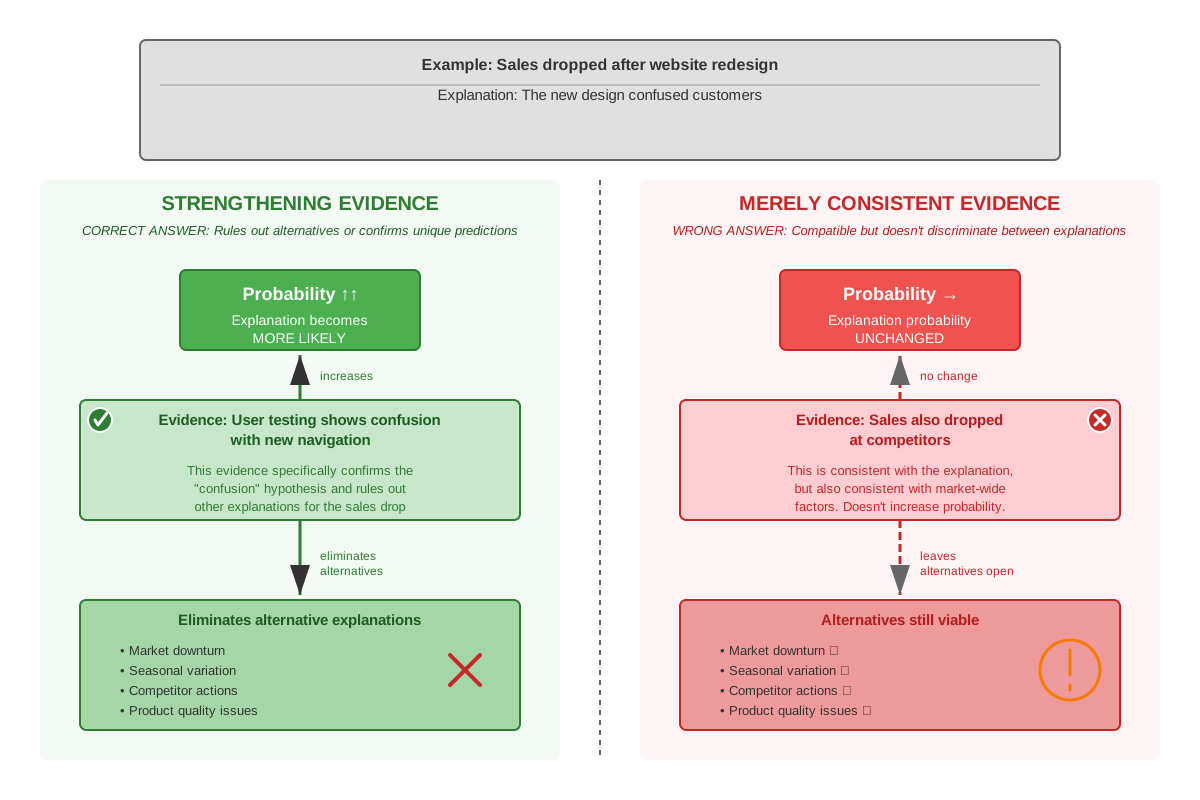
A critical distinction in logical reasoning is between evidence that is consistent with an explanation versus evidence that strengthens it. Many wrong answers in strengthening explanation questions provide information that could be true alongside the explanation but doesn't make it more likely to be correct.
Consider this example: If the explanation is "Sales dropped because competitors lowered prices," an answer stating "The company's product quality remained constant" is consistent with the explanation but doesn't strengthen it. Quality remaining constant doesn't make the price-competition explanation more probable. However, an answer stating "Customer surveys showed price was the primary factor in purchasing decisions" would genuinely strengthen the explanation by providing evidence that price matters to the relevant population.
Alternative Explanation Elimination
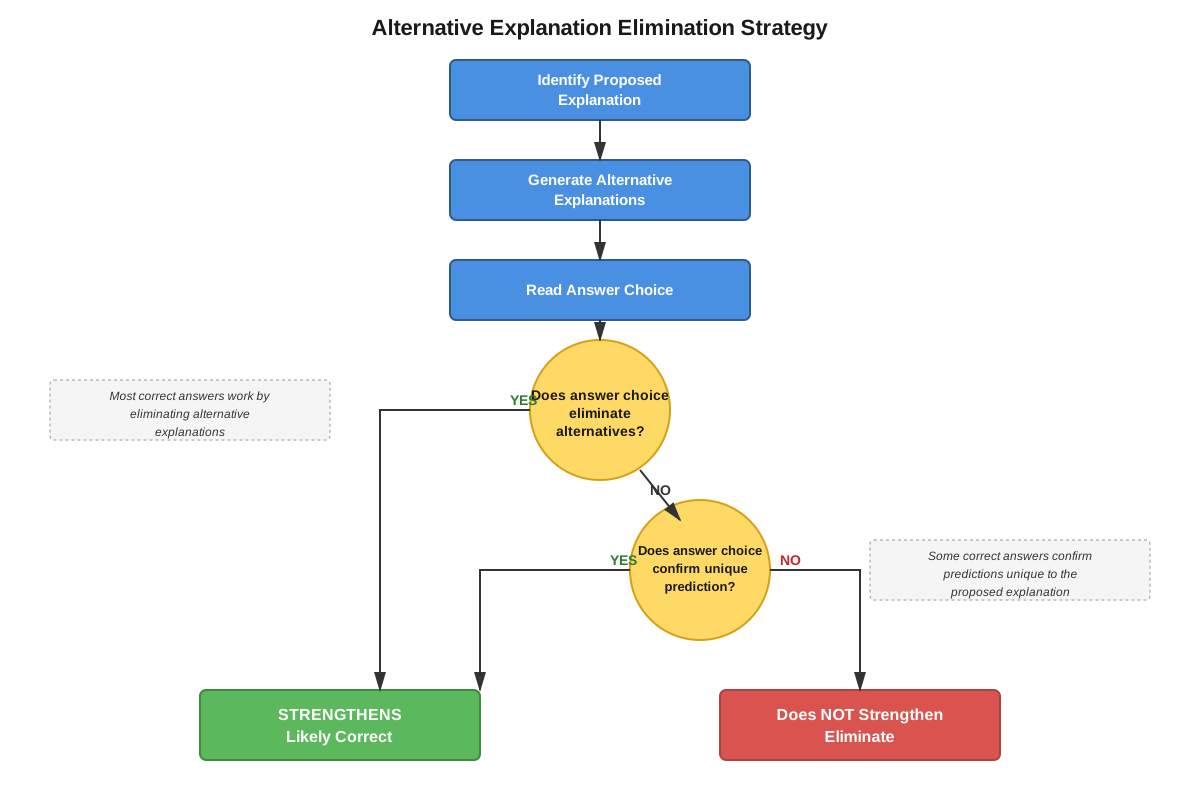
The most powerful way to strengthen an explanation is often to eliminate or weaken alternative explanations. When multiple hypotheses could account for an observation, evidence that rules out competing theories makes the remaining explanation more likely by default.
| Evidence Type | Effect on Explanation | Example |
|---|---|---|
| Eliminates alternative | Strongly strengthens | "No other factors changed during the period" |
| Confirms precondition | Moderately strengthens | "The proposed cause was present" |
| Shows mechanism | Moderately strengthens | "This cause produces this effect in similar cases" |
| Merely consistent | Does not strengthen | "The explanation could be true" |
| Irrelevant information | Does not strengthen | "An unrelated fact about the situation" |
The Temporal Dimension
Strengthening explanation questions often involve temporal reasoning. For a proposed cause to explain an effect, the cause must precede or coincide with the effect—it cannot occur afterward. Evidence establishing the correct temporal sequence strengthens explanations, while evidence showing temporal impossibility destroys them.
Additionally, evidence showing that the proposed cause was present before the effect occurred, and that the effect followed with appropriate timing, provides strong support. Conversely, evidence that the supposed cause only appeared after the effect would weaken rather than strengthen the explanation.
Sufficient vs. Necessary Evidence
Students must understand that strengthening an explanation doesn't require proving it correct beyond all doubt. The correct answer needs only to make the explanation more likely than it was before considering the new evidence. This probabilistic thinking is essential—the LSAT asks for the answer that "most strengthens" or "most helps to explain," not the answer that definitively proves the explanation.
Wrong answers often fail because they provide evidence that is neither sufficient nor necessary for the explanation, even though they might seem topically related. The correct answer will shift the probability assessment in favor of the proposed explanation, even if uncertainty remains.
Concept Relationships
The concepts within strengthening explanations form an interconnected reasoning framework. The structure of explanation arguments provides the foundation—students must first recognize the observation-hypothesis pattern before they can evaluate supporting evidence. This structural understanding leads directly to recognizing what makes evidence strengthen an explanation, as students learn to identify which types of information increase explanatory probability.
The consistency trap concept serves as a crucial warning that emerges from understanding genuine strengthening. Once students grasp what truly strengthens an explanation, they can better avoid the tempting wrong answers that merely describe consistent scenarios. This connects to alternative explanation elimination, which represents the most powerful application of strengthening principles—by ruling out competing theories, evidence makes the proposed explanation more probable.
Temporal reasoning and sufficient vs. necessary evidence operate as refinement concepts that help students evaluate answer choices more precisely. Temporal considerations help eliminate impossible explanations, while understanding probabilistic strengthening prevents students from incorrectly rejecting answers that don't provide absolute proof.
This topic connects to prerequisite knowledge of causal reasoning by applying those principles specifically to explanatory contexts. It extends standard strengthen questions by focusing on backward-looking explanations rather than forward-looking predictions. The skills developed here also prepare students for weaken questions (by understanding strengthening in reverse) and resolve/explain paradox questions (which share the explanatory structure but ask for complete resolution rather than mere strengthening).
Relationship map: Argument Structure Recognition → Explanation Structure Identification → Evidence Evaluation Criteria → Distinguishing Consistency from Strengthening → Alternative Elimination Strategy → Temporal Analysis → Probabilistic Assessment → Correct Answer Selection
High-Yield Facts
- ⭐ Strengthening explanation questions present an observation followed by a hypothesis about why that observation occurred, then ask which answer choice best supports the hypothesis
- ⭐ Evidence that eliminates alternative explanations is typically the strongest form of support for a proposed explanation
- ⭐ Information that is merely consistent with an explanation does NOT strengthen it—the evidence must make the explanation more probable
- ⭐ The correct answer doesn't need to prove the explanation correct; it only needs to make it more likely than before
- ⭐ Evidence showing that necessary preconditions for the explanation were actually present strengthens the explanation
- Temporal sequence matters: the proposed cause must precede or coincide with the effect, never follow it
- Evidence demonstrating that the proposed causal mechanism operates in similar cases strengthens the explanation
- Wrong answers often provide background information that seems relevant but doesn't increase the explanation's probability
- Correlation evidence (showing the cause and effect appear together consistently) provides moderate support for causal explanations
- Evidence that the proposed cause was present while alternative causes were absent provides particularly strong support
- Strengthening explanation questions typically use stems like "most helps to explain," "most strongly supports the hypothesis," or "provides the best evidence for"
- The observation being explained is usually something surprising, counterintuitive, or requiring special explanation
- Correct answers often work by showing that conditions predicted by the explanation actually existed
- Evidence about the frequency or prevalence of the proposed cause can strengthen explanations by showing the cause was likely present
- Strengthening an explanation is distinct from proving it—partial support is sufficient for the correct answer
Quick check — test yourself on Strengthening explanations so far.
Try Flashcards →Common Misconceptions
Misconception: Any information that could be true alongside the explanation strengthens it.
Correction: Consistency is not strengthening. Evidence must make the explanation more probable, not merely possible. An answer that describes a scenario compatible with the explanation but doesn't increase its likelihood is incorrect.
Misconception: The correct answer must prove the explanation is definitely true.
Correction: Strengthening is probabilistic, not absolute. The correct answer needs only to make the explanation more likely than it was before, even if significant uncertainty remains. Look for the answer that provides the most support, not necessarily complete proof.
Misconception: Background information about the situation always strengthens the explanation.
Correction: Context and background are often irrelevant to whether the specific explanation is correct. Unless the information directly bears on the probability of the proposed explanation versus alternatives, it doesn't strengthen the argument.
Misconception: If an answer choice mentions the same topic as the explanation, it must strengthen it.
Correction: Topical relevance doesn't equal logical support. An answer might discuss the same subject matter while providing no evidence that increases the explanation's probability. Evaluate whether the information actually makes the hypothesis more likely.
Misconception: Strengthening an explanation means showing the observed effect was predictable.
Correction: Explanation questions work backward from effect to cause, not forward from cause to effect. The task is to support why something that already happened occurred, not to show it was inevitable or predictable beforehand.
Misconception: Evidence that the explanation is popular or widely believed strengthens it.
Correction: Consensus or popularity doesn't constitute logical support. The number of people who believe an explanation has no bearing on whether evidence supports it. Focus on whether the answer choice provides actual evidence for the explanation's accuracy.
Misconception: Eliminating one alternative explanation is sufficient when multiple alternatives exist.
Correction: While eliminating alternatives does strengthen an explanation, if numerous other alternatives remain viable, the strengthening effect may be minimal. The strongest answers eliminate multiple alternatives or the most plausible competing explanation.
Worked Examples
Example 1: The Museum Attendance Puzzle
Stimulus: "The City Art Museum experienced a 30% increase in attendance last year despite raising admission prices by 25%. The museum director hypothesizes that the increase was due to the museum's new interactive exhibits, which were installed at the beginning of last year."
Question: Which one of the following, if true, most strengthens the director's hypothesis?
Answer Choices:
A) Other museums in the city that did not install interactive exhibits experienced declining attendance last year
B) The museum's advertising budget remained constant throughout the year
C) Interactive exhibits have become increasingly popular at museums nationwide
D) The museum's traditional exhibits remained unchanged during the year
E) Admission prices at competing museums remained stable
Analysis:
First, identify the structure: The observation is increased attendance despite higher prices (surprising because higher prices typically reduce attendance). The hypothesis is that new interactive exhibits caused the increase.
To strengthen this explanation, we need evidence that makes the interactive exhibits more likely to be the cause, ideally by eliminating alternative explanations or confirming the proposed mechanism.
Choice A: This is the correct answer. It eliminates a major alternative explanation—that some other factor affecting all museums caused the increase. By showing that museums without interactive exhibits experienced declining attendance, this evidence suggests the interactive exhibits specifically drove the increase at City Art Museum. This is alternative explanation elimination, the strongest form of support.
Choice B: This is merely consistent with the explanation but doesn't strengthen it. The advertising budget remaining constant doesn't make the interactive exhibit explanation more likely; it just means advertising wasn't a factor. This falls into the consistency trap.
Choice C: This provides general background but doesn't strengthen the specific explanation. Interactive exhibits being popular elsewhere doesn't prove they caused this museum's attendance increase. This is topically relevant but logically insufficient.
Choice D: This is also merely consistent. The traditional exhibits remaining unchanged doesn't make the interactive exhibits more likely to be the cause; it just means traditional exhibits weren't a factor.
Choice E: This might seem relevant to the price issue, but it doesn't strengthen the interactive exhibit explanation. It doesn't tell us why people came to this museum specifically or why interactive exhibits would be the cause.
Key Lesson: The correct answer eliminates the alternative explanation that "some general trend affected all museums." By showing other museums declined while this one increased, and the key difference was interactive exhibits, Choice A makes the director's hypothesis substantially more probable.
Example 2: The Productivity Paradox
Stimulus: "Despite implementing new time-management software across all departments, Acme Corporation's overall productivity decreased by 15% in the first quarter after implementation. Management hypothesizes that the productivity decline occurred because employees spent significant time learning the new software system rather than performing their regular duties."
Question: Which one of the following, if true, most strongly supports management's hypothesis?
Answer Choices:
A) The software company provided training materials for all employees
B) Productivity in departments that adopted the software earliest showed improvement by the end of the quarter
C) Employee surveys indicated that most workers found the software interface confusing initially
D) Other companies that implemented the same software experienced similar initial productivity declines
E) The software was designed to improve long-term productivity rather than provide immediate benefits
Analysis:
The observation is decreased productivity after implementing software meant to improve it. The hypothesis is that learning time caused the decrease.
Choice A: This is merely consistent. Training materials being available doesn't tell us whether employees actually spent significant time learning or whether that learning time caused the productivity decline. This doesn't strengthen the hypothesis.
Choice B: This is the correct answer. It provides evidence for the proposed mechanism—that learning time caused the decline. If departments that adopted the software earliest (and thus had more time to complete the learning process) showed improvement by quarter's end, this suggests the initial decline was indeed due to temporary learning time rather than fundamental software problems. This demonstrates the proposed causal mechanism and shows the effect was temporary, exactly as the learning-time hypothesis would predict.
Choice C: This seems tempting but only shows the software was confusing, not that learning time specifically caused the productivity decline. Confusion could cause permanent productivity problems, not just temporary learning-related declines. This doesn't specifically support the learning-time hypothesis.
Choice D: This shows the pattern is common but doesn't explain why it occurred or support the learning-time hypothesis specifically. Other companies might have experienced declines for different reasons. This is the consistency trap—it's compatible with the hypothesis but doesn't make it more probable.
Choice E: This provides background about the software's design but doesn't support the specific hypothesis that learning time caused the decline. The software being designed for long-term benefits doesn't prove that learning time caused the short-term decline.
Key Lesson: The correct answer provides evidence for the specific mechanism proposed (learning time) by showing that the effect was temporary and reversed as learning was completed. This temporal pattern matches what the learning-time hypothesis predicts, making it more probable than alternatives like "the software is fundamentally flawed."
Exam Strategy
When approaching lsat strengthening explanations questions, follow this systematic process:
Step 1: Identify the observation and hypothesis (15-20 seconds)
Read the stimulus carefully and distinguish between the puzzling fact being explained and the proposed explanation. Often the hypothesis appears in phrases like "researchers believe," "the explanation is," or "this is attributed to."
Step 2: Consider alternative explanations (10-15 seconds)
Before looking at answer choices, briefly think about what else might explain the observation. This primes your mind to recognize answers that eliminate alternatives.
Step 3: Predict what would strengthen (10 seconds)
Ask yourself: "What evidence would make this explanation more likely?" Look for evidence that would eliminate alternatives, confirm preconditions, or demonstrate the proposed mechanism.
Step 4: Evaluate each answer choice (30-40 seconds total)
For each choice, ask: "Does this make the explanation more probable, or is it merely consistent?" Eliminate answers that fall into the consistency trap.
Exam Tip: Trigger phrases in correct answers often include "only," "no other," "all other," or "the same pattern occurred when"—language that eliminates alternatives or establishes patterns.
Trigger words in question stems:
- "most helps to explain"
- "most strongly supports the hypothesis"
- "provides the best evidence for"
- "most justifies the conclusion that"
- "if true, most strengthens the explanation"
Process of elimination strategy:
- Eliminate answers that are merely consistent but don't increase probability
- Eliminate answers that provide irrelevant background information
- Eliminate answers that discuss the wrong time period (especially effects that occurred before proposed causes)
- Between remaining choices, select the one that most directly addresses alternative explanations or confirms the proposed mechanism
Time allocation: Spend 60-75 seconds total on strengthening explanation questions. They require careful analysis but shouldn't consume excessive time. If you're stuck between two answers, choose the one that more directly eliminates alternatives rather than one that merely provides supporting context.
Common wrong answer patterns to recognize quickly:
- Answers that restate the observation without providing new evidence
- Answers that discuss general trends without connecting to the specific case
- Answers that provide background but don't affect the explanation's probability
- Answers that strengthen a different explanation than the one proposed
Memory Techniques
STRENGTHEN mnemonic for evaluating answer choices:
Specific to this explanation (not just general background)
Temporal sequence correct (cause before effect)
Rules out alternatives (eliminates competing explanations)
Evidence, not assumption (provides actual support)
Necessary conditions confirmed (shows preconditions existed)
Genuine probability increase (not merely consistent)
Tests the mechanism (shows the proposed process works)
Hypothesis-focused (directly addresses the proposed explanation)
Eliminates doubt (reduces uncertainty about the explanation)
Not just topically related (logically connected, not just same subject)
Visualization strategy: Picture a balance scale with the proposed explanation on one side and alternative explanations on the other. The correct answer adds weight to the proposed explanation's side or removes weight from the alternatives' side, tipping the balance.
The "Alternative Elimination" acronym - AIM:
- Alternatives identified
- Information that rules them out
- Makes the hypothesis more probable
Memory phrase: "Consistency is NOT strengthening"—repeat this before each strengthening explanation question to avoid the most common trap.
Summary
Strengthening explanations represents a sophisticated LSAT question type that tests the ability to evaluate evidential support for proposed hypotheses. These questions present an observation requiring explanation, offer a hypothesis about why the observation occurred, and ask which answer choice best supports that explanation. Success requires distinguishing between evidence that genuinely increases an explanation's probability versus information that is merely consistent with it. The most powerful strengthening evidence typically eliminates alternative explanations, confirms necessary preconditions, or demonstrates the proposed causal mechanism. Students must think probabilistically, recognizing that strengthening doesn't require proof but only an increase in likelihood. Temporal reasoning matters because causes must precede effects, and the correct answer often works by showing that conditions predicted by the explanation actually existed while alternative causes were absent. Mastering this question type requires systematic analysis: identify the observation and hypothesis, consider alternatives, predict strengthening evidence, and evaluate choices based on whether they genuinely increase the explanation's probability rather than merely describing compatible scenarios.
Key Takeaways
- Strengthening explanation questions ask for evidence that makes a proposed explanation for an observation more probable, not necessarily proven
- Evidence that eliminates alternative explanations provides the strongest support for a hypothesis
- Information that is merely consistent with an explanation does NOT strengthen it—avoid the consistency trap
- The correct answer must increase the probability of the specific explanation proposed, not just provide relevant background
- Temporal sequence matters: proposed causes must precede or coincide with effects, never follow them
- Look for answers that confirm necessary preconditions, demonstrate the proposed mechanism, or show patterns consistent with the explanation
- Strengthening is probabilistic—the correct answer needs only to make the explanation more likely than before, not prove it definitively
Related Topics
Weaken Questions: Understanding how to strengthen explanations provides direct insight into weakening them—simply reverse the logic to identify evidence that makes explanations less probable. Mastering strengthening explanations makes weaken questions significantly easier.
Resolve/Explain Paradox Questions: These questions share the explanatory structure but ask for information that completely resolves an apparent contradiction rather than merely supporting one explanation. The skills developed with strengthening explanations transfer directly.
Causal Reasoning: Strengthening explanations heavily involves causal analysis. Deeper study of causal reasoning patterns, including necessary and sufficient conditions for causation, enhances performance on explanation questions.
Assumption Questions: Many strengthening explanation questions implicitly test assumptions—the gap between observation and hypothesis. Understanding assumptions helps identify what evidence would bridge that gap.
Parallel Reasoning: Some strengthening explanation questions involve recognizing that similar causal patterns in analogous situations support the proposed explanation. Parallel reasoning skills enhance this capability.
Practice CTA
Now that you've mastered the core concepts of strengthening explanations, it's time to apply this knowledge to actual LSAT questions. The practice questions and flashcards will help solidify your understanding and build the pattern recognition necessary for quick, accurate performance on test day. Focus especially on distinguishing between consistency and genuine strengthening—this distinction appears in nearly every strengthening explanation question. Remember that mastery comes through deliberate practice: analyze not just why correct answers are right, but why wrong answers fail. Each practice question is an opportunity to refine your reasoning process and build confidence for the LSAT. You've got this!
Sign up free to keep reading
Create a free AnvayaPrep account to finish this LSAT guide on Strengthening explanations — plus flashcards and practice questions.