Overview
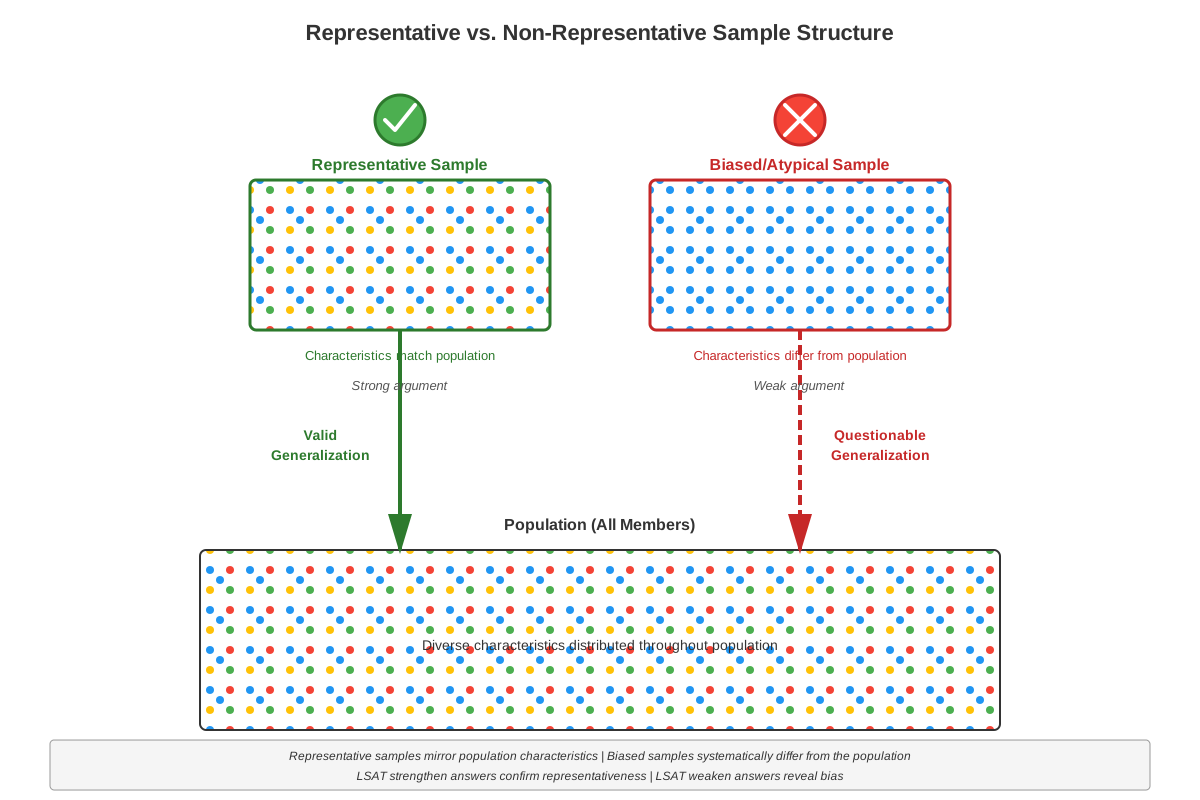
Supporting representativeness is a critical reasoning pattern that appears frequently in LSAT Logical Reasoning sections, particularly within strengthen and weaken questions. This concept addresses a fundamental issue in arguments that draw conclusions about a larger population based on evidence from a sample or subset. When an argument relies on a sample to make claims about a broader group, the strength of that argument depends heavily on whether the sample accurately represents the population in question. Understanding how to identify and evaluate representativeness is essential for success on the LSAT, as test-makers consistently exploit this reasoning vulnerability.
The core principle behind supporting representativeness involves recognizing when an argument's conclusion depends on the assumption that a sample mirrors the characteristics of the whole population. When you encounter answer choices that strengthen an argument by confirming the sample is representative—or weaken it by revealing the sample is biased or atypical—you're dealing with this reasoning pattern. This appears in various contexts: scientific studies, surveys, historical examples, and observational evidence. The LSAT tests whether you can identify when representativeness matters and evaluate how information about the sample's composition affects the argument's validity.
Within the broader landscape of Logical Reasoning, supporting representativeness connects to fundamental concepts of inductive reasoning, sampling methodology, and the relationship between evidence and conclusions. It shares conceptual territory with other strengthen/weaken patterns but has distinct characteristics that make it identifiable. Mastering this topic enables you to quickly recognize when an argument's vulnerability lies in its sampling method and to predict what kind of information would strengthen or weaken such arguments—a skill that translates directly into faster, more accurate performance on test day.
Learning Objectives
- [ ] Identify how Supporting representativeness appears in LSAT questions
- [ ] Explain the reasoning pattern behind Supporting representativeness
- [ ] Apply Supporting representativeness to solve LSAT-style problems accurately
- [ ] Distinguish between representative and non-representative samples in argument structures
- [ ] Predict what information would strengthen or weaken arguments based on sample representativeness
- [ ] Recognize trigger language that signals representativeness issues in LSAT stimuli
- [ ] Evaluate the degree to which sample characteristics affect argument strength
Prerequisites
- Basic argument structure: Understanding premises, conclusions, and how evidence supports claims is essential because representativeness issues arise in the connection between evidence and conclusion
- Inductive vs. deductive reasoning: Recognizing that arguments from samples are inductive (probabilistic rather than certain) helps explain why representativeness matters
- Strengthen and weaken question types: Familiarity with how these question types function provides the framework for applying representativeness concepts
- Population vs. sample distinction: Understanding the difference between a subset and the whole group is fundamental to recognizing when representativeness is relevant
Why This Topic Matters
In real-world contexts, representativeness determines the validity of countless decisions and policies. Medical research depends on whether clinical trial participants represent the broader patient population. Political polling accuracy hinges on whether surveyed voters reflect the electorate. Business decisions based on focus groups succeed or fail depending on whether those groups represent actual customers. The ability to evaluate representativeness is a core critical thinking skill that extends far beyond standardized testing.
On the LSAT specifically, lsat supporting representativeness questions appear with remarkable frequency. Approximately 15-20% of strengthen and weaken questions involve representativeness issues, making this one of the highest-yield patterns to master. These questions appear across both Logical Reasoning sections, and the pattern also surfaces in Reading Comprehension passages that discuss research methodology or statistical arguments. Test-makers favor this pattern because it tests genuine analytical reasoning rather than mere vocabulary or formal logic.
Common manifestations include: arguments citing survey results to draw conclusions about public opinion; studies using animal subjects to predict human outcomes; historical examples used to forecast future events; observations of one group applied to another; and expert testimony based on limited experience. The LSAT presents these scenarios in various content areas—science, law, business, social policy—but the underlying logical structure remains consistent. Recognizing this pattern allows you to approach diverse question content with a unified analytical framework.
Core Concepts
The Fundamental Logic of Representativeness
Supporting representativeness refers to the logical principle that when an argument draws a conclusion about a population based on evidence from a sample, the argument's strength depends on whether the sample accurately reflects the relevant characteristics of the population. The reasoning pattern follows this structure:
- Evidence is gathered from a sample (subset of a population)
- A conclusion is drawn about the entire population
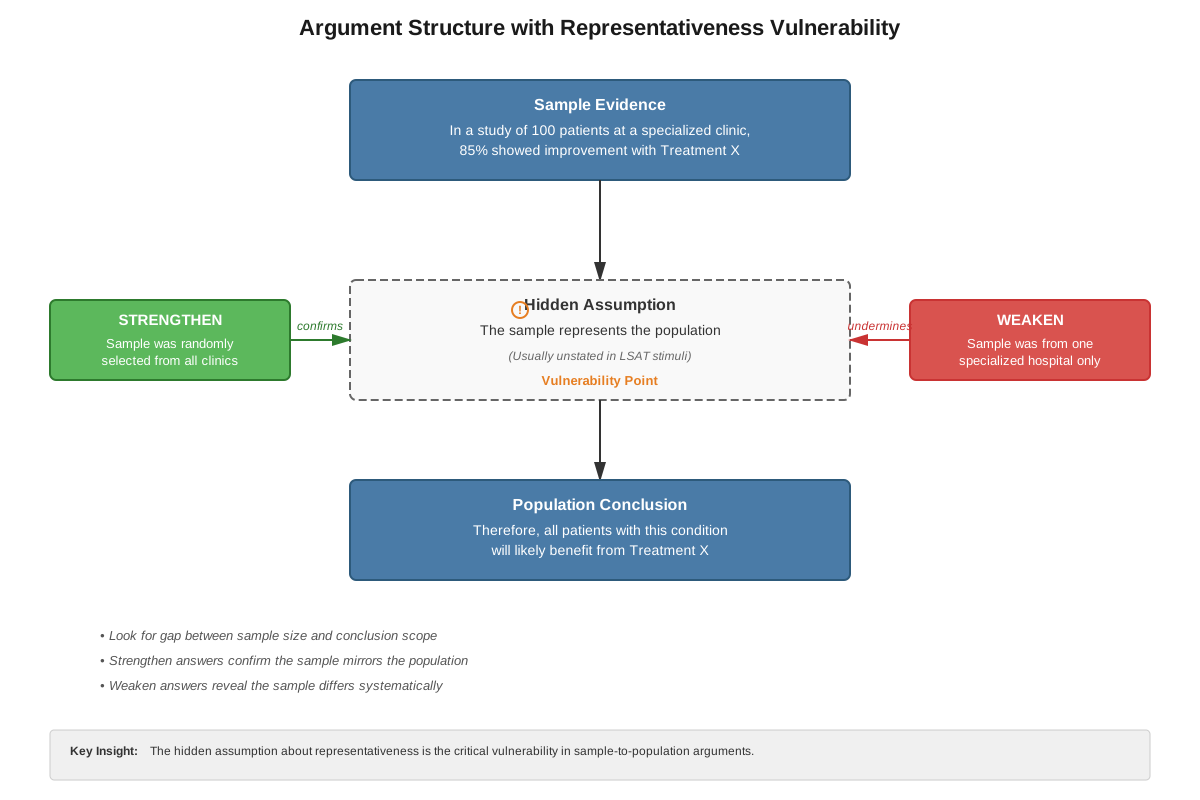
- The argument implicitly assumes the sample represents the population
- Information confirming or undermining this assumption strengthens or weakens the argument
The key insight is that not all differences between sample and population matter equally. Only differences in relevant characteristics—those that directly relate to the conclusion being drawn—affect argument strength. For example, if an argument concludes that a medication is safe based on trials with participants aged 20-30, the age composition matters if age affects drug metabolism, but participants' hair color likely doesn't matter.
Identifying Representativeness Arguments
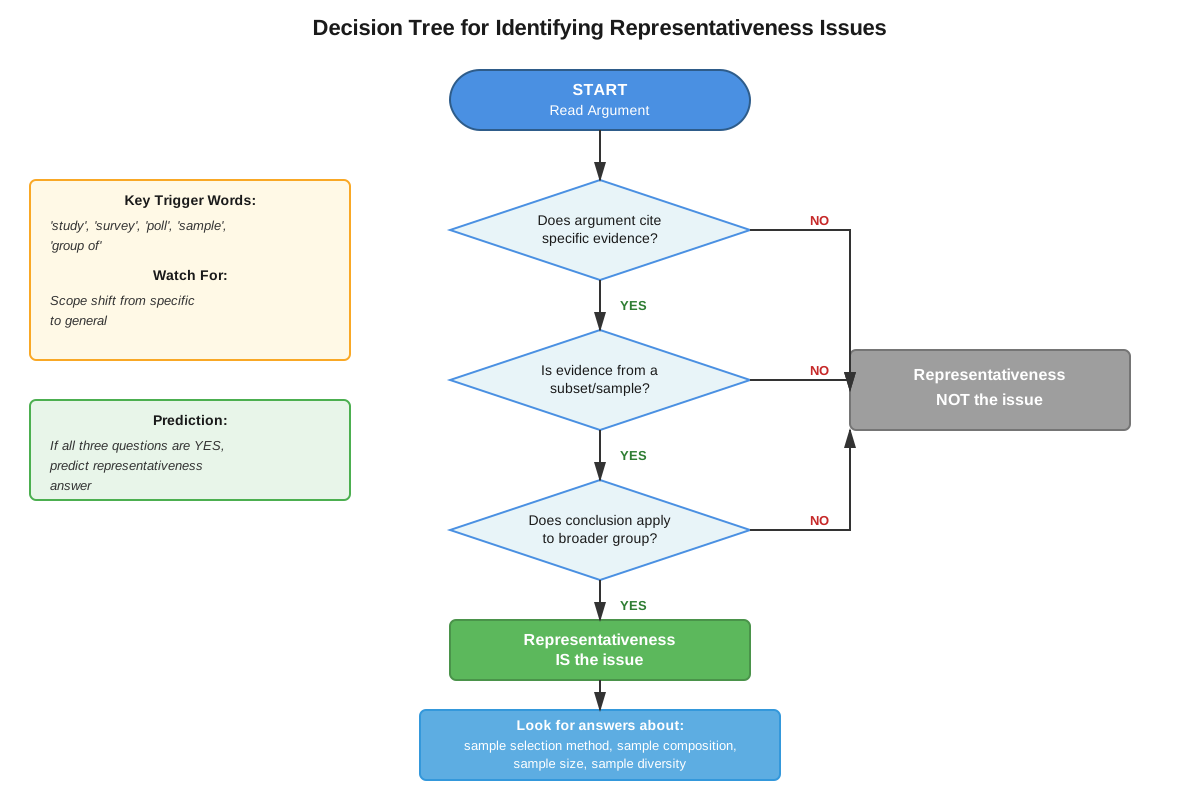
Several structural features signal that an argument involves representativeness:
- Sample-to-population reasoning: The evidence describes a subset, while the conclusion addresses a larger group
- Generalization language: Words like "typically," "generally," "most," or "people" in the conclusion suggest broad claims from limited evidence
- Study or survey citations: References to research, polls, or investigations often involve sampling
- Specific-to-general movement: The argument moves from particular instances to universal or broad claims
Consider this structure: "In a study of 100 patients, Treatment X proved effective. Therefore, Treatment X will be effective for patients generally." The conclusion extends beyond the studied sample to all patients, creating a representativeness dependency.
Types of Representativeness Issues
| Issue Type | Description | Example |
|---|---|---|
| Selection bias | The sample selection method systematically excludes or overrepresents certain groups | Surveying only landline phone users to gauge technology adoption |
| Temporal mismatch | The sample comes from a different time period than the population of interest | Using 1990s data to predict current trends |
| Geographic limitation | The sample comes from one location but conclusions apply broadly | Studying urban residents to draw conclusions about all citizens |
| Demographic skew | The sample's demographic composition differs from the population | Testing products only on young adults when all ages will use them |
| Self-selection | Participants volunteer, potentially differing from non-volunteers | Drawing conclusions from people who chose to respond to a survey |
Strengthening Through Representativeness
Answer choices strengthen arguments by confirming the sample represents the population in relevant ways:
- Affirming similarity: Stating the sample matches the population in characteristics relevant to the conclusion
- Random selection: Indicating the sample was randomly chosen, reducing systematic bias
- Diverse composition: Showing the sample includes variety that mirrors population diversity
- Eliminating confounds: Ruling out factors that might make the sample atypical
- Appropriate scope: Confirming the sample size and selection method are adequate
For instance, if an argument concludes that a teaching method works based on one classroom, learning that the classroom was randomly selected from many schools and included students of varying abilities would strengthen the argument by supporting representativeness.
Weakening Through Representativeness
Conversely, answer choices weaken arguments by revealing the sample is unrepresentative:
- Highlighting differences: Showing the sample differs from the population in relevant characteristics
- Exposing bias: Revealing systematic selection problems
- Identifying confounds: Introducing factors that make the sample atypical
- Questioning methodology: Revealing flawed sampling procedures
- Showing self-selection: Indicating participants differ from non-participants
If that teaching method study only included students who volunteered for the new approach, this self-selection would weaken the argument because volunteers might be more motivated than typical students.
The Relevance Criterion
Not every difference between sample and population matters. The relevance criterion requires asking: "Does this difference plausibly affect the conclusion?" This prevents falling for wrong answer choices that mention true differences that don't impact the argument.
For example, if an argument concludes that a car model is reliable based on owner surveys, learning that surveyed owners are predominantly male doesn't weaken the argument unless gender somehow relates to reliability assessments or driving patterns relevant to reliability. However, learning that surveyed owners only drove the car for one month would weaken it, because reliability typically emerges over longer periods.
Concept Relationships
The concepts within supporting representativeness form an interconnected logical framework. The fundamental logic of representativeness serves as the foundation, establishing why sample characteristics matter when making population-level claims. This leads directly to identifying representativeness arguments, which requires recognizing structural patterns that signal sample-to-population reasoning.
Once identified, understanding types of representativeness issues provides a taxonomy of specific ways samples can fail to represent populations. These types inform both strengthening through representativeness and weakening through representativeness, which are mirror concepts—strengthening confirms representativeness while weakening undermines it. Both strengthening and weakening applications depend on the relevance criterion, which filters out irrelevant differences and focuses analysis on characteristics that actually affect the conclusion.
This topic connects to prerequisite knowledge of argument structure by adding a specific vulnerability pattern to general premise-conclusion analysis. It relates to inductive reasoning because representativeness issues arise specifically in inductive arguments that generalize from samples. Within the broader category of strengthen and weaken questions, representativeness forms one of several recurring patterns, alongside causal reasoning, analogy evaluation, and alternative explanation consideration.
Relationship map: Argument structure → Sample-to-population reasoning → Representativeness dependency → Types of bias → Strengthen/weaken opportunities → Relevance filtering → Answer selection
High-Yield Facts
⭐ Arguments that draw conclusions about a population based on a sample depend on the sample being representative of that population in relevant characteristics
⭐ Information showing the sample was randomly selected or matches the population in key ways strengthens the argument
⭐ Information revealing the sample differs from the population in relevant characteristics weakens the argument
⭐ Not all differences between sample and population matter—only those relevant to the conclusion affect argument strength
⭐ Self-selection bias (when participants volunteer) is a common way samples become unrepresentative
- Temporal differences between sample and population can undermine representativeness when conditions change over time
- Geographic limitations create representativeness issues when location affects the characteristic being studied
- Sample size alone doesn't guarantee representativeness—a large biased sample remains unrepresentative
- Demographic skew matters only when demographics relate to the conclusion being drawn
- Random selection reduces but doesn't eliminate all representativeness concerns
- Representativeness issues appear in approximately 15-20% of strengthen and weaken questions
- The LSAT often presents representativeness issues in contexts involving surveys, studies, historical examples, and expert testimony
- Answer choices that seem to weaken but address irrelevant differences are common wrong answers
Quick check — test yourself on Supporting representativeness so far.
Try Flashcards →Common Misconceptions
Misconception: Any difference between the sample and population weakens the argument → Correction: Only differences in characteristics relevant to the conclusion affect argument strength. Irrelevant differences don't impact the logical connection between evidence and conclusion.
Misconception: Larger samples are always more representative → Correction: Sample size and representativeness are distinct issues. A large sample with systematic bias remains unrepresentative, while a smaller random sample may better represent the population.
Misconception: Random selection guarantees perfect representativeness → Correction: Random selection reduces systematic bias and increases the likelihood of representativeness, but doesn't guarantee the sample perfectly mirrors every population characteristic. It strengthens arguments but doesn't make them bulletproof.
Misconception: Representativeness only matters in survey or study contexts → Correction: The representativeness pattern appears in any argument that generalizes from specific instances to broader claims, including historical examples, expert testimony based on limited experience, and observations of particular cases.
Misconception: If the sample includes some diversity, it's representative → Correction: Representativeness requires that the sample's composition proportionally reflects the population in relevant characteristics. Token diversity doesn't ensure adequate representation if the overall composition remains skewed.
Misconception: Strengthen questions always require showing the sample is identical to the population → Correction: Strengthening requires showing similarity in relevant characteristics, not identity in all respects. Perfect matching is neither necessary nor possible; the question is whether relevant features align sufficiently.
Misconception: Weaken questions require proving the sample is completely unrepresentative → Correction: Weakening only requires introducing reasonable doubt about representativeness. Showing a significant relevant difference is sufficient; complete non-representativeness isn't necessary.
Worked Examples
Example 1: Medical Study Argument
Stimulus: A recent study found that patients who took Medication Z experienced significant pain reduction. The study included 200 patients from a single hospital who volunteered to try the new medication. Therefore, Medication Z will be effective for pain management in patients generally.
Question: Which of the following, if true, most strengthens the argument?
Answer Choices:
A) The hospital where the study was conducted is one of the largest in the region
B) Patients in the study had various types of pain conditions similar to those in the general patient population
C) Medication Z has fewer side effects than other pain medications
D) The study was conducted over a six-month period
E) Patients who volunteered were eager to find effective pain relief
Analysis:
This argument exhibits classic sample-to-population reasoning. The evidence comes from 200 patients at one hospital who volunteered, while the conclusion extends to "patients generally." The argument's vulnerability lies in whether these 200 volunteers represent all patients.
Step 1: Identify the representativeness issue. The sample might differ from the general patient population in several ways: single hospital location, volunteer self-selection, or types of conditions treated.
Step 2: Evaluate each answer for relevance to representativeness:
- (A) Hospital size doesn't address whether patients there represent all patients. Large hospitals can still serve atypical populations. Not relevant to representativeness.
- (B) Directly addresses representativeness by confirming the sample's pain conditions match those in the general population. This is the key relevant characteristic—if the studied conditions represent typical pain conditions, the results are more likely to generalize. CORRECT
- (C) Side effects are irrelevant to whether the sample represents the population. This addresses a different aspect of the medication's profile.
- (D) Study duration doesn't address sample representativeness. It might relate to result reliability but not to whether these patients represent all patients.
- (E) This actually weakens by highlighting self-selection. Eager volunteers might respond differently than typical patients due to placebo effects or motivation differences.
Conclusion: Choice B strengthens by confirming the sample represents the population in the characteristic most relevant to the conclusion—type of pain condition.
Example 2: Consumer Survey Argument
Stimulus: A survey of 1,000 consumers found that 75% prefer Brand X coffee over competitors. The survey was conducted online, and participants were recruited through social media advertisements. The company concluded that Brand X is the preferred coffee brand among consumers generally.
Question: Which of the following, if true, most weakens the argument?
Answer Choices:
A) The survey included consumers from various age groups
B) People who respond to online surveys tend to be younger and more tech-savvy than the general consumer population
C) Brand X coffee is more expensive than most competing brands
D) The survey asked about several different coffee brands
E) Some participants in the survey had never tried Brand X before
Analysis:
This argument generalizes from 1,000 surveyed consumers to "consumers generally," creating a representativeness dependency.
Step 1: Identify potential representativeness problems. The online recruitment through social media might create selection bias.
Step 2: Evaluate each answer:
- (A) Age diversity within the sample strengthens rather than weakens representativeness. This makes the sample more representative, not less.
- (B) Directly undermines representativeness by showing the sampling method systematically selects an unrepresentative group. If online survey respondents differ from general consumers in ways that might affect coffee preferences (perhaps tech-savvy younger people have different taste preferences), the sample doesn't represent the population. CORRECT
- (C) Price is irrelevant to whether the surveyed consumers represent all consumers. This might explain why Brand X is preferred but doesn't address sample representativeness.
- (D) Asking about multiple brands doesn't affect whether the respondents represent all consumers. This addresses survey design, not sample composition.
- (E) Including people unfamiliar with Brand X doesn't clearly affect representativeness. If anything, it might make the sample more representative by including non-users.
Conclusion: Choice B weakens by revealing the sampling method produces an unrepresentative sample, undermining the generalization to all consumers.
Exam Strategy
Recognition Triggers
Watch for these phrases that signal representativeness arguments:
- "A study/survey found..." followed by broad conclusions
- "Based on observations of [specific group]..." with conclusions about larger groups
- "In trials involving..." extending to general populations
- "Experts who have examined..." when expertise comes from limited cases
- "Historical examples show..." applied to current or future situations
- Conclusions using "generally," "typically," "most people," or "in general"
Systematic Approach
- Identify the sample: What specific group provided the evidence?
- Identify the population: What broader group does the conclusion address?
- Spot the gap: How might the sample differ from the population?
- Assess relevance: Which differences would actually matter for this conclusion?
- Predict the answer: Before reading choices, anticipate what would strengthen (sample is representative) or weaken (sample is biased)
Process of Elimination
For strengthen questions, eliminate answers that:
- Address irrelevant characteristics
- Actually highlight differences between sample and population
- Discuss issues unrelated to representativeness
- Strengthen through different reasoning patterns (causation, etc.)
For weaken questions, eliminate answers that:
- Mention true but irrelevant differences
- Actually confirm similarity between sample and population
- Address tangential issues
- Weaken through different patterns
Time Management
Exam Tip: Representativeness questions are typically faster to solve than complex causal reasoning questions. Allocate 1:00-1:15 per question. If you quickly identify the representativeness pattern, you can often predict the correct answer before reading choices, saving valuable seconds.
Common Traps
Beware of answer choices that:
- Mention true facts that don't affect representativeness: "The study was expensive" might be true but doesn't address whether the sample represents the population
- Confuse sample size with representativeness: "The sample was large" doesn't guarantee representativeness
- Introduce irrelevant demographic information: Not all demographic differences matter for every conclusion
- Seem to weaken but actually strengthen: "The sample included diverse participants" strengthens, not weakens
Memory Techniques
The SAMPLE Acronym
Use SAMPLE to remember key representativeness considerations:
- Selection method: Was it random or biased?
- Adequate diversity: Does the sample include relevant variety?
- Matching characteristics: Do relevant features align with the population?
- Participant self-selection: Did volunteers differ from non-volunteers?
- Location and timing: Are geographic and temporal factors appropriate?
- Exclusions: Were any relevant groups systematically excluded?
Visualization Strategy
Picture a puzzle analogy: The sample is a few puzzle pieces, and the population is the complete puzzle. Representativeness means those few pieces accurately reflect the whole picture's characteristics. A biased sample is like selecting only blue pieces from a multicolored puzzle—you can't know what the full image looks like.
The Relevance Filter
Remember: "Different doesn't mean defective." Not every difference between sample and population undermines the argument. Always ask: "Does this difference plausibly affect the conclusion?" This prevents falling for wrong answers that mention true but irrelevant distinctions.
Summary
Supporting representativeness is a high-yield LSAT Logical Reasoning pattern that appears in 15-20% of strengthen and weaken questions. The core principle is straightforward: when arguments draw conclusions about populations based on samples, the argument's strength depends on whether the sample accurately represents the population in characteristics relevant to the conclusion. Strengthening such arguments involves confirming representativeness through random selection, demographic matching, or diverse composition. Weakening involves revealing bias, self-selection, or relevant differences between sample and population. The critical skill is distinguishing relevant from irrelevant differences—not every distinction matters, only those that plausibly affect the conclusion. Success requires recognizing the sample-to-population structure, identifying potential representativeness issues, and evaluating whether answer choices address relevant characteristics. This pattern appears across diverse content areas but maintains consistent logical structure, making it highly predictable once mastered.
Key Takeaways
- Supporting representativeness addresses whether samples used as evidence accurately represent the populations about which conclusions are drawn
- Strengthen answers confirm the sample represents the population in relevant ways; weaken answers reveal the sample is biased or atypical
- Only differences in characteristics relevant to the conclusion affect argument strength—irrelevant differences are distractors
- Common representativeness issues include selection bias, self-selection, temporal mismatches, geographic limitations, and demographic skew
- Recognition triggers include study/survey citations, sample-to-population language, and generalizations from specific instances
- Random selection strengthens representativeness but doesn't guarantee perfect representation
- This pattern appears in approximately 15-20% of strengthen and weaken questions, making it one of the highest-yield topics to master
Related Topics
Causal Reasoning in Strengthen/Weaken Questions: While representativeness focuses on whether samples represent populations, causal reasoning examines whether one factor causes another. Both patterns frequently appear in strengthen/weaken questions, and some arguments involve both issues simultaneously.
Statistical Reasoning: Understanding representativeness provides foundation for evaluating statistical arguments more broadly, including margin of error, confidence levels, and correlation versus causation.
Analogy Evaluation: Like representativeness, analogy evaluation asks whether one case resembles another sufficiently to support conclusions. Mastering representativeness develops the comparative reasoning skills needed for analogy questions.
Necessary Assumption Questions: Representativeness arguments depend on the assumption that samples represent populations. Recognizing this pattern helps identify necessary assumptions in assumption family questions.
Practice CTA
Now that you understand the logical structure and strategic approach to supporting representativeness, you're ready to apply these concepts to practice questions. Work through the accompanying practice set, focusing on identifying the sample-to-population structure and evaluating whether answer choices address relevant characteristics. Use the flashcards to reinforce recognition of trigger language and common representativeness issues. Remember: this pattern appears frequently on the LSAT, making every practice question a high-value investment in your score. With focused practice, you'll develop the pattern recognition and analytical skills to handle these questions quickly and accurately on test day. You've got this!
Sign up free to keep reading
Create a free AnvayaPrep account to finish this LSAT guide on Supporting representativeness — plus flashcards and practice questions.