Overview
Too strong answer choices represent one of the most prevalent and deceptive trap patterns on the LSAT Logical Reasoning section. These answer choices contain language that goes beyond what the stimulus supports or requires, making claims that are more extreme, absolute, or comprehensive than necessary. Understanding this concept is critical because the LSAT test-makers deliberately craft these attractive wrong answers to exploit common reasoning errors that test-takers make under time pressure.
In strengthen and weaken questions, too strong answer choices are particularly insidious because they often address the right topic and move in the correct direction (strengthening or weakening the argument), but they overreach in their claims. A student might recognize that an answer choice is relevant to the argument and makes the conclusion more or less likely, but fail to notice that the answer choice makes an unnecessarily extreme claim that introduces new vulnerabilities or unsupported assumptions. The LSAT rewards precision in reasoning, and recognizing when an answer choice exceeds the scope of what's needed is a hallmark of high-scoring test-takers.
This topic sits at the intersection of multiple critical LSAT skills: scope recognition, degree assessment, and answer choice evaluation. Mastering too strong answer choices requires understanding not just what makes an argument stronger or weaker, but also calibrating the appropriate degree of support needed. This skill connects directly to assumption identification, flaw recognition, and sufficient/necessary condition reasoning—all fundamental components of LSAT success.
Learning Objectives
- [ ] Identify how too strong answer choices appears in LSAT questions
- [ ] Explain the reasoning pattern behind too strong answer choices
- [ ] Apply too strong answer choices to solve LSAT-style problems accurately
- [ ] Distinguish between appropriately strong and excessively strong answer choices in strengthen/weaken contexts
- [ ] Recognize common linguistic markers that signal overly extreme claims
- [ ] Evaluate whether an answer choice's strength is proportional to the argument's needs
- [ ] Predict how test-makers will construct too strong distractors for specific argument types
Prerequisites
- Basic argument structure: Understanding premises, conclusions, and how they relate is essential because too strong answer choices must be evaluated against what the argument actually claims and needs.
- Strengthen and weaken question fundamentals: Recognizing what it means to make an argument more or less convincing provides the baseline for determining when support goes too far.
- Scope and degree concepts: Familiarity with how arguments can be limited in their claims helps identify when answer choices exceed those boundaries.
- Conditional reasoning basics: Understanding necessary versus sufficient conditions aids in recognizing when answer choices claim more than required.
Why This Topic Matters
Too strong answer choices appear with remarkable frequency across the LSAT Logical Reasoning sections. Research on released LSAT exams indicates that approximately 15-20% of wrong answer choices in strengthen and weaken questions are eliminated primarily because they are too strong. This makes "too strong" one of the top three most common wrong answer patterns, alongside "out of scope" and "opposite effect."
In real-world reasoning, the ability to calibrate the strength of claims is essential for legal analysis, policy evaluation, and critical thinking. Lawyers must distinguish between what evidence proves definitively versus what it merely suggests. They must avoid overstating their case while still making persuasive arguments. The LSAT tests this skill because it's fundamental to legal reasoning.
On the exam, too strong answer choices most commonly appear in:
- Strengthen questions where an answer choice provides more support than necessary, often claiming something is always true or completely eliminates a concern
- Weaken questions where an answer choice claims to completely destroy the argument rather than simply raising doubt
- Necessary assumption questions where an answer choice states something stronger than what the argument requires
- Flaw questions where answer choices overstate the severity or nature of the reasoning error
The financial stakes are significant: missing just two questions due to too strong answer choices could lower an LSAT score by 2-3 points, potentially affecting law school admissions and scholarship opportunities worth hundreds of thousands of dollars.
Core Concepts
Defining Too Strong Answer Choices
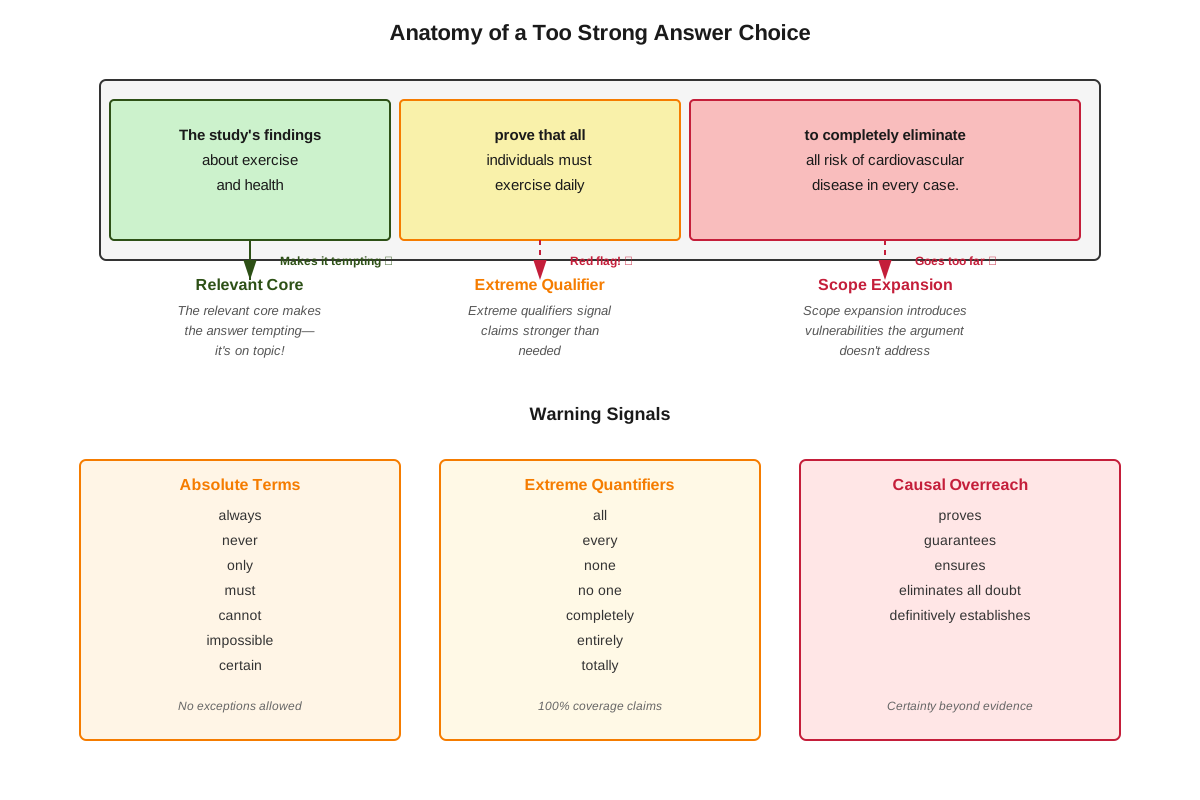
A too strong answer choice is an option that makes a claim more extreme, absolute, comprehensive, or categorical than what the argument requires or what the evidence supports. These answer choices often contain the right general idea but express it in language that goes beyond the necessary scope. The key insight is that the LSAT rewards precision—an answer choice can be relevant and move in the right direction while still being incorrect because it overreaches.
Consider the distinction between "most experts agree" versus "all experts unanimously agree." In many contexts, the former would adequately strengthen an argument, while the latter makes an unnecessarily strong claim that could be easily challenged and isn't required for the argument to work.
Linguistic Markers of Excessive Strength
Too strong answer choices frequently employ specific language patterns that signal their extreme nature:
| Extreme Language | Moderate Alternative | Context |
|---|---|---|
| Always, never, all, none, every, no | Usually, often, many, some, most | Frequency and universality |
| Must, cannot, impossible, inevitable | Likely, probably, tends to, suggests | Certainty and necessity |
| Only, solely, exclusively, entirely | Primarily, mainly, largely, significantly | Exclusivity and completeness |
| Completely eliminates, proves definitively | Reduces, suggests, indicates, supports | Degree of impact |
| Absolutely necessary, essential requirement | Helpful, beneficial, contributes to | Necessity level |
However, context matters critically. The word "all" isn't automatically wrong—it's only too strong if the argument doesn't require or support such a universal claim. Some correct answers do use strong language when that strength is warranted by the stimulus.
The Goldilocks Principle in Strengthen/Weaken Questions
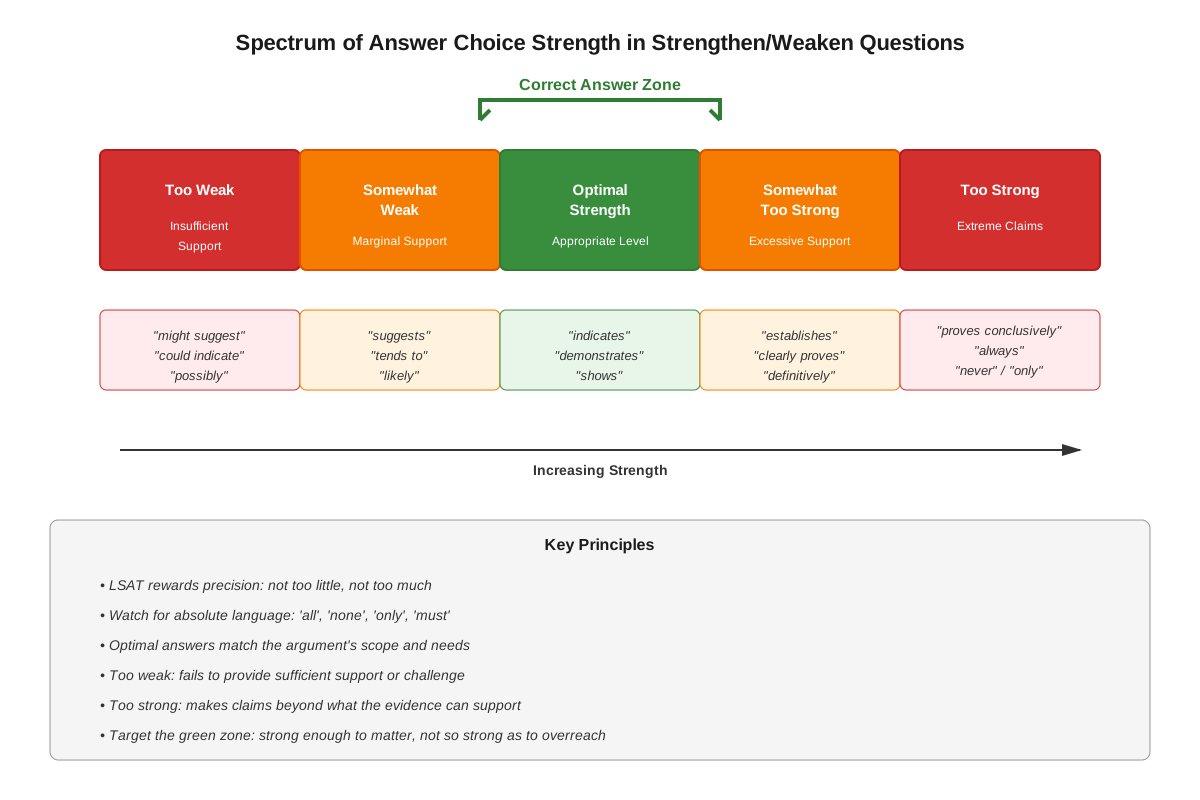
In strengthen and weaken questions, the correct answer must be "just right" in its degree of impact. An answer that's too weak fails to adequately affect the argument, while an answer that's too strong makes claims beyond what's supportable or necessary.
For Strengthen Questions:
- Too weak: Provides minimal or tangential support that doesn't meaningfully increase the conclusion's likelihood
- Just right: Provides clear, relevant support that makes the conclusion more likely without making unsupported claims
- Too strong: Claims to prove the conclusion definitively, eliminate all doubts, or make universal claims that aren't necessary
For Weaken Questions:
- Too weak: Raises a minor concern that doesn't significantly challenge the argument
- Just right: Introduces legitimate doubt or identifies a genuine problem with the reasoning
- Too strong: Claims to completely refute the argument, prove the conclusion false, or make extreme counterclaims
Why Test-Makers Use Too Strong Distractors
The LSAT deliberately includes too strong answer choices because they exploit several cognitive biases:
Confirmation bias: Test-takers who identify the relevant topic may accept an answer without scrutinizing its degree of strength. If an answer choice addresses the right issue and moves in the correct direction, students under time pressure may select it without noticing the excessive language.
Overcompensation: Students who have learned to look for "strong" answers in strengthen questions or "damaging" answers in weaken questions may gravitate toward the most extreme option, mistaking intensity for correctness.
Incomplete evaluation: Many test-takers evaluate whether an answer choice is relevant and directionally correct but fail to assess whether its strength is proportional to what the argument needs.
Scope Creep in Too Strong Answers
A particularly subtle form of too strong answer choices involves scope creep—where an answer choice expands the argument's domain beyond its original boundaries. For example:
- Argument scope: "This marketing strategy will increase sales in urban markets"
- Too strong answer: "This marketing strategy will increase sales in all markets"
The answer choice might strengthen the argument about urban markets, but by claiming applicability to all markets, it introduces unsupported territory. The correct answer would focus specifically on urban markets without expanding the claim.
Necessary vs. Sufficient Confusion
Too strong answer choices often confuse what's sufficient to support a conclusion with what's necessary. In strengthen questions, the correct answer needs to make the conclusion more likely (sufficient to provide some support), not prove it's the only possible conclusion (necessary for the conclusion to be true).
Example pattern:
- Argument: "Because the new policy reduced costs, it should be implemented company-wide"
- Too strong answer: "The new policy is the only way to reduce costs" (claims necessity when only sufficiency is needed)
- Appropriate answer: "The new policy reduced costs without compromising quality" (provides sufficient support without overclaiming)
The "Complete Solution" Trap
In strengthen questions, too strong answer choices often present themselves as complete solutions that eliminate all possible objections or alternative explanations. While this might seem ideal, it's usually too strong because:
- The argument doesn't require all objections to be eliminated—just that the conclusion is more likely
- Claiming to eliminate all alternatives is itself a strong claim that would need support
- Real-world reasoning rarely achieves absolute certainty
The LSAT tests whether students understand that strengthening an argument means making it better, not making it perfect.
Concept Relationships
The concept of too strong answer choices connects to multiple fundamental LSAT reasoning patterns:
Scope Recognition → Too Strong Identification: Understanding an argument's scope (what it claims and doesn't claim) enables recognition of when answer choices exceed those boundaries. An answer choice that's too strong often expands scope inappropriately.
Degree Assessment → Strength Calibration: Evaluating the degree of certainty or universality in claims leads directly to identifying when answer choices are excessively strong. This skill applies across question types.
Sufficient vs. Necessary Conditions → Appropriate Support Level: Distinguishing what's sufficient from what's necessary helps identify when strengthen answer choices overclaim by suggesting something is required rather than merely helpful.
Assumption Identification → Strength Evaluation: Recognizing unstated assumptions in arguments helps identify when answer choices make assumptions that are too strong or introduce new vulnerabilities.
Flaw Recognition → Too Strong Patterns: Many flaws involve reasoning that's too strong (overgeneralization, unwarranted certainty), making the pattern recognition transferable.
The relationship map flows as: Argument Analysis → Scope Determination → Degree Assessment → Answer Choice Evaluation → Too Strong Identification → Elimination
High-Yield Facts
⭐ Too strong answer choices are among the top three most common wrong answer patterns in strengthen and weaken questions, appearing in 15-20% of incorrect options.
⭐ An answer choice can be relevant, address the right topic, and move in the correct direction while still being wrong because it's too strong.
⭐ Words like "always," "never," "all," "only," and "must" are red flags but aren't automatically wrong—context determines whether the strength is appropriate.
⭐ In strengthen questions, the correct answer makes the conclusion more likely, not certain or proven—answers claiming to prove or guarantee are usually too strong.
⭐ In weaken questions, the correct answer raises legitimate doubt, not complete refutation—answers claiming to disprove or completely undermine are usually too strong.
- Too strong answer choices often expand the scope of the argument beyond its original boundaries (scope creep).
- The LSAT rewards precision in reasoning; an answer that provides more support than necessary is still wrong if it makes unsupported claims.
- Test-takers under time pressure are particularly vulnerable to too strong distractors because they may stop evaluating after confirming relevance and direction.
- Necessary assumption questions frequently include too strong distractors that state something stronger than what the argument requires to work.
- The "complete solution" trap presents answer choices that eliminate all possible objections when the argument only needs some support.
- Comparing answer choices side-by-side helps identify which provides adequate support without overclaiming.
- Too strong answer choices often introduce new vulnerabilities or assumptions that the original argument didn't have.
Quick check — test yourself on Too strong answer choices so far.
Try Flashcards →Common Misconceptions
Misconception: Strong language always indicates a wrong answer on the LSAT.
Correction: Strong language is only problematic when it exceeds what the argument requires or supports. Some correct answers appropriately use strong language when the stimulus warrants it. The key is proportionality, not the mere presence of absolute terms.
Misconception: In strengthen questions, the answer that provides the most support is always correct.
Correction: The correct answer provides adequate, well-supported strengthening without making claims beyond what's justified. An answer that seems to provide maximum support but does so through unsupported or extreme claims is too strong and incorrect.
Misconception: If an answer choice addresses the right topic and moves in the correct direction, it must be correct.
Correction: Relevance and directionality are necessary but not sufficient for correctness. The answer must also be appropriately calibrated in its strength and scope. Many too strong answer choices pass the relevance test but fail the proportionality test.
Misconception: Weaken questions require answers that completely destroy the argument.
Correction: Weakening means raising legitimate doubt or identifying a genuine problem, not proving the conclusion false. Answers claiming to completely refute or disprove the argument are typically too strong.
Misconception: Too strong answer choices are easy to spot because they use obvious extreme language.
Correction: While some too strong answers use blatant absolute terms, others are subtle, using phrases like "the primary factor" or "significantly reduces" that seem moderate but are still too strong for the specific argument context. Careful comparison to what the argument actually needs is essential.
Misconception: If the stimulus uses strong language, answer choices can also use strong language.
Correction: The appropriateness of strong language in answer choices depends on what the question asks and what the argument requires, not simply on matching the stimulus's tone. A stimulus with strong claims might still need only moderate support.
Worked Examples
Example 1: Strengthen Question
Stimulus: "City officials claim that the new traffic light timing system has improved traffic flow. Since the system was implemented three months ago, average commute times during rush hour have decreased by 8%."
Question: Which of the following, if true, most strengthens the city officials' claim?
Answer Choices:
(A) No other changes to traffic infrastructure or patterns occurred during the three-month period.
(B) The new traffic light timing system is the only possible explanation for reduced commute times.
(C) All cities that implement similar systems experience reduced commute times.
(D) Traffic engineers universally agree that this type of system always improves traffic flow.
(E) The decrease in commute times will continue indefinitely.
Analysis:
The argument concludes that the new system improved traffic flow, based on evidence that commute times decreased after implementation. The gap in reasoning is that other factors might explain the decrease—this is a classic correlation/causation issue.
(A) addresses the key concern by ruling out alternative explanations. It strengthens the argument by making it more likely that the system caused the improvement. This is appropriately strong—it doesn't claim to prove causation, just eliminates competing factors.
(B) is too strong. It claims the system is "the only possible explanation," which is an extreme, unprovable claim. The argument doesn't need this level of certainty—it just needs to be more likely that the system helped. Additionally, claiming something is the "only" explanation is itself a strong assertion that would require extensive support.
(C) is too strong in its universality ("all cities"). The argument is about this specific city's system. Even if this were relevant, claiming universal success is excessive and introduces the vulnerability that if even one city didn't experience this result, the answer would be false.
(D) is too strong on multiple levels: "universally agree" and "always improves." Expert consensus doesn't guarantee results in this specific case, and "always" is an absolute claim that's unnecessary and unsupportable.
(E) is too strong and also shifts scope to future predictions. "Indefinitely" is an extreme timeframe, and the argument is about whether the system has improved traffic flow, not whether it will continue to do so forever.
Correct Answer: (A)
Learning Objective Connection: This example demonstrates how to identify too strong answer choices by comparing the degree of support needed (ruling out alternatives) versus excessive claims (only possible explanation, universal application, absolute certainty).
Example 2: Weaken Question
Stimulus: "A recent study found that students who take handwritten notes score higher on conceptual questions than students who type notes on laptops. Therefore, schools should ban laptops in classrooms to improve student learning."
Question: Which of the following, if true, most weakens the argument?
Answer Choices:
(A) The study's participants were not representative of all students.
(B) Taking handwritten notes is completely ineffective for learning factual information.
(C) Students who typed notes were simultaneously browsing social media during lectures.
(D) Laptops are absolutely essential for all forms of modern education.
(E) Banning laptops would eliminate all educational benefits they provide.
Analysis:
The argument moves from evidence about note-taking methods to a recommendation to ban laptops. It assumes that the note-taking method itself caused the difference in scores.
(A) raises a legitimate concern about generalizability but is relatively weak. It suggests the study might not apply broadly but doesn't directly challenge the causal reasoning.
(B) is too strong ("completely ineffective") and also shifts scope to factual information when the study addressed conceptual questions. The extreme language makes an unsupported claim that goes beyond what's needed to weaken the argument.
(C) provides an alternative explanation for the performance difference—it wasn't the typing itself but the distraction. This appropriately weakens the argument by suggesting the conclusion doesn't follow from the evidence. This is the correct answer.
(D) is too strong ("absolutely essential for all forms"). This extreme claim isn't necessary to weaken the argument and would itself require substantial support. The argument could be weak even if laptops aren't absolutely essential.
(E) is too strong ("eliminate all educational benefits"). The argument doesn't require that laptops have zero benefits—it just claims that banning them would improve learning through better note-taking. This answer overclaims by suggesting total elimination of all benefits.
Correct Answer: (C)
Learning Objective Connection: This example shows how too strong answer choices in weaken questions often claim to completely refute or eliminate something when only raising doubt is necessary. The correct answer provides adequate weakening without extreme claims.
Exam Strategy
Recognition Strategy
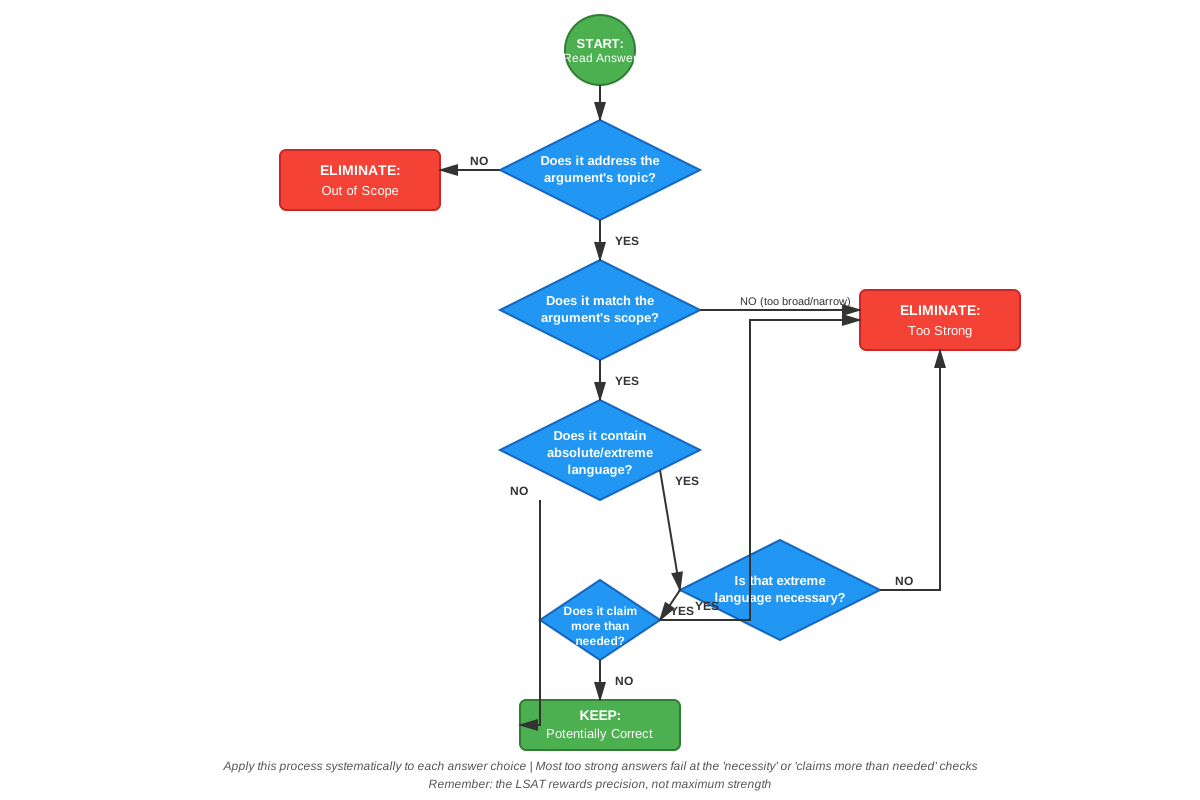
When evaluating answer choices in strengthen and weaken questions, implement this three-step process:
- Relevance Check: Does the answer choice address the argument's topic and reasoning?
- Direction Check: Does it move in the correct direction (strengthen or weaken)?
- Calibration Check: Is the strength proportional to what the argument needs?
Most test-takers stop after steps 1 and 2, making them vulnerable to too strong distractors. The calibration check is where too strong answer choices are eliminated.
Trigger Words and Phrases
Develop heightened awareness when encountering these phrases:
High-Alert Terms (frequently but not always too strong):
- "Only," "solely," "exclusively," "the only"
- "Always," "never," "all," "none," "every"
- "Must," "cannot," "impossible," "inevitable"
- "Completely," "entirely," "totally," "absolutely"
- "Proves," "guarantees," "ensures," "definitively shows"
- "Eliminates all," "rules out every," "accounts for all"
Context-Dependent Terms (require careful evaluation):
- "Significantly," "substantially," "considerably"
- "Primary," "main," "principal"
- "Most," "majority," "generally"
Exam Tip: When you see strong language, don't automatically eliminate the answer. Instead, ask: "Does the argument require or support this level of strength?" Compare it to what the stimulus actually claims and needs.
Process of Elimination Technique
Use comparative analysis to identify too strong answer choices:
- Identify the argument's scope and degree: What exactly does it claim? How certain or universal is it?
- Evaluate each answer against this baseline: Does this answer stay within the scope? Is its strength proportional?
- Compare remaining answers: If multiple answers seem relevant, which provides adequate support/weakening without overclaiming?
Time Allocation Advice
Don't rush the calibration check. While the LSAT is time-pressured, spending an extra 10-15 seconds to verify that an answer choice isn't too strong can prevent costly errors. Too strong answer choices are designed to trap test-takers who evaluate quickly and move on after confirming relevance.
Time-Saving Insight: If you've narrowed to two answer choices and both seem relevant and directionally correct, the distinguishing factor is often that one is too strong. Look for the more moderate, precisely calibrated option.
Question Stem Clues
Pay attention to how the question is phrased:
- "Most strengthens" doesn't mean "proves" or "guarantees"
- "Most weakens" doesn't mean "refutes" or "disproves"
- "Most supports" suggests making more likely, not certain
- "Most undermines" suggests raising doubt, not eliminating possibility
The question stem itself signals the appropriate degree of impact to look for in the correct answer.
Memory Techniques
The SCOPE Acronym
Strength - Is the claim's strength appropriate?
Calibration - Is it calibrated to what's needed?
Overclaim - Does it claim more than necessary?
Proportional - Is the impact proportional to the argument?
Extreme - Does it use extreme, absolute language?
The Goldilocks Visualization
Picture three bears representing answer choice strength:
- Papa Bear (too strong): Claims too much, goes too far
- Mama Bear (too weak): Doesn't provide enough support/challenge
- Baby Bear (just right): Provides adequate, well-calibrated impact
When evaluating answers, visualize which bear each represents.
The "Prove It" Test
For strengthen questions, mentally add "This proves the conclusion" to each answer choice. If the statement becomes absurd or clearly false, the answer is appropriately calibrated. If it seems plausible, the answer might be too strong (claiming to prove rather than support).
For weaken questions, use "This disproves the conclusion." The same principle applies.
The Comparison Mantra
Memorize: "Right topic, right direction, right degree." All three must be satisfied. This three-part check prevents accepting answers that pass the first two tests but fail the third.
Summary
Too strong answer choices represent a critical trap pattern in LSAT Logical Reasoning, particularly in strengthen and weaken questions. These answer choices contain language that exceeds what the argument requires or supports, making claims that are more extreme, absolute, or comprehensive than necessary. While they often address the correct topic and move in the right direction, they overclaim in ways that make them incorrect. Success requires not just identifying relevance and directionality, but also calibrating whether an answer's strength is proportional to the argument's needs. Common markers include absolute terms like "always," "never," "only," and "must," though context determines whether such language is appropriate. The key insight is that the LSAT rewards precision—an answer providing more support than necessary while making unsupported claims is still wrong. Mastering this concept requires careful evaluation of scope, degree, and proportionality, distinguishing between what's sufficient to strengthen or weaken an argument versus what would prove or disprove it entirely.
Key Takeaways
- Too strong answer choices are among the most common wrong answer patterns, appearing in 15-20% of incorrect options in strengthen and weaken questions
- An answer can be relevant and directionally correct while still being wrong due to excessive strength or scope
- The correct answer in strengthen questions makes the conclusion more likely, not certain; in weaken questions, it raises doubt, not proof of falsity
- Absolute language (always, never, only, must) signals potential problems but isn't automatically wrong—proportionality to the argument's needs is key
- Implement a three-step evaluation: relevance check, direction check, and calibration check—most test-takers skip the crucial third step
- Compare answer choices to identify which provides adequate impact without overclaiming or expanding scope inappropriately
- Too strong answer choices exploit time pressure and confirmation bias by seeming correct until their excessive degree is carefully examined
Related Topics
Scope Errors in Answer Choices: Understanding how answer choices can inappropriately expand or shift an argument's scope builds directly on too strong answer choice recognition and helps identify other common trap patterns.
Necessary vs. Sufficient Assumptions: This topic deepens understanding of what arguments require versus what would merely help them, directly connecting to calibrating answer choice strength appropriately.
Degree and Intensity in Arguments: Exploring how arguments make claims of varying strength and certainty provides the foundation for evaluating whether answer choices match that degree appropriately.
Causal Reasoning Flaws: Many too strong answer choices in causal arguments claim to prove causation or eliminate all alternatives, making this a natural extension of the current topic.
Comparative Answer Choice Analysis: Developing systematic methods for comparing answer choices when multiple seem plausible helps distinguish appropriately strong from excessively strong options.
Practice CTA
Now that you understand how to identify and eliminate too strong answer choices, it's time to put this knowledge into practice. Attempt the practice questions focusing specifically on calibrating answer choice strength—don't just ask if an answer is relevant, but whether its degree of impact is proportional to what the argument needs. Use the flashcards to reinforce recognition of common linguistic markers and patterns. Remember: mastering this single concept can improve your score by 2-3 points by preventing errors on questions where you've correctly identified the topic but selected an answer that overclaims. Every question you practice is an opportunity to sharpen your calibration skills and build the precision that distinguishes top scorers.
Sign up free to keep reading
Create a free AnvayaPrep account to finish this LSAT guide on Too strong answer choices — plus flashcards and practice questions.