Overview
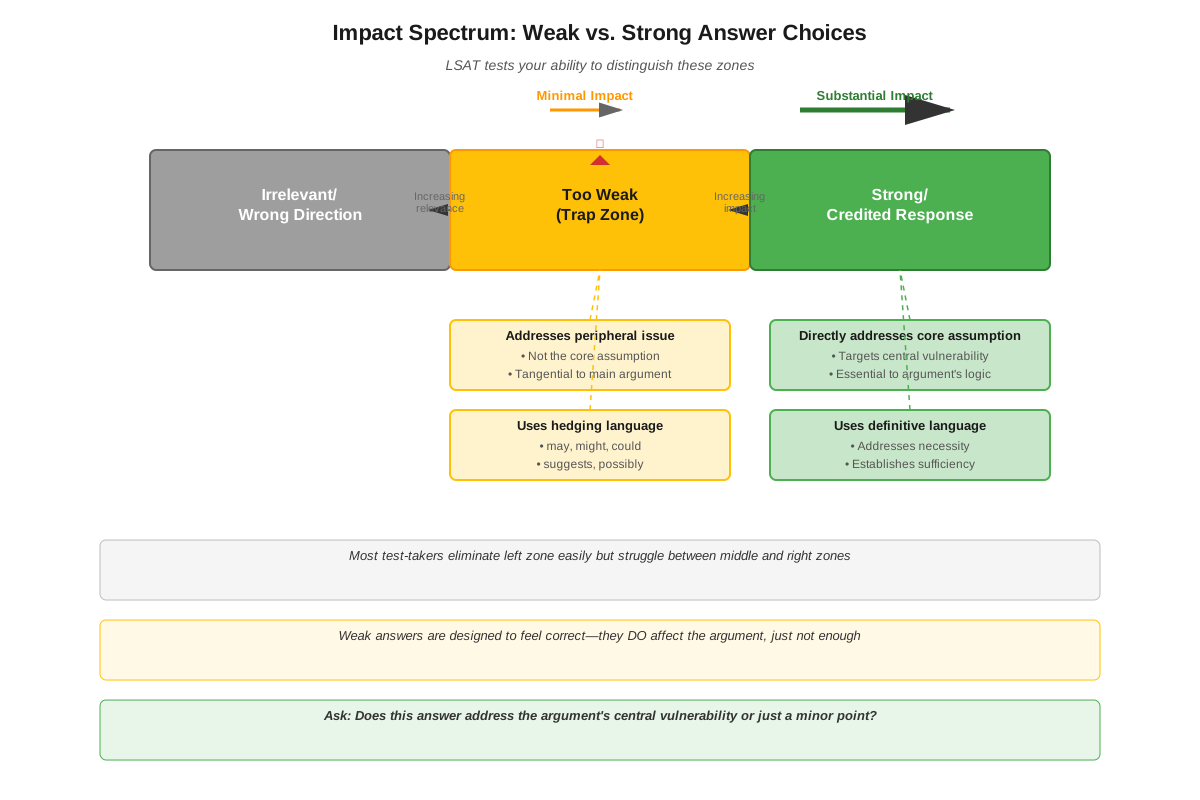
Too weak answer choices represent one of the most frequently encountered trap answers on LSAT Logical Reasoning sections, particularly within strengthen and weaken questions. These answer choices appear correct at first glance because they relate to the argument's subject matter and move in the right direction—they genuinely do strengthen or weaken the argument to some degree. However, they fail to provide sufficient impact to be the credited response. Understanding this trap is essential because the LSAT deliberately designs these answers to appeal to test-takers who recognize the general relationship between the answer and the argument but fail to evaluate the magnitude of that relationship.
The challenge with too weak answer choices lies in their subtlety. Unlike clearly irrelevant answers or those that move in the wrong direction, weak answers require test-takers to make comparative judgments about degree and impact. The LSAT tests not just whether students can identify relevant information, but whether they can distinguish between minimally relevant support and substantially relevant support. This skill mirrors the analytical precision required in legal reasoning, where attorneys must evaluate the relative strength of different pieces of evidence.
Mastering the identification of too weak answer choices connects directly to broader Logical Reasoning competencies, including understanding argument structure, recognizing scope limitations, and evaluating evidential support. This topic serves as a bridge between basic argument analysis and advanced critical reasoning skills. Students who excel at identifying weak answers demonstrate sophisticated understanding of how premises relate to conclusions and can assess the proportionality between evidence and claims—skills that appear across all Logical Reasoning question types.
Learning Objectives
- [ ] Identify how too weak answer choices appears in LSAT questions
- [ ] Explain the reasoning pattern behind too weak answer choices
- [ ] Apply too weak answer choices to solve LSAT-style problems accurately
- [ ] Distinguish between minimally relevant and substantially relevant answer choices in strengthen/weaken contexts
- [ ] Evaluate the magnitude of impact an answer choice has on an argument's conclusion
- [ ] Recognize specific linguistic markers that signal potentially weak answer choices
- [ ] Compare multiple answer choices to select the one with the strongest impact on the argument
Prerequisites
- Basic argument structure: Understanding premises, conclusions, and assumptions is essential because evaluating answer strength requires identifying what the argument claims and what evidence supports it
- Strengthen and weaken question fundamentals: Familiarity with how these question types function provides the foundation for understanding why some strengthening or weakening is insufficient
- Scope recognition: The ability to identify an argument's precise scope helps determine whether an answer choice addresses the right elements with sufficient breadth
- Conditional reasoning basics: Many weak answers fail because they address only one part of a conditional relationship or provide support that's too narrow
Why This Topic Matters
In legal practice, attorneys must constantly evaluate the strength of evidence and arguments, distinguishing between marginally relevant information and decisively persuasive support. The ability to recognize when evidence provides insufficient support for a claim is fundamental to legal analysis, making this topic directly relevant to the skills law schools seek in applicants.
On the LSAT, too weak answer choices appear with remarkable frequency. Approximately 60-70% of strengthen and weaken questions include at least one answer choice that moves in the correct direction but lacks sufficient impact. These questions appear 10-12 times per test on average, making this one of the highest-yield topics for score improvement. Test-takers who cannot distinguish weak from strong answers often plateau in the 155-160 score range, while those who master this distinction regularly score above 165.
This topic manifests in several common patterns on the exam. Weak answers might address only a small subset of the cases discussed in the argument, provide support that's too conditional or uncertain, offer evidence about tangentially related matters, or strengthen/weaken a premise rather than the conclusion itself. The LSAT also frequently presents weak answers alongside one strong answer, forcing test-takers to make direct comparisons and select the most impactful option.
Core Concepts
Defining Too Weak Answer Choices
Too weak answer choices are responses that technically move in the correct direction—they do strengthen or weaken the argument—but fail to provide sufficient impact to be the best answer. These choices are characterized by their limited scope, conditional nature, or tangential relevance. The key distinction is between answers that are wrong (irrelevant or moving in the wrong direction) and answers that are insufficient (relevant but not strong enough).
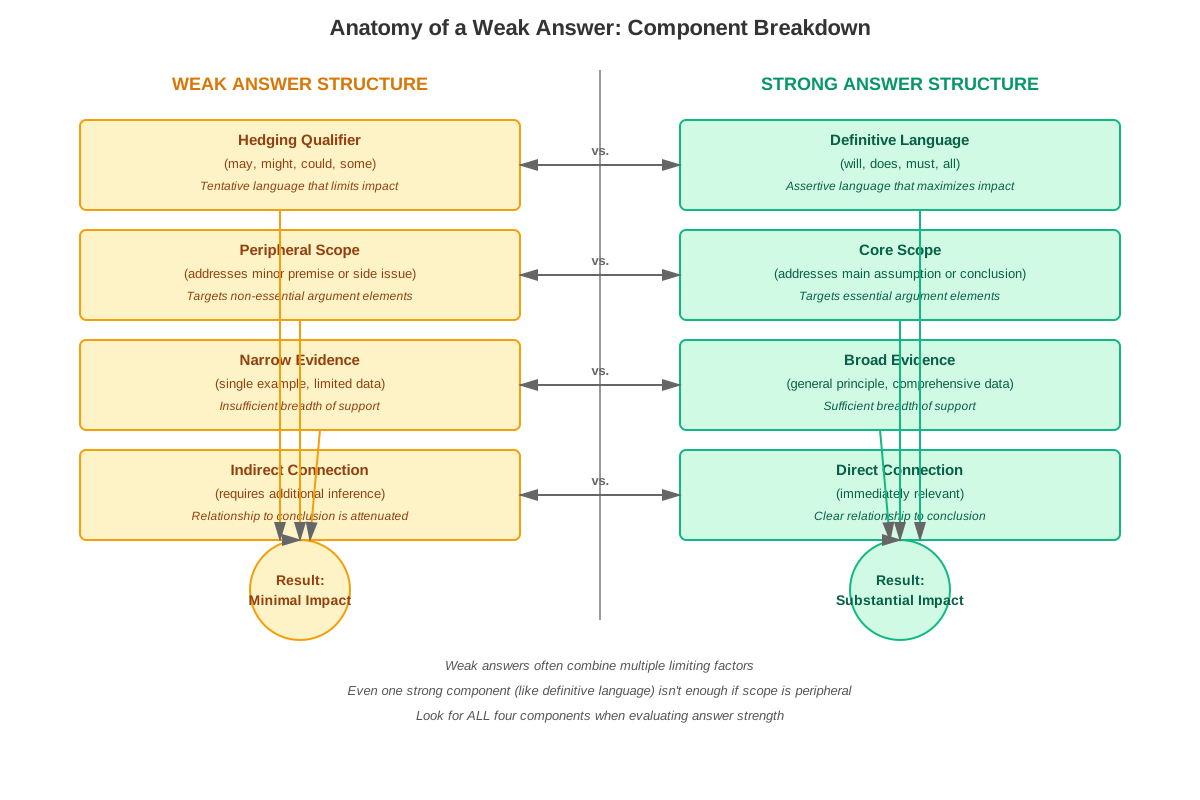
The weakness can manifest in several dimensions:
- Magnitude: The answer provides minimal support or opposition
- Scope: The answer addresses only a small portion of the argument's domain
- Certainty: The answer is too hedged or conditional to provide robust support
- Directness: The answer relates to the argument only through multiple inferential steps
The Comparative Nature of Weakness
Understanding weak answers requires recognizing that "weak" is inherently comparative. An answer isn't weak in absolute terms—it's weak relative to other available options. On the LSAT, the instructions ask for the answer that "most strengthens" or "most weakens," explicitly requiring comparison. A moderately strengthening answer becomes the correct choice if all others are weaker, but that same answer would be incorrect if a stronger option exists.
This comparative framework means that effective test-takers must:
- Evaluate each answer's impact independently
- Compare impacts across all five answer choices
- Select the answer with the greatest magnitude of effect
Scope Limitations as a Source of Weakness
One of the most common reasons answers are too weak involves scope limitations. The argument might discuss "all employees," but the answer choice provides information about "some employees" or "employees in one department." The argument might concern "profitability," but the answer addresses "revenue" without considering costs.
| Argument Scope | Weak Answer Scope | Why It's Weak |
|---|---|---|
| All customers prefer Product A | Customers in one region prefer Product A | Addresses only a subset; doesn't support the universal claim |
| The policy will reduce crime | The policy will reduce one type of crime | Too narrow; doesn't address crime generally |
| Students learn better with Method X | Some students report liking Method X | Preference doesn't equal learning; "some" is too limited |
Conditional and Hedged Language
Weak answers often contain conditional language that limits their impact. Words like "might," "could," "possibly," "sometimes," or "in certain circumstances" reduce the certainty of the support provided. While the LSAT occasionally credits conditional answers when they're the strongest available, more often these hedges signal weakness.
For example, if an argument concludes that "implementing the new software will increase productivity," an answer stating "the software might increase productivity if employees receive adequate training" is weaker than one stating "companies using this software consistently report 30% productivity gains." The conditional nature of the first answer introduces uncertainty that diminishes its strengthening power.
Addressing Premises vs. Conclusions
A subtle but crucial source of weakness occurs when answer choices strengthen or weaken a premise rather than the conclusion. Since strengthen and weaken questions ask about the argument's reasoning—the connection between premises and conclusion—supporting a premise that's already accepted as true provides minimal value.
Consider this argument structure:
- Premise: Sales increased 20% last quarter
- Conclusion: The new marketing campaign was effective
An answer stating "sales data was accurately recorded" strengthens the premise but doesn't address whether the marketing campaign caused the increase. This is weaker than an answer stating "no other factors changed that could affect sales," which directly strengthens the causal connection to the conclusion.
The "One Step Removed" Problem
Weak answers are often one or more inferential steps removed from the argument's core reasoning. They provide information that could be relevant if combined with additional unstated assumptions, but they don't directly impact the argument as written.
For instance, if an argument concludes that "electric cars will reduce carbon emissions," an answer about "advances in battery technology" is one step removed—it might make electric cars more viable, which could lead to more adoption, which could reduce emissions. Compare this to an answer stating "electric cars produce 60% less carbon than gasoline cars over their lifetime," which directly supports the conclusion.
Quantitative Insufficiency
Sometimes answers are weak because they provide quantitative information that's insufficient to meaningfully impact the argument. An answer might show a small percentage change when a large one is needed, or provide absolute numbers without context for whether they're significant.
If an argument claims "the new drug is highly effective," an answer stating "3% of patients showed improvement" is quantitatively weak. The small percentage doesn't support "highly effective." Conversely, "78% of patients showed complete symptom resolution" provides strong quantitative support.
Concept Relationships
The concept of too weak answer choices connects hierarchically to the broader category of strengthen and weaken questions. Within this category, weak answers represent one of several trap answer types, alongside irrelevant answers, opposite answers, and out-of-scope answers. However, weak answers are distinct because they maintain relevance and directionality—they're sophisticated traps that require deeper analysis.
The relationship flows as follows:
Argument Analysis → Identify Conclusion and Support → Determine What Would Strengthen/Weaken → Evaluate Answer Choice Relevance → Assess Answer Choice Magnitude → Compare Relative Strength
Weak answers typically fail at the "Assess Magnitude" stage. Test-takers correctly identify relevance but incorrectly judge impact. This connects to prerequisite knowledge of scope, as scope limitations are the primary mechanism creating weakness. It also connects to conditional reasoning, as conditional statements often create the hedging that weakens answers.
Understanding weak answers enhances performance on other question types as well. Necessary Assumption questions require identifying what's essential versus merely helpful—a similar distinction to strong versus weak support. Sufficient Assumption questions demand recognizing what fully bridges a gap versus what partially addresses it. The analytical skill of evaluating evidential strength transfers across the entire Logical Reasoning section.
High-Yield Facts
⭐ Too weak answer choices move in the correct direction but lack sufficient impact to be the credited response
⭐ Approximately 60-70% of strengthen and weaken questions include at least one weak answer choice as a trap
⭐ Scope limitations are the most common source of weakness—answers that address only a subset of the argument's domain
⭐ Conditional language ("might," "could," "possibly") often signals a weak answer by introducing uncertainty
⭐ Answers that strengthen premises rather than the conclusion are typically too weak
- Weak answers often require additional unstated assumptions to impact the argument meaningfully
- Quantitative insufficiency—small percentages or numbers—can make otherwise relevant answers too weak
- The LSAT instructions specify "most strengthens/weakens," explicitly requiring comparative evaluation
- An answer can be weak in one context but strong in another, depending on the other available options
- Weak answers are more sophisticated traps than irrelevant answers because they demonstrate partial understanding
- Test-takers who eliminate weak answers correctly improve their scores by an average of 3-5 points
Quick check — test yourself on Too weak answer choices so far.
Try Flashcards →Common Misconceptions
Misconception: If an answer choice is relevant to the argument and moves in the right direction, it must be correct.
Correction: Relevance and correct directionality are necessary but not sufficient. The answer must also provide substantial impact relative to other options. Many trap answers are designed to be relevant but weak.
Misconception: Conditional language ("might," "could") always makes an answer wrong.
Correction: While conditional language often signals weakness, occasionally the credited response contains such language when all other answers are weaker or when the conditionality is appropriate to the argument's scope. Evaluate comparatively rather than applying absolute rules.
Misconception: Any answer that strengthens or weakens the argument at all should be selected.
Correction: The question asks for the answer that most strengthens or weakens. Even if an answer provides some support, it's incorrect if another answer provides stronger support. Always compare all five options.
Misconception: Longer, more detailed answers are always stronger than shorter ones.
Correction: Length doesn't correlate with strength. Some weak answers are verbose but address tangential issues, while strong answers can be concise and directly impactful. Focus on the substance of the impact, not the word count.
Misconception: If an answer addresses the conclusion's topic, it must be strong.
Correction: Topical relevance differs from argumentative impact. An answer might discuss the same subject matter but fail to address the specific reasoning gap or provide sufficient magnitude of support. Evaluate whether the answer affects the logical connection between premises and conclusion.
Worked Examples
Example 1: Identifying Weak vs. Strong Strengtheners
Argument:
"City officials claim that installing speed cameras at major intersections will reduce traffic accidents. They point to a study showing that intersections with speed cameras have 15% fewer accidents than those without cameras. Therefore, the city should install speed cameras at all major intersections."
Question: Which of the following, if true, most strengthens the argument?
Answer Choices:
(A) Some drivers report being more cautious when they know speed cameras are present.
(B) The intersections studied were similar to the city's major intersections in traffic volume and design.
(C) Speed cameras have become less expensive to install and maintain in recent years.
(D) Traffic accidents cause significant economic costs to cities.
(E) Other cities have considered installing speed cameras.
Analysis:
Let's evaluate each answer's impact:
(A) This answer moves in the right direction—if drivers are more cautious, that could lead to fewer accidents. However, it's weak for several reasons: "some drivers" is limited in scope, "report being" doesn't confirm actual behavior change, and the connection to accident reduction requires an additional inference. This is a classic too weak answer choice.
(B) This directly addresses a potential weakness in the argument: whether the study's findings apply to this city's intersections. If the studied intersections are similar, the 15% reduction is more likely to transfer. This strengthens the argument substantially by validating the relevance of the evidence.
(C) This is irrelevant to whether cameras will reduce accidents. It addresses implementation feasibility, not effectiveness.
(D) This strengthens the importance of reducing accidents but doesn't strengthen the claim that cameras will accomplish this reduction. It's addressing the wrong part of the argument.
(E) What other cities have considered is irrelevant to whether cameras work in this city.
Correct Answer: (B)
The key distinction is between (A) and (B). Answer (A) is tempting because it's relevant and moves in the right direction, but it's too weak compared to (B). Answer (B) directly validates the study's applicability, while (A) provides uncertain, limited-scope support that requires additional inferences.
Example 2: Recognizing Scope Limitations
Argument:
"Economist: Our country's unemployment rate has decreased from 8% to 6% over the past year. This demonstrates that the government's new economic policies have been successful in creating jobs and improving the economy."
Question: Which of the following, if true, most weakens the argument?
Answer Choices:
(A) Some economists disagree about the best methods for calculating unemployment rates.
(B) The decrease in unemployment was entirely due to workers leaving the workforce rather than finding jobs.
(C) Unemployment rates in one region of the country actually increased slightly.
(D) Creating jobs is only one aspect of improving an economy.
(E) The government implemented several different economic policies simultaneously.
Analysis:
(A) This is too weak because disagreement about calculation methods doesn't directly challenge whether the policies caused the improvement. It's one step removed from the argument's reasoning.
(B) This directly undermines the argument by providing an alternative explanation for the decreased rate. If workers left the workforce rather than finding jobs, the policies didn't create jobs as claimed. This is a strong weakener.
(C) This is a too weak answer choice due to scope limitations. "One region" and "slightly" both limit the impact. The argument is about the overall country rate, and one region's small increase doesn't significantly challenge the 2% overall decrease.
(D) This is weak because it doesn't challenge the claim that the policies created jobs—it just notes that job creation isn't the only economic factor. The argument's conclusion is about the policies being successful, and creating jobs is evidence of success even if other factors also matter.
(E) This is somewhat relevant but weak. Multiple simultaneous policies make it harder to attribute success to specific policies, but this doesn't strongly weaken the claim that the policies collectively were successful.
Correct Answer: (B)
Answer (C) demonstrates the classic scope limitation weakness: it addresses only a small subset (one region) with minimal impact (slight increase). Test-takers often select this because it moves in the right direction (weakening), but it's insufficient compared to (B), which completely undermines the causal reasoning.
Exam Strategy
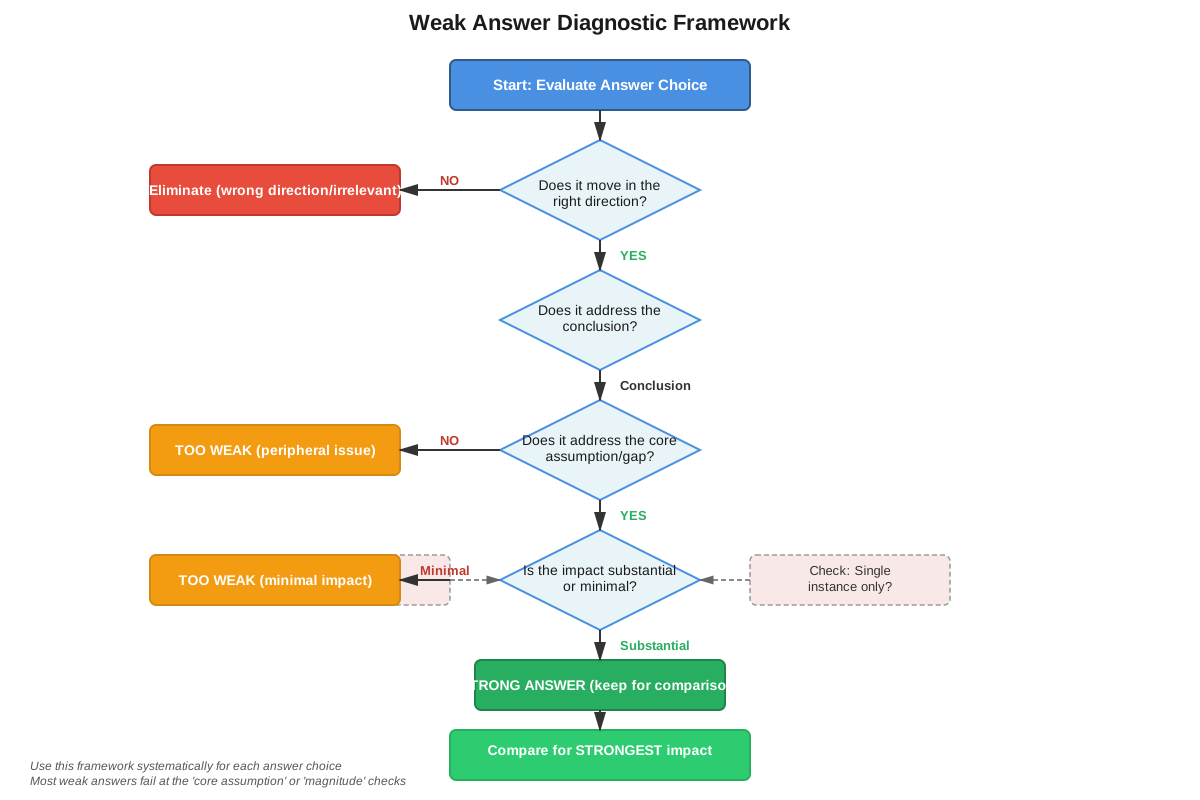
When approaching strengthen and weaken questions, implement this systematic process to avoid selecting weak answers:
Step 1: Identify the Conclusion and Reasoning Gap
Before looking at answers, clearly articulate what the argument concludes and what assumption or gap exists in the reasoning. This helps you recognize what would substantially strengthen or weaken the argument versus what would only tangentially affect it.
Step 2: Predict the Impact Type
Determine what kind of information would have strong impact: evidence about alternative explanations, data about representativeness, information about causal mechanisms, or facts about scope applicability. This prediction helps you recognize strong answers quickly.
Step 3: Use Two-Pass Elimination
- First pass: Eliminate clearly wrong answers (irrelevant, opposite direction, out of scope)
- Second pass: Among remaining answers, compare magnitude of impact
Step 4: Watch for Weakness Triggers
Be alert to language that often signals weak answers:
- Quantitative hedges: "some," "a few," "slightly," "marginally"
- Conditional language: "might," "could," "possibly," "if certain conditions"
- Scope limiters: "in one case," "sometimes," "certain types"
- Indirect connections: "related to," "associated with," "connected to"
Step 5: Apply the "So What?" Test
For each remaining answer, ask: "So what? How much does this really affect the conclusion?" If the answer requires you to make additional assumptions or inferential leaps, it's likely too weak.
Step 6: Compare Directly
When down to two answers, compare them side-by-side. Ask which one more directly addresses the reasoning gap and which provides greater magnitude of impact. The stronger answer typically:
- Addresses a broader scope
- Provides more certain support
- Requires fewer additional assumptions
- Directly impacts the conclusion rather than premises
Exam Tip: If you're torn between two answers and one seems "pretty good" while the other seems "perfect," choose the perfect one. The LSAT rarely credits "pretty good" when "perfect" is available.
Time Allocation: Spend approximately 1:20-1:30 on strengthen and weaken questions. Allocate 30 seconds to understanding the argument, 15 seconds to prediction, and 35-45 seconds to answer evaluation. If you're spending more time, you're likely overthinking—trust your analysis of magnitude and move forward.
Memory Techniques
SCOPED Acronym for Evaluating Weakness:
- Scope: Does the answer address the full scope of the argument?
- Certainty: Is the answer hedged with conditional language?
- One-step-removed: Does the answer require additional inferences?
- Premise vs. conclusion: Does it strengthen the right part?
- Evidence magnitude: Is the quantitative impact sufficient?
- Direct impact: Does it directly affect the reasoning gap?
The "Zoom In/Zoom Out" Visualization:
Picture the argument as a photograph. Strong answers affect the entire image clearly and directly. Weak answers only affect one corner of the image, or affect the whole image but very faintly. When evaluating answers, visualize whether they're changing the whole picture substantially or just tweaking a small portion.
The "Bridge Strength" Metaphor:
Think of the argument as requiring a bridge between premises and conclusion. Strong answers provide sturdy, wide bridges that clearly connect both sides. Weak answers provide narrow footbridges or bridges that only partially span the gap. When you read an answer, visualize whether it's building a highway or a tightrope.
The "Some/Most/All" Hierarchy:
Remember that scope matters: "some" < "most" < "all" in terms of strength. When comparing answers, the one addressing more of the argument's scope is typically stronger. Visualize a pyramid with "all" at the top—answers higher on the pyramid are stronger.
Summary
Too weak answer choices represent sophisticated traps on LSAT Logical Reasoning sections, particularly in strengthen and weaken questions. These answers are characterized by their relevance and correct directionality—they genuinely do strengthen or weaken the argument—but fail to provide sufficient magnitude of impact to be the credited response. The primary sources of weakness include scope limitations (addressing only a subset of the argument's domain), conditional or hedged language that introduces uncertainty, addressing premises rather than conclusions, requiring additional inferential steps, and providing quantitatively insufficient support. Mastering this topic requires developing comparative evaluation skills: test-takers must not only identify whether an answer is relevant and moves in the right direction, but also assess its magnitude of impact relative to other options. The key to avoiding weak answer traps lies in systematic analysis—clearly identifying the argument's reasoning gap, predicting what would substantially affect that gap, and directly comparing the impact of remaining answers after eliminating clearly wrong options.
Key Takeaways
- Too weak answer choices are relevant and move in the correct direction but lack sufficient impact compared to stronger alternatives
- Scope limitations are the most common source of weakness—answers addressing only a subset of the argument's domain are typically too weak
- The LSAT explicitly asks for answers that "most" strengthen or weaken, requiring comparative evaluation rather than absolute judgments
- Conditional language ("might," "could," "possibly") often signals weakness by introducing uncertainty that diminishes impact
- Strong answers directly address the reasoning gap between premises and conclusion, while weak answers often strengthen premises or require additional inferential steps
- Systematic evaluation using the SCOPED framework helps distinguish weak from strong answers efficiently
- Recognizing and eliminating weak answers is a high-yield skill that can improve LSAT scores by 3-5 points on average
Related Topics
Strengthen and Weaken Question Fundamentals: Understanding the basic structure and approach to these question types provides the foundation for recognizing weak answers. Mastering weak answer identification builds directly on this foundational knowledge.
Scope Errors in Logical Reasoning: Since scope limitations are the primary source of weakness, deeper study of how scope functions across all Logical Reasoning question types enhances the ability to spot weak answers quickly.
Necessary vs. Sufficient Assumptions: The distinction between what's required versus what's merely helpful parallels the distinction between strong and weak support, making these topics mutually reinforcing.
Causal Reasoning: Many strengthen and weaken questions involve causal arguments, and understanding how to strengthen or weaken causal claims helps identify which answers provide substantial versus minimal impact.
Comparative Reasoning: Since identifying weak answers requires comparing magnitude of impact across multiple options, studying comparative reasoning more broadly enhances this analytical skill.
Practice CTA
Now that you understand how to identify and avoid too weak answer choices, it's time to apply these concepts to actual LSAT-style questions. The practice questions and flashcards will help you internalize the patterns of weak answers and develop the comparative evaluation skills essential for success. Remember: recognizing weakness is a skill that improves dramatically with deliberate practice. Each question you analyze strengthens your ability to distinguish substantial from minimal impact, bringing you closer to your target score. Approach the practice materials systematically, applying the SCOPED framework and comparing answers directly. Your investment in mastering this high-yield topic will pay dividends across the entire Logical Reasoning section.
Sign up free to keep reading
Create a free AnvayaPrep account to finish this LSAT guide on Too weak answer choices — plus flashcards and practice questions.