Overview
Weakening conditional arguments represents one of the most frequently tested and strategically important skills in LSAT Logical Reasoning. Conditional statements form the backbone of formal logic and appear in approximately 20-30% of all Logical Reasoning questions. When the LSAT asks test-takers to weaken an argument containing conditional reasoning, it tests not only the ability to understand logical relationships but also the capacity to identify vulnerabilities in how those relationships are applied.
Conditional arguments typically follow an "if-then" structure, establishing relationships between sufficient and necessary conditions. However, arguments built on conditional logic often contain hidden assumptions, overgeneralizations, or flawed applications of these logical relationships. LSAT weakening conditional arguments questions require students to identify answer choices that expose these vulnerabilities—whether by showing that the necessary condition can be satisfied without the sufficient condition occurring, demonstrating that alternative explanations exist, or revealing that the conditional relationship doesn't apply in the specific context presented.
This topic sits at the intersection of formal logic and critical reasoning within the broader LSAT curriculum. Mastery of weakening conditional arguments builds directly on understanding basic conditional logic while serving as a foundation for more complex question types including Flaw questions, Assumption questions, and Parallel Reasoning questions. Success with strengthen and weaken questions involving conditional logic demonstrates the analytical sophistication that law schools seek in prospective students, as legal reasoning frequently involves identifying weaknesses in conditional claims and rule-based arguments.
Learning Objectives
- [ ] Identify how weakening conditional arguments appears in LSAT questions
- [ ] Explain the reasoning pattern behind weakening conditional arguments
- [ ] Apply weakening conditional arguments to solve LSAT-style problems accurately
- [ ] Distinguish between weakening the conditional relationship itself versus weakening the argument's application of that relationship
- [ ] Recognize the difference between necessary and sufficient condition attacks in weakening questions
- [ ] Evaluate answer choices to determine which most effectively undermines a conditional argument's conclusion
- [ ] Identify common conditional argument structures that are vulnerable to specific weakening strategies
Prerequisites
- Basic conditional logic notation and terminology: Understanding "if-then" statements, sufficient conditions, and necessary conditions is essential because weakening questions assume fluency with these fundamental logical structures
- Contrapositive formation: Recognizing logically equivalent statements helps identify when an argument misapplies conditional logic or when an answer choice targets the relationship from a different angle
- Argument structure analysis: The ability to identify premises, conclusions, and assumptions enables students to pinpoint exactly what needs to be weakened in conditional arguments
- Distinction between correlation and causation: Many conditional arguments conflate these concepts, and weakening them requires recognizing this distinction
- Understanding of necessary versus sufficient conditions: Confusion between these concepts is the most common source of errors in conditional reasoning questions
Why This Topic Matters
Conditional reasoning pervades legal thinking, making it a natural focus for the LSAT. Statutes, regulations, and legal precedents are typically expressed as conditional statements ("If X condition is met, then Y legal consequence follows"). Lawyers must constantly evaluate whether these conditional relationships hold in specific cases, identify exceptions, and recognize when opposing counsel overgeneralizes from conditional rules. The LSAT tests this skill directly through weakening questions.
Statistically, strengthen and weaken questions constitute approximately 15-20% of all Logical Reasoning questions on any given LSAT, with conditional arguments appearing in roughly one-third of these questions. This translates to 3-5 questions per test specifically targeting the ability to weaken conditional reasoning—enough to significantly impact a test-taker's score. Furthermore, the skills developed through mastering this topic transfer to other high-frequency question types, including Flaw questions (which often involve conditional reasoning errors) and Sufficient Assumption questions (which require completing conditional chains).
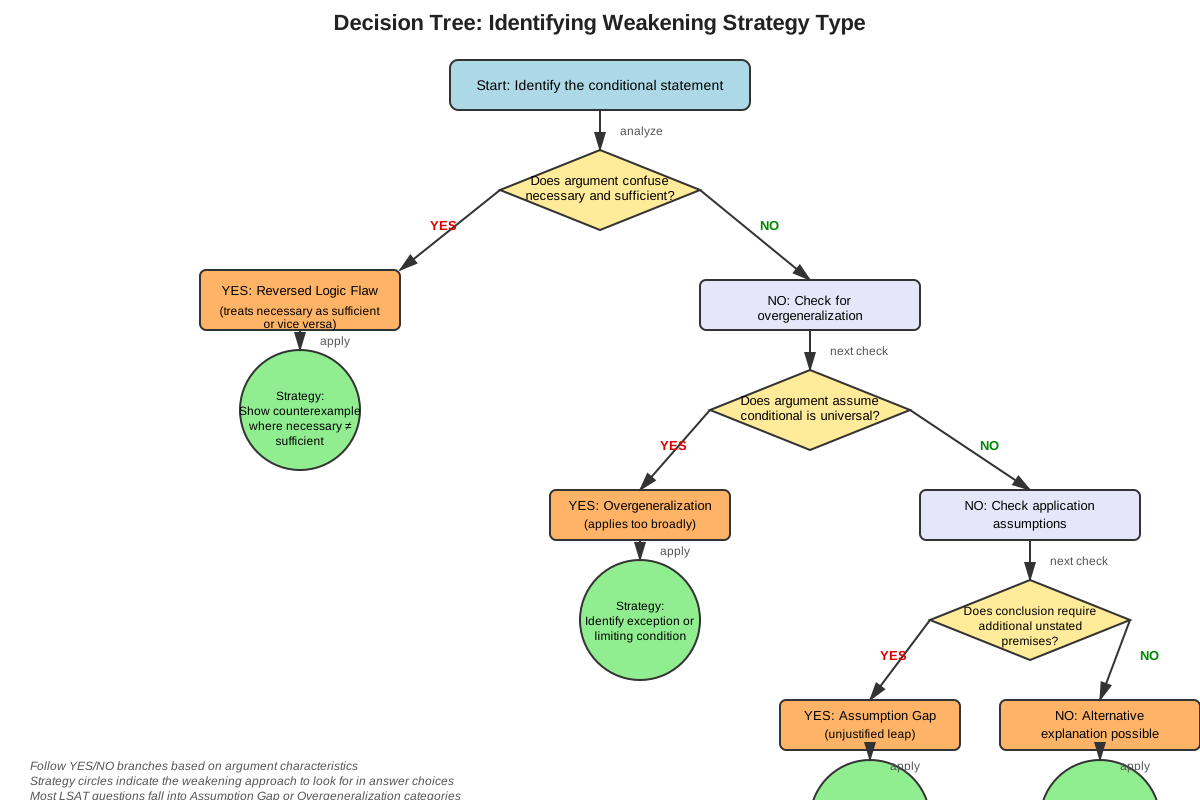
On the LSAT, weakening conditional arguments typically appears in several distinct formats: arguments that overgeneralize from a conditional rule to a specific case, arguments that confuse necessary and sufficient conditions, arguments that assume a conditional relationship is the only explanation for an observed pattern, and arguments that fail to consider alternative ways a necessary condition might be satisfied. Recognizing these patterns enables efficient question identification and strategic answer choice evaluation.
Core Concepts
Understanding Conditional Arguments
A conditional argument builds its reasoning on one or more "if-then" relationships. The basic structure establishes that when a sufficient condition occurs, a necessary condition must follow. For example: "If a student studies diligently (sufficient condition), then that student will pass the exam (necessary condition)." Arguments using conditional logic typically apply these relationships to specific situations, drawing conclusions about what must, might, or cannot happen based on the conditional rules established.
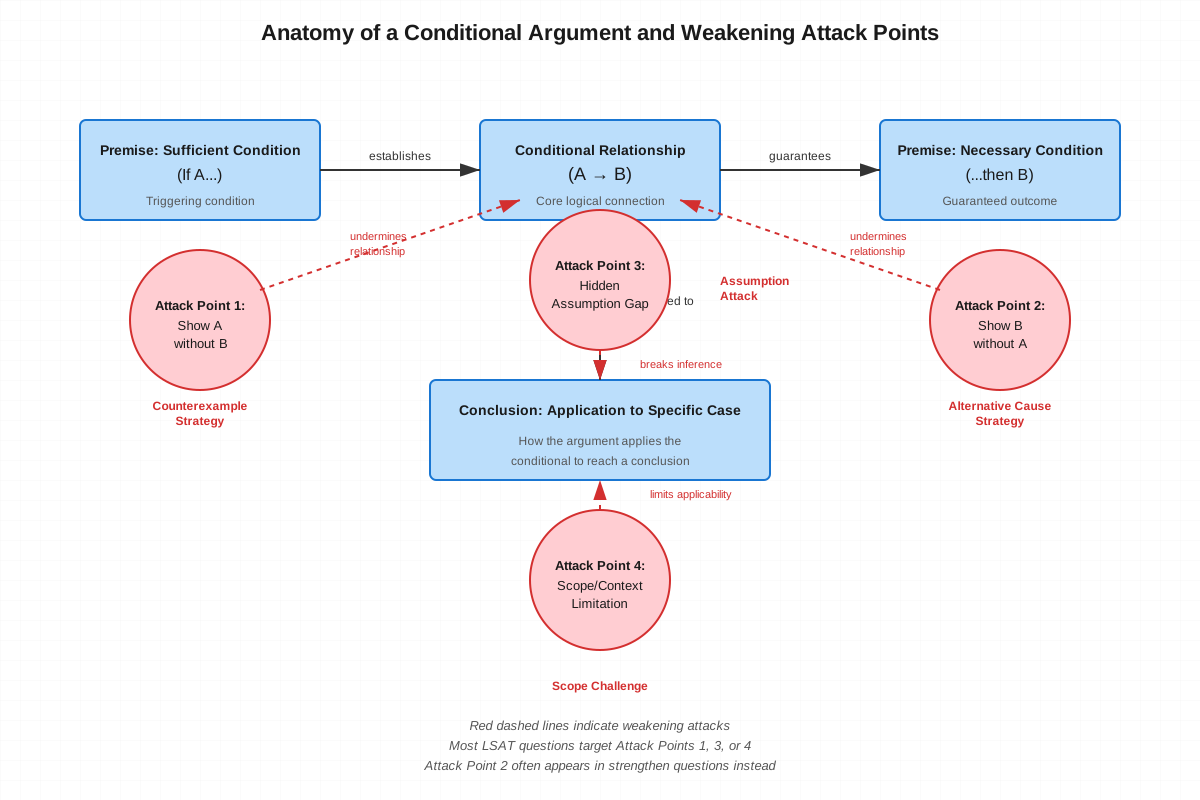
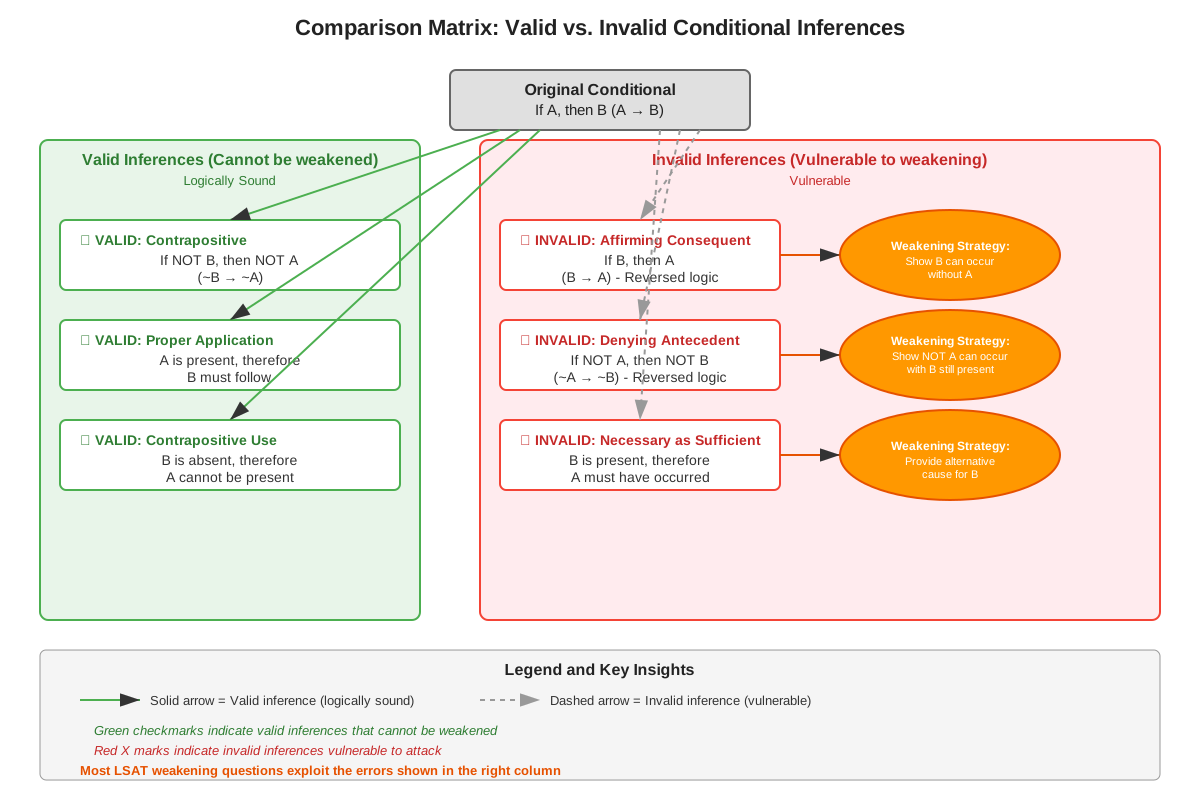
The vulnerability of conditional arguments lies in several key areas. First, conditional statements only work in one direction—the sufficient condition guarantees the necessary condition, but the necessary condition does not guarantee the sufficient condition. Second, conditional relationships may have unstated limitations, exceptions, or contextual dependencies. Third, arguments often assume that a conditional relationship is the only explanation for an observed outcome when alternative explanations exist.
The Logic of Weakening Conditional Arguments
Weakening conditional arguments involves introducing information that makes the argument's conclusion less likely to be true or less well-supported by its premises. Unlike strengthening, which provides additional support, weakening creates doubt about the connection between premises and conclusion. For conditional arguments specifically, effective weakening strategies target either the conditional relationship itself or the argument's application of that relationship.
The most powerful weakening approaches include:
- Showing the necessary condition can occur without the sufficient condition: If an argument assumes that because the necessary condition is present, the sufficient condition must have occurred, demonstrating alternative causes for the necessary condition weakens this reasoning
- Demonstrating exceptions to the conditional rule: Providing cases where the sufficient condition occurs but the necessary condition does not undermines the reliability of the conditional relationship
- Revealing relevant differences: When an argument applies a conditional rule from one context to another, showing that the contexts differ in relevant ways weakens the application
- Introducing alternative explanations: If an argument treats a conditional relationship as the only explanation for an observed pattern, presenting other plausible explanations weakens the argument
Common Conditional Argument Structures
| Argument Structure | Logical Form | Typical Weakness |
|---|---|---|
| Affirming the Consequent | If A→B; B occurred; Therefore A occurred | B could occur without A; alternative causes exist |
| Denying the Antecedent | If A→B; A didn't occur; Therefore B didn't occur | B could occur through other means besides A |
| Overgeneralization | If A→B in context X; Therefore A→B in context Y | Contexts may differ in relevant ways |
| Assuming Exclusivity | If A→B; B occurred; Therefore only A could cause B | Multiple sufficient conditions may exist for B |
| Temporal Confusion | If A→B; A and B both present; Therefore A caused B | Correlation doesn't establish the conditional relationship |
Necessary vs. Sufficient Condition Attacks
Understanding which part of a conditional relationship an argument relies upon determines the most effective weakening strategy. Arguments that assume sufficient conditions are necessary can be weakened by showing alternative ways to achieve the outcome. For example, if an argument claims "Only students who study diligently pass the exam" (treating studying as necessary), showing that some students pass through natural aptitude weakens this claim.
Conversely, arguments that assume necessary conditions are sufficient can be weakened by showing that the necessary condition alone is inadequate. If an argument claims "Students who attend class will pass the exam" (treating attendance as sufficient), demonstrating that attendance without studying leads to failure weakens this reasoning.
The Role of Context and Scope
Many conditional arguments are vulnerable because they apply conditional relationships beyond their appropriate scope. A conditional statement might be true in general but have exceptions in specific circumstances. Weakening such arguments involves introducing information about contextual factors that limit the conditional relationship's applicability.
For instance, an argument might state: "If a medication is FDA-approved, it is safe for public use. Medication X is FDA-approved. Therefore, Medication X is safe for public use." This argument can be weakened by introducing information about specific populations (pregnant women, children) for whom the general conditional relationship doesn't hold, or by noting that FDA approval doesn't account for long-term effects not yet discovered.
Distinguishing Weakening from Disproving
A critical distinction in LSAT logical reasoning is that weakening an argument does not require proving it wrong. An answer choice that makes the conclusion less likely or less well-supported weakens the argument, even if the conclusion could still be true. This is particularly important for conditional arguments, where introducing a single exception or alternative explanation can significantly undermine the argument's force without completely disproving the conclusion.
Concept Relationships
The concepts within weakening conditional arguments form an interconnected system. Understanding basic conditional logic (sufficient and necessary conditions) provides the foundation → which enables recognition of common conditional argument structures → which reveals typical vulnerabilities in conditional reasoning → which guides selection of effective weakening strategies → which ultimately enables accurate answer choice evaluation.
This topic connects backward to prerequisite knowledge of conditional logic and argument structure analysis. The ability to identify premises and conclusions determines what needs to be weakened, while fluency with conditional notation enables quick recognition of the logical relationships at play. The topic connects forward to Flaw questions (which often ask test-takers to identify the error in conditional reasoning), Sufficient Assumption questions (which require completing conditional chains), and Parallel Reasoning questions (which test the ability to recognize structurally similar conditional arguments).
Within the broader category of strengthen and weaken questions, conditional arguments represent a specific subtype with distinctive characteristics. While general weakening strategies (introducing alternative explanations, questioning representativeness of evidence, revealing relevant differences) apply to conditional arguments, these arguments also have unique vulnerabilities stemming from their logical structure. Mastering conditional-specific weakening strategies enhances overall performance on strengthen and weaken questions while building skills applicable across Logical Reasoning question types.
High-Yield Facts
- ⭐ Weakening a conditional argument does not require proving the conclusion false; it only requires making the conclusion less likely or less well-supported
- ⭐ The most common weakness in conditional arguments is affirming the consequent—assuming that because the necessary condition occurred, the sufficient condition must have occurred
- ⭐ Showing that the necessary condition can be satisfied through alternative means effectively weakens arguments that assume a specific sufficient condition is required
- ⭐ Demonstrating relevant differences between contexts weakens arguments that apply conditional rules from one situation to another
- ⭐ Introducing exceptions to a conditional rule undermines arguments that treat the rule as universally applicable
- Conditional arguments that confuse correlation with conditional relationships are vulnerable to evidence showing the correlation is coincidental
- Arguments assuming a conditional relationship is bidirectional (works both ways) can be weakened by showing the relationship only holds in one direction
- Temporal sequence does not establish conditional relationships; showing that two events occur together without one causing the other weakens conditional claims
- Conditional arguments often contain hidden scope limitations; revealing these limitations weakens the argument's application to specific cases
- The contrapositive of a conditional statement is logically equivalent; an answer choice that weakens the contrapositive also weakens the original statement
- Necessary conditions can be satisfied by multiple different sufficient conditions; arguments assuming only one sufficient condition exists are vulnerable to counterexamples
Quick check — test yourself on Weakening conditional arguments so far.
Try Flashcards →Common Misconceptions
Misconception: Weakening a conditional argument requires finding an answer choice that proves the conclusion is false.
Correction: Weakening only requires making the conclusion less likely or less well-supported. An answer choice that introduces doubt or reveals a gap in reasoning weakens the argument even if the conclusion could still be true.
Misconception: Any exception to a conditional rule completely invalidates the rule.
Correction: On the LSAT, conditional rules can have exceptions while still being generally reliable. Weakening questions ask which answer choice most undermines the argument, not which proves the conditional relationship never holds. A single exception weakens but doesn't destroy an argument based on a general conditional pattern.
Misconception: If an argument states "If A, then B," showing that B can occur without A doesn't weaken the argument.
Correction: This depends on what the argument concludes. If the argument observes B and concludes A must have occurred (affirming the consequent), then showing B can occur without A directly weakens this reasoning by revealing alternative explanations.
Misconception: Strengthening and weakening are symmetrical—whatever strengthens an argument, its opposite weakens it.
Correction: While this is sometimes true, the relationship is not perfectly symmetrical. Some information is relevant to strengthening but not weakening, or vice versa. For conditional arguments specifically, showing the conditional relationship holds in additional cases strengthens it, but showing it fails in one case can significantly weaken it—an asymmetry.
Misconception: Conditional arguments are only about formal logic and don't involve real-world reasoning.
Correction: LSAT conditional arguments typically embed conditional logic within substantive contexts (scientific studies, policy debates, historical claims). Weakening these arguments often requires both logical analysis and contextual reasoning about whether the conditional relationship plausibly holds in the specific situation described.
Misconception: The correct answer to a weakening question will always directly contradict a premise or the conclusion.
Correction: Effective weakening answers often introduce new information that reveals a gap in reasoning or an unstated assumption, rather than directly contradicting what the argument explicitly states. For conditional arguments, the best weakening answer might show that a conditional relationship doesn't apply in a specific context without denying that the relationship exists in general.
Worked Examples
Example 1: Affirming the Consequent
Argument: "Studies show that successful entrepreneurs typically have high levels of self-confidence. Maria has very high self-confidence. Therefore, Maria will likely become a successful entrepreneur."
Question: Which of the following, if true, most weakens the argument?
Answer Choices:
(A) Many people with high self-confidence pursue careers other than entrepreneurship
(B) Self-confidence is necessary for success in many different fields
(C) Some successful entrepreneurs attribute their success primarily to luck rather than self-confidence
(D) High self-confidence without relevant business skills rarely leads to entrepreneurial success
(E) Maria has expressed interest in starting her own business
Analysis:
First, identify the argument structure. The argument establishes a conditional pattern: successful entrepreneurs → high self-confidence. It then observes that Maria has high self-confidence and concludes she will likely become a successful entrepreneur. This commits the fallacy of affirming the consequent—observing the necessary condition and concluding the sufficient condition will occur.
To weaken this argument, we need information suggesting that high self-confidence alone doesn't make entrepreneurial success likely, or that other factors are required.
(A) This weakens the argument by showing that high self-confidence doesn't specifically predict entrepreneurship—many people with this trait pursue other paths. However, it doesn't directly address whether Maria will be successful if she does pursue entrepreneurship.
(B) This actually suggests self-confidence is broadly important, which if anything slightly supports the idea that Maria's self-confidence is relevant to potential success.
(C) This introduces some doubt about whether self-confidence causes entrepreneurial success, but it doesn't directly address whether someone with high self-confidence is likely to succeed.
(D) This is the correct answer. It directly weakens the argument by showing that high self-confidence (the necessary condition observed in Maria) is insufficient for entrepreneurial success without additional factors. This reveals that the argument's reasoning—from observing high self-confidence to predicting entrepreneurial success—is flawed because the necessary condition alone doesn't make the outcome likely.
(E) This slightly strengthens the argument by showing Maria is actually pursuing entrepreneurship, making the conclusion more relevant.
Key Takeaway: This example demonstrates how weakening an argument that affirms the consequent requires showing that the necessary condition alone is insufficient to produce the outcome, or that other factors are required.
Example 2: Overgeneralization Across Contexts
Argument: "In controlled laboratory studies, increased exposure to natural sunlight has been shown to improve mood and reduce symptoms of depression. Therefore, the recent increase in depression rates in urban areas can be reversed by designing buildings with larger windows that allow more natural light to enter workspaces."
Question: Which of the following, if true, most seriously weakens the argument?
Answer Choices:
(A) Some people who work in buildings with large windows still experience depression
(B) Depression rates have increased in both urban and rural areas over the past decade
(C) The controlled studies measured sunlight exposure during dedicated time outdoors, not merely through windows
(D) Many factors besides sunlight exposure contribute to depression rates
(E) Building designs with larger windows are more expensive to construct than traditional designs
Analysis:
The argument structure involves a conditional relationship established in one context (laboratory studies: increased sunlight → improved mood) and applied to a different context (urban workspaces: more windows → reduced depression rates). This is vulnerable to weakening through relevant differences between contexts.
(A) This shows the proposed solution isn't perfect, but doesn't strongly weaken the argument that it would help reduce depression rates overall.
(B) This suggests the problem is broader than urban areas, but doesn't directly address whether the proposed solution would work in urban areas.
(C) This is the correct answer. It reveals a critical difference between the context where the conditional relationship was established (direct outdoor sunlight exposure) and the context where the argument applies it (sunlight through windows). This relevant difference suggests the conditional relationship may not transfer to the new context, directly weakening the argument's reasoning.
(D) While true, this doesn't specifically weaken the claim that increased natural light would help. Many factors can contribute to a problem while a specific intervention still helps address it.
(E) This is a practical concern but doesn't weaken the argument's claim about effectiveness—it addresses implementation cost, not whether the solution would work.
Key Takeaway: This example illustrates how conditional arguments that apply relationships from one context to another are vulnerable to evidence revealing relevant differences between the contexts. The most effective weakening answer identifies a specific difference that undermines the transferability of the conditional relationship.
Exam Strategy
When approaching LSAT questions involving weakening conditional arguments, follow this systematic process:
Step 1: Identify the conditional structure (30 seconds)
Look for "if-then" language, necessary/sufficient condition indicators, or patterns suggesting conditional relationships. Common triggers include: "if," "when," "whenever," "only," "unless," "requires," "depends on," "necessary for," and "sufficient for." Quickly diagram the conditional relationship using standard notation (A → B) to clarify the logical structure.
Step 2: Determine what the argument concludes (15 seconds)
Identify whether the argument: (a) observes the sufficient condition and concludes the necessary condition will follow, (b) observes the necessary condition and concludes the sufficient condition occurred (affirming the consequent), (c) applies a conditional rule from one context to another, or (d) treats a conditional relationship as the only explanation for something. This determines the argument's vulnerability.
Step 3: Predict the weakness (20 seconds)
Before looking at answer choices, articulate what would weaken this specific argument. For affirming the consequent, predict: "alternative ways the necessary condition could occur." For context transfer, predict: "relevant differences between contexts." For exclusivity assumptions, predict: "other sufficient conditions that could produce the outcome."
Step 4: Evaluate answer choices strategically (60-90 seconds)
Eliminate answers that: strengthen the argument, are irrelevant to the conditional relationship, address practical concerns rather than logical weaknesses, or are too weak to significantly impact the argument. Focus on answers that directly target the specific vulnerability identified in Step 2.
Exam Tip: Wrong answers in weakening questions often address tangential issues or provide information that would weaken a different argument. Always return to what the argument actually concludes and what logical step it takes to reach that conclusion.
Time Allocation: Spend approximately 2 minutes total on weakening conditional argument questions—slightly more than average Logical Reasoning questions because the logical analysis requires precision. However, if you've correctly identified the argument structure and vulnerability, answer choice elimination should proceed quickly.
Process of Elimination Triggers:
- Eliminate answers that introduce new conditional relationships unrelated to the argument's reasoning
- Eliminate answers that would weaken the argument only if combined with additional unstated assumptions
- Eliminate answers that address whether the conclusion is desirable rather than whether it's well-supported
- Be cautious of answers that seem to weaken but actually address a different conclusion than what the argument states
Common Trap Patterns:
Watch for answer choices that weaken a general principle while the argument applies that principle to a specific case—these often don't weaken the specific application. Also beware of answers that show the conclusion might not occur for reasons unrelated to the conditional reasoning; these are often wrong because they don't target the logical structure of the argument.
Memory Techniques
SCAN Mnemonic for Weakening Conditional Arguments:
- Show alternative Sufficient conditions (the necessary condition can occur without the stated sufficient condition)
- Context differences (the conditional rule doesn't transfer to the new situation)
- Assumption exposure (reveal that the argument assumes the conditional relationship is exclusive or bidirectional)
- Necessary isn't sufficient (having the necessary condition doesn't guarantee the outcome)
Visualization Strategy: Picture conditional relationships as one-way bridges. The sufficient condition is the entrance; the necessary condition is the destination. Weakening strategies either show: (1) other bridges lead to the same destination (alternative sufficient conditions), (2) the bridge has gaps or doesn't reach the destination (exceptions to the rule), or (3) this bridge only works in certain weather conditions (context limitations).
The "Reverse Test" Technique: When an argument observes the necessary condition and concludes something about the sufficient condition, mentally reverse the conditional statement. If the argument's reasoning would require the reverse to be true, you've identified affirming the consequent—one of the most common weaknesses.
Acronym for Common Weaknesses - RACE:
- Reverse reasoning (affirming consequent or denying antecedent)
- Alternative explanations exist
- Context doesn't match
- Exceptions to the rule
Summary
Weakening conditional arguments on the LSAT requires both formal logical analysis and contextual reasoning. These questions test the ability to identify vulnerabilities in arguments built on "if-then" relationships, particularly when arguments affirm the consequent (observe the necessary condition and conclude the sufficient condition occurred), overgeneralize conditional rules across different contexts, or assume conditional relationships are exclusive or bidirectional. The most effective weakening strategies show that necessary conditions can be satisfied through alternative means, demonstrate relevant differences between contexts that limit a conditional rule's applicability, or reveal exceptions to conditional relationships. Success requires distinguishing between weakening the conditional relationship itself versus weakening the argument's application of that relationship, recognizing that weakening makes a conclusion less likely without necessarily proving it false, and systematically evaluating answer choices against the specific vulnerability in the argument's conditional reasoning. Mastery of this topic significantly impacts LSAT performance, as conditional reasoning appears throughout Logical Reasoning sections and the analytical skills developed transfer to multiple question types including Flaw, Assumption, and Parallel Reasoning questions.
Key Takeaways
- Weakening conditional arguments most commonly involves exposing the fallacy of affirming the consequent—showing that observing the necessary condition doesn't prove the sufficient condition occurred
- Effective weakening demonstrates alternative explanations, reveals relevant contextual differences, or shows exceptions to conditional rules without needing to prove the conclusion false
- The distinction between necessary and sufficient conditions is critical: arguments treating necessary conditions as sufficient or sufficient conditions as necessary are highly vulnerable to weakening
- Conditional relationships established in one context may not transfer to different contexts; revealing relevant differences is a powerful weakening strategy
- Systematic analysis—identifying the conditional structure, determining what the argument concludes, predicting the weakness, then evaluating answer choices—leads to accurate and efficient question solving
- Wrong answers often address tangential issues or would weaken different arguments; always focus on the specific logical step the argument takes
- Mastering weakening conditional arguments builds skills applicable across multiple LSAT question types and significantly impacts overall Logical Reasoning performance
Related Topics
Strengthening Conditional Arguments: The complement to this topic, focusing on how to support rather than undermine conditional reasoning. Mastering weakening strategies provides insight into what makes conditional arguments strong, as strengthening often involves addressing the exact vulnerabilities that weakening exploits.
Flaw Questions with Conditional Reasoning: Many Flaw questions ask test-takers to identify errors in conditional reasoning. The analytical skills developed through weakening conditional arguments transfer directly to recognizing and articulating these flaws.
Sufficient Assumption Questions: These questions require identifying what additional conditional relationship would make an argument valid. Understanding how to weaken conditional arguments reveals what's missing from invalid conditional reasoning, making it easier to identify sufficient assumptions.
Necessary Assumption Questions: Conditional arguments often rely on unstated assumptions about the scope or applicability of conditional relationships. Weakening skills help identify these hidden assumptions, which is precisely what Necessary Assumption questions test.
Parallel Reasoning with Conditional Logic: Recognizing the structure of conditional arguments—including their weaknesses—enables accurate matching of argument structures in Parallel Reasoning questions, particularly those involving conditional relationships.
Practice CTA
Now that you've mastered the core concepts and strategies for weakening conditional arguments, it's time to apply this knowledge to actual LSAT-style questions. The practice questions and flashcards have been specifically designed to reinforce the patterns, vulnerabilities, and analytical techniques covered in this guide. Each practice question will challenge you to identify conditional structures quickly, predict weaknesses accurately, and evaluate answer choices strategically—exactly as you'll need to do on test day. Approach each question systematically using the SCAN framework and the step-by-step process outlined in the Exam Strategy section. Remember: mastery comes through deliberate practice with immediate feedback. Your investment in working through these practice materials will directly translate to improved performance on one of the LSAT's highest-yield question types. You've built the foundation—now strengthen it through application.
Sign up free to keep reading
Create a free AnvayaPrep account to finish this LSAT guide on Weakening conditional arguments — plus flashcards and practice questions.