Overview
Strengthening conditional arguments represents one of the most frequently tested question types in LSAT Logical Reasoning sections. These questions require test-takers to identify answer choices that make conditional reasoning more persuasive by supporting the connection between sufficient and necessary conditions, filling logical gaps, or eliminating potential objections to the argument's validity. Mastery of this topic is essential because conditional reasoning forms the backbone of approximately 20-25% of all Logical Reasoning questions, and the ability to strengthen such arguments demonstrates sophisticated analytical thinking that the LSAT specifically measures.
Understanding how to strengthen conditional arguments requires recognizing the structure of conditional statements (if-then relationships), identifying where these arguments are vulnerable, and selecting answer choices that address those vulnerabilities. Unlike simple factual support, strengthening conditional arguments often involves confirming that the sufficient condition reliably triggers the necessary condition, ruling out alternative explanations, or establishing that the conditional relationship holds across relevant contexts. This skill directly builds upon foundational knowledge of conditional logic while preparing students for more complex question types involving causal reasoning and argument evaluation.
The relationship between strengthen and weaken questions and conditional logic is symbiotic: conditional statements provide the structural framework, while strengthening techniques provide the analytical tools to evaluate and improve these arguments. Students who master this topic gain a significant advantage not only on direct strengthening questions but also on Must Be True, Sufficient Assumption, and Parallel Reasoning questions where conditional logic appears. The ability to recognize what makes a conditional argument stronger translates directly into faster, more accurate performance across multiple question types throughout both Logical Reasoning sections.
Learning Objectives
- [ ] Identify how Strengthening conditional arguments appears in LSAT questions
- [ ] Explain the reasoning pattern behind Strengthening conditional arguments
- [ ] Apply Strengthening conditional arguments to solve LSAT-style problems accurately
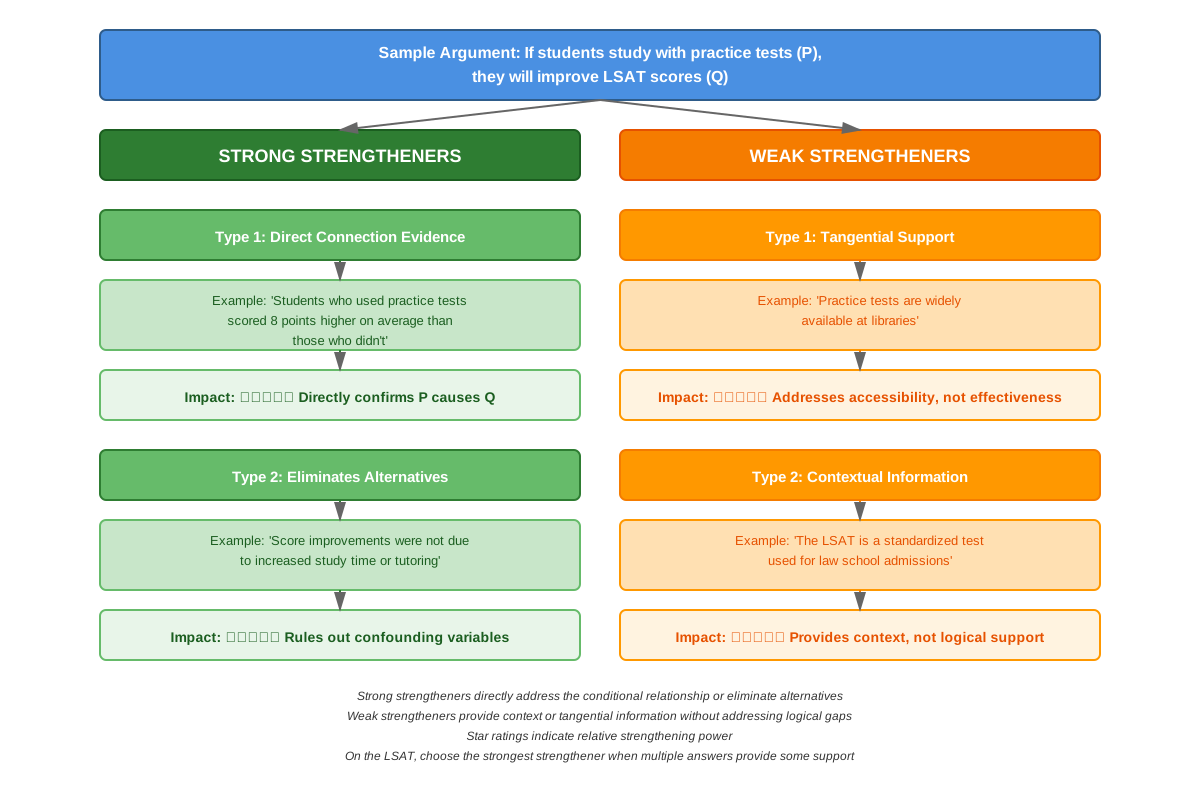
- [ ] Distinguish between answer choices that strengthen conditional relationships versus those that merely provide tangential support
- [ ] Recognize common vulnerabilities in conditional arguments that strengthening answer choices typically address
- [ ] Evaluate the relative strength of multiple answer choices that each provide some degree of support to conditional reasoning
- [ ] Construct original examples of effective strengtheners for various types of conditional arguments
Prerequisites
- Conditional Logic Fundamentals: Understanding if-then statements, sufficient and necessary conditions, contrapositive formation, and logical equivalence is essential because strengthening questions assume fluency with conditional structure
- Argument Structure Analysis: Ability to identify premises, conclusions, and assumptions enables recognition of where conditional arguments need support
- Basic Logical Operators: Familiarity with "and," "or," "not," and their relationships to conditional statements helps parse complex conditional chains
- Distinction Between Correlation and Causation: Understanding this difference prevents confusion when conditional arguments involve causal relationships
- Negation Techniques: Knowing how to properly negate statements is crucial for understanding contrapositives and evaluating answer choices
Why This Topic Matters
Strengthening conditional arguments appears with remarkable frequency on the LSAT, making it one of the highest-yield topics for focused study. Statistical analysis of recent LSAT administrations reveals that lsat strengthening conditional arguments questions appear in approximately 3-5 questions per test, accounting for roughly 6-10% of all Logical Reasoning questions. When combined with related question types that involve conditional reasoning (Necessary Assumption, Sufficient Assumption, Flaw questions), conditional logic influences nearly one-third of the Logical Reasoning section.
Beyond exam performance, the skill of strengthening conditional arguments has profound real-world applications. Legal reasoning—the very domain the LSAT prepares students for—relies heavily on conditional structures: "If the defendant had malicious intent, then they are guilty of first-degree murder." Attorneys must constantly strengthen such conditional claims by providing evidence that confirms the relationship, eliminates alternative explanations, or demonstrates the reliability of the conditional connection. Similarly, policy analysis, scientific reasoning, and business decision-making all require the ability to evaluate and strengthen conditional relationships.
On the LSAT specifically, strengthening conditional arguments appears in several distinct formats. Most commonly, the question stem explicitly asks "Which one of the following, if true, most strengthens the argument?" when the stimulus contains conditional reasoning. However, these questions also appear disguised as "Which one of the following provides the most support for the conclusion?" or "Which one of the following, if true, most helps to justify the reasoning above?" Recognition of the underlying conditional structure, regardless of question stem wording, is crucial for consistent performance.
Core Concepts
Understanding Conditional Arguments
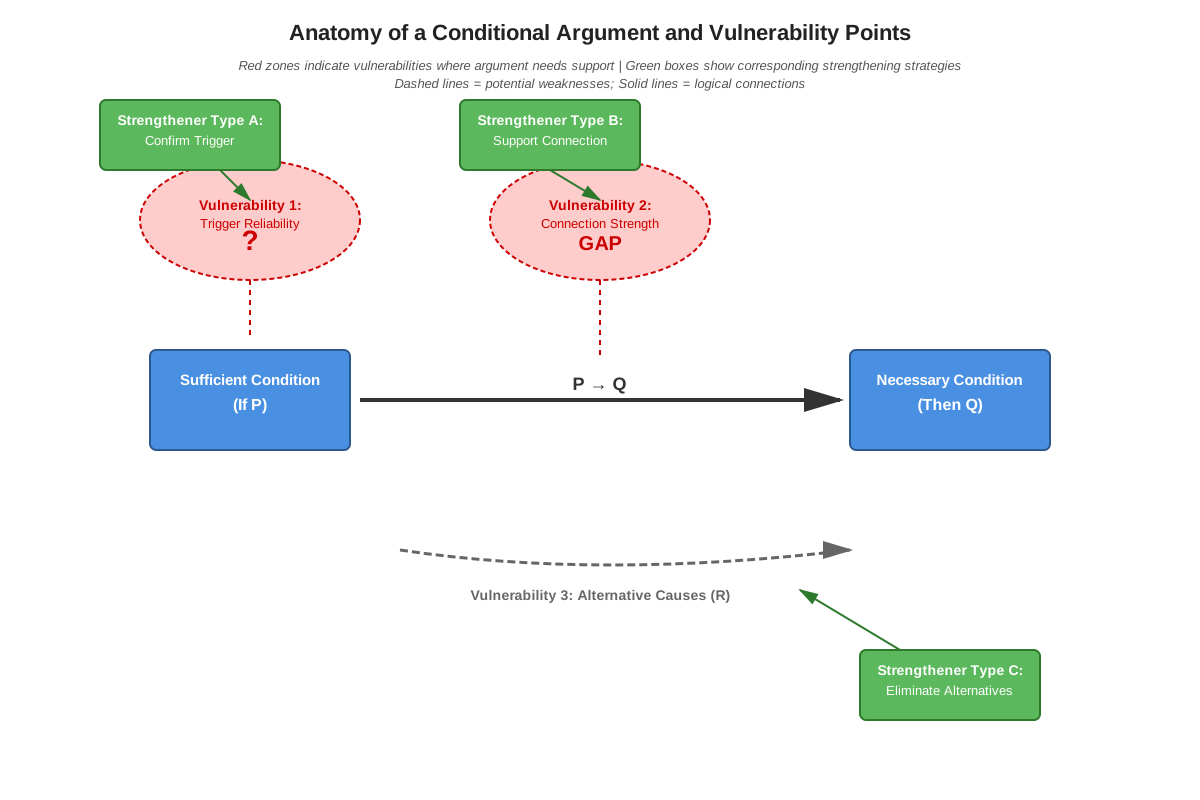
A conditional argument is any reasoning that relies on an if-then relationship to reach its conclusion. The basic structure involves a sufficient condition (the "if" part) that guarantees a necessary condition (the "then" part). In LSAT arguments, these relationships are rarely stated in simple "if-then" format; instead, they appear through various linguistic indicators such as "whenever," "only if," "provided that," "requires," and "depends on."
The critical vulnerability in most conditional arguments lies in the gap between what is stated and what is assumed. For example, an argument might state: "If a company implements flexible work policies, employee satisfaction increases. TechCorp should implement flexible work policies to increase employee satisfaction." This argument assumes that the conditional relationship is reliable, that no other factors will interfere, and that TechCorp is similar enough to the companies where this relationship was observed.
Types of Conditional Argument Vulnerabilities
Conditional arguments on the LSAT typically exhibit four main vulnerabilities that strengthening answer choices address:
| Vulnerability Type | Description | Example Weakness |
|---|---|---|
| Reliability Gap | Uncertainty about whether the sufficient condition consistently produces the necessary condition | The conditional relationship might work only sometimes or under specific circumstances |
| Relevance Gap | Doubt about whether the conditional relationship applies to the specific case discussed | The general rule might not apply to this particular situation |
| Alternative Explanation Gap | Possibility that something other than the sufficient condition causes the necessary condition | The outcome might occur for reasons unrelated to the stated condition |
| Implementation Gap | Uncertainty about whether the sufficient condition can actually be achieved or properly applied | The "if" part might be impossible or impractical to fulfill |
Strengthening Strategies for Conditional Arguments
Strategy 1: Confirming the Conditional Relationship
The most direct way to strengthen a conditional argument is to provide evidence that the conditional relationship is reliable and consistent. This involves showing that whenever the sufficient condition occurs, the necessary condition follows. For instance, if an argument claims "If students use active recall techniques, their test scores improve," a strengthener might provide data showing that across multiple studies and diverse student populations, active recall consistently correlates with improved performance.
Strategy 2: Eliminating Alternative Explanations
Many conditional arguments are vulnerable because the necessary condition might occur for reasons other than the sufficient condition. Strengthening such arguments requires ruling out these alternatives. Consider: "If a city reduces parking availability downtown, public transit ridership increases." This argument is stronger if we can eliminate the possibility that ridership increased due to new transit routes, fare reductions, or population growth rather than reduced parking.
Strategy 3: Establishing Relevance to the Specific Case
Conditional arguments often apply a general rule to a specific situation. Strengtheners can bridge this gap by showing that the specific case shares relevant characteristics with cases where the conditional relationship holds. If an argument applies a conditional relationship observed in large corporations to a small startup, a strengthener might demonstrate that company size doesn't affect the conditional relationship in question.
Strategy 4: Confirming Necessary Background Conditions
Some conditional relationships depend on background conditions being met. For example, "If a plant receives adequate sunlight, it will grow rapidly" assumes adequate water, nutrients, and appropriate temperature. A strengthener might confirm these background conditions are present, making the conditional relationship more likely to hold.
The Contrapositive Connection
Understanding contrapositives is crucial for strengthening conditional arguments. The contrapositive of "If A, then B" is "If not B, then not A." These statements are logically equivalent, meaning anything that strengthens one strengthens the other. On the LSAT, correct answer choices sometimes strengthen the argument by supporting the contrapositive rather than the original conditional statement. For instance, if an argument relies on "If elected, the candidate will raise taxes," evidence showing "The candidate did not raise taxes in their previous term when not elected" actually weakens rather than strengthens, while "Every time this candidate held office, taxes increased" strengthens the relationship.
Conditional Chains and Strengthening
Complex LSAT arguments often involve conditional chains: If A, then B; if B, then C; therefore, if A, then C. Strengthening such arguments may require supporting any link in the chain or confirming that the chain holds as a whole. A single weak link undermines the entire chain, so strengtheners often target the most vulnerable connection. For example, in a chain arguing "If we reduce emissions → global temperatures stabilize → polar ice caps stop melting → coastal cities are protected," a strengthener might confirm that temperature stabilization is sufficient to stop ice cap melting, addressing what might be the weakest link.
Distinguishing Strengthening from Proving
A critical concept for LSAT success is recognizing that strengthening answer choices need not prove the conclusion or make the argument airtight. The question stem typically asks for what "most strengthens" the argument, meaning the correct answer makes the conclusion more likely or the reasoning more persuasive, even if gaps remain. Students often eliminate correct answers because they don't completely validate the argument, when in fact they provide meaningful support that makes the conditional relationship more reliable than it was without that information.
Concept Relationships
The concepts within strengthening conditional arguments form an interconnected system where each element reinforces the others. The foundation begins with conditional logic structure (sufficient and necessary conditions), which determines what vulnerabilities exist in the argument. These vulnerabilities (reliability, relevance, alternatives, implementation) then dictate which strengthening strategies are most effective. The relationship flows: Conditional Structure → Identifies Vulnerabilities → Determines Appropriate Strengthening Strategy → Guides Answer Choice Evaluation.
The contrapositive connection operates in parallel to direct conditional strengthening, providing an alternative pathway to support the same logical relationship. This creates a dual-track system where strengtheners may support either the original conditional or its contrapositive, both ultimately reinforcing the argument's validity.
Conditional chains represent a more complex manifestation of basic conditional relationships, where strengthening concepts must be applied to multiple links simultaneously. The relationship here is multiplicative rather than additive: Chain Strength = (Link 1 Strength) × (Link 2 Strength) × (Link 3 Strength), meaning weakness in any link disproportionately affects the whole.
Connections to prerequisite topics are essential: Basic conditional logic provides the grammatical structure that strengthening techniques enhance. Argument structure analysis enables identification of where conditional relationships appear within complex stimuli. Negation techniques support both contrapositive formation and evaluation of answer choices that work by eliminating alternatives.
Looking forward, mastery of strengthening conditional arguments enables progression to Necessary Assumption questions (which ask what must be true for a conditional argument to work), Sufficient Assumption questions (which ask what would guarantee a conditional conclusion), and Flaw questions (which identify weaknesses in conditional reasoning that strengtheners would address).
High-Yield Facts
⭐ Strengthening a conditional argument does not require proving the conclusion; it only requires making the conclusion more likely or the reasoning more persuasive.
⭐ The most common way to strengthen a conditional argument is to provide evidence that the sufficient condition reliably produces the necessary condition across relevant contexts.
⭐ Eliminating alternative explanations for the necessary condition is a powerful strengthening technique that appears in approximately 30% of strengthening questions involving conditional logic.
⭐ Answer choices that strengthen the contrapositive of a conditional statement equally strengthen the original conditional statement due to logical equivalence.
⭐ Conditional arguments are most vulnerable at the point where a general conditional relationship is applied to a specific case; strengtheners often bridge this gap.
- Strengthening answer choices for conditional arguments frequently confirm that background conditions necessary for the conditional relationship are present.
- In conditional chains, the correct strengthening answer often supports the weakest link rather than the strongest link.
- Answer choices that merely restate the conditional relationship without providing new evidence do not strengthen the argument.
- Temporal or causal conditional statements ("If A happens, then B will happen") are strengthened by evidence of consistent temporal or causal patterns.
- Conditional arguments involving prescriptive conclusions ("should," "ought to," "must") require strengtheners that confirm both the conditional relationship and its applicability to the recommended action.
- Wrong answer choices in strengthening questions often provide support that is too weak, irrelevant to the specific conditional relationship, or that actually addresses a different argument component.
- The distinction between "some" and "most" matters significantly in strengthening conditional arguments; evidence that the relationship holds "most of the time" strengthens more than evidence it holds "sometimes."
Quick check — test yourself on Strengthening conditional arguments so far.
Try Flashcards →Common Misconceptions
Misconception: A strengthening answer choice must make the argument's conclusion certain or prove it beyond doubt.
Correction: Strengthening questions ask only for answer choices that make the conclusion more likely or the reasoning more persuasive than it was before. The correct answer may leave significant doubt remaining while still providing the most support among the available options.
Misconception: If an answer choice introduces new information not mentioned in the stimulus, it cannot be correct.
Correction: Strengthening answer choices almost always introduce new information—that's how they provide support. The key is whether the new information makes the conditional relationship more reliable, not whether it was previously mentioned.
Misconception: Strengthening the premises of an argument is the same as strengthening the argument itself.
Correction: Strengthening questions target the connection between premises and conclusion. Simply confirming that a premise is true doesn't strengthen the argument unless it also supports the inference from premises to conclusion. For conditional arguments, this means supporting the conditional relationship itself.
Misconception: An answer choice that strengthens one part of a conditional chain equally strengthens the entire argument.
Correction: While supporting any link in a conditional chain provides some strengthening effect, the degree of strengthening depends on which link is weakest and most crucial to the argument. Supporting an already-strong link provides minimal benefit compared to supporting a vulnerable link.
Misconception: Conditional arguments can only be strengthened by confirming that the sufficient condition leads to the necessary condition, not by eliminating alternatives.
Correction: Eliminating alternative explanations for the necessary condition is one of the most powerful and frequently tested strengthening techniques. If an argument claims "If A, then B," showing that nothing other than A causes B significantly strengthens the conditional relationship.
Misconception: The correct answer in a strengthening question will always directly address the conclusion.
Correction: Correct strengthening answers may support any part of the reasoning chain, including intermediate steps, background assumptions, or the contrapositive. As long as the support ultimately makes the conclusion more likely, the answer strengthens the argument.
Misconception: Quantitative evidence (statistics, percentages) always strengthens conditional arguments more than qualitative evidence.
Correction: The strength of evidence depends on its relevance to the specific vulnerability in the argument, not its format. A relevant qualitative observation may strengthen more than irrelevant statistical data.
Worked Examples
Example 1: Basic Conditional Strengthening
Stimulus: "Companies that invest heavily in employee training programs experience lower turnover rates. Therefore, Acme Corporation should invest heavily in employee training programs to reduce its turnover rate."
Question: Which one of the following, if true, most strengthens the argument?
Answer Choices:
(A) Acme Corporation's turnover rate is higher than the industry average.
(B) Employee training programs are expensive to implement and maintain.
(C) Acme Corporation's workforce demographics closely match those of companies where training investment reduced turnover.
(D) Some companies with low turnover rates do not invest heavily in training.
(E) Acme Corporation's employees have expressed interest in professional development opportunities.
Analysis:
First, identify the conditional structure: If [invest heavily in training] → [lower turnover rates]. The argument applies this general conditional relationship to the specific case of Acme Corporation.
The primary vulnerability is the relevance gap: Will this conditional relationship hold for Acme specifically? The argument assumes Acme is similar enough to the companies where this relationship was observed.
Evaluating each answer:
(A) This tells us Acme has a problem to solve but doesn't strengthen the conditional relationship between training investment and turnover reduction. It's irrelevant to whether the proposed solution will work.
(B) This actually weakens the argument by suggesting a potential drawback to the recommendation, though it doesn't directly address the conditional relationship.
(C) CORRECT. This directly addresses the relevance gap by establishing that Acme shares relevant characteristics with companies where the conditional relationship holds. If workforce demographics affect whether training reduces turnover, confirming similarity strengthens the inference that the relationship will hold for Acme.
(D) This weakens rather than strengthens by suggesting alternative explanations for low turnover (the necessary condition can occur without the sufficient condition). However, it doesn't completely undermine the argument since the conditional claim is only that training investment is sufficient for lower turnover, not that it's necessary.
(E) This is tempting but only suggests that implementation might be easier; it doesn't strengthen the conditional relationship between training investment and turnover reduction. Employee interest doesn't confirm that training will actually reduce turnover.
Key Takeaway: This example demonstrates Strategy 3 (Establishing Relevance). The correct answer bridges the gap between the general conditional relationship and the specific application by confirming relevant similarity.
Example 2: Eliminating Alternatives in Conditional Reasoning
Stimulus: "Archaeological evidence shows that whenever ancient civilizations developed writing systems, their populations exceeded 50,000 people. The recently discovered Zeta civilization had a population of approximately 75,000 at its peak. Therefore, the Zeta civilization likely developed a writing system."
Question: Which one of the following, if true, most strengthens the argument?
Answer Choices:
(A) Several ancient civilizations with populations under 50,000 had no writing systems.
(B) The Zeta civilization engaged in long-distance trade, which typically requires record-keeping.
(C) Population size is the primary factor that determines whether a civilization develops writing.
(D) Archaeological evidence of the Zeta civilization is relatively complete and well-preserved.
(E) Writing systems in ancient civilizations typically took several generations to develop fully.
Analysis:
The conditional structure here is: If [population > 50,000] → [developed writing]. The argument then observes that Zeta had a population > 50,000 and concludes Zeta likely developed writing.
This commits a formal logical error: affirming the sufficient condition to conclude the necessary condition is valid, but the argument actually has the structure backwards. The stimulus states: If [developed writing] → [population > 50,000]. The argument then observes [population > 50,000] and concludes [developed writing], which is affirming the consequent—a logical fallacy.
However, LSAT strengthening questions often ask us to strengthen flawed reasoning. The question is: what would make this inference more reasonable despite the logical gap?
The primary vulnerability is the alternative explanation gap: population size might be necessary for writing development, but is it sufficient? Could other factors prevent writing development even with adequate population?
Evaluating each answer:
(A) This confirms the contrapositive (if no writing → population < 50,000) but doesn't help establish that population > 50,000 is sufficient for writing development. It's consistent with the stimulus but doesn't strengthen the inference.
(B) This suggests Zeta had additional reasons to develop writing but doesn't strengthen the population-based conditional relationship. It's a separate argument for the same conclusion.
(C) CORRECT. This transforms population size from merely necessary to primarily sufficient for writing development. If population is the "primary factor," then having adequate population makes writing development likely, which directly strengthens the inference from Zeta's population to its likely writing system. This eliminates alternative explanations by establishing that other factors are secondary.
(D) This might help us discover evidence of writing if it exists but doesn't strengthen the logical relationship between population size and writing development.
(E) This provides information about the timeline of writing development but doesn't address whether Zeta's population size makes writing development likely.
Key Takeaway: This example demonstrates Strategy 2 (Eliminating Alternative Explanations) by establishing that the stated factor (population) is primary, thereby reducing the likelihood that other factors prevented the expected outcome. It also shows how strengthening questions may ask you to support reasoning that contains logical gaps.
Exam Strategy
Approaching Strengthening Questions with Conditional Arguments
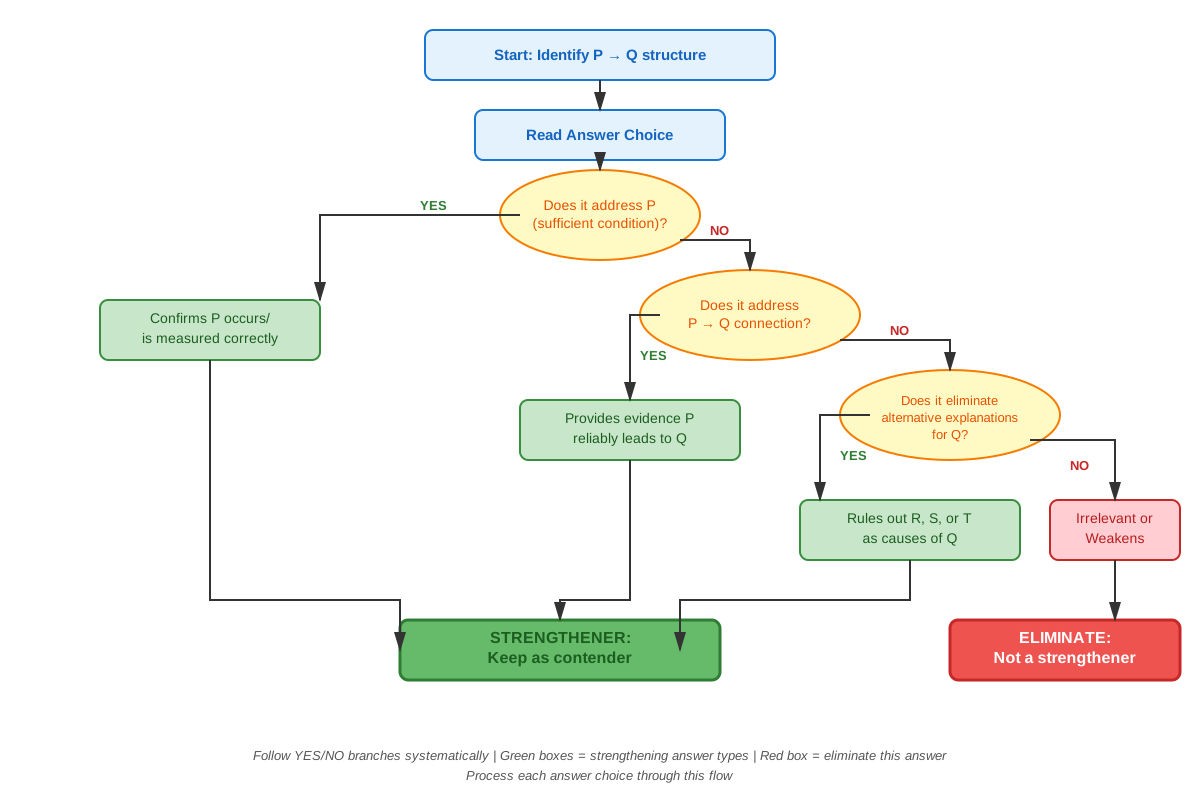
When encountering a strengthening question, follow this systematic process:
- Identify the conditional structure (30 seconds): Look for if-then relationships, even when disguised by alternative phrasings. Diagram the conditional if helpful: A → B.
- Locate the conclusion (15 seconds): What is the argument trying to prove? Often this involves applying the conditional relationship to a specific case or extending it to a new context.
- Identify the vulnerability (30 seconds): Ask yourself: "What could go wrong with this reasoning?" Common vulnerabilities include reliability gaps, relevance gaps, alternative explanations, and implementation issues.
- Predict the strengthener (20 seconds): Before looking at answer choices, mentally formulate what would address the vulnerability. This prevents attractive wrong answers from derailing your analysis.
- Evaluate answer choices (90 seconds): Eliminate answers that are irrelevant, weaken the argument, or address the wrong vulnerability. Select the choice that most directly addresses the primary gap in reasoning.
Trigger Words and Phrases
Question Stem Triggers that indicate strengthening questions:
- "most strengthens"
- "provides the most support"
- "most helps to justify"
- "if true, would provide the strongest grounds"
Stimulus Triggers that indicate conditional reasoning:
- "if," "when," "whenever," "provided that"
- "only if," "only when"
- "requires," "depends on," "necessary for"
- "sufficient for," "guarantees," "ensures"
- "all," "every," "any" (universal quantifiers often signal conditional relationships)
Process of Elimination Tips
Eliminate answers that:
- Merely restate information already in the stimulus without adding support
- Address a different conclusion than the one stated in the argument
- Strengthen a premise rather than the inference from premises to conclusion
- Introduce irrelevant information that doesn't connect to the conditional relationship
- Actually weaken the argument (surprisingly common trap answers)
- Provide support that is too weak or qualified ("might," "could," "some") when stronger options exist
Favor answers that:
- Directly address the identified vulnerability in the conditional reasoning
- Eliminate alternative explanations for the necessary condition
- Confirm the reliability or consistency of the conditional relationship
- Establish relevance of the general conditional to the specific case
- Use strong language ("always," "never," "all," "most") when appropriate to the argument's needs
Time Allocation
For a strengthening question involving conditional arguments, allocate approximately 2.5 minutes total:
- Reading and diagramming: 45 seconds
- Identifying vulnerability and predicting: 50 seconds
- Evaluating answer choices: 75 seconds
If you find yourself spending more than 3 minutes, flag the question and move on. These questions reward pattern recognition and systematic analysis more than prolonged deliberation.
Exam Tip: If two answer choices both seem to strengthen the argument, choose the one that addresses the most fundamental vulnerability. An answer that confirms the basic conditional relationship is usually stronger than one that addresses a secondary concern.
Memory Techniques
The RACE Mnemonic for Conditional Vulnerabilities
Reliability - Does the sufficient condition consistently produce the necessary condition?
Alternatives - Could something else cause the necessary condition?
Context - Does the conditional relationship apply to this specific case?
Execution - Can the sufficient condition actually be implemented?
When analyzing a conditional argument, mentally run through RACE to identify which vulnerability the argument exhibits, then look for an answer choice that addresses that specific concern.
The "Bridge Builder" Visualization
Visualize conditional arguments as bridges spanning a gap between the sufficient condition (one shore) and the necessary condition (opposite shore). The argument's vulnerability is a weak point in the bridge structure. Strengthening answer choices are like adding support beams, reinforcing cables, or eliminating obstacles that might cause the bridge to fail. This metaphor helps remember that strengtheners don't build an entirely new bridge (prove the conclusion) but rather reinforce the existing structure (make the reasoning more reliable).
The Contrapositive Flip
Remember: "Strengthen one, strengthen both." Any evidence that supports a conditional statement equally supports its contrapositive. Create a mental habit of considering both directions: If the argument says "A → B," immediately think "not B → not A" as well. Sometimes the correct answer strengthens the contrapositive rather than the original statement.
The Three E's of Effective Strengtheners
Eliminate alternatives
Establish reliability
Extend relevance
These three strategies account for approximately 85% of correct answers in strengthening questions involving conditional logic. When evaluating answer choices, ask which of the three E's each choice accomplishes.
Summary
Strengthening conditional arguments is a high-yield LSAT skill that requires recognizing if-then relationships, identifying vulnerabilities in conditional reasoning, and selecting answer choices that make these relationships more reliable or applicable. The four primary vulnerabilities—reliability gaps, relevance gaps, alternative explanations, and implementation issues—can be addressed through strategies including confirming the conditional relationship, eliminating alternatives, establishing relevance to specific cases, and confirming necessary background conditions. Success requires understanding that strengthening doesn't mean proving; correct answers make conclusions more likely without necessarily making them certain. The contrapositive principle ensures that supporting either the original conditional or its logical equivalent strengthens the argument equally. Systematic analysis following the five-step approach (identify structure, locate conclusion, identify vulnerability, predict strengthener, evaluate choices) combined with recognition of trigger words and effective time management enables consistent performance on these frequently-tested questions.
Key Takeaways
- Strengthening conditional arguments appears in 6-10% of LSAT Logical Reasoning questions and influences many additional question types involving conditional logic
- The four main vulnerabilities in conditional arguments are reliability gaps, relevance gaps, alternative explanations, and implementation issues—identifying which applies is crucial for selecting correct strengtheners
- Correct strengthening answers make conclusions more likely but need not prove them; the standard is "most strengthens," not "completely validates"
- Eliminating alternative explanations for the necessary condition is one of the most powerful and frequently tested strengthening techniques
- Supporting the contrapositive of a conditional statement equally strengthens the original statement due to logical equivalence
- Systematic analysis using the five-step approach (identify structure → locate conclusion → identify vulnerability → predict strengthener → evaluate choices) dramatically improves accuracy and speed
- Wrong answers often restate existing information, address irrelevant issues, or actually weaken the argument—active elimination of these patterns is essential for efficient problem-solving
Related Topics
Weakening Conditional Arguments: The mirror image of strengthening, this topic explores how to undermine conditional reasoning by introducing alternative explanations, showing the conditional relationship is unreliable, or demonstrating irrelevance to the specific case. Mastering strengthening provides the foundation for understanding weakening.
Necessary Assumption Questions: These questions ask what must be true for a conditional argument to work, essentially identifying the gaps that strengthening answers would fill. Understanding strengthening techniques reveals what assumptions conditional arguments depend upon.
Sufficient Assumption Questions: These ask what, if added to the premises, would guarantee the conclusion. For conditional arguments, this often involves completing a conditional chain or establishing that a necessary condition is also sufficient.
Flaw Questions: Many flaw questions identify errors in conditional reasoning—the same vulnerabilities that strengthening questions address. Recognizing these flaws is the inverse of knowing how to strengthen arguments.
Formal Logic and Conditional Chains: Advanced conditional reasoning involving multiple linked conditionals, which requires applying strengthening principles to complex logical structures.
Practice CTA
Now that you've mastered the core concepts of strengthening conditional arguments, it's time to put your knowledge into action. The practice questions and flashcards designed for this topic will help you recognize conditional structures quickly, identify vulnerabilities accurately, and select strengthening answer choices confidently. Remember: expertise in LSAT Logical Reasoning comes not just from understanding concepts but from applying them repeatedly under test-like conditions. Each practice question you complete strengthens your pattern recognition and builds the automaticity you need for test day success. You've built the foundation—now construct your mastery through deliberate practice!
Sign up free to keep reading
Create a free AnvayaPrep account to finish this LSAT guide on Strengthening conditional arguments — plus flashcards and practice questions.