Overview
Weakening predictions represents a critical subset of strengthen and weaken questions within LSAT Logical Reasoning sections. These questions challenge test-takers to identify information that undermines a prediction or forecast about future events, outcomes, or trends. Unlike weakening questions that target general arguments or causal claims, weakening predictions specifically focuses on arguments that project current conditions, patterns, or trends into the future. The LSAT frequently tests this skill because it mirrors the analytical thinking required in legal practice—attorneys must constantly evaluate the strength of predictions about case outcomes, legislative impacts, and behavioral patterns.
Understanding how to weaken predictions requires recognizing the inherent vulnerability in all forward-looking claims: the assumption that current conditions will persist, that identified trends will continue unchanged, or that no intervening factors will disrupt the projected outcome. The test-makers exploit this vulnerability by crafting answer choices that introduce alternative scenarios, identify overlooked variables, or demonstrate that the basis for the prediction is flawed. Mastering this question type demands both pattern recognition—identifying when an argument makes a prediction—and strategic thinking about what kinds of information would make that prediction less likely to occur.
Within the broader landscape of LSAT Logical Reasoning, weakening predictions connects intimately with causal reasoning, assumption identification, and flaw recognition. These questions often appear 2-4 times per LSAT administration and carry significant weight because they test multiple reasoning skills simultaneously: argument analysis, critical evaluation, and the ability to think counterfactually about future possibilities. Success on these questions directly translates to higher Logical Reasoning section scores and demonstrates the analytical sophistication law schools seek in candidates.
Learning Objectives
- [ ] Identify how Weakening predictions appears in LSAT questions
- [ ] Explain the reasoning pattern behind Weakening predictions
- [ ] Apply Weakening predictions to solve LSAT-style problems accurately
- [ ] Distinguish between predictions and other argument types (causal claims, generalizations, recommendations)
- [ ] Recognize the common structural vulnerabilities in predictive arguments
- [ ] Evaluate answer choices systematically to identify the most effective weakener
- [ ] Anticipate the types of information that typically weaken predictions before reviewing answer choices
Prerequisites
- Basic argument structure: Understanding premises, conclusions, and how evidence supports claims is essential because weakening questions require identifying what the argument asserts before determining how to undermine it
- Causal reasoning fundamentals: Recognizing cause-and-effect relationships matters because many predictions rest on causal assumptions about what will produce future outcomes
- Assumption identification: Detecting unstated assumptions is crucial since predictions invariably rely on assumptions about continuity, stability, or the absence of interfering factors
- General strengthen/weaken mechanics: Familiarity with how information can support or undermine arguments provides the foundation for the specialized skill of weakening predictions
Why This Topic Matters
Weakening predictions appears with remarkable consistency on the LSAT, typically comprising 8-12% of all Logical Reasoning questions across both LR sections. This translates to approximately 4-6 questions per test administration—a significant portion that can materially impact overall scores. The question stem variations include phrases like "most seriously weakens the prediction," "casts the most doubt on the forecast," or "if true, provides the strongest reason to doubt the projected outcome."
Beyond exam performance, the skill of evaluating predictions has profound real-world applications. Legal professionals constantly assess predictions: Will a jury find the defendant credible? How will a judge rule on a motion? What impact will new legislation have on client operations? Corporate attorneys predict regulatory changes, criminal defense attorneys forecast prosecution strategies, and policy advocates project the societal effects of proposed laws. The analytical framework developed through mastering weakening predictions transfers directly to these professional contexts.
On the LSAT, these questions most commonly appear in passages discussing business forecasts, scientific projections, policy predictions, and trend extrapolations. Test-makers favor scenarios involving market predictions, demographic trends, technological adoption rates, environmental forecasts, and behavioral projections. The arguments typically follow a pattern: evidence about current or past conditions, followed by a conclusion about what will happen in the future. Recognizing this structure immediately signals the need to think about what could prevent the predicted outcome from materializing.
Core Concepts
The Structure of Predictive Arguments
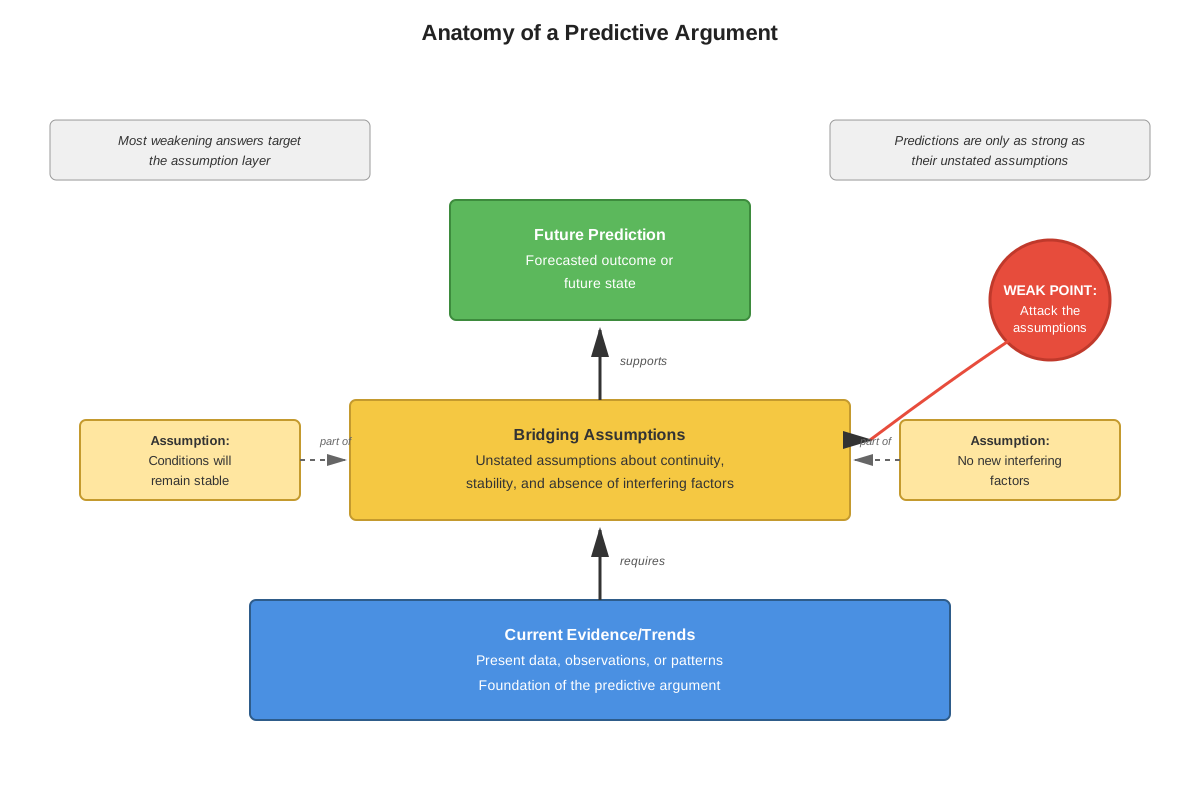
Lsat weakening predictions questions always contain an argument that makes a claim about the future. The predictive argument structure typically includes: (1) evidence about current conditions, past trends, or existing patterns; (2) implicit or explicit assumptions about continuity or causation; and (3) a conclusion forecasting a future state, event, or outcome. Understanding this three-part structure is fundamental because weakeners target different components.
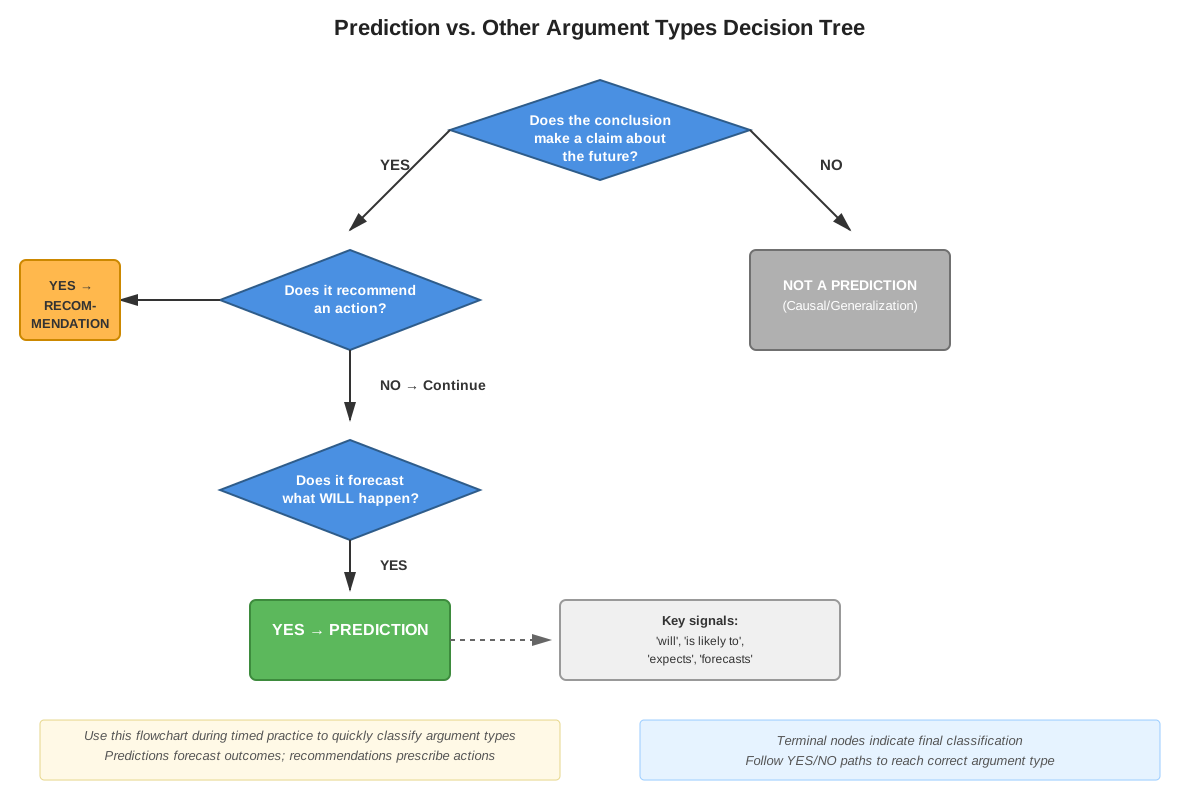
The evidence portion might describe current market conditions, recent statistical trends, historical patterns, or present circumstances. The assumption layer—often unstated—presumes that current conditions will persist, that identified trends will continue, that no new factors will emerge, or that the causal mechanism will operate as expected. The conclusion explicitly states what will happen, often using future-tense language or predictive modal verbs like "will," "is likely to," or "should."
Types of Predictions Tested
The LSAT tests several distinct categories of predictions, each with characteristic vulnerabilities:
Trend-based predictions extrapolate from current or recent patterns. Example: "Sales have increased 10% annually for three years, so they will increase 10% next year." These predictions assume trend continuity and are vulnerable to information showing the trend is slowing, reversing, or was caused by temporary factors.
Condition-based predictions forecast outcomes based on current circumstances. Example: "The company currently has strong cash reserves, so it will weather the economic downturn." These predictions assume conditions will remain stable and are vulnerable to information about changing circumstances or overlooked factors.
Causal predictions project future effects from identified causes. Example: "The new policy will reduce traffic because it incentivizes carpooling." These predictions assume the causal mechanism will operate as expected and are vulnerable to information about alternative causes, prevention of the mechanism, or counteracting factors.
Comparative predictions forecast relative outcomes. Example: "Product A will outsell Product B because consumers prefer its features." These predictions assume the basis for comparison will remain relevant and are vulnerable to information about changing preferences or overlooked competitive factors.
Common Vulnerabilities in Predictions
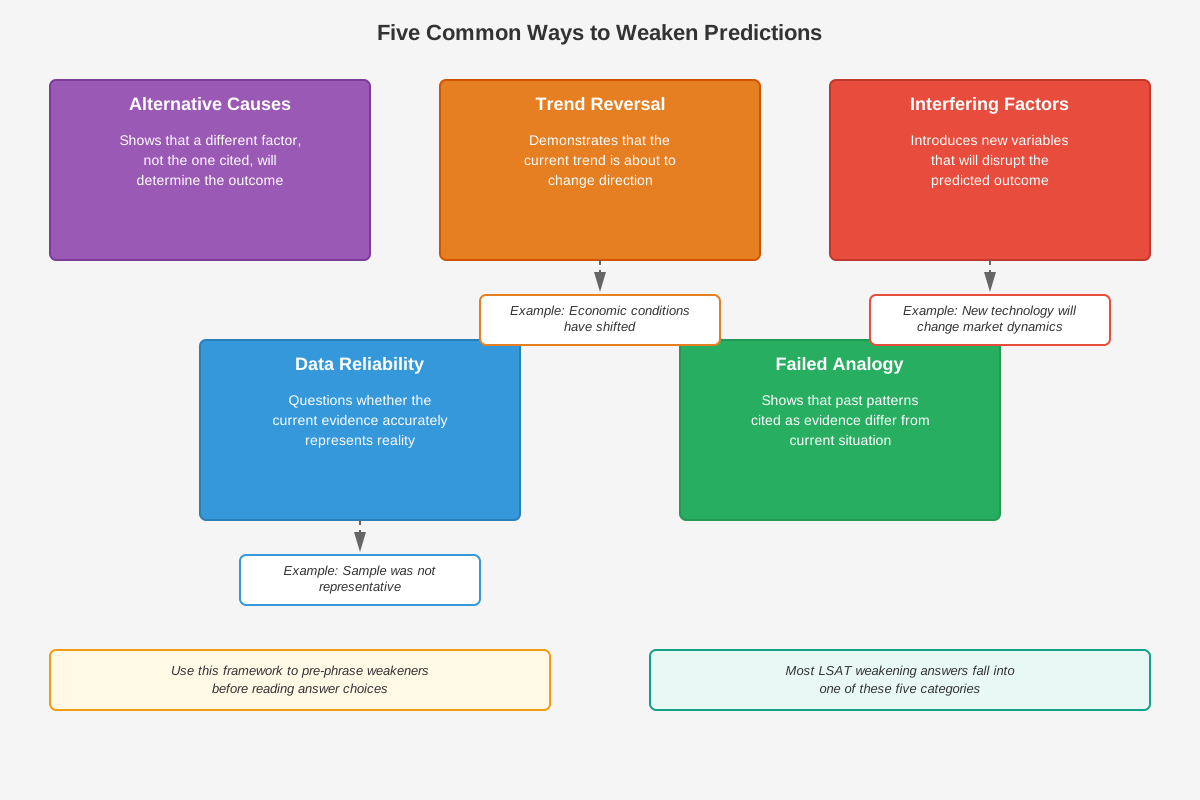
All predictions share inherent weaknesses that LSAT questions exploit. The assumption of continuity presumes that current conditions, trends, or patterns will persist unchanged into the future. Weakeners introduce information showing conditions are changing, trends are reversing, or patterns were temporary.
The overlooked variable problem occurs when predictions fail to account for relevant factors. Effective weakeners introduce new variables that will impact the outcome: regulatory changes, competitor actions, technological developments, or shifting preferences.
The false extrapolation vulnerability appears when predictions extend patterns beyond their valid range or assume linear continuation of non-linear phenomena. Weakeners might show the pattern was limited to specific conditions, that growth is reaching natural limits, or that the underlying mechanism is changing.
The timing assumption presumes that predicted outcomes will occur within a relevant timeframe. Some weakeners don't deny the prediction will eventually occur but show it won't happen soon enough to matter or that intervening events will occur first.
Mechanisms for Weakening Predictions
| Weakening Mechanism | How It Works | Example Application |
|---|---|---|
| Introduce counteracting factor | Presents information about a force that will oppose the predicted outcome | "New regulations will increase production costs, offsetting the predicted profit increase" |
| Show trend reversal | Demonstrates the trend underlying the prediction is changing direction | "Recent data shows the growth rate has declined each of the last three quarters" |
| Identify false assumption | Reveals that a key assumption underlying the prediction is incorrect | "The prediction assumes consumer preferences will remain stable, but surveys show shifting attitudes" |
| Present alternative scenario | Describes a plausible future that contradicts the prediction | "Competitors are launching similar products, which will fragment market share" |
| Demonstrate insufficient basis | Shows the evidence doesn't adequately support the prediction | "The three-year trend cited occurred during unusual economic conditions unlikely to repeat" |
| Introduce timing problem | Indicates the predicted outcome won't occur in the relevant timeframe | "The technology required won't be commercially available for five years" |
The Process of Weakening Predictions
Effective weakening follows a systematic approach:
- Identify the prediction: Locate the future-oriented conclusion. What specifically does the argument claim will happen?
- Analyze the basis: Determine what evidence supports the prediction. Is it based on trends, current conditions, causal claims, or comparisons?
- Detect assumptions: Identify what must be true for the prediction to follow from the evidence. What is the argument taking for granted about the future?
- Anticipate weakeners: Before reading answer choices, brainstorm what information would make the prediction less likely. What could change? What factors might intervene?
- Evaluate answer choices: Assess each option's impact on the prediction's likelihood. The correct answer makes the predicted outcome less probable, not impossible.
Distinguishing Predictions from Other Arguments
Not all future-oriented statements constitute predictions in the LSAT sense. Recommendations suggest what should be done but don't necessarily predict outcomes. Conditional statements describe what would happen if certain conditions were met, not what will happen. Explanations account for existing phenomena rather than forecasting future ones. Recognizing genuine predictions requires identifying arguments that assert future events will occur based on current or past evidence.
Concept Relationships
The concepts within weakening predictions form an interconnected analytical framework. The structure of predictive arguments provides the foundation for identifying types of predictions, which in turn determines which common vulnerabilities are most relevant. Understanding these vulnerabilities guides the application of specific weakening mechanisms, which are deployed through the systematic process of weakening predictions.
This topic connects to prerequisite knowledge in several ways: Basic argument structure → enables identification of predictive conclusions; Causal reasoning → underlies many predictions and their vulnerabilities; Assumption identification → reveals the unstated premises that weakeners target; General strengthen/weaken mechanics → provides the broader framework within which prediction-specific strategies operate.
Weakening predictions also relates to parallel topics: Strengthening predictions uses inverse logic (confirming assumptions, supporting continuity); Flaw questions often identify the same vulnerabilities but ask for abstract descriptions rather than concrete weakeners; Assumption questions target the same unstated premises that effective weakeners undermine.
The relationship map: Evidence about current/past conditions → Assumptions about continuity/causation → Predictive conclusion → Vulnerable to information showing: changed conditions, trend reversal, overlooked factors, false assumptions, or timing problems → Weakening answer choice that introduces such information.
High-Yield Facts
⭐ Predictions always contain assumptions about the future that can be challenged by showing conditions will change, trends will reverse, or new factors will emerge.
⭐ The most effective weakeners don't make the prediction impossible; they make it significantly less likely to occur as stated.
⭐ Trend-based predictions are particularly vulnerable to information showing the trend is slowing, was caused by temporary factors, or is reaching natural limits.
⭐ Answer choices that introduce new relevant variables that will affect the outcome are frequently correct weakeners.
⭐ Predictions based on current conditions are weakened by information showing those conditions are changing or were mischaracterized.
- Weakening predictions questions typically use stems containing "weaken," "cast doubt on," "call into question," or "undermine" paired with "prediction," "forecast," "projection," or "claim about the future."
- The correct answer must be relevant to the specific prediction made, not just generally negative about the topic.
- Information about past failures of similar predictions can weaken current predictions by suggesting unreliable methodology or overlooked patterns.
- Weakeners often work by showing that a necessary condition for the prediction won't be met or that a sufficient condition for a contrary outcome will occur.
- Comparative predictions are weakened by information that changes the relative standing of the compared entities or introduces new competitors.
- Timing-based weakeners are effective when the prediction implicitly assumes a specific timeframe for the outcome.
- Predictions that rely on human behavior are vulnerable to information about changing preferences, incentives, or awareness.
- Economic predictions are frequently weakened by information about regulatory changes, market disruptions, or competitor actions.
- The scope of the weakener must match the scope of the prediction—information about a subset may not weaken a prediction about the whole, and vice versa.
- Weakeners that identify alternative causes for observed trends undermine predictions that extrapolate those trends into the future.
Quick check — test yourself on Weakening predictions so far.
Try Flashcards →Common Misconceptions
Misconception: A weakener must prove the prediction is definitely wrong. → Correction: Weakeners only need to make the prediction less likely or cast reasonable doubt on it. The prediction could still occur, but the weakener reduces its probability or introduces significant uncertainty.
Misconception: Any negative information about the topic weakens the prediction. → Correction: The weakener must be specifically relevant to the mechanism or assumptions underlying the particular prediction. General negative information that doesn't affect the prediction's logic is irrelevant.
Misconception: Information about the past cannot weaken predictions about the future. → Correction: Past information can be highly relevant if it shows that similar predictions failed, that historical patterns differ from those assumed, or that the basis for the current prediction is flawed.
Misconception: The strongest weakener introduces the most dramatic or extreme scenario. → Correction: The strongest weakener is the one most directly relevant to the prediction's core assumptions, regardless of how dramatic it is. A subtle but directly relevant weakener beats a dramatic but tangential one.
Misconception: Weakening a prediction requires showing that the opposite outcome will occur. → Correction: Effective weakening only requires reducing confidence in the prediction. The outcome might simply be uncertain, different in magnitude, or delayed, rather than completely reversed.
Misconception: If the prediction is based on expert opinion, it cannot be weakened by factual information. → Correction: Expert-based predictions are vulnerable to information showing the expert lacked relevant data, that conditions have changed since the expert's analysis, or that other experts disagree based on additional evidence.
Misconception: Weakeners must address the conclusion directly. → Correction: Weakeners can target the premises (showing the evidence is flawed), the assumptions (revealing unstated premises are false), or the reasoning (demonstrating the conclusion doesn't follow), not just the conclusion itself.
Worked Examples
Example 1: Business Forecast Prediction
Argument: "TechCorp's revenue has grown 15% annually for the past five years. The company has just released a new product line that early reviews suggest will be popular. Therefore, TechCorp's revenue will grow by at least 15% next year."
Question: Which of the following, if true, most seriously weakens the prediction?
Answer Choices:
(A) TechCorp's main competitor is planning to release a similar product line next quarter
(B) TechCorp's revenue growth over the past five years exceeded industry averages
(C) Some technology companies have experienced revenue declines despite positive product reviews
(D) TechCorp's previous growth was primarily driven by a government contract that expired last month
(E) The new product line required significant research and development investment
Analysis:
Step 1 - Identify the prediction: TechCorp's revenue will grow by at least 15% next year.
Step 2 - Analyze the basis: The prediction rests on (1) historical trend of 15% annual growth, and (2) positive early reviews of new product.
Step 3 - Detect assumptions: The argument assumes the factors that drove past growth will continue, that the new product will actually be successful, and that no negative factors will offset growth.
Step 4 - Anticipate weakeners: Information showing the past trend was due to temporary factors, that the new product won't generate expected revenue, or that new obstacles will prevent growth.
Step 5 - Evaluate choices:
(A) Introduces competition that could reduce market share—this is relevant and weakens the prediction by suggesting a counteracting factor. This is a strong contender.
(B) Strengthens rather than weakens by confirming TechCorp's strong performance.
(C) Too general—the fact that some companies declined despite good reviews doesn't specifically address TechCorp's situation.
(D) CORRECT - This directly undermines the basis for the prediction by showing the historical trend was driven by a specific factor (government contract) that no longer exists. The past growth pattern is therefore not a reliable indicator of future growth.
(E) High R&D costs might affect profitability but don't directly address revenue growth, which is what the prediction concerns.
Correct Answer: (D) - This weakens the prediction by revealing that the historical trend cited as evidence was caused by a temporary factor that has ended, making extrapolation from that trend unreliable.
Example 2: Policy Impact Prediction
Argument: "The city council has proposed a new ordinance requiring all restaurants to post calorie information on menus. Studies show that when consumers have calorie information, they choose lower-calorie options. Therefore, the new ordinance will lead to reduced obesity rates in the city."
Question: Which of the following, if true, most weakens the prediction?
Answer Choices:
(A) Some cities with similar ordinances have seen modest reductions in average calorie consumption
(B) Restaurant industry groups have opposed the ordinance as burdensome
(C) Most of the city's residents regularly eat meals prepared at home rather than at restaurants
(D) Calorie information is already available online for most restaurant menu items
(E) Obesity rates are influenced by many factors beyond calorie consumption
Analysis:
Step 1 - Identify the prediction: The ordinance will lead to reduced obesity rates.
Step 2 - Analyze the basis: The prediction relies on (1) the ordinance will provide calorie information, (2) consumers will choose lower-calorie options when given information, and (3) lower-calorie choices will reduce obesity.
Step 3 - Detect assumptions: The argument assumes that restaurant eating is a significant contributor to obesity in this city, that the information will actually change behavior in this context, and that reduced calories at restaurants will meaningfully impact overall obesity rates.
Step 4 - Anticipate weakeners: Information showing restaurant eating isn't a major factor, that the information won't change behavior, or that other factors will prevent obesity reduction.
Step 5 - Evaluate choices:
(A) Actually provides mild support by showing similar ordinances had some effect.
(B) Opposition doesn't affect whether the ordinance will achieve its predicted outcome.
(C) CORRECT - This severely weakens the prediction by showing that restaurant eating is not a major component of residents' diets. If most meals are eaten at home, then changing restaurant menu choices will have minimal impact on overall calorie consumption and obesity rates, regardless of whether the ordinance changes restaurant behavior.
(D) Existing online availability might reduce the ordinance's additional impact, but this is weaker than (C) because people might not currently access that information, whereas (C) shows the entire mechanism is limited in scope.
(E) While true, this is too vague—the prediction could still hold even if other factors exist, unless those factors are shown to be more important or counteracting.
Correct Answer: (C) - This weakens the prediction by revealing that the scope of the ordinance's impact is too limited to achieve the predicted outcome, since restaurant eating represents only a small portion of residents' total food consumption.
Exam Strategy
When approaching lsat weakening predictions questions, implement this systematic strategy:
Recognition Phase: Identify prediction questions through stem language. Watch for "weaken the prediction," "cast doubt on the forecast," "undermine the projection," or "call into question the claim that [future event] will occur." The presence of future-tense language in the conclusion confirms you're dealing with a prediction.
Analysis Phase: Before reading answer choices, invest 15-20 seconds in active analysis:
- Underline or mentally note the specific prediction (what will happen)
- Identify the evidence supporting it (current conditions, trends, causal claims)
- Ask yourself: "What is this argument assuming about the future?"
- Brainstorm one or two ways the prediction could fail
Evaluation Phase: Apply these process-of-elimination strategies:
Trigger words for correct answers: "however," "but," "although," "despite," "recently," "new," "changing," "declining," "increasing" (in ways that contradict the prediction's assumptions)
Red flags for incorrect answers: Information that strengthens the prediction, irrelevant details about the past that don't affect future projections, overly general statements that don't specifically address the prediction's mechanism, extreme scenarios that seem implausible
Common trap patterns to avoid:
- The opposite answer: Strengthens instead of weakens—always verify the direction of impact
- The irrelevant detail: Sounds related to the topic but doesn't affect the prediction's likelihood
- The wrong scope: Addresses a different timeframe, population, or outcome than the prediction specifies
- The insufficient weakener: Provides minor doubt when another answer provides major doubt
Time allocation: Spend approximately 1:15-1:30 per weakening prediction question. Allocate 20 seconds to reading and understanding the argument, 15 seconds to anticipating weakeners, 30 seconds to evaluating answer choices, and 10 seconds to confirming your selection.
Confidence markers: You've likely found the correct answer when it directly addresses an assumption you identified during analysis, introduces a highly relevant new factor that will affect the outcome, or shows that the basis for the prediction (trend, condition, causal mechanism) is flawed or changing.
Memory Techniques
PREDICT mnemonic for analyzing predictions:
- Prediction identified (what future outcome is claimed?)
- Reasoning examined (what evidence supports it?)
- Evidence evaluated (is the basis sound?)
- Detect assumptions (what must be true?)
- Intervening factors considered (what could change?)
- Counterfactuals generated (what would weaken it?)
- Test answer choices (which best undermines it?)
The Three C's of Weakening Predictions:
- Change: Conditions are changing in ways that undermine the prediction
- Counteract: New factors will work against the predicted outcome
- Challenge: The basis for the prediction is flawed or insufficient
Visualization technique: Picture the prediction as a bridge from present to future. Effective weakeners either remove support pillars (undermine the basis), introduce obstacles on the bridge (counteracting factors), or show the bridge leads to the wrong destination (false assumptions about outcomes).
The TREND acronym for trend-based predictions:
- Temporary factors caused the trend
- Reversing or slowing pattern
- External changes will disrupt continuation
- Natural limits being reached
- Different conditions in the future
Summary
Weakening predictions constitutes a high-yield LSAT Logical Reasoning question type that tests the ability to identify and undermine future-oriented claims. These questions present arguments that forecast outcomes based on current conditions, historical trends, or causal mechanisms, then ask test-takers to select information that makes the prediction less likely to occur. Success requires recognizing the structure of predictive arguments (evidence → assumptions → future conclusion), understanding common vulnerabilities (continuity assumptions, overlooked variables, false extrapolations, timing problems), and systematically applying weakening mechanisms (introducing counteracting factors, showing trend reversals, revealing false assumptions, presenting alternative scenarios). The most effective weakeners directly target the assumptions underlying predictions rather than merely introducing tangentially related negative information. Mastery involves both pattern recognition—quickly identifying predictions and their structural weaknesses—and strategic evaluation of answer choices to select the option that most significantly reduces confidence in the predicted outcome.
Key Takeaways
- Predictions are arguments about future events based on current/past evidence and are vulnerable to information showing conditions will change or assumptions are false
- The correct weakener makes the prediction significantly less likely without necessarily proving it impossible
- Always identify the specific prediction, analyze its evidential basis, and detect its assumptions before evaluating answer choices
- Trend-based predictions are weakened by showing trends are slowing, reversing, or were caused by temporary factors
- Introducing relevant new variables that will affect the outcome is a common and effective weakening mechanism
- The scope and relevance of the weakener must precisely match the prediction—general negative information is insufficient
- Anticipate potential weakeners during the analysis phase to evaluate answer choices more efficiently and accurately
Related Topics
Strengthening Predictions: The inverse skill of identifying information that makes predictions more likely by confirming assumptions, supporting trend continuation, or eliminating alternative scenarios. Mastering weakening predictions provides the foundation for understanding strengthening through contrast.
Necessary Assumption Questions: These questions identify unstated premises that predictions rely upon. Understanding weakening predictions enhances assumption identification because effective weakeners often deny necessary assumptions.
Flaw in Reasoning Questions: Many flawed arguments make unjustified predictions. The analytical skills developed for weakening predictions transfer directly to identifying and articulating predictive flaws in abstract terms.
Causal Reasoning: Since many predictions rest on causal claims (X will cause Y in the future), mastering weakening predictions requires and reinforces understanding of how to undermine causal arguments.
Parallel Reasoning: Some parallel reasoning questions involve matching predictive argument structures, requiring recognition of prediction patterns developed through this topic.
Practice CTA
Now that you've mastered the conceptual framework for weakening predictions, it's time to cement your understanding through active practice. Attempt the practice questions associated with this topic, focusing on applying the systematic analysis process outlined in this guide. As you work through problems, consciously identify the prediction, analyze its basis, detect assumptions, and anticipate weakeners before evaluating answer choices. Use the flashcards to reinforce recognition of common prediction patterns and weakening mechanisms. Remember: expertise in weakening predictions develops through deliberate practice that transforms conceptual knowledge into automatic analytical reflexes. Each practice question you complete strengthens the neural pathways that will serve you on test day. You've built the foundation—now construct mastery through application!
Sign up free to keep reading
Create a free AnvayaPrep account to finish this LSAT guide on Weakening predictions — plus flashcards and practice questions.