Overview
Strengthening predictions is a critical skill within LSAT Logical Reasoning that tests the ability to identify which piece of information would make a future-oriented claim more likely to be true. These questions appear frequently on the LSAT and require students to understand the logical gap between evidence presented and a conclusion about what will happen, what should be done, or what is likely to occur. Unlike strengthening arguments about past or present facts, strengthening predictions demands careful attention to assumptions about future conditions, causal relationships, and the stability of current trends.
The LSAT tests this concept because legal reasoning constantly involves predictions: Will a particular legal strategy succeed? What will be the consequences of a policy change? How will a precedent apply to future cases? Attorneys must evaluate which additional facts would make their predictions more reliable and which factors could undermine them. On the exam, these questions typically present an argument that concludes with a prediction, then ask which answer choice, if true, would most strengthen that prediction. Success requires identifying the logical vulnerabilities in predictive reasoning and recognizing what information would address those vulnerabilities.
Within the broader framework of strengthen and weaken questions, strengthening predictions represents a specialized application that combines elements of causal reasoning, assumption identification, and conditional logic. While general strengthening questions might ask students to support any type of conclusion, lsat strengthening predictions questions specifically target forward-looking claims, making them particularly challenging because they require consideration of multiple possible future scenarios and the factors that make one outcome more probable than others.
Learning Objectives
- [ ] Identify how Strengthening predictions appears in LSAT questions
- [ ] Explain the reasoning pattern behind Strengthening predictions
- [ ] Apply Strengthening predictions to solve LSAT-style problems accurately
- [ ] Distinguish between strengthening predictions and strengthening other argument types
- [ ] Recognize the common logical gaps in predictive arguments
- [ ] Evaluate answer choices based on their relevance to future conditions versus present facts
- [ ] Construct effective pre-phrasing strategies for prediction-strengthening questions
Prerequisites
- Basic argument structure: Understanding premises, conclusions, and how they relate is essential because strengthening questions require identifying what the argument claims and what evidence supports it
- Causal reasoning fundamentals: Recognizing cause-and-effect relationships matters because predictions often assume that current causes will produce similar future effects
- Conditional logic: Understanding if-then relationships is relevant because predictions frequently depend on certain conditions being met
- Assumption identification: Recognizing unstated premises is crucial because strengthening a prediction typically involves supporting an underlying assumption about future conditions
Why This Topic Matters
In legal practice, attorneys constantly make predictions: predicting jury behavior, forecasting the outcome of appeals, anticipating how judges will interpret statutes, and projecting the consequences of contractual terms. The ability to identify what information would make these predictions more reliable is fundamental to effective legal strategy. Lawyers must gather evidence that strengthens their predictions about case outcomes while recognizing what factors could undermine those predictions.
On the LSAT, strengthening predictions questions appear in approximately 10-15% of all Logical Reasoning questions, making them a high-frequency question type that significantly impacts overall scores. These questions typically appear 2-4 times per test across both Logical Reasoning sections. They are considered medium-to-high difficulty because they require multiple cognitive steps: identifying that the conclusion is predictive, recognizing the logical gap between current evidence and future claims, and selecting information that specifically addresses future conditions rather than merely supporting present facts.
Common manifestations in LSAT passages include: business predictions (a company will succeed based on current market conditions), policy predictions (a new law will reduce crime), scientific predictions (a treatment will prove effective in future trials), behavioral predictions (people will respond in a certain way to incentives), and technological predictions (an innovation will be widely adopted). The test-makers deliberately create answer choices that seem relevant but fail to address the specific vulnerabilities in predictive reasoning, making careful analysis essential.
Core Concepts
The Nature of Predictive Arguments
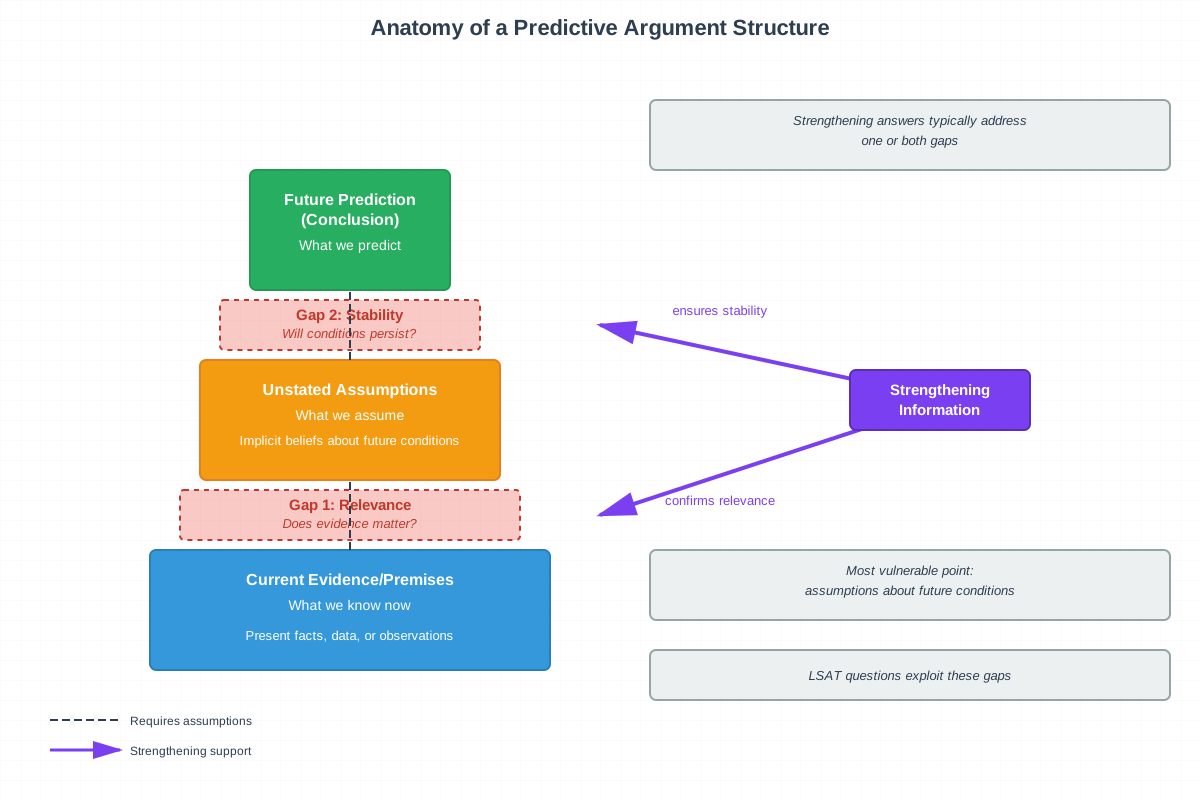
A predictive argument makes a claim about what will happen, what should be done based on expected outcomes, or what is likely to occur under certain conditions. Unlike arguments about established facts, predictive arguments inherently involve uncertainty and depend on assumptions about how current conditions will persist or change. The conclusion uses future-oriented language: "will," "is likely to," "should," "is expected to," or "will probably."
The logical structure of predictive arguments typically follows this pattern:
- Evidence about current or past conditions
- Implicit assumption that these conditions are relevant to future outcomes
- Conclusion predicting a future state or outcome
The vulnerability in predictive arguments lies in the gap between what is known now and what is claimed about the future. Multiple factors could intervene, conditions could change, or the relationship between current evidence and future outcomes might not hold as assumed.
Types of Predictive Reasoning
Trend-based predictions extrapolate from current patterns to future outcomes. For example: "Sales have increased 10% annually for five years, so they will continue increasing next year." These predictions assume trend stability and the absence of disruptive factors.
Causal predictions claim that because a cause is present or will be introduced, a particular effect will follow. For example: "Implementing this training program will improve employee performance." These predictions assume the causal relationship is genuine and that no interfering factors will prevent the effect.
Comparative predictions argue that because something worked in one context, it will work in another. For example: "This policy reduced traffic in City A, so it will reduce traffic in City B." These predictions assume relevant similarity between contexts.
Conditional predictions claim that if certain conditions are met, a particular outcome will follow. For example: "If we hire more staff, customer satisfaction will increase." These predictions assume the conditions are sufficient and that the conditional relationship is valid.
How to Strengthen Predictions
Strengthening a prediction involves providing information that makes the predicted outcome more likely by addressing potential vulnerabilities in the reasoning. Effective strengtheners accomplish one or more of the following:
| Strengthening Strategy | How It Works | Example |
|---|---|---|
| Confirm assumption validity | Shows that a key assumption about future conditions is true | Evidence that market conditions will remain stable |
| Eliminate alternative outcomes | Rules out competing predictions or interfering factors | Data showing no new competitors will enter the market |
| Establish causal mechanism | Demonstrates the causal connection between current facts and predicted outcome | Research confirming the cause-effect relationship |
| Show relevant similarity | Proves that past/present conditions genuinely parallel future conditions | Evidence that compared situations are truly analogous |
| Provide supporting precedent | Offers examples where similar predictions proved accurate | Historical cases where the same pattern held |
The Temporal Dimension
A crucial aspect of strengthening predictions involves the temporal gap between the evidence (usually about the present or past) and the conclusion (about the future). Strong answer choices bridge this gap by providing information specifically about future conditions or about factors that will remain constant over time.
Weak answer choices often provide additional information about current or past conditions without addressing whether those conditions will persist or whether new factors might intervene. For instance, if an argument predicts a restaurant will succeed based on its current popularity, learning that it's currently very popular doesn't strengthen the prediction—we already knew that. However, learning that the restaurant has secured a long-term lease in a developing neighborhood addresses future conditions and strengthens the prediction.
Recognizing Logical Gaps in Predictions
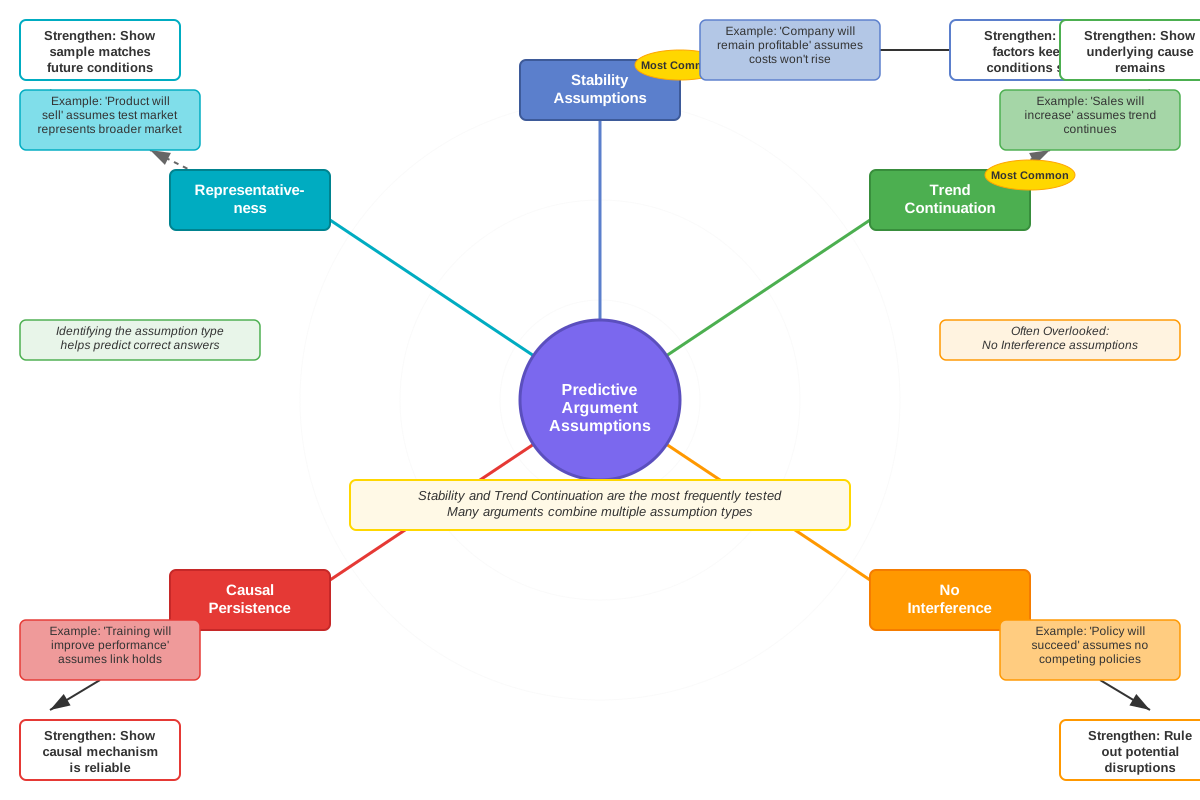
The most common logical gaps in predictive arguments include:
- Assumption of stability: The argument assumes current conditions will continue unchanged
- Assumption of sufficiency: The argument assumes the cited factors are enough to produce the predicted outcome
- Assumption of no interference: The argument assumes no new factors will prevent the predicted outcome
- Assumption of relevance: The argument assumes past/present evidence is genuinely indicative of future outcomes
- Assumption of mechanism: The argument assumes the process by which the prediction would come true will function as expected
Identifying which gap is most critical to a particular argument enables effective pre-phrasing of what would strengthen the prediction.
Concept Relationships
The concepts within strengthening predictions form an interconnected logical framework. Predictive arguments serve as the foundation, establishing the type of reasoning being evaluated. Understanding types of predictive reasoning (trend-based, causal, comparative, conditional) enables identification of specific logical gaps inherent to each type. These gaps, in turn, determine which strengthening strategies will be most effective. The temporal dimension cuts across all these concepts, as every predictive argument involves bridging the gap between present evidence and future claims.
This topic connects to prerequisite knowledge in several ways: Causal reasoning → provides the foundation for understanding causal predictions and how to strengthen them. Assumption identification → enables recognition of the unstated premises about future conditions that predictive arguments depend upon. Conditional logic → underlies conditional predictions and helps evaluate whether stated conditions are sufficient for predicted outcomes.
Strengthening predictions relates to other topics within strengthen and weaken questions: Weakening predictions represents the inverse skill—identifying what would make predictions less likely. Strengthening causal arguments overlaps significantly with causal predictions but focuses on establishing past/present causation rather than future outcomes. Necessary assumptions connects because many prediction-strengthening answer choices confirm necessary assumptions about future conditions.
Relationship map: Current Evidence → [Logical Gap] → Future Prediction | Strengthening Information → [Bridges Gap] → Makes Prediction More Likely
High-Yield Facts
- ⭐ Strengthening predictions questions ask which answer choice makes a future-oriented conclusion more likely to be true
- ⭐ The correct answer must address future conditions or factors that will persist over time, not merely provide more information about the present
- ⭐ Predictive arguments contain an inherent logical gap between current evidence and future claims
- ⭐ The most common vulnerability in predictions is the assumption that current conditions will remain stable
- ⭐ Eliminating potential interfering factors is one of the most powerful ways to strengthen a prediction
- Trend-based predictions assume that observed patterns will continue without disruption
- Causal predictions assume both that the causal relationship is genuine and that no factors will block the effect
- Comparative predictions assume relevant similarity between the compared situations
- Answer choices that only strengthen present claims without addressing future conditions are incorrect
- The temporal gap between evidence and conclusion is the defining feature of predictive arguments
- Strengthening a prediction often involves confirming that necessary conditions for the predicted outcome will be met
- Wrong answers frequently provide additional support for premises rather than bridging the gap to the conclusion
Quick check — test yourself on Strengthening predictions so far.
Try Flashcards →Common Misconceptions
Misconception: Any answer choice that supports the argument strengthens the prediction → Correction: Only information that specifically addresses the gap between current evidence and future outcome strengthens a prediction. Answer choices that merely provide additional evidence for premises already accepted as true don't make the future prediction more likely.
Misconception: Strengthening a prediction requires proving it will definitely happen → Correction: Strengthening makes the prediction more likely or more probable, not certain. The correct answer increases confidence in the prediction without eliminating all doubt.
Misconception: Information about past success automatically strengthens predictions about future success → Correction: Past success only strengthens future predictions if there's reason to believe the conditions that led to past success will persist or that the past situation is relevantly similar to the future situation.
Misconception: The longest or most detailed answer choice is most likely to strengthen the prediction → Correction: Length and detail are irrelevant. The correct answer directly addresses the specific logical gap in the predictive reasoning, which may be accomplished concisely.
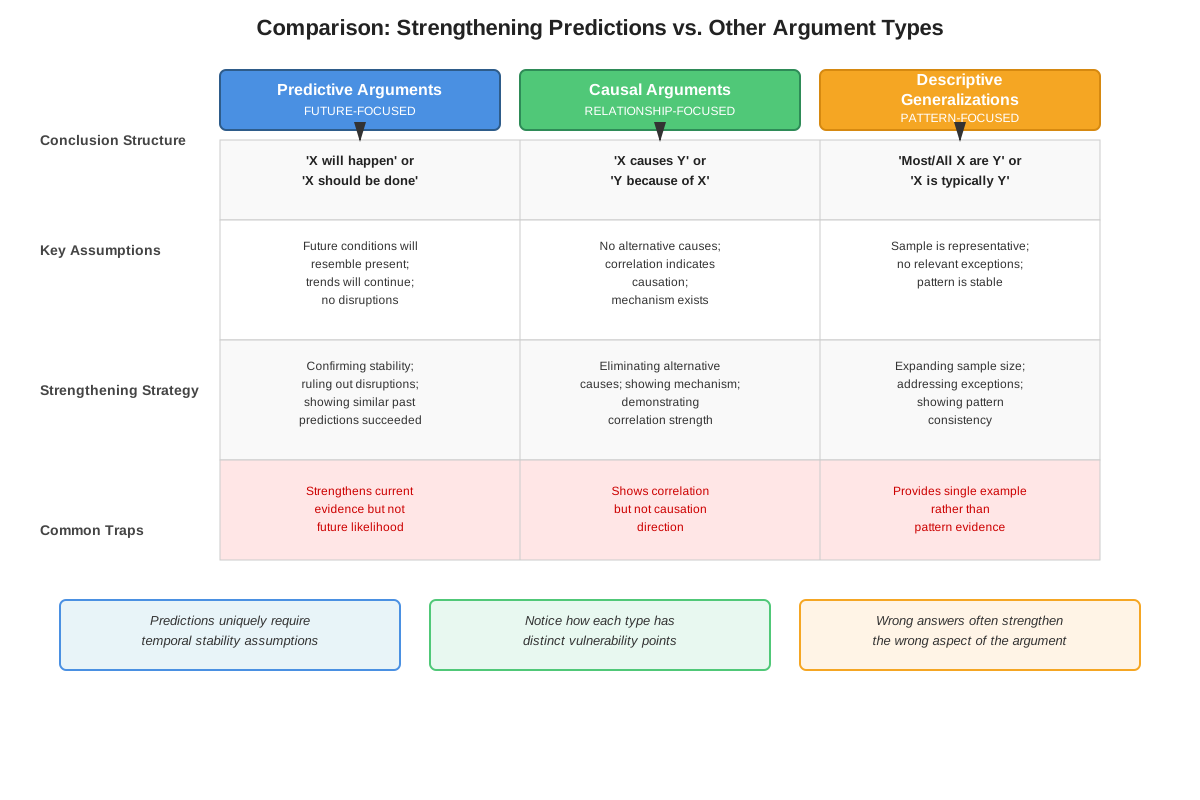
Misconception: Strengthening predictions is the same as strengthening any argument → Correction: Strengthening predictions specifically requires addressing the temporal gap and future conditions, whereas strengthening other arguments might involve supporting causal links, providing examples, or confirming present facts without the future-oriented dimension.
Misconception: If an answer choice is true and relevant to the topic, it strengthens the prediction → Correction: Relevance to the general topic is insufficient. The answer must be relevant specifically to making the predicted future outcome more likely by addressing assumptions about future conditions or eliminating alternative scenarios.
Worked Examples
Example 1: Business Prediction
Argument: "TechStart Inc. has developed a revolutionary smartphone app that has gained 100,000 users in its first month. The company's revenue has doubled each month for the past three months. Therefore, TechStart Inc. will become highly profitable within the next year."
Question: Which of the following, if true, most strengthens the prediction?
Answer Choices:
A) TechStart Inc.'s app has received positive reviews from technology journalists
B) The company has secured sufficient funding to maintain operations for at least two years
C) Similar apps have historically gained users rapidly in their first months
D) TechStart Inc.'s founders have extensive experience in the technology industry
E) The app addresses a need that no competing product currently satisfies
Analysis:
First, identify the conclusion: TechStart will become highly profitable within the next year (predictive conclusion).
Second, identify the evidence: 100,000 users in first month, revenue doubled each month for three months.
Third, identify the logical gap: The argument assumes that current growth trends will continue and translate into profitability. Key vulnerabilities include: Will user growth continue? Will revenue growth continue? Will the company be able to sustain operations long enough to achieve profitability? Will competition emerge?
Fourth, evaluate each answer:
(A) Positive reviews support that the app is currently good but don't address whether growth will continue or profitability will be achieved. This strengthens a premise (the app is good) but not the prediction about future profitability.
(B) CORRECT: This directly addresses a major threat to the prediction—that the company might run out of money before becoming profitable. By confirming the company can maintain operations for two years (longer than the one-year prediction timeframe), this eliminates a significant interfering factor and makes the prediction more likely.
(C) This provides context about typical patterns but doesn't tell us whether TechStart's growth will continue beyond the initial months. If anything, it might suggest the rapid growth is temporary.
(D) The founders' experience is about current capabilities, not about future conditions that would ensure profitability.
(E) While this suggests competitive advantage, it doesn't address whether this advantage will persist (competitors could develop similar products) or whether the company can sustain operations long enough to achieve profitability.
Key Lesson: The correct answer addresses a specific future-oriented vulnerability (financial sustainability) rather than providing additional support for current success.
Example 2: Policy Prediction
Argument: "City Council plans to reduce traffic congestion by implementing a new bus rapid transit system. In City X, a similar system reduced car traffic by 15% within two years of implementation. Therefore, our city should expect similar reductions in traffic congestion."
Question: Which of the following, if true, most strengthens the prediction?
Answer Choices:
A) City X's bus rapid transit system was completed on schedule and within budget
B) Our city's population density and commuting patterns closely resemble those of City X
C) Traffic congestion has been increasing in our city for the past five years
D) The bus rapid transit system will use modern, energy-efficient vehicles
E) City X's residents reported high satisfaction with their bus rapid transit system
Analysis:
Conclusion: Our city should expect similar traffic reductions (prediction based on comparison).
Evidence: City X achieved 15% reduction with similar system.
Logical gap: This is a comparative prediction, which assumes relevant similarity between the two cities. The argument assumes that factors that made the system successful in City X are present in our city.
Evaluate answers:
(A) Implementation details in City X don't address whether our city is similar enough for the comparison to be valid.
(B) CORRECT: This directly addresses the key assumption in comparative predictions—that the compared situations are relevantly similar. If population density and commuting patterns are similar, the factors that led to success in City X are more likely to produce similar results in our city, strengthening the prediction.
(C) This tells us about the current problem but doesn't address whether the proposed solution will work in our context.
(D) Vehicle characteristics don't address the relevant similarity between cities or whether the system will achieve the predicted results.
(E) Satisfaction in City X doesn't tell us whether our city is similar enough for the comparison to hold.
Key Lesson: For comparative predictions, strengthening requires establishing relevant similarity between the compared situations, not just providing more information about one of them.
Exam Strategy
When approaching lsat strengthening predictions questions, follow this systematic process:
Step 1: Identify the conclusion and confirm it's predictive (15-20 seconds)
Look for future-oriented language: "will," "is likely to," "should," "is expected to," "will probably." If the conclusion is about what will happen rather than what is currently true, you're dealing with a prediction.
Step 2: Identify the evidence and the type of prediction (10-15 seconds)
Determine whether the prediction is trend-based, causal, comparative, or conditional. This reveals the likely logical gaps.
Step 3: Identify the logical gap (15-20 seconds)
Ask: What must be true about future conditions for this prediction to hold? What could go wrong? What's assumed about the stability of current conditions or the relevance of past evidence?
Exam Tip: The most common gaps involve assumptions that (1) current trends will continue, (2) no interfering factors will emerge, (3) compared situations are relevantly similar, or (4) causal mechanisms will function as expected.
Step 4: Pre-phrase the strengthener (10-15 seconds)
Before looking at answer choices, articulate what information would address the gap: "The correct answer will probably confirm that [specific assumption about future conditions]" or "eliminate the possibility that [specific interfering factor]."
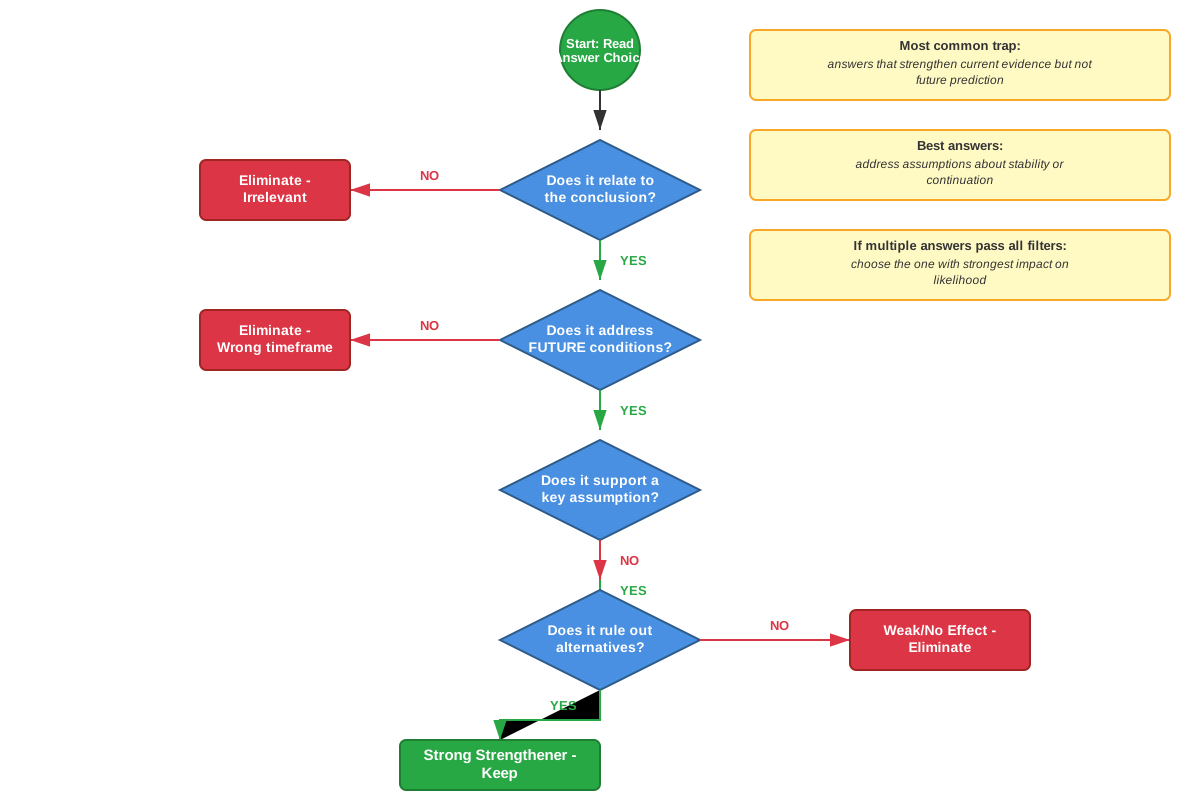
Step 5: Evaluate answer choices with temporal focus (30-40 seconds)
Eliminate answers that only address current/past conditions without bridging to the future. Eliminate answers that strengthen premises rather than the conclusion. Select the answer that most directly addresses the identified gap.
Trigger words to watch for:
- Question stems: "strengthen," "support," "most justifies," "provides the best reason for"
- Conclusion indicators with future orientation: "will," "should," "is likely," "probably," "is expected to"
- Comparative language: "similarly," "likewise," "just as," "in the same way"
Process of elimination tips:
- Eliminate answers that only provide more evidence for premises already accepted as true
- Eliminate answers about past/present that don't address future conditions
- Eliminate answers that are relevant to the topic but not to the specific logical gap
- Be suspicious of answers that seem to strengthen but actually introduce new concerns
Time allocation: Spend approximately 1:20-1:30 per strengthening prediction question. If you've correctly identified the gap and pre-phrased, the right answer should be recognizable within 30-40 seconds of evaluating choices.
Memory Techniques
PREDICT mnemonic for evaluating predictions:
- Predictive conclusion identified?
- Reasoning type determined? (trend/causal/comparative/conditional)
- Evidence about present/past noted?
- Difference between now and future considered?
- Interfering factors possible?
- Conditions assumed to remain stable?
- Temporal gap bridged by answer choice?
The Bridge Visualization: Picture the argument as two cliffs—one labeled "Current Evidence" and one labeled "Future Prediction"—with a gap between them. The correct answer is a bridge that specifically spans this gap. Wrong answers either add more ground to the "Current Evidence" cliff (strengthening premises) or build bridges to the wrong place.
The Three S's for strengthening predictions:
- Stability: Does the answer confirm conditions will remain stable?
- Sufficiency: Does the answer confirm cited factors are enough?
- Similarity: Does the answer confirm relevant similarity (for comparisons)?
Acronym for common gaps: FINE
- Future conditions different from present
- Interfering factors could emerge
- Necessary conditions might not be met
- Extrapolation from past/present might not hold
Summary
Strengthening predictions is a high-frequency LSAT skill that requires identifying what information would make a future-oriented conclusion more likely to be true. These questions test the ability to recognize the inherent logical gap between current evidence and future claims, then select answer choices that bridge this temporal gap by addressing assumptions about future conditions, eliminating potential interfering factors, or confirming the stability of current trends. Success requires distinguishing between information that merely supports present claims and information that specifically makes predicted outcomes more probable. The key insight is that predictive arguments are vulnerable at the point where they extrapolate from what is known now to what will happen later, and effective strengtheners address this specific vulnerability rather than simply providing additional support for premises. Students must recognize the type of prediction (trend-based, causal, comparative, or conditional), identify the corresponding logical gap, and select answers that directly address future-oriented concerns rather than past or present facts.
Key Takeaways
- Strengthening predictions requires addressing the gap between current evidence and future outcomes, not merely supporting present claims
- The correct answer must specifically relate to future conditions or factors that will persist over time
- Identify the type of prediction (trend-based, causal, comparative, conditional) to recognize the likely logical gap
- The most common vulnerabilities involve assumptions about stability, sufficiency, absence of interference, and relevant similarity
- Pre-phrasing what would strengthen the prediction before evaluating answer choices dramatically improves accuracy
- Eliminate answers that only strengthen premises or provide information about past/present without bridging to the future
- The temporal dimension—the gap between now and the predicted future—is the defining feature that distinguishes these questions from other strengthening questions
Related Topics
Weakening Predictions: The inverse skill of identifying what would make predictions less likely; mastering strengthening predictions provides the foundation for recognizing what undermines predictive reasoning.
Necessary Assumptions in Predictions: Focuses on identifying what must be true for predictions to hold; strengthening predictions often involves confirming these necessary assumptions.
Causal Reasoning: Many predictions involve causal claims about future effects; understanding causal strengthening and weakening enhances prediction analysis.
Conditional Logic in Arguments: Conditional predictions depend on if-then relationships; mastering conditional logic improves evaluation of whether conditions sufficient for predictions will be met.
Comparative Reasoning: Comparative predictions require evaluating relevant similarities; this topic deepens understanding of when comparisons support future-oriented conclusions.
Practice CTA
Now that you understand the core principles of strengthening predictions, it's time to apply this knowledge to actual LSAT questions. The practice questions and flashcards will help you internalize the recognition patterns and develop the quick analytical reflexes needed for test day. Focus on identifying the temporal gap in each argument and pre-phrasing what would bridge that gap before evaluating answer choices. With deliberate practice, you'll develop the ability to quickly spot predictive conclusions and confidently select the answer that makes future outcomes more likely. Each practice question you complete strengthens your mastery of this high-yield topic—start practicing now to maximize your LSAT score!
Sign up free to keep reading
Create a free AnvayaPrep account to finish this LSAT guide on Strengthening predictions — plus flashcards and practice questions.