Overview
Agreement between passages is a critical skill tested in the LSAT's Comparative Reading section, where students must analyze two related passages (Passage A and Passage B) and determine points of convergence between the authors' views, arguments, or evidence. Unlike questions that ask about differences or contrasts, agreement questions require test-takers to identify where both authors would concur on a particular claim, principle, or interpretation—even when the passages approach their topics from different angles or with different emphases.
This topic represents one of the most frequently tested question types in comparative reading sets, appearing in approximately 60-70% of all comparative passage questions on recent LSATs. Mastering agreement identification is essential because it demands sophisticated reading comprehension skills: students must not only understand each passage independently but also synthesize information across both texts, recognizing implicit agreements that may not be explicitly stated. The LSAT deliberately constructs passages where agreement exists at deeper conceptual levels rather than through identical wording, testing whether students can move beyond surface-level reading to grasp underlying principles.
Within the broader landscape of Reading Comprehension, agreement questions bridge multiple analytical skills. They require the same careful attention to author's purpose and tone demanded by single-passage questions, while adding the comparative dimension that tests logical reasoning abilities similar to those used in the Logical Reasoning section. Success with lsat agreement between passages questions demonstrates mastery of synthesis, inference, and the ability to distinguish between what authors explicitly state versus what they implicitly endorse—skills that form the foundation of legal analysis and are therefore central to the LSAT's predictive validity for law school success.
Learning Objectives
- [ ] Identify how Agreement between passages appears in LSAT questions
- [ ] Explain the reasoning pattern behind Agreement between passages
- [ ] Apply Agreement between passages to solve LSAT-style problems accurately
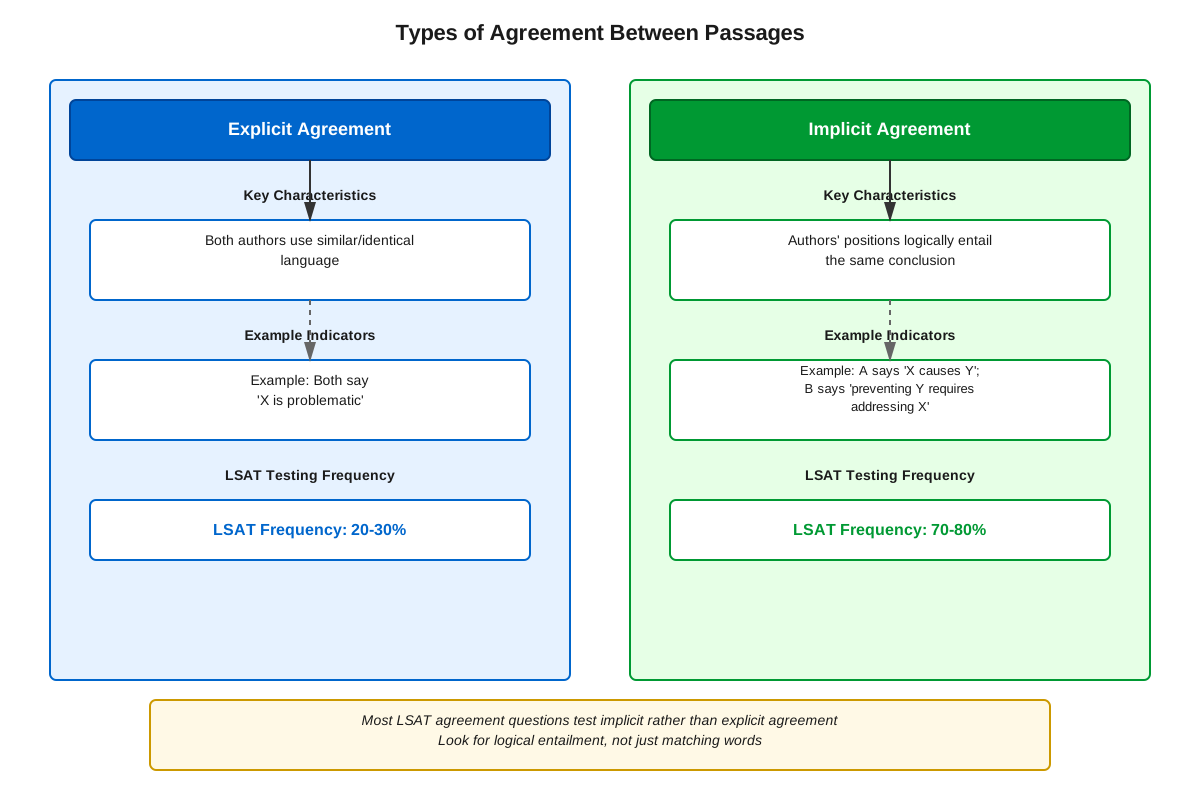
- [ ] Distinguish between explicit agreements (directly stated) and implicit agreements (logically inferred)
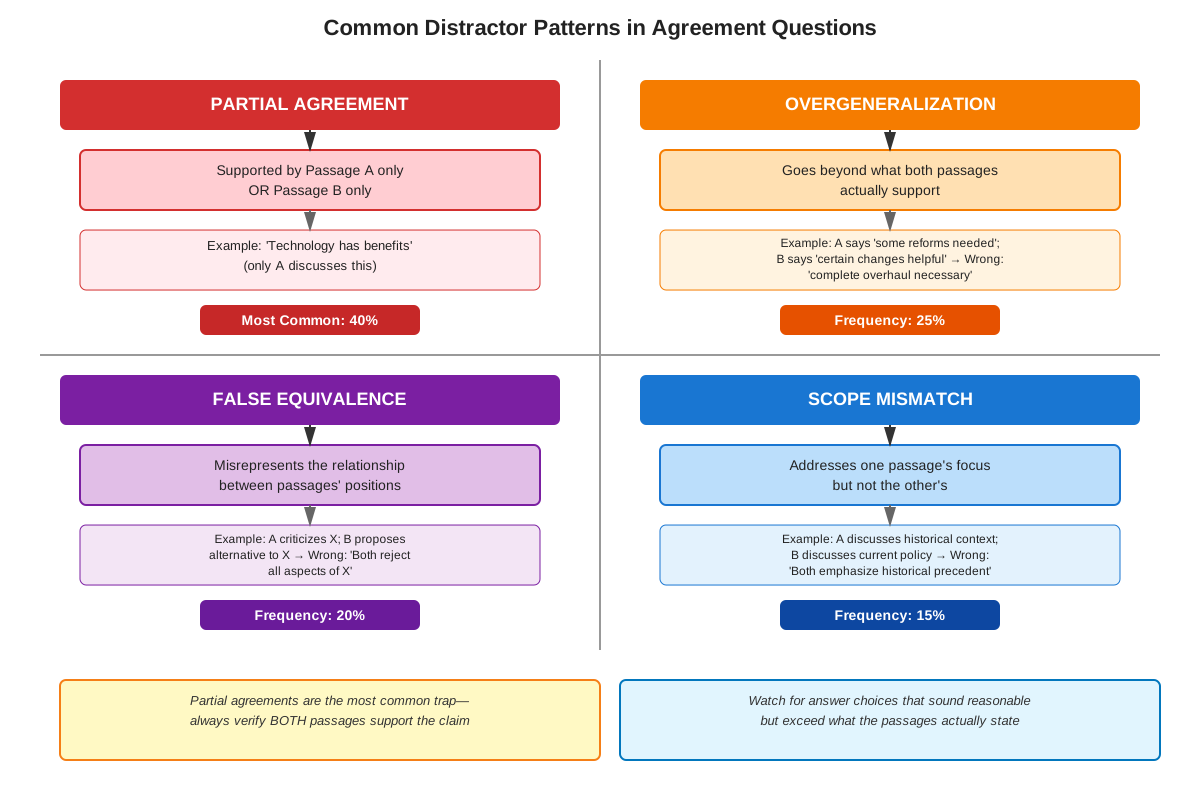
- [ ] Recognize common distractors that present false agreements or partial agreements
- [ ] Evaluate answer choices by systematically checking each passage's support for the proposed agreement
- [ ] Synthesize information across passages to identify agreements at different levels of abstraction
Prerequisites
- Single-passage reading comprehension skills: Understanding main ideas, author's purpose, and tone in individual passages is essential before comparing two passages for points of agreement.
- Inference-making ability: Agreement questions often require recognizing what authors would likely agree with based on their stated positions, not just what they explicitly say.
- Understanding of argument structure: Recognizing premises, conclusions, and supporting evidence helps identify where authors' reasoning aligns.
- Familiarity with comparative reading format: Knowing that Passage A and Passage B are related but distinct texts with potentially different perspectives or emphases.
Why This Topic Matters
Agreement between passages questions test a fundamental legal skill: the ability to find common ground between different perspectives, authorities, or precedents. In legal practice, attorneys must frequently identify where courts, statutes, or legal scholars agree on principles, even when their reasoning or applications differ. This synthesis skill is essential for building persuasive arguments, finding binding precedent, and understanding the scope of legal consensus.
On the LSAT, agreement questions appear in every comparative reading set, which constitutes one of the four Reading Comprehension passages on each test. Typically, 2-3 of the 5-7 questions accompanying a comparative reading set will ask about agreements between the passages. These questions carry the same weight as any other Reading Comprehension question, making them worth approximately 3-5% of your total LSAT score. Given their predictable appearance, mastering this question type offers high return on study investment.
Agreement questions manifest in several common forms on the exam. The most straightforward asks: "The authors of both passages would be most likely to agree with which one of the following?" More nuanced versions might ask what principle both authors would endorse, what claim both passages support, or what both authors would accept as evidence for a particular conclusion. Some questions present a statement and ask whether each author would agree or disagree, requiring students to evaluate both passages' positions independently before determining alignment. The LSAT also tests this skill through questions asking what would strengthen or weaken both passages simultaneously, which requires identifying their shared assumptions or vulnerabilities.
Core Concepts
Defining Agreement in Comparative Reading
Agreement between passages occurs when both Passage A and Passage B support, endorse, or are consistent with the same claim, principle, or conclusion. Crucially, agreement does not require identical language or even similar reasoning—two authors can agree on a conclusion while arriving at it through completely different arguments. The LSAT tests whether students can recognize this conceptual alignment despite surface-level differences in presentation, emphasis, or supporting evidence.
Agreement exists on a spectrum from explicit to implicit. Explicit agreement occurs when both passages directly state the same or equivalent claims using similar language. For example, if Passage A states "renewable energy costs have decreased significantly" and Passage B states "the price of renewable energy has dropped substantially," both passages explicitly agree on this factual claim. However, explicit agreements are relatively rare on the LSAT because they're too easy to identify.
More commonly, the LSAT tests implicit agreement, where both passages support a claim without directly stating it. For instance, Passage A might discuss how solar panel efficiency has improved while costs have fallen, and Passage B might describe increasing adoption of solar energy by utilities. Neither passage explicitly states "solar energy has become more economically viable," but both passages' content supports this conclusion, creating an implicit agreement.
Levels of Agreement
Agreements can occur at different levels of abstraction, and the LSAT systematically tests whether students can identify agreements at each level:
Factual-level agreements involve specific, concrete claims about the world. Both passages might agree that a particular event occurred, that a statistic is accurate, or that a phenomenon exists. These are the most straightforward agreements but appear less frequently in correct answers because they're easier to identify.
Principle-level agreements involve broader rules, standards, or generalizations. For example, both passages might endorse the principle that "technological innovation requires sustained investment" even if one passage discusses renewable energy while the other discusses medical devices. Recognizing principle-level agreements requires abstracting from specific examples to underlying concepts.
Methodological agreements concern how to approach problems, evaluate evidence, or conduct analysis. Both authors might agree that "historical context is essential for understanding current policy debates" even while discussing completely different policies. These agreements focus on process rather than content.
Evaluative agreements involve shared judgments about what is important, valuable, problematic, or worthy of attention. Both passages might agree that "current regulations are inadequate" even while proposing different solutions or focusing on different aspects of the regulatory framework.
The Agreement Identification Process
Identifying agreements requires a systematic approach that prevents common errors. The process involves three distinct phases:
Phase 1: Passage-by-Passage Analysis
Before attempting to identify agreements, thoroughly understand each passage independently. For each passage, identify:
- The main conclusion or thesis
- Key supporting claims and evidence
- The author's tone and attitude toward the subject
- Any principles or assumptions underlying the argument
- Scope limitations (what the author does and doesn't claim)
Phase 2: Comparative Synthesis
After understanding each passage individually, actively look for points of convergence:
- What factual claims appear in both passages?
- What principles would both authors endorse based on their arguments?
- What assumptions do both passages rely upon?
- What conclusions are consistent with both passages' content?
- Where do the passages complement rather than contradict each other?
Phase 3: Answer Choice Evaluation
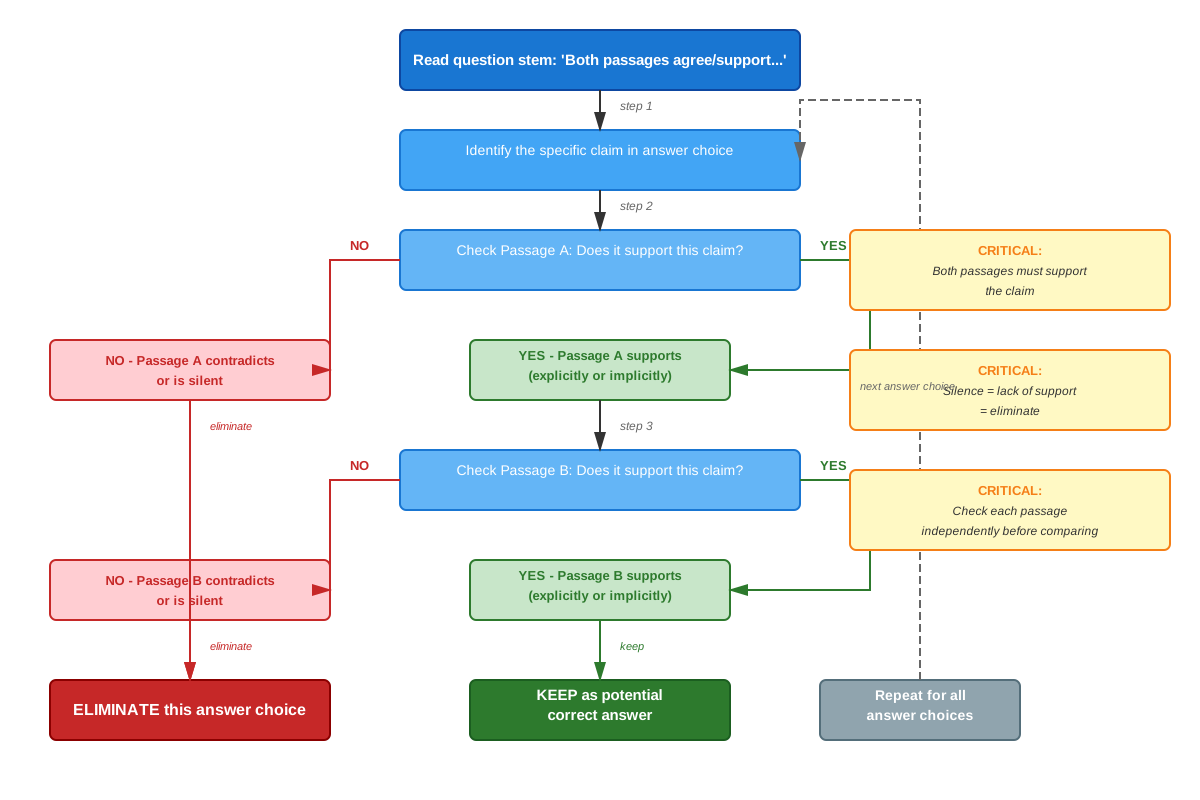
For each answer choice, systematically verify support from both passages:
- Does Passage A support this claim? (If no, eliminate)
- Does Passage B support this claim? (If no, eliminate)
- Is the agreement genuine or does it involve subtle misrepresentation?
- Is the scope appropriate (not too broad or too narrow)?
Common Agreement Patterns
The LSAT employs several recurring patterns in constructing agreement questions:
Complementary Focus Pattern: Passage A discusses one aspect of a topic while Passage B discusses a different aspect, but both support the same broader conclusion. For example, Passage A might discuss environmental benefits of a policy while Passage B discusses economic benefits, but both agree the policy is beneficial overall.
Different Evidence, Same Conclusion Pattern: Both passages reach the same conclusion but through entirely different reasoning or evidence. Passage A might use historical examples while Passage B uses statistical analysis, but both conclude that a particular approach is effective.
Shared Assumption Pattern: Both passages rely on the same unstated assumption, even though they may reach different conclusions or discuss different topics. Identifying what both authors take for granted reveals an implicit agreement.
Negative Agreement Pattern: Both passages criticize, reject, or identify problems with the same thing, even if they propose different solutions or have different reasons for their criticism.
Distinguishing Agreement from Related Concepts
Understanding what agreement is NOT helps avoid common errors:
| Concept | Definition | Relationship to Agreement |
|---|---|---|
| Compatibility | Claims that don't contradict each other | Weaker than agreement; compatible claims might simply address different topics without supporting the same conclusion |
| Similarity | Passages that discuss related topics or use similar approaches | Doesn't guarantee agreement on any specific claim |
| Partial Agreement | Agreement on some aspects but not others | Not sufficient for LSAT agreement questions, which require full support from both passages |
| Implied Disagreement | One passage's claims suggest the other is wrong, though not explicitly stated | The opposite of agreement; requires careful reading to detect |
Concept Relationships
The skill of identifying agreement between passages builds directly on foundational reading comprehension abilities. Single-passage comprehension → enables → understanding each passage's position independently → which is prerequisite for → comparative analysis → leading to → agreement identification.
Within comparative reading, agreement questions connect closely to other question types. Understanding agreements ↔ helps identify disagreements because recognizing where authors align clarifies where they diverge. Similarly, agreement identification → supports → synthesis questions that ask about the relationship between passages, since agreements represent one type of relationship.
The reasoning patterns used in agreement questions parallel those in Logical Reasoning. Identifying implicit agreements uses the same inference skills required for Must Be True questions. Evaluating whether both passages support a claim mirrors the sufficient assumption pattern where you verify whether premises adequately support a conclusion. Recognizing shared assumptions connects to necessary assumption identification in Logical Reasoning.
Agreement questions also relate to scope analysis—a critical skill across all LSAT sections. An answer choice might present a claim that one passage supports but that exceeds the scope of the other passage. Scope awareness in single passages → transfers to → recognizing when proposed agreements extend beyond what both passages actually support.
High-Yield Facts
⭐ Agreement questions appear in approximately 40-50% of all comparative reading question sets, making them the most common comparative question type.
⭐ Correct answers to agreement questions are often supported implicitly rather than explicitly stated in both passages.
⭐ Both passages must independently support the correct answer; if only one passage supports a claim, it cannot be the correct answer regardless of how strongly that passage supports it.
⭐ The LSAT frequently uses different terminology in the two passages to express the same underlying concept, testing whether students recognize conceptual equivalence.
⭐ Principle-level agreements are more commonly tested than specific factual agreements because they require higher-order thinking.
- Agreement questions often feature wrong answers that one passage strongly supports but the other passage is neutral toward or doesn't address.
- The correct answer to an agreement question may represent a point that neither passage emphasizes but that both passages' content logically supports.
- Extreme language in answer choices (always, never, only, must) is more likely to be incorrect because it's harder for both passages to support absolute claims.
- When passages discuss the same topic from different perspectives (e.g., historical vs. contemporary, theoretical vs. practical), agreements often exist at the methodological or principle level rather than the factual level.
- Time period matters: both passages must support the claim as of the time frame each discusses; a historical passage and contemporary passage might not agree on current conditions even if they agree on principles.
- The correct answer will never contradict or be inconsistent with either passage, even if it's not the main point of either passage.
- Agreement questions sometimes ask what both authors would "likely agree" with, which requires inference based on the passages' content and reasoning, not just what's explicitly stated.
Common Misconceptions
Misconception: If both passages discuss the same topic, they must agree on most points about that topic.
Correction: Passages can discuss the same topic while disagreeing on most substantive claims. Agreement must be verified for each specific claim, not assumed based on topical similarity. The LSAT often pairs passages that take contrasting positions on the same issue.
Misconception: Agreement requires both passages to explicitly state the same claim using similar language.
Correction: Most LSAT agreement questions test implicit agreement where both passages support a claim without directly stating it, or where passages use different terminology to express equivalent ideas. Students must recognize conceptual alignment, not just verbal similarity.
Misconception: If Passage A strongly supports a claim and Passage B doesn't contradict it, that constitutes agreement.
Correction: Agreement requires positive support from both passages. Mere absence of contradiction or neutrality from one passage is insufficient. Both passages must provide evidence or reasoning that supports the claim.
Misconception: The correct answer will be a major point emphasized in both passages.
Correction: Agreements often involve secondary points, underlying assumptions, or logical implications that neither passage emphasizes. The LSAT tests whether students can identify these less obvious points of convergence.
Misconception: When passages reach different conclusions, they cannot agree on anything.
Correction: Passages can agree on facts, principles, or intermediate claims while reaching different overall conclusions. For example, both might agree that a problem exists while proposing different solutions, or both might accept the same evidence while interpreting it differently.
Misconception: Agreement questions are easier than other comparative reading questions because you just look for what's in both passages.
Correction: Agreement questions are often among the most difficult comparative reading questions because they require synthesizing information across passages, recognizing implicit support, and distinguishing genuine agreements from superficial similarities or partial agreements.
Misconception: If an answer choice is too broad or general, it's more likely to be correct because both passages can support it.
Correction: Overly broad or general answer choices are often incorrect because they extend beyond what both passages actually support. The correct answer must be fully supported by both passages without requiring additional assumptions or extending beyond their scope.
Quick check — test yourself on Agreement between passages so far.
Try Flashcards →Worked Examples
Example 1: Scientific Research Passages
Passage A (summarized): Discusses how peer review in scientific publishing helps identify methodological flaws before publication. Notes that reviewers caught significant errors in 30% of submitted papers. Argues that despite its imperfections, peer review remains essential for maintaining research quality.
Passage B (summarized): Examines the time delays caused by peer review, noting that important findings can be delayed 6-12 months before publication. Proposes supplementing traditional peer review with post-publication review where papers are published quickly and then evaluated by the broader scientific community. Acknowledges that some quality control mechanism is necessary.
Question: The authors of both passages would be most likely to agree with which one of the following?
Answer Choices:
(A) Peer review successfully prevents most flawed research from being published.
(B) The scientific community requires some mechanism for evaluating research quality.
(C) Post-publication review is superior to traditional peer review for identifying errors.
(D) The benefits of peer review outweigh its drawbacks.
(E) Delays in publication pose more serious problems than publication of flawed research.
Step-by-Step Analysis:
Step 1: Analyze Passage A's position
- Supports peer review despite acknowledging imperfections
- Emphasizes its role in catching errors
- Considers it essential for quality control
Step 2: Analyze Passage B's position
- Criticizes peer review's delays
- Proposes alternative approach
- Acknowledges need for "some quality control mechanism"
Step 3: Evaluate each answer choice against both passages
(A) "Peer review successfully prevents most flawed research from being published."
- Passage A: Supports this (caught errors in 30% of papers)
- Passage B: Doesn't address whether peer review successfully prevents flawed research; focuses on delays
- Eliminate: Not supported by Passage B
(B) "The scientific community requires some mechanism for evaluating research quality."
- Passage A: Strongly supports (argues peer review is essential for maintaining quality)
- Passage B: Explicitly states "some quality control mechanism is necessary"
- Keep: Both passages support this claim
(C) "Post-publication review is superior to traditional peer review for identifying errors."
- Passage A: Doesn't discuss post-publication review
- Passage B: Proposes post-publication review but doesn't claim it's superior for identifying errors; focuses on speed
- Eliminate: Not supported by Passage A, and Passage B doesn't make this specific claim
(D) "The benefits of peer review outweigh its drawbacks."
- Passage A: Supports this position
- Passage B: Suggests the opposite by proposing an alternative due to peer review's drawbacks
- Eliminate: Passage B doesn't support this
(E) "Delays in publication pose more serious problems than publication of flawed research."
- Passage A: Suggests the opposite priority
- Passage B: Emphasizes delays but doesn't explicitly compare their seriousness to flawed research publication
- Eliminate: Not supported by Passage A
Correct Answer: (B)
This example illustrates a principle-level agreement. Neither passage explicitly states that the scientific community "requires" a quality evaluation mechanism, but both passages' arguments rest on this shared assumption. Passage A defends peer review as essential for quality, and Passage B acknowledges the necessity of quality control even while proposing modifications. The correct answer abstracts from the specific debate about peer review to identify the underlying principle both authors accept.
Example 2: Legal Theory Passages
Passage A (summarized): Argues that judicial interpretation should focus on the original public meaning of constitutional text at the time of ratification. Claims this approach constrains judicial discretion and prevents judges from imposing personal preferences. Acknowledges that determining original meaning requires historical research but argues this is more objective than alternative approaches.
Passage B (summarized): Contends that constitutional interpretation must account for contemporary values and social conditions that the framers could not have anticipated. Argues that rigid adherence to historical meaning produces unjust outcomes in modern contexts. Notes that all interpretation involves some degree of judgment and discretion, making complete objectivity impossible.
Question: Both passages indicate which one of the following?
Answer Choices:
(A) Constitutional interpretation inevitably involves some subjective judgment.
(B) Judges should prioritize contemporary values over historical meaning.
(C) The framers' intentions are impossible to determine with certainty.
(D) Judicial discretion poses challenges for constitutional interpretation.
(E) Historical research is essential for legitimate constitutional interpretation.
Step-by-Step Analysis:
Step 1: Identify each passage's main argument and supporting points
Passage A:
- Main argument: Use original public meaning
- Acknowledges: Determining original meaning requires historical research
- Claims: This approach constrains discretion and is more objective
Passage B:
- Main argument: Account for contemporary values
- Acknowledges: All interpretation involves judgment and discretion
- Claims: Complete objectivity is impossible
Step 2: Look for points of convergence despite opposing conclusions
Both passages discuss judicial discretion and objectivity, though they reach different conclusions about how to handle these issues.
Step 3: Evaluate answer choices
(A) "Constitutional interpretation inevitably involves some subjective judgment."
- Passage A: Acknowledges interpretation requires judgment (historical research involves judgment) but claims originalism is "more objective," implying some subjectivity exists
- Passage B: Explicitly states "all interpretation involves some degree of judgment" and "complete objectivity impossible"
- Keep: Both passages acknowledge this, though they emphasize it differently
(B) "Judges should prioritize contemporary values over historical meaning."
- Passage A: Opposes this position
- Passage B: Supports this position
- Eliminate: This is a point of disagreement, not agreement
(C) "The framers' intentions are impossible to determine with certainty."
- Passage A: Doesn't claim impossibility; argues historical research can determine original meaning
- Passage B: Doesn't address whether framers' intentions can be determined
- Eliminate: Not supported by Passage A
(D) "Judicial discretion poses challenges for constitutional interpretation."
- Passage A: Presents judicial discretion as a problem that originalism solves by constraining it
- Passage B: Acknowledges discretion exists but doesn't characterize it as a problem; rather, accepts it as inevitable
- Possible: Passage A clearly views discretion as challenging, but does Passage B?
- Eliminate on closer reading: Passage B doesn't indicate discretion "poses challenges"; it simply acknowledges discretion as a feature of interpretation
(E) "Historical research is essential for legitimate constitutional interpretation."
- Passage A: Strongly supports this
- Passage B: Doesn't suggest historical research is essential; emphasizes contemporary values instead
- Eliminate: Not supported by Passage B
Correct Answer: (A)
This example demonstrates an implicit agreement where both passages acknowledge the same limitation of constitutional interpretation, even though they respond to this limitation differently. Passage A minimizes the role of subjective judgment by advocating originalism, while Passage B accepts subjective judgment as inevitable. The agreement exists at the level of acknowledging that some subjectivity exists, not at the level of how to respond to that fact. Students must recognize that acknowledging a phenomenon (subjectivity in interpretation) constitutes agreement even when the passages evaluate that phenomenon differently or propose different responses.
Exam Strategy
Question Stem Recognition
Agreement questions use predictable language patterns. Watch for these trigger phrases:
- "Both passages indicate/suggest/support..."
- "The authors of both passages would most likely agree..."
- "Which one of the following is supported by both passages?"
- "Both passages provide information that answers which one of the following questions?"
- "The author of Passage A and the author of Passage B would be most likely to agree on..."
When you identify an agreement question, immediately shift to comparative mode: you must verify support from BOTH passages before selecting an answer.
Reading Strategy for Comparative Passages
During initial reading, create a mental (or physical, if time permits) comparison chart:
- Main point of Passage A vs. Main point of Passage B
- Tone of Passage A vs. Tone of Passage B
- Key evidence in Passage A vs. Key evidence in Passage B
- What Passage A emphasizes vs. What Passage B emphasizes
Mark potential agreement points while reading:
- Factual claims that appear in both passages
- Similar principles or assumptions
- Shared criticisms or concerns
- Complementary evidence or examples
Answer Choice Evaluation Process
Use this systematic approach for every answer choice:
- Passage A Test: Does Passage A support this claim?
- If NO → Eliminate immediately
- If YES → Proceed to step 2
- If UNCERTAIN → Mark and return after checking other choices
- Passage B Test: Does Passage B support this claim?
- If NO → Eliminate immediately
- If YES → Keep as contender
- If UNCERTAIN → Mark and return
- Scope Check: Is the claim appropriately scoped?
- Too broad? (Extends beyond what both passages support)
- Too narrow? (More specific than both passages support)
- Appropriate scope? (Matches what both passages actually support)
- Verification: Re-read relevant portions of both passages to confirm support
Exam Tip: If you're torn between two answer choices, the correct answer is usually the one that requires less inference or assumption. The LSAT prefers answers that both passages clearly support over answers that require multiple inferential steps.
Time Management
Agreement questions typically take 60-90 seconds to answer accurately. Allocate time as follows:
- 10-15 seconds: Read and understand the question stem
- 30-45 seconds: Evaluate answer choices systematically
- 15-30 seconds: Verify the correct answer by checking both passages
If you're spending more than 90 seconds, you may be:
- Failing to eliminate clearly wrong answers quickly
- Not understanding one or both passages well enough
- Overthinking the level of support required
Common Trap Patterns
The "One Passage Strongly Supports" Trap: The LSAT frequently includes wrong answers that one passage strongly supports but the other doesn't address. Students who focus on the strong support from one passage may select this answer without verifying the other passage. Always check BOTH passages.
The "Seems Reasonable" Trap: Wrong answers often present claims that seem consistent with both passages' general perspectives but aren't actually supported by either passage's content. Don't select answers based on what seems like it could be true; verify actual textual support.
The "Too Specific" Trap: An answer might accurately reflect a specific detail from one passage but be too narrow for the other passage to support. The correct answer must be at a level of generality that both passages support.
The "Scope Creep" Trap: An answer might start with something both passages support but then extend beyond that support. Read answer choices carefully to ensure every part is supported by both passages.
Memory Techniques
The "BOTH" Acronym
Use BOTH to remember the systematic evaluation process:
- Both passages must support (not just one)
- Obvious support isn't required (implicit agreement counts)
- Test each passage independently
- Highlight or mark potential agreements while reading
The Agreement Levels Pyramid
Visualize agreements as a pyramid from concrete to abstract:
        Principles/Methods (top - most abstract)
              Evaluations
           Interpretations
        Factual Claims (bottom - most concrete)
Remember: LSAT agreement questions more frequently test the upper levels (principles, evaluations) than the bottom level (specific facts). When stuck, consider whether the answer choice represents a broader principle both passages would endorse.
The "Two Thumbs Up" Rule
For each answer choice, visualize each passage giving a "thumbs up" (supports), "thumbs down" (contradicts), or "thumbs sideways" (neutral/doesn't address). Only select answers where both passages give "thumbs up." This simple visualization prevents the common error of selecting answers that one passage is merely neutral toward.
The Venn Diagram Mental Model
Picture a Venn diagram with Passage A as one circle and Passage B as another. The correct answer to an agreement question must fall in the overlapping section where both circles intersect. This visualization helps distinguish between:
- What only Passage A supports (left circle only)
- What only Passage B supports (right circle only)
- What both passages support (intersection)
Summary
Agreement between passages questions test the ability to identify points of convergence between two related texts, requiring synthesis of information across both passages and recognition of both explicit and implicit agreements. Success demands understanding each passage independently before comparing them, systematically verifying that both passages support proposed agreements, and distinguishing genuine agreements from superficial similarities or partial support. The LSAT most frequently tests principle-level and methodological agreements rather than specific factual agreements, requiring students to abstract from concrete details to underlying concepts. Common errors include selecting answers that only one passage supports, failing to recognize implicit agreements, and choosing answers that extend beyond the scope of what both passages actually support. The key to mastering this question type is methodical evaluation: test each answer choice against both passages independently, eliminate any choice that lacks support from either passage, and verify that the correct answer is fully supported by both passages without requiring additional assumptions. This skill represents a high-yield area for LSAT preparation because agreement questions appear predictably in every comparative reading set and, once mastered, can be answered accurately and efficiently.
Key Takeaways
- Both passages must independently support the correct answer; strong support from only one passage is insufficient regardless of how compelling that support is.
- Implicit agreements are more commonly tested than explicit agreements; the correct answer often represents a principle or conclusion that both passages support without directly stating.
- Agreement can exist at multiple levels (factual, principle, methodological, evaluative), with principle-level agreements being most frequently tested on the LSAT.
- Systematic evaluation prevents errors: test each answer choice against Passage A first, then Passage B, eliminating any choice that lacks support from either passage.
- Passages can agree on specific points while disagreeing overall; don't assume that passages with different conclusions or perspectives cannot agree on anything.
- Scope matters critically: the correct answer must be neither too broad nor too narrow but must match what both passages actually support at an appropriate level of generality.
- Recognition of conceptual equivalence is essential; the LSAT uses different terminology in the two passages to express the same underlying ideas, testing whether students recognize conceptual alignment despite verbal differences.
Related Topics
Disagreement Between Passages: After mastering agreement identification, the natural progression is understanding how to identify and characterize points of disagreement, which requires similar comparative analysis skills but focuses on divergence rather than convergence.
Passage Relationship Questions: These questions ask about the overall relationship between passages (e.g., "Passage B responds to Passage A by..."), requiring synthesis of agreements, disagreements, and the passages' different emphases or approaches.
Synthesis Questions: Advanced comparative reading questions that ask students to combine information from both passages to answer questions that neither passage alone could answer, building on agreement identification skills.
Author's Attitude in Comparative Reading: Understanding how to compare the tones, attitudes, and perspectives of two authors, which helps identify both agreements and disagreements at the evaluative level.
Inference Questions in Comparative Reading: Questions that ask what can be inferred from both passages together, requiring recognition of implicit agreements and the ability to draw conclusions supported by the combined content of both texts.
Practice CTA
Now that you understand the core concepts and strategies for identifying agreement between passages, it's time to apply these skills to actual LSAT-style questions. The practice questions and flashcards accompanying this guide will help you internalize the systematic evaluation process and develop the pattern recognition skills necessary for quick, accurate performance on test day. Remember: agreement questions are highly learnable and represent one of the best opportunities to improve your Reading Comprehension score through focused practice. Each practice question you work through strengthens your ability to synthesize information across passages and recognize both explicit and implicit points of convergence—skills that will serve you throughout the LSAT and in law school. Approach the practice materials systematically, reviewing both correct and incorrect answers to understand why each answer choice succeeds or fails the "both passages support" test.
Sign up free to keep reading
Create a free AnvayaPrep account to finish this LSAT guide on Agreement between passages — plus flashcards and practice questions.