Overview
Both authors agree questions represent a critical question type within the comparative reading section of the LSAT Reading Comprehension module. These questions require test-takers to identify points of consensus between two passages that typically present contrasting or complementary perspectives on a shared topic. Unlike questions that ask about differences or disagreements, both authors agree questions demand careful attention to the subtle areas where seemingly opposed authors find common ground. This question type tests not only reading comprehension but also the ability to synthesize information across multiple texts and distinguish between what authors explicitly state, what they imply, and what they leave unaddressed.
Mastering LSAT both authors agree questions is essential because they appear with high frequency in comparative reading sets, which constitute approximately one-quarter of all Reading Comprehension questions on the exam. These questions are particularly challenging because wrong answer choices often present statements that only one author would support, or they subtly misrepresent the degree or nature of agreement between the passages. Success requires developing a systematic approach to tracking each author's claims, understanding the logical scope of their arguments, and recognizing when two authors, despite different emphases or conclusions, share fundamental assumptions or acknowledge the same facts.
Within the broader landscape of Reading Comprehension, both authors agree questions connect directly to skills tested throughout the section: identifying main points, understanding author attitudes, recognizing logical structure, and making valid inferences. However, these questions add an additional layer of complexity by requiring simultaneous analysis of two texts and the relationship between them. They build upon foundational comparative reading skills while demanding precision in distinguishing between agreement, disagreement, and silence on particular issues.
Learning Objectives
- [ ] Identify how Both authors agree questions appears in LSAT questions
- [ ] Explain the reasoning pattern behind Both authors agree questions
- [ ] Apply Both authors agree questions to solve LSAT-style problems accurately
- [ ] Distinguish between explicit agreement and implicit agreement based on shared assumptions
- [ ] Eliminate answer choices that represent only one author's position or mischaracterize the nature of agreement
- [ ] Recognize common trap patterns in both authors agree questions, including scope shifts and degree mismatches
- [ ] Develop a systematic annotation strategy for tracking points of potential agreement while reading comparative passages
Prerequisites
- Basic Reading Comprehension skills: Understanding main ideas, supporting details, and author's purpose forms the foundation for analyzing any passage, which must be solid before attempting comparative analysis
- Familiarity with LSAT passage structure: Recognizing how arguments are constructed, evidence is presented, and conclusions are drawn enables efficient navigation of comparative texts
- Understanding of inference questions: Both authors agree questions often require inference rather than explicit statement recognition, building on general inference skills
- Knowledge of comparative passage format: Understanding that comparative reading presents two shorter passages (Passage A and Passage B) on a related topic, typically with different perspectives or approaches
Why This Topic Matters
Both authors agree questions test a sophisticated reading skill that extends far beyond standardized testing: the ability to find common ground between different perspectives. In legal practice, attorneys must identify areas of agreement between opposing parties to facilitate negotiation and settlement. In judicial reasoning, understanding where precedents converge despite different factual contexts is essential. This skill translates directly to law school, where students must synthesize multiple cases, statutes, and scholarly articles that may approach issues from different angles while sharing certain fundamental principles.
On the LSAT, both authors agree questions appear in virtually every comparative reading set, which means test-takers can expect to encounter 1-2 such questions per exam. According to LSAC data, comparative reading passages appear once per Reading Comprehension section, and these passages typically generate 6-8 questions total, with both authors agree questions representing approximately 15-25% of those questions. This makes them high-yield material that directly impacts scores.
These questions commonly appear in several formats: "Both passages provide support for which one of the following?" "The authors of both passages would be most likely to agree with which one of the following statements?" "Which one of the following is supported by both passages?" The passages themselves often present contrasting viewpoints (e.g., optimistic vs. pessimistic assessments of a technology, different theoretical approaches to a problem, or competing interpretations of historical events), making areas of agreement less obvious and requiring careful analysis.
Core Concepts
Understanding the Question Type
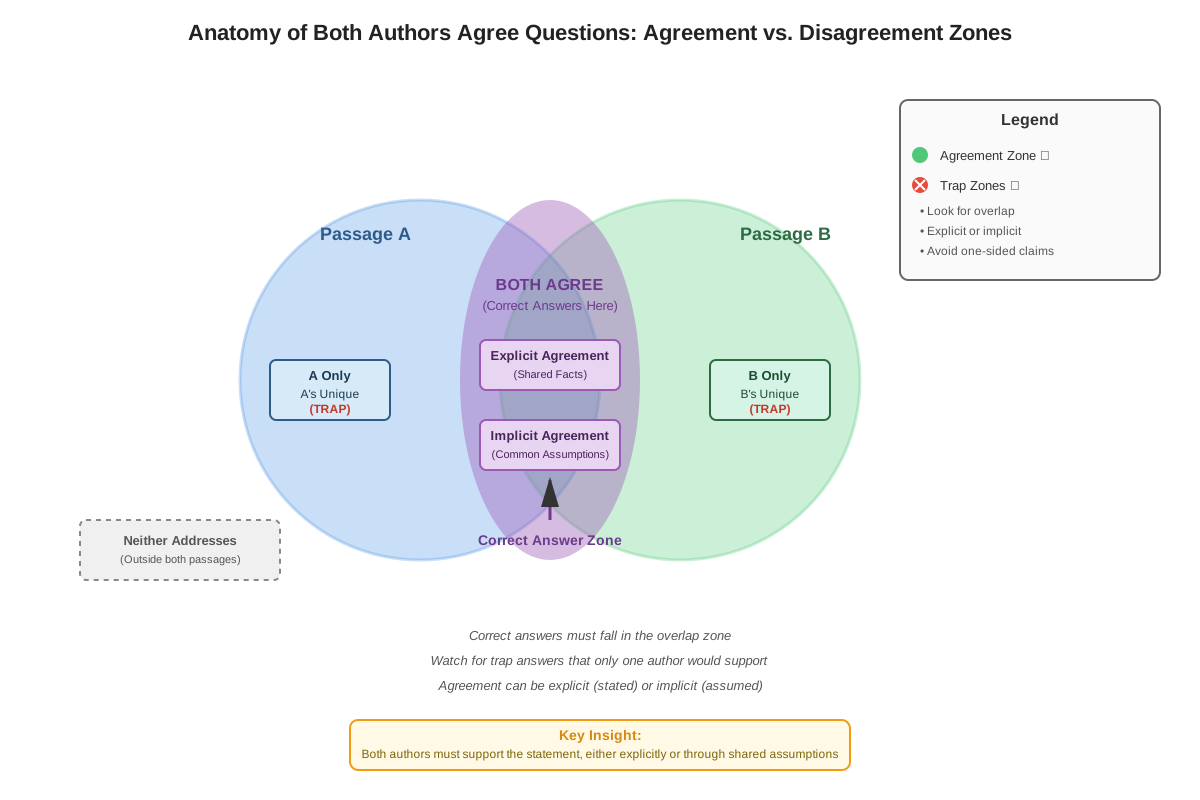
Both authors agree questions ask test-takers to identify propositions that both passages support, either explicitly or through logical implication. The key challenge lies in recognizing that agreement doesn't require identical language or emphasis—two authors can agree on a fact or principle while discussing it in different contexts or drawing different conclusions from it. These questions test whether students can extract the logical commitments of each passage and find the intersection between them.
The question stems typically include phrases like "both passages," "both authors," "each passage," or "the authors would agree." Recognizing these triggers immediately signals the need to verify any answer choice against both passages, not just one. A statement might be perfectly supported by Passage A, but if Passage B contradicts it or remains silent on the issue, it cannot be correct.
Types of Agreement
Agreement between passages can manifest in several distinct ways, and recognizing these categories helps systematically evaluate answer choices:
Factual Agreement: Both authors acknowledge the same objective facts or historical events. For example, if both passages discuss climate change, they might agree that global temperatures have risen over the past century, even if they disagree about causes or solutions.
Definitional Agreement: Both authors use key terms in the same way or accept the same definitions. If both passages discuss "artificial intelligence," they might agree on what qualifies as AI, even while disagreeing about its implications.
Problem Recognition: Both authors acknowledge that a particular problem or challenge exists, even if they propose different solutions. Two passages about healthcare might agree that access is inadequate while disagreeing about whether market-based or government-based solutions are preferable.
Principle Agreement: Both authors accept the same underlying principle or value, even if they apply it differently. Passages about criminal justice might both agree that punishment should be proportionate to harm caused, while disagreeing about what constitutes proportionate punishment.
Limitation Acknowledgment: Both authors recognize the same constraints, limitations, or uncertainties. Scientific passages might both acknowledge that current data is incomplete, even while drawing different tentative conclusions from available evidence.
The Verification Process
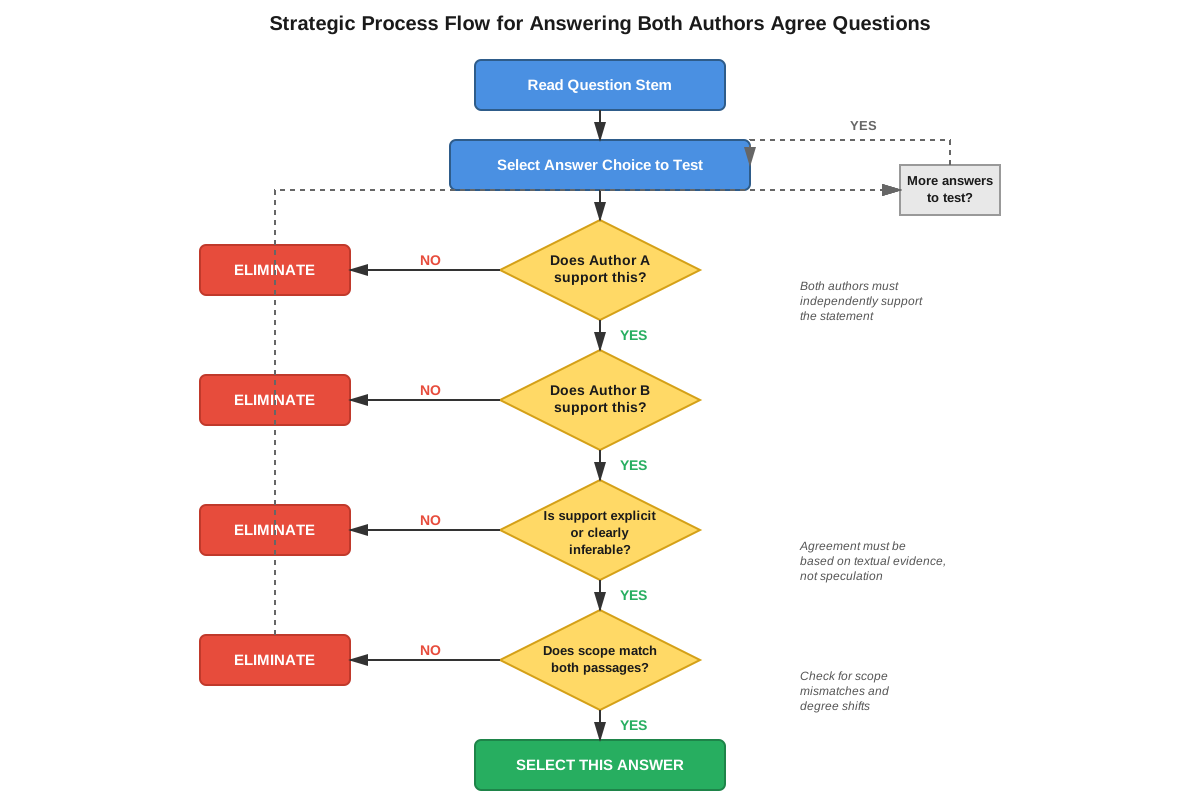
Answering both authors agree questions requires a systematic verification process:
- Read the question stem carefully to understand exactly what type of agreement is being sought
- Evaluate each answer choice against Passage A first, determining whether the passage supports, contradicts, or is silent on the claim
- For choices supported by Passage A, verify against Passage B, using the same analysis
- Eliminate choices that fail either test, remembering that silence (neither supporting nor contradicting) is insufficient—both passages must actively support the claim
- Compare remaining choices to select the one with the strongest support from both passages
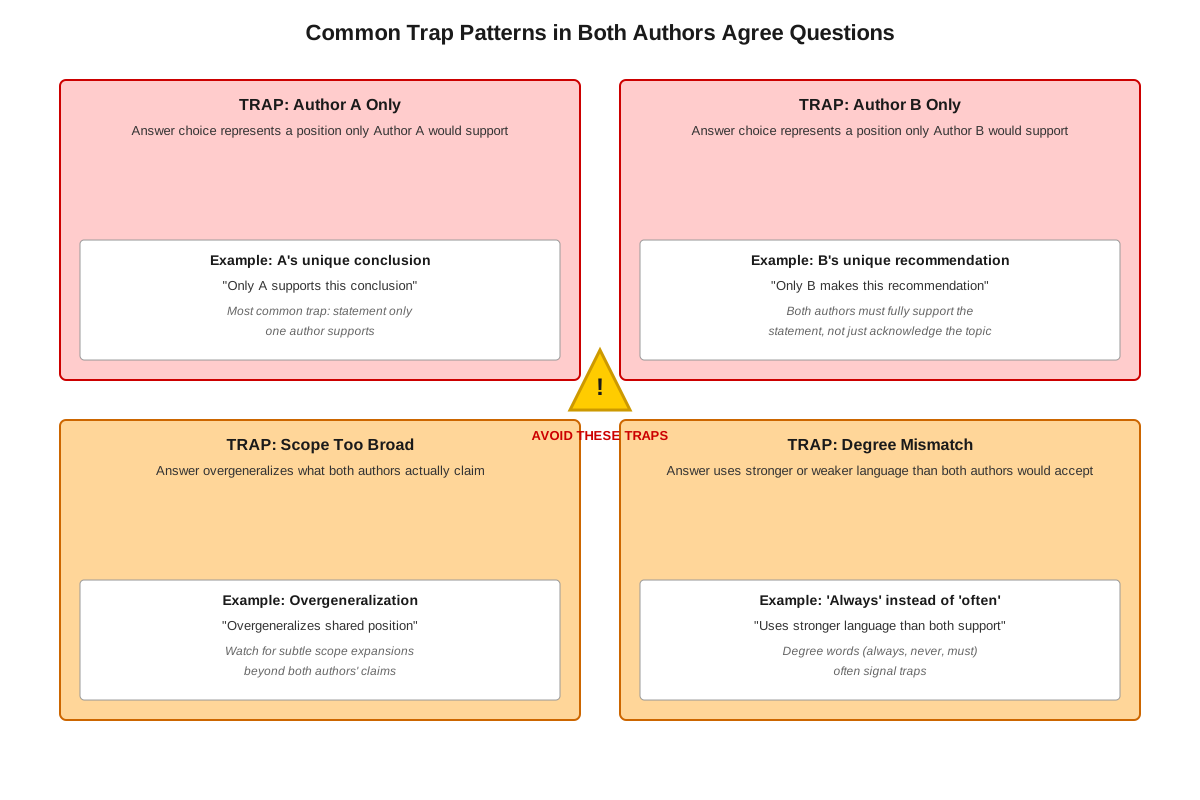
Common Trap Patterns
Understanding how wrong answers are constructed helps avoid them:
| Trap Type | Description | Example |
|---|---|---|
| One-Passage Support | Strongly supported by one passage but not addressed by the other | "Passage A explicitly states X, but Passage B never discusses X" |
| Degree Mismatch | Both passages address the topic but with different levels of commitment | "Passage A says X is possible; Passage B says X is certain" |
| Scope Shift | Answer choice is broader or narrower than what both passages support | "Both passages discuss urban pollution, but answer discusses all environmental problems" |
| Opposite Positions | One passage supports while the other contradicts | "Passage A endorses policy X; Passage B criticizes policy X" |
| Inference Too Far | Requires assumptions beyond what both passages actually commit to | "Both passages imply X might be true, but answer states X is definitely true" |
Reading Strategy for Comparative Passages
Effective annotation while reading comparative passages sets up success on both authors agree questions:
- Track main points separately: Note each passage's primary argument or thesis
- Mark explicit claims: Underline or bracket specific factual assertions each author makes
- Identify tone and attitude: Note whether each author is optimistic, pessimistic, neutral, critical, or supportive regarding key issues
- Flag areas of potential overlap: While reading Passage B, actively look for topics, facts, or principles that Passage A also addressed
- Note explicit disagreements: Understanding where authors differ helps avoid confusion about where they agree
- Distinguish facts from opinions: Both authors might acknowledge the same facts while holding different opinions about their significance
Logical Scope and Commitment
A critical skill for both authors agree questions is understanding what each passage logically commits to, even if not explicitly stated. If Passage A argues that "all mammals require oxygen," it logically commits to the claim that "dogs require oxygen," even if dogs are never mentioned. Similarly, if Passage B discusses how "dogs, cats, and horses all need oxygen to survive," it commits to the broader principle about mammals, even if that generalization isn't explicitly stated.
However, test-takers must be cautious about over-inferring. The LSAT rewards careful reading that distinguishes between what passages definitely commit to and what they merely suggest or leave open. If Passage A says "many experts believe X," it doesn't commit to X being true, only to the fact that many experts believe it.
Concept Relationships
The concepts within both authors agree questions form an interconnected system. The verification process depends on understanding types of agreement, as different answer choices will present different kinds of potential consensus. Recognizing common trap patterns enhances the verification process by alerting test-takers to specific pitfalls during elimination. The reading strategy feeds into all other concepts by ensuring that the necessary information is captured during the initial reading, making verification more efficient and accurate.
These concepts connect to broader comparative reading skills: understanding the relationship between passages (whether they present opposing views, complementary perspectives, or different aspects of the same issue) provides context for where agreement is likely to occur. The skill of identifying main points in single passages extends to identifying the main point of each passage in a comparative set, which often reveals fundamental agreements or disagreements.
Both authors agree questions also relate to inference questions in single passages, as both require understanding what a passage logically commits to beyond explicit statements. They connect to author's attitude questions because understanding each author's perspective helps predict where they might find common ground. Finally, they relate to application questions because both require taking principles or claims from the passage and recognizing them in different forms.
Relationship Map: Reading Strategy → Annotation of key claims → Identification of Agreement Types → Application of Verification Process → Recognition of Trap Patterns → Elimination of Wrong Answers → Selection of Correct Answer
High-Yield Facts
⭐ Both authors agree questions require verification against BOTH passages—support from only one passage makes an answer choice incorrect
⭐ Agreement can be implicit or explicit; authors don't need to use the same language to agree on a principle or fact
⭐ The most common trap is the "one-passage support" answer that strongly appears in one passage but isn't addressed by the other
⭐ Silence is not agreement—if a passage doesn't address a claim, it doesn't support it, even if it doesn't contradict it
⭐ Both authors can agree on facts while disagreeing on interpretations, implications, or solutions
- Authors can agree on problems while disagreeing on solutions, or agree on goals while disagreeing on methods
- Degree matters: if one passage says something is "possible" and another says it's "certain," they don't agree on the strength of the claim
- Scope matters: if one passage discusses a specific case and another discusses a general principle, verify that the relationship between them supports the answer choice
- Both authors agree questions often have correct answers that seem less exciting or comprehensive than wrong answers that only one passage supports strongly
- The correct answer must be defensible from both passages using only what's stated or clearly implied, without requiring outside knowledge
Quick check — test yourself on Both authors agree questions so far.
Try Flashcards →Common Misconceptions
Misconception: If both passages discuss the same topic, they must agree on basic facts about it.
Correction: Passages can discuss the same topic while disagreeing on fundamental facts, definitions, or the existence of problems. Always verify specific claims against both passages rather than assuming agreement based on shared subject matter.
Misconception: Agreement requires both authors to emphasize a point equally or discuss it at similar length.
Correction: One passage might mention a fact briefly in passing while another discusses it extensively. As long as both passages support the claim (explicitly or implicitly), the difference in emphasis doesn't prevent agreement.
Misconception: If an answer choice is strongly supported by one passage and the other passage doesn't contradict it, that's sufficient for a both authors agree question.
Correction: Both passages must actively support the claim. Lack of contradiction is not the same as support. The passage that doesn't contradict might simply not address the issue at all.
Misconception: The correct answer will typically be the main point of both passages.
Correction: While both authors might agree on their main points, this is relatively rare in comparative reading, which typically presents contrasting perspectives. Agreement more commonly occurs on subsidiary facts, shared assumptions, or acknowledged limitations.
Misconception: If both authors have the same attitude (both critical or both supportive) toward something, they agree about it.
Correction: Authors can both be critical of something for entirely different reasons, or both supportive while emphasizing different benefits. Shared attitude doesn't guarantee agreement on specific claims.
Misconception: Complex or sophisticated-sounding answer choices are more likely to be correct.
Correction: Correct answers to both authors agree questions are often relatively simple, straightforward claims that both passages clearly support. Complex answers frequently introduce subtle scope shifts or degree mismatches that make them incorrect.
Misconception: The correct answer will use language that appears in both passages.
Correction: While some correct answers do use passage language, many rephrase or synthesize ideas from both passages using different terminology. Conversely, wrong answers sometimes deliberately use language from both passages while making a claim that one or both don't actually support.
Worked Examples
Example 1: Scientific Passages on Climate Modeling
Passage A discusses the limitations of current climate models, arguing that they cannot accurately predict regional climate changes because they operate at too coarse a resolution. The passage notes that while global temperature trends can be modeled with reasonable confidence, precipitation patterns and extreme weather events remain highly uncertain. The author concludes that policymakers should be cautious about relying on regional predictions.
Passage B presents recent advances in climate modeling, including higher-resolution models and better incorporation of ocean dynamics. The author argues that these improvements make models increasingly reliable for policy purposes. However, the passage acknowledges that even improved models have difficulty with certain phenomena, particularly precipitation patterns, which involve complex interactions at scales smaller than model grid sizes.
Question: Both passages provide support for which one of the following?
Answer Choices:
(A) Climate models are sufficiently accurate for policymakers to rely on them with confidence
(B) Precipitation patterns are more difficult to model accurately than global temperature trends
(C) Recent advances have eliminated most uncertainties in climate modeling
(D) Regional climate predictions are now as reliable as global temperature predictions
(E) Ocean dynamics are the most important factor in climate modeling accuracy
Analysis:
Step 1: Evaluate (A) against Passage A: Passage A explicitly argues that policymakers should be cautious about relying on models, particularly for regional predictions. This contradicts (A). Eliminate (A).
Step 2: Evaluate (B) against Passage A: Passage A states that "global temperature trends can be modeled with reasonable confidence" but "precipitation patterns...remain highly uncertain." This supports (B).
Step 3: Evaluate (B) against Passage B: Passage B acknowledges that "even improved models have difficulty with certain phenomena, particularly precipitation patterns." While Passage B is more optimistic overall, it agrees that precipitation is challenging. This supports (B). Keep (B) as strong candidate.
Step 4: Evaluate (C) against Passage A: Passage A emphasizes ongoing limitations. This contradicts (C). Eliminate (C).
Step 5: Evaluate (D) against Passage A: Passage A explicitly distinguishes between global predictions (more reliable) and regional predictions (less reliable). This contradicts (D). Eliminate (D).
Step 6: Evaluate (E) against Passage A: Passage A doesn't discuss ocean dynamics at all. Eliminate (E) for lack of support from Passage A.
Correct Answer: (B)
This example illustrates several key principles: The correct answer (B) represents a point where both passages agree despite their different overall perspectives (pessimistic vs. optimistic about modeling). The agreement is on a specific, factual claim rather than on the main point of either passage. Wrong answer (A) represents what only Passage B would support. Wrong answer (E) represents the "one-passage support" trap—Passage B discusses ocean dynamics, but Passage A doesn't.
Example 2: Legal Theory Passages on Judicial Interpretation
Passage A advocates for originalism in constitutional interpretation, arguing that judges should interpret the Constitution according to its original public meaning at the time of ratification. The author contends this approach provides stability and prevents judges from imposing their personal values. The passage acknowledges that original meaning isn't always clear and may require historical research, but argues this is preferable to unconstrained judicial discretion.
Passage B defends living constitutionalism, arguing that the Constitution should be interpreted in light of contemporary values and circumstances. The author argues that the Framers intended the Constitution to be adaptable and that rigid adherence to 18th-century understandings produces unjust results. However, the passage acknowledges that judges must be constrained by the text and cannot simply impose their policy preferences—interpretation must be grounded in constitutional language and structure.
Question: The authors of both passages would be most likely to agree with which one of the following statements?
Answer Choices:
(A) Constitutional interpretation should be guided primarily by the original understanding of the Framers
(B) Judges should have broad discretion to interpret the Constitution according to their own values
(C) Some form of constraint on judicial interpretation is necessary and desirable
(D) Historical research into original meaning is essential for proper constitutional interpretation
(E) Contemporary values should play no role in constitutional interpretation
Analysis:
Evaluate (A): Passage A supports this, but Passage B explicitly rejects rigid adherence to original understanding. Eliminate (A).
Evaluate (B): Both passages reject unconstrained judicial discretion. Passage A argues against judges "imposing their personal values," and Passage B states judges "cannot simply impose their policy preferences." Eliminate (B).
Evaluate (C): Passage A argues for constraint through original meaning, preventing judges from imposing personal values. Passage B explicitly states that judges "must be constrained by the text" and that interpretation must be "grounded in constitutional language and structure." Despite advocating different forms of constraint, both passages agree that constraint is necessary. Keep (C) as strong candidate.
Evaluate (D): Passage A supports this, but Passage B doesn't discuss historical research as essential. Eliminate (D) for lack of support from Passage B.
Evaluate (E): Passage A might support this, but Passage B explicitly argues that the Constitution "should be interpreted in light of contemporary values." Eliminate (E).
Correct Answer: (C)
This example demonstrates agreement on an underlying principle (need for constraint) despite disagreement on how that principle should be implemented. The correct answer captures what both authors would accept, even though they advocate different approaches. This illustrates that both authors agree questions often focus on shared assumptions or values rather than specific methodological claims.
Exam Strategy
When approaching both authors agree questions on the LSAT, implement this systematic strategy:
During Initial Reading:
- Read Passage A completely, noting its main point, key claims, and author's attitude
- Before reading Passage B, briefly predict areas where agreement might occur (shared facts, acknowledged problems, common assumptions)
- While reading Passage B, actively note when it addresses topics from Passage A, marking whether it agrees, disagrees, or takes a different angle
- Pay special attention to concessions or acknowledgments in each passage—these often reveal areas of agreement
When Answering the Question:
- Read the question stem carefully to confirm it's asking for agreement (not disagreement or what one author would say about the other's view)
- Develop a hypothesis about what both passages might support before looking at answer choices
- Evaluate each answer choice systematically, always checking both passages
- Use a two-step elimination: first eliminate choices that fail the Passage A test, then eliminate remaining choices that fail the Passage B test
Trigger Words to Watch For:
- Question stems: "both passages," "each passage," "the authors would agree," "both passages support," "both passages provide evidence for"
- In answer choices, watch for absolute language ("always," "never," "only") that might be too strong for one or both passages
- Be alert to scope words ("some," "many," "most," "all") that might create degree mismatches
Process of Elimination Tips:
- Immediately eliminate any choice that contradicts either passage
- Eliminate choices where one passage is silent on the issue (neither supporting nor contradicting)
- Be suspicious of choices that seem to represent the main point of only one passage
- When stuck between two choices, look for subtle scope or degree differences
- The correct answer often feels less "exciting" than wrong answers that strongly appear in one passage
Time Allocation:
- Don't rush the initial reading of comparative passages—investing 30-45 seconds extra to note relationships between passages saves time on questions
- Budget approximately 60-75 seconds per both authors agree question
- If verification is taking too long, mark the question and return to it after completing easier questions in the set
- Remember that comparative reading sets typically have 6-8 questions, so spending extra time on careful reading pays dividends across multiple questions
Exam Tip: If you're unsure about an answer choice, try to find the specific sentence or phrase in each passage that supports it. If you can't point to support in both passages, the answer is wrong.
Memory Techniques
BOTH Acronym for Verification:
- Both passages must support (not just one)
- Obvious support is better than stretched inference
- Test each passage separately
- Hesitation means eliminate (if you're unsure whether a passage supports a claim, it probably doesn't support it strongly enough)
The "Two Thumbs Up" Visualization:
Picture yourself as a movie critic giving thumbs up or thumbs down to each answer choice from the perspective of each author. Only when both authors give "thumbs up" (support) is the answer correct. One thumb up and one neutral (silence) means eliminate. One up and one down (contradiction) definitely means eliminate.
The Agreement Hierarchy (from most to least common):
- Factual acknowledgments (both note the same facts)
- Problem recognition (both see the same challenge)
- Limitations (both acknowledge the same constraints)
- Definitions (both use terms the same way)
- Principles (both accept the same underlying values)
Remember this as "FP-LDP" (Factual-Problem-Limitation-Definition-Principle)
The Silence Rule:
"Silence isn't support, and support isn't silence." If you can't find where a passage addresses a claim, it doesn't support it, no matter how much the other passage does.
Summary
Both authors agree questions in LSAT comparative reading require identifying propositions that both passages support, either explicitly or through clear implication. Success depends on systematic verification against both passages, understanding that agreement can take multiple forms (factual, definitional, problem recognition, principle-based, or limitation acknowledgment), and recognizing common trap patterns, particularly the "one-passage support" trap where an answer is strongly supported by one passage but not addressed by the other. The key insight is that silence is not agreement—both passages must actively support the correct answer. Effective strategy involves careful annotation during reading to track each author's claims and commitments, followed by methodical evaluation of answer choices against both passages. These questions test the sophisticated skill of finding common ground between different perspectives, a critical ability for legal reasoning and law school success. The correct answer typically represents a point of genuine consensus, often on subsidiary facts or shared assumptions rather than main points, and frequently appears less dramatic than wrong answers that only one passage strongly supports.
Key Takeaways
- Both authors agree questions require active support from both passages—one passage supporting and the other being silent is insufficient for a correct answer
- Agreement can be explicit or implicit, and authors don't need to use identical language or emphasis to agree on facts, principles, or problems
- The most common trap is the "one-passage support" answer that appears strongly in one passage but isn't addressed by the other
- Systematic verification is essential: evaluate each answer choice against Passage A first, then verify surviving choices against Passage B
- Correct answers often represent shared assumptions, acknowledged limitations, or factual agreements rather than the main point of either passage
- Understanding the types of agreement (factual, definitional, problem recognition, principle-based, limitation acknowledgment) helps predict and identify correct answers
- Careful annotation during initial reading—noting each author's claims, attitude, and areas of potential overlap—sets up efficient and accurate answering of these questions
Related Topics
Both Authors Disagree Questions: The complement to agreement questions, these ask test-takers to identify points of conflict or contrast between passages. Mastering both authors agree questions provides the foundation for understanding disagreement questions, as both require careful tracking of each author's positions.
Author's Attitude in Comparative Reading: Understanding each author's perspective, tone, and purpose helps predict where they might agree or disagree. This topic builds on both authors agree questions by adding nuance about how authors' overall stances relate to specific claims.
Inference Questions in Comparative Reading: These questions ask what can be inferred from one or both passages. Both authors agree questions are essentially a specialized type of inference question, requiring inference about what both passages commit to.
Application Questions in Comparative Reading: These ask how one or both authors would respond to new scenarios or how principles from the passages apply to new situations. Success with both authors agree questions—understanding what each passage commits to—enables accurate prediction of how authors would respond to novel situations.
Practice CTA
Now that you've mastered the core concepts and strategies for both authors agree questions, it's time to put your knowledge into practice. Work through the practice questions and flashcards to reinforce these skills and build the speed and accuracy you need for test day. Remember, these questions appear on virtually every LSAT, making them high-yield material that directly impacts your score. Each practice question you complete strengthens your ability to identify agreement, avoid traps, and verify answers systematically. You've built a strong foundation—now apply it with confidence!
Sign up free to keep reading
Create a free AnvayaPrep account to finish this LSAT guide on Both authors agree questions — plus flashcards and practice questions.