Overview
Comparative application is a critical skill tested in the LSAT Reading Comprehension section, specifically within comparative reading passages. This question type requires test-takers to apply principles, arguments, or reasoning from one passage to scenarios, claims, or contexts presented in a paired passage. Unlike simple comparison questions that ask students to identify similarities or differences between two texts, comparative application questions demand deeper analytical thinking: students must extract an underlying principle or method from one passage and determine how it would function when applied to the content of the other passage.
Mastering comparative application is essential for LSAT success because these questions appear with high frequency in the comparative reading set—typically one of the four Reading Comprehension passages on every LSAT. The Law School Admission Council (LSAC) deliberately tests this skill because it mirrors the type of reasoning lawyers perform daily: taking legal principles from one case or statute and applying them to new factual situations. Students who struggle with comparative application often lose valuable points not because they misunderstand individual passages, but because they fail to synthesize information across texts and recognize how concepts transfer between contexts.
Within the broader framework of Reading Comprehension, comparative application represents an advanced synthesis skill that builds upon foundational abilities like identifying main ideas, understanding author's purpose, and recognizing argumentative structure. While basic comparative reading questions might ask "How do the authors' tones differ?" or "What do both passages agree upon?", comparative application questions push further by asking "How would the author of Passage A respond to the proposal in Passage B?" or "Which principle from Passage A, if applied to Passage B, would resolve the problem discussed there?" This topic sits at the intersection of critical reading, logical reasoning, and analytical synthesis—making it one of the most intellectually demanding yet high-yield areas to master.
Learning Objectives
- [ ] Identify how Comparative application appears in LSAT questions
- [ ] Explain the reasoning pattern behind Comparative application
- [ ] Apply Comparative application to solve LSAT-style problems accurately
- [ ] Distinguish comparative application questions from other comparative reading question types
- [ ] Evaluate answer choices by testing whether principles from one passage genuinely apply to scenarios in the paired passage
- [ ] Recognize common distractor patterns in comparative application answer choices
- [ ] Synthesize information across both passages to construct valid cross-textual inferences
Prerequisites
- Basic passage comprehension skills: Understanding main ideas, supporting details, and passage structure is essential because comparative application requires accurate comprehension of both passages before synthesis can occur.
- Argument identification: Recognizing claims, evidence, and conclusions within individual passages enables students to extract the principles that will be applied across texts.
- Comparative reading fundamentals: Familiarity with paired passage format and basic comparison questions (similarities, differences, relationships) provides the foundation for more complex application tasks.
- Inference skills: The ability to draw valid conclusions from stated information is crucial since comparative application often requires inferring how unstated principles would function in new contexts.
Why This Topic Matters
Comparative application represents one of the most authentic assessments of legal reasoning on the LSAT. In legal practice, attorneys constantly apply precedents, statutory interpretations, and legal principles from one case to new factual situations—exactly the cognitive process tested by these questions. Law schools value this skill because it demonstrates the analytical flexibility and cross-contextual reasoning essential for success in legal education and practice.
From an exam perspective, comparative application questions appear in approximately 60-70% of comparative reading sets, typically comprising 1-3 questions out of the 5-7 questions that follow paired passages. These questions carry the same point value as any other Reading Comprehension question, but they often prove more time-consuming because they require students to work with both passages simultaneously rather than focusing on one text at a time. Students who master comparative application gain a significant competitive advantage, as these questions frequently separate high scorers from average performers.
On the LSAT, comparative application manifests in several recognizable forms. Questions might ask how an author would respond to claims in the paired passage, which principle from one passage would resolve a problem in the other, how a method described in one passage would apply to a situation in the other, or which example from one passage best illustrates a concept from the other. The passages themselves typically present related but distinct perspectives on a shared topic—for instance, two different approaches to environmental regulation, contrasting theories about artistic interpretation, or complementary but non-identical views on scientific methodology. The LSAC deliberately constructs these paired passages to create opportunities for meaningful application questions that test genuine analytical synthesis rather than superficial pattern matching.
Core Concepts
Understanding Comparative Application
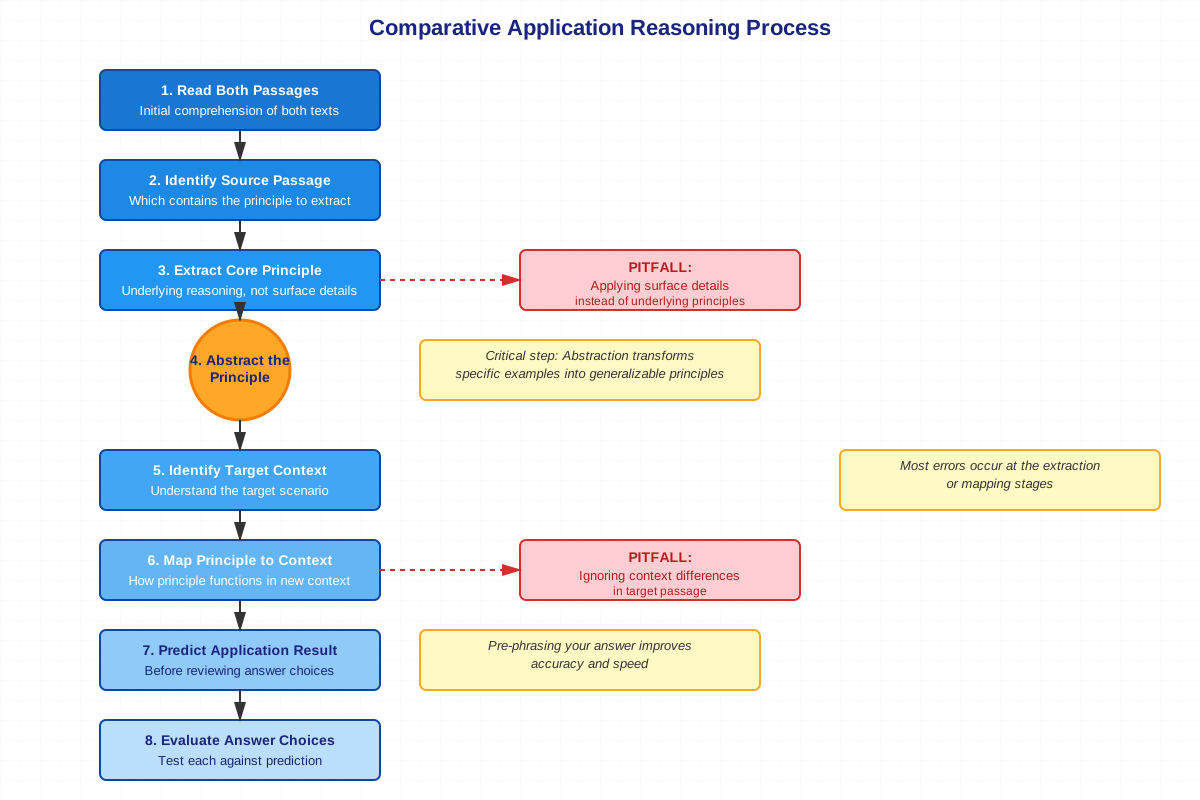
Comparative application refers to the cognitive process of taking a principle, method, argument, or reasoning pattern from one passage and determining how it would function when applied to the content, scenarios, or claims presented in a paired passage. This process requires three distinct analytical steps: (1) accurately identifying and extracting the relevant principle or method from the source passage, (2) thoroughly understanding the target scenario or claim in the second passage, and (3) reasoning through how the principle would interact with the new context—whether it would support, contradict, resolve, explain, or otherwise affect the target material.
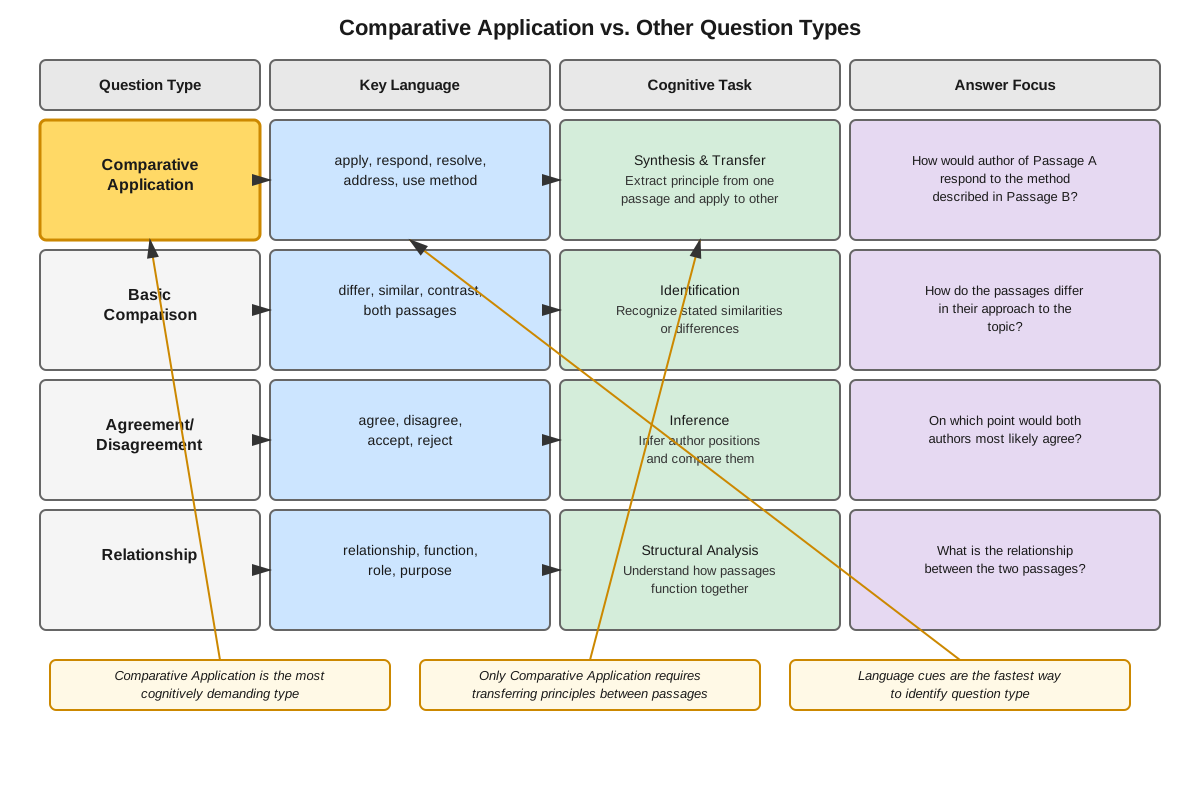
The key distinction between comparative application and simpler comparison questions lies in the directionality and depth of analysis required. A basic comparison question might ask "Do both authors agree that X?" which requires only identifying stated positions in each passage. In contrast, a comparative application question asks "How would Author A's principle apply to the situation described by Author B?"—requiring students to extract an often-implicit principle, understand its logical structure, and project its effects onto new material.
The Reasoning Pattern Behind Application Questions
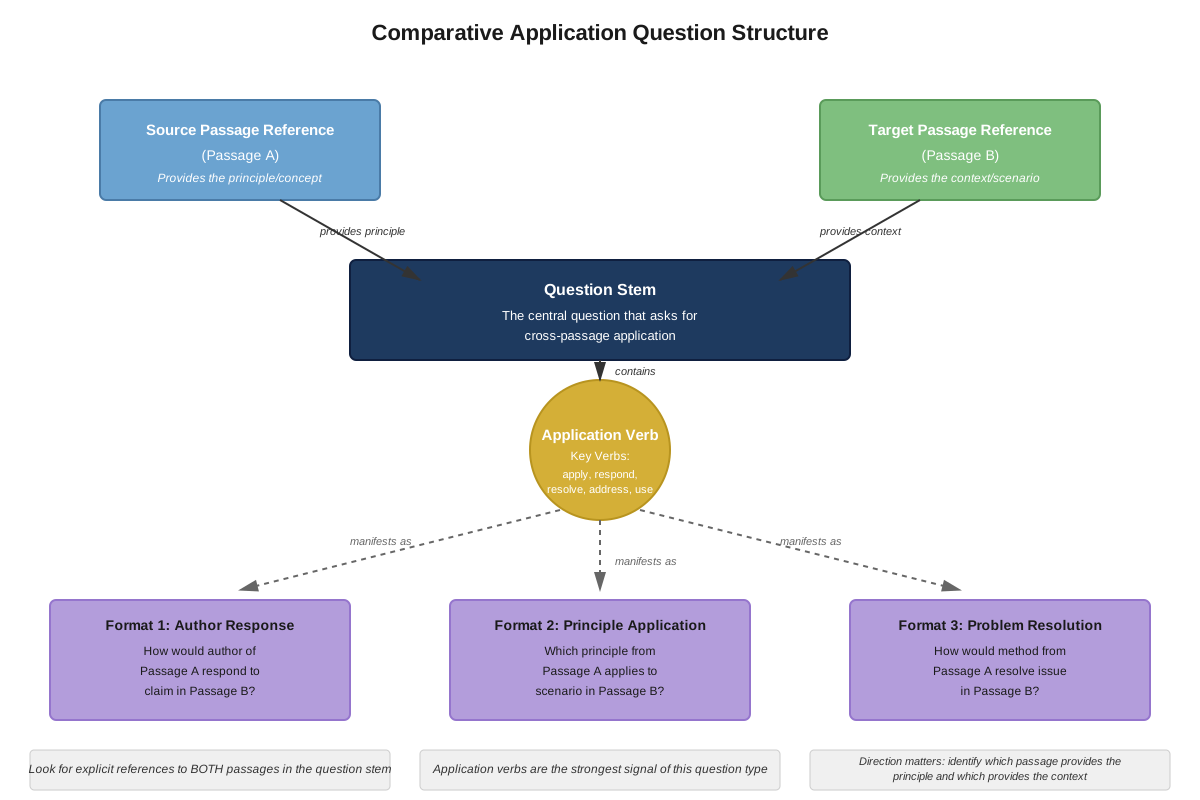
The logical structure of comparative application follows a consistent pattern that mirrors legal reasoning. First, the question stem identifies a source element (a principle, method, argument, or approach from one passage) and a target element (a claim, scenario, problem, or situation from the other passage). The student's task is to construct a valid inference about their relationship.
This reasoning pattern typically involves analogical reasoning: recognizing that if Principle P applies to Situation S1 in Passage A, and Situation S2 in Passage B shares relevant characteristics with S1, then Principle P should apply to S2 in a predictable way. The challenge lies in determining which characteristics are "relevant"—which features of the situations matter for the principle's application and which are merely superficial differences.
Consider this structure:
- Extraction: Identify the principle/method in the source passage (often requiring inference from examples or arguments)
- Analysis: Understand the logical conditions under which this principle operates
- Mapping: Identify the relevant features of the target scenario
- Application: Determine how the principle would function in the new context
- Evaluation: Assess answer choices based on whether they accurately represent this application
Types of Comparative Application Questions
LSAT comparative application questions appear in several distinct formats, each testing slightly different aspects of cross-textual reasoning:
| Question Type | What It Tests | Example Stem |
|---|---|---|
| Author Response | How one author would react to claims in the other passage | "The author of Passage A would most likely respond to the proposal in lines 34-38 of Passage B by..." |
| Principle Application | Which principle from one passage applies to scenarios in the other | "Which principle from Passage A, if valid, would most help resolve the dilemma described in Passage B?" |
| Method Transfer | How a method from one passage would function if applied to the other | "If the approach described in Passage B were applied to the situation in Passage A, the result would most likely be..." |
| Example Illustration | Which example from one passage best illustrates a concept from the other | "Which example from Passage A best illustrates the phenomenon described in lines 12-15 of Passage B?" |
| Analogical Reasoning | Identifying parallel structures or situations across passages | "The relationship between X and Y in Passage A is most analogous to which relationship in Passage B?" |
Identifying Application Questions
Recognizing comparative application questions quickly allows for efficient time management and appropriate strategic approaches. These questions contain characteristic trigger phrases that signal the need for cross-textual synthesis:
- "The author of Passage A would most likely..."
- "If the principle from Passage B were applied to..."
- "Which approach from Passage A would best address..."
- "The method described in Passage B would most likely..."
- "How would the author of Passage A respond to..."
- "Which example from Passage B best illustrates the concept in Passage A..."
The presence of explicit references to both passages (either by letter designation or line references to each) combined with language suggesting action, response, or transfer ("would," "if applied," "would respond") reliably indicates a comparative application question.
The Role of Implicit Principles
Many comparative application questions require students to work with implicit principles—underlying rules or patterns that aren't explicitly stated but can be inferred from the passage's arguments or examples. For instance, a passage might describe how a particular environmental regulation succeeded by involving local stakeholders in decision-making. The implicit principle might be: "Regulatory approaches that incorporate affected parties' input are more likely to succeed than top-down mandates." This principle, once extracted, could then be applied to evaluate a different regulatory scenario in the paired passage.
Extracting implicit principles requires asking: "What general rule or pattern would explain why the author makes these specific claims?" or "What underlying assumption connects this evidence to this conclusion?" Students must move from the concrete specifics of the passage to the abstract principle that governs them, then return to concrete application in the new context.
Concept Relationships
The concepts within comparative application form a hierarchical and sequential relationship. Basic passage comprehension serves as the foundation, enabling principle extraction, which in turn allows for analogical mapping between passages, ultimately resulting in valid application inferences. Each step depends on the previous one: without accurate comprehension, principle extraction fails; without clear principles, mapping becomes impossible; without proper mapping, application inferences will be invalid.
Comparative application connects to prerequisite topics in essential ways. Argument identification skills enable students to recognize the logical structure of claims in both passages, which is necessary for determining how principles would support or contradict new claims. Inference skills extend naturally into comparative application—while basic inference works within a single passage, comparative application requires cross-textual inference that synthesizes information from both sources. Main idea identification helps students distinguish between central principles (which are more likely to be the subject of application questions) and peripheral details.
The relationship map for this topic flows as follows:
Passage Comprehension → Principle/Method Extraction → Target Scenario Analysis → Analogical Mapping → Application Reasoning → Answer Evaluation
Additionally, comparative application connects forward to broader LSAT skills. The analogical reasoning practiced here directly supports Logical Reasoning questions, particularly those involving principles, parallels, and application. The synthesis skills developed through comparative application also enhance performance on complex single-passage Reading Comprehension questions that require integrating information from different parts of a text.
High-Yield Facts
⭐ Comparative application questions appear in 60-70% of LSAT comparative reading sets, making them one of the most frequently tested question types in paired passages.
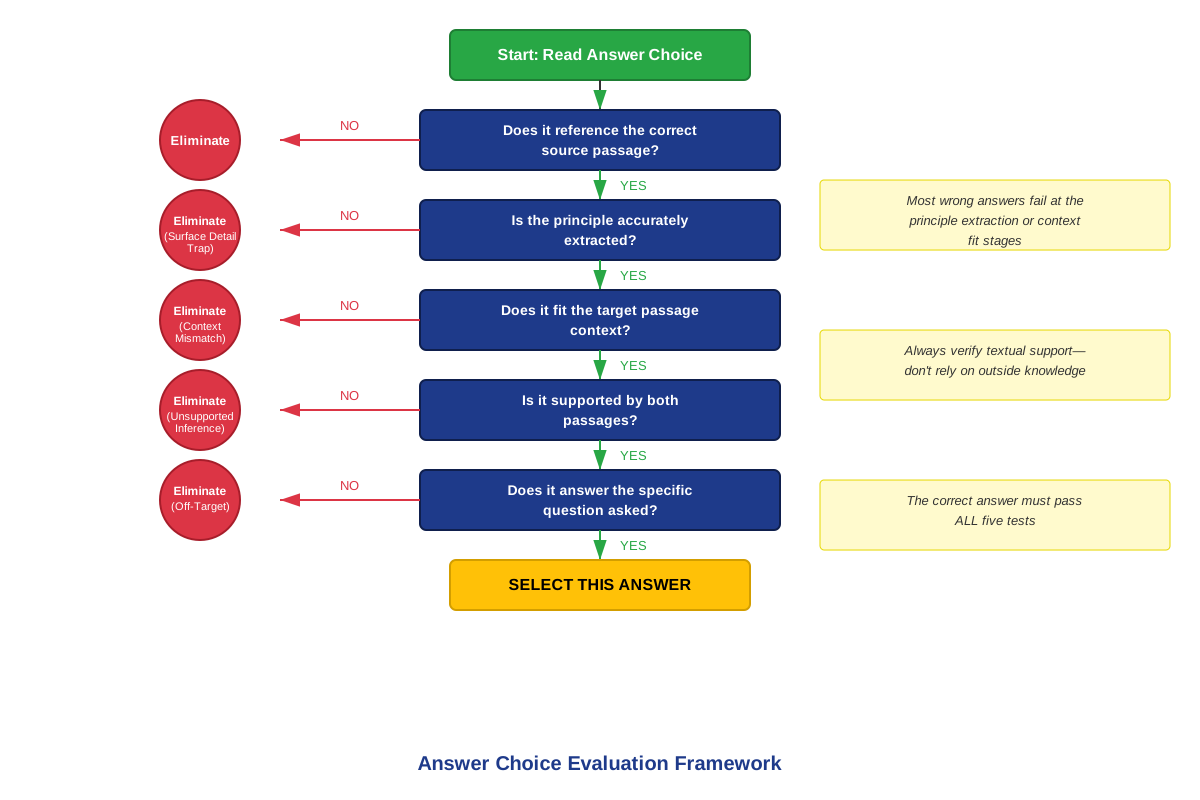
⭐ The correct answer to a comparative application question must be supported by both passages—it must accurately represent the principle from the source passage AND correctly describe how it applies to the target passage.
⭐ Implicit principles are more commonly tested than explicit ones—students must often infer the underlying rule or pattern from examples or arguments rather than finding it directly stated.
⭐ Author response questions require understanding not just what an author said, but the reasoning pattern and values underlying their position, enabling prediction of how they would react to new claims.
⭐ The most common wrong answer type in comparative application questions is the "misapplication" distractor—an answer that correctly identifies a principle from one passage but incorrectly describes how it would apply to the other.
- Comparative application questions typically take 30-45 seconds longer to answer than basic comparison questions because they require working with both passages simultaneously.
- The principle being applied is usually drawn from the passage that takes a more theoretical, abstract, or methodological approach, while the target scenario comes from the more concrete or example-focused passage.
- Extreme language in answer choices ("completely resolve," "entirely eliminate," "prove conclusively") is usually incorrect because principles typically have qualified or limited effects when applied to new contexts.
- Questions asking how one author would "respond to" or "evaluate" claims in the other passage require understanding the author's perspective and values, not just their explicit statements.
- The LSAC often constructs paired passages where one presents a problem and the other presents a method or principle—creating natural opportunities for application questions about whether the method would solve the problem.
Quick check — test yourself on Comparative application so far.
Try Flashcards →Common Misconceptions
Misconception: Comparative application questions can be answered by finding explicit statements in the passages that directly address each other.
Correction: These questions almost always require inference and synthesis. The passages rarely directly reference each other's specific claims; instead, students must extract principles from one passage and independently reason through how they would apply to scenarios in the other. The analytical work happens in the student's mind, not on the page.
Misconception: If a principle from Passage A seems related to a topic in Passage B, it must apply in a supportive or helpful way.
Correction: Principles can apply in various ways—they might support, contradict, complicate, or be irrelevant to claims in the other passage. The relationship must be reasoned through carefully. A principle about the importance of empirical evidence, for instance, might actually undermine a theoretical argument in the paired passage rather than supporting it.
Misconception: The correct answer will use similar vocabulary or phrasing to what appears in the passages.
Correction: Correct answers often paraphrase or describe principles using different language than the passage itself. Students who rely on word-matching rather than conceptual understanding frequently select wrong answers that use passage vocabulary but misrepresent the actual application. Focus on concepts, not keywords.
Misconception: Comparative application questions are just asking for opinions about what might happen—any reasonable-sounding answer could be correct.
Correction: These questions have objectively correct answers that must be fully supported by the passage content. The application must follow logically from the principle as described in the source passage and must accurately characterize the target scenario. Personal intuition about what "seems reasonable" is irrelevant; only passage-supported inferences count.
Misconception: You need to fully understand every detail of both passages before attempting comparative application questions.
Correction: While solid comprehension is important, these questions typically focus on specific principles or scenarios that can be analyzed in isolation. Students can often answer application questions by thoroughly understanding the relevant portions of each passage referenced in the question stem, rather than needing complete mastery of every detail. Strategic focus on the referenced content is more efficient than attempting comprehensive memorization.
Worked Examples
Example 1: Author Response Question
Passage A Summary: Describes how traditional economic models assume rational actors who maximize utility, but behavioral economics has revealed systematic cognitive biases that cause predictable deviations from rational choice. The author argues these biases should be incorporated into economic models to improve their predictive accuracy.
Passage B Summary: Discusses a proposed policy to automatically enroll employees in retirement savings plans (with opt-out options) rather than requiring them to actively opt in. The author notes that participation rates increase dramatically under automatic enrollment.
Question: The author of Passage A would most likely view the policy described in Passage B as:
(A) an example of how traditional economic models successfully predict behavior
(B) evidence that cognitive biases can be leveraged to improve policy outcomes
(C) proof that rational choice theory should be completely abandoned
(D) a demonstration that behavioral economics has limited practical applications
(E) an indication that people's preferences are fundamentally unknowable
Step 1 - Extract the principle from Passage A: The author believes cognitive biases cause predictable deviations from rational choice, and understanding these biases can improve outcomes (in this case, economic models, but the principle extends to policy).
Step 2 - Analyze the scenario in Passage B: The automatic enrollment policy works because of a cognitive bias (status quo bias or default bias)—people tend to stick with default options rather than actively choosing. This is a "predictable deviation from rational choice" (a fully rational actor would evaluate the retirement plan and make an active choice based on utility maximization).
Step 3 - Apply the principle: The author of Passage A, who advocates for incorporating cognitive biases into our understanding to improve outcomes, would view this policy as a positive example of using bias knowledge to achieve better results (higher retirement savings participation).
Step 4 - Evaluate answers:
- (A) is incorrect—traditional models assume rational choice; this policy works precisely because people aren't fully rational
- (B) is correct—this perfectly captures how understanding cognitive biases (default bias) leads to improved policy outcomes
- (C) is too extreme—the author advocates incorporating biases, not abandoning rational choice theory entirely
- (D) contradicts the passage—the author thinks behavioral economics improves practical applications
- (E) is unsupported—the author believes biases are predictable, not that preferences are unknowable
Answer: (B)
This example demonstrates how comparative application requires extracting an implicit principle (understanding biases improves outcomes) and recognizing how a concrete scenario in the other passage exemplifies that principle.
Example 2: Principle Application Question
Passage A Summary: Argues that effective science communication requires scientists to understand their audience's existing knowledge and concerns, then frame scientific information in terms that connect to those concerns. Provides examples of failed communication campaigns that used technical jargon without considering audience perspective.
Passage B Summary: Describes a controversy over a proposed wind farm. Local residents oppose it due to concerns about property values and landscape aesthetics, while environmental advocates emphasize climate benefits and cite technical studies about wind energy efficiency.
Question: Which approach from Passage A, if applied to the situation in Passage B, would most likely improve the environmental advocates' effectiveness?
(A) Conducting additional technical studies to provide more comprehensive data
(B) Framing wind energy benefits in terms of local property values and community aesthetics
(C) Using more precise scientific terminology to increase credibility
(D) Focusing exclusively on the global climate crisis to emphasize urgency
(E) Avoiding any discussion of residents' concerns to prevent legitimizing them
Step 1 - Extract the method from Passage A: Effective communication requires understanding the audience's existing concerns and framing information in terms that connect to those concerns (not just presenting technical information).
Step 2 - Analyze the problem in Passage B: Environmental advocates are emphasizing technical studies and climate benefits, but local residents care about property values and aesthetics—there's a mismatch between the advocates' framing and the audience's concerns.
Step 3 - Apply the method: Following Passage A's approach, advocates should understand residents' concerns (property values, aesthetics) and frame wind energy benefits in those terms rather than focusing on technical efficiency or global climate issues that don't address local concerns.
Step 4 - Evaluate answers:
- (A) contradicts Passage A—more technical data doesn't address the communication problem
- (B) is correct—this applies Passage A's method by connecting to audience concerns (property values, aesthetics)
- (C) contradicts Passage A—technical jargon was identified as ineffective
- (D) contradicts Passage A—this ignores audience concerns rather than connecting to them
- (E) contradicts Passage A—understanding and addressing audience concerns is central to the method
Answer: (B)
This example shows how comparative application can involve transferring a method from one passage to solve a problem in another, requiring students to recognize the structural parallel between the communication failures described in Passage A and the situation in Passage B.
Exam Strategy
When approaching comparative application questions on the LSAT, employ a systematic process that ensures accuracy while managing time effectively. First, identify the question type by looking for trigger phrases like "would respond," "if applied," or "would most likely view." This recognition allows you to activate the appropriate analytical framework.
Second, locate and thoroughly understand the referenced content in both passages. If the question references specific lines, reread those lines plus surrounding context. For principle extraction, identify not just what the passage says but why—what underlying rule or pattern explains the author's reasoning? For target scenarios, understand the specific features and context that matter for application.
Third, perform the application reasoning before looking at answer choices. Predict how the principle would function in the new context: Would it support or contradict? Resolve or complicate? Explain or challenge? This prediction serves as your guide when evaluating answers, preventing you from being swayed by attractive but incorrect options.
Fourth, use strategic elimination. Wrong answers in comparative application questions typically fall into predictable categories:
- Misapplication: Correctly identifies the principle but incorrectly describes its application
- Wrong principle: Applies something from the passage that isn't the relevant principle
- Unsupported inference: Makes claims about application that go beyond what the passages support
- Reversal: Gets the direction of application backwards (e.g., says the principle would support when it would actually contradict)
- Extreme language: Claims the principle would "completely resolve" or "prove conclusively" when the passages support only qualified effects
Exam Tip: If you're stuck between two answers, return to the passages and verify each answer's claims. The correct answer must be supported by BOTH passages—it must accurately represent the source principle AND correctly describe the target scenario.
Time allocation for comparative application questions should be approximately 60-75 seconds—slightly longer than average Reading Comprehension questions because of the dual-passage analysis required. If a question is taking longer than 90 seconds, make your best educated guess and move on; these questions can become time sinks if you get caught in circular reasoning.
Watch for these trigger words that signal specific types of application:
- "Would respond/react/view" → Author response question (requires understanding perspective and values)
- "If applied/if used" → Method transfer question (requires understanding how a process works)
- "Would help/resolve/address" → Problem-solving application (requires matching principle to problem features)
- "Best illustrates/exemplifies" → Example matching (requires identifying parallel structures)
Memory Techniques
Use the acronym EXTRACT to remember the systematic process for comparative application questions:
- Examine the question stem to identify what's being applied and where
- X-tract the principle or method from the source passage
- Target scenario analysis—understand the relevant features
- Reason through the application before viewing answers
- Analyze answer choices against your prediction
- Check that the correct answer is supported by BOTH passages
- Test remaining answers by returning to passage content
For remembering the common wrong answer types, use MURU:
- Misapplication (right principle, wrong application)
- Unsupported inference (goes beyond passage support)
- Reversal (gets the direction backwards)
- Unrelated principle (applies the wrong concept)
Visualize comparative application as a bridge-building exercise: You're constructing a logical bridge from one passage to the other. The principle from the source passage is your building material, the target scenario is your destination, and your reasoning is the bridge structure. If any component is weak (misunderstood principle, unclear target, faulty reasoning), the bridge collapses and you select a wrong answer.
For author response questions specifically, imagine the authors in a debate or conversation. What would Author A say if Author B made this claim? This personification helps you think about perspective, values, and reasoning patterns rather than just isolated facts.
Summary
Comparative application represents a sophisticated analytical skill that requires students to extract principles or methods from one passage and determine how they would function when applied to scenarios, claims, or problems in a paired passage. This question type appears frequently in LSAT comparative reading sets and tests the kind of cross-contextual reasoning essential for legal practice. Success requires a systematic approach: accurately identifying and extracting relevant principles (often implicit rather than explicit), thoroughly understanding target scenarios, reasoning through how principles would apply in new contexts, and carefully evaluating answer choices against passage support. The most common errors involve misapplication (correct principle, incorrect application), selecting answers based on superficial word-matching rather than conceptual understanding, and failing to verify that answers are supported by both passages. Students who master comparative application gain significant competitive advantage because these questions effectively separate high scorers from average performers, requiring genuine synthesis and analytical reasoning rather than simple information retrieval.
Key Takeaways
- Comparative application questions require extracting principles from one passage and reasoning through how they would apply to scenarios in the paired passage—this is synthesis, not simple comparison.
- The correct answer must be supported by BOTH passages: it must accurately represent the source principle AND correctly describe how it applies to the target content.
- Implicit principles are more commonly tested than explicit ones—look for underlying patterns and rules that explain the passage's arguments and examples.
- Perform application reasoning BEFORE viewing answer choices to avoid being misled by attractive but incorrect options that misapply principles.
- Common wrong answers include misapplications, unsupported inferences, reversals, and extreme claims—use these patterns for strategic elimination.
- Author response questions require understanding perspective and values, not just explicit statements—consider the reasoning pattern underlying the author's position.
- Allocate 60-75 seconds per comparative application question and use systematic processes (EXTRACT) to ensure accuracy while managing time effectively.
Related Topics
Comparative Reading Fundamentals: Understanding how to approach paired passages, identify relationships between texts, and answer basic comparison questions provides the foundation for more advanced comparative application skills. Mastering this topic enables progression to complex synthesis questions.
Inference Questions in Reading Comprehension: The ability to draw valid conclusions from stated information extends naturally into comparative application, where cross-textual inferences are required. Strong inference skills make application reasoning more reliable and efficient.
Parallel Reasoning in Logical Reasoning: The analogical reasoning practiced in comparative application directly supports Logical Reasoning questions that ask students to identify parallel argument structures or apply principles to new scenarios. Skills developed here transfer across LSAT sections.
Main Point and Primary Purpose Questions: Distinguishing central principles from peripheral details helps students identify which concepts from a passage are most likely to be the subject of application questions, improving efficiency and accuracy.
Author's Attitude and Perspective: Understanding how authors' values and reasoning patterns shape their arguments enables more accurate predictions about how they would respond to claims in paired passages, particularly for author response application questions.
Practice CTA
Now that you've mastered the core concepts and strategies for comparative application, it's time to put your knowledge into practice. Attempt the practice questions and flashcards designed specifically for this topic—they'll help you internalize the systematic approach and recognize common patterns in real LSAT questions. Remember, comparative application is a skill that improves dramatically with deliberate practice. Each question you work through strengthens your ability to extract principles, reason through applications, and avoid common traps. You're building the analytical synthesis skills that will serve you not just on test day, but throughout your legal education and career. Approach each practice question as an opportunity to refine your process and deepen your mastery!
Sign up free to keep reading
Create a free AnvayaPrep account to finish this LSAT guide on Comparative application — plus flashcards and practice questions.