Overview
Comparative extreme answers represent one of the most frequently tested trap patterns in LSAT Reading Comprehension, particularly within the Comparative Reading section. This question type exploits test-takers' tendency to overstate the relationship between two passages, pushing them toward answer choices that claim one passage is "completely opposed to," "entirely contradicts," or "wholly supports" another passage when the actual relationship is more nuanced. Understanding how to identify and eliminate these extreme comparative statements is essential for achieving a competitive score on the LSAT, as they appear in approximately 60-70% of Comparative Reading question sets.
The LSAT tests critical reading skills that law schools value: the ability to make precise distinctions, avoid overgeneralization, and recognize when evidence supports only moderate rather than absolute claims. Comparative extreme answers in reading comprehension questions specifically assess whether test-takers can accurately characterize the relationship between two passages without exaggerating areas of agreement or disagreement. These questions require students to hold two complex arguments in mind simultaneously while making careful judgments about the degree and nature of their relationship.
Within the broader framework of LSAT comparative extreme answers, this topic connects directly to fundamental Reading Comprehension skills including passage analysis, author's tone identification, and scope recognition. Mastering comparative extreme answers builds upon general extreme answer recognition while adding the complexity of evaluating relationships between texts rather than single-passage claims. This skill transfers directly to other LSAT sections, particularly Logical Reasoning, where degree and scope distinctions separate correct from incorrect answers.
Learning Objectives
- [ ] Identify how Comparative extreme answers appears in LSAT questions
- [ ] Explain the reasoning pattern behind Comparative extreme answers
- [ ] Apply Comparative extreme answers to solve LSAT-style problems accurately
- [ ] Distinguish between appropriately strong comparative statements and unjustified extreme claims
- [ ] Recognize the specific language markers that signal extreme comparative answers
- [ ] Evaluate the degree of support each passage provides for comparative claims
- [ ] Predict common extreme answer traps before reviewing answer choices
Prerequisites
- Basic Reading Comprehension skills: Understanding main ideas, author's purpose, and passage structure forms the foundation for comparing two passages effectively
- Familiarity with standard LSAT question types: Knowledge of inference, main point, and function questions helps recognize how comparative questions modify these formats
- Understanding of scope and degree in LSAT answers: Recognizing when single-passage answers are too extreme prepares students for the added complexity of comparative extremes
- Experience with Comparative Reading format: Knowing that Comparative Reading presents two shorter passages (Passage A and Passage B) on related topics establishes the context for relationship questions
Why This Topic Matters
The ability to avoid comparative extreme answers directly impacts LSAT performance because these trap answers appear with remarkable consistency. Statistical analysis of released LSAT exams reveals that approximately 2-3 questions per Comparative Reading set (which typically contains 5-7 questions) include at least one extreme comparative answer as a trap. Given that Comparative Reading appears once per exam and represents roughly 25% of the Reading Comprehension section, mastering this skill affects 5-8% of the total LSAT score—a significant margin in a test where 3-4 additional correct answers can raise a score by 5 points.
Beyond test performance, the analytical skill of precisely characterizing relationships between arguments has direct real-world applications in legal practice. Attorneys must accurately represent precedent cases, distinguish their client's situation from unfavorable rulings, and avoid overstating the support that authorities provide for their positions. Law school admissions committees value the LSAT specifically because it tests these precise reasoning abilities.
In exam passages, comparative extreme answers most commonly appear in questions asking about the relationship between passages ("The author of Passage B would most likely respond to the argument in Passage A by..."), questions about agreement or disagreement ("On which of the following would the authors of both passages be most likely to agree?"), and questions about how one passage relates to claims in the other ("Which of the following best describes the relationship between the two passages?"). These questions reward careful, moderate characterizations and punish overstatement.
Core Concepts
Definition of Comparative Extreme Answers
Comparative extreme answers are incorrect answer choices in LSAT comparative reading questions that overstate the degree, scope, or nature of the relationship between two passages. These answers use absolute language to characterize one passage as completely supporting, entirely contradicting, or wholly agreeing with another passage when the textual evidence supports only a partial or qualified relationship. The extremity lies not in the content itself but in the unwarranted strength of the comparative claim.
Unlike extreme answers in single-passage questions (which make unjustified absolute claims about one passage's content), comparative extreme answers specifically exaggerate the connection between passages. An answer might accurately describe each passage individually but still be extreme in how it characterizes their relationship. For example, if Passage A discusses economic benefits of a policy and Passage B discusses environmental concerns, an answer stating "Passage B directly refutes the central argument of Passage A" would be extreme because the passages address different aspects rather than directly opposing each other.
The Spectrum of Comparative Relationships
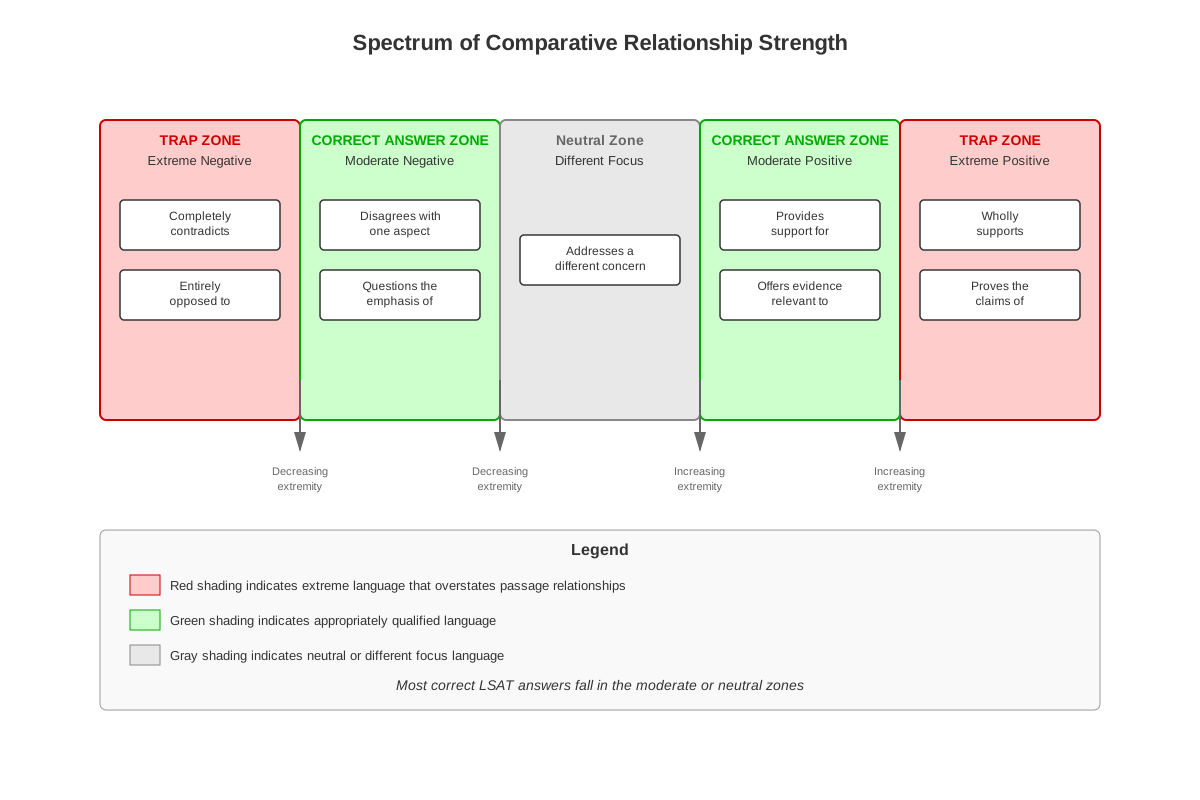
Understanding comparative extreme answers requires recognizing that passage relationships exist on a spectrum rather than in binary categories. The LSAT tests whether students can identify the precise point on this spectrum:
| Relationship Strength | Appropriate Language | Extreme Language |
|---|---|---|
| Complete opposition | "directly contradicts," "fundamentally incompatible" | "utterly refutes," "completely disproves" |
| Partial disagreement | "raises concerns about," "questions an assumption of" | "demolishes," "entirely undermines" |
| Different focus | "addresses a different aspect," "takes an alternative approach" | "contradicts," "opposes" |
| Partial agreement | "shares a concern with," "would likely agree that" | "fully supports," "completely validates" |
| Strong agreement | "reinforces," "provides additional support for" | "proves," "definitively establishes" |
The middle categories—partial disagreement, different focus, and partial agreement—represent where most passage relationships actually fall, yet extreme answers push test-takers toward the endpoints of complete opposition or total agreement.
Common Extreme Comparative Language Markers
Certain words and phrases reliably signal comparative extreme answers. Recognizing these markers enables rapid identification of potentially problematic choices:
Absolute agreement markers:
- "completely supports"
- "entirely validates"
- "fully endorses"
- "proves the argument in"
- "definitively establishes"
- "provides conclusive evidence for"
Absolute opposition markers:
- "directly refutes"
- "completely contradicts"
- "entirely undermines"
- "thoroughly disproves"
- "fundamentally incompatible with"
- "wholly rejects"
Scope expansion markers:
- "both passages agree that" (when they agree on one point but not broadly)
- "the passages are primarily concerned with" (when they share one concern among several)
- "throughout both passages" (when the relationship exists in only one section)
Not every answer containing these words is incorrect—occasionally, passages do completely contradict each other. However, these markers should trigger careful verification that the passage relationship truly justifies such strong language.
The Mechanism of Comparative Extreme Traps
The psychological mechanism behind comparative extreme answer traps exploits several cognitive tendencies. First, after reading two passages on related topics, test-takers naturally focus on the most obvious points of connection or contrast, making these salient features seem more representative of the overall relationship than they actually are. Second, the mental effort of holding two complex arguments simultaneously encourages simplification—reducing nuanced relationships to simple "agree/disagree" binaries. Third, extreme answers often feel more decisive and confident, creating an illusion of correctness.
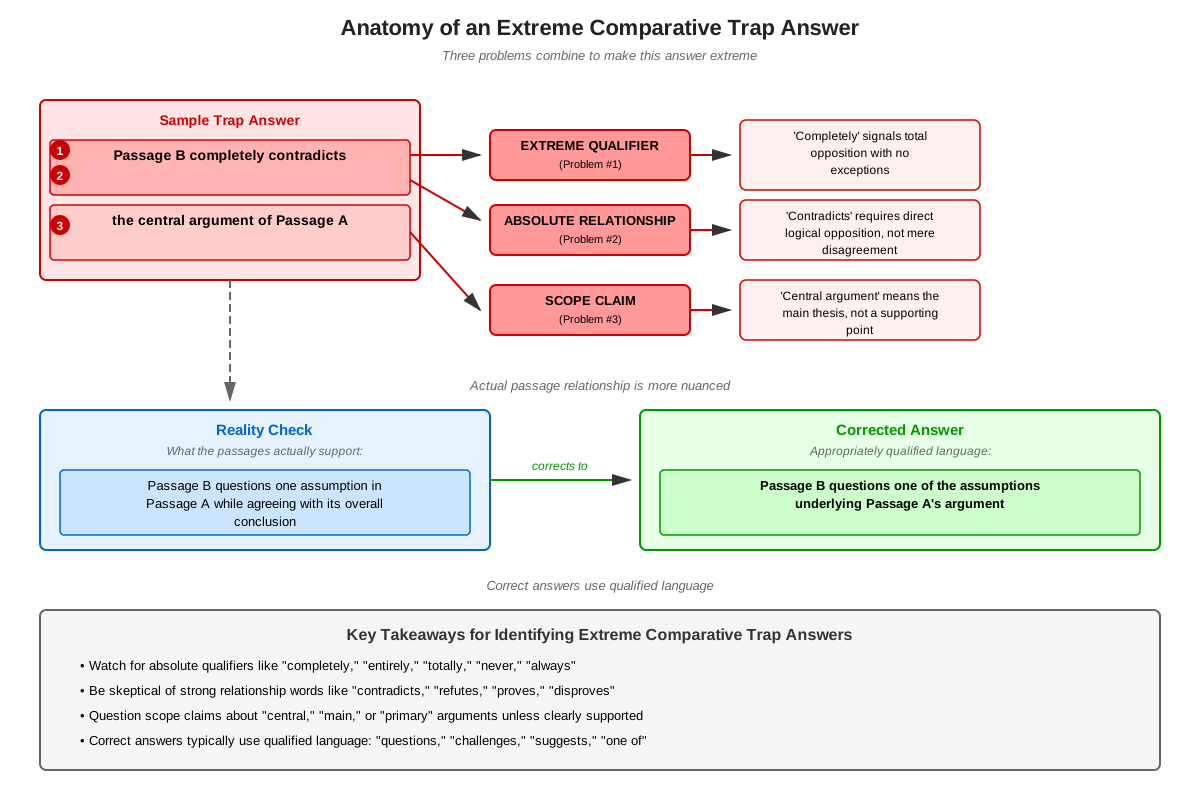
The LSAT constructs these traps systematically. A typical extreme comparative answer will:
- Identify a real point of connection or contrast between passages
- Accurately describe that specific point
- Overstate how representative or significant that point is to the overall relationship
- Use absolute language that the passages don't support
For example, if Passage A argues that technology improves education and Passage B argues that technology creates classroom management challenges, an extreme answer might state: "Passage B directly refutes the central claim of Passage A." This is extreme because both passages could be correct—technology might both improve learning outcomes and create management challenges. The passages address different aspects rather than contradicting each other.
Distinguishing Justified Strong Claims from Unjustified Extremes
The critical skill is not avoiding all strong language but rather distinguishing when strong comparative language is textually justified. Some passage pairs do exhibit strong relationships that warrant strong characterizations. The test is whether the passages provide sufficient evidence for the strength of the claim.
Justified strong claim criteria:
- The passages explicitly address the same specific issue or claim
- One passage provides direct evidence or reasoning that contradicts or supports the other's central argument
- The scope of the comparative claim matches the scope of the actual overlap
- The passages use language indicating awareness of opposing views (suggesting direct engagement)
Unjustified extreme claim indicators:
- The passages address related but distinct aspects of a broader topic
- The comparative claim requires inferential leaps beyond what the text supports
- The answer characterizes the entire relationship based on one point of connection
- Neither passage acknowledges or responds to the type of argument the other makes
Degree vs. Kind Distinctions in Comparative Answers
A sophisticated form of comparative extreme answer confuses differences in degree with differences in kind. Two passages might disagree about how much weight to give a factor without disagreeing about whether the factor matters at all. Extreme answers exploit this by characterizing degree disagreements as fundamental opposition.
For instance, if Passage A argues that economic factors are the primary driver of policy decisions and Passage B argues that both economic and social factors significantly influence policy, an extreme answer might claim the passages are "fundamentally opposed" when they actually differ in degree (how much economic factors matter) rather than kind (whether economic factors matter).
Concept Relationships
The concept of comparative extreme answers builds directly upon the foundation of recognizing extreme answers in single-passage Reading Comprehension questions. The core principle—that LSAT correct answers match the scope and degree of support in the passage—extends to comparative questions with added complexity: now students must evaluate whether the comparative claim matches the relationship between passages, not just whether a claim matches one passage.
Within comparative extreme answers, the relationship flows as follows:
Language markers → signal potential extremes → trigger verification process → evaluate actual passage relationship → compare relationship to answer claim → eliminate if mismatch exists
This topic connects forward to advanced Comparative Reading skills including synthesizing information across passages, identifying implicit assumptions in comparative claims, and predicting how one author would respond to another's argument. Mastering comparative extreme answers also reinforces skills tested in Logical Reasoning, particularly recognizing when conclusions overstate their premises and distinguishing between necessary and sufficient conditions in argument relationships.
The relationship between comparative extreme answers and author's tone is particularly important: extreme comparative answers often mischaracterize not just what passages say but how strongly or definitively they say it. A passage presenting a tentative hypothesis cannot "definitively establish" anything, and a passage acknowledging counterarguments cannot "completely refute" an opposing view.
High-Yield Facts
⭐ Comparative extreme answers appear in approximately 60-70% of LSAT Comparative Reading question sets, making them one of the most common trap patterns.
⭐ The most frequently tested extreme comparative language includes "completely contradicts," "entirely supports," "fundamentally opposed," and "fully agrees."
⭐ Most passage relationships fall in the middle of the agreement-disagreement spectrum, involving partial overlap, different emphases, or complementary perspectives rather than total opposition or complete agreement.
⭐ An answer can accurately describe both passages individually but still be extreme in characterizing their relationship.
⭐ When passages address different aspects of a broader topic, answers claiming direct contradiction or support are typically extreme.
- Extreme comparative answers often take a single point of connection between passages and overstate its significance to the overall relationship.
- The presence of absolute language (completely, entirely, wholly, fundamentally) should trigger careful verification but does not automatically make an answer incorrect.
- Passages that acknowledge complexity, limitations, or counterarguments rarely support extreme comparative claims about their relationship to other passages.
- Questions asking how one author would "respond to" or "evaluate" the other's argument are particularly prone to extreme answer traps.
- The correct answer in comparative questions often uses qualified language like "would likely question," "might raise concerns about," or "would probably agree that" rather than absolute terms.
Quick check — test yourself on Comparative extreme answers so far.
Try Flashcards →Common Misconceptions
Misconception: Any answer containing words like "completely" or "entirely" must be incorrect in Comparative Reading questions.
Correction: While extreme language often signals incorrect answers, occasionally passages do completely contradict each other or entirely support related claims. The key is verifying whether the textual evidence justifies the strength of the comparative claim, not automatically eliminating answers with strong language.
Misconception: If two passages discuss the same general topic, they must either agree or disagree with each other.
Correction: Passages can address different aspects of the same topic without agreeing or disagreeing. For example, one passage might discuss the economic benefits of a policy while another discusses its implementation challenges—these perspectives are complementary rather than contradictory, and answers claiming direct opposition would be extreme.
Misconception: The correct answer in comparative questions should always use moderate, qualified language.
Correction: While correct answers often use measured language, the appropriate strength depends on the actual passage relationship. If passages genuinely do directly contradict each other on a central claim, the correct answer should reflect that strong relationship rather than artificially moderating it.
Misconception: Comparative extreme answers only appear in questions explicitly asking about the relationship between passages.
Correction: Extreme comparative language can appear in any Comparative Reading question type, including inference questions ("Both passages suggest that..."), application questions ("The author of Passage B would most likely respond to the example in lines 15-20 of Passage A by..."), and even detail questions that require synthesizing information from both passages.
Misconception: If one passage criticizes an idea and another passage supports that idea, they "completely contradict" each other.
Correction: The degree of contradiction depends on how central the idea is to each passage, how strongly each passage commits to its position, and whether they're addressing precisely the same formulation of the idea. Passages can have opposing views on one point without their overall arguments being "completely contradictory."
Worked Examples
Example 1: Identifying Extreme Opposition Claims
Passage A Summary: Discusses how artificial intelligence can enhance medical diagnosis by identifying patterns in imaging data that human radiologists might miss. Acknowledges that AI should supplement rather than replace human expertise.
Passage B Summary: Examines the challenges of implementing AI in clinical settings, including the need for extensive training data, potential algorithmic bias, and the importance of maintaining physician oversight. Emphasizes that successful AI integration requires careful attention to these implementation concerns.
Question: Which of the following best describes the relationship between the two passages?
Answer Choices:
(A) Passage B directly refutes the central argument of Passage A by demonstrating that AI cannot improve medical diagnosis.
(B) Passage B raises practical concerns about implementing the type of technology discussed in Passage A.
(C) Passage B completely contradicts Passage A by arguing that human physicians are superior to AI in all diagnostic tasks.
(D) Passage B provides additional evidence supporting the main claim of Passage A.
(E) Passage B and Passage A are fundamentally incompatible in their views on the role of AI in medicine.
Analysis:
Choice (A) is a comparative extreme answer. The word "directly refutes" is extreme language, and the characterization is inaccurate. Passage B doesn't argue that AI cannot improve diagnosis; it discusses implementation challenges. The passages address different aspects (potential benefits vs. implementation concerns) rather than contradicting each other. Eliminate.
Choice (B) uses appropriately moderate language ("raises practical concerns") and accurately characterizes the relationship. Passage A discusses what AI can do; Passage B discusses challenges in doing it. These perspectives are complementary, not contradictory. Strong contender.
Choice (C) contains multiple extreme elements: "completely contradicts" and "all diagnostic tasks." Passage B never claims human physicians are superior in all tasks; it emphasizes the need for oversight and careful implementation. Eliminate.
Choice (D) overstates the relationship in the opposite direction. While Passage B doesn't contradict Passage A, it doesn't provide "additional evidence supporting" Passage A's claims either—it shifts focus to different concerns. Eliminate.
Choice (E) uses extreme language ("fundamentally incompatible") to characterize passages that actually present complementary perspectives. Both passages could be correct simultaneously: AI might enhance diagnosis (Passage A) while requiring careful implementation (Passage B). Eliminate.
Correct Answer: (B)
Key Lesson: When passages address different aspects of a topic (benefits vs. challenges, theory vs. practice, one factor vs. another factor), extreme answers claiming direct contradiction or fundamental incompatibility are typically incorrect. The passages complement rather than contradict each other.
Example 2: Identifying Extreme Agreement Claims
Passage A Summary: Argues that urban green spaces provide significant mental health benefits to city residents, citing studies showing reduced stress and improved mood among people with access to parks. Focuses primarily on psychological benefits.
Passage B Summary: Discusses how urban trees and vegetation improve air quality by filtering pollutants and producing oxygen, leading to better respiratory health outcomes in cities with more green infrastructure. Focuses primarily on physical health benefits.
Question: The authors of both passages would be most likely to agree with which of the following statements?
Answer Choices:
(A) Urban green spaces provide both mental and physical health benefits to city residents.
(B) The primary value of urban green spaces lies in their psychological effects on residents.
(C) Increasing urban vegetation can contribute to improved health outcomes for city residents.
(D) Mental health benefits of green spaces are more significant than physical health benefits.
(E) All cities should prioritize creating parks over other forms of urban development.
Analysis:
Choice (A) might seem attractive because it combines both passages' points, but it's actually a comparative extreme answer in disguise. The phrase "both mental and physical health benefits" requires that each author would agree with both types of benefits. However, Passage A focuses on mental health and doesn't discuss physical health benefits, while Passage B focuses on physical health and doesn't discuss mental health benefits. This answer overstates what both authors would agree to. Eliminate.
Choice (B) is extreme because it claims "primary value" lies in psychological effects. The author of Passage B, who focuses on physical health benefits, would likely not agree that psychological effects are primary. Eliminate.
Choice (C) uses appropriately moderate language ("can contribute to") and makes a claim both authors would support. Passage A's author would agree that green spaces improve health (through mental health benefits), and Passage B's author would agree (through physical health benefits). Neither author needs to agree with the other's specific mechanism to agree with this general statement. Strong contender.
Choice (D) makes a comparative claim (mental health benefits are "more significant" than physical health benefits) that neither passage supports. Passage A doesn't compare the two types of benefits, and Passage B doesn't address mental health at all. Eliminate.
Choice (E) is extreme in scope ("all cities") and strength ("should prioritize...over other forms"). Neither passage makes such an absolute policy recommendation. Eliminate.
Correct Answer: (C)
Key Lesson: In agreement questions, the correct answer typically identifies a general principle or claim that both passages support through different specific arguments. Extreme answers often require both authors to agree with more specific claims than the passages actually support, or they overstate the strength of the shared commitment.
Exam Strategy
Pre-Reading Strategy
Before reading the passages, note that Comparative Reading questions will test the relationship between passages. Prime your mind to track not just what each passage argues but also how the arguments relate: Do they address the same question or different questions? Do they share assumptions or challenge each other's assumptions? This mental framework helps prevent extreme characterizations later.
Active Reading Technique
While reading, create a simple mental or written map of each passage's scope and main claim. For Passage A, note: "Main point: [X]. Scope: [Y]. Tone: [Z]." Repeat for Passage B. Then, before looking at questions, articulate the relationship in one sentence: "Passage A argues [X] while Passage B argues [Y], so they [agree/disagree/address different aspects] regarding [topic]." This pre-articulation prevents extreme answers from distorting your understanding.
Trigger Word Recognition
When reviewing answer choices, immediately flag these extreme comparative triggers:
- Absolute agreement: "completely supports," "entirely validates," "proves," "definitively establishes"
- Absolute opposition: "directly refutes," "completely contradicts," "fundamentally incompatible," "thoroughly disproves"
- Scope expansion: "both passages," "throughout," "primary concern of each"
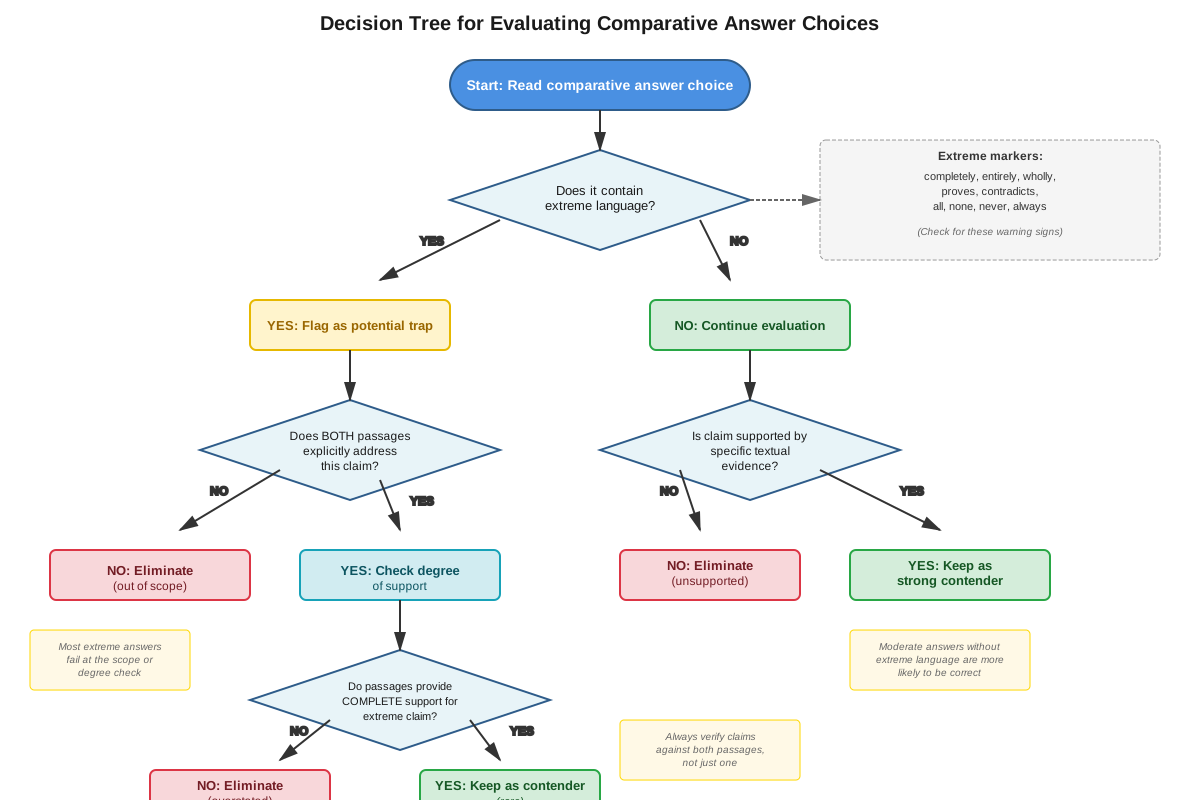
These triggers don't automatically eliminate answers, but they demand verification: return to the passages and confirm that the relationship truly justifies such strong language.
The Verification Process
For any answer containing extreme comparative language:
- Identify the specific claim about the passage relationship
- Locate the relevant sections in both passages
- Evaluate the actual relationship between those sections
- Compare the relationship to the answer's characterization
- Eliminate if the answer overstates the strength, scope, or nature of the relationship
This process takes 15-30 seconds but prevents costly errors on high-value questions.
Process of Elimination Approach
In Comparative Reading questions, eliminate answers in this order:
- First pass: Eliminate obvious extreme answers where the language clearly overstates the relationship
- Second pass: Eliminate answers that mischaracterize the type of relationship (e.g., claiming disagreement when passages address different aspects)
- Third pass: Choose between remaining answers based on which most precisely matches the scope and degree of the actual passage relationship
Exam Tip: If you're down to two answers and one uses extreme language while the other uses moderate language, the moderate answer is correct approximately 80% of the time in Comparative Reading questions, unless you can point to specific textual evidence justifying the extreme characterization.
Time Management
Allocate approximately 45-60 seconds per Comparative Reading question. If a question asks about the passage relationship and you find yourself spending more than 60 seconds, you're likely overthinking it. The correct answer should be supportable with clear textual evidence, not require elaborate inferential chains. Extreme answers often consume extra time because test-takers search for evidence to support them—if you can't quickly find strong support, the answer is likely too extreme.
Memory Techniques
The "SCOPE" Mnemonic
When evaluating comparative answers, remember SCOPE:
- Strength: Does the answer's language match the strength of the passage relationship?
- Coverage: Does the answer characterize the entire relationship or overstate one point of connection?
- Opposition vs. Different Focus: Do passages actually oppose each other or just address different aspects?
- Precision: Does the answer precisely describe what the passages say about each other?
- Evidence: Can you point to specific textual evidence supporting the comparative claim?
The Spectrum Visualization
Visualize passage relationships on a spectrum:
Complete Opposition ← Partial Disagreement ← Different Focus → Partial Agreement → Complete AgreementMost passage relationships fall in the middle three categories. When an answer places the relationship at either extreme endpoint, verify carefully.
The "Both/And" vs. "Either/Or" Distinction
Remember: passages can both be correct even when discussing different aspects (complementary relationship), or they can present either/or alternatives when genuinely contradicting each other. Extreme answers often falsely characterize "both/and" relationships as "either/or" opposition.
The Absolute Language Alert
Create a mental "alarm" that sounds when you encounter these words in comparative answers: completely, entirely, wholly, fundamentally, directly (when modifying "refutes" or "contradicts"), proves, definitively. The alarm doesn't mean "eliminate," but rather "verify carefully."
Summary
Comparative extreme answers represent a high-frequency trap pattern in LSAT reading comprehension, particularly within comparative reading questions. These incorrect answers overstate the degree, scope, or nature of the relationship between two passages, using absolute language to characterize relationships that are actually more nuanced. The LSAT tests whether students can precisely distinguish between passages that completely contradict each other versus those that partially disagree, address different aspects of a topic, or share some common ground while differing in emphasis. Mastering this skill requires recognizing extreme language markers (completely, entirely, fundamentally, directly refutes), understanding that most passage relationships fall in the middle of the agreement-disagreement spectrum, and systematically verifying whether textual evidence supports the strength of comparative claims. Success depends on reading actively to track not just what each passage argues but how the arguments relate, pre-articulating the relationship before reviewing answers, and eliminating choices that overstate connections or conflicts. The ability to avoid lsat comparative extreme answers directly impacts test performance, as these traps appear in the majority of Comparative Reading question sets and exploit natural cognitive tendencies toward oversimplification and binary thinking.
Key Takeaways
- Comparative extreme answers overstate the relationship between passages using absolute language that the textual evidence doesn't support, appearing in 60-70% of Comparative Reading question sets
- Most passage relationships involve partial agreement, partial disagreement, or different emphases rather than complete opposition or total agreement—answers claiming extreme relationships are usually incorrect
- Trigger words like "completely contradicts," "entirely supports," "fundamentally incompatible," and "directly refutes" should prompt careful verification of whether the passage relationship justifies such strong language
- Passages can address different aspects of the same topic without agreeing or disagreeing with each other; answers claiming opposition in these cases are extreme
- The correct answer in comparative questions matches both the type of relationship (agreement, disagreement, different focus) and the degree of that relationship (complete, partial, qualified) to what the passages actually demonstrate
- Effective strategy involves pre-articulating the passage relationship before reviewing answers, flagging extreme language during answer review, and systematically verifying whether textual evidence supports comparative claims
- When choosing between a moderate and an extreme answer, the moderate answer is correct approximately 80% of the time unless specific textual evidence clearly justifies the extreme characterization
Related Topics
Extreme Answers in Single-Passage Reading Comprehension: Understanding how to recognize unjustified absolute claims within individual passages provides the foundation for identifying comparative extremes; mastering comparative extreme answers reinforces and extends these fundamental scope-recognition skills
Author's Tone and Attitude: Recognizing the strength of an author's commitment to claims (definitive vs. tentative, absolute vs. qualified) helps evaluate whether comparative answers accurately characterize how strongly passages relate to each other
Inference Questions in Comparative Reading: Many inference questions require synthesizing information across passages without overstating what can be concluded; avoiding extreme comparative answers directly supports accurate inference-making
Logical Reasoning Flaw Questions: The skill of recognizing when conclusions overstate their premises transfers directly between Reading Comprehension comparative extremes and Logical Reasoning flaw identification
Synthesis Questions in Comparative Reading: Advanced questions asking students to combine information from both passages require the same careful attention to scope and degree that prevents extreme answer selection
Practice CTA
Now that you understand how comparative extreme answers function as trap answers in LSAT comparative reading questions, you're ready to apply these concepts to practice problems. The flashcards will help you memorize extreme language triggers and relationship types, while the practice questions will develop your ability to quickly identify and eliminate extreme comparative answers under timed conditions. Remember: recognizing these patterns is a learnable skill that improves with deliberate practice. Each practice question you complete strengthens your ability to make the precise distinctions that separate competitive LSAT scores from exceptional ones. Approach the practice materials actively, articulating why extreme answers are incorrect and what makes correct answers appropriately moderate. Your investment in mastering this high-yield topic will pay dividends across the entire Reading Comprehension section.
Sign up free to keep reading
Create a free AnvayaPrep account to finish this LSAT guide on Comparative extreme answers — plus flashcards and practice questions.