Overview
Comparative organization is a critical skill within the LSAT's Reading Comprehension section, specifically appearing in the comparative reading format introduced in 2007. This question type presents two shorter passages (Passage A and Passage B) that address related topics, and test-takers must analyze how each passage structures its argument, presents evidence, and develops its central thesis. Understanding comparative organization means recognizing the architectural choices authors make—whether they present chronological narratives, problem-solution frameworks, claim-and-support structures, or contrasting viewpoints—and then identifying similarities and differences in these structural approaches across both passages.
The LSAT tests comparative organization because legal reasoning demands the ability to analyze multiple arguments simultaneously, recognize structural patterns in legal briefs, and understand how different advocates organize their cases. When facing LSAT comparative organization questions, students must move beyond surface-level content comprehension to examine the underlying blueprint each author employs. This skill directly translates to law school, where students regularly compare majority and dissenting opinions, analyze competing legal theories, and evaluate how different scholars structure their arguments about the same legal principle.
Within the broader Reading Comprehension framework, comparative organization serves as a bridge between basic passage structure analysis and advanced critical reasoning. While single-passage questions might ask about one author's organizational strategy, comparative reading questions require simultaneous analysis of two organizational frameworks, testing both individual passage comprehension and the meta-cognitive ability to compare structural approaches. This makes comparative organization one of the highest-yield topics for LSAT preparation, as it appears in every comparative reading set and often determines whether test-takers can efficiently navigate these challenging question pairs.
Learning Objectives
- [ ] Identify how Comparative organization appears in LSAT questions
- [ ] Explain the reasoning pattern behind Comparative organization
- [ ] Apply Comparative organization to solve LSAT-style problems accurately
- [ ] Distinguish between content-based differences and organizational differences in paired passages
- [ ] Recognize the six most common organizational structures in LSAT comparative passages
- [ ] Predict likely comparative organization questions based on passage structure
- [ ] Evaluate answer choices by mapping them to specific organizational features in each passage
Prerequisites
- Basic passage structure recognition: Understanding introductions, body paragraphs, and conclusions is essential because comparative organization builds on identifying these elements across two passages simultaneously.
- Argument identification skills: Recognizing claims, evidence, and reasoning allows students to distinguish between what an author says (content) and how they say it (organization).
- Comparative reading fundamentals: Familiarity with the dual-passage format ensures students can navigate between Passage A and Passage B efficiently without losing track of each passage's distinct approach.
- Question stem interpretation: Knowing how to decode LSAT question language helps students recognize when a question specifically targets organizational structure versus content or tone.
Why This Topic Matters
Comparative organization questions appear in every comparative reading set on the LSAT, making them unavoidable for test-takers. Since June 2007, when LSAC introduced the comparative reading format, one of the four Reading Comprehension passages has consistently been a paired-passage set, typically generating 6-8 questions. Of these questions, 1-3 directly test comparative organization, asking students to identify structural similarities, contrast organizational approaches, or recognize how each passage develops its argument. This represents approximately 15-20% of all Reading Comprehension questions, making comparative organization a high-frequency, high-impact topic.
In legal practice, attorneys constantly compare how different parties structure their arguments. A prosecutor might organize a case chronologically, while a defense attorney structures the same events thematically to emphasize reasonable doubt. Judges must recognize these organizational differences to evaluate each argument fairly. Similarly, legal scholars might approach the same constitutional question through historical analysis, textual interpretation, or policy consequences—each requiring different organizational frameworks. The LSAT tests comparative organization because this analytical skill predicts success in legal reasoning.
Common manifestations in LSAT passages include: scientific passages where Passage A presents a theory chronologically while Passage B uses a problem-solution structure; humanities passages where one author employs narrative organization while another uses analytical categorization; and social science passages where competing researchers structure their findings through different methodological frameworks. Questions might ask: "The organization of Passage A differs from that of Passage B in that Passage A..." or "Both passages employ which of the following organizational strategies?" or "The author of Passage B develops the argument primarily by..."
Core Concepts
Defining Organizational Structure vs. Content
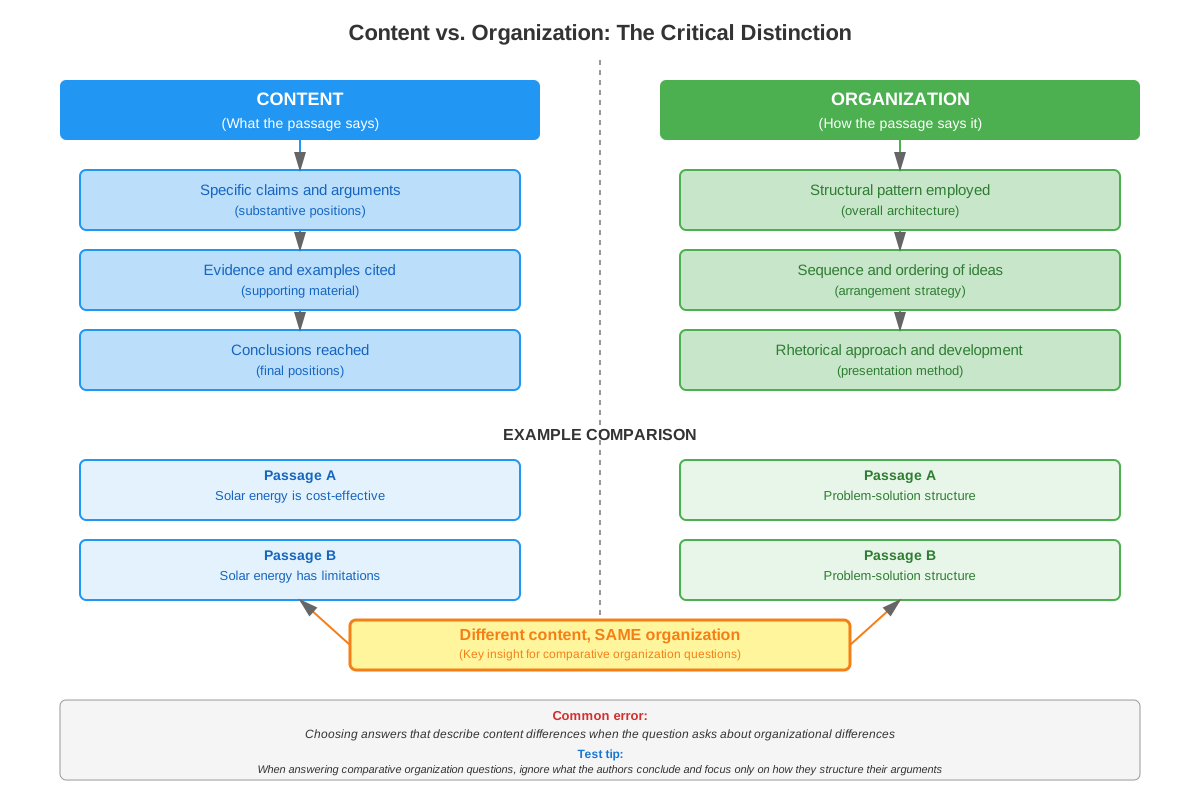
The fundamental distinction in comparative organization analysis separates what an author discusses from how they organize that discussion. Content refers to the specific ideas, examples, facts, and arguments presented. Organization refers to the structural framework—the sequence, hierarchy, and relationship among those elements. For example, two passages about climate change might both discuss carbon emissions (content), but one might organize the discussion chronologically (historical development of emissions) while the other uses cause-and-effect structure (emissions leading to specific consequences). LSAT questions targeting comparative organization focus exclusively on this structural dimension, requiring students to abstract away from specific content to recognize underlying patterns.
Six Primary Organizational Patterns
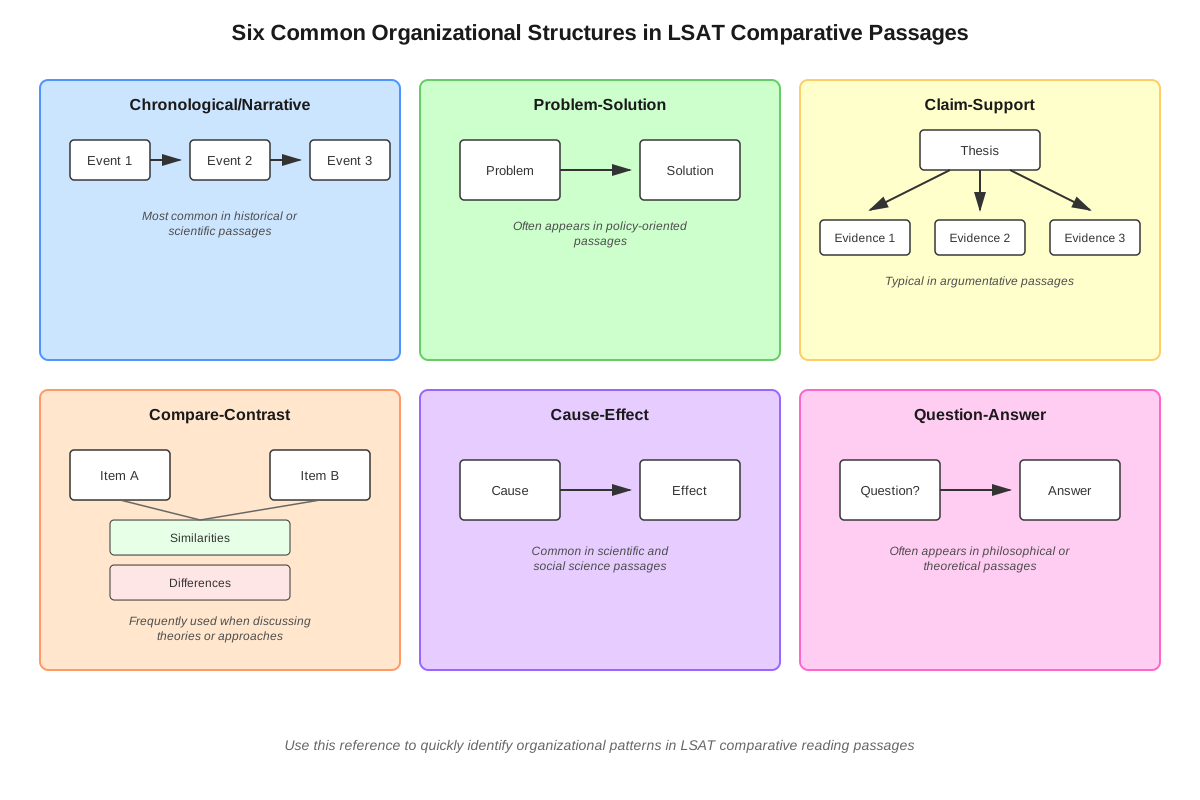
The LSAT employs six recurring organizational structures in comparative reading passages:
| Organizational Pattern | Characteristics | Typical Indicators |
|---|---|---|
| Chronological/Historical | Events or ideas presented in time sequence | Dates, temporal transitions ("initially," "subsequently," "eventually") |
| Problem-Solution | Issue identified, then resolution proposed | "The challenge is," "One approach to addressing," "This can be resolved by" |
| Claim-and-Support | Thesis stated, then evidence marshaled | "The argument is," "Evidence includes," "This demonstrates that" |
| Compare-and-Contrast | Two or more items systematically analyzed | "Similarly," "In contrast," "Unlike X, Y..." |
| Cause-and-Effect | Phenomenon explained through causal relationships | "Because," "As a result," "This leads to," "Consequently" |
| Classification/Categorical | Subject divided into types or categories | "There are three types," "Categories include," "Can be classified as" |
Understanding these patterns enables rapid passage mapping. When reading Passage A, students should identify its primary organizational structure, then immediately compare this to Passage B's approach. Often, the passages employ different structures, creating the basis for comparative organization questions.
Structural Markers and Transition Language
Authors signal organizational choices through specific linguistic markers. Structural markers are words and phrases that reveal how ideas connect within the organizational framework. Chronological organization uses temporal markers ("first," "then," "finally," "during the 1990s"). Problem-solution structures employ problem-identification language ("the difficulty," "poses a challenge") followed by solution indicators ("can be addressed through," "one remedy involves"). Cause-and-effect organization relies on causal connectors ("therefore," "thus," "as a consequence," "stems from").
Recognizing these markers while reading allows students to construct mental maps of each passage's organization. For Passage A, a student might note: "Chronological—starts with 18th century, moves to modern era, concludes with future implications." For Passage B: "Problem-solution—identifies issue in paragraph 1, proposes three solutions in paragraphs 2-4." This comparative mapping directly prepares students for organizational questions.
Parallel vs. Contrasting Organizational Structures
Comparative passages exhibit two relationship types regarding organization. Parallel structures occur when both passages employ the same organizational pattern, though applied to different content or reaching different conclusions. For example, both passages might use claim-and-support organization, with Passage A supporting one position and Passage B supporting an opposing view. Questions about parallel structures often ask: "Both passages employ which organizational strategy?" or "The passages are similar in that each..."
Contrasting structures occur when passages use fundamentally different organizational approaches. Passage A might present a chronological history while Passage B analyzes the same topic through categorical classification. These differences become the focus of questions like: "Unlike Passage A, Passage B develops its argument primarily by..." or "The organization of Passage A differs from Passage B in that..." Recognizing whether passages share or contrast organizational approaches helps predict question types and prepare appropriate analytical frameworks.
Macro vs. Micro Organization
Organizational analysis operates at two levels. Macro organization refers to the overall structure of the entire passage—how the passage as a whole is constructed from beginning to end. Does it move chronologically? Does it state a thesis and then support it? Does it present a problem and then offer solutions? Macro organization questions ask about the passage's overarching framework.
Micro organization refers to how individual paragraphs or sections are structured within the larger framework. A passage with macro chronological organization might include a paragraph with micro cause-and-effect organization explaining why a particular historical event occurred. LSAT questions can target either level, though macro organization questions are more common in comparative reading. Students must be prepared to analyze both levels and recognize when a question asks about overall passage structure versus the organization of a specific section.
Organizational Purpose and Function
Every organizational choice serves a rhetorical purpose. Authors select structures that best advance their argumentative goals. Chronological organization effectively traces development or evolution. Problem-solution structures naturally lead readers toward the author's proposed remedy. Cause-and-effect organization emphasizes causal relationships the author wants to highlight. Understanding organizational purpose means recognizing why an author chose a particular structure and how that choice advances their argument.
Comparative organization questions sometimes test this understanding by asking how organizational choices serve each author's purpose. For example: "The author of Passage A employs chronological organization primarily in order to..." or "Passage B's categorical structure serves to..." These questions require students to connect organizational analysis with purpose analysis, recognizing that structure is not arbitrary but strategically chosen to achieve specific rhetorical effects.
Concept Relationships
The concepts within comparative organization form an interconnected analytical framework. Organizational patterns (the six primary structures) serve as the foundation, providing the vocabulary and categories for describing passage structure. These patterns are identified through structural markers, the linguistic signals that reveal organizational choices. Once patterns are identified in each passage, students determine whether the passages exhibit parallel or contrasting structures, which directly predicts question types and answer patterns.
This structural analysis operates at both macro and micro levels, with macro organization providing the overall framework and micro organization explaining how individual sections function within that framework. All organizational analysis ultimately connects to organizational purpose, as structure serves rhetorical function. The relationship flows: Structural markers → Organizational patterns → Parallel/contrasting structures → Macro/micro analysis → Organizational purpose.
This topic builds directly on prerequisite knowledge of basic passage structure and argument identification. Students must first recognize arguments (prerequisite) before analyzing how those arguments are organized (current topic). Comparative organization then enables progression to more advanced topics like comparative reasoning patterns and relationship questions, where organizational understanding provides the foundation for analyzing how authors' arguments interact and relate.
The distinction between content and structure serves as the conceptual gateway, ensuring students analyze organizational frameworks rather than getting lost in specific details. This meta-cognitive skill—thinking about how passages are constructed rather than just what they say—represents the core intellectual move that enables all other comparative organization analysis.
High-Yield Facts
⭐ Comparative organization questions appear in every LSAT comparative reading set, making them unavoidable and high-priority for preparation.
⭐ The six primary organizational patterns (chronological, problem-solution, claim-and-support, compare-and-contrast, cause-and-effect, classification) account for virtually all LSAT passage structures.
⭐ Structural markers (transition words and phrases) reliably signal organizational patterns and should be actively noted during passage reading.
⭐ Questions asking "Unlike Passage A, Passage B..." or "Passage A differs from Passage B in that..." specifically target contrasting organizational structures.
⭐ Parallel structure questions ("Both passages employ which organizational strategy?") require identifying the same organizational pattern used in both passages despite different content.
- Chronological organization is most common in historical and scientific passages tracing development over time.
- Problem-solution structures typically appear in policy-oriented passages where authors advocate for specific remedies.
- Macro organization refers to overall passage structure, while micro organization describes individual paragraph or section structure.
- Organizational purpose questions connect structure to rhetorical function, asking why an author chose a particular organizational approach.
- Passages with contrasting organizations generate more comparative organization questions than passages with parallel structures.
- The first sentence of each passage often signals its organizational approach through structural markers.
- Comparative organization questions rarely require detailed content recall but demand accurate structural mapping.
- Answer choices for organizational questions often use abstract language describing structure rather than specific content.
Quick check — test yourself on Comparative organization so far.
Try Flashcards →Common Misconceptions
Misconception: Comparative organization questions ask about the topics or subjects discussed in each passage.
Correction: These questions focus exclusively on how passages are structured, not what they discuss. Two passages about the same topic can have entirely different organizations, and that structural difference is what the LSAT tests.
Misconception: If both passages reach different conclusions, they must have different organizational structures.
Correction: Passages can employ identical organizational patterns while reaching opposite conclusions. For example, both might use claim-and-support organization, with Passage A supporting position X and Passage B supporting position Y. The organization (claim-and-support) is parallel even though the content differs.
Misconception: Chronological organization means the passage discusses history or past events.
Correction: Chronological organization refers to presenting information in time sequence, which can include future projections or hypothetical scenarios presented in temporal order. The key is sequential time-based structure, not necessarily historical content.
Misconception: A passage can only have one organizational pattern.
Correction: Passages often combine organizational patterns, using one structure at the macro level and different structures at the micro level. A passage might have overall chronological organization but include a paragraph with cause-and-effect micro organization explaining why a particular event occurred.
Misconception: Identifying organizational structure requires reading every word carefully and understanding all details.
Correction: Organizational structure can often be identified through structural markers and topic sentences alone, without deep comprehension of every detail. Efficient test-takers map organization while reading, focusing on how ideas connect rather than memorizing specific facts.
Misconception: Comparative organization questions are subjective and depend on interpretation.
Correction: LSAT organizational questions have definitively correct answers based on objective structural features. If Passage A presents events in time sequence, it uses chronological organization—this is not interpretive but factual. Answer choices can be systematically evaluated against textual evidence of organizational structure.
Misconception: The more complex the organizational structure, the harder the passage.
Correction: Organizational complexity does not correlate directly with passage difficulty. A straightforward chronological passage might discuss highly technical content, while a passage with complex nested organization might discuss accessible topics. Structure and content difficulty are independent variables.
Worked Examples
Example 1: Identifying Contrasting Organizational Structures
Passage A (abbreviated): "The development of jazz music began in the early 20th century in New Orleans. Initially, musicians combined African rhythms with European harmonic structures. By the 1920s, jazz had spread to Chicago, where artists like Louis Armstrong pioneered new improvisational techniques. The 1930s saw the swing era emerge, characterized by big band arrangements. Subsequently, bebop developed in the 1940s as a reaction against commercialized swing..."
Passage B (abbreviated): "Jazz music can be understood through three essential elements. First, improvisation allows musicians to create spontaneous melodic variations. This distinguishes jazz from classical music's adherence to written scores. Second, syncopation creates rhythmic complexity by emphasizing off-beats. Third, the call-and-response pattern, derived from African musical traditions, structures interaction between soloists and ensemble..."
Question: The organization of Passage A differs from that of Passage B in that Passage A:
(A) presents a chronological history while Passage B employs categorical classification
(B) uses cause-and-effect reasoning while Passage B relies on narrative description
(C) compares multiple viewpoints while Passage B advocates a single position
(D) provides specific examples while Passage B discusses abstract principles
(E) analyzes technical details while Passage B offers historical context
Solution Process:
Step 1: Identify Passage A's organizational structure. Structural markers include "early 20th century," "Initially," "By the 1920s," "The 1930s," "Subsequently," and "the 1940s." These temporal markers clearly indicate chronological organization. Passage A traces jazz development through time sequence.
Step 2: Identify Passage B's organizational structure. Structural markers include "three essential elements," "First," "Second," "Third." This language signals categorical classification—dividing jazz into distinct categories or components for analysis.
Step 3: Evaluate answer choices against these organizational identifications.
(A) CORRECT: Accurately describes Passage A as chronological and Passage B as categorical classification. This matches our structural analysis.
(B) Incorrect: Passage A uses chronological, not cause-and-effect organization. While it might mention some causal relationships, the primary structure is temporal sequence. Passage B uses classification, not narrative description.
(C) Incorrect: Neither passage compares multiple viewpoints. This describes content, not organizational structure.
(D) Incorrect: This describes content characteristics (specific vs. abstract) rather than organizational structure. Both passages could include examples and principles regardless of organizational framework.
(E) Incorrect: This reverses the actual content focus and describes content rather than organization. The question asks about organizational structure, not subject matter.
Connection to Learning Objectives: This example demonstrates identifying how comparative organization appears in LSAT questions (Learning Objective 1) and applying comparative organization to solve problems accurately (Learning Objective 3). The solution process shows the reasoning pattern: identify each passage's structure through markers, then match that analysis to answer choices (Learning Objective 2).
Example 2: Recognizing Parallel Organizational Structures
Passage A (abbreviated): "Urban sprawl creates significant environmental problems. The expansion of cities into surrounding areas increases automobile dependence, leading to higher carbon emissions. Additionally, sprawl destroys natural habitats, threatening biodiversity. The conversion of farmland to suburban development reduces agricultural capacity..."
Passage B (abbreviated): "Urban sprawl offers important economic benefits. The development of suburban areas creates construction jobs and stimulates economic growth. Furthermore, sprawl provides affordable housing options for families priced out of urban centers. The expansion allows businesses to access cheaper land, reducing operational costs..."
Question: Both passages employ which of the following organizational strategies?
(A) Presenting a chronological narrative of urban development
(B) Stating a central claim and then providing supporting evidence
(C) Comparing historical and contemporary urban planning approaches
(D) Describing a problem and then proposing specific solutions
(E) Categorizing different types of urban environments
Solution Process:
Step 1: Identify Passage A's organizational structure. The passage begins with a claim ("Urban sprawl creates significant environmental problems") and then provides supporting evidence (increased emissions, habitat destruction, reduced agricultural capacity). This is claim-and-support organization.
Step 2: Identify Passage B's organizational structure. The passage begins with a claim ("Urban sprawl offers important economic benefits") and then provides supporting evidence (job creation, affordable housing, cheaper land for businesses). This is also claim-and-support organization.
Step 3: Recognize that both passages employ the same organizational pattern despite reaching opposite conclusions about urban sprawl. This is a parallel structure question.
Step 4: Evaluate answer choices.
(A) Incorrect: Neither passage uses chronological organization. No temporal sequence or historical development is presented.
(B) CORRECT: Both passages state a central claim in the opening sentence and then marshal supporting evidence. This accurately describes the parallel claim-and-support structure both passages employ.
(C) Incorrect: Neither passage compares historical and contemporary approaches. No temporal comparison is present.
(D) Incorrect: Neither passage proposes solutions. Passage A identifies problems, and Passage B identifies benefits, but neither offers remedies or proposals.
(E) Incorrect: Neither passage categorizes types of urban environments. Both discuss urban sprawl specifically, not different urban categories.
Key Insight: This example illustrates a crucial principle—passages can employ identical organizational structures while presenting opposing viewpoints. The organization (how arguments are structured) is independent of the position taken (what is argued). Students must distinguish structural parallelism from content agreement.
Connection to Learning Objectives: This example demonstrates explaining the reasoning pattern behind comparative organization (Learning Objective 2)—recognizing that parallel structures can support different conclusions. It also shows how to distinguish between organizational similarities and content differences (Learning Objective 4).
Exam Strategy
Approaching Comparative Organization Questions
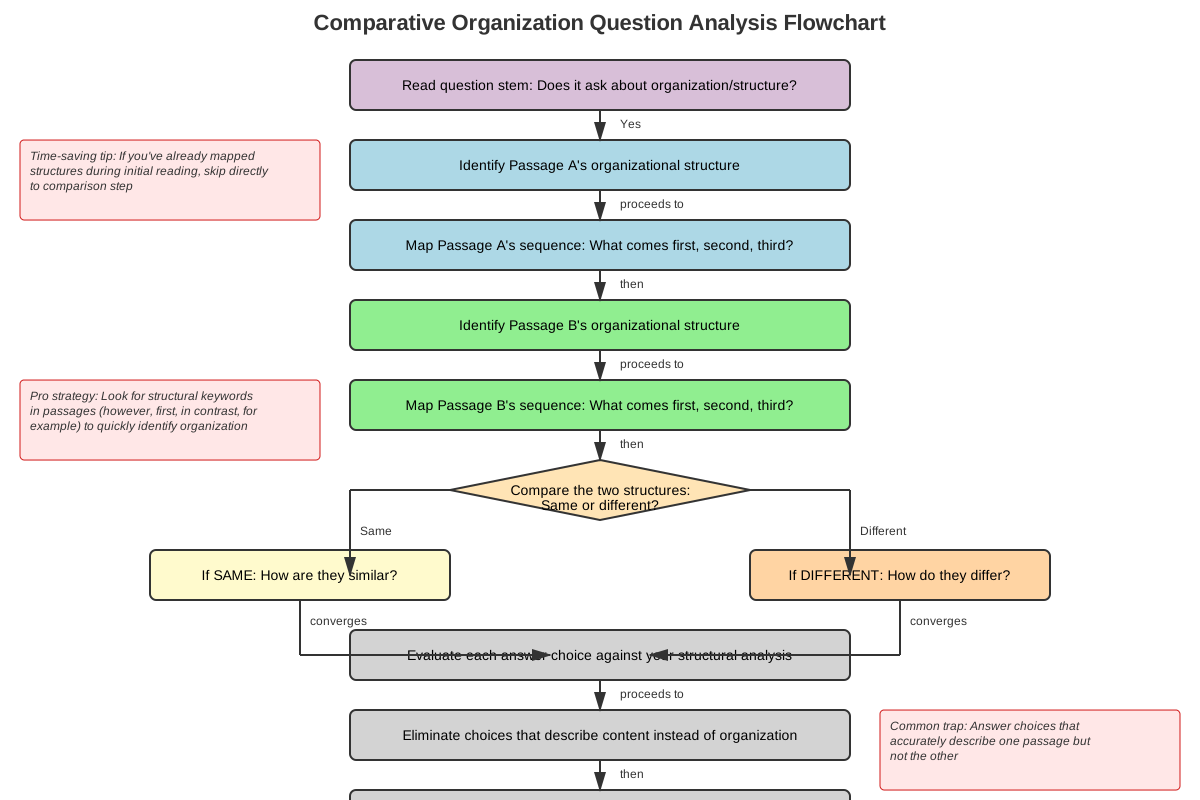
When encountering comparative reading passages, implement a three-phase strategy. Phase 1 (During Reading): Actively map each passage's organizational structure while reading. Note structural markers and identify the primary organizational pattern for each passage. Write brief annotations like "A: chronological" or "B: problem-solution" in the margin. This upfront investment saves time when answering questions.
Phase 2 (Question Identification): Recognize comparative organization questions through trigger language. Questions containing "organization," "structure," "develops the argument," "presents information," or "Both passages employ" typically target organizational analysis. Questions asking how passages "differ" or are "similar" often focus on organizational contrasts or parallels.
Phase 3 (Answer Evaluation): Systematically eliminate answer choices by checking each against the organizational structures identified during reading. For "difference" questions, eliminate any choice that describes the same structure for both passages. For "similarity" questions, eliminate choices describing different structures. Always verify that the answer describes organization (how information is presented) rather than content (what information is presented).
Trigger Words and Phrases
High-yield trigger phrases that signal comparative organization questions include:
- "The organization of Passage A differs from that of Passage B in that..."
- "Both passages employ which organizational strategy..."
- "Unlike Passage A, Passage B develops its argument primarily by..."
- "The author of Passage A presents information by..."
- "Passage B is organized around..."
- "The structure of Passage A can best be described as..."
- "In terms of organization, the passages are similar in that..."
When these phrases appear, immediately recall the organizational structures mapped during reading and prepare to evaluate answer choices based on structural features rather than content.
Process of Elimination Strategies
For comparative organization questions, eliminate answer choices that:
- Describe content rather than structure: If an answer choice discusses what the passage says rather than how it's organized, eliminate it. "Passage A discusses environmental issues" describes content; "Passage A presents a chronological history" describes organization.
- Misidentify organizational patterns: Check each organizational claim against structural markers in the passage. If an answer claims chronological organization but the passage lacks temporal markers, eliminate it.
- Confuse macro and micro organization: If a question asks about overall passage organization, eliminate choices describing only a single paragraph's structure.
- Reverse the passages: For "difference" questions, verify that the organizational description matches the correct passage. Answer choices sometimes accurately describe organizational structures but attribute them to the wrong passage.
- Describe parallel structures for "difference" questions: If a question asks how passages differ organizationally, eliminate any choice that describes the same structure for both passages.
Time Allocation
Comparative organization questions typically require 60-90 seconds each—slightly less than relationship or inference questions. The key to efficiency is accurate organizational mapping during initial reading. Invest 30-45 seconds per passage identifying organizational structure while reading, which enables rapid question answering later. If organizational structure wasn't clearly identified during reading, briefly skim topic sentences and structural markers before attempting the question rather than guessing. This 15-20 second investment prevents careless errors and improves accuracy.
Memory Techniques
The "CPCCCC" Mnemonic for Organizational Patterns
Remember the six primary organizational patterns using CPCCCC:
- Chronological
- Problem-solution
- Claim-and-support
- Compare-and-contrast
- Cause-and-effect
- Classification
Visualize this as "See-P-See-See-See-See"—you "see" the problem, then "see" five ways to organize information about it.
The "WHAT vs. HOW" Distinction
Create a mental image of two doors labeled "WHAT" and "HOW." Content questions go through the WHAT door; organizational questions go through the HOW door. When reading a question stem, visualize which door it enters. This prevents the common error of answering content questions when organizational structure is being tested.
Structural Marker Highlighting
Develop a mental highlighting system for structural markers while reading. Visualize temporal markers (first, then, subsequently) in blue, causal markers (because, therefore, as a result) in red, and categorical markers (types, categories, elements) in green. This color-coding creates a visual map of organizational structure that can be mentally recalled when answering questions.
The "Skeleton" Visualization
For each passage, visualize its organizational structure as a skeleton—the underlying framework that supports the content. Chronological organization looks like a timeline skeleton. Problem-solution looks like a two-part skeleton (problem bones, solution bones). Claim-and-support looks like a tree skeleton (trunk claim, branch evidence). This anatomical metaphor reinforces that organization is the structural framework beneath surface content.
Acronym for Answer Evaluation: "MATCH"
When evaluating answer choices for comparative organization questions, use MATCH:
- Markers: Does the answer align with structural markers in the passage?
- Accuracy: Does it accurately describe the organizational pattern?
- Type: Does it describe organization (HOW) not content (WHAT)?
- Correspondence: For difference questions, does it correctly identify contrasting structures?
- Holistic: Does it describe macro organization when the question asks about overall structure?
Summary
Comparative organization represents a high-yield LSAT Reading Comprehension skill that tests the ability to analyze and compare how paired passages structure their arguments. Success requires distinguishing organizational structure (how information is presented) from content (what information is presented), identifying six primary organizational patterns (chronological, problem-solution, claim-and-support, compare-and-contrast, cause-and-effect, and classification), and recognizing whether passages employ parallel or contrasting structures. Structural markers—transition words and phrases—signal organizational choices and enable efficient passage mapping during reading. Questions targeting comparative organization use specific trigger language ("organization differs," "both passages employ," "develops the argument by") and require systematic answer evaluation based on structural features rather than content. Effective strategy involves mapping organization during initial reading, recognizing question types through trigger phrases, and eliminating answer choices that describe content rather than structure, misidentify organizational patterns, or confuse macro and micro organization. Because comparative organization questions appear in every comparative reading set and account for 15-20% of Reading Comprehension questions, mastering this topic significantly impacts overall LSAT performance and directly develops analytical skills essential for legal reasoning.
Key Takeaways
- Comparative organization questions appear in every LSAT comparative reading set, making this a mandatory mastery topic for test preparation.
- The six organizational patterns (chronological, problem-solution, claim-and-support, compare-and-contrast, cause-and-effect, classification) account for virtually all LSAT passage structures and should be memorized.
- Structural markers (transition words and temporal indicators) reliably signal organizational patterns and should be actively noted during passage reading for efficient question answering.
- Organization (HOW) differs fundamentally from content (WHAT)—comparative organization questions test structural frameworks, not subject matter or specific arguments.
- Parallel organizational structures occur when both passages employ the same organizational pattern despite potentially different content or conclusions, while contrasting structures use fundamentally different organizational approaches.
- Macro organization (overall passage structure) differs from micro organization (individual paragraph structure), and questions can target either level of analysis.
- Systematic answer evaluation using process of elimination—checking for content vs. structure descriptions, verifying organizational pattern identification, and confirming passage correspondence—maximizes accuracy on comparative organization questions.
Related Topics
Comparative Reasoning Patterns: Building on organizational analysis, this topic examines how authors employ different reasoning strategies (analogical, deductive, inductive) across paired passages. Mastering comparative organization provides the structural foundation for analyzing reasoning patterns.
Relationship Questions in Comparative Reading: These questions ask how passages relate to each other (agreement, disagreement, elaboration, challenge). Understanding organizational differences helps predict and analyze these relationships, as organizational choices often reflect underlying argumentative relationships.
Author's Purpose and Perspective: Organizational structure serves rhetorical purpose. After mastering comparative organization, students can analyze why authors chose particular structures and how organizational choices reveal authorial intent and perspective.
Passage Mapping Techniques: Advanced passage mapping integrates organizational analysis with content tracking, creating comprehensive visual representations of passage structure. Comparative organization skills form the structural component of effective passage maps.
Single-Passage Organization Questions: The organizational analysis skills developed through comparative reading transfer directly to single-passage questions about structure, making comparative organization a gateway skill for broader Reading Comprehension mastery.
Practice CTA
Now that you've mastered the conceptual framework for comparative organization, it's time to apply these skills to authentic LSAT passages. Attempt the practice questions associated with this topic, focusing on identifying organizational patterns through structural markers, distinguishing parallel from contrasting structures, and systematically evaluating answer choices based on organizational features rather than content. Use the worked examples as models for your reasoning process, and refer back to the exam strategies when you encounter challenging questions. Remember: comparative organization questions are highly predictable once you've trained your analytical eye to see structural frameworks beneath surface content. Each practice question you complete strengthens the pattern recognition skills that will serve you throughout the Reading Comprehension section. You've built the foundation—now construct mastery through deliberate practice!
Sign up free to keep reading
Create a free AnvayaPrep account to finish this LSAT guide on Comparative organization — plus flashcards and practice questions.