Overview
Organization questions represent a critical category within LSAT Reading Comprehension that tests a student's ability to analyze and articulate the structural framework of a passage. Unlike questions that focus on specific details or the author's attitude, organization questions require test-takers to step back and view the passage as an architectural whole—understanding how the author has arranged ideas, arguments, and evidence to achieve a particular rhetorical purpose. These questions typically ask students to identify the overall structure, describe how paragraphs relate to one another, or explain the function of specific sections within the broader argumentative framework.
Mastering organization questions is essential for LSAT success because they appear with reliable frequency across all Reading Comprehension sections and often serve as gateway questions that, when answered correctly, facilitate understanding of subsequent questions about the same passage. The ability to quickly map a passage's structure provides a strategic advantage: students who can identify organizational patterns can more efficiently locate information, predict where certain types of content will appear, and better understand the author's reasoning chain. This skill becomes particularly valuable when facing dense, complex passages under strict time constraints.
Organization questions occupy a unique position within the broader landscape of reading comprehension question types. While detail questions focus on "what" the passage says and inference questions probe "what follows" from the text, organization questions address "how" the passage is constructed. This structural awareness serves as foundational knowledge that enhances performance across all question types—understanding where an argument begins and ends, recognizing when the author shifts from presenting a theory to critiquing it, and identifying the relationship between examples and claims all contribute to comprehensive passage mastery.
Learning Objectives
- [ ] Identify how Organization questions appears in LSAT questions
- [ ] Explain the reasoning pattern behind Organization questions
- [ ] Apply Organization questions to solve LSAT-style problems accurately
- [ ] Distinguish between different organizational patterns commonly used in LSAT passages (chronological, comparative, problem-solution, thesis-support)
- [ ] Analyze the function of individual paragraphs within the overall passage structure
- [ ] Evaluate answer choices by matching structural descriptions to actual passage organization
- [ ] Recognize common wrong answer traps specific to organization questions
Prerequisites
- Basic passage comprehension skills: The ability to understand main ideas and follow arguments is necessary before analyzing how those ideas are structured
- Familiarity with paragraph structure: Understanding topic sentences, supporting details, and transitions helps identify how paragraphs function within larger organizational frameworks
- Knowledge of common rhetorical purposes: Recognizing when authors are arguing, explaining, comparing, or critiquing enables accurate structural analysis
- Experience with LSAT Reading Comprehension format: Understanding the basic format of passages and question stems allows focus on organization-specific challenges
Why This Topic Matters
Organization questions matter profoundly because they test a meta-cognitive skill that distinguishes strong readers from merely adequate ones: the ability to perceive structure while processing content. In legal practice—the ultimate destination for LSAT-takers—attorneys must constantly analyze how arguments are constructed, identify logical progressions in case law, and structure their own persuasive documents. The LSAT uses organization questions to assess whether candidates possess this architectural thinking that proves essential in law school and beyond.
From a purely strategic standpoint, organization questions appear in approximately 15-20% of all Reading Comprehension questions on the LSAT, making them one of the most reliable question types students will encounter. Each Reading Comprehension section typically contains 1-2 organization questions per passage, and these questions often appear early in the question set for a given passage. This positioning is strategic: correctly answering an organization question provides a structural roadmap that makes subsequent questions easier to navigate.
Organization questions manifest in several distinct forms on the exam. The most common asks students to identify the overall organizational structure of the passage (e.g., "Which one of the following most accurately describes the organization of the passage?"). Another frequent variant asks about the function of a specific paragraph or section (e.g., "The second paragraph serves primarily to..."). A third type requires students to identify the relationship between different parts of the passage (e.g., "The discussion in lines 35-42 relates to the preceding paragraph by..."). Each variant tests the same fundamental skill—structural awareness—but requires slightly different analytical approaches.
Core Concepts
What Are Organization Questions?
Organization questions (also called structure questions or passage organization questions) are a specific type of reading comprehension question that asks test-takers to identify, describe, or analyze the structural framework of a passage or passage component. Rather than testing comprehension of specific facts or the ability to draw inferences, these questions assess whether students can recognize how an author has arranged ideas to build an argument, present information, or achieve a rhetorical goal.
The defining characteristic of organization questions is their focus on the "architecture" of the passage rather than its content. A student might fully understand every claim an author makes yet still struggle with organization questions if they haven't consciously tracked how those claims relate structurally. Conversely, a student with strong structural awareness can often answer organization questions correctly even if they found certain content challenging, because these questions reward recognition of patterns and relationships rather than deep content mastery.
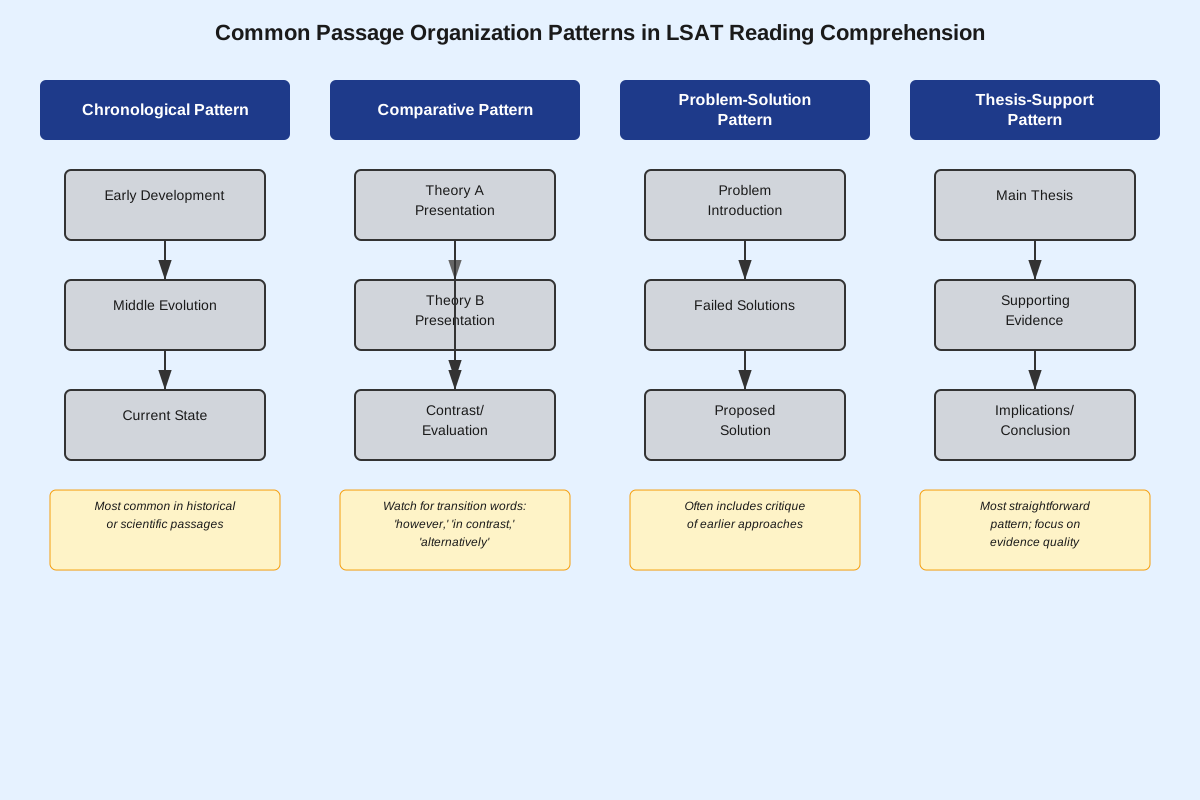
Common Organizational Patterns in LSAT Passages
LSAT passages employ several recurring organizational structures. Recognizing these patterns quickly allows students to anticipate how passages will develop and more easily identify correct answers to organization questions.
| Organizational Pattern | Description | Typical Structure | Common Indicators |
|---|---|---|---|
| Thesis-Support | Author presents a main claim and provides evidence/reasoning | Paragraph 1: Thesis; Paragraphs 2-4: Supporting arguments/evidence | "This essay argues...", "The evidence suggests...", "Furthermore..." |
| Problem-Solution | Author identifies an issue and proposes or evaluates solutions | Paragraph 1-2: Problem description; Paragraph 3-4: Solutions and evaluation | "The challenge is...", "One approach...", "A better solution..." |
| Comparative Analysis | Author examines two or more theories, approaches, or phenomena | Paragraph 1: Introduction; Paragraph 2: Theory A; Paragraph 3: Theory B; Paragraph 4: Comparison/evaluation | "In contrast...", "Similarly...", "Unlike X, Y..." |
| Chronological Development | Author traces historical evolution or development over time | Paragraphs organized by time periods or developmental stages | "Initially...", "By the 1950s...", "More recently..." |
| Phenomenon-Explanation | Author describes something and then explains why/how it occurs | Paragraph 1-2: Description of phenomenon; Paragraph 3-4: Explanatory theories | "Scientists have observed...", "This occurs because...", "The explanation lies in..." |
| Critique-Response | Author presents a view and then critiques or defends it | Paragraph 1-2: Presentation of view; Paragraph 3-4: Critical analysis | "However...", "Critics argue...", "This objection fails because..." |
Identifying Organization Question Stems
Organization questions can be identified by specific language patterns in their question stems. Recognizing these patterns immediately signals that structural analysis, not content recall, is required.
Typical organization question stems include:
- "Which one of the following most accurately describes the organization of the passage?"
- "The author's discussion proceeds by..."
- "The primary purpose of the third paragraph is to..."
- "The passage as a whole is best described as..."
- "In relation to the passage as a whole, the first paragraph serves to..."
- "The author develops the argument by..."
- "Which one of the following most accurately represents the structure of the passage?"
- "The discussion in the second paragraph functions primarily to..."
The key linguistic markers are words like "organization," "structure," "proceeds," "develops," "functions," and "serves." These signal that the question targets how the passage is built rather than what it says.
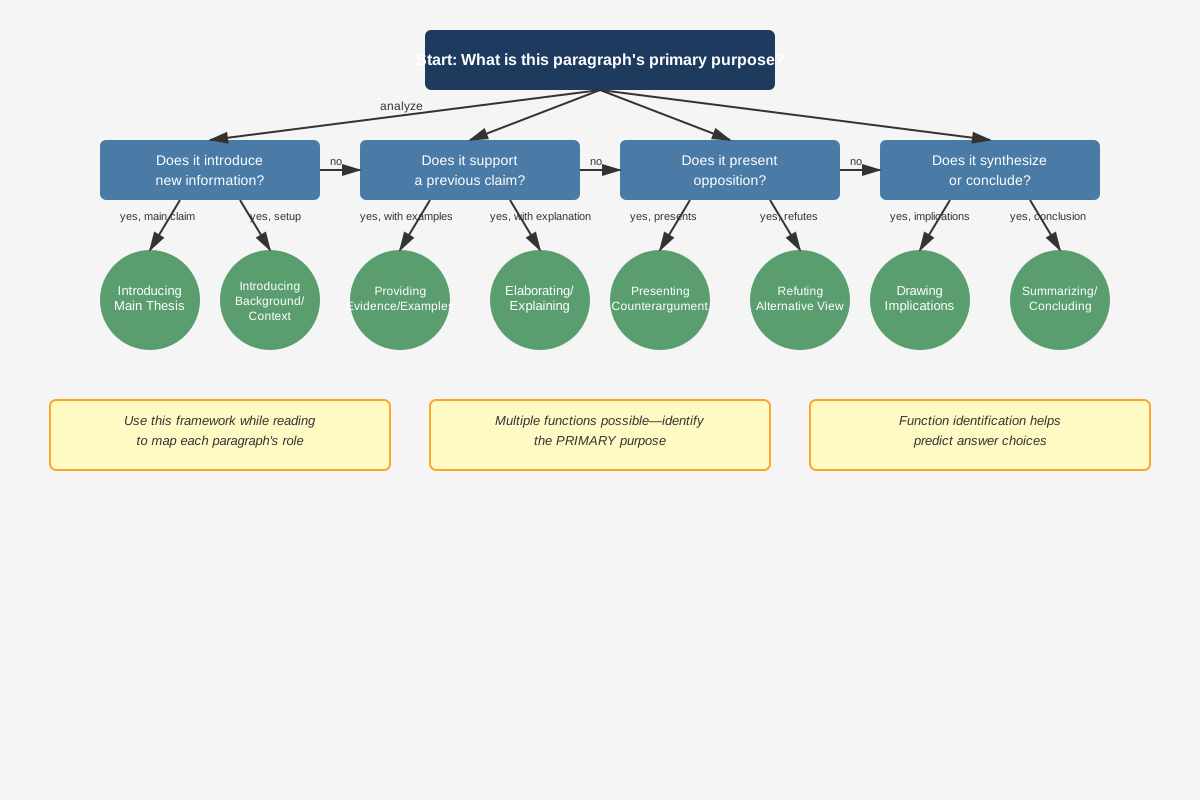
Paragraph Function Analysis
A crucial skill for organization questions involves identifying the specific function each paragraph serves within the overall passage structure. Paragraphs can serve numerous functions:
Common paragraph functions:
- Introduce a topic or phenomenon: Establishes what the passage will discuss
- Present a thesis or main argument: States the author's central claim
- Provide supporting evidence: Offers data, examples, or reasoning that supports a claim
- Present an opposing view: Introduces a theory or position the author will critique
- Critique or refute a position: Explains why a particular view is flawed
- Compare or contrast: Examines similarities and differences between concepts
- Provide background or context: Supplies historical or conceptual information necessary for understanding
- Illustrate with examples: Offers concrete instances that clarify abstract concepts
- Synthesize or conclude: Brings together previous points or states implications
- Qualify or nuance a claim: Adds complexity or limitations to a previously stated position
When answering organization questions about paragraph function, students must distinguish between what a paragraph discusses (its content) and what role it plays (its function). For example, a paragraph might discuss scientific experiments (content) while serving to refute a competing theory (function).
The Relationship Between Structure and Purpose
Understanding organization questions requires recognizing that structural choices reflect rhetorical purposes. Authors don't arrange passages randomly; they select organizational patterns that best achieve their goals. A comparative structure suits an author who wants to evaluate competing theories. A problem-solution structure serves an author advocating for policy change. A chronological structure benefits an author explaining historical development.
This connection between structure and purpose means that organization questions often overlap with main point or primary purpose questions. However, organization questions specifically ask students to articulate the structural means by which the author achieves their purpose, not merely to identify the purpose itself.
Analyzing Transitions and Structural Signals
Skilled readers use transition words and structural signals to track organizational patterns as they read. These linguistic markers indicate relationships between ideas and signal shifts in the passage's structure.
Key transition categories:
- Addition/Continuation: furthermore, moreover, additionally, in addition
- Contrast/Opposition: however, nevertheless, in contrast, on the other hand, yet
- Cause/Effect: therefore, consequently, as a result, thus, because
- Example/Illustration: for instance, for example, to illustrate, specifically
- Comparison: similarly, likewise, in the same way
- Concession: although, while, despite, admittedly
- Emphasis: indeed, in fact, certainly, clearly
- Sequence: first, second, finally, subsequently, then
Recognizing these transitions helps students map the passage's structure in real-time, making organization questions more manageable.
Concept Relationships
The concepts within organization questions form an interconnected system where each element supports and reinforces the others. Organizational patterns serve as the overarching frameworks that authors select based on their rhetorical goals. Within these patterns, individual paragraph functions operate as building blocks—each paragraph contributes a specific structural role that advances the overall organizational design. Transition words and structural signals act as the connective tissue, explicitly marking the relationships between these building blocks and guiding readers through the organizational structure.
This relationship can be visualized as: Author's Purpose → determines → Organizational Pattern → implemented through → Paragraph Functions → connected by → Transitions and Signals → perceived through → Structural Analysis → tested via → Organization Questions.
The connection to prerequisite knowledge is equally important. Basic passage comprehension skills provide the foundation for understanding what each section says, which is necessary before analyzing how sections relate structurally. Familiarity with paragraph structure enables recognition of how individual paragraphs function, which aggregates into understanding of overall passage organization. Knowledge of rhetorical purposes helps students connect structural choices to authorial intent, making organizational patterns more predictable and recognizable.
Organization questions also connect forward to other question types. Strong structural awareness enhances performance on main point questions (by clarifying which ideas are central versus peripheral), function questions (by identifying why specific content appears where it does), and inference questions (by revealing logical relationships between claims). In this way, mastering organization questions creates a multiplier effect that improves overall Reading Comprehension performance.
High-Yield Facts
⭐ Organization questions appear in approximately 15-20% of all LSAT Reading Comprehension questions, making them one of the most reliable question types.
⭐ The most common organization question asks students to identify the overall structure of the passage, typically appearing as "Which one of the following most accurately describes the organization of the passage?"
⭐ Correct answers to organization questions describe structure and function, not content—they focus on what roles different parts play, not what topics they discuss.
⭐ The six most common organizational patterns on the LSAT are: thesis-support, problem-solution, comparative analysis, chronological development, phenomenon-explanation, and critique-response.
⭐ Transition words serve as structural roadmaps—words like "however," "moreover," and "for example" signal relationships between ideas and shifts in organizational structure.
- Organization questions often appear early in the question set for a passage because they provide structural understanding that aids subsequent questions.
- Wrong answers to organization questions frequently describe content accurately but mischaracterize structure or function.
- Paragraph function questions require distinguishing between what a paragraph discusses (content) and what role it plays (function).
- The first paragraph typically introduces the topic, presents background, or states a thesis, while later paragraphs develop, support, or complicate the initial presentation.
- Recognizing organizational patterns during initial passage reading significantly reduces time spent on organization questions.
- Organization questions reward active reading strategies like mentally summarizing each paragraph's function while reading.
- The correct answer to an organization question must account for all major parts of the passage, not just some sections.
Quick check — test yourself on Organization questions so far.
Try Flashcards →Common Misconceptions
Misconception: Organization questions can be answered by understanding the passage's main point alone.
Correction: While related, main point and organization are distinct. A student might correctly identify that a passage argues for a new theory but still incorrectly describe how that argument is structured. Organization questions require explicit attention to how ideas are arranged and how sections relate, not just what the passage ultimately claims.
Misconception: The correct answer to an organization question will use the same vocabulary as the passage.
Correction: Correct answers typically describe structure using abstract, functional language (e.g., "presents a theory and evaluates objections to it") rather than repeating the passage's specific content vocabulary. Students who look for content matches often select wrong answers that accurately describe what the passage discusses but mischaracterize how it's organized.
Misconception: Organization questions are subjective and multiple answers could be correct.
Correction: Organization questions have definitively correct answers based on objective structural features of the passage. While students might perceive ambiguity, one answer will accurately describe the passage's structure while others will contain specific structural inaccuracies—perhaps reversing the order of presentation, omitting key structural elements, or mischaracterizing relationships between sections.
Misconception: Every paragraph must be explicitly mentioned in the correct answer to an organization question.
Correction: Correct answers describe the overall organizational pattern and may group paragraphs by function rather than addressing each individually. For example, "presents a problem and evaluates three proposed solutions" might accurately describe a five-paragraph passage without mentioning each paragraph separately.
Misconception: Organization questions are easier than other question types because they don't require detailed understanding.
Correction: Organization questions require a different, not lesser, form of understanding. They demand meta-cognitive awareness of structure that many students find challenging precisely because it requires stepping back from content engagement. Students who read only for content often struggle with organization questions despite strong comprehension.
Misconception: The organizational pattern can be determined from the first paragraph alone.
Correction: While the first paragraph often signals the likely organizational pattern, confirmation requires reading the entire passage. A passage might appear to be setting up a thesis-support structure but actually develop into a comparative analysis or critique-response pattern. Premature conclusions about organization lead to errors.
Worked Examples
Example 1: Identifying Overall Organization
Passage Summary:
Paragraph 1 introduces the concept of "legal formalism" and notes that it dominated legal thinking in the early 20th century. Paragraph 2 describes the core tenets of legal formalism, including the belief that legal reasoning is purely deductive and that judges merely apply existing rules. Paragraph 3 introduces legal realism as a competing school of thought that emerged in the 1920s and 1930s. Paragraph 4 explains how legal realists critiqued formalism, arguing that judicial decisions are influenced by social, economic, and political factors. Paragraph 5 discusses how contemporary legal theory has synthesized insights from both schools.
Question: Which one of the following most accurately describes the organization of the passage?
Answer Choices:
(A) A legal theory is described, an alternative theory is presented, and a synthesis of both theories is discussed.
(B) A historical development is traced chronologically from early to contemporary legal thought.
(C) A problem in legal reasoning is identified and various solutions are evaluated.
(D) Two competing theories are compared and one is shown to be superior.
(E) A legal concept is defined and its practical applications are illustrated with examples.
Analysis:
First, identify the function of each paragraph:
- Paragraph 1: Introduces legal formalism and its historical context
- Paragraph 2: Describes the core tenets of legal formalism
- Paragraph 3: Introduces legal realism as an alternative
- Paragraph 4: Explains realist critique of formalism
- Paragraph 5: Discusses contemporary synthesis
Now evaluate each answer choice against this structure:
(A) A legal theory is described, an alternative theory is presented, and a synthesis of both theories is discussed.
This accurately captures the three-part structure: formalism (paragraphs 1-2), realism (paragraphs 3-4), and synthesis (paragraph 5). The description focuses on function (describing, presenting, discussing) rather than specific content. This matches the passage structure.
(B) A historical development is traced chronologically from early to contemporary legal thought.
While the passage does move chronologically, this description misses the comparative and synthetic elements. The passage isn't primarily tracing development; it's presenting competing theories and their synthesis. The chronological element is secondary to the comparative structure.
(C) A problem in legal reasoning is identified and various solutions are evaluated.
The passage doesn't present formalism as a "problem" requiring solutions. It presents two theoretical approaches and their synthesis. This mischaracterizes the passage's structure.
(D) Two competing theories are compared and one is shown to be superior.
While two theories are presented, the passage doesn't argue for the superiority of one. Instead, it discusses how contemporary thought synthesizes both. This mischaracterizes the passage's conclusion.
(E) A legal concept is defined and its practical applications are illustrated with examples.
The passage doesn't focus on practical applications or provide illustrative examples. It discusses theoretical approaches. This fundamentally mischaracterizes the passage's content and structure.
Correct Answer: (A)
Key Takeaway: The correct answer accurately describes the functional structure (describe theory A, present theory B, discuss synthesis) without getting distracted by secondary features like chronology or specific content. Wrong answers either miss major structural elements (B, E), mischaracterize relationships (D), or impose structures that don't exist (C).
Example 2: Paragraph Function Question
Passage Summary:
Paragraph 1 describes how coral reefs are experiencing widespread bleaching events. Paragraph 2 explains the biological mechanism of coral bleaching—how increased water temperature causes corals to expel symbiotic algae. Paragraph 3 presents the traditional view that bleaching inevitably leads to coral death. Paragraph 4 introduces recent research showing that some coral species can recover from bleaching by acquiring different, more heat-tolerant algae species. Paragraph 5 discusses the implications of this finding for reef conservation strategies.
Question: The primary purpose of the third paragraph is to
Answer Choices:
(A) provide evidence supporting the claim that coral bleaching is increasing
(B) present a view that subsequent research will complicate
(C) explain why coral reefs are ecologically important
(D) describe the methodology used in recent coral research
(E) argue that coral bleaching is irreversible
Analysis:
First, identify what the third paragraph does within the passage's overall structure. The passage follows a phenomenon-explanation-complication pattern:
- Paragraphs 1-2: Describe bleaching phenomenon and mechanism
- Paragraph 3: Present traditional understanding (bleaching → death)
- Paragraph 4: Introduce new research that complicates this understanding
- Paragraph 5: Discuss implications
The third paragraph's function is to establish the conventional wisdom that the new research (paragraph 4) will challenge. It sets up a "before" that makes the "after" significant.
(A) provide evidence supporting the claim that coral bleaching is increasing
Paragraph 3 discusses the consequences of bleaching (death), not its frequency or increase. This confuses the content of paragraph 1 with paragraph 3's function.
(B) present a view that subsequent research will complicate
This accurately describes the paragraph's structural function. It presents the traditional view (bleaching → death) that paragraph 4's research complicates (some corals can recover). The word "complicate" perfectly captures how new research doesn't completely overturn but adds nuance to the traditional view.
(C) explain why coral reefs are ecologically important
The passage doesn't discuss ecological importance. This introduces content not present in the passage.
(D) describe the methodology used in recent coral research
Paragraph 4, not paragraph 3, discusses recent research. Paragraph 3 presents the traditional view that existed before this research.
(E) argue that coral bleaching is irreversible
While paragraph 3 presents the view that bleaching leads to death, it doesn't "argue" for this position—it presents it as the existing understanding. More importantly, this focuses on content rather than function. The function isn't to argue for irreversibility but to establish the baseline understanding that makes the new research noteworthy.
Correct Answer: (B)
Key Takeaway: Paragraph function questions require identifying the role a paragraph plays in the passage's overall argument or structure, not just summarizing its content. The correct answer describes how the paragraph relates to surrounding paragraphs and contributes to the passage's development. Notice how (B) uses relational language ("subsequent research will complicate") that explicitly connects paragraph 3 to paragraph 4, while wrong answers either describe content without function or misidentify which paragraph does what.
Exam Strategy
Pre-Reading Strategy
Before diving into the passage, quickly scan the question stems to identify whether organization questions are present. If you spot stems containing words like "organization," "structure," "proceeds," or "primary purpose of [paragraph]," mentally prepare to track structural elements while reading. This priming helps activate the appropriate reading mode.
Active Reading for Structure
While reading, maintain dual awareness: comprehend content while simultaneously tracking structure. After each paragraph, mentally articulate its function in 3-5 words (e.g., "introduces problem," "presents solution," "critiques theory"). This running structural summary makes organization questions significantly easier because you've already done the analytical work.
Create a mental or physical (if time permits) structural map:
- P1: [function]
- P2: [function]
- P3: [function]
- P4: [function]
This map becomes your reference for organization questions.
Trigger Words and Phrases
In question stems, watch for:
- "organization of the passage"
- "structure of the passage"
- "author's discussion proceeds by"
- "primary purpose of [paragraph X]"
- "passage as a whole is best described as"
- "in relation to the passage as a whole"
- "functions primarily to"
In answer choices, recognize functional language:
- "presents," "describes," "introduces," "explains"
- "critiques," "evaluates," "challenges," "defends"
- "compares," "contrasts," "distinguishes"
- "supports," "illustrates," "provides evidence for"
- "synthesizes," "reconciles," "integrates"
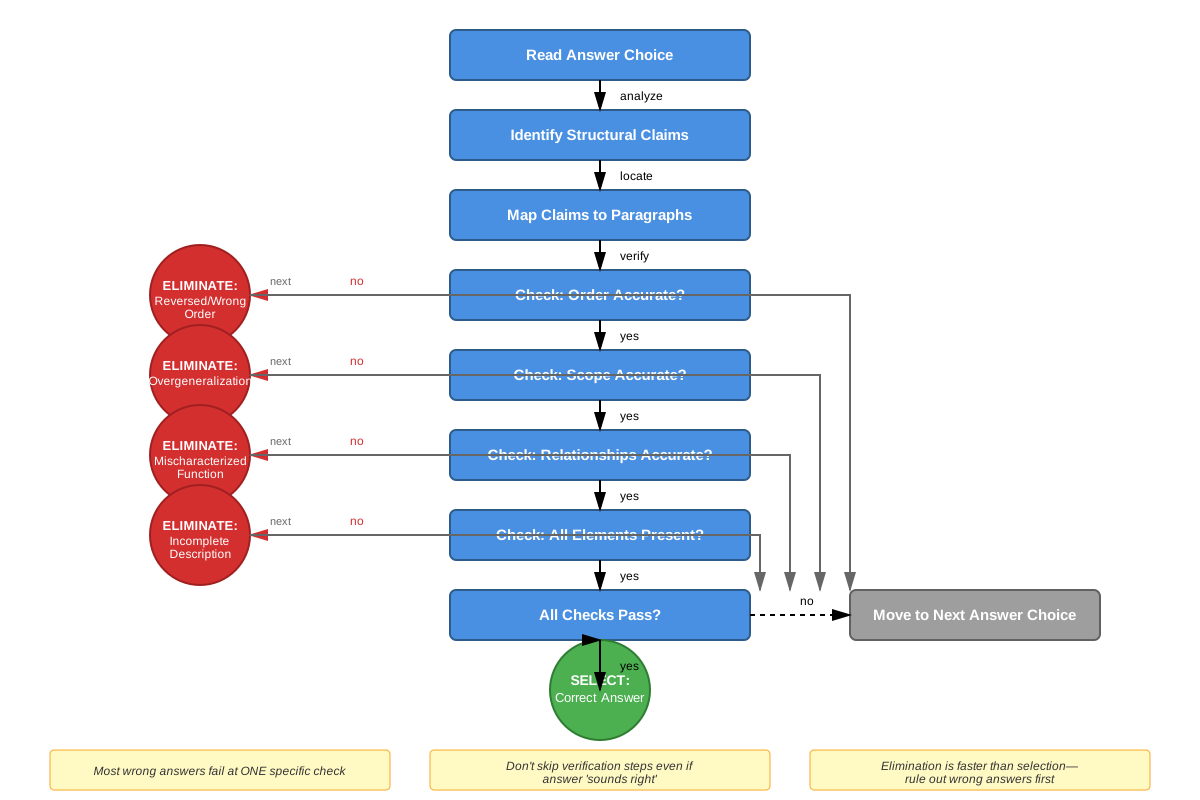
Process of Elimination Tips
Eliminate answers that:
- Focus on content rather than structure: If an answer choice discusses what the passage is about rather than how it's organized, eliminate it. For example, "discusses coral bleaching" describes content; "presents a phenomenon and explains its causes" describes structure.
- Misorder the passage's development: If an answer claims the passage "presents a solution and then identifies the problem," but the passage actually presents the problem first, eliminate it regardless of other accuracies.
- Omit major structural elements: If the passage clearly has three main parts but an answer only accounts for two, eliminate it.
- Overstate or understate relationships: If an answer claims the author "proves" something when they merely "suggests" it, or says they "mention" something when they actually "extensively analyze" it, eliminate it.
- Introduce elements not present: If an answer mentions "practical applications" or "historical examples" that don't appear in the passage, eliminate it.
Time Allocation
Organization questions typically require 45-60 seconds once you've read the passage—slightly less than detail or inference questions. The key is investing time during passage reading to track structure, which pays dividends across multiple questions. If you've maintained structural awareness while reading, organization questions become among the fastest to answer. If you haven't, they can become time-consuming as you re-read to determine structure.
Efficient approach:
- Identify the question as an organization question (5 seconds)
- Consult your mental structural map (10 seconds)
- Predict the answer in your own words (10 seconds)
- Scan answer choices for a match (15 seconds)
- Verify the match accounts for all relevant structural elements (15 seconds)
When to Skip and Return
If you encounter an organization question before reading the passage (some students preview questions), skip it and return after reading. Organization questions require holistic understanding of the passage structure, which only comes from complete reading. Attempting to answer them prematurely wastes time.
Memory Techniques
The PACES Acronym for Organizational Patterns
Remember the six most common organizational patterns with PACES:
- Problem-Solution
- Analysis (Comparative)
- Chronological Development
- Explanation (Phenomenon-Explanation)
- Support (Thesis-Support)
(Note: Critique-Response can be remembered as a variant of Comparative Analysis)
The "Function First" Mantra
When reading each paragraph, immediately ask: "What is this paragraph's function?" Repeat this mantra to maintain structural awareness. The question itself triggers the appropriate analytical mode.
The Transition Signal Map
Visualize transitions as road signs indicating structural direction:
- "However" = U-turn (contrast/opposition)
- "Moreover" = Straight ahead (continuation)
- "For example" = Scenic viewpoint (illustration)
- "Therefore" = Destination ahead (conclusion/result)
This spatial metaphor helps recognize structural shifts while reading.
The Three-Part Structure Default
Many LSAT passages follow a three-part structure: Introduction → Development → Complication/Synthesis. When uncertain about organization, check whether this pattern fits. This default structure provides a starting hypothesis that can be confirmed or adjusted.
Paragraph Function Checklist
Memorize common paragraph functions using the acronym CRISP BEES:
- Critique
- Refute
- Introduce
- Support
- Present (opposing view)
- Background
- Explain
- Exemplify
- Synthesize
After each paragraph, mentally check which function applies.
Summary
Organization questions test the ability to analyze and articulate the structural framework of LSAT Reading Comprehension passages. These questions, appearing in 15-20% of all Reading Comprehension questions, require students to identify how passages are constructed rather than merely what they say. Success depends on recognizing common organizational patterns (thesis-support, problem-solution, comparative analysis, chronological development, phenomenon-explanation, and critique-response), understanding paragraph functions within overall structure, and using transition words as structural signals. The key distinction is between content (what is discussed) and function (what role it plays). Correct answers describe structure using abstract, functional language and account for all major passage elements. Students must develop dual awareness while reading—comprehending content while simultaneously tracking structural relationships. This meta-cognitive skill enhances performance not only on organization questions but across all Reading Comprehension question types by providing a roadmap for efficient information location and logical relationship understanding.
Key Takeaways
- Organization questions focus on how passages are structured, not what they say—distinguishing content from function is essential
- The six most common organizational patterns (thesis-support, problem-solution, comparative analysis, chronological development, phenomenon-explanation, critique-response) account for the vast majority of LSAT passages
- Correct answers use abstract, functional language (presents, critiques, synthesizes) rather than repeating passage content vocabulary
- Active reading with structural awareness—mentally summarizing each paragraph's function—makes organization questions significantly easier and faster
- Transition words serve as structural roadmaps that signal relationships between ideas and shifts in organizational patterns
- Organization questions often appear early in question sets and provide structural understanding that aids subsequent questions about the same passage
- Wrong answers typically describe content accurately but mischaracterize structure, omit structural elements, or reverse the order of presentation
Related Topics
Main Point and Primary Purpose Questions: These question types closely relate to organization questions, as understanding passage structure helps identify which ideas are central versus peripheral. Mastering organization questions provides the structural framework that makes main point identification more reliable.
Function Questions: While organization questions address overall passage structure, function questions focus on why specific details, examples, or statements appear. The analytical skills developed for organization questions transfer directly to function questions.
Comparative Reading Passages: LSAT Reading Comprehension includes paired passages that must be compared. Organization skills become even more critical here, as students must track the structure of two passages simultaneously and understand how they relate to each other.
Argument Structure in Logical Reasoning: The structural analysis skills developed through organization questions apply directly to Logical Reasoning, where identifying argument structure (premise-conclusion relationships) is fundamental to success.
Practice CTA
Now that you've mastered the conceptual foundation of organization questions, it's time to apply this knowledge to actual LSAT passages. The practice questions and flashcards will reinforce your ability to quickly identify organizational patterns, distinguish content from function, and select correct answers with confidence. Remember: organization questions reward active, structural reading—a skill that improves with deliberate practice. Each practice question you complete strengthens your structural awareness and builds the pattern recognition that makes these questions increasingly automatic. Approach the practice materials with the strategies you've learned, and you'll see measurable improvement in both accuracy and speed. Your investment in mastering organization questions will pay dividends across your entire Reading Comprehension performance!
Sign up free to keep reading
Create a free AnvayaPrep account to finish this LSAT guide on Organization questions — plus flashcards and practice questions.