Overview
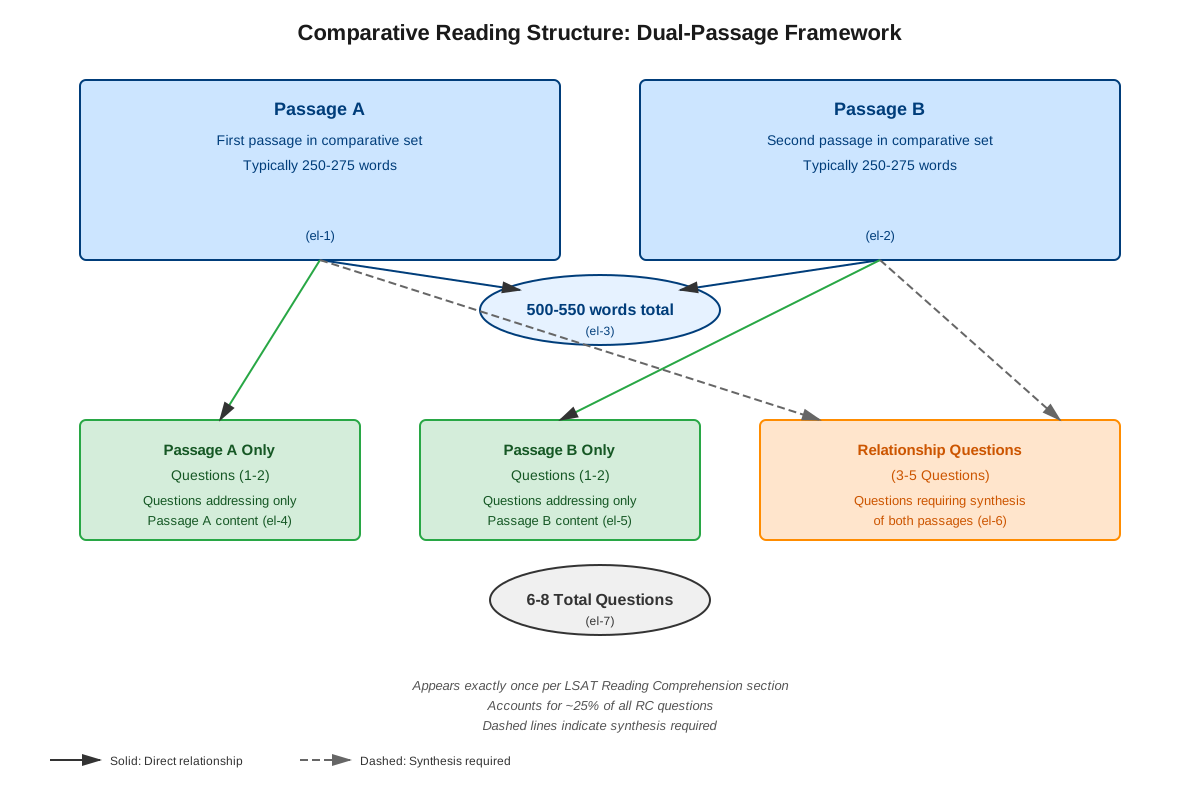
Comparative reading structure is a distinctive format introduced to the LSAT Reading Comprehension section in June 2007. Unlike traditional single-passage questions, comparative reading presents two shorter passages (Passage A and Passage B) that address related topics, themes, or arguments. These paired passages typically total 500-550 words combined and are followed by 6-8 questions that test the student's ability to analyze each passage individually and understand the relationship between them. This format appears exactly once in every LSAT Reading Comprehension section, making it a guaranteed component of the exam that accounts for approximately 25% of all reading comprehension questions.
The lsat comparative reading structure requires a unique analytical approach that goes beyond simple comprehension of individual texts. Test-takers must simultaneously track the main point, tone, structure, and reasoning of each passage while identifying points of agreement, disagreement, and thematic overlap. This dual-processing demand makes comparative reading one of the most cognitively challenging components of the reading comprehension section, as students must maintain mental separation between the passages while also synthesizing their relationship.
Understanding comparative reading structure is essential for LSAT success because it represents a predictable, high-value opportunity to demonstrate advanced analytical skills. The passage pair format creates unique question types that don't appear elsewhere in the exam, including questions about how one author would respond to the other's argument, which passage provides more support for a particular claim, and what principles or assumptions the authors share or dispute. Mastering this structure provides a strategic advantage, as the predictable appearance of one comparative set per test allows for targeted preparation and confident execution on test day.
Learning Objectives
- [ ] Identify how Comparative reading structure appears in LSAT questions
- [ ] Explain the reasoning pattern behind Comparative reading structure
- [ ] Apply Comparative reading structure to solve LSAT-style problems accurately
- [ ] Distinguish between questions that address individual passages versus questions that require synthesis of both passages
- [ ] Analyze the relationship between paired passages using standard relationship categories (agreement, disagreement, complementary perspectives, etc.)
- [ ] Develop an efficient reading strategy that balances individual passage comprehension with relationship analysis
- [ ] Recognize common comparative question stems and select appropriate answering strategies for each type
Prerequisites
- Basic passage comprehension skills: The ability to identify main points, supporting details, and author's purpose in single passages is foundational before tackling dual-passage analysis
- Understanding of argument structure: Recognizing premises, conclusions, and reasoning patterns helps identify where passages align or diverge in their logical approaches
- Familiarity with LSAT question types: Knowledge of standard Reading Comprehension question formats (main point, inference, function, etc.) provides the framework for understanding how these types adapt to comparative contexts
- Active reading techniques: Skills like annotation, passage mapping, and identifying structural keywords are essential for managing the increased cognitive load of dual passages
Why This Topic Matters
Comparative reading structure represents a critical evolution in standardized testing that reflects real-world analytical demands. Legal professionals, academics, and policy makers regularly encounter multiple perspectives on complex issues and must synthesize competing viewpoints to form reasoned judgments. The LSAT's inclusion of this format tests a candidate's readiness for law school seminars, case analysis, and legal writing, where understanding how different authorities relate to one another is fundamental.
From an exam statistics perspective, comparative reading appears with absolute consistency: every LSAT contains exactly one comparative reading set, typically as one of the four Reading Comprehension passages. This set generates 6-8 questions (most commonly 7), representing approximately 13-15% of the total LSAT score and 25-27% of the Reading Comprehension section score. The predictability of this format makes it a high-yield study investment—students who master comparative reading structure gain a reliable advantage on a known quantity of questions.
The comparative format appears across diverse content areas, including law, science, humanities, and social sciences. Common manifestations include: two scholars debating a historical interpretation; a traditional view paired with a modern critique; complementary approaches to solving a problem; competing scientific theories; or different applications of the same principle. Questions typically fall into three categories: those addressing Passage A only (1-2 questions), those addressing Passage B only (1-2 questions), and those requiring synthesis of both passages (3-5 questions). The synthesis questions are unique to comparative reading and include relationship questions, comparative inference questions, and questions about how one author would respond to the other's claims.
Core Concepts
The Dual-Passage Format
The comparative reading structure consists of two passages labeled "Passage A" and "Passage B" that together approximate the length of a single standard LSAT passage. Passage A typically ranges from 200-300 words, while Passage B ranges from 250-300 words, with the combined length rarely exceeding 550 words. This format creates a unique reading challenge: students must process two complete arguments, perspectives, or presentations while maintaining awareness of how they relate to one another.
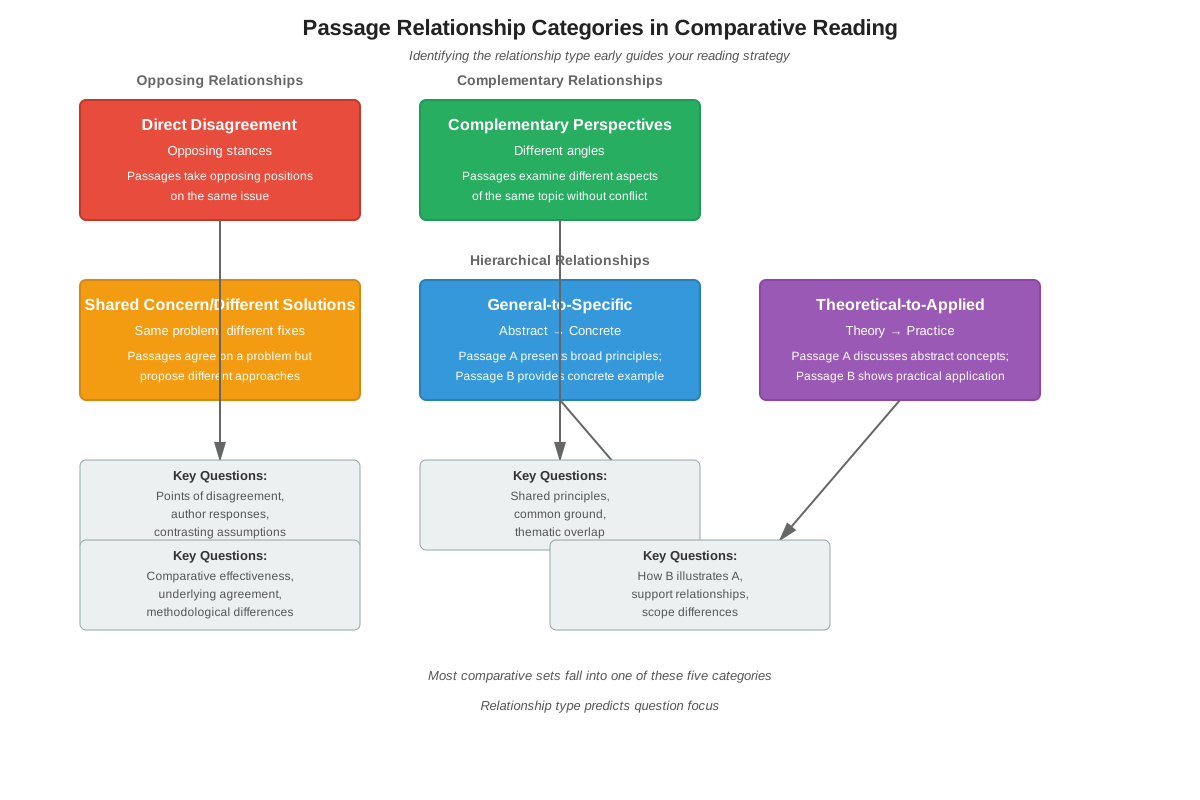
The passages are always thematically linked but present distinct perspectives, approaches, or aspects of a common topic. The relationship between passages falls into several standard categories:
| Relationship Type | Description | Example Topics |
|---|---|---|
| Direct Disagreement | Authors take opposing positions on the same question | Whether a legal doctrine should be reformed |
| Complementary Perspectives | Authors address different aspects of the same phenomenon | Two approaches to environmental conservation |
| General-to-Specific | One passage presents broad principles; the other applies them | Abstract theory paired with case study |
| Problem-Solution Variants | Authors propose different solutions to the same problem | Competing strategies for education reform |
| Traditional-Modern | Classic view contrasted with contemporary revision | Historical interpretation vs. new evidence |
Question Distribution Pattern
Understanding the typical question distribution helps optimize reading strategy. The standard comparative reading set includes:
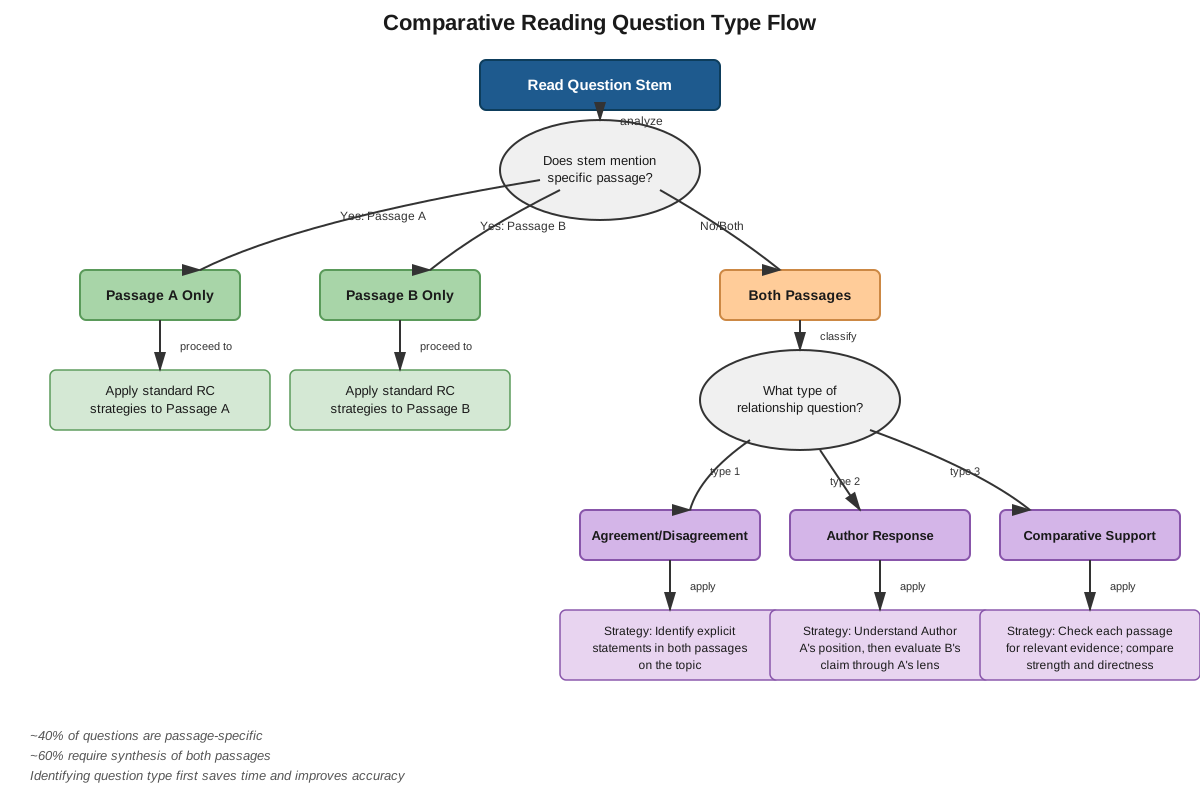
- Individual Passage Questions (2-4 total): These function identically to questions on single passages, asking about main point, purpose, structure, or details within one passage only. The question stem explicitly references "Passage A" or "Passage B."
- Relationship Questions (1-2): These directly ask about how the passages relate, such as "Which one of the following most accurately describes the relationship between the two passages?" or "The authors would be most likely to agree on which one of the following?"
- Comparative Analysis Questions (2-4): These require understanding both passages to answer but don't explicitly ask about their relationship. Examples include: "Which passage provides more support for the claim that...?" or "How would the author of Passage B most likely respond to the argument in lines 15-20 of Passage A?"
The Relationship Spectrum
The core analytical task in comparative reading is determining where the passages fall on the relationship spectrum. This spectrum ranges from complete agreement to direct opposition, with several intermediate positions:
Strong Agreement: Both authors advocate the same position using similar reasoning. Questions focus on shared assumptions, common evidence, or unified conclusions.
Qualified Agreement: Authors reach similar conclusions but through different reasoning paths or with different emphases. Questions test understanding of these nuanced differences.
Complementary/Neutral: Passages address related but non-overlapping aspects of a topic without directly agreeing or disagreeing. Questions focus on how the passages could be synthesized or which addresses particular sub-issues.
Qualified Disagreement: Authors disagree on specific points while sharing some common ground. Questions test ability to identify precise points of divergence versus areas of agreement.
Direct Opposition: Authors take contradictory positions on the central question. Questions focus on contrasting evidence, opposing conclusions, and incompatible assumptions.
Structural Markers and Signposts
Efficient comparative reading requires identifying structural markers that signal the relationship between passages. Key signposts include:
Opening sentences: The first sentence of each passage often establishes the author's stance or approach, providing immediate insight into whether the passages will agree, disagree, or complement each other.
Transition words within passages: Terms like "however," "in contrast," "similarly," and "moreover" indicate how ideas relate within each passage, which helps predict inter-passage relationships.
Tone indicators: Words conveying approval, skepticism, enthusiasm, or criticism reveal authorial attitude, which is crucial for relationship questions.
Explicit references: Occasionally, Passage B will directly reference the type of view presented in Passage A (e.g., "Some scholars argue..." in Passage B might directly describe Passage A's position).
The Synthesis Requirement
The defining feature of comparative reading is the synthesis requirement—the cognitive demand to hold both passages in working memory while analyzing their relationship. This differs fundamentally from single-passage reading, where all information comes from one source. Synthesis questions require:
- Accurate representation of each passage's position: Misunderstanding either passage leads to incorrect relationship analysis
- Identification of comparable elements: Recognizing which claims, evidence, or reasoning in one passage correspond to elements in the other
- Evaluation of compatibility: Determining whether corresponding elements support, contradict, or remain neutral to each other
- Perspective-taking: Imagining how one author would evaluate or respond to the other's arguments
Common Question Stems in Comparative Reading
Recognizing question stem patterns helps activate appropriate answering strategies:
Relationship stems: "The relationship between the two passages is most analogous to..." or "Which one of the following most accurately characterizes the relationship between the two passages?"
Agreement/disagreement stems: "The authors would be most likely to disagree about which one of the following?" or "Both passages are concerned with answering which one of the following questions?"
Comparative support stems: "Which passage provides stronger support for the claim that...?" or "The claim in lines X-Y of Passage A is most supported by information in which part of Passage B?"
Response stems: "The author of Passage B would be most likely to respond to the argument in Passage A by..." or "How would the author of Passage A most likely regard the proposal in Passage B?"
Unique element stems: "Which one of the following is discussed in Passage B but not in Passage A?" or "Passage A differs from Passage B in that only Passage A..."
Concept Relationships
The concepts within comparative reading structure form an interconnected analytical framework. The dual-passage format serves as the foundation, creating the structural context for all other concepts. This format necessitates understanding the question distribution pattern, which determines how reading time and analytical energy should be allocated. The question distribution directly connects to question stem recognition, as identifying whether a question addresses one passage or both determines the answering approach.
The relationship spectrum represents the central analytical task that connects all other concepts. Determining where passages fall on this spectrum requires attention to structural markers and signposts, which provide textual evidence for relationship claims. The relationship analysis then enables effective handling of the synthesis requirement, which is tested through specific question types identified via common question stems.
This topic builds on prerequisite knowledge of single-passage reading comprehension by adding a comparative layer. The progression flows: Basic comprehension → Individual passage analysis → Relationship identification → Synthesis and comparative reasoning. Mastering comparative reading structure prepares students for advanced analytical tasks throughout the LSAT, particularly in Logical Reasoning where comparing arguments and identifying parallel reasoning are essential skills.
The relationship map: Dual-Passage Format → creates → Question Distribution Pattern → requires → Efficient Reading Strategy → depends on → Structural Markers → enable → Relationship Spectrum Analysis → fulfills → Synthesis Requirement → tested through → Comparative Question Stems → answered using → Strategic Approach
High-Yield Facts
⭐ Every LSAT contains exactly one comparative reading set, consistently appearing as one of the four Reading Comprehension passages
⭐ Comparative reading sets generate 6-8 questions (most commonly 7), representing approximately 25% of all Reading Comprehension questions
⭐ The two passages combined total 500-550 words, with Passage B typically equal to or slightly longer than Passage A
⭐ Approximately 50-60% of questions in a comparative set require synthesis of both passages, while 40-50% address individual passages
⭐ The most common relationship types are direct disagreement, complementary perspectives, and traditional-modern contrasts
- Questions explicitly referencing "Passage A" or "Passage B" in the stem can be answered using only that passage
- The first and last sentences of each passage are disproportionately important for identifying the relationship between passages
- Comparative reading passages appear across all content domains (law, science, humanities, social sciences) with no predictable pattern
- Wrong answers on relationship questions often accurately describe one passage but mischaracterize the other or the connection between them
- Time management for comparative reading should allocate approximately 3-4 minutes for reading both passages and 5-6 minutes for questions
Quick check — test yourself on Comparative reading structure so far.
Try Flashcards →Common Misconceptions
Misconception: Both passages must be read with equal depth and attention before attempting any questions.
Correction: While both passages require careful reading, an efficient strategy involves reading Passage A thoroughly, briefly noting its main point and structure, then reading Passage B while actively comparing it to Passage A. Some test-takers even answer individual Passage A questions before reading Passage B to reduce cognitive load.
Misconception: Comparative reading passages always present opposing viewpoints in direct disagreement.
Correction: While disagreement is common, passages frequently present complementary perspectives, different applications of the same principle, or varying approaches to the same problem without direct opposition. Assuming disagreement can lead to mischaracterizing neutral or complementary relationships.
Misconception: Questions asking about "both passages" require finding information explicitly stated in both texts.
Correction: "Both passages" questions often require synthesis and inference rather than explicit statements. For example, a question asking what both authors would agree on might require inferring shared assumptions that neither author directly states.
Misconception: The relationship between passages remains constant throughout both texts.
Correction: Passages may agree on some points while disagreeing on others, or one passage may address issues the other ignores. The relationship is often multifaceted, requiring careful attention to which specific claims or aspects are being compared in each question.
Misconception: Longer passages contain more important information than shorter passages.
Correction: Passage length doesn't correlate with importance or question frequency. A shorter Passage A may generate just as many questions as a longer Passage B, and the relationship questions give equal weight to both passages regardless of length.
Misconception: Comparative reading requires memorizing both passages in detail before attempting questions.
Correction: Like all LSAT Reading Comprehension, comparative reading is an open-book test—students can and should return to the passages when answering questions. The goal during initial reading is to understand structure, main points, and relationships, not to memorize details.
Worked Examples
Example 1: Identifying Passage Relationship
Passage A Summary: A legal scholar argues that judicial precedent should be strictly followed to maintain consistency and predictability in the legal system. The author emphasizes that overturning precedents creates uncertainty and undermines public confidence in courts.
Passage B Summary: A different legal scholar acknowledges the value of precedent but argues that courts must be willing to overturn outdated precedents when they conflict with contemporary understandings of justice and constitutional principles. The author provides examples of beneficial precedent reversals.
Question: Which one of the following most accurately describes the relationship between the two passages?
Analysis Process:
- Identify each passage's main claim:
- Passage A: Precedent should be strictly maintained
- Passage B: Precedent is valuable but should be overturned when outdated
- Determine areas of agreement: Both authors value precedent and recognize its role in the legal system
- Identify the point of disagreement: Whether precedent should be strictly maintained (A) or subject to revision (B)
- Characterize the relationship: This is qualified disagreement—the authors share common ground (valuing precedent) but reach different conclusions about its application
- Predict answer characteristics: The correct answer will acknowledge both the shared foundation and the specific disagreement about flexibility versus strict adherence
Correct answer type: "Passage A advocates strict adherence to a principle that Passage B argues should be applied flexibly" or "Both passages address the value of legal precedent, but they disagree about the circumstances under which precedent should be overturned"
Wrong answer patterns to eliminate:
- Answers suggesting complete opposition (ignoring shared values)
- Answers suggesting agreement (ignoring the central disagreement)
- Answers mischaracterizing either passage's position
- Answers describing relationships that don't match the passages (e.g., general-to-specific when both are equally abstract)
Example 2: Comparative Response Question
Passage A (lines 15-22): "The widespread adoption of renewable energy technologies will inevitably lead to economic disruption in fossil fuel-dependent regions. Policymakers must acknowledge these costs rather than dismissing concerns about job losses as obstacles to progress."
Passage B Main Point: Renewable energy transition creates more jobs than it eliminates, and economic studies consistently show net employment gains in regions that invest in green technology infrastructure.
Question: The author of Passage B would most likely respond to the claim in lines 15-22 of Passage A by:
Analysis Process:
- Identify the specific claim in Passage A: Renewable energy adoption will cause economic disruption and job losses that shouldn't be dismissed
- Determine Passage B's relevant position: Renewable energy creates net job gains, not losses
- Assess compatibility: Passage B directly contradicts the economic disruption claim in Passage A
- Consider Passage B's tone and approach: Passage B uses economic evidence to support optimism about renewable energy
- Predict response characteristics: The author of Passage B would likely challenge the claim using economic data, arguing that the feared job losses are outweighed by job creation
Correct answer type: "Pointing out that economic studies show renewable energy creates more jobs than it eliminates" or "Arguing that the claim overlooks evidence of net employment gains in regions adopting renewable energy"
Wrong answer patterns to eliminate:
- Responses suggesting agreement or partial agreement (Passage B contradicts this claim)
- Responses that don't address the economic/employment aspect of the claim
- Responses that mischaracterize Passage B's evidence-based approach
- Responses that are too extreme or go beyond what Passage B actually argues
Key strategic insight: Response questions require precise understanding of both the specific claim being addressed and the responding author's relevant position. The correct answer must be consistent with the responding author's tone, evidence, and reasoning approach, not just their general conclusion.
Exam Strategy
Reading Approach
Develop a systematic reading process for comparative passages:
- Read Passage A completely and actively, noting main point, structure, and tone
- Briefly summarize Passage A's position in your own words (mental or marginal note)
- Read Passage B while actively comparing to Passage A, noting agreements, disagreements, and unique elements
- Immediately identify the relationship before moving to questions
- Create a simple relationship note (e.g., "A: strict precedent, B: flexible precedent—qualified disagreement")
Trigger Words and Phrases
Watch for these high-value signals in question stems:
Individual passage questions: "According to Passage A," "The author of Passage B mentions," "In Passage A, the reference to"—these can be answered using only the specified passage
Relationship questions: "The relationship between," "most accurately describes how the passages relate," "differ in their"—these require explicit relationship analysis
Agreement/disagreement questions: "would be most likely to agree," "disagree about which," "both passages are concerned with"—these require identifying overlap or divergence
Comparative support questions: "Which passage provides more support," "better supported by," "more directly addresses"—these require evaluating both passages against a criterion
Response questions: "would most likely respond," "would regard," "would be most likely to view"—these require perspective-taking and understanding one author's position relative to specific claims in the other passage
Process of Elimination Strategy
For comparative reading questions, eliminate answers that:
- Mischaracterize either passage: If any part of an answer inaccurately describes Passage A or Passage B, eliminate it immediately
- Confuse the passages: Answers that attribute Passage A's position to Passage B or vice versa are common wrong answers
- Overstate agreement or disagreement: Answers using extreme language ("complete agreement," "total opposition") are usually wrong unless the passages truly are at the extremes
- Introduce outside information: Answers that bring in reasonable-sounding ideas not present in either passage
- Address only one passage: On synthesis questions, answers that could be supported by one passage but ignore the other are typically incorrect
Time Allocation
Allocate approximately 8-9 minutes total for a comparative reading set:
- 3-4 minutes: Reading both passages and identifying relationship
- 5-6 minutes: Answering 6-8 questions (approximately 45 seconds per question)
If running short on time, prioritize individual passage questions (which are typically faster) before synthesis questions. However, the relationship identification during initial reading makes synthesis questions more efficient, so don't skip the comparative analysis phase.
Strategic Question Order
Consider answering questions in this order:
- Individual Passage A questions: Answered while Passage A is freshest in memory
- Individual Passage B questions: Answered while Passage B is freshest in memory
- Relationship questions: These reinforce your understanding of how passages connect
- Comparative synthesis questions: Answered last, after all individual passage content is activated
This order minimizes cognitive load by grouping similar tasks and building from simpler (individual passage) to more complex (synthesis) questions.
Memory Techniques
The COMPARE Acronym
Use COMPARE to remember the systematic reading approach:
- Complete Passage A first
- Outline A's main point
- Match and contrast while reading B
- Pinpoint the relationship type
- Annotate key differences
- Review both positions briefly
- Engage with questions strategically
The Relationship Spectrum Visualization
Visualize the relationship spectrum as a horizontal line with five positions:
Strong Agreement — Qualified Agreement — Complementary — Qualified Disagreement — Direct OppositionAs you read Passage B, mentally place the passages on this spectrum. This visualization helps answer relationship questions and predict how authors would respond to each other's claims.
The "Two Lawyers" Mental Model
Imagine Passages A and B as two lawyers presenting arguments to a judge (you). This mental model helps with:
- Maintaining separation: Each lawyer has distinct arguments
- Identifying relationships: Are they opposing counsel or co-counsel with different strategies?
- Response questions: How would one lawyer respond to the other's argument?
- Evaluation questions: Which lawyer provides better support for a particular claim?
The Three-Column Note System
For complex comparative sets, use mental or physical three-column organization:
| Passage A Only | Both Passages | Passage B Only |
|---|---|---|
| Unique claims | Shared assumptions | Unique claims |
| Unique evidence | Common concerns | Unique evidence |
| Unique approach | Areas of agreement | Unique approach |
This organization makes synthesis questions more manageable by clearly categorizing information.
Summary
Comparative reading structure is a distinctive LSAT format that presents two related passages followed by questions testing individual passage comprehension and inter-passage synthesis. Appearing exactly once per test, this format accounts for approximately 25% of Reading Comprehension questions and requires a unique analytical approach. The two passages, totaling 500-550 words combined, present related perspectives that fall along a relationship spectrum from strong agreement to direct opposition, with most passages exhibiting qualified disagreement or complementary perspectives. Success requires efficiently reading both passages while identifying their relationship, then strategically approaching three question types: individual passage questions (40-50% of questions), relationship questions, and comparative synthesis questions (50-60% combined). The key analytical task is maintaining accurate mental representations of both passages while evaluating how they relate on specific points. Mastery of comparative reading structure provides a reliable advantage on a predictable component of every LSAT, making it a high-yield study investment for test-takers.
Key Takeaways
- Comparative reading appears exactly once per LSAT as one of four Reading Comprehension passages, generating 6-8 questions that represent approximately 25% of the section
- The two passages present related perspectives that must be understood individually and in relation to each other, requiring both comprehension and synthesis skills
- Passage relationships fall into predictable categories (direct disagreement, complementary perspectives, traditional-modern, etc.) that should be identified during initial reading
- Approximately half of comparative reading questions require synthesis of both passages, while the other half address individual passages and can be answered using only the specified passage
- Efficient strategy involves reading Passage A thoroughly, then reading Passage B while actively comparing it to Passage A, and immediately identifying the relationship before attempting questions
- Question stems provide clear signals about whether individual passage knowledge or synthesis is required, enabling strategic approach selection
- Success depends on maintaining accurate mental representations of both passages while avoiding common errors like confusing the passages or overstating agreement/disagreement
Related Topics
Passage Mapping and Annotation Techniques: Developing efficient note-taking systems for tracking main points, structure, and key details in reading passages. Mastering comparative reading structure creates demand for advanced annotation methods that handle dual passages.
Inference Questions in Reading Comprehension: Understanding how to draw valid conclusions from passage information without overstepping textual support. Comparative reading frequently includes inference questions that require synthesizing information from both passages.
Author's Tone and Attitude Analysis: Identifying and characterizing how authors feel about their subjects through word choice and rhetorical strategies. Tone analysis is crucial for relationship questions and response questions in comparative reading.
Argument Structure and Reasoning Patterns: Recognizing how authors build and support claims through evidence and logical connections. This skill transfers directly to identifying where comparative passages agree or disagree in their reasoning approaches.
Perspective-Taking and Viewpoint Questions: Understanding how to adopt an author's perspective to predict responses or evaluate claims. This advanced skill is essential for the unique "response" questions that appear in comparative reading sets.
Practice CTA
Now that you understand the structure and strategy of comparative reading, it's time to apply these concepts to actual LSAT passages. The practice questions and flashcards for this topic will help you internalize the relationship patterns, question types, and strategic approaches covered in this guide. Comparative reading is one of the most predictable components of the LSAT—you know it will appear exactly once per test, so every practice set you complete directly prepares you for test day. Approach each practice passage systematically, using the COMPARE method and relationship spectrum to build the analytical habits that lead to consistent high performance. Your investment in mastering this format will pay dividends on every LSAT you take.
Sign up free to keep reading
Create a free AnvayaPrep account to finish this LSAT guide on Comparative reading structure — plus flashcards and practice questions.