Overview
Social science passages constitute one of the four major passage types that appear consistently on the LSAT reading comprehension section, alongside humanities, natural science, and law passages. These passages draw from disciplines such as sociology, psychology, anthropology, political science, economics, and history. Understanding how to navigate social science passages is critical because they typically comprise 25% of the reading comprehension section, appearing as one of the four passages in each administration of the exam. The LSAT uses social science passages to test a student's ability to comprehend complex arguments about human behavior, social structures, cultural phenomena, and research methodologies.
What distinguishes social science passages from other passage types is their focus on empirical research, theoretical frameworks, and the interpretation of human social phenomena. These passages frequently present competing theories, describe research studies and their implications, or analyze social trends and their causes. The LSAT social science passages often require test-takers to understand not just what researchers discovered, but how they reached their conclusions and what limitations or alternative explanations might exist. This emphasis on methodology and interpretation makes social science passages particularly challenging for students who struggle to distinguish between evidence and inference.
Mastering social science passages is foundational to success in passage fundamentals because these passages exemplify core reading comprehension skills: identifying main ideas, understanding author's purpose, recognizing argumentative structure, and evaluating evidence. The analytical skills developed through social science passage practice transfer directly to other passage types and strengthen overall critical reading abilities essential for law school success.
Learning Objectives
- [ ] Identify how Social science passages appears in LSAT questions
- [ ] Explain the reasoning pattern behind Social science passages
- [ ] Apply Social science passages to solve LSAT-style problems accurately
- [ ] Distinguish between empirical findings and theoretical interpretations in social science texts
- [ ] Recognize common structural patterns in social science research presentations
- [ ] Evaluate the strength of evidence and identify methodological limitations in social science arguments
- [ ] Synthesize information from multiple viewpoints presented within a single passage
Prerequisites
- Basic reading comprehension skills: The ability to understand complex academic prose is essential for parsing the sophisticated vocabulary and sentence structures common in social science passages.
- Familiarity with argument structure: Recognizing premises, conclusions, and supporting evidence helps identify the logical flow of social science reasoning.
- Understanding of main idea identification: Social science passages require distinguishing central claims from supporting details and examples.
- Knowledge of author's tone and purpose: Detecting whether an author is advocating, critiquing, or neutrally presenting information is crucial for answering inference questions.
Why This Topic Matters
Social science passages represent a significant portion of the LSAT reading comprehension section, appearing in approximately 25% of all passages. Each LSAT administration includes four reading comprehension passages, and one is consistently drawn from social science disciplines. This predictability makes social science passages a high-yield study area where focused preparation directly translates to improved scores.
In real-world legal practice, attorneys regularly encounter social science research in cases involving discrimination, public policy, criminal justice reform, and expert testimony. Understanding how to critically evaluate social science methodology, identify limitations in research design, and distinguish correlation from causation are skills that extend beyond the LSAT into legal reasoning itself. Judges and lawyers must assess the validity of social science evidence presented in court, making this passage type particularly relevant to legal education.
On the LSAT, social science passages commonly appear in several formats: presentations of research studies with findings and implications, discussions of competing theoretical frameworks, historical analyses of social movements or institutions, and examinations of cultural phenomena through various disciplinary lenses. Question types frequently test understanding of research methodology, the relationship between evidence and conclusions, the author's attitude toward different theories, and the implications of findings for broader social issues. Students can expect questions about main purpose, specific details, inference, author's tone, logical structure, and application of passage principles to new scenarios.
Core Concepts
Characteristics of Social Science Passages
Social science passages on the LSAT share distinctive features that set them apart from other passage types. These passages typically present information about human behavior, social structures, cultural practices, or institutional dynamics. The content draws from established academic disciplines including sociology, psychology, anthropology, economics, political science, and history. Unlike natural science passages that focus on physical phenomena, social science passages examine phenomena that involve human agency, interpretation, and social context.
The language in social science passages tends to be more accessible than natural science passages but more technical than humanities passages. Authors frequently employ discipline-specific terminology such as "social stratification," "cognitive bias," "cultural relativism," or "institutional framework." However, the LSAT typically provides sufficient context for understanding these terms without requiring prior specialized knowledge.
Common Structural Patterns
Social science passages follow predictable organizational structures that, once recognized, significantly improve comprehension and question-answering efficiency:
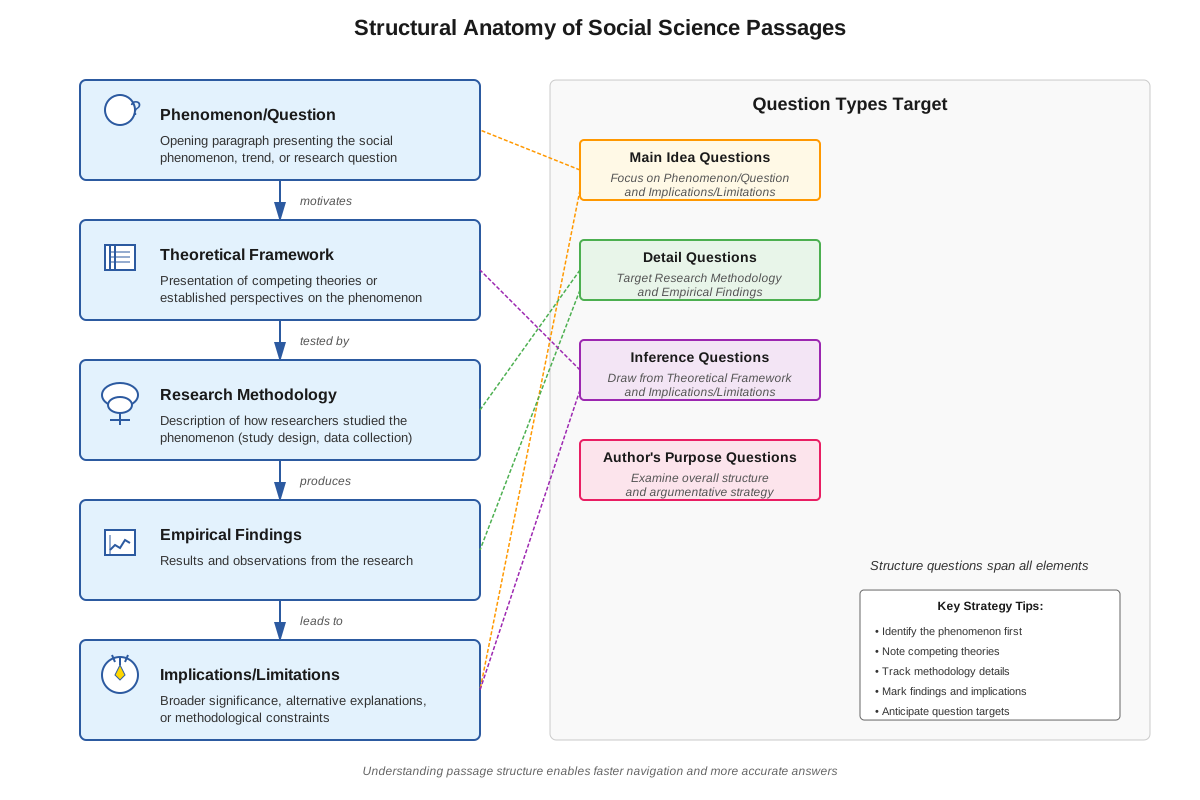
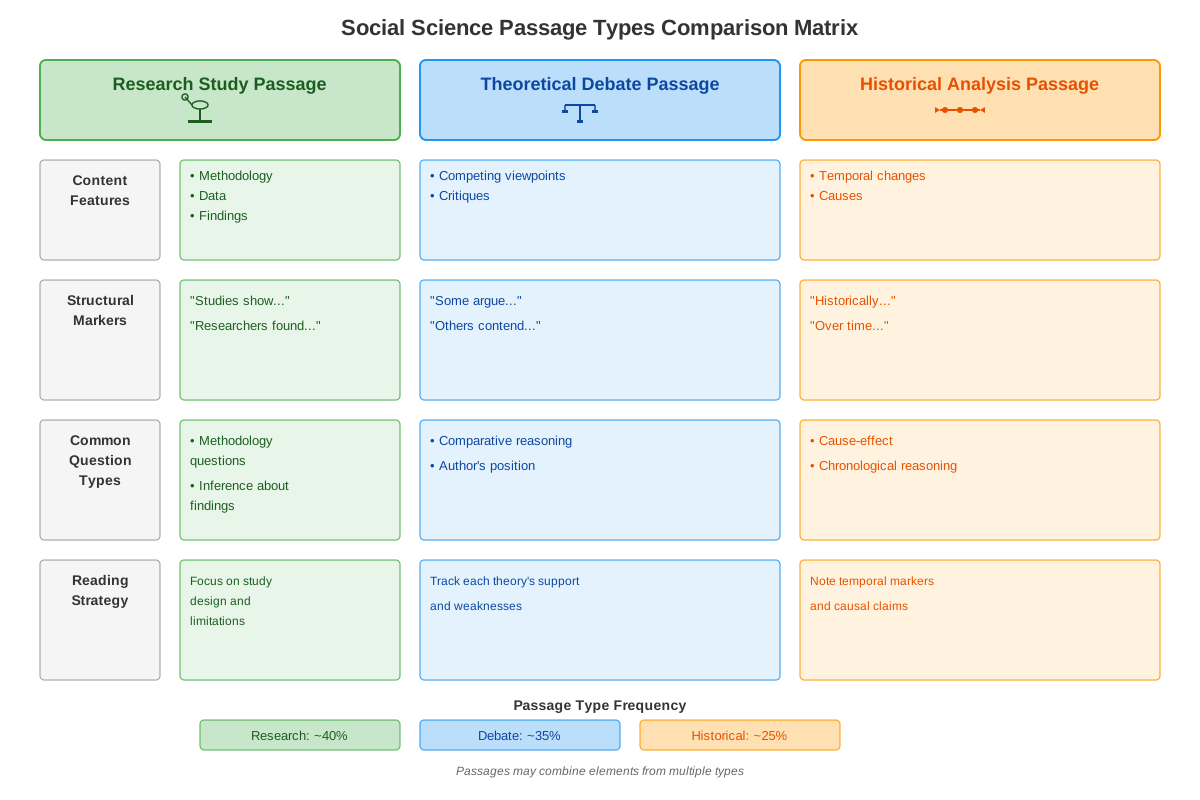
The Research Study Pattern: The passage describes a research question, methodology, findings, and implications. This structure often includes discussion of how the research challenges previous assumptions or contributes to ongoing debates. The LSAT frequently tests understanding of the relationship between methodology and conclusions, as well as potential limitations of the research design.
The Competing Theories Pattern: The passage presents two or more theoretical frameworks for understanding a social phenomenon. The author may remain neutral, presenting each theory's strengths and weaknesses, or may advocate for one perspective over others. Questions often focus on distinguishing the theories, understanding their underlying assumptions, and recognizing which evidence supports which theory.
The Historical Development Pattern: The passage traces how understanding of a social phenomenon has evolved over time, often showing how earlier theories were refined or replaced. This structure emphasizes chronological progression and causal relationships between intellectual developments.
The Problem-Solution Pattern: The passage identifies a social problem or puzzle, discusses why it matters, and presents one or more proposed solutions or explanations. Questions typically test understanding of the problem's significance and the logic connecting proposed solutions to the underlying issue.
Evidence and Reasoning in Social Science
Understanding how social scientists use evidence is crucial for LSAT success. Social science passages distinguish between several types of claims:
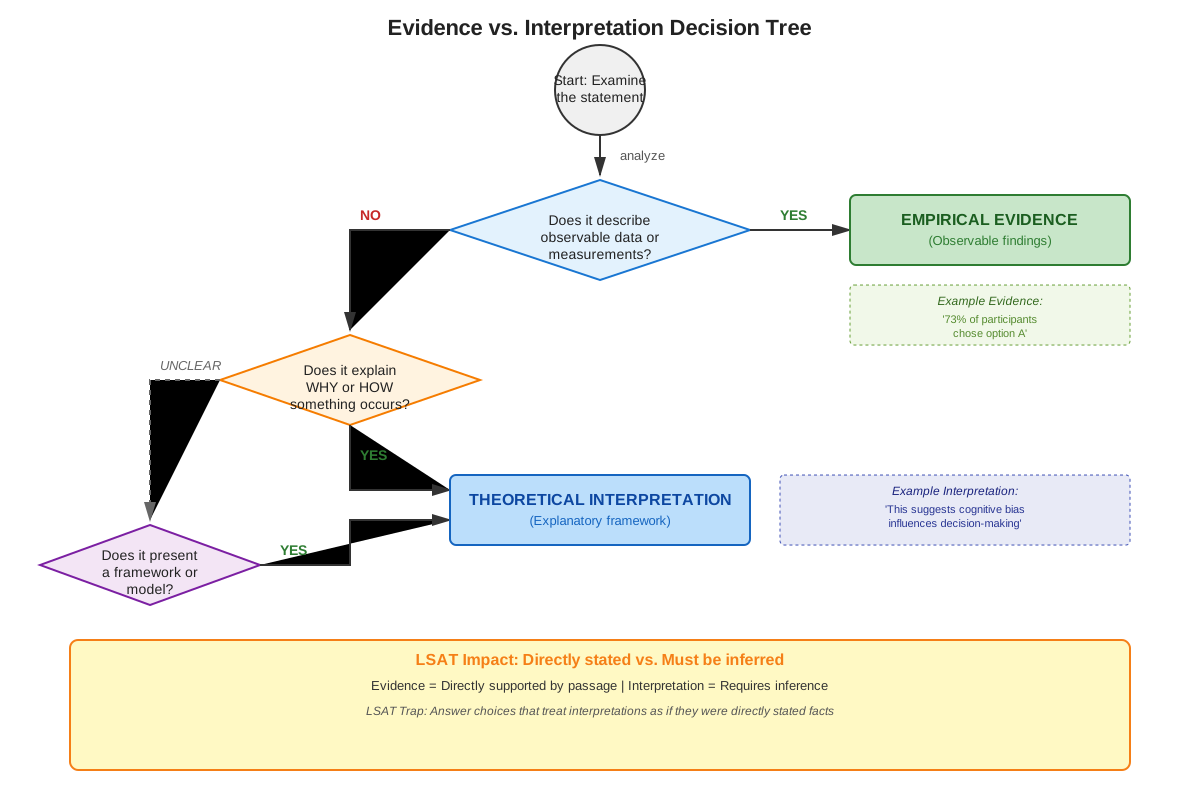
Empirical findings are observations or data collected through research methods such as surveys, experiments, ethnographic studies, or historical analysis. These represent what researchers actually observed or measured.
Interpretations are explanations of what the empirical findings mean or why they occurred. Multiple interpretations may be consistent with the same empirical data.
Theoretical claims are broader principles or frameworks that organize understanding of social phenomena. Theories generate predictions that can be tested through empirical research.
The LSAT frequently tests whether students can distinguish these levels of analysis. A common question type asks what evidence would strengthen or weaken a particular interpretation, requiring recognition that empirical findings support or undermine theoretical claims.
Methodological Considerations
Social science passages often discuss research methodology, and understanding basic methodological concepts enhances comprehension:
| Methodological Concept | Definition | LSAT Relevance |
|---|---|---|
| Correlation vs. Causation | Correlation shows variables change together; causation shows one causes the other | Questions often test whether students incorrectly infer causation from correlational evidence |
| Sample Representativeness | Whether research participants accurately reflect the broader population | Passages may discuss limitations when samples are not representative |
| Confounding Variables | Factors other than the studied variable that might explain results | Understanding alternative explanations is crucial for inference questions |
| Qualitative vs. Quantitative | Qualitative research examines meanings and experiences; quantitative research measures numerical data | Different methods suit different research questions |
Author's Purpose and Tone
Social science passages exhibit various authorial stances:
Neutral presentation: The author objectively describes theories, research, or debates without advocating a position. Questions test whether students can distinguish the author's views from those being described.
Critical evaluation: The author assesses strengths and weaknesses of theories or research, often using phrases like "however," "despite," or "problematically." Recognizing evaluative language helps identify the author's perspective.
Advocacy: The author argues for a particular interpretation or approach, marshaling evidence to support a specific conclusion. Understanding the argumentative structure is essential for main purpose questions.
Interdisciplinary Connections
Social science passages frequently draw on multiple disciplines to examine a phenomenon from various angles. A passage might discuss economic incentives, psychological motivations, and historical context within a single analysis. The LSAT tests whether students can track how different disciplinary perspectives contribute to the overall argument and recognize when the author privileges one perspective over others.
Concept Relationships
The concepts within social science passages form an interconnected system. Structural patterns provide the organizational framework within which evidence and reasoning operate. Understanding the passage structure helps predict where key information will appear and how different parts of the passage relate to each other. For instance, in the research study pattern, methodology precedes findings, which precede implications—recognizing this sequence helps locate answers efficiently.
Evidence and reasoning directly connect to methodological considerations because the strength of social science arguments depends on research design quality. When a passage discusses a study's findings, understanding potential confounding variables or sample limitations enables evaluation of how strongly the evidence supports the author's interpretation.
Author's purpose and tone influence how all other elements are presented. A critical author will emphasize methodological limitations or alternative interpretations, while an advocating author will highlight evidence supporting their preferred theory. Recognizing authorial stance helps predict which aspects of the research or theory will receive emphasis.
These passage-level concepts build on prerequisite knowledge of argument structure and main idea identification. The ability to recognize premises and conclusions transfers directly to distinguishing empirical findings from interpretations. Similarly, main idea identification skills enable recognition of whether a passage's primary purpose is to present research, compare theories, or advocate for a position.
The relationship map flows as follows: Structural pattern recognition → enables efficient navigation → Evidence identification → supports understanding of → Reasoning and interpretation → which is evaluated through → Methodological considerations → all filtered through → Author's purpose and tone → ultimately serving → Question answering strategies.
High-Yield Facts
⭐ Social science passages appear in approximately 25% of LSAT reading comprehension sections, making them one of four standard passage types.
⭐ The most common structural patterns are: research study presentation, competing theories, historical development, and problem-solution.
⭐ Questions frequently test the distinction between empirical findings (what was observed) and interpretations (what the findings mean).
⭐ Correlation does not imply causation—passages often present correlational evidence while questions test whether students incorrectly infer causal relationships.
⭐ Author's tone in social science passages ranges from neutral presentation to critical evaluation to advocacy—identifying the stance is crucial for inference questions.
- Social science passages draw from sociology, psychology, anthropology, economics, political science, and history.
- Methodological limitations are frequently discussed and tested, including sample representativeness, confounding variables, and research design constraints.
- Passages often present multiple perspectives or theories, requiring careful tracking of which evidence supports which viewpoint.
- The LSAT does not require prior knowledge of social science content—all necessary information is provided within the passage.
- Questions about "the author would most likely agree" require distinguishing the author's views from positions merely described in the passage.
- Specific detail questions often focus on research methodology, findings, or the relationship between evidence and conclusions.
- Application questions may ask how passage principles would apply to new scenarios or what additional evidence would strengthen or weaken an argument.
Quick check — test yourself on Social science passages so far.
Try Flashcards →Common Misconceptions
Misconception: Social science passages require prior knowledge of sociology, psychology, or other social science disciplines. → Correction: The LSAT is designed to test reading comprehension, not content knowledge. All information needed to answer questions is contained within the passage itself. While familiarity with social science concepts may increase reading speed, it is not necessary for success.
Misconception: If a passage describes a theory or viewpoint, the author endorses that position. → Correction: Authors frequently present theories or perspectives neutrally without advocating for them. Distinguishing between what the passage describes and what the author believes is essential. Look for evaluative language, qualifiers, or explicit statements of the author's position.
Misconception: Correlation between two variables means one causes the other. → Correction: Correlation indicates variables change together but does not establish causation. A third variable might cause both, or the relationship might be coincidental. Social science passages often present correlational evidence, and questions test whether students inappropriately infer causation.
Misconception: Research findings definitively prove a theory or interpretation. → Correction: Social science research provides evidence that supports or undermines theories, but alternative explanations often remain possible. Passages frequently discuss limitations, and questions test understanding that findings are provisional and subject to alternative interpretations.
Misconception: All parts of a social science passage are equally important for answering questions. → Correction: While the entire passage should be read carefully, certain elements are more frequently tested: main purpose, author's attitude, key distinctions between theories, research methodology, and the relationship between evidence and conclusions. Recognizing structural patterns helps identify high-yield information.
Misconception: Technical terminology in social science passages must be memorized or fully understood. → Correction: The LSAT provides sufficient context to understand specialized terms within the passage. Focus on how terms function in the argument rather than memorizing definitions. Questions rarely test vocabulary in isolation but rather how concepts relate to the passage's overall argument.
Worked Examples
Example 1: Research Study Pattern
Passage Excerpt (simplified for illustration):
"Sociologist Maria Chen conducted a study examining the relationship between workplace flexibility and employee productivity. Chen surveyed 500 employees at technology companies that had recently implemented flexible work schedules, allowing employees to work remotely up to three days per week. Her findings showed that 73% of surveyed employees reported increased productivity after the policy change. However, Chen notes that her study did not include a control group of employees at companies without flexible schedules, making it difficult to determine whether the productivity gains resulted from schedule flexibility itself or from other factors such as the novelty of the policy or employees' awareness of being studied."
Question: The author's discussion of Chen's study suggests which of the following?
(A) Flexible work schedules definitively increase employee productivity.
(B) The productivity gains Chen observed might have alternative explanations.
(C) Chen's methodology was fundamentally flawed and her findings are invalid.
(D) Technology companies should not implement flexible work policies.
(E) Employee self-reports are always unreliable measures of productivity.
Step-by-step reasoning:
- Identify the passage structure: This follows the research study pattern—research question, methodology, findings, and limitations.
- Distinguish findings from interpretations: The finding is that 73% reported increased productivity. The interpretation would be that flexible schedules cause productivity increases.
- Recognize methodological limitations: The passage explicitly states Chen lacked a control group and mentions alternative explanations (novelty effect, awareness of being studied).
- Evaluate answer choices:
- (A) is too strong—the passage emphasizes limitations that prevent definitive conclusions
- (B) aligns with the passage's discussion of alternative explanations
- (C) is too extreme—limitations don't make findings invalid, just less conclusive
- (D) makes a policy recommendation the passage doesn't support
- (E) overgeneralizes beyond what the passage states
- Select the best answer: (B) correctly captures that the passage presents Chen's findings while noting alternative explanations remain possible.
Connection to learning objectives: This example demonstrates identifying how social science passages appear (research study format), explaining the reasoning pattern (empirical findings with methodological limitations), and applying this understanding to answer questions accurately.
Example 2: Competing Theories Pattern
Passage Excerpt (simplified for illustration):
"Two competing theories attempt to explain the decline in violent crime rates across American cities during the 1990s. The 'broken windows' theory, advocated by criminologists Wilson and Kelling, argues that aggressive policing of minor offenses creates an environment of order that deters serious crime. By contrast, economist Steven Levitt attributes the decline primarily to demographic factors, particularly the legalization of abortion in the 1970s, which he argues reduced the population of individuals most likely to commit crimes two decades later. While both theories have garnered support, critics note that the broken windows approach struggles to explain why crime declined in cities that did not adopt aggressive policing strategies, while Levitt's demographic theory faces challenges in accounting for the timing and geographic variation of crime reductions."
Question: Based on the passage, which of the following would most strengthen the broken windows theory relative to the demographic theory?
(A) Evidence that crime declined in cities with diverse policing strategies
(B) Data showing crime rates decreased uniformly across all cities regardless of policing approach
(C) Research demonstrating that cities implementing aggressive policing of minor offenses experienced steeper crime declines than demographically similar cities without such policies
(D) Studies indicating that abortion rates in the 1970s varied significantly across states
(E) Findings that violent crime rates began declining before the 1990s
Step-by-step reasoning:
- Identify competing theories: Broken windows (policing causes decline) vs. demographic factors (abortion legalization causes decline).
- Understand each theory's weakness: Broken windows struggles to explain declines in cities without aggressive policing; demographic theory struggles with timing and geographic variation.
- Determine what would strengthen broken windows: Evidence showing policing policies correlate with crime reductions while controlling for other factors.
- Evaluate answer choices:
- (A) weakens broken windows by showing diverse strategies worked
- (B) weakens broken windows by showing policing approach didn't matter
- (C) strengthens broken windows by showing policing policies correlated with greater declines while controlling for demographics
- (D) is irrelevant to comparing the theories
- (E) challenges timing but doesn't distinguish between theories
- Select the best answer: (C) provides evidence that policing policies, not just demographics, explain crime reductions.
Connection to learning objectives: This example shows how to distinguish between competing theoretical frameworks, evaluate what evidence supports each theory, and apply reasoning to determine what would strengthen one theory relative to another.
Exam Strategy
Initial Approach
When encountering a social science passage, invest 30-45 seconds identifying the structural pattern before diving into details. Ask: Is this presenting research findings? Comparing theories? Tracing historical development? Recognizing the structure creates a mental framework for organizing information and predicting where key details will appear.
Active Reading Techniques
Mark structural transitions: Note when the passage shifts from describing one theory to another, from presenting findings to discussing limitations, or from historical background to contemporary analysis. These transitions often signal information tested in questions.
Track multiple viewpoints: Social science passages frequently present various perspectives. Create a mental (or physical, if allowed) map of who believes what. When the passage discusses "some scholars argue" versus "other researchers contend," distinguish these positions clearly.
Identify the author's voice: Separate what the passage describes from what the author believes. Look for evaluative language: "problematically," "convincingly," "however," "despite." These signal the author's perspective and frequently appear in inference questions.
Trigger Words and Phrases
Methodological signals: "the study examined," "researchers found," "the sample consisted of," "controlling for" → These indicate empirical research and often precede tested details about methodology.
Limitation indicators: "however," "nevertheless," "critics note," "a weakness of this approach" → These signal important qualifications that appear in questions about argument evaluation.
Theoretical language: "framework," "model," "theory," "paradigm," "approach" → These mark abstract concepts that organize the passage's argument.
Causal language: "caused," "resulted in," "led to," "because," "therefore" → Distinguish these from correlational language ("associated with," "correlated with") as questions often test this distinction.
Question-Specific Strategies
Main purpose questions: Return to the passage structure. Research study passages typically aim to present findings and implications. Competing theory passages often aim to compare approaches or evaluate their relative merits. The first and last paragraphs usually contain the clearest statement of overall purpose.
Detail questions: Use structural knowledge to locate information efficiently. If asked about research methodology, scan for the paragraph describing the study design. If asked about a theory's weakness, look for limitation language.
Inference questions: The correct answer must be supported by passage evidence but won't be explicitly stated. Eliminate answers that go beyond what the passage supports, contradict passage information, or confuse the author's view with positions merely described.
Application questions: Identify the principle or pattern in the passage, then apply it to the new scenario. If the passage discusses how research design affects conclusion strength, apply that reasoning to evaluate a hypothetical study.
Time Management
Allocate approximately 3-4 minutes for initial reading of a social science passage and 5-6 minutes for answering questions. If a question requires re-reading a specific section, budget 30-45 seconds for targeted review. Social science passages typically contain fewer technical terms than natural science passages, allowing slightly faster reading, but their argumentative complexity requires careful attention to logical relationships.
Process of Elimination
Eliminate extreme answers: Social science passages rarely support absolute claims. Answers containing "always," "never," "completely," or "definitively" are usually incorrect unless the passage explicitly makes such strong claims.
Eliminate scope violations: Wrong answers often discuss topics beyond the passage's scope or make claims about populations not addressed in the passage.
Eliminate reversals: Watch for answers that reverse the passage's logic, such as claiming the author criticizes a theory the passage actually supports.
Memory Techniques
Structural Pattern Acronym: RCPH
Research study
Competing theories
Problem-solution
Historical development
When beginning a social science passage, quickly determine which pattern applies using RCPH.
Evidence Hierarchy: FIT
Findings (empirical observations)
Interpretations (explanations of findings)
Theories (broader frameworks)
Remember that findings support interpretations, which connect to theories. Questions often test whether students confuse these levels.
Methodology Checklist: SCRAM
Sample representativeness
Confounding variables
Research design
Alternative explanations
Measurement validity
When a passage discusses research methodology, mentally check which of these elements are addressed or potentially problematic.
Author's Stance Spectrum Visualization
Visualize a spectrum from left to right:
Neutral Description ← → Critical Evaluation ← → Strong Advocacy
As you read, place the author on this spectrum. Neutral authors present multiple views without preference. Critical authors evaluate strengths and weaknesses. Advocates argue for specific positions.
Correlation vs. Causation Reminder: "Together ≠ Because"
When encountering statistical relationships, remember: variables changing together (correlation) doesn't mean one causes the other (causation). This simple phrase prevents a common reasoning error.
Summary
Social science passages constitute a high-yield component of LSAT reading comprehension, appearing in approximately 25% of passages and testing critical analytical skills essential for legal reasoning. These passages draw from disciplines including sociology, psychology, anthropology, economics, and political science, presenting research studies, competing theoretical frameworks, historical developments, or problem-solution analyses. Success requires distinguishing empirical findings from interpretations, recognizing common structural patterns, understanding methodological considerations like correlation versus causation, and identifying the author's purpose and tone. The LSAT tests whether students can evaluate evidence quality, recognize alternative explanations, distinguish the author's views from positions merely described, and apply passage principles to new scenarios. Mastering social science passages develops transferable skills for analyzing all passage types: tracking complex arguments, evaluating evidence, and making warranted inferences. Strategic approaches include identifying structural patterns early, marking viewpoint transitions, distinguishing findings from interpretations, and using trigger words to locate tested information efficiently.
Key Takeaways
- Social science passages appear in 25% of reading comprehension sections and follow predictable structural patterns: research studies, competing theories, historical development, and problem-solution.
- The critical distinction between empirical findings (observations), interpretations (explanations), and theories (broader frameworks) is frequently tested through inference and evaluation questions.
- Correlation does not imply causation—recognizing this distinction prevents common reasoning errors when passages present statistical relationships.
- Author's stance ranges from neutral presentation to critical evaluation to advocacy; distinguishing the author's views from positions merely described is essential for inference questions.
- Methodological considerations (sample representativeness, confounding variables, research design) often appear in passages and questions about argument strength and limitations.
- Strategic reading involves identifying structural patterns early, tracking multiple viewpoints, marking transitions, and using trigger words to locate information efficiently.
- No prior social science knowledge is required—all necessary information appears within the passage, making careful reading and logical reasoning the keys to success.
Related Topics
Natural Science Passages: While social science passages examine human behavior and social phenomena, natural science passages focus on physical and biological processes. Mastering social science passages builds skills for handling technical content and research methodology that transfer to natural science passages.
Humanities Passages: These passages explore literature, philosophy, art, and cultural criticism. The interpretive and evaluative skills developed through social science passage analysis apply directly to understanding arguments about aesthetic and philosophical questions.
Law Passages: Legal passages present judicial reasoning, statutory interpretation, and legal theory. The argumentative analysis skills honed on social science passages—distinguishing claims from evidence, recognizing limitations, evaluating competing interpretations—are fundamental to legal reasoning.
Comparative Reading: This format presents two shorter passages on related topics, requiring synthesis and comparison. Skills developed through competing-theories social science passages directly support comparative reading success.
Logical Reasoning: The ability to evaluate arguments, identify assumptions, recognize methodological flaws, and distinguish correlation from causation transfers directly from social science passage analysis to logical reasoning questions.
Practice CTA
Now that you understand the structure, reasoning patterns, and strategic approaches for social science passages, apply this knowledge through targeted practice. Complete the practice questions associated with this topic, focusing on identifying structural patterns, distinguishing findings from interpretations, and recognizing the author's purpose. Use the flashcards to reinforce high-yield concepts like methodological considerations and common structural patterns. Remember: social science passages reward systematic analysis and careful attention to logical relationships. Each practice passage strengthens your ability to navigate complex arguments efficiently and accurately—skills that will serve you throughout the LSAT and in law school. Approach practice with confidence, knowing that these passages follow predictable patterns you now understand deeply.
Sign up free to keep reading
Create a free AnvayaPrep account to finish this LSAT guide on Social science passages — plus flashcards and practice questions.