Overview
Comparative scope traps represent one of the most frequently tested—and commonly missed—question types in LSAT Reading Comprehension, particularly within the Comparative Reading section. These traps exploit a fundamental challenge: when presented with two related passages (Passage A and Passage B), test-takers must maintain precise awareness of which claims, arguments, or evidence appear in which passage, and crucially, what scope of comparison the question stem actually requests. A comparative scope trap occurs when an answer choice makes a statement that exceeds, distorts, or misrepresents the actual relationship between the passages—often by claiming both passages address something when only one does, or by overstating the degree of agreement or disagreement between the authors.
The LSAT deliberately designs these traps to punish careless reading and reward meticulous attention to textual boundaries. Students who fail to recognize LSAT comparative scope traps often select answers that "feel right" because they accurately describe one passage but incorrectly extend that description to both passages, or they choose options that describe a relationship (agreement, contradiction, complementarity) that doesn't actually exist in the text. These errors are particularly costly because comparative reading questions typically appear in sets, meaning one conceptual mistake can cascade into multiple wrong answers.
Mastering comparative scope traps is essential not only for maximizing your comparative reading score but also for developing the precision mindset required throughout the entire Reading Comprehension section. The skills you develop here—careful tracking of textual support, resistance to inference creep, and rigorous scope discipline—transfer directly to single-passage questions, particularly those involving author's attitude, primary purpose, and inference questions where scope violations are equally common.
Learning Objectives
- [ ] Identify how Comparative scope traps appears in LSAT questions
- [ ] Explain the reasoning pattern behind Comparative scope traps
- [ ] Apply Comparative scope traps to solve LSAT-style problems accurately
- [ ] Distinguish between statements supported by one passage versus both passages
- [ ] Recognize when answer choices overstate or understate the relationship between passages
- [ ] Develop a systematic approach to eliminating scope-violating answer choices under timed conditions
Prerequisites
- Basic passage mapping skills: Understanding how to identify main points, supporting evidence, and structural elements is necessary because comparative scope traps exploit confusion about where specific content appears.
- Familiarity with LSAT answer choice patterns: Recognizing common wrong answer types (extreme language, distortions, out-of-scope) provides the foundation for identifying the specific scope violations in comparative questions.
- Understanding of comparative reading format: Knowing that Passage A and Passage B address related topics but from different perspectives or with different emphases is essential for tracking which passage supports which claims.
Why This Topic Matters
Comparative scope traps matter because they directly test the analytical precision that law schools value most: the ability to distinguish between what a text actually says versus what it might imply, and to maintain clear boundaries between different sources of information. In legal practice, attorneys must constantly track which evidence supports which claims, which precedents apply to which situations, and which arguments come from opposing counsel versus their own side. The LSAT's comparative reading section simulates this cognitive demand in miniature.
From an exam strategy perspective, comparative scope traps appear with remarkable consistency. Approximately 25-30% of all Reading Comprehension questions involve comparative passages, and within those sets, roughly 40-50% of questions specifically test your ability to accurately characterize the relationship between passages or to identify what both (or only one) passage addresses. This means that in a typical LSAT Reading Comprehension section with 27 questions, you can expect 3-4 questions that directly test comparative scope awareness, with several additional questions where scope discipline provides a decisive advantage.
These traps most commonly appear in question stems asking about: (1) points of agreement or disagreement between the authors, (2) what both passages address or discuss, (3) how one author would respond to the other's argument, (4) the relationship between the passages, and (5) which statement is supported by both passages. The test-makers know that under time pressure, students will conflate similar-sounding ideas from different passages or assume that because both passages discuss a general topic, they must both address every specific aspect of that topic.
Core Concepts
The Fundamental Nature of Comparative Scope Traps
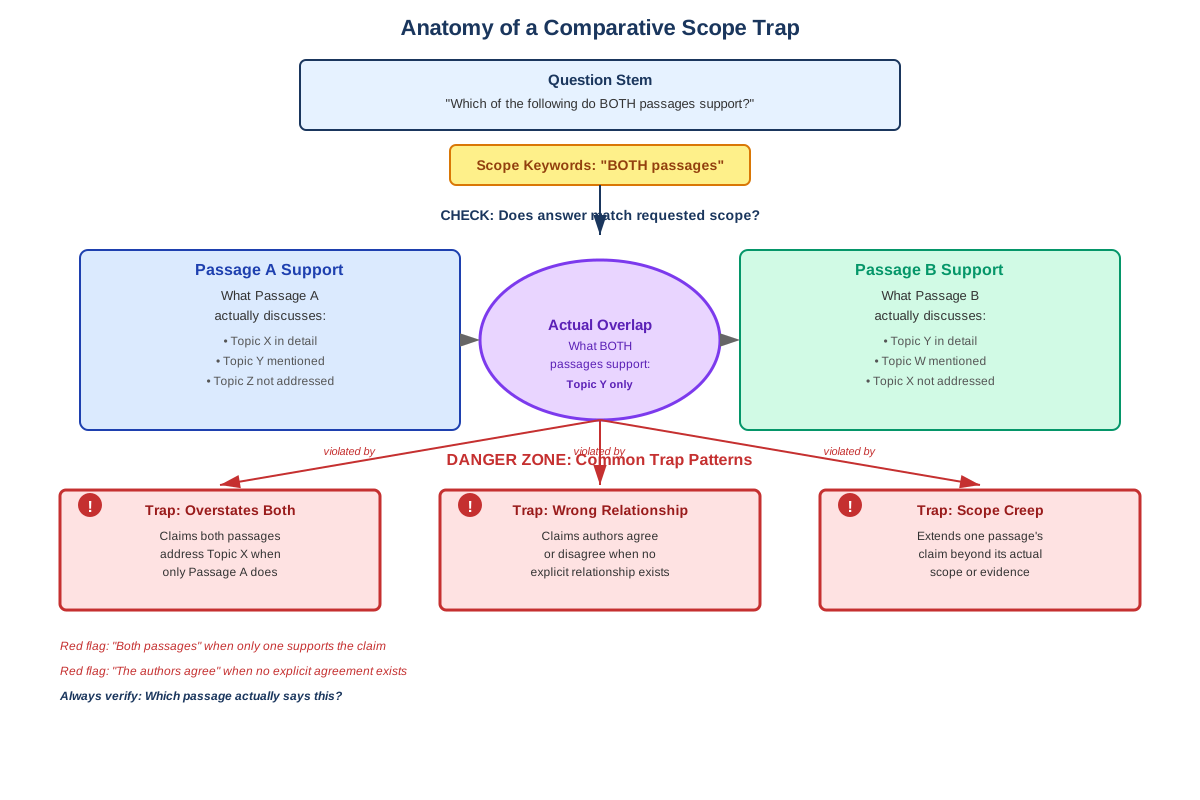
A comparative scope trap is an incorrect answer choice that violates the boundaries of what the passages actually say about their relationship to each other. These violations take several predictable forms, each exploiting a different aspect of how readers process paired texts. The core mechanism underlying all comparative scope traps is the test-taker's tendency to create a unified mental model of "what these passages are about" rather than maintaining distinct, precise records of what each passage specifically states.
The LSAT constructs these traps by leveraging the fact that Passage A and Passage B always share a common general topic but differ in their specific focus, emphasis, evidence, or conclusions. This creates a cognitive environment where similar concepts appear in both passages but with crucial differences in scope, degree, or application. Test-takers operating under time pressure naturally gravitate toward answer choices that capture the "gist" of the relationship rather than its precise contours.
Types of Comparative Scope Violations
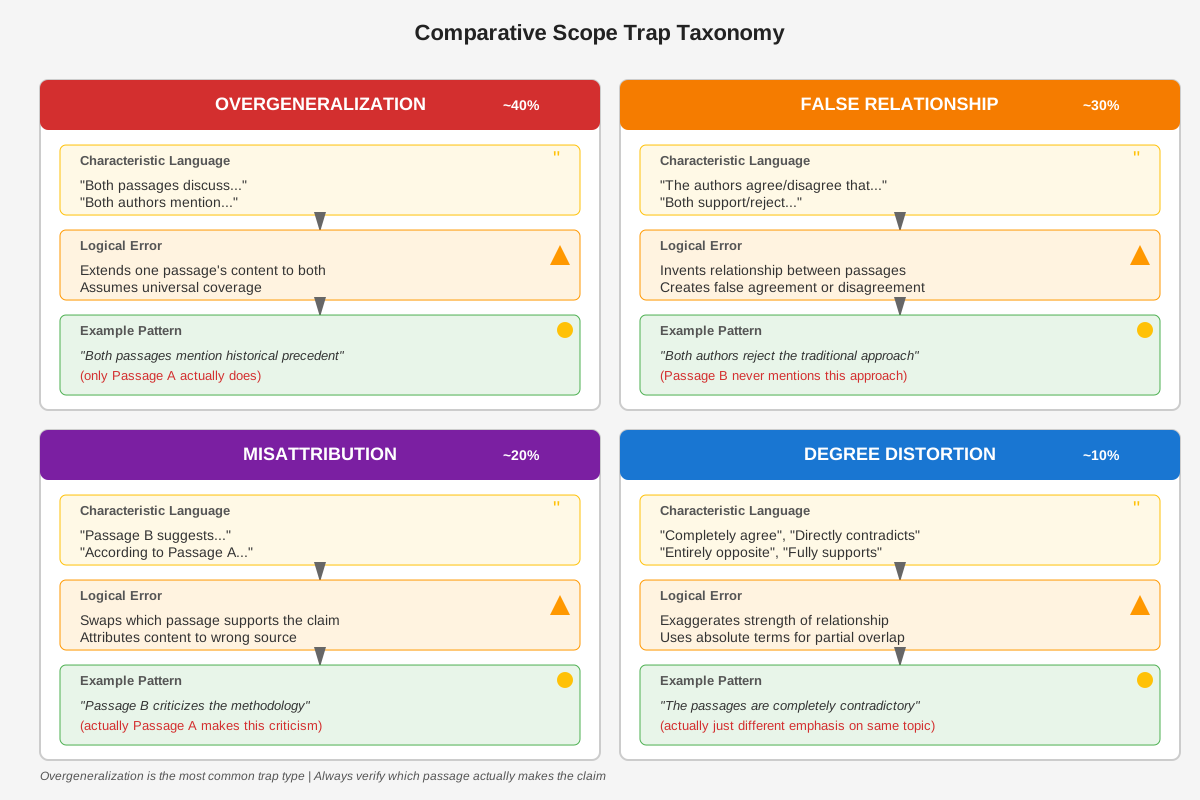
| Violation Type | Description | Example Pattern |
|---|---|---|
| False Universalization | Claims both passages address something only one discusses | "Both passages mention the economic impact of..." when only Passage B discusses economics |
| Overstated Agreement | Suggests authors agree when they merely discuss the same topic | "The authors agree that..." when they simply address the same phenomenon differently |
| Overstated Disagreement | Claims direct contradiction when passages simply emphasize different aspects | "The authors disagree about..." when they're actually discussing different dimensions |
| Scope Expansion | Extends a narrow claim from one passage to a broader comparative claim | Passage A discusses "urban pollution" but answer claims "both passages address environmental concerns generally" |
| Relationship Fabrication | Invents a relationship (complementary, contradictory, etc.) not supported by text | Claims passages present "alternative solutions" when one doesn't propose solutions at all |
The "Both Passages" Trap
The most common comparative scope trap involves answer choices that use the phrase "both passages" or equivalent language ("the authors agree," "each passage discusses," "the passages share the view that"). These answers are tempting because they often describe something that appears in one passage accurately and something that seems related to content in the other passage. However, the trap lies in the precise claim being made.
For an answer stating "both passages discuss X" to be correct, both passages must explicitly address X, not merely touch on topics related to X. If Passage A discusses how social media affects teenage mental health and Passage B discusses how teenagers use social media for identity formation, an answer claiming "both passages address the psychological impact of social media on adolescents" might seem correct. However, if Passage B never actually discusses psychological impacts (only usage patterns), this answer commits a scope violation by attributing content to Passage B that isn't there.
The Degree and Specificity Problem
Comparative scope traps frequently exploit the difference between general and specific claims. A passage might discuss a broad topic while only making specific claims about a narrow subset of that topic. The trap answer will then attribute the broader discussion to the passage when only the narrow claim is supported.
Consider this pattern: Passage A argues that "renewable energy subsidies have proven effective in Scandinavia." A trap answer might state "Passage A supports government intervention in energy markets." While this seems like a reasonable inference, it represents a scope expansion—the passage only supports one specific type of intervention in one specific context, not government intervention broadly. In comparative questions, this becomes even more treacherous when the answer claims "both passages support government intervention" when Passage B discusses an entirely different intervention or no intervention at all.
The Implicit Relationship Assumption
Test-takers often assume that because two passages appear together, they must have a clear, definable relationship: one supports the other, one critiques the other, they present alternative viewpoints, etc. While passages do have relationships, comparative scope traps exploit the tendency to impose a stronger or more specific relationship than the text actually supports.
The passages might simply present two different perspectives on a topic without directly engaging with each other's arguments. A trap answer might claim "Passage B responds to the criticism raised in Passage A" when Passage B never actually addresses that criticism—it simply discusses a related topic from a different angle. The relationship exists at the topic level but not at the argumentative level the answer choice suggests.
Tracking Textual Support
Avoiding comparative scope traps requires a systematic approach to tracking what each passage actually says. This means:
- Maintaining separate mental (or physical) maps of each passage's main point, supporting claims, and evidence
- Flagging specific language when passages use similar terms but with different meanings or applications
- Noting what each passage does NOT discuss, which is often as important as what it does discuss
- Distinguishing between explicit statements and reasonable inferences, then being even more conservative with inferences in comparative contexts
- Checking answer choices against both passages independently before accepting any claim about their relationship
Concept Relationships
The concept of comparative scope traps builds directly on fundamental reading comprehension skills, particularly scope discipline (understanding what a passage does and doesn't claim) and textual support verification (confirming that answer choices match what the passage actually states). These foundational skills, when applied to single passages, become more complex in comparative reading because you must maintain scope discipline for two passages simultaneously while also evaluating claims about their relationship.
Comparative scope traps connect intimately with inference questions because both question types test your ability to distinguish between what's stated, what's implied, and what goes beyond the text. However, comparative scope traps add an additional layer: you must also distinguish between what's implied about each passage individually versus what's implied about their relationship.
The relationship flow works as follows: Basic scope awareness (understanding a single passage's boundaries) → Comparative scope awareness (understanding two passages' individual boundaries) → Relationship scope awareness (understanding what claims about their relationship are supported) → Trap recognition (identifying when answer choices violate any of these boundaries).
Additionally, comparative scope traps relate closely to author's attitude questions and primary purpose questions because trap answers often mischaracterize what an author is trying to accomplish or how they view their subject, then extend that mischaracterization to false claims about agreement or disagreement between authors.
High-Yield Facts
⭐ Comparative scope traps most commonly appear in questions asking what "both passages" address or what the authors "agree" about.
⭐ An answer claiming both passages discuss X requires explicit textual support from both passages, not just topical relevance.
⭐ Passages can discuss the same general topic while addressing completely different specific aspects without any actual overlap in claims.
⭐ The phrase "both passages" or "the authors agree" should trigger immediate, careful verification against each passage independently.
⭐ Overstating the degree of agreement or disagreement is more common than completely fabricating a relationship.
- Comparative scope traps exploit time pressure by offering answers that capture the "gist" but violate precise boundaries.
- An answer can accurately describe Passage A and still be wrong if it falsely claims Passage B addresses the same point.
- Passages that seem to contradict each other often simply emphasize different aspects rather than directly disagreeing.
- The absence of discussion about a topic in one passage is often as important as its presence in the other.
- Trap answers frequently use broader or more general language than either passage actually supports.
- When passages use similar terminology, trap answers exploit the assumption that they're using terms in the same way.
- Questions about how one author would respond to the other require explicit evidence about that author's position, not assumptions.
- The correct answer to a comparative question must be defensible by pointing to specific text in the relevant passage(s).
- Comparative scope traps are more common in questions appearing later in a question set, when time pressure is greatest.
- Eliminating answers that violate scope for even one passage is often the fastest path to the correct answer.
Quick check — test yourself on Comparative scope traps so far.
Try Flashcards →Common Misconceptions
Misconception: If both passages discuss the same general topic, then any claim about that topic applies to both passages.
Correction: Passages can share a general topic while making completely different specific claims. Passage A might discuss climate change's economic impacts while Passage B discusses its scientific measurement—both are "about climate change" but don't overlap in their specific content.
Misconception: When passages seem to take different positions, they must disagree with each other.
Correction: Passages can address different dimensions of an issue without contradicting each other. One might discuss practical applications while the other discusses theoretical foundations—these are different focuses, not disagreements.
Misconception: If you can infer something from Passage A, and you can infer something similar from Passage B, then "both passages support" that inference.
Correction: Comparative questions require explicit support, not chains of inference. Even if both inferences seem reasonable individually, the answer must be directly supported by both passages, not constructed through interpretation.
Misconception: The correct answer to "what both passages discuss" will be the broadest, most general option that could apply to both.
Correction: The correct answer must identify something both passages actually address explicitly, not just a general category that encompasses their different specific topics. Overly broad answers are often traps.
Misconception: If Passage A makes a claim and Passage B doesn't contradict it, then the authors agree.
Correction: Absence of contradiction is not agreement. Passage B might simply not address the issue at all. Agreement requires both passages to take affirmative positions on the same specific point.
Misconception: Comparative questions are just harder versions of regular comprehension questions.
Correction: Comparative questions test a distinct skill—relationship tracking—that requires different strategies. You must maintain awareness of two separate texts and their interaction, not just understand each individually.
Worked Examples
Example 1: Identifying False Universalization
Passage A discusses how artificial intelligence has transformed medical diagnostics by enabling faster analysis of imaging data, citing specific examples of AI detecting tumors in radiology scans.
Passage B discusses the ethical concerns surrounding AI in healthcare, focusing on issues of algorithmic bias, patient privacy, and the need for regulatory frameworks.
Question: Both passages address which of the following?
Answer Choices:
(A) The technical capabilities of AI systems in medical contexts
(B) The transformation of healthcare through technological innovation
(C) The role of artificial intelligence in contemporary medicine
(D) The need for careful consideration of AI's impact on healthcare
(E) The specific applications of machine learning in diagnostic procedures
Analysis:
Let's evaluate each answer by checking both passages:
(A) The technical capabilities of AI systems in medical contexts - Passage A explicitly discusses technical capabilities (faster analysis, tumor detection). Does Passage B discuss technical capabilities? No—it discusses ethical concerns, not what AI can technically do. SCOPE VIOLATION: False universalization.
(B) The transformation of healthcare through technological innovation - Passage A discusses transformation through AI. Does Passage B discuss transformation? It discusses concerns about AI but doesn't actually address whether or how healthcare is being transformed. SCOPE VIOLATION: Passage B doesn't address transformation.
(C) The role of artificial intelligence in contemporary medicine - Passage A discusses AI's role in diagnostics. Passage B discusses AI's ethical dimensions in healthcare. Both passages do address AI's role, though from different angles. POTENTIALLY CORRECT—verify carefully.
(D) The need for careful consideration of AI's impact on healthcare - Passage A describes what AI does but doesn't argue for "careful consideration" or discuss "need." Passage B does discuss the need for careful consideration (through its focus on ethics and regulation). SCOPE VIOLATION: Only Passage B addresses this.
(E) The specific applications of machine learning in diagnostic procedures - Passage A discusses this explicitly. Passage B discusses ethics, not specific applications. SCOPE VIOLATION: Only Passage A addresses this.
Correct Answer: (C)
This example demonstrates how trap answers (A, B, D, E) each accurately describe one passage but falsely extend that description to both. The key is verifying that both passages actually address the claim, not just that the claim relates to the general topic.
Example 2: Distinguishing Different Aspects from Disagreement
Passage A argues that urban green spaces provide significant mental health benefits to city residents, citing studies showing reduced stress and improved mood among people with access to parks.
Passage B discusses how urban green spaces contribute to biodiversity conservation, explaining how city parks serve as habitats for various species and create ecological corridors.
Question: The relationship between the two passages is best described as:
Answer Choices:
(A) Passage B challenges the primary benefit of urban green spaces identified in Passage A
(B) Passage B provides an alternative rationale for the urban planning approach discussed in Passage A
(C) The passages present conflicting views on the value of urban green spaces
(D) Passage B extends the argument in Passage A by identifying an additional benefit
(E) The passages offer complementary perspectives on different benefits of urban green spaces
Analysis:
(A) Passage B challenges the primary benefit - Does Passage B challenge or dispute mental health benefits? No—it simply doesn't discuss them. It discusses a completely different benefit (biodiversity). SCOPE VIOLATION: Fabricates a challenge relationship.
(B) Passage B provides an alternative rationale for the urban planning approach - Does Passage A actually discuss an "urban planning approach"? It discusses benefits but doesn't propose or discuss planning approaches. SCOPE VIOLATION: Mischaracterizes Passage A.
(C) The passages present conflicting views - Do they conflict? No—they discuss different benefits without contradicting each other. One can believe both that green spaces help mental health AND that they support biodiversity. SCOPE VIOLATION: Overstates disagreement.
(D) Passage B extends the argument in Passage A by identifying an additional benefit - Does Passage B "extend" Passage A's argument? This implies Passage B builds on or continues Passage A's line of reasoning. However, Passage B doesn't reference or build on the mental health argument—it simply discusses a different topic. SCOPE VIOLATION: Overstates the connection.
(E) The passages offer complementary perspectives on different benefits - Passage A discusses mental health benefits. Passage B discusses biodiversity benefits. They are complementary (both support the value of green spaces) and they do focus on different benefits. CORRECT—accurately describes the relationship without overstating it.
Correct Answer: (E)
This example shows how trap answers create false relationships (challenge, conflict, extension) when the passages simply address different aspects of a topic. The correct answer acknowledges both the connection (complementary) and the distinction (different benefits) without overstating either.
Exam Strategy
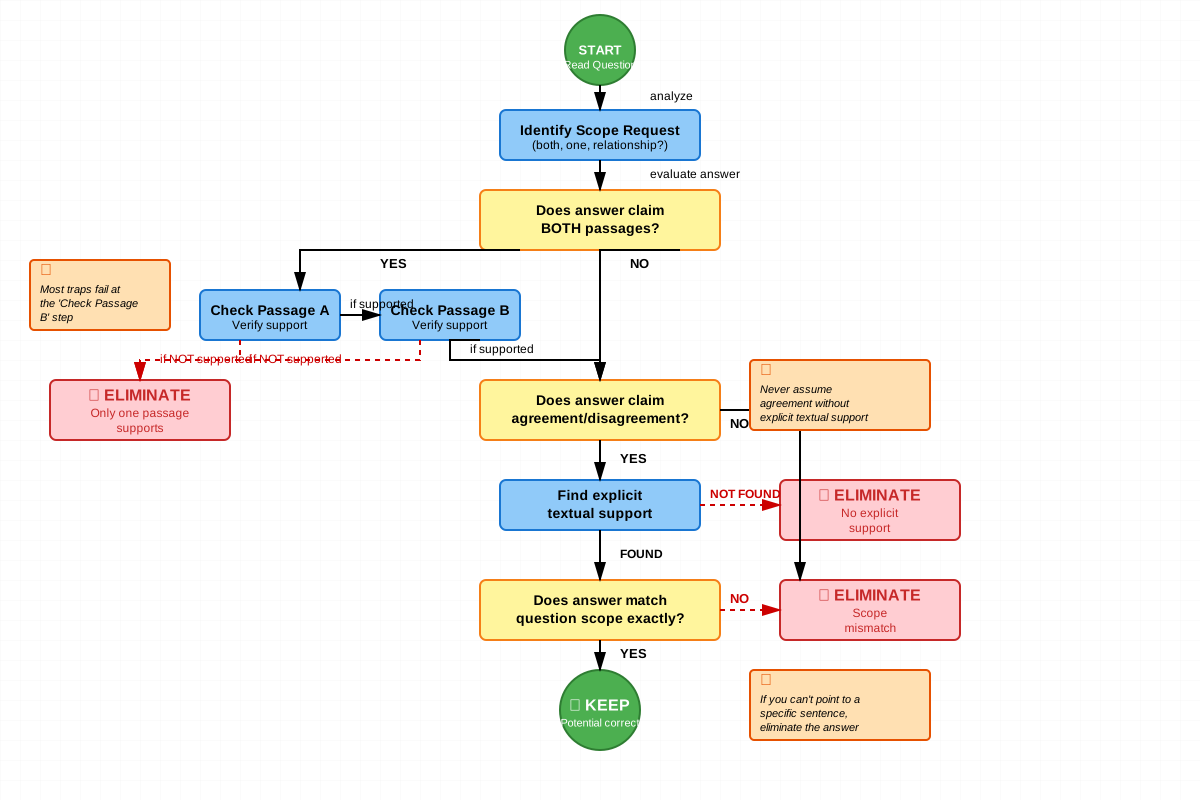
When approaching comparative reading questions, implement this systematic process to avoid scope traps:
Before reading answer choices:
- Identify the exact scope of what the question asks (both passages? one passage? their relationship?)
- Predict what you know from your passage maps about each passage's content
- For relationship questions, articulate the relationship in your own words first
While evaluating answer choices:
- For "both passages" questions: Check each passage independently. If the answer fails for even one passage, eliminate it immediately.
- Watch for trigger phrases: "both passages," "the authors agree," "each passage discusses," "the passages share the view"—these demand verification against both texts.
- Compare specificity levels: If an answer uses broader language than either passage supports, it's likely a scope trap.
- Distinguish absence from disagreement: If one passage doesn't discuss something, that's not the same as disagreeing with it.
Process of elimination priorities:
- First pass: Eliminate answers that clearly violate scope for at least one passage
- Second pass: Among remaining answers, eliminate those that overstate or understate relationships
- Final verification: Confirm the remaining answer has explicit textual support from the required passage(s)
Time allocation:
Comparative questions deserve slightly more time than average (90-120 seconds vs. 60-90 seconds) because they require checking multiple passages. However, if you've mapped passages well initially, this verification should be quick. Don't re-read entire passages—use your map to locate relevant sections.
Red flags in answer choices:
- Absolute language ("completely agree," "entirely contradicts") when passages show nuanced positions
- Broad categorical claims ("environmental concerns," "social impacts") when passages discuss specific narrow topics
- Relationship terms ("responds to," "challenges," "extends") when passages don't actually engage with each other's arguments
- Inference chains that require multiple steps from both passages
Exam Tip: When stuck between two answers on a comparative question, the correct answer is almost always the one that makes the more conservative, limited claim about the relationship. The LSAT rewards precision over comprehensiveness.
Memory Techniques
SCOPE Acronym for Comparative Questions:
- Separate: Keep each passage's content mentally separate
- Check: Verify claims against both passages independently
- Overstated: Watch for overstated relationships (agreement, disagreement)
- Precise: Demand precise textual support, not general relevance
- Eliminate: Remove answers that fail for even one passage
The "Both Test" Visualization:
When you see "both passages," visualize two separate boxes labeled A and B. The answer must fit completely inside both boxes. If any part sticks out of either box, it's wrong.
The Relationship Spectrum:
Memorize this spectrum from weakest to strongest relationship claims:
- "Discuss the same topic" (weakest—easiest to support)
- "Address the same question"
- "Offer complementary perspectives"
- "Present alternative solutions"
- "Disagree about"
- "Directly contradict" (strongest—hardest to support)
Trap answers often claim a stronger relationship than the text supports. When in doubt, choose the answer that claims a weaker relationship.
The "Only One" Elimination Technique:
Create a mental habit: whenever you see "both passages," immediately think "or only one?" This triggers verification mode and prevents automatic acceptance of comparative claims.
Summary
Comparative scope traps represent a high-yield, frequently tested vulnerability in LSAT Reading Comprehension that rewards meticulous attention to textual boundaries. These traps exploit the natural tendency to create unified mental models of paired passages rather than maintaining precise awareness of what each passage specifically states. The most common violations include false universalization (claiming both passages address something only one discusses), overstated agreement or disagreement, and fabricated relationships between passages. Success requires systematic verification of any claim about "both passages" or author agreement by checking each passage independently, maintaining conservative standards for what counts as textual support, and distinguishing between passages that discuss the same general topic versus passages that make overlapping specific claims. The key insight is that passages can share a topic while addressing completely different aspects without any actual overlap in their claims, and that absence of discussion is not the same as disagreement. By implementing the SCOPE framework and consistently applying the "both test" to verify comparative claims, test-takers can convert these common traps into opportunities for confident, accurate answers.
Key Takeaways
- Comparative scope traps appear in 40-50% of comparative reading questions, making them one of the highest-yield patterns to master.
- "Both passages" claims require explicit textual support from both passages independently—topical relevance is insufficient.
- Passages discussing the same general topic often address completely different specific aspects without any overlap in claims.
- Overstating relationships (agreement, disagreement, challenge, extension) is more common than completely fabricating them—watch for degree and specificity.
- Absence of discussion about a topic is not disagreement—distinguish between passages that contradict each other versus passages that simply focus on different dimensions.
- The correct answer to comparative questions is typically the one making the most conservative, precisely supported claim about the relationship.
- Systematic verification (checking each passage independently before accepting any comparative claim) is the most reliable defense against these traps.
Related Topics
Inference Questions in Single Passages: Mastering comparative scope traps builds the precision needed for inference questions, where distinguishing between what's stated, implied, and beyond the text is equally critical. The scope discipline developed here transfers directly to avoiding inference traps in standard passages.
Author's Attitude and Tone Questions: Understanding comparative scope traps enhances your ability to accurately characterize author attitudes because both require careful attention to what the text actually supports versus what seems plausible. Mischaracterizing one author's attitude often leads to false claims about agreement or disagreement.
Primary Purpose Questions in Comparative Reading: These questions test whether you understand what each passage is trying to accomplish, which directly relates to avoiding scope traps about their relationship. Accurately identifying each passage's purpose prevents false claims about how they interact.
Strengthening and Weakening in Logical Reasoning: The skill of identifying what would strengthen or weaken an argument requires the same scope discipline as comparative reading—understanding precisely what a claim says and what evidence would actually support or undermine it.
Practice CTA
Now that you understand the mechanics and patterns of comparative scope traps, you're ready to put this knowledge into practice. Attempt the practice questions designed for this topic, paying special attention to implementing the SCOPE framework and the "both test" verification process. As you work through questions, focus not just on getting the right answer but on articulating exactly why wrong answers violate scope—this active analysis will cement your mastery. Remember that comparative scope traps are highly predictable once you know what to look for, and each practice question you complete strengthens your ability to spot and avoid these traps under timed conditions. Your investment in mastering this high-yield topic will pay dividends across the entire Reading Comprehension section.
Sign up free to keep reading
Create a free AnvayaPrep account to finish this LSAT guide on Comparative scope traps — plus flashcards and practice questions.