Overview
Comparing examples is a critical analytical skill tested extensively in the LSAT's Reading Comprehension section, particularly within comparative reading passages. This topic requires test-takers to identify, analyze, and evaluate how different examples, cases, or illustrations relate to one another across paired passages or within a single complex text. The ability to compare examples effectively distinguishes high-scoring candidates from average performers because it demands simultaneous comprehension of multiple perspectives, recognition of subtle similarities and differences, and application of logical reasoning to textual evidence.
The LSAT frequently presents passages where authors use examples to support arguments, illustrate principles, or demonstrate applications of theories. When engaging with lsat comparing examples questions, students must move beyond surface-level reading to understand the structural and functional roles that examples play within arguments. This skill becomes particularly challenging in comparative reading sets, where two passages may present analogous examples that serve different rhetorical purposes, or where one passage's example directly contradicts or qualifies another's illustration.
Mastering this topic strengthens overall reading comprehension abilities by developing the mental flexibility required to track multiple lines of reasoning simultaneously, recognize patterns across texts, and evaluate the strength of evidence. This skill connects directly to other Reading Comprehension competencies including identifying main ideas, understanding author's purpose, recognizing argument structure, and making inferences. Students who excel at comparing examples demonstrate sophisticated analytical thinking that translates to success across all LSAT sections.
Learning Objectives
- [ ] Identify how Comparing examples appears in LSAT questions
- [ ] Explain the reasoning pattern behind Comparing examples
- [ ] Apply Comparing examples to solve LSAT-style problems accurately
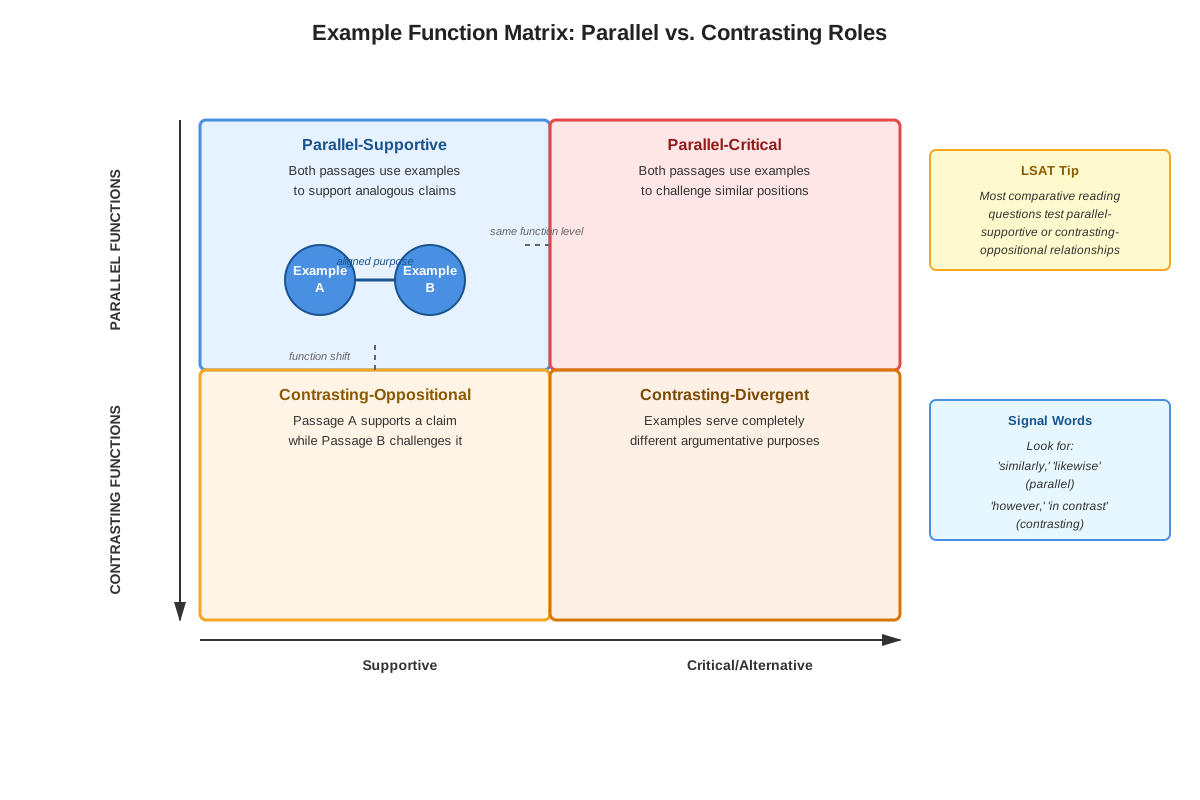
- [ ] Distinguish between examples that serve parallel functions versus contrasting functions across passages
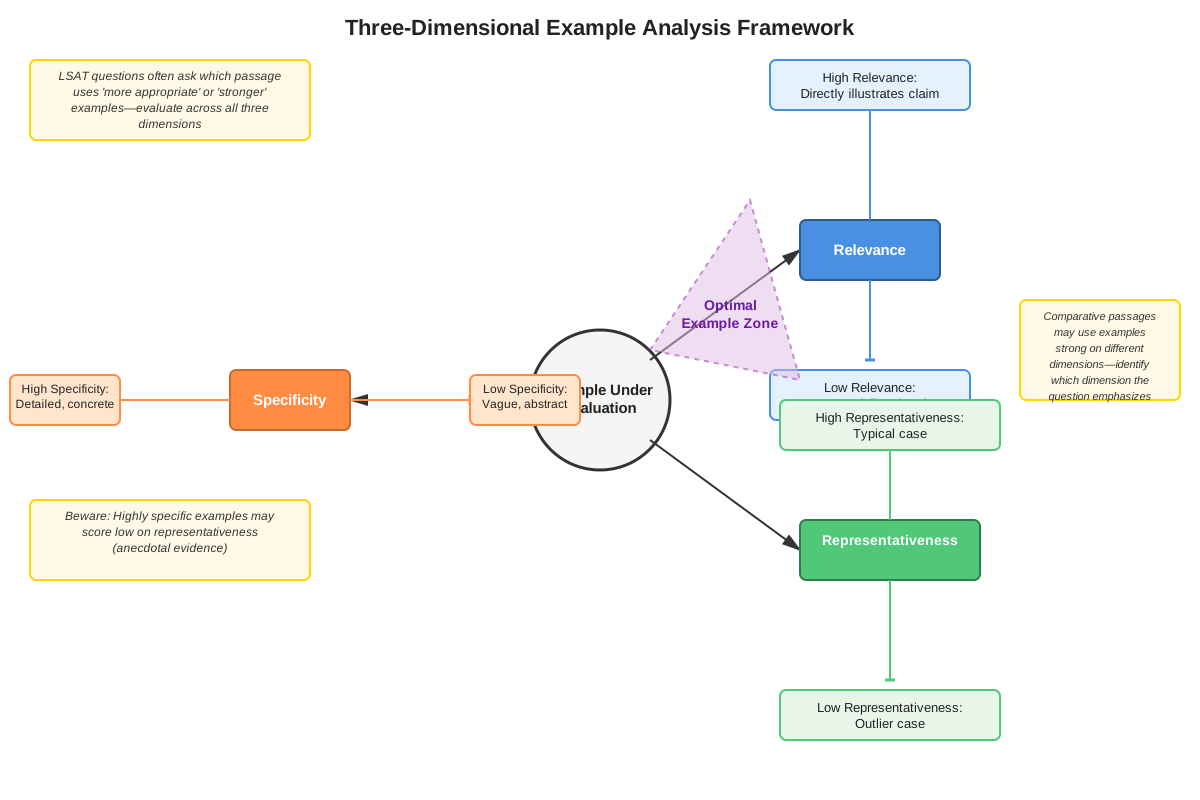
- [ ] Evaluate the relative strength and relevance of examples used to support different arguments
- [ ] Synthesize information from multiple examples to draw broader conclusions about passage relationships
- [ ] Recognize when examples are analogous in structure but different in purpose or implication
Prerequisites
- Basic passage comprehension skills: Understanding main ideas, supporting details, and passage structure forms the foundation for comparing how examples function within texts
- Argument identification: Recognizing claims, evidence, and conclusions enables students to see how examples support or challenge specific positions
- Comparative reading fundamentals: Familiarity with paired passage formats and basic relationship types (agreement, disagreement, elaboration) provides the framework for more nuanced example comparison
- Inference-making ability: Drawing logical conclusions from textual evidence is essential when examples are not explicitly compared but require synthesis
Why This Topic Matters
In real-world legal practice, attorneys constantly compare precedents, case examples, and factual scenarios to build arguments and distinguish their cases from opposing counsel's examples. Law school instruction relies heavily on the case method, where students must compare and contrast judicial decisions to extract legal principles. The LSAT's emphasis on comparing examples directly assesses readiness for this fundamental legal reasoning skill.
Statistically, comparative reading passages appear in every modern LSAT Reading Comprehension section, comprising approximately 25% of the section's questions. Within these passages, questions specifically targeting example comparison appear with high frequency—typically 2-3 questions per comparative reading set. Additionally, single longer passages often include questions asking students to compare multiple examples within one text, making this skill relevant across 40-50% of all Reading Comprehension questions.
This topic commonly appears in several question formats: questions asking how examples in Passage A relate to examples in Passage B; questions requiring identification of analogous situations across passages; questions testing whether a new hypothetical example would be treated similarly or differently by each author; and questions asking students to identify which example from one passage best corresponds to a principle or case described in another. The LSAT also tests this skill through questions about how authors would respond to each other's examples or whether specific examples support or undermine claims made in the paired passage.
Core Concepts
Understanding Example Function in Arguments
Examples serve specific rhetorical and logical functions within LSAT passages. An example is a concrete instance, case study, illustration, or scenario that an author presents to support, clarify, or demonstrate an abstract principle, theory, or claim. Before comparing examples across passages, students must identify what function each example serves within its original context. Examples may serve to: provide evidence for a claim, illustrate how a principle operates in practice, demonstrate an exception to a rule, show the consequences of a particular approach, or make an abstract concept more concrete and understandable.
The key to effective comparison lies in distinguishing between structural similarity and functional similarity. Two examples may describe structurally similar situations (both involving scientific experiments, both discussing legal cases, both referencing historical events) while serving entirely different functions in their respective arguments. Conversely, examples that appear superficially different may serve parallel functions—one author might use a scientific example while another uses a historical example, yet both examples serve to illustrate the same type of limitation in human reasoning.
Types of Example Relationships
When comparing examples across passages or within a single passage, several relationship patterns emerge consistently on the LSAT:
Parallel Examples: Both examples support similar conclusions or illustrate the same principle, even if the specific subject matter differs. For instance, Passage A might describe how peer review improves scientific research quality, while Passage B describes how editorial review improves journalistic quality—both examples serve parallel functions in supporting claims about quality control mechanisms.
Contrasting Examples: Examples that support opposing conclusions or illustrate conflicting principles. One passage might present an example showing successful government intervention in markets, while another presents an example of government intervention causing market distortions.
Complementary Examples: Examples that address different aspects of the same issue, where one example fills gaps left by another or extends the analysis to new domains. These examples don't contradict each other but rather provide a more complete picture when considered together.
Hierarchical Examples: One example represents a specific instance of a broader category illustrated by another example, or one example provides greater detail about a situation sketched more generally in another example.
Analytical Framework for Comparing Examples
Effective comparison requires systematic analysis across multiple dimensions:
| Comparison Dimension | Questions to Ask |
|---|---|
| Subject Matter | What specific situation, case, or scenario does each example describe? |
| Function | What claim does each example support? What purpose does it serve in the argument? |
| Scope | How broad or narrow is each example? Does it represent a general pattern or an exceptional case? |
| Implications | What conclusions does the author draw from each example? What does each example suggest about broader principles? |
| Limitations | What does each example fail to address? What counterexamples might challenge it? |
| Author's Attitude | How does each author characterize their example—as typical, exceptional, problematic, ideal? |
When approaching comparative reading questions about examples, students should first identify the relevant examples in each passage, then analyze each example independently using this framework, and finally compare the examples across these dimensions to identify relationships.
Recognition Patterns in LSAT Questions
Questions testing example comparison typically contain specific trigger language that signals the skill being tested. Common question stems include: "Which of the following examples from Passage A is most analogous to the situation described in lines X-Y of Passage B?"; "The author of Passage B would most likely regard the example in Passage A (lines X-Y) as..."; "Both passages use examples to illustrate which of the following?"; "The relationship between the examples in lines X-Y of Passage A and lines A-B of Passage B is most analogous to the relationship between..."
These questions require students to move beyond simple comprehension to perform comparative analysis. The correct answer typically requires understanding not just what each example describes, but how it functions within its argumentative context and how that function relates to the other passage's use of examples.
Strategic Comparison Process
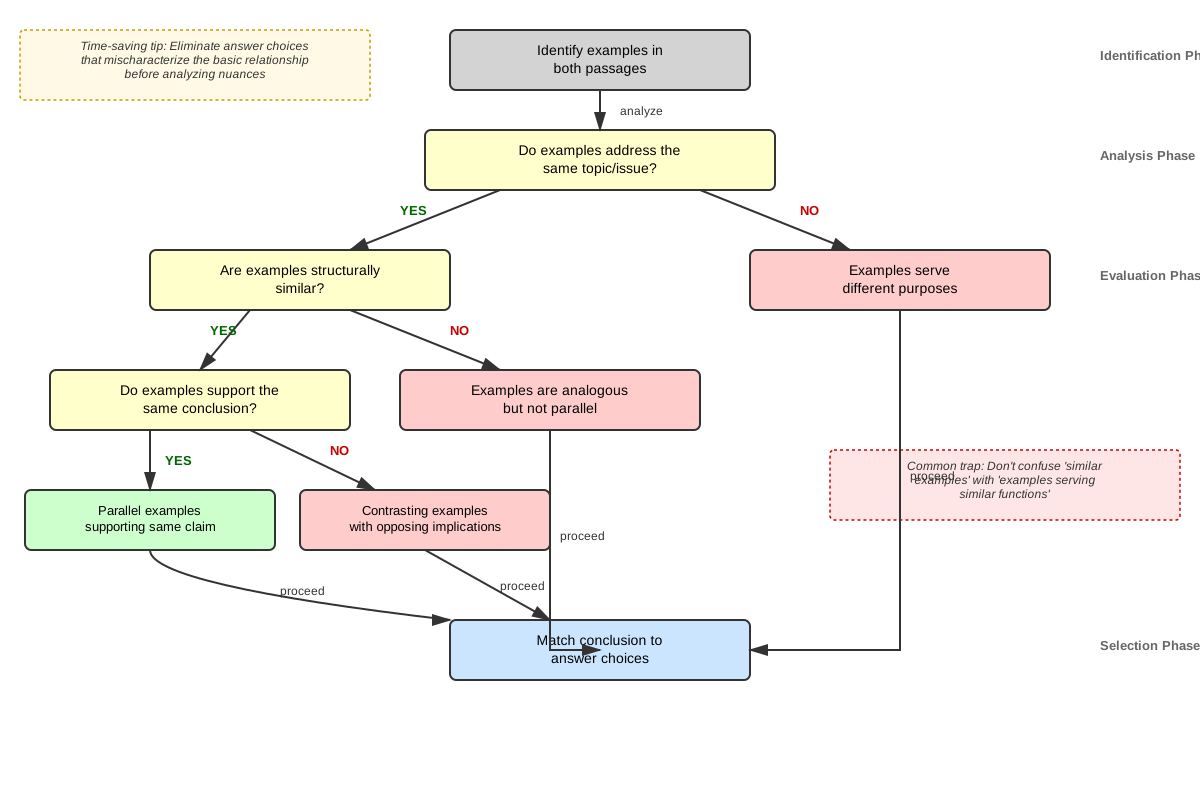
Successful comparison follows a structured process: First, locate and bracket the specific examples referenced in the question stem. Second, identify the claim or principle each example supports in its original context. Third, note any explicit characterization the author provides about the example (whether it's typical, exceptional, successful, failed, etc.). Fourth, consider what each example demonstrates about the author's broader perspective or methodology. Fifth, evaluate the relationship between the examples based on their functions rather than their surface similarities. Finally, predict the relationship type before examining answer choices, then select the answer that best matches that prediction.
This systematic approach prevents common errors such as selecting answers based on superficial subject-matter similarity while missing functional differences, or focusing exclusively on differences while overlooking deeper structural parallels.
Concept Relationships
The skill of comparing examples builds directly upon fundamental reading comprehension abilities. Students must first master identifying main ideas and supporting details before they can recognize how examples function as evidence. This foundational skill leads to understanding argument structure, which enables recognition of how examples support claims. Once students can analyze individual arguments, they develop the capacity for comparative analysis, which encompasses comparing examples as a specific application.
Within the domain of comparing examples, several sub-skills interconnect: Identifying example function serves as the foundation for all comparison work. This skill connects to recognizing parallel structures, which enables students to see when superficially different examples serve similar purposes. Both of these skills feed into evaluating example strength and relevance, which requires judging how effectively examples support their intended claims. Finally, synthesizing across examples represents the highest-level skill, where students integrate information from multiple examples to draw broader conclusions about passage relationships.
The relationship map flows as follows: Basic Comprehension → Argument Analysis → Example Function Identification → Parallel Structure Recognition → Example Comparison → Synthesis and Evaluation. Each stage builds upon previous skills while adding new analytical dimensions. This topic also connects forward to inference questions and application questions, where students must extend reasoning from passage examples to new scenarios.
High-Yield Facts
- ⭐ Examples that describe different subject matter can serve identical functions in supporting parallel arguments across passages
- ⭐ The LSAT frequently tests whether students focus on superficial similarities versus functional relationships between examples
- ⭐ When comparing examples, the author's characterization of the example (typical, exceptional, problematic, ideal) is often more important than the example's content
- ⭐ Correct answers to comparison questions often require understanding what each example demonstrates about the author's broader methodology or perspective
- ⭐ Examples in comparative reading passages may agree on facts while disagreeing on implications, or vice versa
- Questions asking how one author would view another's example require understanding both the example's function and the evaluating author's criteria
- Analogous examples across passages typically share structural features (both showing cause-effect, both illustrating exceptions, both demonstrating applications) even when subject matter differs
- The scope of examples matters: one passage may use a narrow example while another uses a broad example to illustrate the same principle
- Examples can relate hierarchically, with one representing a specific instance of a category illustrated more generally in another passage
- Contrasting examples often differ in a single key variable while holding other factors constant, allowing authors to isolate causal factors
Quick check — test yourself on Comparing examples so far.
Try Flashcards →Common Misconceptions
Misconception: Examples that discuss the same subject matter must serve the same function in their respective passages.
Correction: Subject matter similarity does not determine functional similarity. Two passages might both discuss climate science examples, but one might use the example to illustrate scientific consensus while the other uses it to demonstrate uncertainty in predictive models. The LSAT specifically tests whether students can distinguish content from function.
Misconception: When passages present contrasting examples, they necessarily disagree with each other.
Correction: Contrasting examples may illustrate different aspects of a complex issue without creating disagreement between authors. One passage might present an example of successful policy implementation while another presents an example of failed implementation, yet both authors might agree that context determines success—they're simply examining different contexts.
Misconception: The correct answer to an example comparison question will always involve examples that appear in parallel locations within their respective passages.
Correction: Functionally analogous examples may appear at different structural points in their passages. An example that appears early in Passage A as initial evidence might be most analogous to an example appearing late in Passage B as a culminating illustration, if both serve to provide the strongest evidence for their respective claims.
Misconception: If two examples reach different conclusions, they cannot be compared or related.
Correction: Examples reaching different conclusions can still be structurally analogous and highly comparable. The LSAT frequently tests understanding of how similar methodologies or reasoning patterns can yield different conclusions when applied to different contexts or based on different assumptions.
Misconception: Comparing examples only requires identifying similarities between them.
Correction: Effective comparison requires identifying both similarities and differences, then determining which dimension is most relevant to the question being asked. Sometimes the key insight involves recognizing a crucial difference between otherwise similar examples; other times it involves recognizing a deep similarity between superficially different examples.
Misconception: The more detailed the example in the passage, the more important it is for comparison questions.
Correction: Example importance depends on function, not length. Brief examples that illustrate central principles may be more significant than lengthy examples that provide tangential illustration. The LSAT tests whether students can identify which examples are load-bearing for the argument versus merely decorative.
Worked Examples
Worked Example 1: Parallel Function with Different Subject Matter
Passage A excerpt: "The development of antibiotics revolutionized medicine by providing targeted interventions against bacterial infections. Before penicillin's discovery, physicians could only support patients' immune systems and hope for recovery. The antibiotic example demonstrates how scientific breakthroughs enable precise solutions to previously intractable problems."
Passage B excerpt: "Legal reforms in contract law during the 19th century transformed commercial relationships by establishing clear frameworks for enforcement. Prior to these reforms, merchants relied on reputation and informal sanctions to ensure compliance. This legal evolution illustrates how institutional innovations create mechanisms for addressing coordination problems that informal systems cannot solve."
Question: The relationship between the antibiotic example in Passage A and the legal reform example in Passage B is best described as:
Analysis Process:
Step 1: Identify what each example describes (subject matter)
- Passage A: Medical/scientific advancement (antibiotics)
- Passage B: Legal/institutional development (contract law reforms)
Step 2: Identify the function each example serves
- Passage A: Demonstrates how scientific breakthroughs enable precise solutions to previously intractable problems
- Passage B: Illustrates how institutional innovations create mechanisms for addressing problems that informal systems cannot solve
Step 3: Compare the functions
- Both examples show how formal, systematic innovations (scientific breakthroughs/institutional innovations) solved problems that previous approaches (supporting immune systems/informal sanctions) could not adequately address
- Both examples illustrate a transition from indirect/informal methods to direct/formal methods
- Both examples serve to demonstrate the transformative power of systematic innovation in their respective domains
Step 4: Evaluate the relationship
- These examples serve parallel functions despite different subject matter
- Both support claims about how formal innovations solve problems that informal approaches cannot
- The structural similarity (problem → inadequate informal solution → formal innovation → effective solution) is identical
Conclusion: The examples are functionally parallel—they serve the same argumentative purpose using the same logical structure, despite addressing completely different domains (medicine versus law). This demonstrates the key principle that functional similarity matters more than subject matter similarity in example comparison.
Worked Example 2: Contrasting Implications from Similar Examples
Passage A excerpt: "The rapid adoption of social media platforms demonstrates users' willingness to sacrifice privacy for convenience and connectivity. Despite widespread awareness of data collection practices, user bases continue expanding. This pattern suggests that privacy concerns, while frequently expressed, rarely influence actual behavior when weighed against perceived benefits."
Passage B excerpt: "The growth of social media platforms occurred during a period when users lacked meaningful alternatives and faced significant network effects that penalized non-participation. As privacy-focused alternatives emerge and regulatory frameworks develop, migration patterns suggest users do value privacy when viable options exist. The initial adoption pattern reflects constrained choice rather than revealed preference."
Question: How would the author of Passage B most likely characterize the example of social media adoption presented in Passage A?
Analysis Process:
Step 1: Identify the example and its function in Passage A
- Example: Continued social media adoption despite privacy concerns
- Function: Evidence that users don't genuinely prioritize privacy (revealed preference argument)
- Implication: Privacy concerns are superficial, not action-guiding
Step 2: Identify Passage B's perspective on similar phenomena
- Acknowledges the same factual pattern (social media growth despite privacy concerns)
- Offers alternative explanation: constrained choice, not revealed preference
- Key distinction: Passage B separates behavior under constraints from genuine preference
Step 3: Determine how Passage B's author would evaluate Passage A's example
- Would likely accept the factual accuracy of the example (social media did grow despite privacy concerns)
- Would reject Passage A's interpretation of what the example demonstrates
- Would argue the example is consistent with users valuing privacy but facing constrained choices
Step 4: Predict the characterization
- Passage B's author would view Passage A's example as accurately described but misinterpreted
- Would argue the example demonstrates constrained decision-making rather than revealed preference
- Would suggest the example is incomplete without considering the availability of alternatives
Conclusion: This example demonstrates how authors can agree on factual examples while disagreeing on their implications. The LSAT frequently tests whether students can recognize that the same example can support different conclusions depending on interpretive framework. The correct answer would indicate that Passage B's author sees Passage A's example as providing accurate data but drawing an unwarranted conclusion by failing to account for choice constraints.
Exam Strategy
When approaching questions about comparing examples, begin by carefully reading the question stem to identify exactly which examples are being compared and what aspect of comparison is being tested (function, implication, analogy, or author's response). Bracket or mark the relevant examples in both passages before attempting to answer.
Exam Tip: Always identify the function of each example within its original argumentative context before comparing across passages. Ask yourself: "What claim does this example support?" and "Why did the author include this specific example?"
Watch for trigger words that signal comparison questions: "analogous," "similar to," "corresponds to," "parallel," "would regard," "would respond," "relationship between," and "both passages use examples to." These phrases indicate that the question tests comparative analysis rather than simple comprehension.
Apply a systematic elimination strategy: First, eliminate answers that focus on superficial subject-matter similarity while ignoring functional differences. Second, eliminate answers that accurately describe one example but mischaracterize the other. Third, eliminate answers that correctly identify similarities or differences but focus on the wrong dimension (describing content similarity when the question asks about functional relationship). Finally, select the answer that accurately captures the relationship along the dimension the question specifies.
Time management for these questions should allocate approximately 60-90 seconds: 20-30 seconds to locate and review both examples, 20-30 seconds to analyze their functions and relationship, and 20-30 seconds to evaluate answer choices. If a question requires more time, mark it and return after completing easier questions, as comparison questions often become clearer after engaging more deeply with the passages.
Exam Tip: When stuck between two answers, return to the question stem to identify the precise relationship being tested. The LSAT often includes attractive wrong answers that describe a real relationship between the examples, but not the specific relationship the question asks about.
For questions asking how one author would view another's example, adopt the evaluating author's perspective completely. Consider their stated criteria, values, and methodology, then apply those standards to assess the other passage's example. The correct answer will be consistent with everything the evaluating author has stated, even if it seems harsh or generous toward the other passage.
Memory Techniques
FICS Framework for analyzing examples before comparison:
- Function: What claim does this example support?
- Implication: What does this example suggest about broader principles?
- Characterization: How does the author describe this example (typical, exceptional, etc.)?
- Scope: How broad or narrow is this example's applicability?
The "Same Job, Different Tools" Visualization: Picture two examples as workers performing the same job (function) using different tools (subject matter). This mental image reinforces that functional similarity matters more than surface similarity. When comparing examples, visualize whether they're doing the same job or different jobs, regardless of their tools.
The Three-Column Method for tracking examples in comparative passages:
- Column 1: Passage A examples and their functions
- Column 2: Passage B examples and their functions
- Column 3: Relationships between corresponding examples
Mentally construct this table while reading comparative passages to organize information for comparison questions.
PACS Acronym for example relationships:
- Parallel: Same function, supporting similar conclusions
- Antagonstic: Supporting opposing conclusions
- Complementary: Addressing different aspects of the same issue
- Subordinate: One example is a specific instance of the other's broader category
Summary
Comparing examples represents a sophisticated analytical skill that distinguishes high-performing LSAT test-takers. Success requires moving beyond surface-level reading to understand the functional role examples play within arguments, then systematically comparing those functions across passages or within complex texts. The key insight is that examples serving parallel functions may describe entirely different subject matter, while examples describing similar situations may serve contrasting functions. Effective comparison demands attention to multiple dimensions: subject matter, function, scope, implications, and author's characterization. Questions testing this skill appear frequently in comparative reading sets and require students to synthesize information from multiple sources, evaluate relationships, and apply analytical frameworks consistently. Mastery involves developing systematic processes for identifying example functions, recognizing relationship patterns, and eliminating answers that focus on irrelevant dimensions of similarity or difference. This skill connects directly to legal reasoning abilities that law schools value, making it both practically important and heavily tested on the LSAT.
Key Takeaways
- Examples with different subject matter frequently serve identical functions in supporting parallel arguments across passages
- The function an example serves in its argument matters more than its content when determining relationships between examples
- Systematic analysis across multiple dimensions (function, implication, scope, characterization) prevents errors caused by focusing on superficial similarities
- Authors can agree on factual examples while disagreeing on their implications, or disagree on facts while drawing similar conclusions
- Comparison questions require understanding both what each example describes and what each example demonstrates about the author's broader perspective
- Effective elimination strategy focuses first on removing answers that confuse subject matter similarity with functional similarity
- The LSAT specifically tests whether students can distinguish between content-level and function-level relationships between examples
Related Topics
Identifying Author's Purpose: Understanding why authors include specific examples requires recognizing their broader rhetorical goals, which builds directly on example comparison skills by adding intentionality analysis.
Evaluating Argument Strength: Comparing examples develops the analytical foundation for assessing whether examples provide strong or weak support for claims, enabling more sophisticated argument evaluation.
Application Questions: The ability to compare passage examples to new hypothetical scenarios represents an extension of example comparison skills to novel situations.
Synthesis Questions in Comparative Reading: Beyond comparing individual examples, synthesis questions require integrating information from multiple examples across passages to draw broader conclusions about passage relationships.
Analogical Reasoning: Example comparison provides the foundation for understanding how analogies function in legal reasoning, a skill tested throughout the LSAT and essential for law school success.
Practice CTA
Now that you've mastered the conceptual framework for comparing examples, it's time to apply these skills to authentic LSAT passages. The practice questions and flashcards will challenge you to identify example functions, recognize relationship patterns, and execute the systematic comparison process under timed conditions. Each practice question provides an opportunity to refine your analytical approach and build the automaticity required for test-day success. Approach the practice materials with the same systematic framework you've learned here, and you'll develop the confidence and competence to excel on even the most challenging comparative reading questions. Your investment in mastering this high-yield skill will pay dividends across the entire Reading Comprehension section.
Sign up free to keep reading
Create a free AnvayaPrep account to finish this LSAT guide on Comparing examples — plus flashcards and practice questions.