Overview
Analogical reasoning is one of the most frequently tested reasoning patterns on the LSAT Logical Reasoning section. This form of reasoning involves drawing a comparison between two situations, arguing that because they share certain relevant similarities, they likely share other characteristics as well. On the LSAT, analogical reasoning appears in multiple question types, including Parallel Reasoning, Flaw questions, Strengthen/Weaken questions, and Method of Reasoning questions. Understanding how analogies function—and more importantly, how they can fail—is essential for achieving a competitive score.
The power of lsat analogical reasoning lies in its ubiquity across legal thinking and everyday argumentation. Lawyers constantly argue by analogy, comparing precedent cases to current situations to predict outcomes or justify positions. The LSAT tests whether students can identify when two situations are genuinely comparable, recognize when an analogy breaks down due to relevant differences, and evaluate whether an analogical argument provides strong or weak support for its conclusion. This skill directly translates to the case-based reasoning that dominates legal education and practice.
Within the broader framework of argument fundamentals, analogical reasoning represents a distinct pattern of support between premises and conclusions. Unlike causal reasoning (which establishes cause-effect relationships) or conditional reasoning (which relies on if-then logic), analogical reasoning derives its strength from the degree of similarity between compared situations. Mastering this topic requires understanding not just how analogies work, but also how they interact with other logical reasoning patterns, particularly when arguments combine multiple reasoning structures or when test-makers deliberately create flawed analogies to test critical thinking skills.
Learning Objectives
- [ ] Identify how Analogical reasoning appears in LSAT questions
- [ ] Explain the reasoning pattern behind Analogical reasoning
- [ ] Apply Analogical reasoning to solve LSAT-style problems accurately
- [ ] Evaluate the strength of analogical arguments by assessing relevant similarities and differences
- [ ] Distinguish between strong and weak analogies based on the number and relevance of shared characteristics
- [ ] Recognize common flaws in analogical reasoning, including false analogies and overlooked dissimilarities
- [ ] Construct parallel analogical structures when solving Parallel Reasoning questions
Prerequisites
- Basic argument structure: Understanding premises, conclusions, and how support flows between them is essential because analogical reasoning is a specific type of support structure
- Identifying assumptions: Recognizing unstated premises helps identify what an analogical argument takes for granted about the similarity between compared situations
- Understanding relevance: Distinguishing relevant from irrelevant information is crucial because not all similarities between compared situations matter equally
- Conditional logic basics: Some analogical arguments incorporate conditional statements, requiring familiarity with sufficient and necessary conditions
Why This Topic Matters
Analogical reasoning appears in approximately 15-20% of all Logical Reasoning questions on the LSAT, making it one of the highest-yield topics for test preparation. Beyond its frequency, this reasoning pattern appears across multiple question types, meaning mastery provides advantages throughout the exam. Students who understand analogical reasoning can quickly identify Parallel Reasoning questions (which require matching analogical structures), spot flawed analogies in Flaw questions, and effectively strengthen or weaken arguments that rely on comparisons.
In legal practice, analogical reasoning forms the backbone of common law systems. Attorneys argue that previous court decisions (precedents) should apply to new cases because the situations share legally relevant similarities. Law school case analysis relies heavily on distinguishing cases (identifying relevant differences) and drawing analogies (identifying relevant similarities). The LSAT tests this skill because it predicts success in legal reasoning, making it both practically and academically significant.
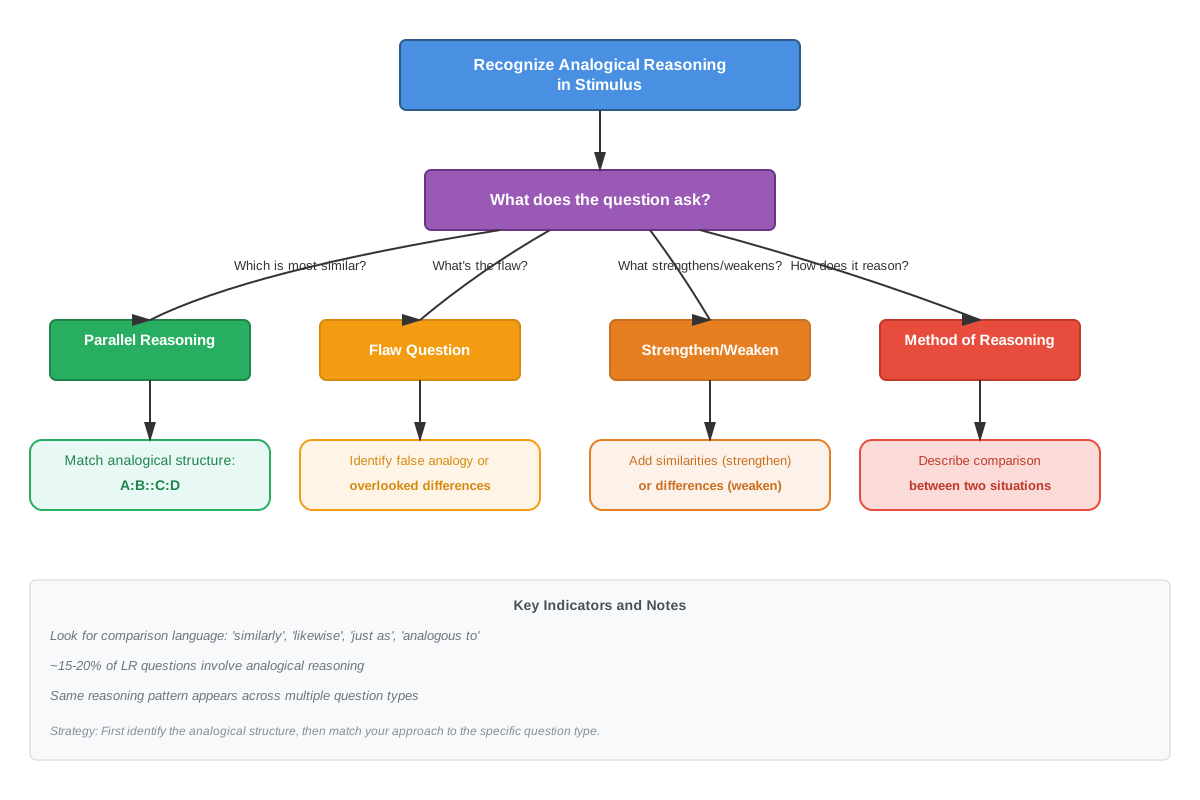
On the exam, analogical reasoning most commonly appears in:
- Parallel Reasoning questions: Requiring identification of arguments with matching analogical structures
- Flaw questions: Testing recognition of false analogies or overlooked differences
- Strengthen/Weaken questions: Where answer choices introduce new similarities or differences between compared situations
- Method of Reasoning questions: Asking students to describe how an argument proceeds by analogy
- Assumption questions: Identifying what must be true about the similarity between compared situations
Core Concepts
The Structure of Analogical Arguments
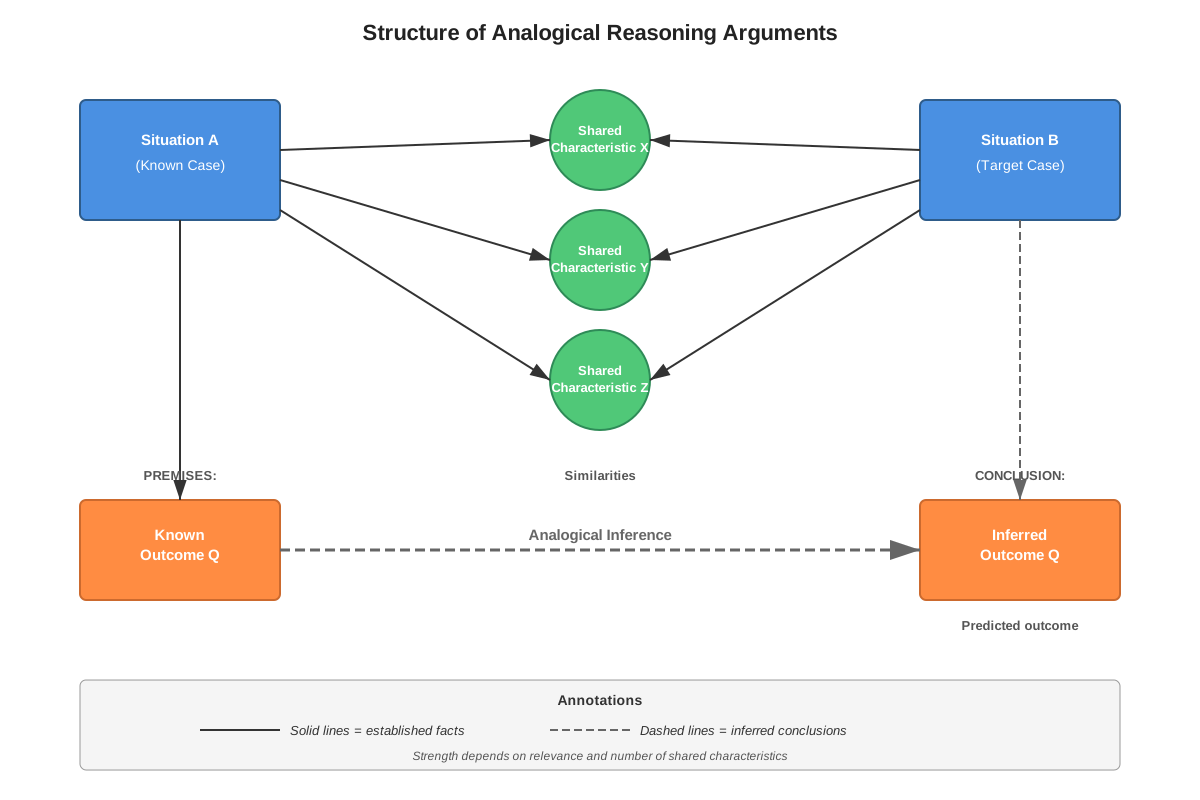
An analogical reasoning pattern follows a predictable structure. The argument presents Situation A (often called the source or base case) with certain known characteristics and outcomes. It then introduces Situation B (the target case) and argues that because A and B share specific similarities, B will likely share additional characteristics with A. The conclusion extends what is known about A to make a claim about B.
The basic form appears as:
- Situation A has characteristics X, Y, and Z
- Situation A also has outcome or characteristic Q
- Situation B has characteristics X, Y, and Z (similar to A)
- Therefore, Situation B probably has outcome or characteristic Q
For example: "Company Alpha implemented flexible work schedules and saw productivity increase by 20%. Company Beta has a similar workforce size, industry sector, and corporate culture. Therefore, Company Beta should also expect productivity gains from implementing flexible work schedules."
Evaluating Analogical Strength
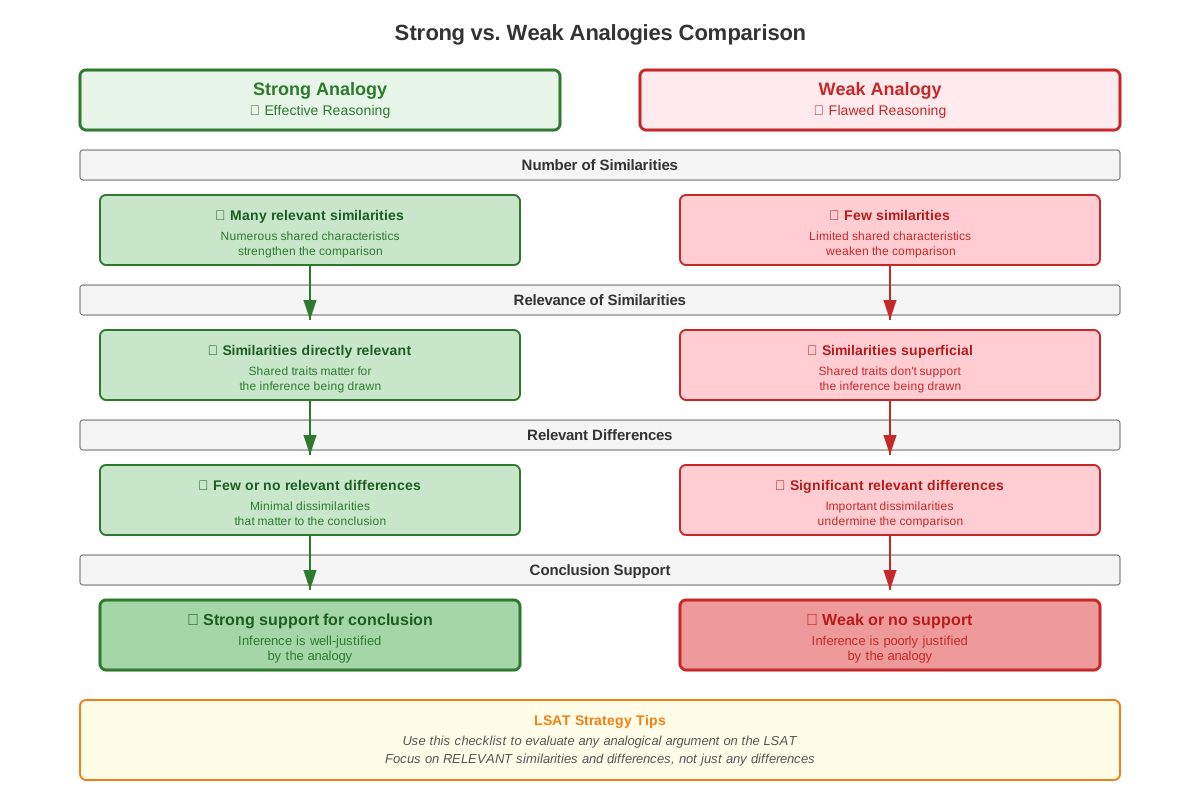
Not all analogies provide equal support for their conclusions. The strength of an analogical argument depends on several critical factors:
Relevant Similarities: The compared situations must share characteristics that actually matter to the conclusion. If arguing that two companies will have similar outcomes, similarities in workforce size and industry are more relevant than similarities in office building color. The LSAT frequently tests whether students can distinguish relevant from irrelevant similarities.
Number of Similarities: Generally, more shared characteristics strengthen an analogy. However, quantity never trumps quality—ten irrelevant similarities provide less support than two highly relevant ones.
Relevant Differences: Any significant difference between the compared situations weakens the analogy. The LSAT often presents answer choices that introduce previously unknown differences, testing whether students recognize how these differences undermine the analogical argument.
Specificity: More specific, detailed similarities typically strengthen analogies more than vague, general ones. Saying two situations both involve "businesses" is less compelling than saying they both involve "mid-sized manufacturing companies in the automotive supply chain."
Common Analogical Patterns on the LSAT
| Pattern Type | Structure | Example Signal Words |
|---|---|---|
| Direct Comparison | A is like B in relevant ways, so what's true of A is true of B | "similarly," "likewise," "in the same way" |
| Precedent-Based | Previous case A had outcome X; current case B resembles A | "precedent suggests," "historically," "previously" |
| Hypothetical Parallel | If we accept reasoning in scenario A, we must accept it in similar scenario B | "by the same logic," "following this reasoning" |
| Reductio by Analogy | The reasoning leads to an absurd conclusion in an analogous case | "this would be like saying," "by this logic" |
The Role of Assumptions in Analogical Reasoning
Every analogical argument contains implicit assumptions about the compared situations. The argument assumes that:
- The similarities mentioned are actually relevant to the conclusion
- No relevant differences exist between the situations
- The characteristics being extended from A to B actually transfer in the way claimed
On Assumption questions, correct answers often state that no relevant difference exists between the compared situations. On Weaken questions, correct answers frequently introduce a relevant difference that undermines the analogy. On Strengthen questions, correct answers typically establish additional relevant similarities or eliminate potential differences.
False Analogies and Flawed Comparisons
A false analogy occurs when an argument treats two situations as comparable despite relevant differences that undermine the comparison. The LST frequently presents arguments that seem superficially similar but break down upon closer examination.
Common forms of false analogies include:
- Overlooking scale differences: Comparing a small local business to a multinational corporation
- Ignoring contextual factors: Comparing policies in different cultural, legal, or economic contexts
- Conflating correlation with causation within the analogy: Assuming that because two situations share an outcome, they share the same causal mechanism
- Cherry-picking similarities: Highlighting shared characteristics while ignoring significant differences
Parallel Reasoning and Structural Matching
Parallel Reasoning questions require identifying arguments with matching logical structures, often involving analogical patterns. Success requires abstracting away from specific content to focus on the underlying reasoning pattern.
When matching analogical structures, focus on:
- The number of entities being compared (two situations, three situations, etc.)
- The direction of the comparison (A to B, or B to A)
- The type of characteristic being extended (outcome, property, causal relationship)
- The strength of the conclusion (definite vs. probable)
- Any additional reasoning elements (conditional logic, causal claims, etc.)
Concept Relationships
Analogical reasoning connects to other argument fundamentals in several important ways. It shares with causal reasoning the goal of predicting outcomes, but while causal reasoning establishes mechanism-based relationships, analogical reasoning relies on similarity-based inferences. When an argument combines both patterns—claiming that because two situations are similar, they share the same causal mechanism—students must evaluate both the analogy and the causal claim.
The relationship to conditional logic appears when analogical arguments incorporate if-then statements. For example: "If flexible schedules increased productivity at Company A, they will increase productivity at similar Company B." Here, the conditional structure embeds an analogical comparison, requiring students to evaluate both logical patterns.
Within analogical reasoning itself, concepts flow as follows:
Identification of compared situations → Assessment of relevant similarities → Recognition of potential differences → Evaluation of analogical strength → Determination of conclusion support
This progression mirrors the critical thinking process required on the LSAT. Students must first recognize that an argument proceeds by analogy, then evaluate whether the analogy provides strong or weak support, and finally determine how answer choices affect the argument's strength.
The connection to assumption identification is particularly strong. Every analogical argument assumes the absence of relevant differences, making "no relevant difference exists" a common correct answer pattern on Assumption questions. Similarly, Strengthen questions often provide additional similarities, while Weaken questions introduce differences—both directly targeting the analogical reasoning structure.
High-Yield Facts
⭐ Analogical reasoning argues that because two situations share certain characteristics, they likely share additional characteristics
⭐ The strength of an analogy depends primarily on the relevance of shared characteristics, not merely their number
⭐ Relevant differences between compared situations weaken analogical arguments
⭐ On Weaken questions, introducing a relevant difference between compared situations is a common correct answer pattern
⭐ On Strengthen questions, establishing additional relevant similarities or eliminating potential differences commonly appears in correct answers
- Analogical reasoning appears in approximately 15-20% of Logical Reasoning questions across multiple question types
- False analogies occur when arguments overlook relevant differences between compared situations
- Parallel Reasoning questions require matching the abstract structure of analogical arguments, not their content
- More specific similarities provide stronger support than vague, general similarities
- Every analogical argument implicitly assumes no relevant differences exist between compared situations
- Signal words like "similarly," "likewise," and "by the same logic" often indicate analogical reasoning
- Analogical arguments can combine with other reasoning patterns, particularly causal and conditional reasoning
- The LSAT tests both the ability to recognize analogical reasoning and to evaluate its strength
Quick check — test yourself on Analogical reasoning so far.
Try Flashcards →Common Misconceptions
Misconception: All similarities between two situations strengthen an analogical argument equally → Correction: Only relevant similarities strengthen an analogy. Irrelevant shared characteristics (like both companies having blue logos) provide no support for conclusions about substantive outcomes like productivity or profitability.
Misconception: Finding any difference between compared situations destroys an analogical argument → Correction: Only relevant differences weaken analogies. Two situations need not be identical in every respect; they must only be similar in ways that matter to the conclusion. If arguing about productivity outcomes, differences in office décor are irrelevant.
Misconception: Analogical reasoning provides certainty about conclusions → Correction: Analogies provide probabilistic support, not deductive certainty. Even strong analogies with many relevant similarities can only suggest that the conclusion is likely, not guaranteed. The LSAT often includes wrong answers that overstate the strength of analogical conclusions.
Misconception: More similarities always mean a stronger analogy → Correction: Quality trumps quantity. Two highly relevant similarities provide stronger support than ten irrelevant ones. The LSAT tests whether students can distinguish between relevant and irrelevant similarities.
Misconception: Parallel Reasoning questions require finding arguments about the same topic → Correction: Parallel Reasoning requires matching logical structure, not content. An argument about business productivity can parallel an argument about athletic training if both use the same analogical reasoning pattern.
Misconception: Analogical reasoning only appears in Parallel Reasoning questions → Correction: Analogical reasoning appears across multiple question types, including Flaw, Strengthen, Weaken, Assumption, and Method of Reasoning questions. Recognizing the pattern is valuable throughout the Logical Reasoning section.
Worked Examples
Example 1: Evaluating Analogical Strength
Argument: "The city of Riverside implemented a bike-sharing program and saw downtown traffic congestion decrease by 15% within six months. Lakewood is a similar-sized city with comparable population density and public transportation infrastructure. Therefore, Lakewood should implement a bike-sharing program to reduce its traffic congestion."
Analysis:
Step 1 - Identify the analogical structure: The argument compares Riverside (Situation A) to Lakewood (Situation B), arguing that because they share certain characteristics and Riverside achieved a specific outcome, Lakewood will likely achieve the same outcome.
Step 2 - Identify stated similarities: Both cities have similar size, population density, and public transportation infrastructure.
Step 3 - Evaluate relevance of similarities: These similarities are highly relevant to whether a bike-sharing program would succeed. Population density affects how many people could feasibly bike instead of drive. Public transportation infrastructure matters because bike-sharing often complements public transit.
Step 4 - Consider potential unstated differences: The argument doesn't address climate (is Lakewood's weather suitable for year-round biking?), topography (is Lakewood hilly?), existing cycling culture, or downtown layout. Any of these could be relevant differences.
Step 5 - Assess conclusion strength: The analogy provides moderate support. The stated similarities are relevant, but potential unstated differences could undermine the comparison.
Question application: If this appeared in a Weaken question, correct answers might introduce relevant differences like "Lakewood has significantly hillier terrain than Riverside" or "Lakewood experiences harsh winters that make cycling impractical for much of the year." For a Strengthen question, correct answers might eliminate potential differences: "Lakewood and Riverside have similar climates and topography" or establish additional similarities: "Both cities have similar percentages of residents who commute to downtown areas."
Example 2: Parallel Reasoning with Analogical Structure
Stimulus: "Historical preservation laws prevented the demolition of the Grandview Theater, which subsequently became a profitable cultural venue. The Riverside Mill, like the Grandview Theater, is a historic structure facing demolition. Therefore, preservation laws should protect the Riverside Mill, as it too could become a profitable venue."
Task: Find the argument with parallel reasoning structure.
Analysis:
Step 1 - Abstract the structure:
- Entity A (theater) had characteristic X (historic, facing demolition)
- Entity A was protected and achieved outcome Y (became profitable venue)
- Entity B (mill) has characteristic X (historic, facing demolition)
- Therefore, Entity B should be protected because it could achieve outcome Y
Step 2 - Identify key structural elements:
- Two entities being compared
- Shared characteristics between entities
- Known outcome for first entity
- Conclusion that second entity should receive similar treatment to achieve similar outcome
- Prescriptive conclusion (what "should" happen)
Correct parallel structure example: "Medication A successfully treated patients with Condition X who had previously tried standard therapies. Patient B has Condition X and has tried standard therapies without success. Therefore, Patient B should try Medication A, as it could successfully treat their condition."
This matches because:
- Two entities compared (Medication A's previous patients vs. Patient B)
- Shared relevant characteristics (same condition, failed standard therapies)
- Known outcome for first entity (successful treatment)
- Prescriptive conclusion about what should happen to second entity
- Analogical reasoning pattern throughout
Incorrect structure example: "The Grandview Theater was profitable because it offered unique entertainment. The Riverside Mill is historic. Therefore, the Riverside Mill should be preserved."
This fails to parallel because it doesn't establish that the mill shares the relevant characteristics that led to the theater's success, and it doesn't complete the analogical reasoning pattern properly.
Exam Strategy
When approaching LSAT questions involving analogical reasoning, follow this systematic process:
Step 1 - Identify the reasoning pattern: Look for signal words like "similarly," "likewise," "in the same way," or "by analogy." Notice when an argument presents two situations and argues that what's true of one applies to the other.
Step 2 - Map the comparison: Clearly identify Situation A (the source) and Situation B (the target). Determine what characteristics they allegedly share and what conclusion is being drawn about B based on A.
Step 3 - Assess relevance: For each stated similarity, ask whether it actually matters to the conclusion. The LSAT frequently includes irrelevant similarities as distractors.
Step 4 - Consider unstated differences: Think about what relevant differences might exist between the situations that the argument overlooks. This is particularly important for Weaken and Assumption questions.
Exam Tip: On Weaken questions, immediately look for answer choices that introduce relevant differences between compared situations. This is one of the most common correct answer patterns for arguments using analogical reasoning.
Time allocation: Spend approximately 1:15-1:30 on questions involving analogical reasoning. These questions often require careful analysis of similarities and differences, but the reasoning pattern itself is straightforward once identified.
Trigger phrases to watch for:
- "Similarly" / "Likewise" / "In the same way"
- "By analogy" / "Analogously"
- "Just as... so too..."
- "By the same logic" / "By this reasoning"
- "Precedent suggests" / "Historically"
- "This is like" / "This resembles"
Process of elimination tips:
- Eliminate answers that introduce irrelevant similarities or differences
- For Parallel Reasoning, eliminate answers with different numbers of compared entities or different conclusion types (definite vs. probable)
- For Strengthen/Weaken, eliminate answers that don't address the comparison between situations
- Watch for answers that seem relevant but actually address a different aspect of the argument
Memory Techniques
SARA Mnemonic for evaluating analogical strength:
- Similarities: Are they relevant and numerous?
- Assumptions: What does the argument assume about the comparison?
- Relevant differences: What differences might undermine the analogy?
- Application: Does the conclusion follow from the comparison?
Visualization Strategy: Picture analogical arguments as two parallel columns. In the left column, list all characteristics of Situation A. In the right column, list all characteristics of Situation B. Draw lines connecting shared characteristics. The more lines connecting relevant features, the stronger the analogy. Any unconnected relevant features in either column represent potential weaknesses.
The "Bridge" Metaphor: Think of analogical reasoning as building a bridge between two situations. The bridge's strength depends on:
- The number of support beams (similarities)
- The quality of materials (relevance of similarities)
- The absence of structural weaknesses (no relevant differences)
- The distance being spanned (how different the situations initially appear)
Acronym for Parallel Reasoning - MATCH:
- Match the number of entities compared
- Abstract away from specific content
- Type of reasoning must be identical
- Conclusion strength must align (definite vs. probable)
- How the argument proceeds must parallel exactly
Summary
Analogical reasoning represents a critical pattern in LSAT Logical Reasoning, appearing across multiple question types and testing the ability to evaluate comparisons between situations. This reasoning pattern argues that because two situations share certain characteristics, they likely share additional characteristics as well. The strength of any analogical argument depends primarily on the relevance of shared characteristics, not merely their quantity, and on the absence of relevant differences between compared situations. The LSAT tests this concept through Parallel Reasoning questions requiring structural matching, Flaw questions identifying false analogies, and Strengthen/Weaken questions that introduce new similarities or differences. Success requires identifying when arguments proceed by analogy, evaluating whether stated similarities are relevant to the conclusion, considering potential unstated differences, and understanding how answer choices affect analogical strength. Mastering this topic provides advantages throughout the Logical Reasoning section and builds skills essential for legal reasoning.
Key Takeaways
- Analogical reasoning argues that shared characteristics between situations suggest additional shared characteristics, with strength depending on the relevance of similarities
- Relevant differences between compared situations weaken analogies more significantly than irrelevant similarities strengthen them
- On Weaken questions, introducing relevant differences is a high-yield correct answer pattern; on Strengthen questions, establishing additional similarities or eliminating differences is common
- Parallel Reasoning requires matching abstract logical structure, not content, demanding focus on the pattern of reasoning rather than the topic
- Every analogical argument implicitly assumes no relevant differences exist between compared situations, making this a common assumption to identify
- Signal words like "similarly," "likewise," and "by the same logic" reliably indicate analogical reasoning patterns
- Quality of similarities matters more than quantity—two highly relevant shared characteristics provide stronger support than ten irrelevant ones
Related Topics
Causal Reasoning: Understanding how arguments establish cause-effect relationships complements analogical reasoning, as arguments often combine both patterns, claiming that similar situations share similar causal mechanisms.
Conditional Logic: Many analogical arguments incorporate if-then structures, requiring students to evaluate both the conditional logic and the underlying comparison between situations.
Flaw Recognition: Identifying false analogies represents one specific type of logical flaw, and mastering analogical reasoning enables recognition of this common error pattern across multiple question types.
Assumption Identification: Since every analogical argument assumes the absence of relevant differences, understanding analogies directly improves performance on Assumption questions throughout the Logical Reasoning section.
Strengthen and Weaken Questions: These question types frequently target analogical reasoning by introducing new information about similarities or differences, making analogical reasoning mastery essential for these high-frequency question types.
Practice CTA
Now that you understand the structure and evaluation of analogical reasoning, it's time to apply these concepts to actual LSAT questions. Work through the practice questions and flashcards to reinforce your ability to identify analogical patterns, evaluate their strength, and predict correct answers. Pay special attention to how answer choices introduce similarities or differences, and practice abstracting argument structures for Parallel Reasoning questions. Consistent practice with these concepts will build the pattern recognition skills that separate good LSAT scores from great ones. Remember: analogical reasoning appears throughout the exam, so mastering this topic provides returns across multiple question types and significantly improves overall Logical Reasoning performance.
Sign up free to keep reading
Create a free AnvayaPrep account to finish this LSAT guide on Analogical reasoning — plus flashcards and practice questions.