Overview
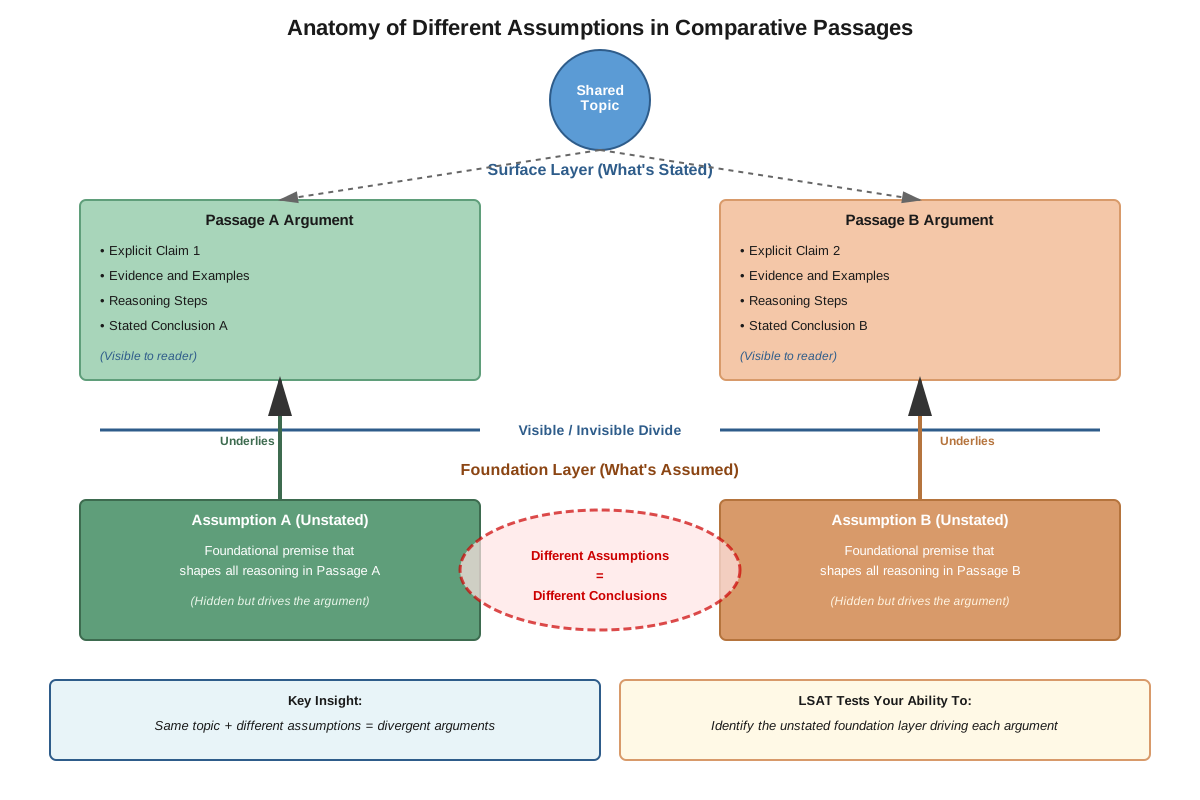
Different assumptions represent one of the most sophisticated analytical challenges in LSAT reading comprehension, particularly within comparative reading passages. When the LSAT presents two passages side by side, these texts frequently operate from fundamentally distinct foundational premises—underlying beliefs, principles, or starting points that shape each author's argument, analysis, or perspective. Recognizing these divergent assumptions is essential because they often explain why two authors examining the same phenomenon reach different conclusions, emphasize different aspects, or propose conflicting solutions. The ability to identify and articulate these underlying differences separates high-scoring test-takers from those who merely understand surface-level content.
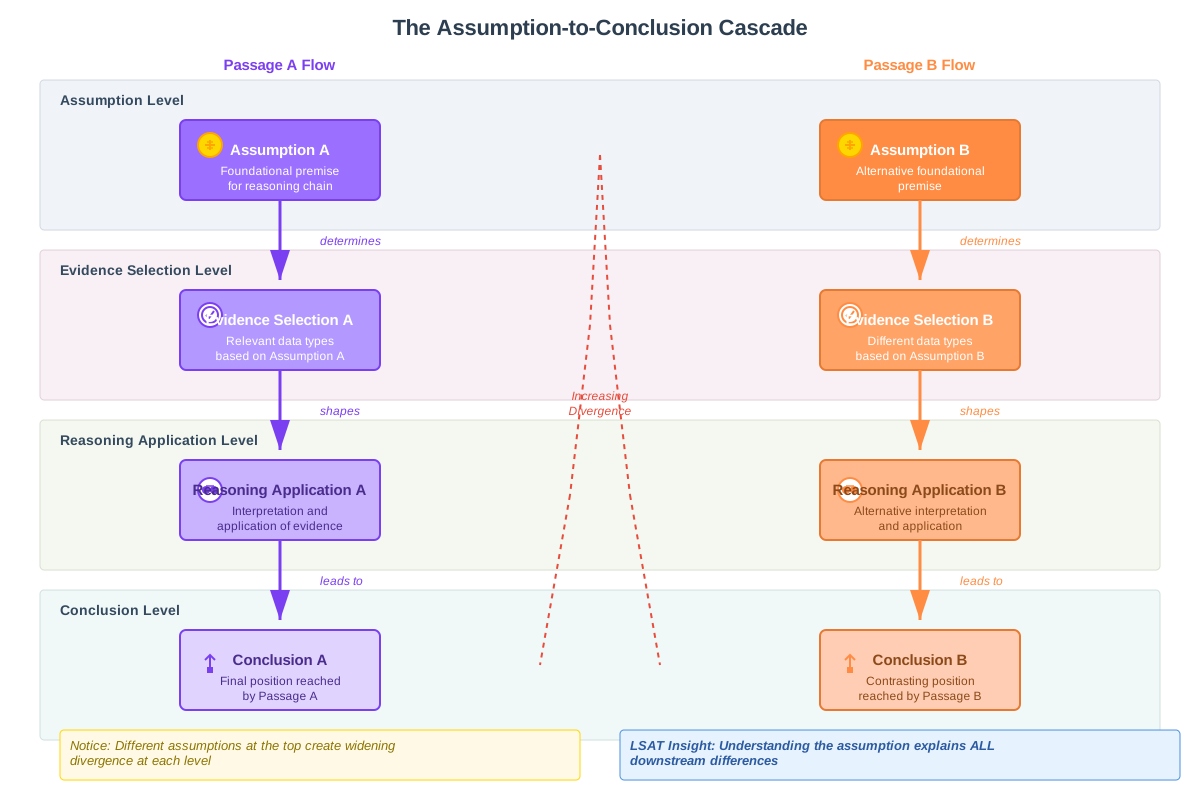
In comparative reading sections, the LSAT deliberately pairs passages that address similar topics but approach them from contrasting intellectual frameworks. One author might assume that human behavior is primarily driven by rational self-interest, while another operates from the assumption that social and cultural factors predominate. These foundational differences cascade through every aspect of their arguments, influencing evidence selection, reasoning patterns, and ultimate conclusions. Test-makers exploit this structure by crafting questions that require students to move beyond explicit statements to infer the unstated premises that make each author's reasoning coherent.
Mastering different assumptions connects directly to broader Reading Comprehension skills, including identifying main points, understanding author's purpose, and recognizing logical structure. This topic also bridges to the Logical Reasoning section, where assumption identification is explicitly tested. In comparative reading specifically, different assumptions questions represent high-value opportunities because they test deep comprehension rather than superficial recall, and they frequently appear in medium-to-difficult question positions where correct answers significantly impact scaled scores.
Learning Objectives
- [ ] Identify how different assumptions appears in LSAT questions
- [ ] Explain the reasoning pattern behind different assumptions
- [ ] Apply different assumptions to solve LSAT-style problems accurately
- [ ] Distinguish between explicit disagreements and underlying assumption differences
- [ ] Trace how foundational assumptions influence an author's choice of evidence and examples
- [ ] Predict likely points of disagreement between authors based on their respective assumptions
- [ ] Evaluate answer choices by testing whether they accurately capture unstated premises
Prerequisites
- Basic argument structure recognition: Understanding premises, conclusions, and supporting evidence is necessary because assumptions function as unstated premises that bridge gaps in reasoning
- Comparative passage format familiarity: Knowing how paired passages are structured (Passage A, Passage B, shared questions) enables efficient navigation and comparison
- Inference skills: The ability to draw valid conclusions from stated information is essential since assumptions are by definition unstated and must be inferred
- Author's purpose and tone recognition: Understanding what authors aim to accomplish helps identify the beliefs that motivate their approaches
Why This Topic Matters
Different assumptions questions test critical thinking at its highest level—the ability to recognize unstated foundational beliefs that shape entire arguments. In legal practice, attorneys must constantly identify the assumptions underlying opposing counsel's arguments, judicial reasoning, and statutory interpretation. Law schools value this skill because it demonstrates the analytical sophistication necessary for legal analysis, where surface-level agreement often masks fundamental philosophical differences.
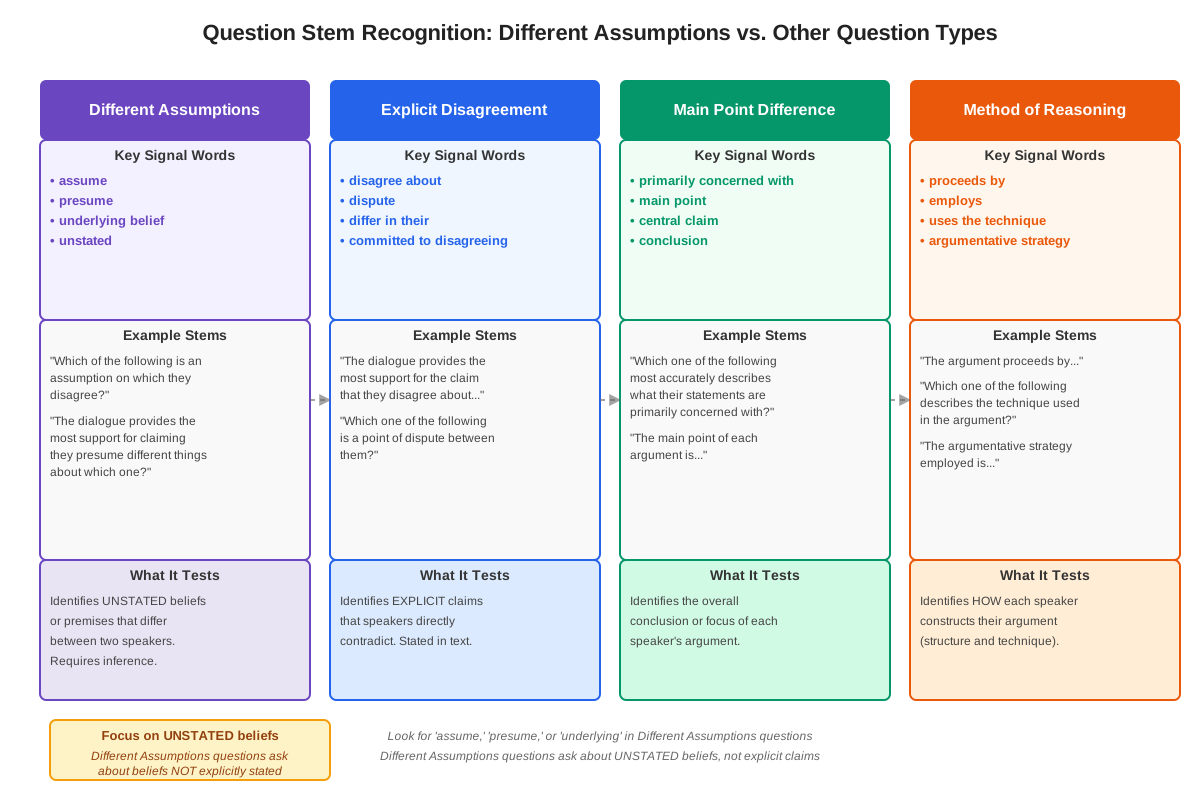
On the LSAT, different assumptions questions appear with significant frequency in comparative reading passages. Approximately 15-20% of comparative reading questions directly test assumption identification, and many additional questions indirectly require this skill. These questions typically appear in the following formats:
- "The authors would be most likely to disagree about which one of the following?"
- "Which one of the following most accurately describes a difference in the assumptions made by the two authors?"
- "Passage A relies on which one of the following assumptions that Passage B does not make?"
- "The relationship between the two passages is most analogous to which one of the following?"
Different assumptions questions carry particular weight because they resist superficial reading strategies. Students who merely skim for explicit statements will struggle, while those who engage deeply with underlying logic gain significant competitive advantage. These questions also tend to have answer choices that require careful discrimination, making them time-intensive but high-yield for prepared test-takers.
Core Concepts
What Constitutes an Assumption
An assumption is an unstated premise that must be true for an argument to work logically. In comparative reading, different assumptions refer to the distinct foundational beliefs, principles, or starting points that underlie each author's reasoning. These are not merely different opinions about conclusions—they are the deeper frameworks that make each author's reasoning internally coherent.
Assumptions operate at multiple levels:
- Factual assumptions: Beliefs about what is true in the world (e.g., "human nature is fundamentally competitive" vs. "human nature is fundamentally cooperative")
- Methodological assumptions: Beliefs about how to investigate or analyze phenomena (e.g., "quantitative data provides the most reliable evidence" vs. "qualitative understanding is essential")
- Value assumptions: Beliefs about what matters or what should be prioritized (e.g., "individual liberty is paramount" vs. "collective welfare is paramount")
- Causal assumptions: Beliefs about what causes what (e.g., "economic factors drive social change" vs. "ideas drive social change")
Identifying Different Assumptions in Comparative Passages
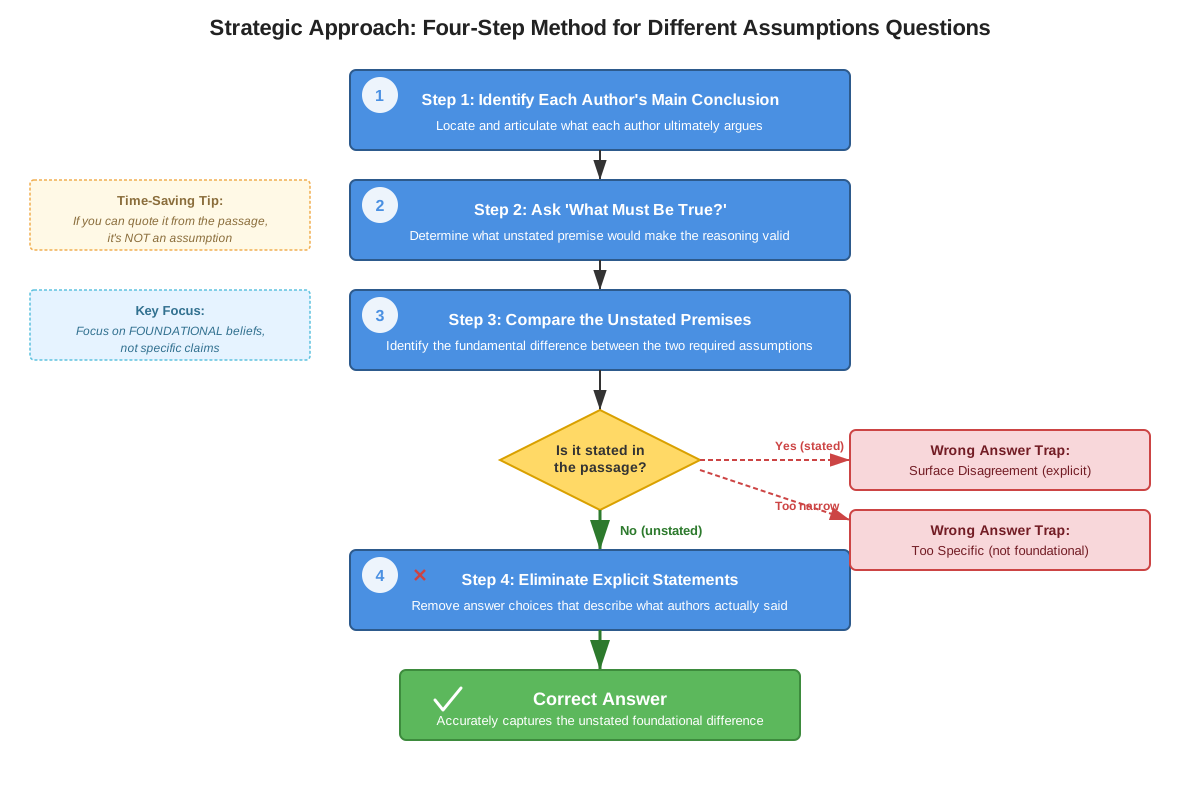
The process of identifying different assumptions requires systematic analysis. First, determine each author's main conclusion or central claim. Then, examine the evidence and reasoning each author uses to support that conclusion. The gap between stated evidence and conclusion reveals where assumptions operate.
Consider this framework for assumption identification:
| Analysis Step | Questions to Ask | What This Reveals |
|---|---|---|
| Identify conclusions | What is each author ultimately arguing? | The endpoint of reasoning |
| Map explicit evidence | What facts, examples, or data does each author cite? | The starting points of reasoning |
| Locate reasoning gaps | What must be true to connect evidence to conclusion? | Where assumptions operate |
| Compare frameworks | How do the authors' unstated premises differ? | The different assumptions |
Common Patterns of Different Assumptions
LSAT comparative passages frequently employ specific patterns of contrasting assumptions:
Optimism vs. Pessimism: One author assumes a problem is solvable or that positive change is likely, while the other assumes inherent limitations or inevitable negative outcomes.
Individual vs. Collective Focus: One author assumes individual-level analysis is most revealing, while the other assumes system-level or collective analysis is necessary.
Stability vs. Change: One author assumes current conditions or categories are relatively stable and enduring, while the other assumes fluidity and transformation.
Empirical vs. Theoretical Priority: One author assumes observable data should drive conclusions, while the other assumes theoretical frameworks should guide interpretation.
Universal vs. Contextual Principles: One author assumes principles apply broadly across contexts, while the other assumes context-specific analysis is essential.
How Assumptions Shape Arguments
Different assumptions create cascading effects throughout passages. An author's foundational assumptions determine:
- Evidence selection: What counts as relevant or persuasive evidence
- Emphasis and focus: Which aspects of a topic receive attention
- Tone and language: Whether the author writes with certainty, caution, advocacy, or skepticism
- Scope of claims: Whether conclusions are presented as universal or limited
- Counterargument treatment: Which objections the author anticipates and addresses
For example, if Author A assumes that technological innovation inevitably improves human welfare, this assumption will lead them to emphasize positive examples, downplay negative consequences, and advocate for minimal regulation. Author B, assuming that technology's effects depend on social context and power structures, will emphasize distributional concerns, highlight cases where technology reinforced inequality, and advocate for careful oversight. These different assumptions explain why the authors reach different conclusions despite examining the same technological developments.
Distinguishing Assumptions from Explicit Disagreements
A critical skill is distinguishing between surface-level disagreements and underlying assumption differences. Authors may explicitly disagree about a factual claim (e.g., whether a policy succeeded), but this disagreement often stems from different assumptions about what constitutes success, what evidence is reliable, or what causal factors matter most.
The LSAT tests whether students can move beyond obvious disagreements to identify the deeper assumptions that generate those disagreements. Wrong answer choices often present explicit disagreements or differences in emphasis rather than true assumption differences.
Testing Assumptions in Answer Choices
When evaluating answer choices for different assumptions questions, apply these tests:
- The Negation Test: If you negate the proposed assumption, does the author's argument fall apart? If not, it's not a necessary assumption.
- The Consistency Test: Is the proposed assumption consistent with everything the author says? Inconsistency suggests the answer is wrong.
- The Sufficiency Test: Does the assumption, combined with stated evidence, make the conclusion follow logically?
- The Contrast Test: Do the two authors genuinely differ on this assumption, or could both accept it?
Concept Relationships
Different assumptions serve as the foundation for understanding comparative reading passages. The relationship flows as follows:
Different Assumptions → Different Evidence Selection → Different Reasoning Patterns → Different Conclusions
This topic connects directly to prerequisite skills in argument structure because assumptions function as unstated premises. Understanding how premises support conclusions enables students to identify what's missing—the assumption that bridges the gap.
Different assumptions also relate closely to author's purpose and tone. An author's foundational assumptions shape their purpose (whether to advocate, critique, explain, or qualify) and their tone (confident, cautious, critical, or neutral). Recognizing these connections allows students to use tone as a clue to underlying assumptions.
Within comparative reading, different assumptions interact with other comparison skills:
- Point of agreement/disagreement identification: Assumptions often explain why authors disagree
- Relationship between passages: Whether passages complement, contradict, or qualify each other depends on assumption compatibility
- Analogical reasoning: Understanding assumptions helps identify parallel situations in answer choices
The skill of identifying different assumptions also transfers to Logical Reasoning, particularly to Necessary Assumption, Sufficient Assumption, and Flaw questions. The analytical framework is identical; only the format differs.
High-Yield Facts
⭐ Different assumptions are unstated premises that must be true for an author's reasoning to work logically
⭐ Approximately 15-20% of comparative reading questions directly test assumption identification
⭐ Assumptions operate at multiple levels: factual, methodological, value-based, and causal
⭐ The gap between stated evidence and conclusion reveals where assumptions operate
⭐ Different assumptions explain why authors examining the same topic reach different conclusions
- Common assumption patterns include optimism vs. pessimism, individual vs. collective focus, and stability vs. change
- Assumptions shape evidence selection, emphasis, tone, scope of claims, and counterargument treatment
- Distinguishing assumptions from explicit disagreements is essential for correct answers
- The negation test helps verify whether a proposed assumption is necessary to an argument
- Wrong answers often present explicit disagreements rather than underlying assumption differences
⭐ Authors may agree on facts but disagree on assumptions about what those facts mean or why they matter
- Assumptions can be identified by asking "What must the author believe for this reasoning to make sense?"
- Comparative passages often pair authors with contrasting philosophical or methodological frameworks
- Recognizing an author's assumptions enables prediction of their likely views on related issues
- Time invested in identifying assumptions pays dividends across multiple questions about the same passage pair
Quick check — test yourself on Different assumptions so far.
Try Flashcards →Common Misconceptions
Misconception: Different assumptions are the same as different conclusions.
Correction: Assumptions are the unstated foundational beliefs that lead to conclusions. Two authors might reach the same conclusion based on different assumptions, or different conclusions based on similar assumptions. The LSAT tests whether students can distinguish between the endpoint of reasoning (conclusion) and the underlying framework (assumptions).
Misconception: If an author explicitly states something, it cannot be an assumption.
Correction: Assumptions are by definition unstated. If an author explicitly articulates a belief, it's a stated premise, not an assumption. Different assumptions questions require identifying what authors believe but don't explicitly say—the foundational premises that make their stated reasoning coherent.
Misconception: Different assumptions questions can be answered by finding where authors explicitly disagree.
Correction: Explicit disagreements are often symptoms of different assumptions, not the assumptions themselves. The LSAT rewards students who can identify the deeper, unstated beliefs that generate surface-level disagreements. An answer choice presenting an explicit disagreement is typically wrong.
Misconception: Both authors must directly address the same specific issue for their assumptions to differ.
Correction: Authors can have different assumptions about broader frameworks, methodologies, or principles even when discussing different aspects of a topic. The assumptions don't need to be about identical narrow issues; they can be about how to approach the general subject matter.
Misconception: The correct answer to a different assumptions question must be something both authors would care about equally.
Correction: Often, one author's argument depends heavily on an assumption that the other author doesn't need to make at all. The question might ask what Passage A assumes that Passage B doesn't, meaning the assumption is relevant to A's reasoning but not necessarily to B's.
Misconception: Assumptions are always controversial or debatable claims.
Correction: Some assumptions are relatively uncontroversial within certain contexts but still function as foundational premises. The key is whether the belief is unstated and necessary for the reasoning to work, not whether it's controversial. However, in comparative passages, the LSAT typically highlights assumptions where authors do differ.
Misconception: Identifying assumptions requires specialized background knowledge about the passage topic.
Correction: Different assumptions questions test logical reasoning skills, not content knowledge. All information needed to identify assumptions is present in the passages. Students should focus on the logical structure of arguments rather than bringing in outside knowledge.
Worked Examples
Example 1: Technology and Social Change
Passage A (summarized): Discusses how social media platforms have revolutionized political organizing, citing examples of movements that used Twitter and Facebook to coordinate protests. The author emphasizes the speed and reach of digital communication, arguing that these tools have fundamentally democratized political participation by lowering barriers to entry.
Passage B (summarized): Examines social media's role in political movements but emphasizes how existing power structures shape platform design and access. The author notes that algorithms amplify certain voices over others and that digital divides exclude many communities. Concludes that social media reflects and sometimes reinforces existing inequalities.
Question: The authors would be most likely to disagree about which one of the following?
Answer Choices:
(A) Whether social media platforms have been used to organize political protests
(B) Whether technology's social impact depends primarily on the technology itself or on the social context in which it's deployed
(C) Whether algorithms affect which content receives the most attention on social media
(D) Whether some communities have less access to digital communication tools than others
(E) Whether political organizing existed before social media platforms were developed
Analysis:
First, identify each author's assumptions:
Passage A's assumption: Technology itself drives social change; the inherent features of social media (speed, reach, low barriers) determine its democratizing effects. This is a technological determinism assumption—the belief that technology's characteristics directly cause social outcomes.
Passage B's assumption: Social context shapes technology's effects; existing power structures, design choices, and access patterns determine whether technology reinforces or challenges inequality. This is a social constructivist assumption—the belief that social factors mediate technology's impact.
Now evaluate answer choices:
(A) Incorrect: Both authors would agree that social media has been used for organizing. This is an explicit fact both accept, not an assumption difference.
(B) Correct: This directly captures the different assumptions. Author A assumes technology itself (the tool) primarily determines impact. Author B assumes social context (power structures, access, design choices) primarily determines impact. This is the foundational difference that explains all other differences between the passages.
(C) Incorrect: Author A doesn't necessarily disagree with this factual claim. The author simply doesn't address algorithms, but nothing in Passage A's reasoning requires denying their existence or effects.
(D) Incorrect: Again, Author A doesn't necessarily disagree. The author focuses on lowered barriers but doesn't claim barriers have been eliminated for everyone. This is an explicit point from Passage B that Passage A simply doesn't address.
(E) Incorrect: Both authors would obviously agree that political organizing predated social media. This is irrelevant to their different assumptions about technology's impact.
Key Lesson: The correct answer identifies the foundational framework difference (technological determinism vs. social constructivism) rather than specific factual disagreements. Notice how this assumption difference explains why the authors emphasize different evidence and reach different conclusions.
Example 2: Legal Interpretation
Passage A (summarized): Argues that judges should interpret statutes by determining the legislature's original intent when the law was passed. Discusses methods for discovering intent, including legislative history, committee reports, and floor debates. Emphasizes that this approach respects democratic legitimacy because elected legislators, not appointed judges, should make policy.
Passage B (summarized): Argues that judges should interpret statutes by focusing on the plain meaning of the text as it would be understood by a reasonable reader today. Contends that legislative intent is often unclear or nonexistent (legislators may not have considered the specific issue) and that relying on legislative history gives too much weight to unelected staff who draft reports. Emphasizes that this approach provides predictability and constrains judicial discretion.
Question: Which one of the following most accurately describes an assumption made by the author of Passage A but not made by the author of Passage B?
Answer Choices:
(A) Judges should exercise some role in interpreting statutes
(B) Democratic legitimacy is an important value in legal interpretation
(C) Legislative intent can be reliably determined from available historical sources
(D) Statutory interpretation sometimes requires choosing among multiple possible meanings
(E) Constraining judicial discretion is a desirable goal
Analysis:
Identify Passage A's key assumptions:
- Legislative intent exists as a determinate fact
- Legislative intent can be reliably discovered through historical sources
- Discovering and following this intent respects democratic values
Identify Passage B's key assumptions:
- Textual meaning is more determinate than legislative intent
- Plain meaning provides better constraint on judges than intent-based approaches
- Democratic legitimacy is served by following enacted text rather than unenacted legislative history
Now evaluate answer choices:
(A) Incorrect: Both authors assume judges interpret statutes; they disagree about the proper method, not whether interpretation happens.
(B) Incorrect: Both authors care about democratic legitimacy; they disagree about which interpretive method better serves it. Passage B explicitly mentions concerns about "unelected staff," showing democratic legitimacy matters to that author too.
(C) Correct: This is Passage A's crucial assumption. For the originalist approach to work, legislative intent must be reliably discoverable. Passage B explicitly rejects this assumption, arguing that intent is "often unclear or nonexistent." This assumption difference is foundational—it explains why the authors advocate different methods.
(D) Incorrect: Both authors would accept that interpretation sometimes involves choosing among meanings; that's why they're proposing interpretive methods.
(E) Incorrect: Both authors value constraining discretion. Passage A thinks intent-based interpretation constrains judges by binding them to legislative choices. Passage B thinks text-based interpretation provides constraint. They disagree about which method better achieves this shared goal.
Key Lesson: The correct answer identifies an assumption that's necessary for one author's argument but rejected (or not needed) by the other. Notice how Passage B explicitly challenges Passage A's assumption about the reliability of determining intent, making this a clear assumption difference rather than a difference in values or goals.
Exam Strategy
Approaching Different Assumptions Questions
When encountering a different assumptions question, follow this systematic process:
- Read both passages with assumptions in mind: As you read, actively ask "What must this author believe for this reasoning to make sense?" Don't wait until the question to start thinking about assumptions.
- Identify each author's conclusion first: Understanding where each author ends up helps you work backward to identify the foundational beliefs that get them there.
- Map the reasoning structure: For each passage, note the evidence provided and the logical steps from evidence to conclusion. The gaps in these steps reveal assumptions.
- Look for methodological and philosophical differences: Pay attention to how authors approach the topic, not just what they conclude. Different methods often reflect different assumptions.
Trigger Words and Phrases
Certain language patterns signal that assumptions are at play:
In the passages themselves:
- "Clearly," "obviously," "certainly" (often precede unstated assumptions)
- "Must," "necessarily," "inevitably" (signal strong claims that require assumptions)
- "The key factor," "primarily," "fundamentally" (indicate what the author prioritizes, revealing value assumptions)
- Causal language: "leads to," "results in," "causes" (causal claims often rest on assumptions)
In question stems:
- "Assumption made by"
- "Relies on which assumption"
- "Presupposes which of the following"
- "Takes for granted that"
- "Most likely to disagree about"
- "Difference in the assumptions"
Process of Elimination Tips
Eliminate answers that:
- Present explicit statements from the passages (assumptions are unstated)
- Describe factual disagreements rather than foundational framework differences
- Could be accepted by both authors (unless the question asks what both assume)
- Are irrelevant to the reasoning in one or both passages
- Confuse conclusions with assumptions
Favor answers that:
- Identify unstated premises necessary for the reasoning to work
- Explain why authors reach different conclusions from similar evidence
- Capture methodological or philosophical framework differences
- Pass the negation test (negating the assumption breaks the argument)
Time Allocation
Different assumptions questions typically require more time than detail questions but less than complex inference questions. Allocate approximately:
- 1.5-2 minutes for straightforward assumption identification questions
- 2-2.5 minutes for questions requiring careful discrimination among subtle answer choices
- Additional 30 seconds if you need to reread portions of passages to verify assumptions
Don't rush these questions. They're high-value, and the time invested in careful analysis pays off. However, if you're genuinely stuck after 2.5 minutes, make your best guess and move on rather than falling behind on timing.
Exam Tip: If you're unsure between two answer choices, apply the negation test to each. The correct assumption, when negated, will make the author's argument fall apart. The incorrect answer, when negated, will leave the argument intact or only weaken it slightly.
Memory Techniques
The ASSUME Acronym
Analyze the argument structure
Spot the gaps between evidence and conclusion
Separate explicit statements from unstated beliefs
Understand each author's framework
Map the differences systematically
Evaluate answers with the negation test
Visualization Strategy
Picture each passage as a building:
- The conclusion is the roof
- The stated evidence is the foundation
- The assumptions are the invisible support beams connecting foundation to roof
When the LSAT asks about different assumptions, visualize two buildings with different internal structures. The buildings might look similar from outside (similar topics), but their support systems (assumptions) are fundamentally different.
The "What Must Be True?" Mantra
Train yourself to automatically ask "What must be true for this to make sense?" after reading each paragraph. This habit transforms assumption identification from a difficult task into an automatic process.
Framework Categories Mnemonic: MOVE
Most comparative passages involve assumptions about:
Methodology (how to investigate or analyze)
Ontology (what exists or what categories are real)
Values (what matters or should be prioritized)
Etiology (what causes what)
When identifying different assumptions, check whether authors differ on any of these dimensions.
Summary
Different assumptions represent the foundational, unstated beliefs that make each author's reasoning coherent in comparative reading passages. These assumptions operate beneath the surface of explicit arguments, shaping evidence selection, reasoning patterns, and conclusions. The LSAT tests whether students can move beyond surface-level comprehension to identify these deeper framework differences. Successful assumption identification requires systematic analysis: determining each author's conclusion, mapping their stated evidence, identifying gaps in reasoning, and recognizing where unstated premises must operate. Common patterns include optimism vs. pessimism, individual vs. collective focus, and empirical vs. theoretical priority. The key distinction is between explicit disagreements (which are stated) and assumption differences (which must be inferred). Mastering this skill requires practice with the negation test, careful attention to reasoning structure, and the ability to distinguish foundational frameworks from specific factual claims. Different assumptions questions appear frequently in comparative reading and represent high-value opportunities for prepared test-takers who can think analytically about unstated premises.
Key Takeaways
- Different assumptions are unstated premises that bridge gaps between evidence and conclusions in arguments
- Approximately 15-20% of comparative reading questions directly test assumption identification, making this a high-yield topic
- Assumptions differ from conclusions and explicit disagreements; they are the foundational beliefs that generate those differences
- The negation test is the most reliable method for verifying whether a proposed assumption is necessary to an argument
- Common assumption patterns include methodological differences, value priority differences, and causal framework differences
- Successful assumption identification requires mapping argument structure and identifying what must be true for reasoning to work
- Different assumptions explain why authors examining the same topic reach different conclusions or emphasize different aspects
Related Topics
Logical Reasoning - Necessary Assumption Questions: The skills developed for identifying different assumptions in comparative reading transfer directly to Necessary Assumption questions in Logical Reasoning, where single arguments are analyzed for unstated premises.
Logical Reasoning - Sufficient Assumption Questions: Understanding how assumptions bridge gaps in reasoning enables success on Sufficient Assumption questions, which ask what additional premise would make an argument's conclusion follow logically.
Reading Comprehension - Author's Purpose and Tone: An author's foundational assumptions shape their purpose and tone, making assumption identification skills valuable for these related question types.
Reading Comprehension - Point at Issue Questions: Different assumptions often explain points of disagreement between authors, making this topic foundational for Point at Issue questions in comparative passages.
Logical Reasoning - Flaw Questions: Many logical flaws involve problematic assumptions, so understanding assumption identification helps recognize when authors make unwarranted assumptions.
Practice CTA
Now that you've mastered the conceptual framework for identifying different assumptions in comparative reading passages, it's time to apply these skills to actual LSAT-style questions. The practice questions and flashcards will reinforce your ability to distinguish assumptions from explicit statements, apply the negation test, and systematically analyze argument structure. Remember: assumption identification is a skill that improves dramatically with deliberate practice. Each practice question you work through strengthens your ability to recognize patterns and think analytically about unstated premises. Approach the practice materials with the same systematic process outlined in this guide, and you'll see measurable improvement in your performance on this high-yield question type. You've built the foundation—now it's time to construct mastery through application.
Sign up free to keep reading
Create a free AnvayaPrep account to finish this LSAT guide on Different assumptions — plus flashcards and practice questions.