Overview
One author would agree questions represent a critical question type within the comparative reading section of the LSAT reading comprehension. These questions require test-takers to analyze two related passages (Passage A and Passage B) and determine which statements, claims, or positions one specific author would endorse based solely on the content and reasoning presented in their passage. Unlike questions that ask about both authors' views or areas of agreement between them, these questions isolate a single author's perspective and test whether students can accurately extrapolate that author's likely position on various propositions.
The challenge of LSAT one author would agree questions lies in their demand for precise textual analysis combined with reasonable inference. Students must avoid the trap of selecting answer choices that reflect the other author's views, represent compromises between the passages, or extend beyond what can be legitimately inferred from the text. Success requires careful attention to the author's tone, argumentative structure, underlying assumptions, and explicitly stated positions. These questions frequently appear in comparative reading sets and typically account for 1-2 questions per paired passage, making them a high-value target for focused preparation.
Within the broader landscape of LSAT Reading Comprehension, one author would agree questions connect directly to fundamental skills of author perspective analysis, inference-making, and textual evidence evaluation. They build upon basic comprehension skills while adding the complexity of comparative analysis, requiring students to maintain clear mental separation between two distinct authorial voices while simultaneously understanding how those voices relate to common themes or questions. Mastering this question type strengthens overall reading comprehension abilities and prepares students for the nuanced analytical thinking required throughout the LSAT.
Learning Objectives
- [ ] Identify how One author would agree questions appears in LSAT questions
- [ ] Explain the reasoning pattern behind One author would agree questions
- [ ] Apply One author would agree questions to solve LSAT-style problems accurately
- [ ] Distinguish between statements one author would agree with versus statements both authors would accept
- [ ] Recognize common trap answers that confuse the perspectives of Passage A and Passage B authors
- [ ] Evaluate answer choices by locating specific textual support within the relevant passage
- [ ] Predict likely positions an author would take on issues not explicitly discussed in their passage
Prerequisites
- Basic passage comprehension skills: Understanding main ideas, supporting details, and passage structure forms the foundation for isolating individual author perspectives
- Inference-making ability: One author would agree questions require extending beyond explicit statements to reasonable conclusions the author would endorse
- Understanding of author's tone and purpose: Recognizing whether an author is critical, supportive, neutral, or advocating helps predict their positions on related issues
- Familiarity with comparative reading format: Students must understand that comparative reading presents two related passages that may agree, disagree, or offer complementary perspectives on a shared topic
Why This Topic Matters
One author would agree questions test a sophisticated reading skill essential both for legal education and professional legal practice: the ability to accurately represent a single party's position while distinguishing it from opposing or alternative viewpoints. Lawyers must constantly analyze multiple perspectives on legal issues, understanding each position's internal logic without conflating different arguments. This question type directly assesses that critical analytical capacity.
On the LSAT, comparative reading passages appear in every Reading Comprehension section, and one author would agree questions constitute approximately 15-25% of comparative reading questions. Given that comparative reading represents one of the four passages in each section (roughly 25% of all reading comprehension questions), students can expect to encounter 1-2 one author would agree questions per test. Their consistent appearance and moderate-to-high difficulty level make them significant score determinants, particularly for students aiming for top-tier scores.
These questions commonly appear in several formats: "The author of Passage A would be most likely to agree with which one of the following?"; "Which one of the following statements is most consistent with the view expressed by the author of Passage B?"; or "Based on Passage A, the author would most likely respond to the argument in Passage B by..." Each format requires isolating one author's perspective and applying their reasoning framework to evaluate statements or predict responses. The questions may ask about explicitly discussed topics, requiring careful textual analysis, or about related issues not directly addressed, requiring inference based on the author's demonstrated reasoning patterns and underlying assumptions.
Core Concepts
Identifying One Author Would Agree Questions
One author would agree questions can be recognized by specific linguistic markers in the question stem. The most common identifiers include phrases that explicitly reference a single passage: "the author of Passage A," "according to Passage B," "the author of Passage A would most likely agree," or "which statement is most consistent with the view in Passage B." These questions deliberately focus attention on one passage while the other serves as a potential source of confusion or contrast.
The question stem structure typically follows one of three patterns:
- Direct agreement questions: "The author of Passage A would be most likely to agree with which one of the following?"
- Consistency questions: "Which statement is most consistent with the position taken in Passage B?"
- Response/reaction questions: "The author of Passage B would most likely respond to [specific claim from Passage A] by..."
Distinguishing these from other comparative reading question types is crucial. Questions asking "Both authors would agree..." or "The authors would be most likely to disagree about..." require analyzing both passages simultaneously and are fundamentally different in approach.
The Reasoning Pattern Behind One Author Would Agree Questions
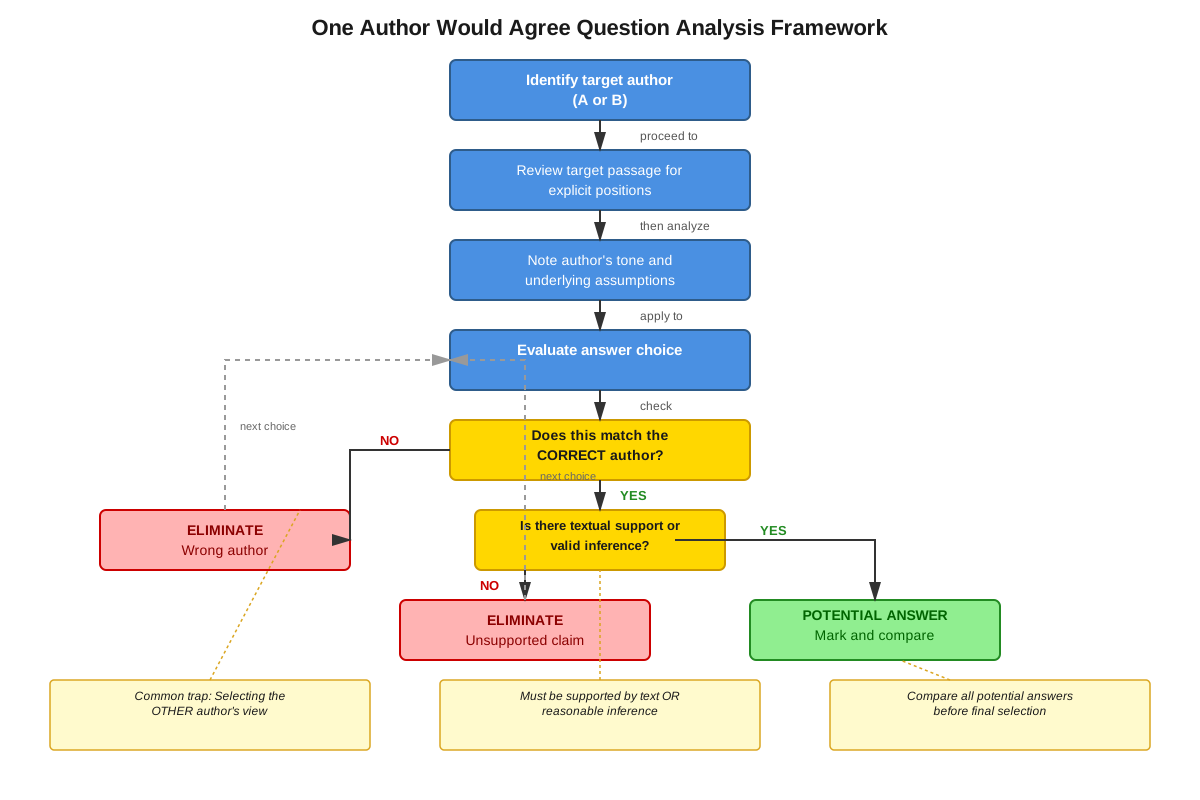
The cognitive process for solving these questions involves several sequential steps that mirror legal reasoning:
Step 1: Isolate the relevant passage. Immediately after reading the question stem, mentally set aside the other passage. While understanding both passages aids overall comprehension, the answer must be supported exclusively by the specified passage.
Step 2: Identify the author's main argument and supporting reasoning. Review the passage's thesis, key claims, evidence presented, and logical structure. Understanding the author's purpose—whether to critique, advocate, explain, or compare—provides the framework for predicting their positions.
Step 3: Note the author's tone and underlying assumptions. An author who skeptically critiques a theory will likely disagree with statements supporting that theory, even if those specific statements weren't addressed. An author advocating for reform likely assumes current systems are inadequate.
Step 4: Evaluate each answer choice against the passage. For each option, ask: "Does the passage provide direct support for this statement?" or "Would this statement logically follow from the author's demonstrated reasoning?" Eliminate choices that contradict the passage, lack support, or reflect the other author's perspective.
Step 5: Select the answer with the strongest textual support. The correct answer may be explicitly stated or require one reasonable inferential step from explicit content. It should never require multiple inferential leaps or assumptions beyond the passage's scope.
Common Structural Elements in Correct Answers
Correct answers to one author would agree questions typically exhibit specific characteristics:
| Characteristic | Description | Example Context |
|---|---|---|
| Direct textual support | The statement paraphrases or directly reflects passage content | Author explicitly argues X; correct answer restates X in different words |
| Single-step inference | The statement follows logically from explicit passage content | Author criticizes theory for flaw Y; correct answer states author would reject applications of theory exhibiting flaw Y |
| Tone consistency | The statement matches the author's attitude (critical, supportive, neutral) | Author skeptically questions methodology; correct answer expresses doubt about conclusions drawn from that methodology |
| Scope alignment | The statement remains within the passage's subject matter boundaries | Passage discusses historical development; correct answer addresses historical factors, not future predictions |
Trap Answer Patterns
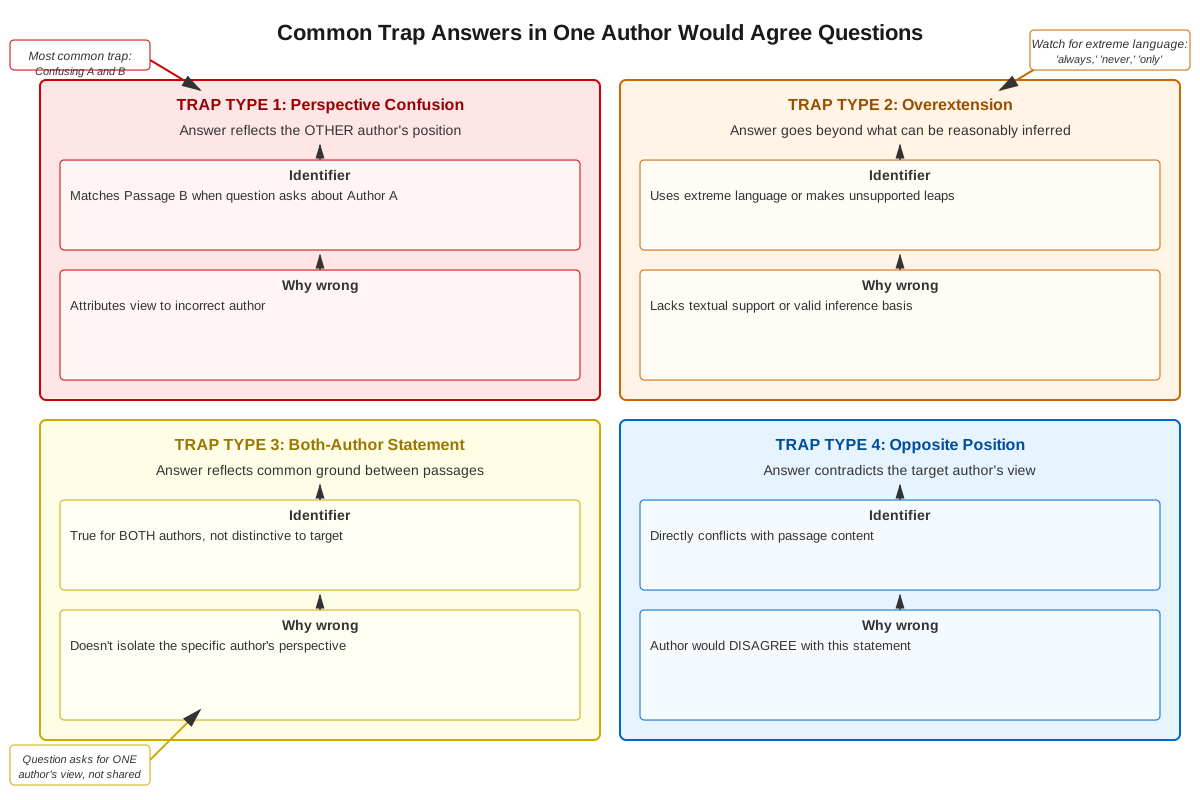
Understanding common wrong answer types accelerates elimination:
The Other Author Trap: Answer choices that accurately reflect the other passage's perspective are frequent distractors. Students who confuse which author said what will select these confidently incorrect answers.
The Both Authors Trap: Statements that both authors might accept are tempting but incorrect if the question asks about one specific author. The correct answer must be distinctly supported by the specified passage.
The Extreme Extension: Answer choices that take the author's position further than the passage supports. If an author criticizes one aspect of a theory, an answer stating the author would reject the entire theory may be too extreme.
The Scope Violation: Statements about topics the passage doesn't address, even if they seem related. Without textual support, these cannot be correct regardless of how reasonable they sound.
The Opposite View: Answer choices that directly contradict the author's stated or implied position, testing whether students actually understood the passage.
Applying Textual Evidence Standards
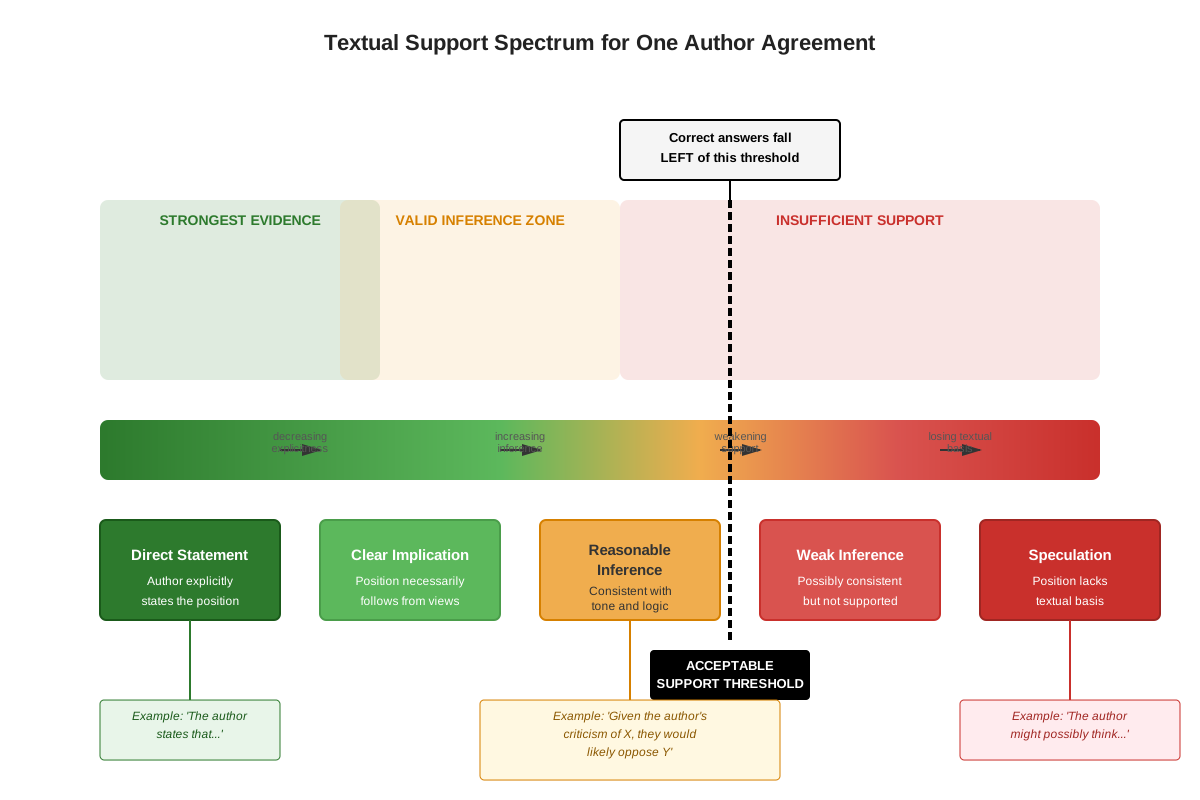
The LSAT requires specific standards of proof for one author would agree questions. The correct answer must be:
- Supported by the passage: Either explicitly stated or following necessarily from stated content
- Consistent with the author's reasoning: Aligning with the logical framework and assumptions demonstrated in the passage
- Within appropriate scope: Not extending beyond what the passage addresses or implies
- Tone-appropriate: Matching the author's attitude and level of certainty
Students should mentally cite specific lines or paragraphs that support their answer choice. If no such citation exists, the answer is likely incorrect. The ability to point to textual evidence distinguishes strong answers from attractive distractors.
Concept Relationships
The concepts within one author would agree questions form an interconnected analytical framework. Identifying question type serves as the entry point, determining the overall approach. This identification leads directly to isolating the relevant passage, which enables focused analysis. The reasoning pattern (the step-by-step analytical process) depends on understanding both the author's main argument and their underlying assumptions and tone. These elements together inform how to evaluate answer choices using textual evidence standards.
The relationship flows sequentially: Question Identification → Passage Isolation → Argument Analysis → Tone/Assumption Recognition → Answer Evaluation → Evidence Verification. However, the process also involves recursive checking—students may need to return to the passage multiple times while evaluating answers, and recognizing trap answer patterns may prompt re-examination of the author's actual position.
One author would agree questions connect to prerequisite skills in clear hierarchies. Basic comprehension forms the foundation, enabling author perspective analysis, which in turn enables comparative analysis distinguishing between two authors. Inference skills operate throughout, allowing students to extend from explicit statements to reasonable conclusions. Tone recognition enhances both argument analysis and answer evaluation.
These questions also relate to other comparative reading question types. Mastering one author would agree questions strengthens skills for both authors would agree questions (by clarifying what each author individually believes), author disagreement questions (by identifying contrasting positions), and passage relationship questions (by understanding each passage's independent perspective). The skill of isolating one author's view while maintaining awareness of the comparative context transfers across all comparative reading challenges.
High-Yield Facts
⭐ One author would agree questions appear 1-2 times per comparative reading passage, making them one of the most frequent comparative reading question types
⭐ The correct answer must be supported by the specified passage alone; information from the other passage is irrelevant except as a source of trap answers
⭐ Answer choices reflecting the other author's perspective are the most common trap answers in one author would agree questions
⭐ The correct answer may be explicitly stated in the passage or require exactly one reasonable inferential step from explicit content
⭐ Tone consistency is crucial—an author who is skeptical throughout will not agree with statements expressing strong support for the criticized position
- Question stems always specify which author's perspective to analyze: "author of Passage A," "according to Passage B," etc.
- Extreme answer choices (using words like "always," "never," "only," "must") are often incorrect unless the passage uses similarly strong language
- The correct answer will align with the author's purpose (critique, advocate, explain, compare) demonstrated throughout the passage
- Students should be able to cite specific lines or paragraphs supporting their answer choice
- Wrong answers often violate scope by addressing topics the passage doesn't discuss, even if those topics seem related
- Response-format questions ("The author of Passage B would most likely respond to Passage A by...") require understanding both the claim from Passage A and how Passage B's author would react based on their demonstrated reasoning
- Authors' underlying assumptions—beliefs they take for granted without explicitly stating—often determine what they would agree with on related issues
- Neutral or balanced passages require especially careful analysis, as the author may agree with moderate statements but not extreme positions on either side
- Time pressure makes passage confusion more likely; physically tracking which passage is relevant (finger on the page, mental note) prevents costly errors
- Practicing with clear passage annotation (marking main claims, tone indicators, key evidence) improves accuracy on these questions
Quick check — test yourself on One author would agree questions so far.
Try Flashcards →Common Misconceptions
Misconception: If a statement seems reasonable or true in general, the author would probably agree with it.
Correction: The author's agreement must be based on what the passage actually says or clearly implies, not on general reasonableness. An author writing about one specific aspect of a topic may not endorse related but unaddressed claims.
Misconception: One author would agree questions require finding points of agreement between the two passages.
Correction: These questions focus exclusively on one author's perspective. Points of agreement between authors are relevant for different question types ("both authors would agree..."). Here, only the specified passage matters.
Misconception: The correct answer will always be explicitly stated in the passage.
Correction: While some correct answers paraphrase explicit statements, others require one reasonable inference from passage content. The key is that the inference must be strongly supported and not require multiple logical leaps.
Misconception: If the other passage contradicts an answer choice, that choice cannot be correct.
Correction: The other passage's position is irrelevant to what one specific author would agree with. In fact, correct answers often represent positions the other author would reject, highlighting the passages' differences.
Misconception: Authors would agree with any statement that doesn't directly contradict their passage.
Correction: Lack of contradiction is insufficient. The correct answer requires positive support—evidence that the author would actually endorse the statement based on their reasoning, not merely that they wouldn't explicitly reject it.
Misconception: Longer or more complex answer choices are more likely to be correct.
Correction: Answer length and complexity don't correlate with correctness. The LSAT deliberately varies answer choice length to avoid patterns. Focus on textual support, not superficial features.
Misconception: If an answer choice uses the same words as the passage, it must be correct.
Correction: While correct answers often paraphrase passage content, word matching alone doesn't guarantee correctness. Trap answers may quote passage language out of context or combine passage phrases in misleading ways.
Worked Examples
Example 1: Direct Agreement Question
Passage A discusses how traditional copyright law, developed for print media, struggles to address digital content sharing. The author argues that while copyright protection remains important, enforcement mechanisms designed for physical copying are "fundamentally mismatched" to digital environments where copying is instantaneous and costless. The author suggests that new approaches emphasizing licensing and access models may better serve both creators and users.
Passage B contends that copyright law's core principles remain sound and that apparent enforcement challenges stem from inadequate resources rather than conceptual flaws. The author maintains that stronger enforcement of existing laws, combined with public education about intellectual property rights, would effectively address digital piracy.
Question: The author of Passage A would be most likely to agree with which one of the following?
Answer Choices:
(A) Copyright law should be abolished in favor of unrestricted digital sharing
(B) The fundamental principles of copyright law are well-suited to digital environments
(C) Enforcement mechanisms effective for print media may not translate effectively to digital contexts
(D) Public education about intellectual property rights would solve most digital piracy problems
(E) Both creators and users benefit most from strict enforcement of traditional copyright rules
Analysis:
Step 1: Isolate Passage A. We're analyzing only what Passage A's author would agree with.
Step 2: Identify Passage A's main argument: Traditional copyright enforcement mechanisms don't work well for digital content; new approaches may be needed.
Step 3: Note tone and assumptions: The author is critical of current enforcement approaches but still values copyright protection. The author assumes digital environments require different solutions than print environments.
Step 4: Evaluate each choice:
(A) Too extreme. The author says copyright protection "remains important"—they're not advocating abolition, just different approaches.
(B) Contradicts the passage. The author explicitly states enforcement mechanisms are "fundamentally mismatched" to digital environments, suggesting principles designed for print don't translate well.
(C) Strongly supported. This directly paraphrases the author's claim that enforcement mechanisms for print media are "fundamentally mismatched" to digital environments—they don't translate effectively.
(D) Reflects Passage B, not Passage A. This is the other author's position. This is a classic "other author trap."
(E) Contradicts the passage. The author suggests new approaches (licensing, access models) rather than strict enforcement of traditional rules.
Correct Answer: (C). This choice accurately captures Passage A's central claim about the mismatch between traditional enforcement and digital contexts, using slightly different wording ("may not translate effectively" vs. "fundamentally mismatched") but preserving the core meaning.
Example 2: Response-Format Question
Passage A argues that standardized testing in education provides valuable objective data about student achievement and school effectiveness. The author acknowledges that tests have limitations but maintains they offer important accountability measures that subjective assessments cannot match.
Passage B criticizes standardized testing for narrowing curriculum, creating test-preparation focus that displaces deeper learning, and failing to measure critical thinking, creativity, and other essential skills. The author advocates for portfolio-based assessment and teacher evaluation as more comprehensive measures of student learning.
Question: The author of Passage B would most likely respond to Passage A's claim that standardized tests provide "objective data" by:
Answer Choices:
(A) Agreeing that objectivity is valuable but arguing that other assessment methods can also be objective
(B) Questioning whether the data provided by standardized tests actually measures meaningful learning outcomes
(C) Conceding that standardized tests have some value while maintaining they should be supplemented with other assessments
(D) Arguing that subjective assessments by trained teachers are actually more reliable than standardized tests
(E) Suggesting that accountability measures are less important than fostering student creativity
Analysis:
Step 1: Focus on Passage B's author and their likely response to Passage A's specific claim about "objective data."
Step 2: Identify Passage B's main argument: Standardized tests are problematic because they narrow curriculum and fail to measure important skills. The author prefers alternative assessments.
Step 3: Note Passage B's tone: Critical of standardized testing, advocating for alternatives. The author doesn't merely suggest supplements but presents alternatives as superior.
Step 4: Evaluate responses:
(A) Too conciliatory. While possibly true, this doesn't capture Passage B's critical stance. The author's concern isn't about objectivity per se but about what's being measured.
(B) Strongly supported. This aligns with Passage B's argument that standardized tests "fail to measure critical thinking, creativity, and other essential skills." The author would likely respond that objective data about the wrong things isn't valuable—the issue is whether tests measure "meaningful learning outcomes."
(C) Too moderate. Passage B doesn't suggest supplementing standardized tests but rather replacing them with portfolio-based and teacher evaluation methods.
(D) Possible but not best supported. While Passage B advocates teacher evaluation, the passage doesn't explicitly compare reliability. The focus is on what gets measured, not reliability.
(E) Misrepresents priorities. Passage B doesn't dismiss accountability; rather, the author proposes different accountability methods (portfolios, teacher evaluation).
Correct Answer: (B). This response captures Passage B's core criticism: standardized tests may provide data, but that data doesn't measure what matters most in education. The author would challenge not the objectivity but the meaningfulness of what's being measured.
Exam Strategy
Systematic Approach Process
When encountering one author would agree questions, implement this timed strategy:
First 10 seconds: Read the question stem carefully and identify which passage is relevant. Physically place your finger on that passage or make a mental note. This prevents the most common error—analyzing the wrong passage.
Next 20-30 seconds: Quickly review the relevant passage's main argument, key supporting points, and author's tone. If you've annotated effectively during initial reading, this review should be rapid. Focus on the author's purpose and primary claims.
Next 60-90 seconds: Evaluate answer choices systematically. For each choice, ask: "Where in the passage does this connect?" If you cannot identify specific textual support, eliminate the choice. Use the process of elimination aggressively.
Final 10 seconds: Verify your selected answer by checking it against the passage one more time. Ensure it doesn't reflect the other author's view and that it aligns with the specified author's tone and reasoning.
Trigger Words and Phrases
Question stems for one author would agree questions contain specific identifiers:
- "The author of Passage A would most likely agree..."
- "According to Passage B..."
- "Which statement is most consistent with the view in Passage A..."
- "The author of Passage B would most likely respond to [claim] by..."
- "Based on Passage A, the author would probably..."
These phrases signal that only one passage is relevant. Train yourself to immediately identify which passage and mentally set the other aside.
Process of Elimination Strategies
Eliminate "other author" answers first: Scan answer choices for positions that clearly reflect the other passage's perspective. These are often the most tempting wrong answers and should be eliminated immediately.
Eliminate scope violations: Remove choices that discuss topics the passage doesn't address. Even if the topic seems related, without textual support, the answer cannot be correct.
Eliminate tone mismatches: If the author is critical throughout, eliminate answers suggesting strong support. If the author is balanced, eliminate extreme positions.
Eliminate contradictions: Remove any choice that directly opposes the author's stated or clearly implied position.
Choose the answer with strongest support: Among remaining choices, select the one with the most direct textual evidence or the most logical single-step inference from passage content.
Time Allocation Guidance
One author would agree questions should take approximately 60-90 seconds once you've read both passages. If you find yourself spending more than two minutes, you're likely overthinking or haven't clearly identified the relevant passage's main argument.
If stuck between two answers, return to the passage and look for specific evidence. The correct answer will have clearer, more direct support. Don't rely on general impressions—find the textual connection.
Exam Tip: During initial passage reading, mark each passage's main claim and tone. This annotation pays dividends when answering one author would agree questions, allowing rapid review of the relevant author's perspective.
Memory Techniques
The ISOLATE Mnemonic
Use ISOLATE to remember the systematic approach:
- Identify which passage the question asks about
- Set aside the other passage mentally
- Outline the author's main argument and tone
- Locate textual support for each answer choice
- Avoid trap answers (other author, scope violations, extremes)
- Test your selected answer against the passage
- Eliminate choices without clear support
The "Finger Method" Visualization
Physically point to or touch the relevant passage when reading the question stem. This kinesthetic reinforcement prevents passage confusion, especially under time pressure. Visualize building a wall between the two passages, with only one passage accessible for each question.
The Three-Question Test
Before selecting an answer, mentally ask three questions:
- "Can I point to where the passage supports this?" (Evidence test)
- "Does this match the author's tone and purpose?" (Consistency test)
- "Am I sure this isn't the other author's view?" (Confusion test)
If you answer "yes" to all three, the answer is likely correct. If you answer "no" to any, reconsider.
The Tone Spectrum Visualization
Visualize each author's position on a spectrum from "strongly opposes" to "strongly supports" regarding the passage topic. Place the author clearly on this spectrum based on their tone. Correct answers will align with that position; wrong answers will often represent different points on the spectrum.
Summary
One author would agree questions test the ability to isolate and accurately represent a single author's perspective within comparative reading passages. Success requires identifying which passage is relevant, understanding that author's main argument and underlying reasoning, and selecting answer choices with clear textual support from that passage alone. The most common errors involve confusing the two authors' perspectives or selecting answers that extend beyond what the passage actually supports. Effective strategy involves systematic passage isolation, careful attention to tone and scope, aggressive elimination of trap answers (especially those reflecting the other author's view), and verification that the selected answer has specific textual support. These questions appear consistently on every LSAT and reward careful, methodical analysis over rushed intuition. Students who master the skill of maintaining clear mental separation between two authorial voices while accurately extrapolating each author's likely positions will consistently answer these high-value questions correctly, contributing significantly to overall Reading Comprehension performance.
Key Takeaways
- One author would agree questions require analyzing only the specified passage; the other passage serves primarily as a source of trap answers
- The correct answer must have clear textual support—either explicit statement or one reasonable inference from passage content
- Answer choices reflecting the other author's perspective are the most frequent and tempting wrong answers
- Tone consistency is crucial: the correct answer must align with the author's demonstrated attitude (critical, supportive, neutral, skeptical)
- Systematic approach matters more than speed: identify the relevant passage, review its main argument, eliminate trap answers, and verify textual support
- Scope violations (answers addressing topics the passage doesn't discuss) are common wrong answers that seem plausible but lack foundation
- Physical or mental techniques to isolate the relevant passage (pointing, annotation, mental walls) prevent costly confusion under time pressure
Related Topics
Both Authors Would Agree Questions: Building on the skill of understanding individual author perspectives, these questions require identifying common ground between passages. Mastering one author would agree questions provides the foundation for recognizing genuine agreement versus superficial similarity.
Author Disagreement Questions: These questions ask where or how the authors differ. Understanding each author's individual position (the focus of one author would agree questions) is prerequisite to identifying their points of divergence.
Passage Relationship Questions: Questions about how the passages relate (one critiques the other, they offer complementary perspectives, etc.) require clear understanding of each passage's independent stance—the core skill developed through one author would agree questions.
Inference Questions in Single Passages: The inference skills required for one author would agree questions (extending from explicit statements to reasonable conclusions) transfer directly to standard inference questions in non-comparative passages.
Author's Attitude and Tone Questions: Recognizing authorial tone is essential for one author would agree questions and represents a distinct skill set applicable across all Reading Comprehension passages.
Practice CTA
Now that you've mastered the conceptual framework for one author would agree questions, it's time to apply these strategies to actual LSAT-style problems. The practice questions and flashcards will reinforce your ability to quickly identify question types, isolate relevant passages, eliminate trap answers, and select choices with strong textual support. Remember: these questions reward systematic analysis over intuition. Each practice question you complete strengthens your pattern recognition and builds the confidence needed to excel on test day. Approach the practice materials methodically, reviewing not just which answers are correct but why wrong answers are tempting and how to eliminate them efficiently. Your investment in deliberate practice now will translate directly into points on the LSAT.
Sign up free to keep reading
Create a free AnvayaPrep account to finish this LSAT guide on One author would agree questions — plus flashcards and practice questions.