Overview
Author attitude is one of the most frequently tested concepts in LSAT reading comprehension passages, appearing in approximately 15-20% of all Reading Comprehension questions. Understanding how to identify and analyze an author's perspective, tone, and evaluative stance toward the subject matter is essential for success on the LSAT. This skill goes beyond simply understanding what an author says—it requires recognizing how they say it and why they've chosen particular language, examples, and argumentative strategies.
The ability to discern author attitude is foundational to passage fundamentals because it provides the interpretive lens through which all other passage elements should be understood. When students accurately identify whether an author is critical, supportive, neutral, or ambivalent toward a topic, they can better predict answers to questions about main point, purpose, and inference. Author attitude questions test whether students can distinguish between the content being discussed and the author's evaluative position on that content—a subtle but crucial distinction that separates high scorers from average performers.
Mastering lsat author attitude questions requires developing sensitivity to tone markers, evaluative language, structural choices, and rhetorical strategies. This topic connects directly to other Reading Comprehension skills including identifying main purpose, understanding passage structure, making valid inferences, and recognizing the function of specific details. Students who excel at detecting author attitude gain a significant advantage across all question types because they understand not just the informational content of passages, but the author's communicative intent and argumentative positioning.
Learning Objectives
- [ ] Identify how Author attitude appears in LSAT questions
- [ ] Explain the reasoning pattern behind Author attitude
- [ ] Apply Author attitude to solve LSAT-style problems accurately
- [ ] Distinguish between author attitude and the views of others discussed in the passage
- [ ] Recognize subtle tone markers and evaluative language that signal author perspective
- [ ] Differentiate between degrees of attitude (strong vs. moderate positions)
- [ ] Predict likely answer choices based on identified author attitude
Prerequisites
- Basic reading comprehension skills: The ability to understand literal meaning in complex texts is necessary before analyzing the author's evaluative stance toward that content.
- Understanding of passage structure: Recognizing how passages are organized helps identify where authors typically reveal their attitudes most clearly.
- Familiarity with argument components: Distinguishing between claims, evidence, and conclusions enables students to separate what the author believes from what they're merely reporting.
- Vocabulary knowledge: A strong vocabulary helps students recognize subtle connotative differences between words that signal different attitudes (e.g., "claims" vs. "demonstrates").
Why This Topic Matters
Author attitude questions appear consistently across all four Reading Comprehension passages on the LSAT, making this one of the highest-yield topics for test preparation. These questions typically appear in several forms: direct attitude questions ("The author's attitude toward X can best be described as..."), tone questions ("The author's tone in discussing Y is primarily..."), and embedded attitude components within other question types (main point, primary purpose, and inference questions often require understanding author attitude to answer correctly).
In real-world applications, the ability to discern author attitude is essential for legal practice. Attorneys must constantly evaluate the positions, biases, and perspectives of judges, opposing counsel, witnesses, and legal scholars. Reading judicial opinions requires understanding not just the holding but the court's attitude toward various arguments and precedents. Law students who enter with strong author attitude skills are better prepared for case analysis and legal writing.
On the LSAT specifically, author attitude appears in multiple question formats: approximately 2-3 questions per test directly ask about author attitude or tone, while another 3-5 questions require understanding author attitude to eliminate wrong answers. Common manifestations include passages where authors critique existing theories, advocate for new approaches, present balanced analyses of competing views, or express skepticism about conventional wisdom. The LSAT frequently tests whether students can distinguish between strong and moderate attitudes, recognize when authors are neutral versus subtly critical, and identify when authors are describing others' views rather than expressing their own.
Core Concepts
Defining Author Attitude
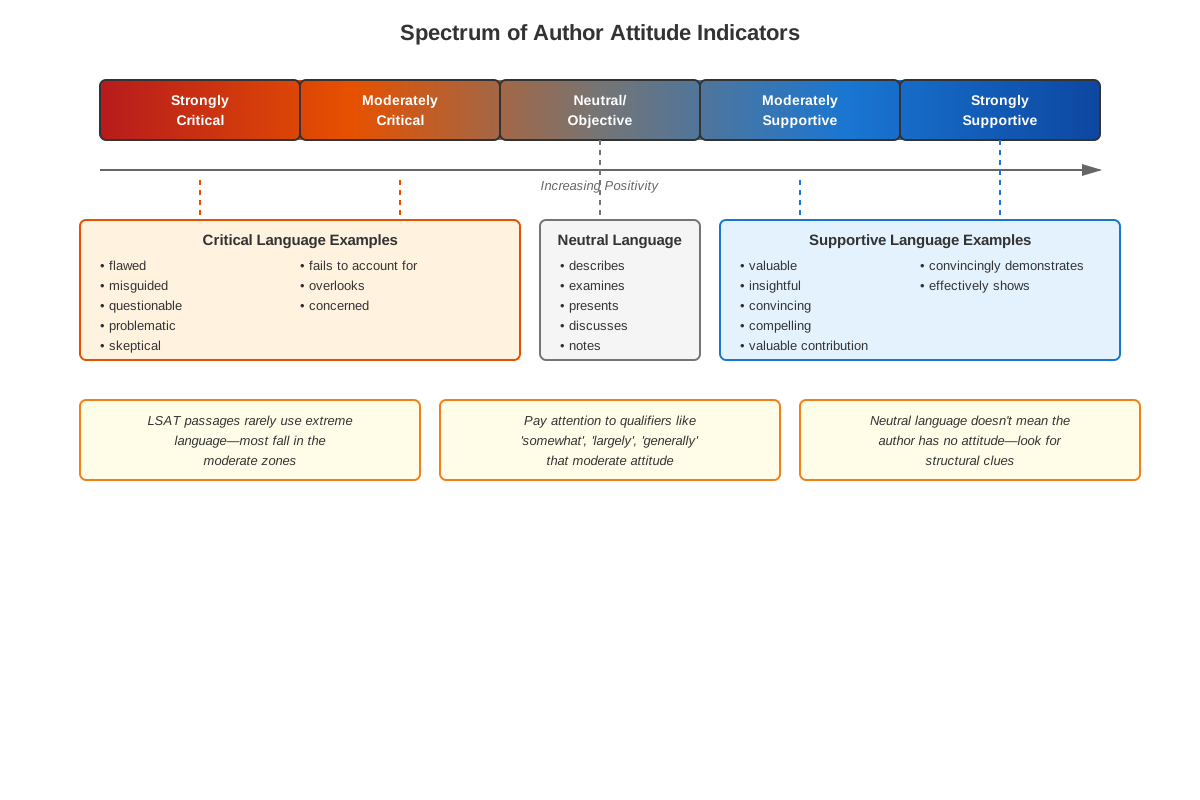
Author attitude refers to the author's evaluative stance, perspective, or emotional/intellectual position toward the subject matter, arguments, theories, or individuals discussed in a passage. This encompasses not just explicit statements of opinion but also the subtle ways authors signal approval, disapproval, skepticism, enthusiasm, or neutrality through word choice, structural decisions, and rhetorical strategies. Author attitude exists on a spectrum from strongly negative to strongly positive, with many gradations including neutral, ambivalent, cautiously optimistic, mildly critical, and enthusiastically supportive.
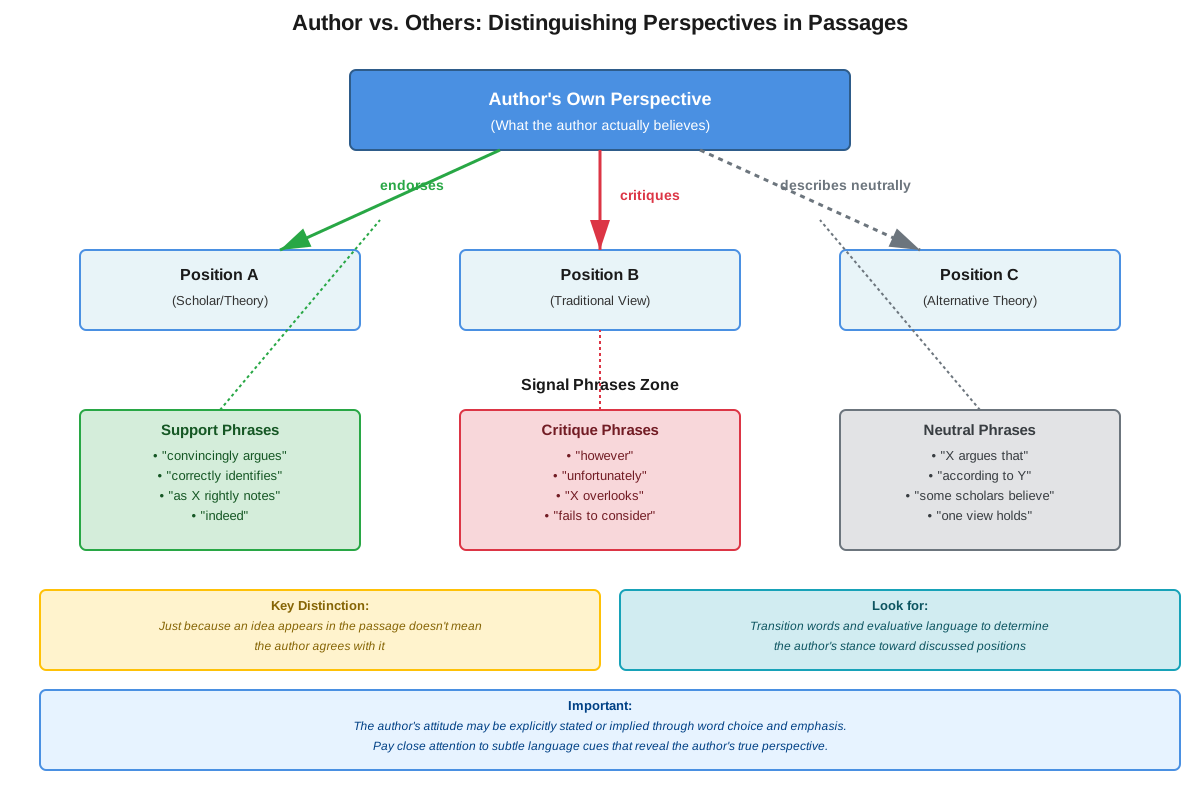
Crucially, author attitude must be distinguished from the content being discussed. An author might describe a theory in detail without endorsing it, critique a position while acknowledging its merits, or present multiple viewpoints while maintaining neutrality. The LSAT specifically tests whether students can separate "what the passage says" from "what the author thinks about what the passage says."
Tone Markers and Evaluative Language
Authors reveal their attitudes primarily through tone markers—specific words and phrases that carry evaluative weight beyond their literal meaning. These fall into several categories:
Positive tone markers include: "compelling," "persuasive," "insightful," "innovative," "successfully demonstrates," "convincingly argues," "valuable contribution," "important advance," and "justified." These words signal author approval or agreement.
Negative tone markers include: "unfortunately," "fails to consider," "overlooks," "problematic," "questionable," "dubious," "exaggerates," "oversimplifies," "misguided," and "inadequate." These indicate author criticism or disagreement.
Neutral/descriptive markers include: "describes," "presents," "outlines," "discusses," "examines," "considers," and "analyzes." These suggest the author is reporting without evaluating.
Qualification markers include: "however," "although," "while," "despite," "nevertheless," and "yet." These often signal that the author is about to express a contrasting view or limitation.
The intensity of tone markers also matters. "Somewhat problematic" expresses mild criticism, while "fundamentally flawed" indicates strong disapproval. The LSAT frequently includes wrong answers that are too extreme or too moderate relative to the author's actual attitude.
Structural Signals of Attitude
Beyond individual words, authors reveal attitudes through structural choices—how they organize and present information:
Emphasis through placement: Ideas presented in opening or closing positions typically receive more authorial weight. If an author ends a passage by highlighting a theory's limitations, this suggests a critical attitude.
Space allocation: The amount of text devoted to different viewpoints often signals author preference. Spending three paragraphs developing one theory and one sentence dismissing another suggests which view the author favors.
Concession and rebuttal patterns: When authors use "while X has merit, Y is more significant" structures, they're revealing their priorities and preferences.
Question posing: Authors who raise questions about a theory ("But can this approach account for...?") are typically expressing skepticism, even without explicit criticism.
Distinguishing Author Voice from Other Voices
LSAT passages frequently present multiple perspectives: the author's view, views of scholars or theorists discussed in the passage, traditional or conventional wisdom, and critics of various positions. A critical skill is distinguishing author voice from these other voices.
Attribution markers help identify whose view is being presented: "Smith argues," "critics contend," "traditional approaches assume," and "some scholars believe" all signal that the author is reporting others' views. When the author writes without attribution—using simple declarative sentences—this typically represents the author's own perspective.
However, the LSAT complicates this by having authors describe others' views in neutral language, then subtly signal agreement or disagreement through tone markers. For example: "Johnson's theory successfully explains the phenomenon" (author agrees with Johnson) versus "Johnson's theory attempts to explain the phenomenon" (author is neutral or skeptical about Johnson's success).
The Attitude Spectrum
Author attitudes exist on a continuum rather than in binary categories:
| Attitude Category | Characteristics | Example Descriptors |
|---|---|---|
| Strongly Positive | Enthusiastic endorsement, minimal qualification | Enthusiastic, admiring, laudatory |
| Moderately Positive | Approval with some reservations | Appreciative, supportive, favorable |
| Mildly Positive | Slight preference or qualified approval | Cautiously optimistic, guardedly positive |
| Neutral | Objective presentation without evaluation | Impartial, detached, analytical |
| Mildly Negative | Subtle criticism or reservation | Skeptical, questioning, doubtful |
| Moderately Negative | Clear criticism with some acknowledgment of merit | Critical, disapproving, concerned |
| Strongly Negative | Harsh criticism, rejection | Dismissive, scornful, contemptuous |
The LSAT rarely uses extreme attitudes (strongly positive or strongly negative). Most passages feature moderate or mild attitudes, and wrong answers often err by being too extreme. An author who is "mildly critical" might be incorrectly described as "dismissive" or "hostile" in wrong answer choices.
Implicit vs. Explicit Attitude
Authors sometimes state their positions explicitly: "This approach is fundamentally flawed" or "The theory represents an important advance." More commonly on the LSAT, attitudes are implicit—conveyed through cumulative word choices, structural decisions, and rhetorical strategies rather than direct statements.
Implicit attitudes require students to synthesize evidence across the passage. An author might never directly criticize a theory but reveal skepticism through: questioning its assumptions, highlighting counterexamples, noting limitations, using qualified language when describing its claims, and devoting more space to alternative approaches. Recognizing these cumulative signals is essential for high performance.
Context-Dependent Attitudes
Authors may hold different attitudes toward different elements within a single passage. An author might be:
- Critical of a theory's methodology but appreciative of its goals
- Supportive of a scholar's overall approach but skeptical of specific claims
- Neutral toward competing theories while critical of the debate's framing
- Enthusiastic about recent developments but concerned about remaining challenges
LSAT questions test whether students can identify the specific target of the author's attitude. A question asking about the author's attitude toward "traditional approaches" requires a different answer than one asking about "recent innovations," even within the same passage.
Concept Relationships
Author attitude serves as the interpretive foundation for understanding passage fundamentals. The relationship flows as follows:
Author Attitude → Main Point: The main point of a passage is typically the claim or position the author most strongly endorses or the conclusion toward which the author's attitude is most positive. Identifying author attitude helps predict and verify main point answers.
Author Attitude → Primary Purpose: An author's purpose (to critique, to advocate, to analyze, to reconcile) directly reflects their attitude. A critical attitude suggests a purpose of critiquing or challenging; a supportive attitude suggests a purpose of defending or promoting.
Author Attitude → Passage Structure: How authors organize passages reflects their attitudes. Authors typically structure passages to build toward their preferred position, placing it in positions of emphasis and providing it with stronger support.
Tone Markers → Author Attitude: Individual evaluative words and phrases accumulate to create the overall author attitude. Recognizing tone markers is the micro-level skill that enables the macro-level understanding of attitude.
Author Voice vs. Other Voices → Author Attitude: Distinguishing whose perspective is being presented enables accurate identification of author attitude. This distinction is prerequisite to attitude analysis.
Author Attitude → Inference Questions: Valid inferences must be consistent with author attitude. If an author is critical of a theory, inferences suggesting the author would endorse expanding that theory are invalid.
The relationship map: Tone Markers → Author Voice Identification → Author Attitude → Main Point/Purpose/Structure → Inference Validity
High-Yield Facts
⭐ Author attitude questions appear in 15-20% of all LSAT Reading Comprehension questions, making this one of the highest-yield topics.
⭐ The LSAT most commonly tests moderate attitudes (mildly critical, cautiously supportive) rather than extreme positions.
⭐ Wrong answers frequently err by being too extreme relative to the author's actual attitude.
⭐ Authors reveal attitude through word choice, structural decisions, space allocation, and rhetorical strategies, not just explicit statements.
⭐ Distinguishing author voice from other voices discussed in the passage is essential for accurate attitude identification.
- Qualification words like "however," "although," and "while" often signal where authors express their own perspective after presenting others' views.
- The absence of tone markers (purely descriptive language) typically indicates neutral author attitude.
- Authors who pose questions about a theory are usually expressing skepticism, even without explicit criticism.
- Space allocation matters: theories receiving more detailed development typically align with author preference.
- Concession-rebuttal patterns ("while X, Y") reveal author priorities, with the post-concession claim receiving more authorial weight.
- Attribution markers ("Smith argues," "critics contend") signal that the author is reporting others' views rather than expressing their own.
- Tone consistency matters: if an author is mildly critical in most of the passage, they're unlikely to be enthusiastic in one section.
- The LSAT rarely includes passages where authors are completely neutral; most passages involve some evaluative positioning.
- Authors can hold different attitudes toward different elements within a single passage (positive toward goals, negative toward methods).
- Implicit attitudes conveyed through cumulative evidence are more common on the LSAT than explicit attitude statements.
Quick check — test yourself on Author attitude so far.
Try Flashcards →Common Misconceptions
Misconception: If an author describes a theory in detail, they must support it.
Correction: Authors frequently describe theories, arguments, or positions in detail while remaining neutral or even critical. Detailed description serves informational purposes and doesn't necessarily indicate endorsement. Look for evaluative language, not just space allocation.
Misconception: Neutral language means the author has no attitude.
Correction: Authors can express subtle attitudes through structural choices, question-posing, and selective emphasis even when using primarily neutral vocabulary. Complete neutrality is rare on the LSAT; most passages involve some evaluative positioning.
Misconception: If an author criticizes one aspect of a theory, they reject the entire theory.
Correction: Authors frequently hold nuanced positions—appreciating some elements while critiquing others. The LSAT specifically tests whether students can identify the specific target of author attitudes rather than overgeneralizing.
Misconception: Strong words always indicate strong author attitudes.
Correction: Authors may use strong language when describing others' views without endorsing those views themselves. Always check attribution: "Critics harshly condemn the theory" describes critics' strong attitude, not necessarily the author's.
Misconception: The author's attitude is always stated explicitly somewhere in the passage.
Correction: Author attitudes are frequently implicit, conveyed through cumulative word choices, structural decisions, and rhetorical strategies rather than direct statements. Students must synthesize evidence across the passage.
Misconception: If an author presents both sides of a debate, they must be neutral.
Correction: Authors can present multiple perspectives while subtly favoring one through tone markers, space allocation, structural positioning, or the strength of evidence provided for each side.
Misconception: Author attitude remains constant throughout the passage.
Correction: While overall attitude should be consistent, authors may express different attitudes toward different elements (positive toward a theory's goals but negative toward its methodology, for example).
Worked Examples
Example 1: Identifying Implicit Attitude Through Tone Markers
Passage Excerpt:
"Traditional approaches to urban planning have long assumed that residential and commercial zones should remain strictly separated. This zoning philosophy, dominant throughout the twentieth century, was thought to protect residential quality of life from commercial intrusion. However, recent studies suggest that mixed-use development may actually enhance community vitality. By integrating residential, commercial, and recreational spaces, these newer approaches create walkable neighborhoods that reduce automobile dependence and foster social interaction. While concerns about noise and congestion merit consideration, preliminary evidence indicates that well-designed mixed-use developments successfully address these challenges through thoughtful architectural planning and traffic management strategies."
Question: The author's attitude toward mixed-use development can best be described as:
Analysis Process:
- Identify tone markers for traditional approaches: "long assumed" (suggests unexamined belief), "was thought to" (indicates past belief now questioned), "dominant throughout the twentieth century" (implies outdated)
- Identify tone markers for mixed-use development: "recent studies suggest" (positive framing), "may actually enhance" (favorable possibility), "create walkable neighborhoods" (positive outcome), "foster social interaction" (positive outcome), "successfully address these challenges" (strong positive marker)
- Note qualification patterns: "While concerns...merit consideration" (acknowledges limitations but doesn't dwell on them), "preliminary evidence indicates" (cautious but positive), "well-designed" (qualified support)
- Assess structural choices: The passage moves from traditional approaches (presented as outdated assumptions) to mixed-use development (presented with positive evidence and outcomes). More space and positive language devoted to mixed-use development.
- Synthesize: The author is clearly more favorable toward mixed-use development than traditional approaches, but uses qualified language ("may," "preliminary," "well-designed") rather than unqualified enthusiasm.
Conclusion: The author's attitude is cautiously supportive or guardedly optimistic toward mixed-use development—positive but with appropriate qualifications. Wrong answers might include "enthusiastic" (too strong), "neutral" (ignores positive tone markers), or "ambivalent" (suggests equal weight to pros and cons, which isn't supported).
Example 2: Distinguishing Author Voice from Other Voices
Passage Excerpt:
"Critics of the new archaeological methodology have raised concerns about its reliance on statistical modeling. They argue that reducing complex cultural phenomena to quantitative data inevitably oversimplifies historical reality and ignores the qualitative aspects of human experience. These objections, while understandable given traditional archaeological training, overlook the methodology's sophisticated integration of multiple data sources. The approach does not, as critics suggest, replace interpretive analysis with mere number-crunching. Rather, it provides a rigorous framework for testing hypotheses that were previously evaluated only through subjective judgment. The methodology's proponents have demonstrated its capacity to reveal patterns invisible to conventional analysis, patterns that have led to significant reinterpretations of settlement development and trade networks."
Question: The author's attitude toward the critics' concerns can best be described as:
Analysis Process:
- Identify whose voice: "Critics...have raised concerns" and "They argue" clearly attribute views to critics, not the author.
- Identify author's response to critics: "These objections, while understandable" (acknowledges validity but signals coming rebuttal), "overlook" (negative tone marker indicating critics are missing something important)
- Identify author's counter-arguments: "does not, as critics suggest" (directly contradicts critics), "Rather, it provides" (presents alternative, more positive framing), "sophisticated integration" (positive tone marker), "rigorous framework" (positive tone marker)
- Assess author's attitude toward the methodology itself: "sophisticated," "rigorous," "demonstrated its capacity," "significant reinterpretations" (all positive tone markers)
- Note concession pattern: "while understandable" is a minor concession that precedes a stronger rebuttal, indicating the author disagrees with critics despite acknowledging their perspective has some basis.
Conclusion: The author's attitude toward the critics' concerns is respectfully dismissive or politely critical—acknowledging the concerns have some basis ("understandable") but ultimately rejecting them as based on misunderstanding ("overlook"). The author is clearly supportive of the methodology the critics oppose. Wrong answers might include "neutral" (ignores the rebuttal), "hostile" (too strong given "understandable"), or "sympathetic" (contradicts the overall defense of the methodology).
Exam Strategy
Approaching Author Attitude Questions
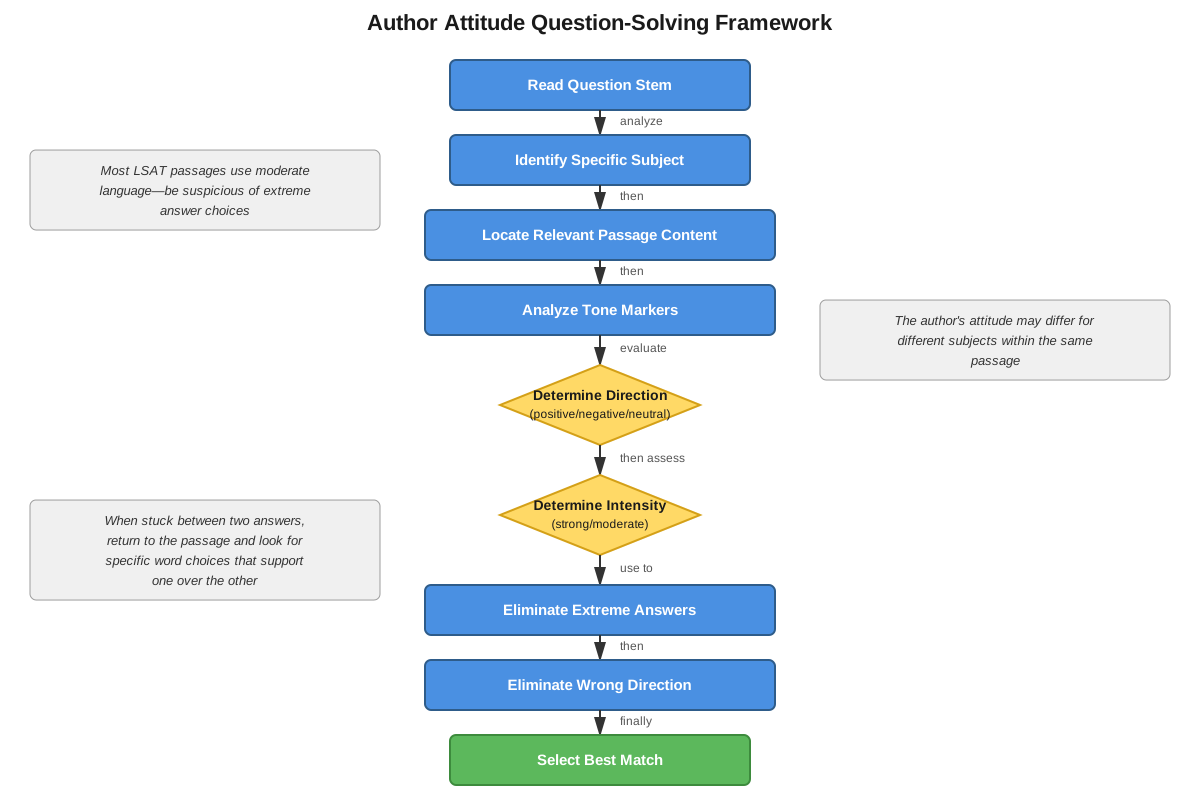
When encountering author attitude questions, follow this systematic process:
- Identify the specific target: Determine exactly what the question asks about—the author's attitude toward a specific theory, person, approach, or claim, not just the general topic.
- Scan for explicit attitude statements: Check if the author directly states their position anywhere in the passage, particularly in opening and closing positions.
- Collect tone markers: Identify evaluative words and phrases throughout the passage related to the target, noting whether they're positive, negative, or neutral.
- Check attribution: Ensure you're identifying the author's attitude, not the attitudes of others discussed in the passage.
- Assess intensity: Determine whether the attitude is strong, moderate, or mild based on the strength of tone markers and presence of qualifications.
- Predict before looking at answers: Based on your analysis, predict the general category of the correct answer (positive, negative, neutral, and intensity level).
Trigger Words and Phrases
Question stem triggers that indicate author attitude questions:
- "The author's attitude toward X can best be described as..."
- "The author's tone in discussing Y is..."
- "The author regards X with..."
- "The author would most likely view X as..."
- "The passage suggests the author considers X to be..."
Passage triggers that signal author attitude:
- Qualification words: however, although, while, despite, nevertheless, yet
- Evaluative adjectives: compelling, problematic, innovative, flawed, significant, questionable
- Evaluative verbs: demonstrates, fails to, overlooks, successfully, convincingly, exaggerates
- Intensifiers: particularly, especially, merely, simply, fundamentally
- Contrast markers: in contrast, on the other hand, conversely
Process of Elimination Tips
Eliminate answers that are too extreme: If the passage uses qualified language ("may," "suggests," "could"), eliminate answers suggesting strong certainty ("definitely," "unquestionably," "enthusiastically").
Eliminate answers that reverse the attitude: If tone markers are predominantly positive, eliminate negative attitude answers and vice versa.
Eliminate answers that confuse author voice with other voices: If an answer describes the attitude of critics or theorists discussed in the passage rather than the author's attitude toward those critics or theorists, eliminate it.
Eliminate answers that are too neutral: If the passage contains clear evaluative language, "neutral" or "objective" answers are likely wrong (though not always—some passages are genuinely neutral).
Eliminate answers that target the wrong element: If the question asks about the author's attitude toward a theory's methodology but an answer describes the attitude toward its goals, eliminate it.
Time Allocation
Author attitude questions typically require 45-60 seconds to answer accurately:
- 15-20 seconds: Carefully read the question stem and identify the specific target
- 20-30 seconds: Review relevant passage sections and collect evidence
- 10-15 seconds: Evaluate answer choices and eliminate wrong answers
Don't rush these questions. Author attitude understanding often unlocks multiple other questions in the passage, making the time investment worthwhile. If uncertain, mark the question and return after completing other questions about the passage, as answering other questions may clarify the author's overall perspective.
Memory Techniques
The VOICE Mnemonic for Identifying Author Attitude
Verbs: Check evaluative verbs (demonstrates vs. claims, successfully vs. attempts)
Organization: Note structural emphasis and space allocation
Intensity: Assess strength of tone markers and presence of qualifications
Contrast: Look for "however," "although," and other qualification markers
Explicit: Search for direct attitude statements, especially at passage beginning/end
The TAME Framework for Attitude Spectrum
Totally positive (rare on LSAT): enthusiastic, admiring, laudatory
Approving (common): supportive, favorable, appreciative
Moderate/Mild (most common): cautiously optimistic, guardedly positive, mildly skeptical
Extremely negative (rare on LSAT): dismissive, scornful, contemptuous
Remember: Most LSAT passages fall in the middle categories (A and M), not the extremes (T and E).
Visualization Strategy
Picture the author as a judge evaluating evidence. As you read:
- Imagine the judge nodding (positive tone markers)
- Imagine the judge shaking their head (negative tone markers)
- Imagine the judge with a neutral expression (descriptive language)
- Imagine the judge raising an eyebrow (skeptical questioning)
This visualization helps maintain awareness of evaluative positioning throughout the passage.
The Attribution Check
When encountering any claim or position in the passage, mentally ask: "Says who?" If the answer is "the author" (no attribution markers), it likely represents the author's view. If the answer is "Smith" or "critics" or "traditional approaches," it's someone else's view, and you need to determine the author's attitude toward that view.
Summary
Author attitude represents one of the most critical and frequently tested concepts in LSAT Reading Comprehension, appearing directly in 15-20% of questions and indirectly affecting many others. Mastering this topic requires developing sensitivity to tone markers (evaluative words and phrases), structural signals (organization, emphasis, space allocation), and the crucial distinction between author voice and other voices discussed in passages. The LSAT most commonly tests moderate attitudes—cautiously supportive, mildly critical, guardedly optimistic—rather than extreme positions, and wrong answers frequently err by being too strong or too weak relative to the author's actual stance. Success requires synthesizing evidence across entire passages, as attitudes are often implicit rather than explicitly stated. Students must learn to identify the specific target of attitude questions, collect relevant tone markers, assess intensity through qualification patterns, and distinguish between what authors describe and what they endorse. This skill connects directly to other passage fundamentals including main point, primary purpose, and inference, making it a high-yield investment of study time.
Key Takeaways
- Author attitude questions appear in approximately 15-20% of Reading Comprehension questions and affect many others indirectly, making this a high-priority topic
- Tone markers (evaluative words and phrases) are the primary evidence for author attitude, supplemented by structural choices and rhetorical strategies
- The LSAT most commonly tests moderate attitudes; wrong answers often err by being too extreme or too neutral
- Distinguishing author voice from other voices discussed in the passage is essential—always check attribution markers
- Author attitudes are frequently implicit rather than explicit, requiring synthesis of evidence across the passage
- Authors can hold different attitudes toward different elements within a single passage (positive toward goals, negative toward methods)
- Qualification markers ("however," "although," "while") often signal where authors express their own perspective after presenting others' views
Related Topics
Main Point and Primary Purpose: Understanding author attitude is essential for identifying main point (the claim the author most strongly endorses) and primary purpose (what the author aims to accomplish, which reflects their attitude). Mastering attitude enables more accurate prediction and verification of main point answers.
Inference Questions: Valid inferences must be consistent with author attitude. If an author is skeptical of a theory, inferences suggesting the author would support expanding that theory are invalid. Attitude understanding constrains and guides inference selection.
Passage Structure and Organization: How authors organize passages reflects their attitudes, with preferred positions typically receiving structural emphasis. Understanding the relationship between structure and attitude enhances both skills.
Tone and Style Analysis: While author attitude focuses on evaluative positioning, tone analysis examines the emotional quality and stylistic choices of writing. These skills complement each other in developing sophisticated reading comprehension.
Comparative Reading: In comparative passages, identifying each author's attitude and comparing their perspectives is essential. Mastering single-passage attitude analysis prepares students for the more complex comparative format.
Practice CTA
Now that you've mastered the core concepts of author attitude, it's time to put your knowledge into practice. Attempt the practice questions and flashcards to reinforce your understanding and develop the quick recognition skills essential for test day success. Remember: author attitude is one of the highest-yield topics in Reading Comprehension—every minute you invest in mastering this skill pays dividends across multiple question types. Focus particularly on distinguishing moderate from extreme attitudes and separating author voice from other voices, as these are the most commonly tested distinctions. You've built the foundation; now build the speed and accuracy that will elevate your score.
Sign up free to keep reading
Create a free AnvayaPrep account to finish this LSAT guide on Author attitude — plus flashcards and practice questions.