Overview
Author tone is one of the most frequently tested elements in LSAT reading comprehension passages, appearing in approximately 15-20% of all Reading Comprehension questions. Understanding author tone requires students to move beyond literal comprehension of what an author says to grasp how the author feels about the subject matter, arguments presented, or other viewpoints discussed in the passage. This skill is fundamental because the LSAT tests not just reading ability, but analytical reasoning applied to complex texts.
Mastering author tone is essential for LSAT success because it directly impacts performance on multiple question types, including attitude questions, purpose questions, and inference questions. The ability to accurately identify whether an author is skeptical, enthusiastic, neutral, or critical can mean the difference between selecting the correct answer and falling for an attractive distractor. Author tone questions often serve as gateway questions—answering them correctly provides insight that helps with other questions about the same passage.
Within the broader framework of passage fundamentals, author tone connects intimately with other core skills such as identifying main purpose, understanding passage structure, and recognizing argumentative moves. While main purpose tells you what the author is trying to accomplish, tone reveals the author's attitude toward that purpose and the subject matter. This distinction is crucial: two authors might have the same purpose (explaining a scientific theory) but vastly different tones (one enthusiastic, one skeptical). Recognizing these nuances separates high scorers from average performers on the LSAT Reading Comprehension section.
Learning Objectives
- [ ] Identify how Author tone appears in LSAT questions
- [ ] Explain the reasoning pattern behind Author tone
- [ ] Apply Author tone to solve LSAT-style problems accurately
- [ ] Distinguish between subtle gradations of tone (e.g., cautious optimism vs. qualified approval)
- [ ] Recognize textual evidence that signals specific tones
- [ ] Eliminate incorrect answer choices by identifying tone mismatches
- [ ] Integrate tone analysis with other passage analysis skills to answer complex questions
Prerequisites
- Basic reading comprehension skills: Understanding literal meaning is necessary before analyzing how something is said
- Vocabulary knowledge: Recognizing tone-indicating words requires familiarity with adjectives describing attitudes and emotions
- Ability to identify main ideas: Tone relates to how an author feels about their main points
- Understanding of argument structure: Recognizing when an author presents, critiques, or supports arguments helps determine tone
Why This Topic Matters
Author tone questions appear in virtually every LSAT Reading Comprehension section, making this one of the highest-yield topics for test preparation. Statistically, students can expect 2-4 direct tone questions per test, plus numerous additional questions where understanding tone provides crucial context for selecting correct answers. The LSAT specifically tests tone because legal practice requires attorneys to analyze not just what arguments say, but how they're presented—the difference between a judge's skeptical questioning and genuine inquiry, or between a brief's confident assertion and tentative suggestion.
In real-world legal contexts, understanding tone helps attorneys gauge judicial receptiveness, interpret opposing counsel's confidence levels, and craft persuasive arguments with appropriate emotional registers. Law school professors expect students to distinguish between an author's presentation of others' views versus their own position—a skill directly tested through tone questions on the LSAT.
Common manifestations of tone questions include:
- Direct attitude questions: "The author's attitude toward X can best be described as..."
- Comparative tone questions: "The author's tone in discussing Theory A differs from the tone in discussing Theory B in that..."
- Inference questions requiring tone understanding: "Which of the following would the author most likely agree with?"
- Purpose questions where tone clarifies intent: "The author mentions X primarily in order to..."
Core Concepts
Defining Author Tone in LSAT Context
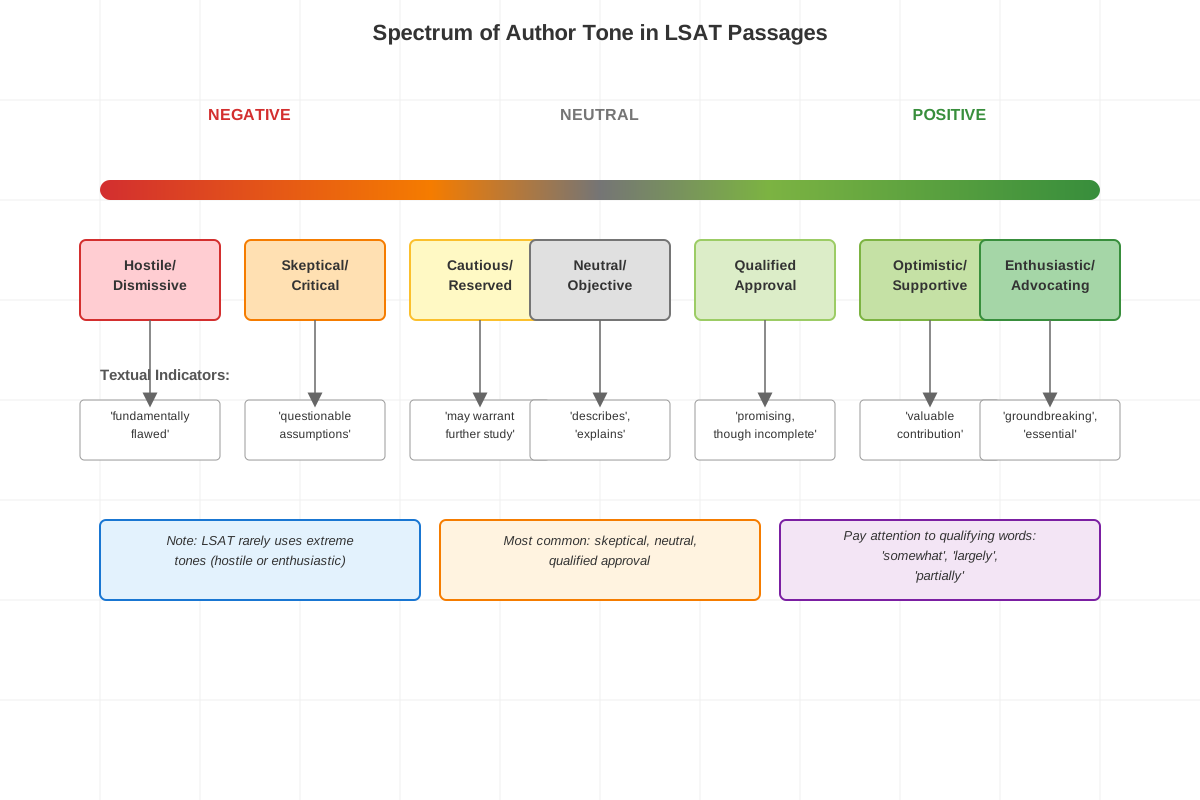
Author tone refers to the attitude, feeling, or emotional stance an author takes toward their subject matter, arguments presented, or viewpoints discussed within a passage. Unlike casual reading where tone might be obvious, LSAT passages typically feature subtle, academic tones that require careful analysis of word choice, qualifiers, and rhetorical moves. The LSAT rarely presents extreme tones (like "angry" or "ecstatic"); instead, passages exhibit measured, intellectual tones such as "cautiously optimistic," "mildly skeptical," or "qualified approval."
The lsat author tone spectrum ranges from negative to neutral to positive, but with crucial gradations within each category. Understanding these gradations is essential because LSAT answer choices often present multiple options within the same general category, requiring students to identify the precise degree of the author's attitude.
The Tone Spectrum and Common LSAT Tones
| Negative Tones | Neutral Tones | Positive Tones |
|---|---|---|
| Dismissive | Objective | Enthusiastic |
| Skeptical | Analytical | Approving |
| Critical | Descriptive | Optimistic |
| Disapproving | Ambivalent | Admiring |
| Pessimistic | Detached | Supportive |
Qualified tones appear most frequently on the LSAT. These include:
- Cautiously optimistic: Hopeful but with reservations
- Qualified approval: Generally positive but with noted limitations
- Measured skepticism: Doubtful but not entirely dismissive
- Tentative support: Favorable but acknowledging uncertainties
Textual Evidence for Tone
Identifying tone requires analyzing specific linguistic markers throughout the passage:
- Evaluative adjectives and adverbs: Words like "unfortunately," "remarkably," "merely," "surprisingly," or "regrettably" signal the author's judgment
- Qualifiers and hedging language: Phrases such as "may," "might," "could," "appears to," or "seems to" indicate caution or uncertainty
- Intensifiers: Words like "clearly," "undoubtedly," "certainly," or "obviously" show confidence
- Contrast markers: "However," "nevertheless," "despite," or "although" often introduce the author's own view contrasting with others'
- Rhetorical questions: Questions the author poses often reveal skepticism or emphasis
- Punctuation choices: Quotation marks around terms can indicate distance or skepticism; exclamation points (rare in LSAT passages) show emphasis
Distinguishing Author's Voice from Others' Views
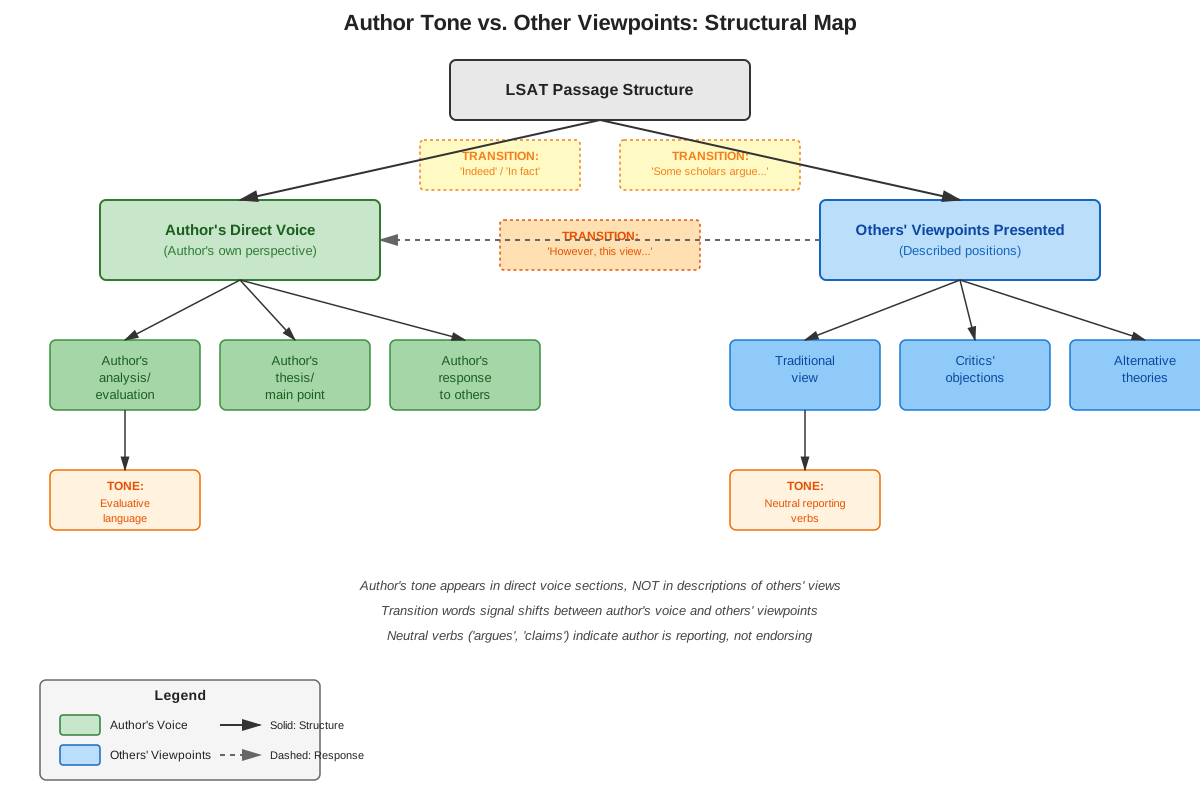
A critical skill in tone analysis involves separating the author's personal attitude from their neutral presentation of others' viewpoints. LSAT passages frequently present multiple perspectives, and the author may describe opposing views without endorsing them. Key indicators of the author's own position include:
- Explicit attribution: "Critics argue..." or "Proponents claim..." signals others' views
- Transition to author's view: "However," "In fact," or "Actually" often precedes the author's perspective
- Unattributed statements: Claims presented without attribution typically represent the author's position
- Evaluative language placement: Where positive or negative language appears reveals what the author endorses
Tone Consistency and Shifts
Authors typically maintain consistent tone toward a given subject throughout a passage, though tone may shift when discussing different subjects or perspectives. Recognizing these patterns helps answer questions:
- Consistent tone: An author skeptical of a theory in paragraph 1 will likely remain skeptical in paragraph 3
- Differential tone: An author may be enthusiastic about new research methods while skeptical of traditional approaches
- Evolving tone: Occasionally, an author's tone shifts as they present new evidence or considerations
Common Tone Question Formats
Understanding how tone questions are constructed helps identify them quickly:
- Direct attitude questions: "The author's attitude toward [subject] is best described as..."
- Tone comparison questions: "The author's discussion of X differs from the discussion of Y in that the author is more..."
- Inference questions requiring tone: "Based on the passage, the author would most likely view [new scenario] with..."
- Purpose questions with tone elements: "The author mentions [detail] primarily to express..."
Concept Relationships
Author tone functions as a central hub connecting multiple passage fundamentals concepts. The relationship flows as follows:
Main Purpose → Author Tone → Specific Details
The author's overall purpose (to critique, explain, advocate, or analyze) establishes the general tone framework. This tone then colors how specific details and examples are presented. For instance, if the main purpose is to critique a theory, the tone will likely be skeptical or critical, and specific details will be presented to highlight weaknesses.
Argument Structure ↔ Author Tone
These concepts interact bidirectionally. Understanding argument structure helps identify tone (recognizing when the author presents counterarguments versus their own position), while recognizing tone helps clarify argument structure (a skeptical tone signals the author is critiquing rather than supporting a claim).
Textual Evidence → Tone Identification → Answer Selection
This linear progression represents the analytical process: students gather textual evidence (word choice, qualifiers, evaluative language), synthesize this evidence to identify tone, then use tone understanding to eliminate incorrect answers and select the correct choice.
Author Tone ↔ Inference Questions
Tone understanding enables stronger inference-making. If an author is enthusiastic about a new methodology, students can infer the author would likely support similar innovative approaches in related contexts.
High-Yield Facts
⭐ Author tone questions appear in approximately 15-20% of all LSAT Reading Comprehension questions, making them one of the highest-yield topics.
⭐ The LSAT rarely uses extreme tones; instead, passages feature measured, academic tones with subtle gradations.
⭐ Qualified tones (cautiously optimistic, qualified approval, measured skepticism) are the most common on the LSAT.
⭐ Evaluative adjectives and adverbs are the strongest textual indicators of author tone.
⭐ Authors typically maintain consistent tone toward a given subject throughout a passage.
- Contrast markers like "however" and "nevertheless" often signal the author's own view differing from others' perspectives.
- Unattributed statements generally represent the author's own position, while attributed statements present others' views.
- Quotation marks around terms often indicate the author's skepticism or distance from those concepts.
- Hedging language ("may," "might," "appears to") indicates caution or uncertainty in the author's tone.
- Intensifiers ("clearly," "undoubtedly") signal the author's confidence in a claim.
- An author can have different tones toward different subjects within the same passage.
- Tone questions often serve as gateway questions that help answer other questions about the passage.
- Incorrect answer choices frequently present tones that are too extreme or in the wrong direction (positive vs. negative).
Quick check — test yourself on Author tone so far.
Try Flashcards →Common Misconceptions
Misconception: The author's tone is always neutral or objective in academic passages.
Correction: While LSAT passages are academic in style, authors frequently take positions and express attitudes. Even scholarly writing contains evaluative language revealing the author's stance. The key is recognizing subtle rather than extreme tones.
Misconception: If an author presents a viewpoint, they endorse it.
Correction: Authors regularly present others' perspectives without supporting them. Look for attribution markers ("critics argue," "proponents claim") and contrast markers ("however," "in fact") that signal when the author is presenting versus endorsing views.
Misconception: Tone is determined by a single word or phrase.
Correction: Accurate tone identification requires analyzing multiple pieces of evidence throughout the passage. A single positive adjective doesn't make the overall tone enthusiastic if the passage contains numerous qualifiers and reservations.
Misconception: "Objective" and "neutral" are always correct answers for academic passages.
Correction: These answers are often traps. While academic in style, most LSAT passages involve authors taking positions, making "objective" or "neutral" incorrect. These answers are only correct when the author truly presents information without evaluation.
Misconception: Tone questions are subjective and based on feeling rather than evidence.
Correction: Tone questions are evidence-based and objective. Correct answers must be supported by specific textual evidence—word choice, qualifiers, evaluative language, and rhetorical moves. Students should be able to point to specific passages supporting their tone identification.
Misconception: An author critical of one aspect of a theory is critical of the entire theory.
Correction: Authors often express nuanced positions, supporting some aspects while critiquing others. This creates tones like "qualified approval" or "measured support." Read carefully to determine what specifically the author is evaluating.
Worked Examples
Example 1: Identifying Qualified Tone
Passage Excerpt:
"While the new archaeological methodology has yielded some intriguing results, particularly in dating organic materials, researchers should exercise caution before abandoning traditional stratigraphic analysis entirely. The technique's reliance on statistical modeling introduces potential sources of error that remain inadequately addressed in current literature. Nevertheless, when used as a complement to established methods, this approach may enhance our understanding of site chronology."
Question: The author's attitude toward the new archaeological methodology can best be described as:
(A) Unqualified enthusiasm
(B) Cautious optimism
(C) Strong disapproval
(D) Complete neutrality
(E) Dismissive skepticism
Analysis:
Step 1: Identify evaluative language
- Positive indicators: "intriguing results," "may enhance our understanding"
- Negative indicators: "should exercise caution," "potential sources of error," "inadequately addressed"
- Qualifiers: "some," "may," "when used as a complement"
Step 2: Determine overall direction
The author sees value in the methodology but expresses significant reservations. This is neither entirely positive nor negative.
Step 3: Assess degree of tone
The positive elements are qualified ("some intriguing results," "may enhance"), while concerns are substantive ("potential sources of error"). The author suggests complementary use rather than replacement.
Step 4: Eliminate answers
- (A) Incorrect: "Unqualified" contradicts the numerous reservations expressed
- (B) CORRECT: "Cautious" captures the reservations; "optimism" reflects the potential value seen
- (C) Incorrect: Too negative; the author sees value in the methodology
- (D) Incorrect: The evaluative language ("intriguing," "should exercise caution") shows the author takes a position
- (E) Incorrect: "Dismissive" is too strong; the author acknowledges value
Answer: (B) Cautious optimism
Connection to Learning Objectives: This example demonstrates identifying tone through textual evidence (evaluative language and qualifiers), explaining the reasoning pattern (balancing positive and negative indicators), and applying tone analysis to select the correct answer.
Example 2: Distinguishing Author's View from Others'
Passage Excerpt:
"Proponents of the efficient market hypothesis argue that stock prices fully reflect all available information, making it impossible to consistently outperform the market through analysis. However, this view overlooks the well-documented phenomenon of market bubbles, where prices clearly diverge from fundamental values. The persistence of such anomalies suggests that behavioral factors, rather than pure information processing, drive significant market movements. Critics who dismiss behavioral economics as merely describing irrational behavior fail to recognize its explanatory power."
Question: The author's attitude toward the efficient market hypothesis is best described as:
(A) Supportive
(B) Ambivalent
(C) Skeptical
(D) Neutral
(E) Enthusiastic
Analysis:
Step 1: Separate attributed views from author's voice
- Others' views: "Proponents...argue" (efficient market hypothesis supporters); "Critics who dismiss" (behavioral economics critics)
- Author's voice: Statements following "However" and unattributed claims
Step 2: Identify author's evaluative language
- "this view overlooks" (negative evaluation of efficient market hypothesis)
- "well-documented phenomenon" (emphasizing contrary evidence)
- "clearly diverge" (strong assertion against the hypothesis)
- "fail to recognize" (criticism of the hypothesis's defenders)
Step 3: Determine tone direction
All author's evaluative language criticizes the efficient market hypothesis or its proponents. No positive evaluation appears.
Step 4: Assess degree
The criticism is substantive but measured—"overlooks" rather than "completely ignores," presenting evidence rather than dismissing outright.
Step 5: Eliminate answers
- (A) Incorrect: The author criticizes rather than supports the hypothesis
- (B) Incorrect: No evidence of mixed feelings; the author consistently critiques
- (C) CORRECT: The author doubts the hypothesis's validity, presenting contrary evidence
- (D) Incorrect: The evaluative language shows clear positioning
- (E) Incorrect: Wrong direction; the author is negative, not positive
Answer: (C) Skeptical
Connection to Learning Objectives: This example demonstrates distinguishing the author's voice from attributed views, identifying tone through contrast markers and evaluative language, and applying this understanding to answer selection.
Exam Strategy
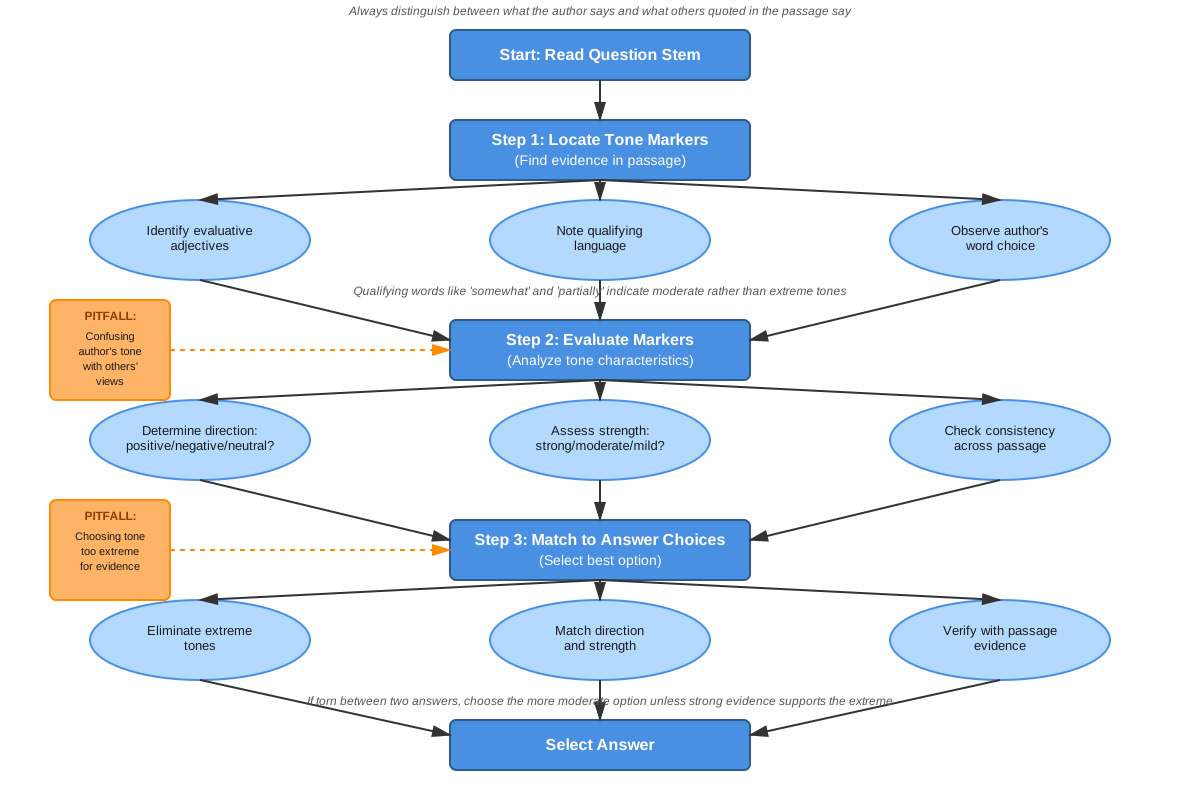
Approaching Tone Questions Systematically
- Read the question stem carefully: Identify whose tone is being asked about (the author's, a group mentioned in the passage, or the author's tone toward a specific subject)
- Return to the passage: Don't rely on memory. Locate the relevant sections and read them with tone in mind
- Gather textual evidence: Mark or note evaluative adjectives, qualifiers, intensifiers, and contrast markers
- Determine direction first: Is the tone positive, negative, or neutral? Eliminate all answers in wrong categories
- Assess degree second: Within the correct direction, identify the intensity level. Is it strong or qualified?
- Match evidence to answer choices: The correct answer must be supported by specific textual evidence
Trigger Words and Phrases
In Question Stems:
- "attitude toward"
- "tone in discussing"
- "author's view of"
- "author regards"
- "author's response to"
- "author would most likely characterize"
In Passages (Indicating Author's Tone):
- Positive: "remarkably," "impressive," "valuable," "significant," "important"
- Negative: "unfortunately," "merely," "problematic," "flawed," "inadequate"
- Qualified: "somewhat," "partially," "to some extent," "may," "might"
- Strong: "clearly," "undoubtedly," "certainly," "obviously," "definitely"
Process of Elimination Tips
Eliminate extreme tones first: Answers like "contemptuous," "ecstatic," "outraged," or "reverent" are almost always incorrect in LSAT passages.
Eliminate tones in the wrong direction: If the author is critical, eliminate all positive tones immediately, and vice versa.
Watch for "objective" and "neutral" traps: These are only correct when the author presents pure description without evaluation—rare in LSAT passages.
Eliminate tones that contradict specific evidence: If the passage contains "may" and "might," eliminate answers suggesting certainty or strong conviction.
Be suspicious of answers that are too weak: If the author uses strong language like "clearly demonstrates," answers like "mildly suggests" are likely incorrect.
Time Allocation
- Initial passage reading: Note tone indicators as you read (15-30 seconds of your reading time)
- Tone question answering: 30-45 seconds
- 10 seconds: Locate relevant passage sections
- 15 seconds: Gather and analyze evidence
- 10-20 seconds: Eliminate wrong answers and confirm correct choice
Tone questions should be among the faster questions to answer because they require less complex reasoning than inference or application questions. If spending more than 45 seconds, move on and return if time permits.
Memory Techniques
The TONE Acronym for Analysis
Textual evidence (What specific words indicate tone?)
Others vs. author (Whose view is being presented?)
Negative, neutral, or positive (What's the direction?)
Extreme or qualified (What's the degree?)
Visualization Strategy: The Tone Thermometer
Visualize a thermometer with three zones:
- Top (red zone): Strong positive tones (enthusiastic, admiring, strongly supportive)
- Middle (yellow zone): Qualified or neutral tones (cautiously optimistic, ambivalent, analytical)
- Bottom (blue zone): Strong negative tones (dismissive, highly critical, contemptuous)
Most LSAT passages fall in the middle zone. When analyzing tone, place the author on this thermometer.
The "However" Rule
Mnemonic: "However Reveals Author's View"
When you see "however," "nevertheless," "in fact," or "actually," the author's own perspective typically follows. These contrast markers are gold mines for tone identification.
Common Tone Pairs
Remember these frequently tested tone distinctions:
- Skeptical vs. Dismissive: Skeptical = doubtful but considering; Dismissive = rejecting without consideration
- Optimistic vs. Enthusiastic: Optimistic = hopeful about outcomes; Enthusiastic = excited and strongly positive
- Critical vs. Analytical: Critical = finding fault; Analytical = examining objectively
- Cautious vs. Uncertain: Cautious = careful and measured; Uncertain = lacking confidence
Summary
Author tone represents one of the highest-yield topics in LSAT Reading Comprehension, appearing in 15-20% of questions and providing crucial context for answering additional questions. Mastering tone requires moving beyond literal comprehension to analyze how authors feel about their subject matter through careful examination of evaluative language, qualifiers, intensifiers, and rhetorical moves. The LSAT predominantly features measured, academic tones with subtle gradations—particularly qualified tones like cautiously optimistic or measured skepticism—rather than extreme emotional stances. Success depends on distinguishing the author's voice from attributed views of others, gathering multiple pieces of textual evidence rather than relying on single words, and systematically eliminating answer choices that misrepresent the direction or degree of the author's attitude. Students must recognize that tone questions are evidence-based and objective, requiring specific textual support for correct answers. By understanding the tone spectrum, identifying linguistic markers, and applying systematic analysis strategies, students can consistently answer tone questions accurately and efficiently, building a foundation for overall Reading Comprehension success.
Key Takeaways
- Author tone questions appear in 15-20% of LSAT Reading Comprehension questions and often unlock answers to other questions about the same passage
- LSAT passages feature measured, academic tones with subtle gradations; extreme tones are rare and usually incorrect answer choices
- Qualified tones (cautiously optimistic, qualified approval, measured skepticism) are the most frequently tested on the LSAT
- Distinguish the author's voice from attributed views by identifying contrast markers, attribution phrases, and unattributed statements
- Gather multiple pieces of textual evidence—evaluative adjectives, qualifiers, intensifiers, and rhetorical moves—to accurately identify tone
- Approach tone questions systematically: determine direction (positive/negative/neutral) first, then assess degree (strong/qualified)
- Tone analysis is evidence-based and objective, not subjective; correct answers must be supported by specific textual markers
Related Topics
Main Purpose and Primary Purpose Questions: Understanding author tone directly supports identifying main purpose, as tone reveals the author's intent (to critique, advocate, explain, or analyze). Mastering tone enables more accurate main purpose identification.
Inference Questions: Tone understanding is essential for inference questions asking what the author would likely think about new scenarios or related topics. The author's established tone toward one subject predicts their likely attitude toward similar subjects.
Argument Structure and Reasoning: Recognizing tone helps identify when authors present counterarguments versus their own positions, clarifying overall argument structure and the logical relationships between different parts of the passage.
Comparative Reading: In comparative reading passages, identifying each author's tone enables analysis of how the authors' perspectives differ, a frequently tested skill in these paired passages.
Strengthen/Weaken Questions: Though more common in Logical Reasoning, understanding an author's tone in Reading Comprehension helps identify what types of evidence would strengthen or weaken their position.
Practice CTA
Now that you've mastered the fundamentals of author tone, it's time to put your knowledge into practice. Attempt the practice questions to test your ability to identify tone through textual evidence, distinguish subtle gradations, and eliminate incorrect answer choices efficiently. Use the flashcards to reinforce your recognition of tone-indicating language and common tone categories. Remember: tone questions are among the most predictable and high-yield on the LSAT—consistent practice with these materials will build the pattern recognition and analytical skills needed to answer them quickly and accurately on test day. Every tone question you master brings you closer to your target score!
Sign up free to keep reading
Create a free AnvayaPrep account to finish this LSAT guide on Author tone — plus flashcards and practice questions.