Overview
High resolution details represent one of the most critical skills tested in LSAT reading comprehension passages. This concept refers to the ability to identify, understand, and work with specific, granular information embedded within complex texts—the precise facts, examples, dates, names, technical terms, and supporting evidence that authors use to build their arguments. Unlike broad thematic understanding, high resolution details require students to zoom in on particular sentences or phrases and extract exact information without distortion or inference beyond what the text explicitly states.
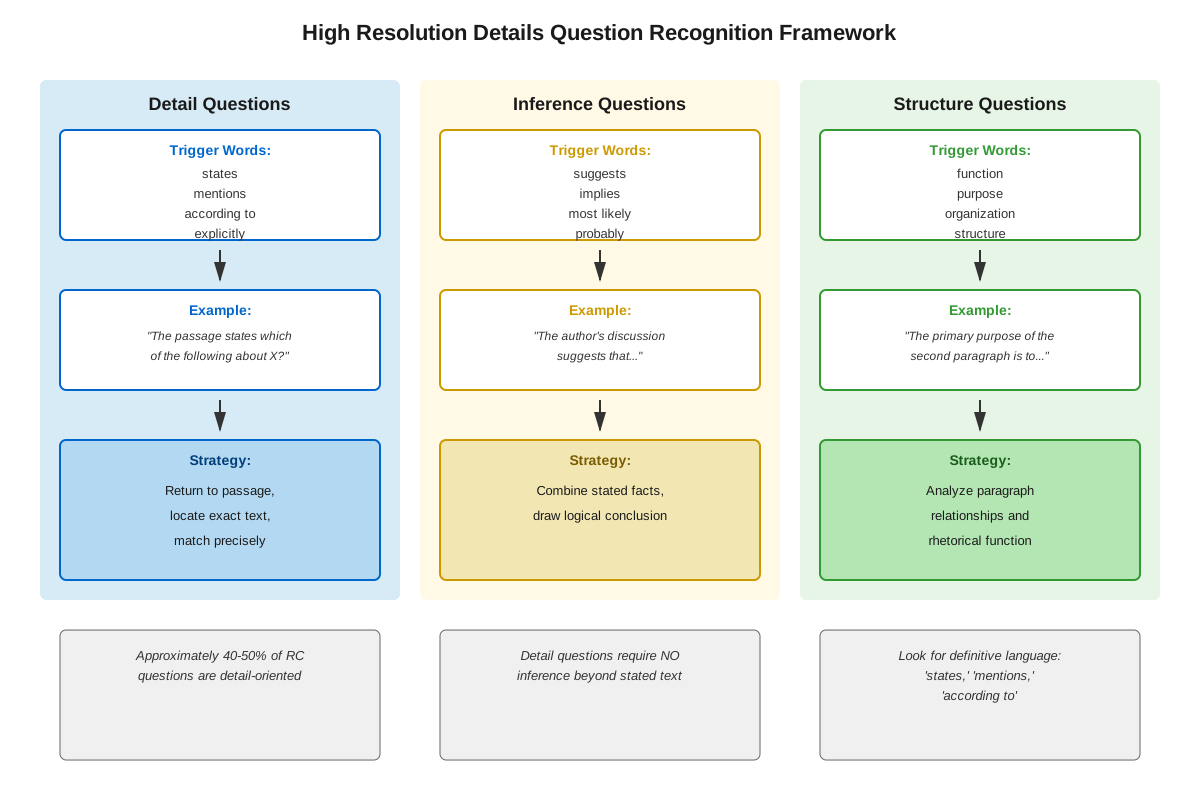
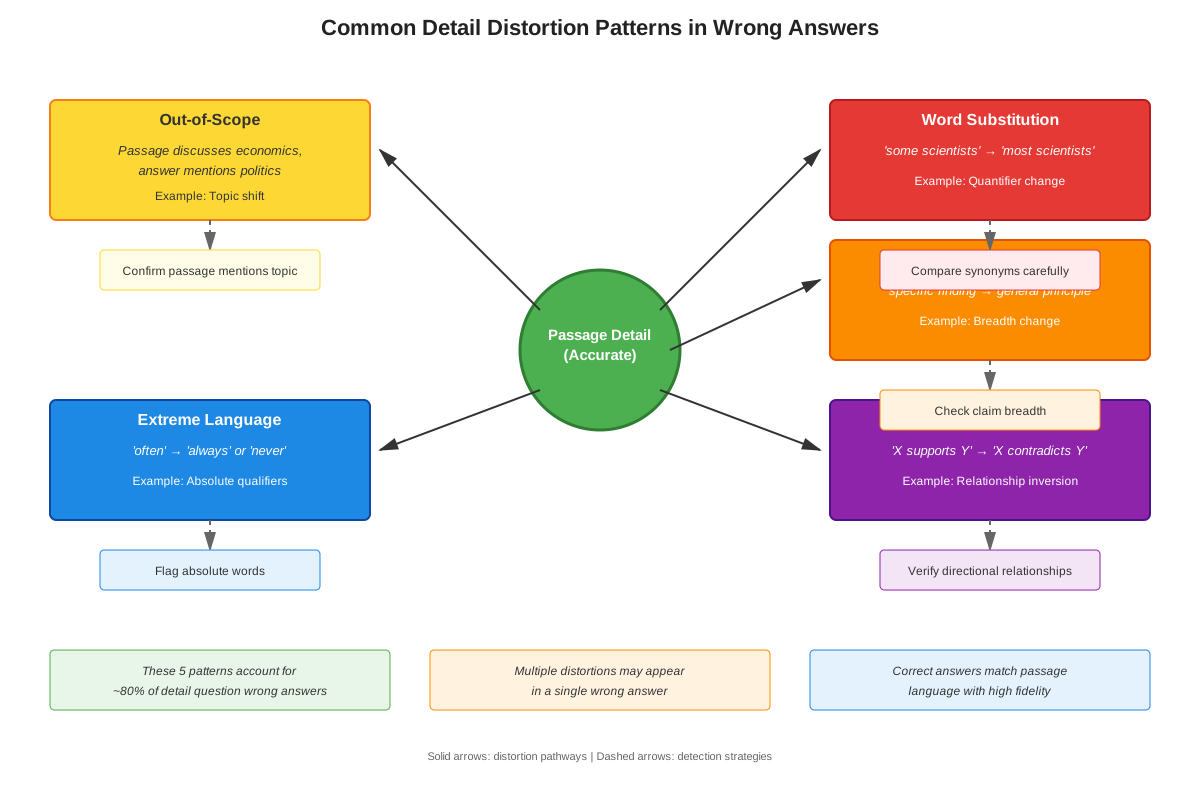
Mastering high resolution details is essential for the LSAT because approximately 40-50% of reading comprehension questions test your ability to locate and accurately interpret specific textual evidence. These questions often ask what the passage "states," what an author "mentions," or which detail "supports" a particular claim. The LSAT deliberately constructs wrong answer choices that distort details through subtle word changes, scope shifts, or logical leaps—making precision reading an absolute necessity. Students who struggle with high resolution details often select answers that "sound right" but misrepresent what the passage actually says, leading to significant point loss.
Within passage fundamentals, high resolution details form the foundation upon which all other reading comprehension skills rest. Before analyzing structure, identifying main ideas, or making inferences, students must first accurately capture what the text explicitly communicates. This skill connects directly to active reading strategies, annotation techniques, and question-specific approaches. High resolution details also interact with inference questions (where you must distinguish stated facts from logical conclusions) and strengthen questions (where specific evidence must match argumentative gaps). Developing this skill transforms passive reading into precise, evidence-based analysis—the hallmark of successful LSAT performance.
Learning Objectives
- [ ] Identify how high resolution details appears in LSAT questions
- [ ] Explain the reasoning pattern behind high resolution details
- [ ] Apply high resolution details to solve LSAT-style problems accurately
- [ ] Distinguish between explicitly stated details and inferences drawn from those details
- [ ] Recognize common distortion patterns in wrong answer choices that misrepresent textual details
- [ ] Develop systematic annotation strategies to track important details during initial passage reading
- [ ] Evaluate answer choices by matching them precisely against specific textual evidence
Prerequisites
- Basic reading comprehension skills: The ability to read complex academic prose and understand sentence-level meaning is necessary before focusing on detail extraction
- Familiarity with LSAT question formats: Understanding how questions are structured helps recognize when detail-oriented questions appear
- Active reading fundamentals: Knowledge of annotation and engagement strategies provides the framework for capturing details during initial reading
- Passage structure awareness: Recognizing how passages organize information helps locate details efficiently when answering questions
Why This Topic Matters
High resolution details matter because the LSAT reading comprehension section fundamentally tests whether students can read with legal precision—the same skill attorneys use when analyzing contracts, statutes, and case law. In legal practice, missing a single word or misinterpreting a specific clause can change the entire meaning of a document. The LSAT simulates this demand for precision through questions that reward exact textual understanding and punish even slight misreadings.
Statistically, detail-oriented questions appear in every LSAT reading comprehension section, typically comprising 8-12 questions out of the 27 total reading comprehension questions. These include "According to the passage" questions, "The author mentions X in order to" questions, and "Which of the following does the passage state about Y" questions. Each passage (approximately 4 per section) contains 2-3 detail questions on average, making this the most consistently tested question type alongside inference questions.
Common manifestations in exam passages include questions asking about specific examples the author provides, particular dates or names mentioned, technical definitions offered in the text, or supporting evidence cited for a claim. The LSAT also tests high resolution details through EXCEPT questions ("All of the following are mentioned EXCEPT") and Roman numeral questions that require checking multiple details. Comparative reading passages particularly emphasize details by asking which passage mentions specific information or how the two passages differ on particular points. Understanding high resolution details isn't just about answering one question type—it's about building the foundational reading accuracy that supports performance across all reading comprehension questions.
Core Concepts
What Constitutes High Resolution Details
High resolution details are specific, concrete pieces of information explicitly stated in the passage text. These include proper nouns (names of people, places, theories), dates and time periods, numerical data, technical terminology with provided definitions, specific examples illustrating broader concepts, quoted material, and particular evidence supporting claims. The "high resolution" metaphor comes from photography: just as a high-resolution image reveals fine details invisible in low-resolution versions, high resolution reading reveals precise textual information that casual reading might blur or overlook.
The key characteristic distinguishing high resolution details from other passage elements is their specificity and explicit nature. When a passage states "Darwin published On the Origin of Species in 1859," the year 1859 is a high resolution detail. When it says "evolutionary theory faced significant religious opposition," the general concept of opposition is lower resolution—it's a broader claim rather than a specific fact. The LSAT tests whether students can identify and accurately work with these precise elements without adding, subtracting, or modifying information.
The Distinction Between Details and Inferences
A critical aspect of lsat high resolution details involves distinguishing what the passage explicitly states from what readers might reasonably conclude. This distinction appears constantly in LSAT questions and wrong answer choices. An explicit detail is directly stated in the text: "The study included 200 participants." An inference requires combining information or drawing conclusions: "The study was large-scale" (this interprets the 200 participants rather than stating what the passage says).
The LSAT exploits this distinction by creating wrong answers that present reasonable inferences as if they were stated facts. For example, if a passage says "Most critics praised the novel's innovative structure," a wrong answer might say "The novel was well-received." While this seems reasonable, "well-received" is broader than "most critics praised," and the passage only mentioned structure, not overall reception. Training in high resolution details means learning to ask: "Did the passage actually say this, or am I filling in information?"
Detail Location and Passage Structure
Understanding where details typically appear helps with efficient retrieval. Passage fundamentals teach that details usually serve specific structural functions: examples supporting main claims, evidence for arguments, contrasting viewpoints, historical background, or technical explanations. Authors rarely include random details—each serves a purpose within the passage's argumentative or explanatory structure.
Effective readers develop a mental map during initial reading, noting where different types of information appear. When a question asks about a specific detail, this map enables quick location rather than rereading the entire passage. For instance, if paragraph two discussed criticisms of a theory and paragraph three presented the author's response, a question about specific criticisms can be answered by returning to paragraph two. This structural awareness transforms detail questions from memory tests into targeted retrieval exercises.
The Role of Precision in Detail Questions
Precision represents the core challenge of high resolution details. The LSAT constructs wrong answers through subtle distortions: changing "some" to "most," "suggested" to "proved," "criticized" to "rejected," or "economic factors" to "economic problems." These shifts seem minor but fundamentally alter meaning. A passage stating "The theory has been criticized" differs significantly from "The theory has been rejected"—criticism doesn't necessarily mean rejection.
Students must develop what might be called "legal reading"—attention to exact wording, qualifiers, scope, and logical relationships. This means noticing when passages use hedging language ("may," "might," "could"), absolute language ("always," "never," "only"), or comparative language ("more," "less," "different from"). Each word carries weight, and the LSAT rewards readers who respect these distinctions.
Common Detail Question Formats
Detail questions appear in several recognizable formats:
- Direct retrieval: "According to the passage, X is..." or "The passage states that..."
- Purpose of detail: "The author mentions X in order to..." or "The author discusses X primarily to..."
- EXCEPT questions: "The passage mentions all of the following EXCEPT..."
- Comparative details: "Both passages mention..." or "Unlike Passage A, Passage B states..."
- Support questions: "Which of the following does the passage offer as evidence for X?"
Each format requires returning to the text and matching answer choices against specific passages. The correct answer will align precisely with textual evidence, while wrong answers introduce distortions, scope shifts, or information from different parts of the passage.
The Relationship Between Details and Main Ideas
While high resolution details focus on specific information, they exist within the context of broader passage themes. Understanding this relationship prevents two common errors: getting lost in details without grasping overall meaning, or focusing only on main ideas while missing crucial specifics. Effective reading comprehension integrates both levels.
Details typically support, illustrate, or complicate main ideas. When reading, students should note not just what details say but why the author includes them. A passage about climate change might mention specific temperature increases (detail) to support the claim that warming is accelerating (main idea). Questions might test either the specific numbers or their argumentative function. Maintaining awareness of both levels enables flexible response to different question types.
Concept Relationships
High resolution details form the foundation of the reading comprehension skill hierarchy. At the base level, accurate detail extraction enables all higher-order tasks. Main idea identification depends on synthesizing multiple details into broader themes. Inference questions require combining stated details with logical reasoning. Tone and attitude questions draw on specific word choices and examples (details) to characterize the author's perspective. Structure questions track how details organize into argumentative patterns.
The relationship flows bidirectionally: while details support broader understanding, structural awareness helps locate details efficiently. A reader who recognizes that paragraph three presents counterarguments can quickly find specific objections mentioned in that section. This creates a reinforcing cycle: structural understanding → efficient detail location → better comprehension → stronger structural grasp.
High resolution details also connect to passage fundamentals through active reading strategies. Annotation techniques (underlining key terms, bracketing examples, noting transitions) serve primarily to mark important details for later retrieval. The skill of reading actively rather than passively develops through practicing detail-focused attention—training the mind to notice and retain specific information rather than letting it blur into general impressions.
Within the broader LSAT context, high resolution details in reading comprehension parallel the precision required in logical reasoning. Just as logical reasoning demands attention to exact argument structure and precise language, reading comprehension requires the same careful attention to textual specifics. Students who develop detail-reading skills in one section often see improvement in the other, as both reward the same fundamental precision.
Concept Flow: Active Reading Strategies → Accurate Detail Capture → Structural Understanding → Efficient Detail Retrieval → Correct Answer Selection → Higher Scores
High-Yield Facts
⭐ Detail questions constitute approximately 30-40% of all LSAT reading comprehension questions, making them the most frequently tested question type alongside inference questions
⭐ The correct answer to a detail question will match the passage text in meaning even if it uses different words; wrong answers introduce subtle distortions
⭐ EXCEPT questions require checking each answer choice against the passage, making them more time-consuming than standard detail questions
⭐ When a question asks what the passage "states" or "mentions," the answer must be explicitly in the text, not inferred
⭐ Wrong answers to detail questions commonly distort through scope shifts (changing "some" to "most"), word substitutions (changing "criticized" to "rejected"), or mixing details from different passage sections
- Detail questions often include line references or paragraph indicators to guide efficient text location
- Comparative reading passages frequently test which passage mentions specific details, requiring tracking information across both texts
- "The author mentions X in order to" questions test both detail recognition and understanding of the detail's argumentative function
- Absolute language in answer choices ("always," "never," "only") should trigger careful verification against passage text
- Details appearing in the first and last paragraphs are disproportionately tested compared to middle-paragraph details
- Technical terms defined in the passage frequently appear in detail questions, testing whether students captured the specific definition provided
- When two answer choices seem close, the one using language closer to the passage's actual wording is typically correct
- Detail questions reward annotation during initial reading—marking examples, definitions, and key facts enables quick retrieval
- The LSAT rarely tests trivial details; questioned details usually serve important structural or argumentative functions
- Time pressure makes detail questions vulnerable to careless errors; systematic verification against text prevents these mistakes
Quick check — test yourself on High resolution details so far.
Try Flashcards →Common Misconceptions
Misconception: If an answer choice sounds reasonable and relates to the passage topic, it's probably correct for a detail question.
Correction: Detail questions demand exact textual support. An answer can be topically relevant and logically reasonable while still being wrong if the passage doesn't explicitly state it. Always verify against specific text.
Misconception: Detail questions test memory, so students should try to remember everything from the passage.
Correction: Detail questions test retrieval skills, not memory. Effective readers develop structural awareness during initial reading, then return to specific passage sections when questions ask about details. Attempting to memorize everything is inefficient and unnecessary.
Misconception: Paraphrasing in answer choices means the answer is wrong; correct answers use the passage's exact words.
Correction: Correct answers often paraphrase passage content using synonyms or restructured phrasing. The key is whether the meaning matches exactly, not whether the words are identical. However, wrong answers use paraphrasing to introduce subtle distortions.
Misconception: If a detail appears in the passage, any answer choice mentioning that detail is correct.
Correction: Wrong answers frequently reference real passage details but misrepresent them, combine them incorrectly with other information, or use them to support false claims. The detail must be used accurately in the answer choice.
Misconception: EXCEPT questions are just regular detail questions in reverse, so they take the same amount of time.
Correction: EXCEPT questions require checking four answer choices against the passage (to confirm they're mentioned) rather than finding one correct answer. This makes them significantly more time-consuming and requires systematic verification of each choice.
Misconception: Details in the middle of long paragraphs are less important and rarely tested.
Correction: While opening and closing details receive disproportionate attention, the LSAT tests details throughout passages. Important examples, evidence, or technical explanations can appear anywhere and frequently become question material.
Misconception: If you understand the main idea, you can answer detail questions without returning to the text.
Correction: Main idea understanding provides context but cannot substitute for specific textual verification. Detail questions require confirming exact information, and memory is unreliable under test pressure. Always return to the text.
Worked Examples
Example 1: Direct Detail Question
Passage Excerpt: "The Harlem Renaissance, flourishing primarily during the 1920s, represented a remarkable outpouring of African American artistic achievement. Langston Hughes, one of the movement's most celebrated poets, published his first poetry collection, The Weary Blues, in 1926. Hughes's work drew heavily on jazz rhythms and vernacular speech, innovations that some contemporary critics dismissed as insufficiently literary but that later scholars recognized as groundbreaking contributions to American poetry."
Question: According to the passage, some contemporary critics responded to Hughes's innovations by:
(A) praising their groundbreaking contribution to American poetry
(B) recognizing their literary merit despite initial reservations
(C) dismissing them as insufficiently literary
(D) comparing them unfavorably to traditional jazz compositions
(E) acknowledging their influence on the Harlem Renaissance
Solution Process:
Step 1: Identify the question type. "According to the passage" signals a direct detail question requiring explicit textual support.
Step 2: Locate the relevant passage section. The question asks about contemporary critics' response to Hughes's innovations. The final sentence addresses this: "innovations that some contemporary critics dismissed as insufficiently literary."
Step 3: Predict an answer before looking at choices. Contemporary critics dismissed the innovations as insufficiently literary.
Step 4: Evaluate each choice against the text:
(A) "Praising" contradicts "dismissed." The passage says later scholars recognized the groundbreaking contribution, not contemporary critics. Incorrect—temporal distortion.
(B) "Despite initial reservations" suggests eventual recognition by the same critics. The passage distinguishes between contemporary critics (who dismissed) and later scholars (who recognized). Incorrect—conflates two different groups.
(C) Matches the passage exactly: "dismissed as insufficiently literary." Correct.
(D) The passage mentions jazz rhythms as an influence on Hughes's work, not as a comparison point for critics. Incorrect—introduces unsupported comparison.
(E) The passage doesn't discuss critics acknowledging influence on the broader movement. Incorrect—unsupported claim.
Step 5: Verify the selected answer. Choice (C) uses the passage's exact language and meaning without distortion.
Key Lesson: This example demonstrates how wrong answers introduce subtle shifts. Choice (A) takes information about later scholars and misattributes it to contemporary critics—a temporal distortion. Choice (B) conflates two distinct groups. Choices (D) and (E) introduce information not stated in the passage. Only (C) precisely matches the textual evidence.
Example 2: Purpose of Detail Question
Passage Excerpt: "Proponents of the efficient market hypothesis argue that stock prices reflect all available information, making it impossible to consistently outperform the market through stock selection. However, behavioral economists point to numerous market anomalies that challenge this view. For instance, the January effect—the tendency for stocks to perform unusually well during January—has persisted for decades despite widespread knowledge of the pattern. If markets were truly efficient, investors would exploit this predictable pattern until it disappeared, yet it continues to recur."
Question: The author mentions the January effect primarily in order to:
(A) illustrate a market anomaly that challenges the efficient market hypothesis
(B) prove that the efficient market hypothesis is entirely incorrect
(C) explain why stock prices reflect all available information
(D) demonstrate that behavioral economists reject all aspects of market efficiency
(E) show that investors cannot exploit predictable market patterns
Solution Process:
Step 1: Recognize this as a "purpose of detail" question. These require understanding both what the detail says and why the author includes it.
Step 2: Identify the detail's location and context. The January effect appears in the third sentence, introduced after the author presents the efficient market hypothesis and notes that behavioral economists point to anomalies challenging it.
Step 3: Determine the detail's function in the argument structure. The passage presents: (1) efficient market hypothesis claim, (2) behavioral economists' challenge, (3) January effect as a specific example of such a challenge, (4) explanation of why this example is problematic for the hypothesis.
Step 4: Predict the answer. The January effect serves as a specific example of a market anomaly that challenges the efficient market hypothesis.
Step 5: Evaluate choices:
(A) Matches the predicted answer—the January effect is presented as an example ("For instance") of anomalies that challenge the hypothesis. Correct.
(B) "Prove" and "entirely incorrect" are too strong. The passage presents a challenge, not a definitive refutation. Incorrect—overstates the claim.
(C) The January effect challenges rather than explains the idea that prices reflect all information. Incorrect—reverses the relationship.
(D) The passage doesn't claim behavioral economists reject all aspects of efficiency, only that they point to anomalies. Incorrect—scope distortion.
(E) The passage actually suggests the opposite—that the pattern persists despite being exploitable. Incorrect—contradicts passage content.
Key Lesson: Purpose questions require understanding argumentative structure. The January effect functions as supporting evidence for the behavioral economists' challenge. Wrong answers either overstate the claim (B, D), reverse relationships (C), or contradict the passage (E). The correct answer (A) accurately captures both the detail's content and its structural function.
Exam Strategy
Systematic Approach to Detail Questions
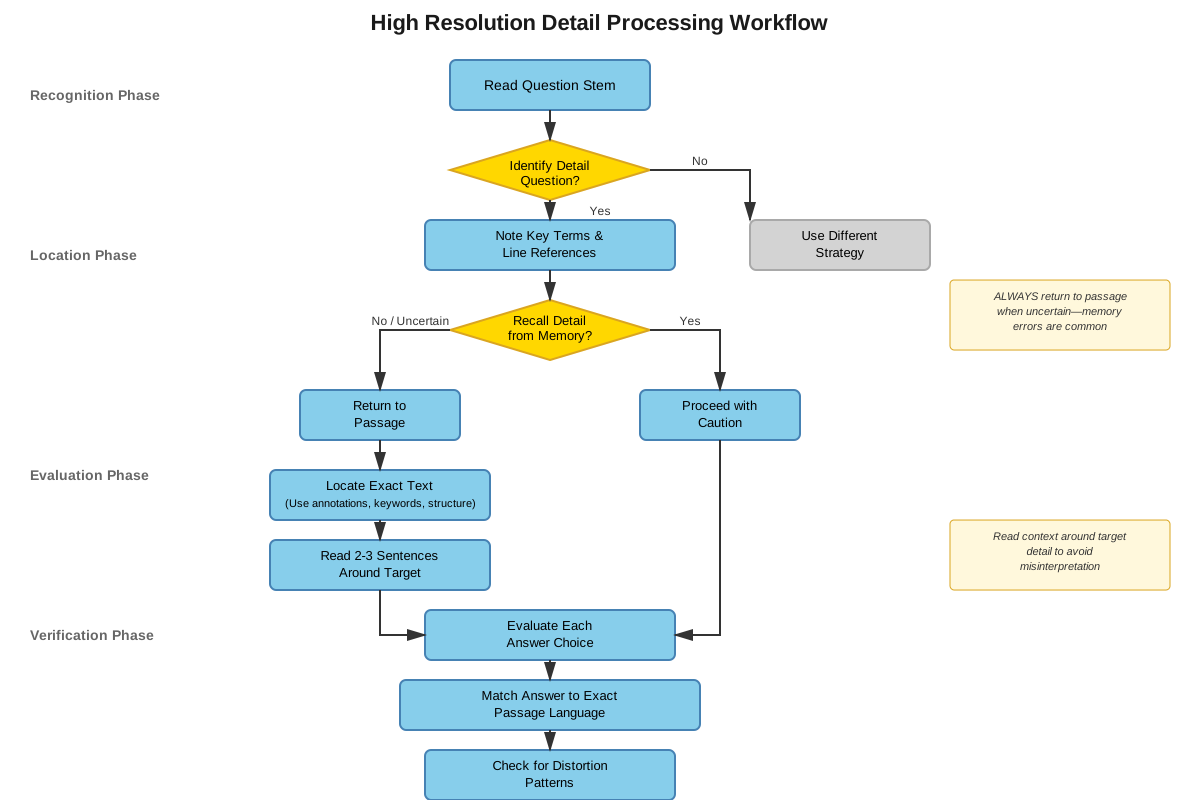
When encountering a detail question, follow this process:
- Read the question stem carefully to identify exactly what information is requested and whether it asks for stated facts or the purpose of those facts
- Return to the passage using paragraph references, line numbers, or content clues to locate the relevant section
- Read 2-3 sentences around the referenced detail to ensure full context
- Predict an answer in your own words before looking at choices
- Eliminate wrong answers systematically, checking each against the passage text
- Verify your selected answer by confirming it matches the passage without adding, subtracting, or distorting information
Trigger Words and Phrases
Detail questions typically include these phrases:
- "According to the passage..."
- "The passage states that..."
- "The author mentions X..."
- "The passage indicates..."
- "Which of the following does the passage say about..."
- "The passage provides information about..."
Purpose-of-detail questions use:
- "The author mentions X in order to..."
- "The author discusses X primarily to..."
- "The function of the reference to X is to..."
- "The author refers to X to..."
EXCEPT questions signal extra time requirements:
- "All of the following are mentioned EXCEPT..."
- "The passage discusses each of the following EXCEPT..."
Process of Elimination Tips
Eliminate answers that:
- Use absolute language ("always," "never," "only," "all") unless the passage uses equally absolute language
- Introduce information from different passage sections that doesn't answer the specific question asked
- Substitute words that shift meaning (e.g., "criticized" for "questioned," "rejected" for "doubted")
- Change scope (e.g., "some critics" becomes "most critics")
- Combine details in ways the passage doesn't
- Present reasonable inferences as if they were stated facts
Favor answers that:
- Use language closely matching passage wording (while recognizing that paraphrasing is acceptable)
- Include appropriate qualifiers matching the passage's level of certainty
- Address the specific detail or purpose the question asks about
- Can be verified by pointing to specific sentences in the passage
Time Allocation
- Standard detail questions: 45-60 seconds (including time to locate and verify)
- Purpose-of-detail questions: 60-75 seconds (require understanding both content and function)
- EXCEPT questions: 90-120 seconds (require checking multiple answer choices)
If a detail question exceeds these times, mark it and return after completing other questions. Some detail questions require extensive searching; don't let one question consume disproportionate time.
Annotation Strategy During Initial Reading
Effective annotation captures details for later retrieval:
- Underline or bracket specific examples, dates, names, and technical terms
- Mark transitions that signal important details ("for instance," "specifically," "in particular")
- Note paragraph topics in margins to enable quick location
- Circle qualifying language ("some," "most," "may," "suggests") that affects meaning
- Flag contrasts where the author presents opposing views or contradictory evidence
This annotation transforms detail questions from memory tests into efficient retrieval exercises.
Memory Techniques
The DETAILS Acronym
Remember what to track during reading:
- Dates and time periods
- Examples and illustrations
- Technical terms and definitions
- Authors, names, and proper nouns
- Important evidence and support
- Language qualifiers (some, most, may, suggests)
- Specific numbers and data
The Three-Zone Visualization
Visualize each passage as having three zones:
- High-attention zones (first and last paragraphs): Disproportionately tested; read carefully and annotate thoroughly
- Medium-attention zones (body paragraphs): Note main points and mark important details
- Reference zones (dense technical sections): Don't try to master on first reading; note location for later retrieval if questioned
This prevents getting bogged down in details during initial reading while ensuring you can find them when needed.
The Precision Mantra
Before selecting an answer to a detail question, mentally ask: "Did the passage actually say this, or am I adding information?" This simple check prevents the most common error—selecting answers that seem reasonable but aren't textually supported.
The EXCEPT Question Strategy: SCAN
- Systematically check each answer choice
- Cross out choices as you verify them in the passage
- Annotate where you found each detail
- Note the one choice you cannot locate—that's your answer
This prevents losing track of which choices you've verified in these time-consuming questions.
Summary
High resolution details represent the foundational skill of LSAT reading comprehension—the ability to identify, understand, and accurately work with specific textual information. This skill appears in 30-40% of reading comprehension questions through direct detail questions, purpose-of-detail questions, EXCEPT questions, and comparative detail questions. Success requires distinguishing explicitly stated information from reasonable inferences, maintaining precision in reading to catch subtle distortions in wrong answers, and developing efficient retrieval strategies through structural awareness and annotation. The LSAT rewards students who read with legal precision, respecting exact wording, qualifiers, and scope while avoiding the temptation to select answers that "sound right" but misrepresent textual evidence. Mastering high resolution details involves systematic verification of answer choices against passage text, recognition of common distortion patterns (scope shifts, word substitutions, temporal confusions), and integration of detail-level reading with broader structural understanding. This skill forms the foundation for all other reading comprehension abilities and directly parallels the precision required throughout the LSAT.
Key Takeaways
- High resolution details questions test your ability to locate and accurately interpret specific textual information without distortion or unsupported inference
- Always return to the passage to verify details rather than relying on memory; effective annotation during initial reading enables efficient retrieval
- Wrong answers introduce subtle distortions through scope shifts, word substitutions, temporal confusions, or combining details inappropriately
- The distinction between stated facts and reasonable inferences is critical—detail questions reward only what the passage explicitly says
- Purpose-of-detail questions require understanding both what a detail says and why the author includes it within the passage's argumentative structure
- EXCEPT questions require systematically checking each answer choice and take significantly more time than standard detail questions
- Precision in reading means respecting qualifiers, exact wording, and scope—treating "some critics" differently from "most critics" and "criticized" differently from "rejected"
Related Topics
Inference Questions: Building on high resolution details, inference questions require combining stated details with logical reasoning to reach supported conclusions. Mastering details provides the foundation for distinguishing warranted inferences from unsupported leaps.
Main Idea and Primary Purpose: While high resolution details focus on specific information, main idea questions require synthesizing multiple details into broader themes. Understanding how details support main ideas enables success on both question types.
Passage Structure and Organization: Recognizing how passages organize information (chronologically, by viewpoint, problem-solution) helps locate details efficiently and understand their argumentative function.
Comparative Reading Strategies: Comparative passages intensify detail demands by requiring tracking which passage mentions specific information. Detail skills developed on single passages transfer directly to comparative reading.
Active Reading and Annotation Techniques: These foundational skills provide the practical methods for capturing and organizing details during initial reading, making retrieval efficient when questions appear.
Practice CTA
Now that you understand high resolution details—the most frequently tested reading comprehension skill—it's time to apply this knowledge. Attempt the practice questions to experience how detail questions appear on actual LSAT passages, paying special attention to the subtle distortions in wrong answers. Use the flashcards to reinforce recognition of common detail question formats and distortion patterns. Remember: precision in reading is a skill developed through deliberate practice. Each practice question you complete with careful attention to textual verification strengthens your ability to read with the legal precision the LSAT demands. Your investment in mastering this foundational skill will pay dividends across every reading comprehension question you encounter.
Sign up free to keep reading
Create a free AnvayaPrep account to finish this LSAT guide on High resolution details — plus flashcards and practice questions.