Overview
Passage purpose is one of the most fundamental and frequently tested concepts in LSAT Reading Comprehension. Understanding passage purpose means grasping the author's primary goal or main objective in writing the passage—why the author chose to present this particular information in this particular way. This skill goes beyond simply identifying what the passage is about; it requires recognizing the author's underlying intention, whether that's to critique a theory, propose a solution, reconcile competing viewpoints, or describe a phenomenon and its implications.
Mastering LSAT passage purpose questions is essential because they appear in virtually every Reading Comprehension section, often as the first or second question following a passage. These questions typically ask test-takers to identify which answer choice best captures the author's primary objective or main point. Success on these questions provides a strong foundation for answering subsequent detail and inference questions, as understanding the passage's overall purpose helps contextualize specific claims and evidence. Students who can quickly and accurately identify passage purpose gain a significant strategic advantage, as this understanding serves as an anchor for navigating more complex question types.
Within the broader framework of passage fundamentals in reading comprehension, passage purpose represents the highest level of comprehension—the ability to synthesize all the passage's components into a coherent understanding of authorial intent. This skill connects directly to identifying main points, recognizing passage structure, understanding tone and attitude, and distinguishing between primary and secondary purposes. While other passage fundamental skills focus on the "what" and "how" of a passage, passage purpose addresses the crucial "why," making it an indispensable tool for achieving top scores on the LSAT.
Learning Objectives
- [ ] Identify how Passage purpose appears in LSAT questions
- [ ] Explain the reasoning pattern behind Passage purpose
- [ ] Apply Passage purpose to solve LSAT-style problems accurately
- [ ] Distinguish between primary purpose and secondary purposes within a passage
- [ ] Recognize common passage purpose categories and their characteristic features
- [ ] Evaluate answer choices by identifying scope errors, tone mismatches, and detail-level distractors
- [ ] Synthesize passage structure, main point, and authorial attitude to determine overall purpose
Prerequisites
- Basic reading comprehension skills: The ability to understand complex academic prose is fundamental to identifying what an author intends to accomplish.
- Familiarity with LSAT passage structure: Understanding how LSAT passages are organized (introduction, development, conclusion) helps locate purpose indicators.
- Recognition of common argument patterns: Knowing how authors typically structure arguments aids in predicting and identifying their purposes.
- Understanding of tone and attitude: An author's purpose is closely tied to their attitude toward the subject matter, making tone recognition essential.
Why This Topic Matters
Passage purpose questions represent approximately 15-20% of all LSAT Reading Comprehension questions, making them one of the most frequently tested question types. These questions appear in multiple forms: "The primary purpose of the passage is to...," "The author's main objective in writing this passage is to...," "Which one of the following most accurately expresses the main point of the passage?" Understanding passage purpose is not merely about answering these specific questions correctly—it fundamentally improves performance across all question types by providing a framework for understanding the passage as a whole.
In real-world legal practice, identifying the purpose of legal documents, judicial opinions, and scholarly articles is a daily necessity. Lawyers must quickly grasp whether a brief is arguing for a new interpretation of law, whether a judicial opinion is narrowing or expanding precedent, or whether a legal scholar is critiquing existing doctrine or proposing reform. The LSAT tests this skill because it directly translates to the analytical reading required in law school and legal practice.
On the exam, passage purpose manifests in several common ways: passages that argue for a particular position, passages that describe and evaluate competing theories, passages that trace the historical development of an idea, passages that analyze the implications of a phenomenon, and passages that reconcile apparent contradictions. Recognizing these patterns allows test-takers to anticipate the types of purposes they'll encounter and develop efficient strategies for identifying them quickly and accurately.
Core Concepts
Defining Passage Purpose
Passage purpose refers to the author's primary reason for writing the passage—the overarching goal that unifies all the passage's components. Unlike the main point, which states what the author wants readers to understand, the purpose describes what the author is trying to accomplish. For example, a passage might have a main point that "Theory X better explains phenomenon Y than Theory Z," while its purpose is "to argue for the superiority of one theory over another." The purpose operates at a higher level of abstraction, capturing the author's rhetorical intention.
Identifying passage purpose requires synthesizing multiple elements: the passage's structure, the author's tone and attitude, the types of evidence presented, and the relationship between different parts of the passage. An author who presents a theory, then systematically addresses counterarguments, is likely arguing for that theory's validity. An author who presents multiple perspectives with neutral language is likely describing or explaining rather than advocating.
Common Passage Purpose Categories
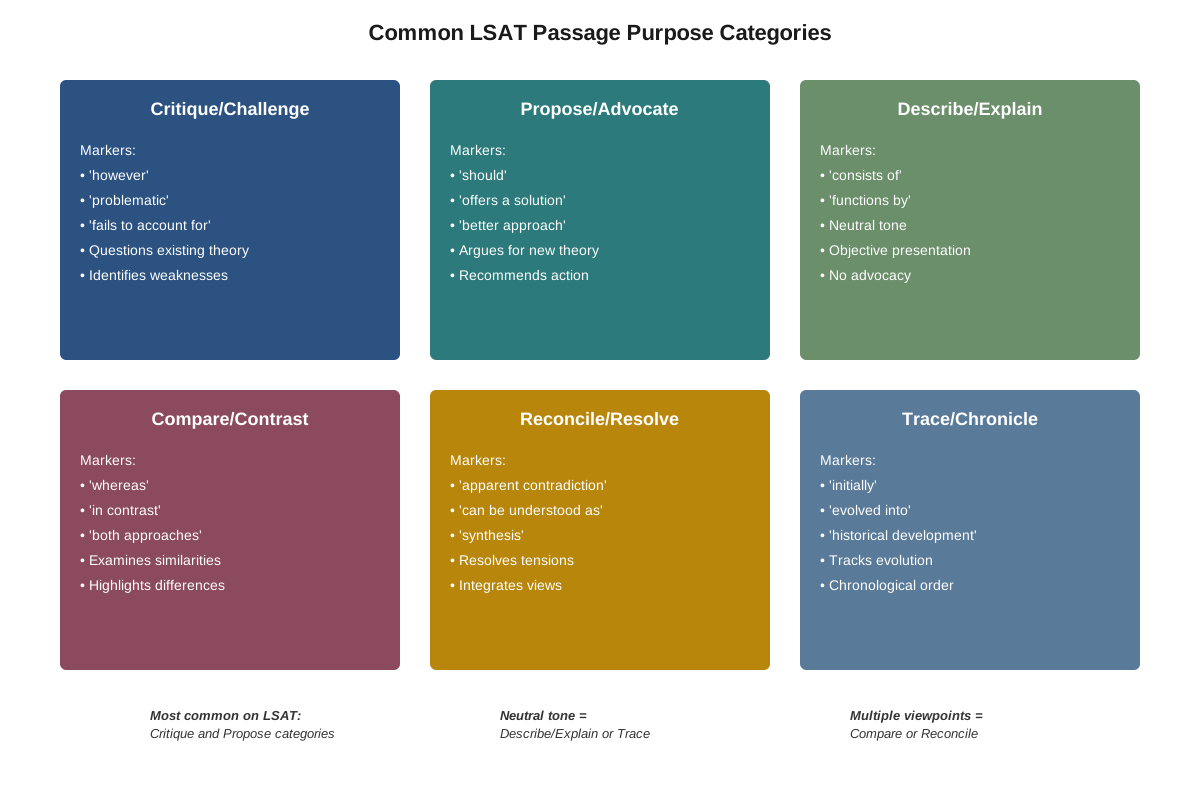
LSAT passages typically fall into several recognizable purpose categories, each with characteristic features:
| Purpose Category | Characteristics | Common Indicators |
|---|---|---|
| Argue/Advocate | Author takes a clear position; presents evidence supporting one view | "However," "in fact," "demonstrates," evaluative language |
| Describe/Explain | Neutral presentation of information; educational tone | "consists of," "involves," "can be understood as" |
| Critique/Challenge | Author identifies flaws in existing theory or practice | "fails to account for," "overlooks," "problematic" |
| Reconcile/Resolve | Author addresses apparent contradiction or competing views | "although," "can be reconciled," "both perspectives" |
| Trace/Analyze Development | Historical or conceptual evolution of an idea | Chronological markers, "initially," "subsequently" |
| Propose Solution | Author identifies problem and suggests remedy | "should," "would improve," "alternative approach" |
Primary vs. Secondary Purposes
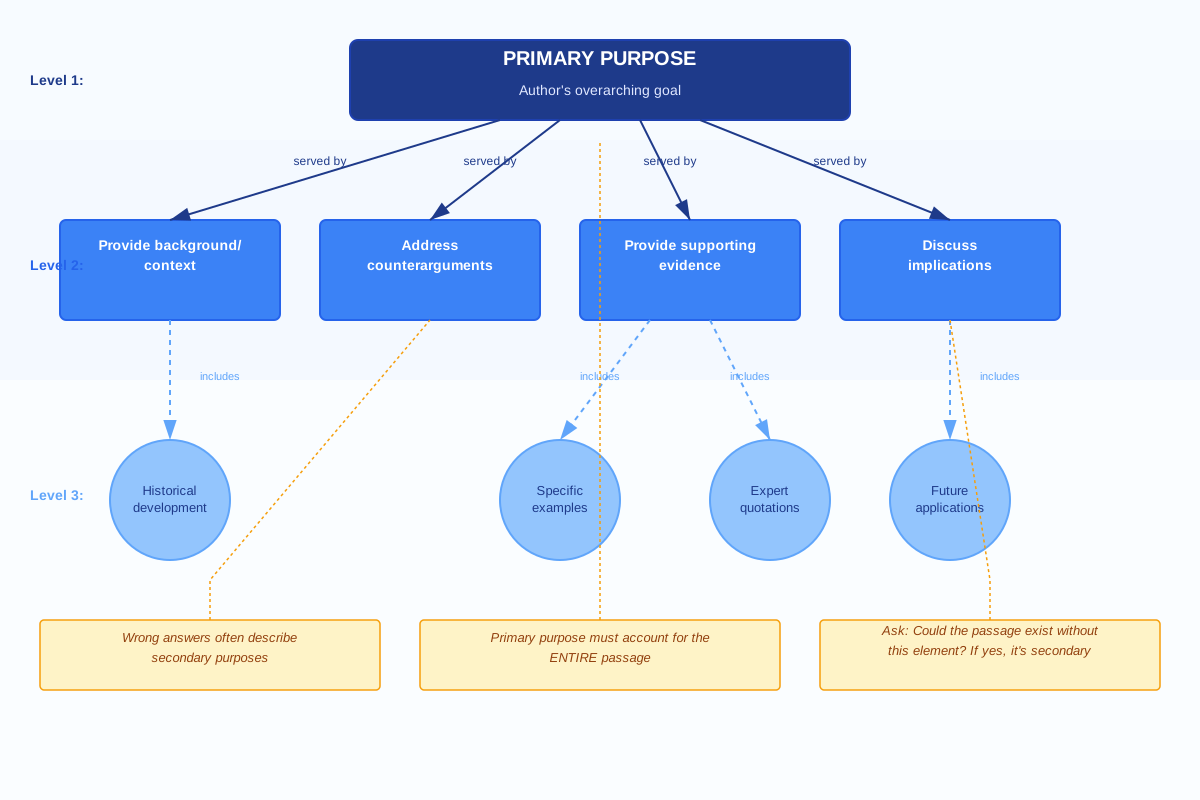
A crucial distinction in LSAT passage purpose questions involves differentiating between primary and secondary purposes. Most passages accomplish multiple objectives, but only one represents the author's main goal. For example, a passage might describe a scientific phenomenon (secondary purpose) in order to argue that current explanations are inadequate (primary purpose). The primary purpose encompasses the entire passage and represents the author's ultimate objective, while secondary purposes serve the primary purpose.
Test-takers often select wrong answers that identify real but secondary purposes. A passage arguing for a new interpretation of historical events might begin by describing those events, but "to describe historical events" would be too narrow and miss the argumentative purpose. The key is asking: "What is the author's ultimate goal? What does everything in the passage work toward?"
Structural Indicators of Purpose
Passage structure provides critical clues to purpose. The opening paragraph typically introduces the topic and hints at the author's approach. Middle paragraphs develop the author's argument, explanation, or analysis. The concluding paragraph often reinforces the primary purpose, sometimes explicitly stating the author's main objective.
Specific structural patterns correlate with specific purposes:
- Problem-Solution Structure: Indicates a purpose of proposing or evaluating solutions
- Thesis-Support Structure: Indicates an argumentative or advocacy purpose
- Chronological Structure: Often indicates a purpose of tracing development or explaining evolution
- Compare-Contrast Structure: May indicate purposes of evaluation, reconciliation, or arguing for superiority
- Question-Answer Structure: Typically indicates an explanatory or analytical purpose
Tone and Attitude as Purpose Indicators
An author's tone—the emotional quality of their language—and attitude—their stance toward the subject—are powerful indicators of purpose. Neutral, objective language suggests descriptive or explanatory purposes. Evaluative language ("unfortunately," "remarkably," "fails to") signals argumentative or critical purposes. Tentative language ("may," "suggests," "possibly") might indicate a purpose of proposing a hypothesis or exploring possibilities.
Consider these examples:
- "The theory adequately explains most observations" (neutral/descriptive)
- "The theory fails to account for crucial evidence" (critical/argumentative)
- "The theory represents a significant advance" (positive/evaluative)
Each tone suggests a different purpose: explaining, critiquing, or advocating, respectively.
Scope and Level of Generality
Correct passage purpose answers match the passage's scope—neither too broad nor too narrow. An answer that's too specific might describe one paragraph's function rather than the entire passage's purpose. An answer that's too broad might apply to many passages on similar topics but miss what makes this particular passage unique.
For instance, if a passage argues that a specific legal doctrine should be reformed, the purpose is not merely "to discuss legal doctrine" (too broad) or "to describe a court case" (too narrow if that case is just supporting evidence), but rather "to argue for reform of a specific legal doctrine" (appropriately scoped).
Concept Relationships
The concepts within passage purpose form an interconnected system where each element informs the others. Passage structure provides the framework through which purpose manifests—the way an author organizes information reveals their intention. Tone and attitude color this structure, indicating whether the author is neutral or partisan, which directly impacts purpose identification. Primary and secondary purposes exist in a hierarchical relationship, where secondary purposes serve and support the primary purpose.
These internal relationships connect to broader passage fundamentals: Understanding main point is closely related to but distinct from understanding purpose—the main point states the author's central claim, while purpose describes why the author is making that claim. Passage structure analysis feeds directly into purpose identification, as structural patterns correlate with specific purposes. Author's tone and viewpoint are inseparable from purpose, as an author's attitude toward their subject shapes their rhetorical goals.
The relationship map flows as follows: Passage Structure → reveals → Organizational Pattern → suggests → Purpose Category ← supported by ← Tone and Attitude ← expressed through ← Word Choice and Emphasis. All these elements converge on Primary Purpose, which then serves as the foundation for answering not just purpose questions but also main point, organization, and function questions.
Quick check — test yourself on Passage purpose so far.
Try Flashcards →High-Yield Facts
⭐ Passage purpose questions appear in approximately 15-20% of all LSAT Reading Comprehension questions, making them one of the most frequently tested question types.
⭐ The primary purpose encompasses the entire passage, while secondary purposes serve specific sections or support the primary purpose.
⭐ Common wrong answer types include: too narrow (describing one paragraph), too broad (applying to many passages), wrong tone (mismatching author's attitude), and detail-level (focusing on supporting evidence rather than overall purpose).
⭐ Structural patterns reliably indicate purpose: problem-solution suggests proposing remedies, thesis-support indicates argumentation, and compare-contrast often signals evaluation.
⭐ The author's tone—neutral, critical, enthusiastic, tentative—is one of the strongest indicators of purpose and helps eliminate wrong answers with mismatched attitudes.
- Purpose questions often use phrases like "primary purpose," "main objective," "primarily concerned with," and "main point of the passage."
- The correct answer to a purpose question should be supportable by multiple paragraphs, not just one section of the passage.
- Authors rarely state their purpose explicitly; test-takers must infer it from structure, tone, and content.
- Passages with multiple viewpoints typically have purposes related to comparing, contrasting, reconciling, or evaluating those viewpoints.
- The opening and closing paragraphs are particularly rich sources of purpose indicators, as authors often frame and reinforce their objectives in these locations.
- Descriptive passages (explaining how something works) differ fundamentally from argumentative passages (claiming something should be believed or done), and this distinction is crucial for purpose identification.
- When two answer choices seem close, the one that better captures the author's attitude and matches the passage's scope is typically correct.
Common Misconceptions
Misconception: The passage purpose is the same as the passage topic.
Correction: The topic is what the passage is about (subject matter), while the purpose is why the author wrote about that topic (the author's goal). A passage about climate change might have a purpose of arguing for policy changes, critiquing scientific methods, or explaining a phenomenon—same topic, different purposes.
Misconception: The purpose is always stated explicitly in the passage.
Correction: Authors rarely announce their purpose directly. Test-takers must infer purpose from structural clues, tone, emphasis, and the relationship between passage components. The purpose must be deduced through careful analysis of how the author presents information.
Misconception: If an answer choice describes something the passage does, it must be the correct purpose.
Correction: Passages accomplish many things, but only one represents the primary purpose. A passage might describe a theory, present evidence, and argue for a conclusion—but if the ultimate goal is argumentation, "to describe a theory" would be incorrect despite being something the passage does.
Misconception: Longer, more complex answer choices are more likely to be correct.
Correction: LSAC often uses complexity and sophisticated language in wrong answers to make them appear authoritative. The correct answer is typically clear, direct, and accurately captures the passage's scope and tone without unnecessary complexity.
Misconception: The purpose can be determined from reading only the first and last paragraphs.
Correction: While opening and closing paragraphs provide important clues, the middle paragraphs reveal how the author develops their purpose. A passage might introduce a topic neutrally but then critique it extensively—reading only the introduction would miss the critical purpose.
Misconception: All passages have argumentative purposes.
Correction: LSAT passages serve various purposes: some argue, some explain, some describe, some reconcile. Assuming every passage is argumentative leads to selecting answers with inappropriate tones (like "advocate" or "critique") for passages that are actually descriptive or explanatory.
Worked Examples
Example 1: Argumentative Passage
Passage Summary: A passage discusses traditional theories of language acquisition, then presents evidence that these theories inadequately explain certain phenomena. The author introduces an alternative theory and shows how it better accounts for the evidence. The tone is measured but clearly favors the alternative theory.
Question: The primary purpose of the passage is to:
Answer Choices:
(A) describe the historical development of language acquisition theories
(B) argue that an alternative theory better explains language acquisition than traditional theories
(C) present evidence about language acquisition
(D) explain how children acquire language
(E) reconcile competing theories of language acquisition
Analysis:
Step 1: Identify the passage structure. The passage follows a thesis-support pattern: traditional theories are inadequate → alternative theory is superior → evidence supports this claim.
Step 2: Assess the author's tone. The language is evaluative ("inadequately explain," "better accounts for"), indicating an argumentative rather than neutral descriptive purpose.
Step 3: Determine scope. The passage focuses specifically on comparing theories and advocating for one, not merely describing or explaining.
Step 4: Evaluate each answer:
- (A) is too narrow and misses the argumentative purpose—the passage isn't primarily historical
- (B) matches the structure, tone, and scope—this is argumentative and encompasses the whole passage
- (C) is too narrow—presenting evidence is a means to the argumentative end, not the purpose itself
- (D) is too broad and misses the comparative, argumentative nature
- (E) is incorrect in tone—the author isn't reconciling but rather advocating for one theory over others
Correct Answer: (B) captures the primary purpose by identifying the argumentative nature, the comparative structure, and the appropriate scope.
Example 2: Descriptive-Analytical Passage
Passage Summary: A passage explains how a particular legal doctrine developed over time, describing key court cases and showing how judicial interpretation evolved. The author maintains a neutral tone throughout, neither praising nor criticizing the doctrine's development.
Question: The author's main objective in the passage is to:
Answer Choices:
(A) critique the current application of a legal doctrine
(B) trace the historical development of a legal doctrine
(C) argue for reform of a legal doctrine
(D) describe a specific court case
(E) reconcile conflicting judicial interpretations
Analysis:
Step 1: Identify the passage structure. The passage follows a chronological structure, moving through time and showing evolution.
Step 2: Assess the author's tone. The language is neutral and explanatory, without evaluative terms suggesting criticism or advocacy.
Step 3: Determine scope. The passage covers the doctrine's development over time, not just one case or one aspect.
Step 4: Evaluate each answer:
- (A) mismatches the tone—the passage is neutral, not critical
- (B) matches the chronological structure, neutral tone, and appropriate scope
- (C) mismatches the tone—there's no advocacy or prescriptive language
- (D) is too narrow—specific cases are discussed as part of the larger developmental story
- (E) doesn't match the structure—the passage traces development rather than resolving conflicts
Correct Answer: (B) accurately captures the descriptive-analytical purpose with appropriate scope and tone.
Exam Strategy
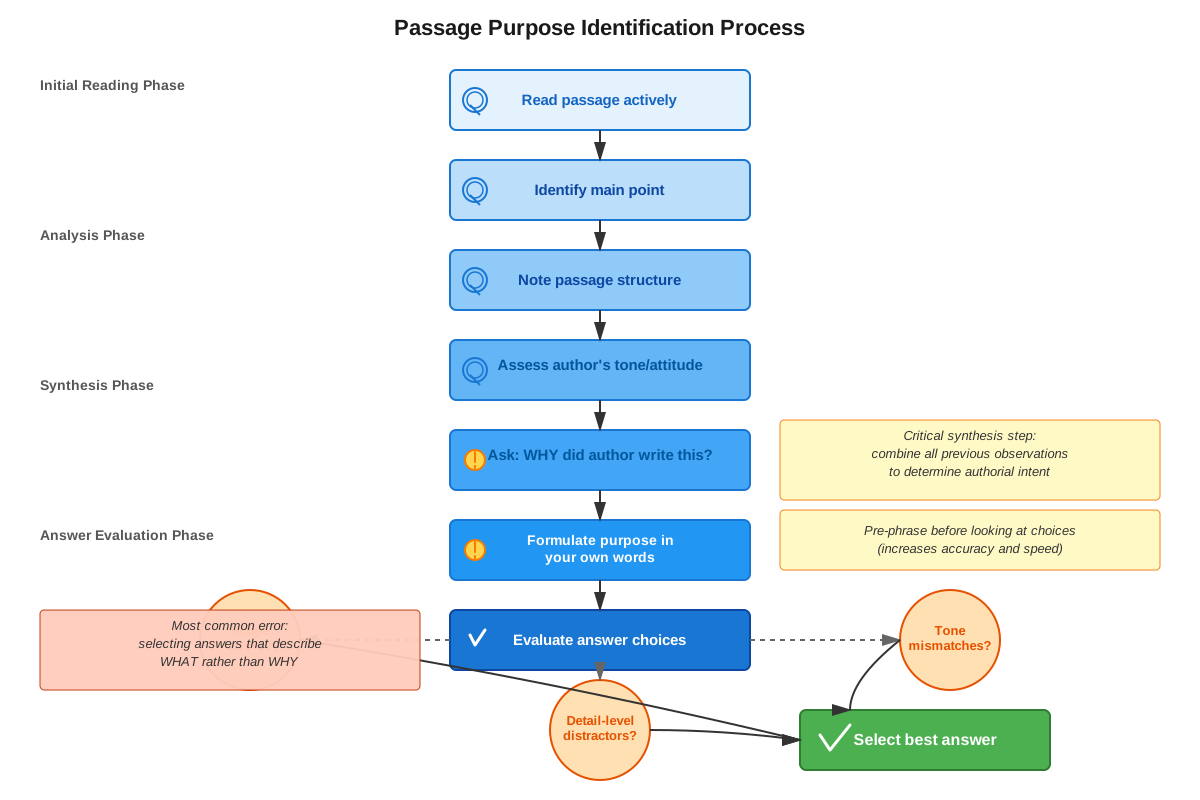
When approaching passage purpose questions on the LSAT, implement this systematic strategy:
Before Reading Answer Choices:
- After reading the passage, articulate the purpose in your own words: "The author is trying to [verb] [object]"
- Identify the passage's structure (problem-solution, thesis-support, chronological, etc.)
- Note the author's tone (neutral, critical, enthusiastic, tentative)
- Distinguish what the passage is about (topic) from what the author is trying to accomplish (purpose)
Trigger Words to Watch For:
- Question stems: "primary purpose," "main objective," "primarily concerned with," "main point"
- In passages: "however" (signals shift to author's view), "in fact" (emphasis), "unfortunately/remarkably" (evaluative tone), "should/must" (prescriptive purpose)
- In answer choices: verbs like "argue," "describe," "critique," "reconcile," "trace," "propose"
Process of Elimination Strategy:
- Eliminate scope errors first: Remove answers that are too narrow (one paragraph's function) or too broad (could apply to many passages)
- Eliminate tone mismatches: Remove answers suggesting argumentation when the passage is neutral, or neutrality when the passage is evaluative
- Eliminate detail-level answers: Remove answers that describe supporting evidence or secondary purposes rather than the overarching goal
- Between two close answers: Choose the one that better captures the author's attitude and encompasses more of the passage
Time Allocation:
Purpose questions should take 30-45 seconds once you've read the passage thoroughly. If you've identified the purpose while reading (which you should), these questions become quick confidence-builders. Don't spend excessive time on them—your initial understanding is usually correct.
Exam Tip: The correct answer to a purpose question should feel like it "covers" the entire passage. If you can point to significant portions of the passage that don't serve the stated purpose, that answer is likely wrong.
Memory Techniques
PASSAGE Acronym for Purpose Analysis:
- Pattern: What structural pattern does the passage follow?
- Attitude: What's the author's attitude toward the subject?
- Scope: Does the answer cover the whole passage?
- Secondary: Am I confusing secondary purposes with primary purpose?
- Action: What action verb best describes what the author is doing?
- Goal: What's the author's ultimate goal?
- Evidence: Does the evidence support this purpose?
The "Why?" Technique:
After reading each paragraph, ask "Why did the author include this?" The answer to this question for the passage as a whole is the purpose. Practice this technique to develop intuition for purpose identification.
Verb Visualization:
Associate common purpose categories with specific verbs and visualize the action:
- Argue/Advocate: Picture a lawyer making a case
- Describe/Explain: Picture a teacher at a blackboard
- Critique: Picture a reviewer pointing out flaws
- Reconcile: Picture someone bringing opposing sides together
- Trace: Picture following a path through time
Tone-Purpose Connection:
Remember: Neutral tone = Descriptive/Explanatory purpose; Evaluative tone = Argumentative/Critical purpose. This simple connection eliminates many wrong answers quickly.
Summary
Passage purpose represents the author's primary objective in writing—the overarching goal that unifies all passage components. Mastering this concept requires synthesizing passage structure, authorial tone, scope, and the relationship between primary and secondary purposes. LSAT passages typically fall into recognizable purpose categories: arguing for a position, describing or explaining phenomena, critiquing existing theories, reconciling competing views, tracing historical development, or proposing solutions. Success on purpose questions depends on distinguishing the author's ultimate goal from the topic, main point, and secondary purposes. Structural patterns provide crucial clues: problem-solution structures suggest remedial purposes, thesis-support patterns indicate argumentation, and chronological organization often signals developmental or explanatory purposes. The author's tone—whether neutral, critical, or enthusiastic—powerfully indicates purpose and helps eliminate wrong answers with mismatched attitudes. Common wrong answers include those that are too narrow (describing one paragraph), too broad (applying to many passages), tone-mismatched, or detail-focused. Effective strategy involves articulating the purpose before reading answer choices, eliminating scope and tone errors first, and selecting answers that encompass the entire passage while matching the author's attitude.
Key Takeaways
- Passage purpose describes why the author wrote the passage—the author's primary objective—not merely what the passage is about
- Purpose questions appear in 15-20% of Reading Comprehension questions and provide a framework for understanding the entire passage
- Common purpose categories include: argue/advocate, describe/explain, critique/challenge, reconcile/resolve, trace development, and propose solutions
- Passage structure and author's tone are the two most reliable indicators of purpose; neutral tone suggests descriptive purposes while evaluative tone suggests argumentative purposes
- The correct answer must encompass the entire passage, match the author's attitude, and capture the primary rather than secondary purposes
- Wrong answers typically fail by being too narrow, too broad, tone-mismatched, or focused on details rather than overall purpose
- Articulate the purpose in your own words before reading answer choices to avoid being swayed by sophisticated but incorrect options
Related Topics
Main Point Identification: While closely related to passage purpose, main point questions ask for the author's central claim rather than their objective. Mastering purpose helps identify main points, as the main point typically serves the passage's purpose.
Passage Structure and Organization: Understanding how passages are organized provides the framework for identifying purpose. Structure questions often test whether students recognize how the passage's organization serves its purpose.
Author's Tone and Attitude: The author's emotional stance and perspective toward the subject matter directly indicate purpose. Tone questions test similar analytical skills to purpose questions.
Function Questions: These ask about the role of specific paragraphs or sentences within the passage. Understanding overall purpose helps determine how individual components function to serve that purpose.
Comparative Reading: In comparative passages, identifying each passage's purpose and how the purposes relate is crucial for answering relationship questions.
Practice CTA
Now that you've mastered the fundamentals of passage purpose, it's time to apply these concepts to actual LSAT passages. Work through the practice questions and flashcards to reinforce your understanding and develop the quick recognition skills necessary for test day. Remember: identifying passage purpose isn't just about answering one question type—it's about building a framework that improves your performance across all Reading Comprehension questions. Each practice passage you analyze strengthens your ability to quickly synthesize structure, tone, and content into a clear understanding of authorial intent. You've learned the concepts; now make them automatic through deliberate practice!
Sign up free to keep reading
Create a free AnvayaPrep account to finish this LSAT guide on Passage purpose — plus flashcards and practice questions.