Overview
Function questions represent one of the most frequently tested reading comprehension question types on the LSAT, appearing in nearly every Reading Comprehension section. These questions ask test-takers to identify the rhetorical purpose or role that a specific portion of the passage serves within the author's overall argument or presentation. Rather than asking what the passage says (a content question), function questions ask why the author included a particular detail, example, paragraph, or statement—what work it performs in the passage's structure.
Mastering LSAT function questions is essential because they test a sophisticated level of reading comprehension that goes beyond surface-level understanding. These questions require students to step back from the content itself and analyze the passage's architecture: How does each component contribute to the author's purpose? Is a particular sentence providing evidence, raising an objection, introducing a contrast, or illustrating a concept? This meta-level analysis mirrors the analytical thinking required throughout law school and legal practice, where understanding the function of arguments and evidence is paramount.
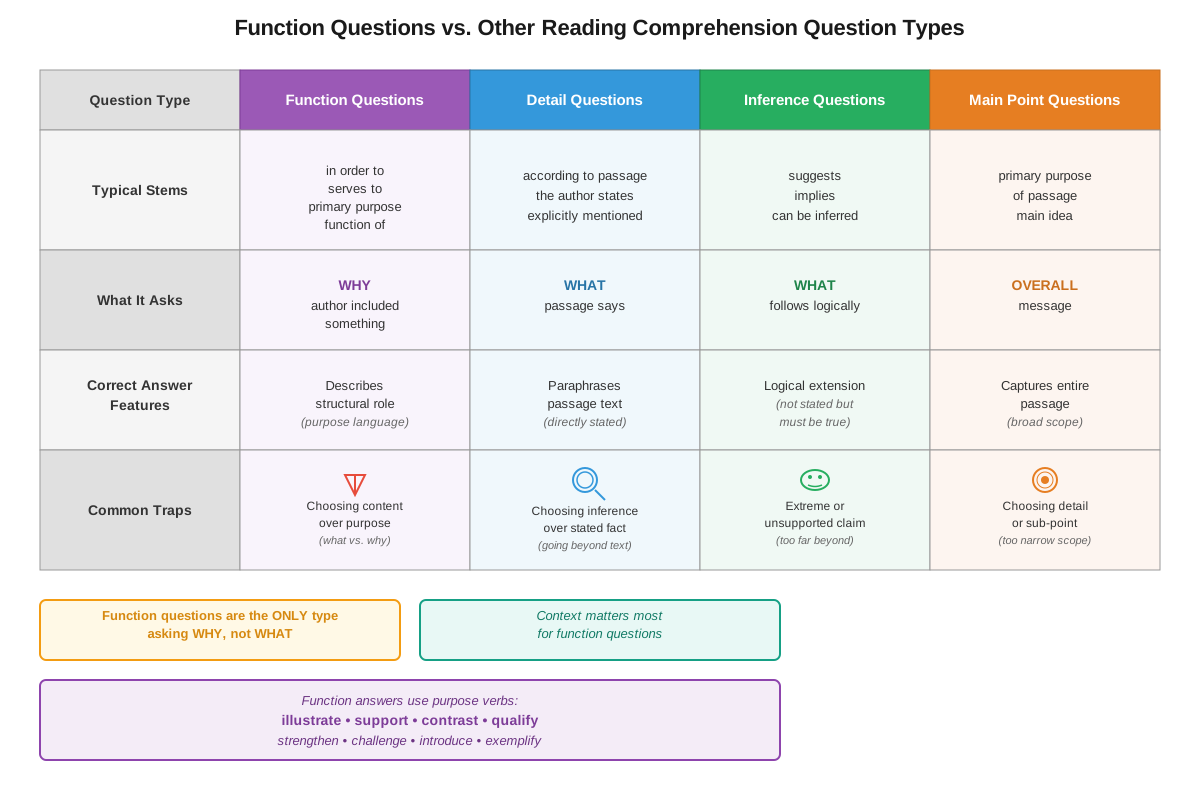
Within the broader landscape of reading comprehension on the LSAT, function questions occupy a middle ground between detail questions (which test recall of specific information) and main point questions (which test global understanding). They connect intimately to structure questions and require the same passage mapping skills that successful test-takers develop for all reading comprehension question types. Understanding function questions also enhances performance on other question types because recognizing how passage components work together deepens overall comprehension and makes wrong answer choices more transparent.
Learning Objectives
- [ ] Identify how Function questions appears in LSAT questions
- [ ] Explain the reasoning pattern behind Function questions
- [ ] Apply Function questions to solve LSAT-style problems accurately
- [ ] Distinguish function questions from other reading comprehension question types based on question stem language
- [ ] Analyze passage structure to predict likely function question targets before reading the questions
- [ ] Evaluate answer choices by matching rhetorical purpose to textual evidence
- [ ] Synthesize understanding of local function with global passage structure
Prerequisites
- Basic passage comprehension skills: Ability to understand the literal meaning of complex academic prose, as function questions require first understanding what the text says before analyzing why it's there
- Familiarity with argument structure: Recognition of premises, conclusions, evidence, and counterarguments, since function questions often ask about these argumentative components
- Understanding of passage mapping techniques: Ability to track the flow of ideas through a passage, which provides the framework for understanding how individual parts function within the whole
- Knowledge of common rhetorical moves: Awareness of how authors use examples, analogies, contrasts, and qualifications to build arguments
Why This Topic Matters
Function questions appear with remarkable consistency on the LSAT, typically comprising 15-25% of all Reading Comprehension questions. In a standard Reading Comprehension section with 27 questions across four passages, students can expect to encounter 4-7 function questions. This frequency alone makes mastery essential for achieving a competitive score.
Beyond test frequency, function questions assess critical reading skills that directly translate to law school success. Legal education requires constant analysis of how arguments are constructed: Why did the judge cite this precedent? What role does this statutory interpretation play in the opinion? How does this piece of evidence support the attorney's theory? Function questions train precisely this analytical mindset.
On the LSAT, function questions commonly appear in several predictable patterns. They frequently target examples that illustrate abstract concepts, asking students to identify what principle the example demonstrates. They often focus on contrasts or comparisons, requiring recognition that the author is distinguishing between two theories or highlighting a difference. They regularly test understanding of how evidence supports claims, asking why the author mentions a particular study or statistic. Finally, they commonly address structural elements like introductory paragraphs, transitional sentences, or concluding remarks, asking students to recognize how these components organize the passage's flow.
The real-world significance extends beyond law school. Professional reading in any field requires understanding not just what a document says but how it's constructed and why. Function questions develop the analytical reading skills that distinguish sophisticated readers from those who merely decode words.
Core Concepts
Defining Function Questions
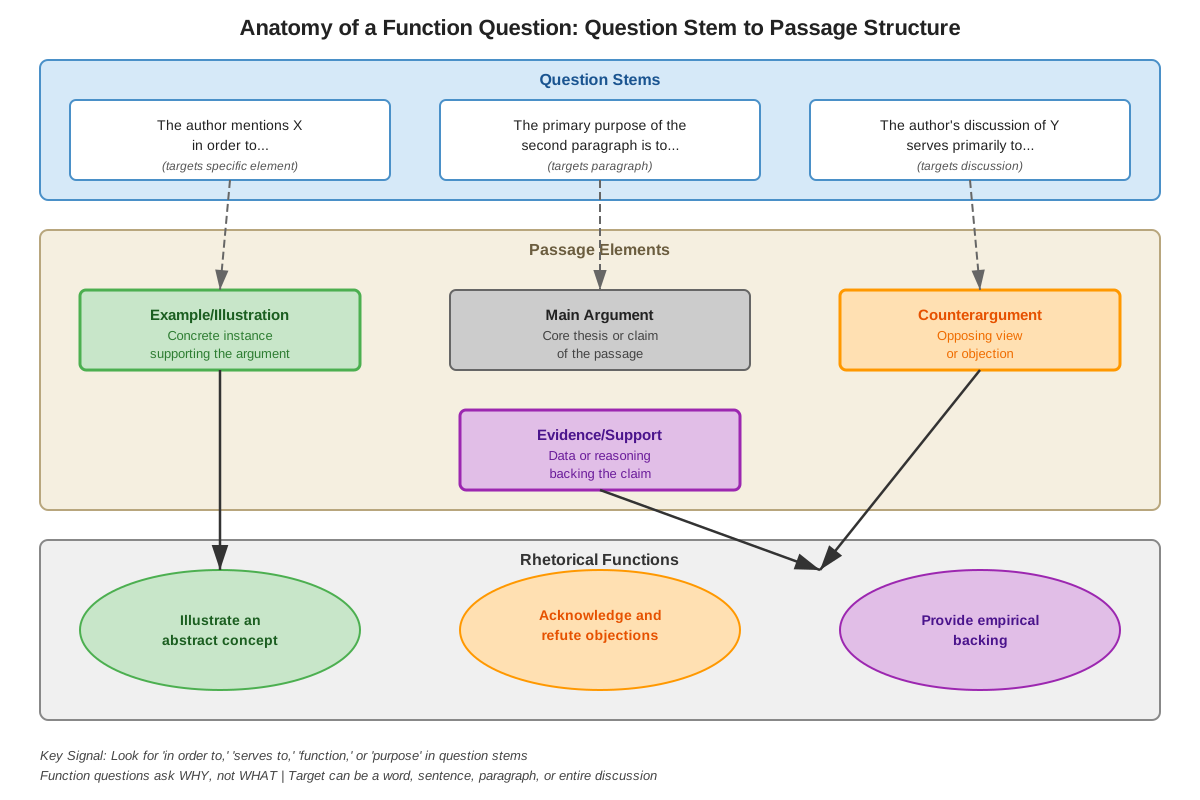
Function questions ask test-takers to identify the rhetorical purpose or structural role of a specific passage element. The defining characteristic is that these questions focus on why something appears in the passage rather than what it says. The question stem typically includes phrases like "in order to," "serves to," "functions to," or "the author mentions X primarily to."
The scope of function questions can vary considerably. Some target a single word or phrase, asking why the author chose particular language. Others focus on a sentence or two, asking what role those sentences play. Still others address entire paragraphs, requiring understanding of how a large passage section contributes to the overall structure. Regardless of scope, all function questions share the same fundamental task: identifying purpose within context.
Common Question Stem Formulations
Recognizing function questions quickly and accurately is the first step to answering them correctly. The LSAT uses several standard formulations:
- "The author mentions X in order to..."
- "The primary function of the second paragraph is to..."
- "The author's discussion of X serves primarily to..."
- "Which one of the following best describes the function of the third paragraph?"
- "The author refers to X most likely in order to..."
- "The example in lines 15-18 functions primarily to..."
Each formulation signals the same task: analyze purpose, not content. The word "primarily" appears frequently because passage elements often serve multiple purposes, and students must identify the most important or central function.
The Relationship Between Local and Global Function
Understanding function requires operating on two levels simultaneously. Local function refers to the immediate purpose of a passage element within its surrounding context—how a sentence relates to the sentences around it. Global function refers to how that element contributes to the passage's overall purpose or main point.
Effective function question analysis moves between these levels. A sentence might locally provide an example of a concept just introduced, but globally it might support the author's argument against a competing theory. Strong answer choices typically capture both levels, while wrong answers often describe only local function or mischaracterize global function.
Categories of Rhetorical Functions
Passage elements serve predictable rhetorical purposes. Understanding these categories helps both in predicting function questions and in evaluating answer choices:
| Function Category | Purpose | Common Indicators |
|---|---|---|
| Illustration/Example | Demonstrate an abstract concept with a concrete instance | "For example," "For instance," "Consider," specific cases following general principles |
| Evidence/Support | Provide data, studies, or facts that substantiate a claim | "Studies show," "Research indicates," citations, statistics |
| Contrast/Distinction | Highlight differences between theories, approaches, or phenomena | "However," "In contrast," "Unlike," "On the other hand" |
| Concession | Acknowledge a limitation or opposing viewpoint before refuting or qualifying it | "Although," "While it is true that," "Admittedly" |
| Elaboration/Explanation | Expand on or clarify a previously stated idea | "That is," "In other words," "More specifically" |
| Introduction/Context | Establish background or frame the discussion | Opening paragraphs, historical background, definitions |
| Qualification/Nuance | Add complexity or limit the scope of a claim | "To some extent," "In certain cases," "With some exceptions" |
The Structure-Function Connection
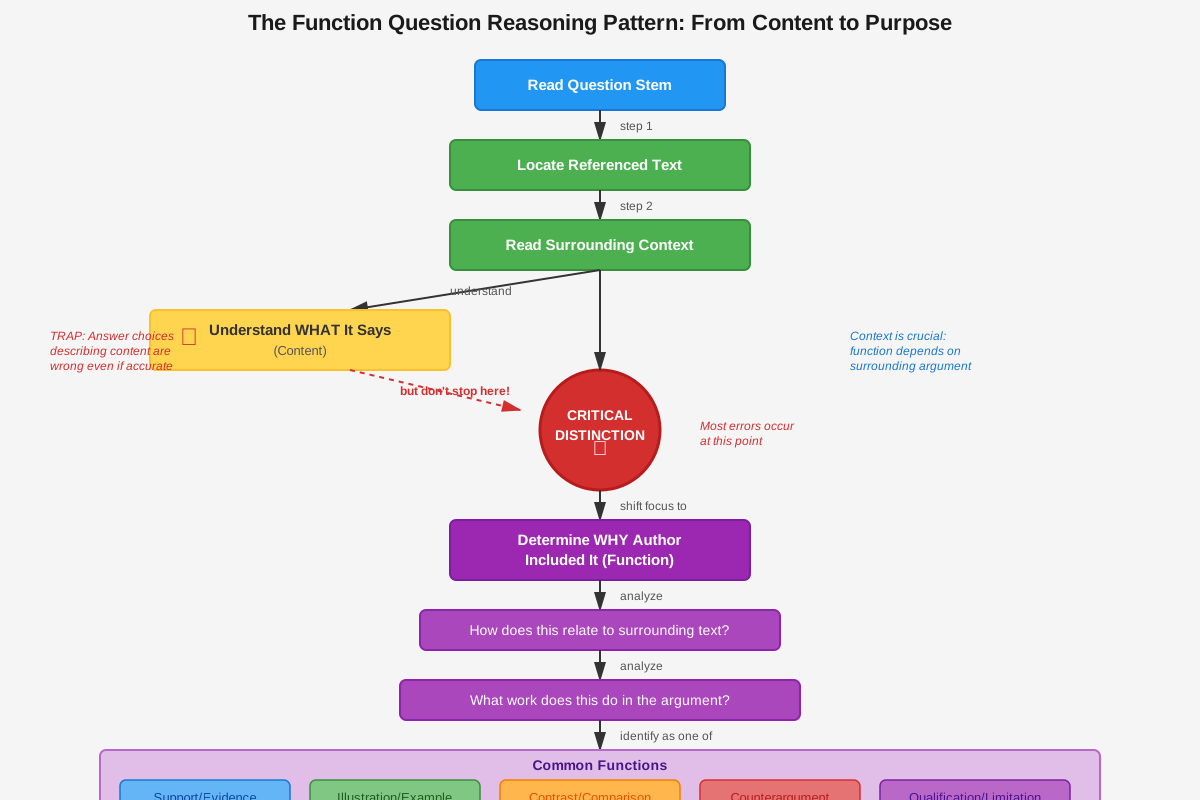
Function questions test understanding of passage structure. Authors construct passages with deliberate architecture, and each component plays a role in that structure. Successful test-takers develop the habit of asking "Why is the author telling me this?" as they read.
Common structural patterns include:
- Problem-Solution: Passage introduces a problem or puzzle, then presents one or more proposed solutions. Function questions might ask about the role of the problem description (establishing the need for solutions) or about competing solutions (presenting alternatives to be evaluated).
- Theory-Evidence: Passage presents a theory or hypothesis, then provides supporting evidence. Function questions often target the evidence, asking students to recognize its supporting role.
- Comparison-Contrast: Passage examines two or more approaches, theories, or phenomena, highlighting similarities and differences. Function questions frequently ask about the purpose of discussing one element (to contrast with another).
- Chronological Development: Passage traces historical development or evolution of ideas. Function questions might ask about earlier stages (providing context for current understanding) or later stages (showing consequences of earlier developments).
Wrong Answer Patterns in Function Questions
Understanding how wrong answers are constructed is as important as recognizing correct answers. Function questions feature predictable wrong answer types:
Content-focused answers describe what the passage says rather than why it says it. If a passage mentions a 1995 study showing increased efficiency, a content-focused wrong answer might say "to indicate that efficiency increased in 1995" rather than the correct function-focused answer "to provide evidence supporting the author's claim about technological improvements."
Scope errors mischaracterize the breadth of the function. An answer might claim a sentence "proves" something when it merely "suggests" it, or state that a paragraph "introduces the passage's main argument" when it only introduces one component of that argument.
Reversal errors flip the actual function, perhaps claiming the author mentions something to support a view when the author actually mentions it to criticize that view.
Misplaced function answers describe a function that appears elsewhere in the passage but not in the referenced location.
Too-specific or too-general answers operate at the wrong level of abstraction, either focusing on minor details of the function or describing it so broadly that the answer becomes vague and unhelpful.
Concept Relationships
Function questions exist within an interconnected web of reading comprehension skills. At the foundation lies basic passage comprehension—students must understand what the passage says before analyzing why it says it. This literal understanding enables structural analysis, the recognition of how passage components relate to each other. Structural analysis, in turn, supports function identification, the ability to articulate the purpose of specific elements.
Function questions connect intimately to structure questions, which ask about overall passage organization. Both question types require passage mapping and architectural thinking. The difference is scope: structure questions address the entire passage's organization, while function questions zoom in on specific components. Mastering function questions thus builds skills directly transferable to structure questions.
Function questions also relate to main point questions and primary purpose questions. Understanding global function—how a passage element contributes to the author's overall purpose—requires knowing what that overall purpose is. Conversely, recognizing how individual parts function helps synthesize understanding of the whole.
The relationship flows as follows:
Literal Comprehension → enables → Structural Analysis → enables → Function Identification → contributes to → Global Understanding → improves performance on → Main Point, Primary Purpose, and Structure Questions
Additionally, function questions connect to inference questions because both require reading between the lines. While inference questions ask what follows logically from the passage, function questions ask what role passage elements play—both require moving beyond surface-level reading.
High-Yield Facts
⭐ Function questions ask WHY the author included something, not WHAT the author said—this distinction is the fundamental key to identifying and answering these questions correctly.
⭐ The word "primarily" in function question stems signals that passage elements may serve multiple purposes, but only one is most important—eliminate answers that describe secondary or minor functions.
⭐ Examples and illustrations are the most frequently tested passage elements in function questions—they typically function to demonstrate, clarify, or support an abstract principle or claim.
⭐ Correct answers to function questions must be supported by both local context (surrounding sentences) and global context (overall passage purpose)—answers that ignore either level are wrong.
⭐ Contrast indicators ("however," "but," "unlike") signal that the following content functions to distinguish, differentiate, or present an alternative—these are high-probability function question targets.
- Function questions typically comprise 15-25% of Reading Comprehension questions on any given LSAT, making them one of the most common question types.
- Opening paragraphs frequently function to provide context, introduce a problem, or present a theory that the rest of the passage will examine.
- Closing paragraphs often function to synthesize information, present implications, or qualify earlier claims.
- When an author mentions a competing theory or alternative view, it typically functions either to contrast with the author's preferred view or to present an objection that will be addressed.
- Statistical data and research studies mentioned in passages almost always function as evidence supporting a claim rather than as the main point themselves.
- Rhetorical questions in passages typically function to introduce a problem, highlight a puzzle, or transition to a new topic.
- Historical background information usually functions to provide context necessary for understanding current debates or developments.
- Technical definitions early in passages function to establish terminology that will be used throughout the passage.
- Qualifications and limitations ("to some extent," "in most cases") function to add nuance and prevent overgeneralization of claims.
- Analogies and comparisons function to clarify unfamiliar concepts by relating them to more familiar ones.
Quick check — test yourself on Function questions so far.
Try Flashcards →Common Misconceptions
Misconception: Function questions are just asking me to summarize the referenced portion of the passage.
Correction: Function questions require analysis of purpose, not summary of content. A summary describes what the passage says; a function answer explains why the author included that information and what role it plays in the passage's structure.
Misconception: The correct answer to a function question must use language that appears in the passage.
Correction: Correct answers typically paraphrase and describe purpose using different language than the passage itself. In fact, answers that closely mirror passage language often describe content rather than function and are frequently wrong.
Misconception: If a passage element serves multiple purposes, any answer describing any of those purposes is correct.
Correction: Function questions typically ask for the "primary" or "main" function. When passage elements serve multiple purposes, only one is central or most important. Correct answers identify this primary function, while wrong answers often describe secondary or minor purposes.
Misconception: Function questions about examples are asking what the example demonstrates.
Correction: While understanding what an example demonstrates is necessary, function questions ask why the author included the example—typically to illustrate a principle, support a claim, or clarify an abstract concept. The answer must articulate this rhetorical purpose, not just identify the content of the example.
Misconception: I can answer function questions by reading only the referenced lines without understanding the surrounding context.
Correction: Function is inherently contextual. Understanding why the author included something requires knowing what comes before and after it, and how it relates to the passage's overall purpose. Reading only the referenced lines leads to misunderstanding function.
Misconception: Function questions are subjective and depend on interpretation.
Correction: While function questions require analysis beyond literal comprehension, they have objectively correct answers supported by textual evidence. The passage structure and context make certain functions clearly correct and others demonstrably wrong.
Misconception: Longer, more detailed answer choices are more likely to be correct because they're more thorough.
Correction: Length doesn't correlate with correctness in function questions. Wrong answers are often longer because they include irrelevant details or describe content rather than function. Correct answers are often concise and precisely capture the rhetorical purpose.
Worked Examples
Example 1: Function of an Example
Passage Excerpt:
"Traditional economic theory assumes that consumers make rational decisions based on complete information. However, behavioral economists have demonstrated that cognitive biases systematically influence purchasing decisions. For instance, consumers consistently overvalue products they already own—a phenomenon known as the endowment effect. In one study, participants who were given coffee mugs demanded an average of $7 to sell them, while participants who were not given mugs were willing to pay only $3 to purchase identical mugs."
Question: The author mentions the study involving coffee mugs primarily in order to
Answer Choices:
(A) demonstrate that consumers make irrational decisions about everyday purchases
(B) provide evidence of a specific cognitive bias affecting consumer behavior
(C) argue that traditional economic theory fails to account for product ownership
(D) illustrate the methodology used by behavioral economists in their research
(E) explain why consumers value coffee mugs more highly than other products
Analysis:
First, identify the question type: "primarily in order to" signals a function question asking why the author included the coffee mug study.
Second, understand the local context: The study appears immediately after the author introduces the endowment effect. The study provides specific data showing that people who own mugs value them more highly than people who don't own mugs.
Third, understand the global context: The passage is discussing how behavioral economics challenges traditional economic theory by showing that cognitive biases affect decisions. The endowment effect is presented as one such bias.
Fourth, articulate the function: The study serves as concrete evidence demonstrating the endowment effect, which is itself an example of the broader point about cognitive biases.
Now evaluate each answer:
(A) is too broad and misses the specific connection to the endowment effect. While the study does show irrational decisions, the function is more specific—to demonstrate a particular bias.
(B) correctly identifies that the study provides evidence (supporting role) of a specific cognitive bias (the endowment effect). This captures both local function (demonstrating the endowment effect) and global function (supporting the broader point about cognitive biases).
(C) overstates the function. The study provides one piece of evidence, but the author doesn't use it to "argue" that traditional theory fails—that's the passage's overall purpose, not the function of this specific study.
(D) focuses on methodology, but the passage doesn't emphasize how behavioral economists conduct research. The function is about what the study shows, not how it was conducted.
(E) is content-focused rather than function-focused. It describes what the study found (consumers value mugs highly) rather than why the author included it (to demonstrate the endowment effect).
Correct Answer: (B)
This example demonstrates several key principles: correct answers capture both local and global function, wrong answers often describe content rather than purpose, and the word "primarily" requires identifying the most important function when multiple purposes exist.
Example 2: Function of a Paragraph
Passage Structure:
- Paragraph 1: Introduces the discovery of extremophiles (organisms living in extreme environments) and notes that this discovery surprised scientists.
- Paragraph 2: Describes several types of extremophiles and the extreme conditions they inhabit.
- Paragraph 3: Explains that extremophiles have forced scientists to reconsider the conditions necessary for life and have implications for the search for extraterrestrial life.
- Paragraph 4: Discusses how extremophiles achieve survival through unique biochemical adaptations.
Question: The primary function of the second paragraph is to
Answer Choices:
(A) provide specific examples of the organisms discussed in the first paragraph
(B) explain why scientists were initially surprised by the discovery of extremophiles
(C) argue that extremophiles represent the most important recent biological discovery
(D) describe the biochemical mechanisms that allow extremophiles to survive
(E) introduce the implications of extremophile research for astrobiology
Analysis:
This function question targets an entire paragraph, requiring understanding of how that paragraph fits into the passage's overall structure.
First, identify what the second paragraph does locally: It provides specific types of extremophiles and describes the extreme environments they inhabit (thermophiles in hot springs, psychrophiles in Antarctic ice, etc.).
Second, identify how this relates to surrounding paragraphs: Paragraph 1 introduces extremophiles generally; paragraph 2 provides specific examples; paragraph 3 discusses implications; paragraph 4 explains mechanisms.
Third, articulate the function: Paragraph 2 serves to concretize the general concept introduced in paragraph 1 by providing specific instances.
Evaluate each answer:
(A) correctly identifies that the paragraph provides specific examples of the general category (extremophiles) introduced in paragraph 1. This accurately captures the paragraph's structural role.
(B) misidentifies the function. While paragraph 1 mentions that scientists were surprised, paragraph 2 doesn't explain why—it just describes different extremophiles.
(C) introduces an evaluative claim ("most important") that doesn't appear in the passage and mischaracterizes the paragraph's function as argumentative when it's actually descriptive.
(D) describes the function of paragraph 4, not paragraph 2. This is a misplaced function answer.
(E) describes the function of paragraph 3, not paragraph 2. Another misplaced function answer.
Correct Answer: (A)
This example illustrates how function questions about paragraphs require understanding passage structure and how each section builds on previous sections. Wrong answers often describe the function of different paragraphs (misplaced function) or mischaracterize the type of work the paragraph performs (descriptive vs. argumentative vs. explanatory).
Exam Strategy
Pre-Reading Strategy
Before reading the questions, develop a structural map of the passage as you read. For each paragraph, note its primary purpose in a few words: "introduces problem," "presents theory A," "contrasts theory B," "provides evidence," "discusses implications." This map becomes invaluable for function questions because you've already identified the purpose of major passage sections.
As you read, pay special attention to structural signals: transition words, contrast indicators, example introductions, and evidence markers. These signal likely function question targets. When you see "for example," mentally note "this is an illustration." When you see "however," note "this is a contrast." This active reading primes you to answer function questions quickly.
Question Identification
Quickly identify function questions by scanning for key phrases: "in order to," "serves to," "functions to," "primary function," "the author mentions X primarily to." Once identified, these questions should be approached with a specific mindset: purpose, not content.
Answering Process
Follow this systematic approach:
- Locate the referenced text and read it carefully in context—at least one sentence before and after.
- Articulate the function in your own words before looking at answer choices. Ask yourself: "Why did the author include this? What work does it do?" Your pre-phrase might be simple: "to give an example" or "to contrast with the previous theory."
- Consider both local and global function: How does this element relate to surrounding sentences? How does it contribute to the passage's overall purpose?
- Evaluate answer choices systematically, eliminating those that:
- Describe content rather than purpose
- Operate at the wrong scope (too broad or too narrow)
- Describe functions that appear elsewhere in the passage
- Mischaracterize the type of work being done (e.g., calling something "proof" when it's merely "evidence")
- Verify the correct answer by confirming it captures both local and global function and is supported by textual evidence.
Trigger Words and Phrases
Certain words in answer choices signal correct or incorrect answers:
Positive signals (often in correct answers):
- "provide evidence for"
- "illustrate"
- "support the claim that"
- "contrast with"
- "introduce"
- "qualify"
- "acknowledge"
Warning signals (often in wrong answers):
- "prove" (too strong—passages rarely prove things definitively)
- "argue that" (when the referenced text is providing evidence, not making an argument)
- "explain why" (when the text is describing what, not explaining why)
- Overly specific content details rather than functional descriptions
Time Management
Function questions typically take 45-60 seconds to answer—slightly longer than detail questions but shorter than complex inference questions. If you've mapped the passage structure while reading, you can often answer function questions about paragraphs in 30-40 seconds because you've already identified the purpose.
Don't spend excessive time on function questions. If you're torn between two answers, verify each against the text: Does this answer describe why the author included this, or what the author said? The answer that describes purpose is correct.
Memory Techniques
The PURPOSE Acronym
When answering function questions, remember PURPOSE:
- Purpose, not content—focus on why, not what
- Understand context—read before and after the referenced text
- Rhetorical role—identify what work the element performs
- Primarily means most important—eliminate secondary functions
- Overall passage connection—link local to global function
- Structural signals—use transition words as clues
- Eliminate content-focused answers—they describe what, not why
Visualization Strategy
Visualize the passage as a building. Each paragraph is a floor, each sentence a room. Function questions ask: "What is this room used for?" Just as a kitchen serves a different purpose than a bedroom, different passage elements serve different purposes. This metaphor helps maintain focus on purpose rather than content.
The "Because" Test
When evaluating answer choices, mentally insert "because" before the answer and see if it logically completes the sentence: "The author mentions X because [answer choice]." This grammatical test helps identify answers that actually explain purpose rather than merely describing content.
Common Function Categories Mnemonic
Remember ICED CELLO for common rhetorical functions:
- Illustrate (provide examples)
- Contrast (distinguish between ideas)
- Evidence (support claims)
- Define (establish terminology)
- Concede (acknowledge limitations)
- Elaborate (expand on ideas)
- Limit (qualify claims)
- Link (transition between topics)
- Object (raise counterarguments)
Summary
Function questions constitute a high-frequency, high-importance question type on LSAT Reading Comprehension, testing the sophisticated analytical skill of identifying rhetorical purpose rather than merely comprehending content. These questions ask why the author included specific passage elements—words, sentences, examples, or entire paragraphs—and what role those elements play in the passage's structure. Success requires operating on two levels simultaneously: understanding local function (how an element relates to surrounding text) and global function (how it contributes to the passage's overall purpose). The most commonly tested passage elements are examples and illustrations, which typically function to demonstrate abstract principles or support claims. Correct answers describe purpose using functional language ("to provide evidence," "to illustrate," "to contrast"), while wrong answers often describe content, operate at the wrong scope, or mischaracterize the type of work being performed. Mastering function questions requires active reading that constantly asks "Why is the author telling me this?" and develops structural maps that track how passage components build on each other. This skill not only improves performance on function questions but enhances overall reading comprehension and transfers directly to other question types, particularly structure questions.
Key Takeaways
- Function questions ask WHY the author included something (purpose) rather than WHAT the author said (content)—this distinction is fundamental to identifying and answering these questions correctly.
- Success requires understanding both local function (how an element relates to surrounding sentences) and global function (how it contributes to the passage's overall purpose).
- Examples, illustrations, and contrasts are the most frequently tested passage elements in function questions, typically appearing in 60-70% of these questions.
- Wrong answers predictably fall into categories: content-focused answers, scope errors, reversal errors, misplaced function answers, and answers that are too specific or too general.
- Active reading that maps passage structure and identifies the purpose of each paragraph dramatically improves speed and accuracy on function questions.
- The word "primarily" signals that passage elements may serve multiple purposes, requiring identification of the most important or central function.
- Mastering function questions builds analytical reading skills that transfer to structure questions, main point questions, and overall passage comprehension.
Related Topics
Structure Questions: These questions ask about the overall organization of the passage rather than the function of specific elements. Mastering function questions provides the foundational skill of analyzing how passage components work together, which directly enables success on structure questions.
Primary Purpose Questions: These global questions ask about the author's overall goal in writing the passage. Understanding how individual elements function contributes to synthesizing the passage's primary purpose.
Point of View Questions: These questions ask about the author's attitude or perspective. Recognizing function helps identify when the author is presenting others' views versus their own position.
Inference Questions: Both inference and function questions require reading beyond surface-level content. The analytical skills developed through function questions—understanding relationships between passage elements—transfer directly to making valid inferences.
Comparative Reading: In comparative passages, function questions often ask about the relationship between passages or how one passage responds to the other, requiring the same functional analysis applied across two texts.
Practice CTA
Now that you understand the principles behind function questions, it's time to apply this knowledge. Work through the practice questions systematically, using the strategies outlined in this guide. For each question, articulate the function in your own words before looking at answer choices, and consciously identify why wrong answers fail. Remember that mastery comes through deliberate practice—each question you analyze deepens your understanding of how passages are constructed and strengthens your ability to recognize rhetorical purpose. The analytical reading skills you're developing will serve you not only on test day but throughout law school and your legal career. Approach each practice question as an opportunity to refine your technique and build confidence in your ability to dissect passage structure efficiently and accurately.
Sign up free to keep reading
Create a free AnvayaPrep account to finish this LSAT guide on Function questions — plus flashcards and practice questions.