Overview
The passage thesis represents the central argument, main point, or overarching claim that an author develops throughout an LSAT reading comprehension passage. Understanding and identifying the passage thesis is fundamental to success on the LSAT Reading Comprehension section, as it serves as the interpretive lens through which all other passage elements—supporting evidence, counterarguments, examples, and structural components—must be understood. The thesis is not merely the topic of the passage, but rather the author's specific perspective, argument, or conclusion about that topic.
Mastering the identification and analysis of the lsat passage thesis is essential because approximately 60-70% of Reading Comprehension questions either directly test your understanding of the main point or require you to use the thesis as a foundation for answering more specific questions about passage details, author's tone, or logical structure. Questions asking about the "main point," "primary purpose," or "central claim" explicitly test thesis identification, while inference, application, and strengthening/weakening questions implicitly require accurate thesis comprehension to eliminate incorrect answer choices and select the credited response.
Within the broader framework of passage fundamentals, the thesis functions as the organizational backbone that connects all other elements. It relates directly to passage structure (how the author builds toward and supports the thesis), author's tone and attitude (which reflects the strength and nature of the thesis), and the function of individual paragraphs (which typically either develop, support, qualify, or contrast with the thesis). Without accurately identifying the passage thesis, students struggle with virtually every question type in Reading Comprehension, making this topic one of the highest-yield areas for focused study and practice.
Learning Objectives
- [ ] Identify how Passage thesis appears in LSAT questions
- [ ] Explain the reasoning pattern behind Passage thesis
- [ ] Apply Passage thesis to solve LSAT-style problems accurately
- [ ] Distinguish between the passage thesis and related but distinct concepts (topic, scope, purpose)
- [ ] Recognize common locations where the thesis appears in LSAT passages
- [ ] Evaluate answer choices for main point questions using thesis-based criteria
- [ ] Synthesize information from multiple paragraphs to construct an accurate thesis statement when it's not explicitly stated
Prerequisites
- Basic reading comprehension skills: The ability to understand complex academic prose is necessary before analyzing argumentative structure and identifying central claims
- Understanding of argument structure: Recognizing the difference between claims, evidence, and conclusions helps distinguish the thesis from supporting details
- Familiarity with LSAT passage types: Knowing the four passage categories (humanities, social sciences, natural sciences, law) provides context for how theses typically appear in different disciplines
- Paragraph function awareness: Understanding that paragraphs serve different roles (introduction, support, counterargument, conclusion) aids in locating thesis statements
Why This Topic Matters
The passage thesis is the single most important element to identify in any LSAT Reading Comprehension passage because it determines how you interpret every other component of the text. In legal practice, attorneys must quickly identify the central holding of a case, the main argument of opposing counsel, or the primary principle in a statute—skills that directly parallel thesis identification on the LSAT. This ability to extract the essential argument from complex text is fundamental to legal reasoning and analysis.
On the LSAT, thesis-related questions appear with remarkable consistency. Approximately 1-2 questions per passage (out of 5-8 total questions) directly ask about the main point, primary purpose, or central claim. Additionally, the thesis serves as the foundation for answering roughly 50% of all other question types, including:
- Inference questions: Correct inferences must be consistent with the passage thesis
- Application questions: Applying the author's reasoning requires understanding the central argument
- Strengthening/Weakening questions: Evaluating what would support or undermine the passage requires knowing what the passage actually argues
- Attitude/Tone questions: The author's tone reflects their stance on the thesis
Common manifestations of thesis in LSAT passages include: explicit thesis statements (often in the first or last paragraph), implicit theses that must be synthesized from multiple claims throughout the passage, qualified theses that acknowledge limitations or counterarguments, and comparative theses that argue for one position over alternatives. The LSAT frequently tests whether students can distinguish between what a passage discusses (the topic) and what it argues (the thesis).
Core Concepts
Defining the Passage Thesis
The passage thesis is the author's central claim, argument, or conclusion about the passage topic—the specific position or perspective the author develops and supports throughout the text. It answers the question: "What is the author trying to convince me of or explain to me?" rather than simply "What is this passage about?"
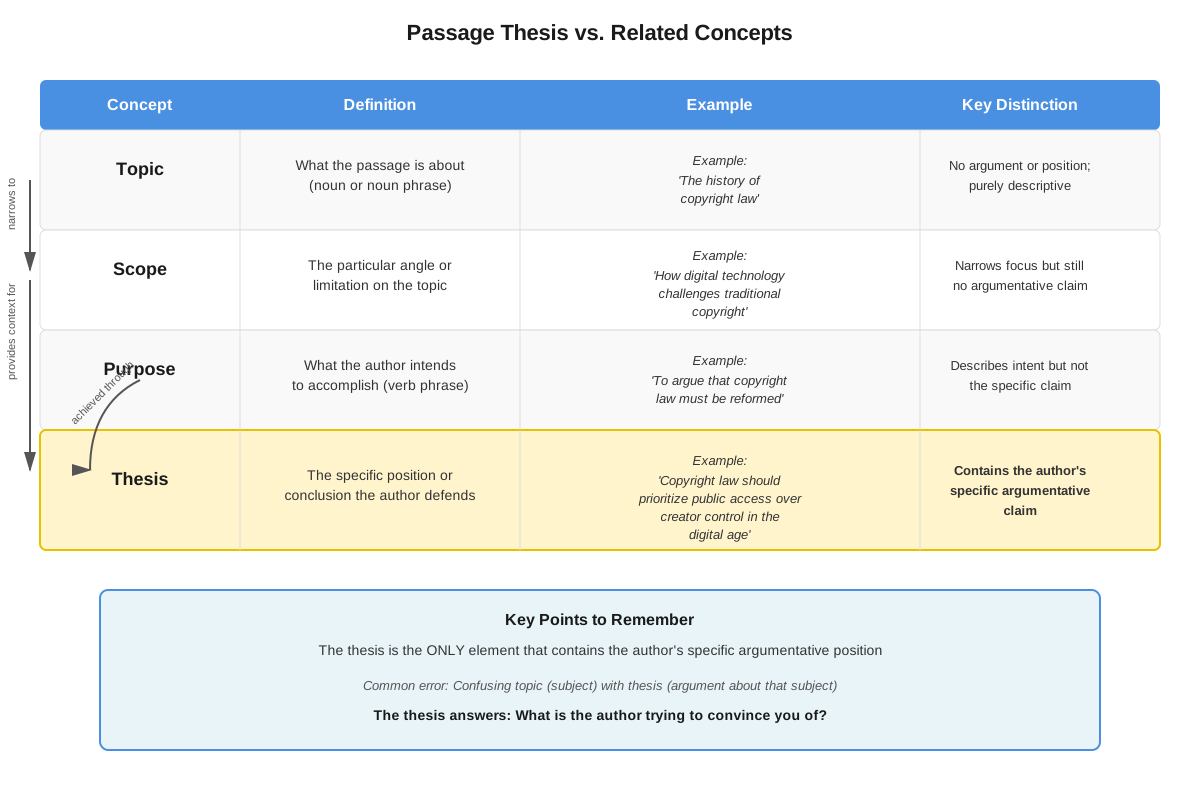
A complete understanding of the thesis requires distinguishing it from three related but distinct concepts:
| Concept | Definition | Example |
|---|---|---|
| Topic | The general subject matter | "Judicial interpretation of statutes" |
| Scope | The specific aspect of the topic addressed | "The debate between textualism and purposivism" |
| Thesis | The author's argument or conclusion about the scoped topic | "Purposivist interpretation better serves legislative intent than strict textualism" |
| Purpose | What the author aims to accomplish | "To argue for purposivist interpretation" |
The thesis is always more specific than the topic and scope, and it includes the author's perspective or argumentative stance. On the LSAT, incorrect answer choices for main point questions frequently offer the topic or scope without the author's specific argument, making this distinction crucial for accurate answer selection.
Characteristics of Strong Thesis Identification
Accurate thesis identification requires recognizing several key characteristics:
- Specificity: The thesis captures the author's precise argument, not a vague generalization
- Completeness: It encompasses the entire passage, not just one paragraph or section
- Accuracy: It reflects what the author actually argues, not what the student thinks or what seems reasonable
- Appropriate scope: It's neither too broad (covering more than the passage addresses) nor too narrow (missing significant portions of the argument)
Common Locations of Thesis Statements
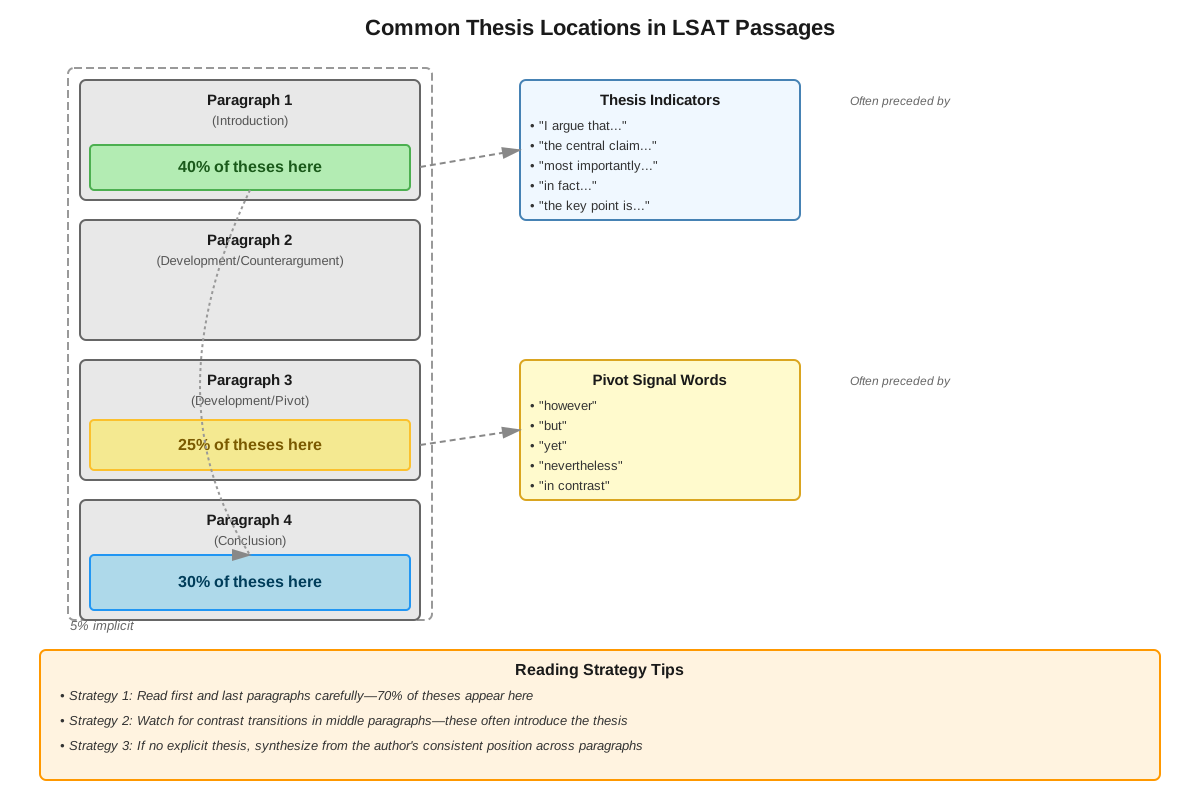
While the thesis can appear anywhere in an LSAT passage, certain locations are more common:
First Paragraph Thesis: Many passages state the thesis explicitly in the opening paragraph, often in the second or third sentence after introducing the topic. Signal phrases include "However," "In fact," "Actually," or "The truth is" that indicate a shift from background to argument.
Last Paragraph Thesis: Some passages build toward a conclusion stated explicitly in the final paragraph, particularly when the passage presents multiple perspectives before advocating for one.
Distributed Thesis: In more complex passages, the thesis emerges from synthesizing claims made across multiple paragraphs. The author may state part of the thesis early, develop it through the middle paragraphs, and complete or qualify it near the end.
Implicit Thesis: Occasionally, the thesis is never stated in a single sentence but must be inferred from the overall argumentative direction and the evidence the author emphasizes.
Thesis vs. Topic Sentences
A critical distinction exists between the passage thesis and paragraph topic sentences. Each paragraph typically has a topic sentence that states the main point of that paragraph, but only one claim serves as the overarching thesis for the entire passage. Topic sentences support, develop, or relate to the thesis, but they are subordinate to it.
For example, in a passage arguing that "restorative justice programs reduce recidivism more effectively than traditional incarceration," individual paragraphs might have topic sentences like:
- "Studies show restorative justice participants reoffend at lower rates"
- "Traditional incarceration fails to address underlying causes of criminal behavior"
- "Critics argue restorative justice is too lenient, but evidence contradicts this concern"
Each topic sentence supports the overall thesis but is not itself the thesis.
Recognizing Thesis Through Structural Signals
LSAT passages employ various structural signals that help identify the thesis:
Contrast markers: Words like "however," "but," "yet," "nevertheless," and "although" often precede the author's main argument, especially when contrasting it with a common view or alternative position.
Emphasis markers: Phrases such as "most importantly," "the key point is," "fundamentally," or "essentially" signal that a central claim follows.
Conclusion indicators: Words like "therefore," "thus," "consequently," and "in sum" often introduce or restate the thesis.
Author's voice: Passages frequently shift from describing others' views (using phrases like "some scholars argue" or "traditional approaches suggest") to presenting the author's own position (using "in fact," "actually," or simply stating claims directly).
Thesis in Different Passage Types
The nature and presentation of the thesis varies somewhat across LSAT passage types:
Argumentative passages: Present a clear thesis advocating for a specific position, often contrasting it with opposing views.
Explanatory passages: Offer a thesis that explains a phenomenon, mechanism, or concept, typically arguing for a particular interpretation or understanding.
Descriptive passages: Even when primarily descriptive, these passages usually include an evaluative or interpretive thesis about the significance or nature of what's described.
Comparative passages: Present theses about the relationship between two texts, theories, or approaches, often arguing that one is superior, that they're complementary, or that a synthesis is needed.
Concept Relationships
The passage thesis serves as the central node connecting all other elements of reading comprehension. Understanding these relationships is crucial for both identifying the thesis and using it effectively to answer questions.
Thesis → Paragraph Function: Each paragraph serves a specific function relative to the thesis. Introductory paragraphs establish context and often state the thesis. Supporting paragraphs provide evidence, examples, or reasoning that develops the thesis. Counterargument paragraphs present objections that the author then addresses to strengthen the thesis. Concluding paragraphs often restate or extend the implications of the thesis.
Thesis → Author's Tone: The author's tone and attitude directly reflect their stance on the thesis. A confident, assertive tone suggests a strong thesis with robust support. A qualified, cautious tone indicates a nuanced thesis with acknowledged limitations. Recognizing tone helps confirm thesis identification and answer attitude questions.
Thesis → Supporting Details: All significant details, examples, studies, and evidence in the passage exist to support, illustrate, or develop the thesis. When evaluating whether you've correctly identified the thesis, ask: "Do the passage's examples and evidence logically support this claim?" If not, reconsider your thesis identification.
Topic/Scope → Thesis: The relationship flows from general to specific. First identify the topic (what the passage discusses), then narrow to the scope (which aspect of the topic), and finally determine the thesis (what the author argues about that scoped topic). This progression provides a systematic approach to thesis identification.
Thesis → Question Types: The thesis connects to virtually every question type. Main point questions test it directly. Inference questions require answers consistent with it. Strengthening/weakening questions ask what would support or undermine it. Application questions extend its reasoning. Structure questions ask how the passage develops it.
Passage Structure → Thesis: The organizational pattern of the passage (problem-solution, cause-effect, comparison-contrast, chronological) shapes how the thesis is presented and developed. Recognizing the structure helps predict where the thesis will appear and how it will be supported.
High-Yield Facts
⭐ The passage thesis is the author's specific argument or conclusion about the topic, not merely what the passage discusses.
⭐ Approximately 1-2 questions per passage directly test thesis identification through "main point" or "primary purpose" questions.
⭐ The thesis is most commonly located in the first paragraph (after topic introduction) or the last paragraph (as a conclusion).
⭐ Contrast markers like "however," "but," and "yet" frequently signal the transition to the author's thesis, especially when contrasting with others' views.
⭐ Correct main point answers must be specific enough to capture the author's actual argument but broad enough to encompass the entire passage.
- The thesis differs from the topic (general subject), scope (specific aspect), and purpose (author's goal), though all are related.
- Implicit theses require synthesizing claims from multiple paragraphs rather than locating a single thesis statement.
- Topic sentences state the main point of individual paragraphs; only one claim serves as the overall passage thesis.
- Wrong answers for main point questions commonly offer details that support the thesis rather than the thesis itself.
- The thesis determines how to interpret ambiguous details, resolve apparent contradictions, and evaluate answer choices across question types.
- Author's qualifications or acknowledgments of limitations are often part of the thesis, not contradictions to it.
- In comparative passages, the thesis typically addresses the relationship between the two texts, not just summarizing each separately.
Quick check — test yourself on Passage thesis so far.
Try Flashcards →Common Misconceptions
Misconception: The thesis is always explicitly stated in a single sentence in the passage.
Correction: While many passages do contain explicit thesis statements, some require synthesizing the thesis from multiple claims distributed throughout the passage. The LSAT tests whether you can construct an accurate thesis even when it's not directly stated.
Misconception: The first sentence of the passage is the thesis.
Correction: The first sentence typically introduces the topic or provides background context. The thesis usually appears after this introduction, often following a contrast marker that signals the shift from context to argument.
Misconception: The thesis is whatever seems most important or interesting to the reader.
Correction: The thesis is specifically what the author argues, which may differ from what the reader finds most significant. LSAT success requires identifying the author's actual argument, not imposing your own interpretation or interests.
Misconception: If a passage discusses multiple viewpoints, it doesn't have a single thesis.
Correction: Passages frequently present multiple perspectives, but the thesis is the author's position on or evaluation of those perspectives. The thesis might argue that one view is correct, that the views should be synthesized, or that all existing views are flawed.
Misconception: The thesis and the author's purpose are the same thing.
Correction: The purpose describes what the author aims to accomplish (e.g., "to argue," "to explain," "to critique"), while the thesis is the specific claim or argument itself. The purpose is the action; the thesis is the content of that action.
Misconception: Details and examples in the passage are equally important as the thesis.
Correction: While details support and develop the thesis, they are subordinate to it. The LSAT frequently includes wrong answers that focus on supporting details rather than the main argument. Understanding this hierarchy is crucial for answer selection.
Misconception: A passage can have multiple theses of equal importance.
Correction: While a passage may contain multiple claims, one overarching thesis unifies the passage. Subsidiary claims support or develop this central thesis. Identifying the hierarchical relationship between claims is essential for accurate thesis identification.
Worked Examples
Example 1: Explicit Thesis with Contrast Structure
Passage Excerpt:
"For decades, economists assumed that rational actors in financial markets would prevent asset bubbles from forming. According to this efficient market hypothesis, prices always reflect true value because rational investors quickly correct any mispricing. However, behavioral economics research has demonstrated that cognitive biases systematically distort investor decision-making, leading to predictable patterns of overvaluation and market bubbles. Studies of the dot-com bubble and the housing crisis reveal that even sophisticated investors fall prey to herd mentality and confirmation bias. These findings suggest that regulatory intervention may be necessary to prevent bubble formation, contrary to the hands-off approach advocated by efficient market theorists."
Analysis Process:
- Identify the topic: Financial markets and asset bubbles
- Identify the scope: The role of investor rationality and whether markets self-correct
- Locate structural signals: "However" in the third sentence signals a contrast and likely introduces the author's position
- Identify competing views: The efficient market hypothesis (markets self-correct) vs. behavioral economics (cognitive biases distort markets)
- Determine author's stance: The author supports the behavioral economics view, as evidenced by "has demonstrated," the supporting examples, and the conclusion about regulatory intervention
- Formulate the thesis: "Cognitive biases systematically distort investor decision-making, undermining the efficient market hypothesis and suggesting the need for regulatory intervention to prevent asset bubbles"
Why this is the thesis: This statement captures the author's specific argument (not just the topic), encompasses the entire passage (including both the critique of efficient markets and the advocacy for regulation), and reflects the author's clear position rather than neutrally describing both views.
Common wrong answer: "The passage discusses two competing theories about financial markets." This describes the topic and structure but not the author's argument or position.
Example 2: Distributed Thesis Requiring Synthesis
Passage Excerpt:
"The discovery of mirror neurons in the premotor cortex has revolutionized neuroscientific understanding of social cognition. These neurons fire both when an individual performs an action and when they observe another performing the same action. Initial research suggested mirror neurons might provide a neural basis for empathy and theory of mind. Subsequent studies have revealed a more complex picture. While mirror neurons do activate during observation of others' actions, this activation alone does not constitute empathy, which requires additional cognitive processing in other brain regions. Furthermore, individuals with autism spectrum disorders, who often struggle with social cognition, show normal mirror neuron functioning. The significance of mirror neurons, therefore, lies not in providing a complete explanation for social understanding, but in representing one component of a distributed neural network that enables social cognition."
Analysis Process:
- Identify the topic: Mirror neurons and social cognition
- Track the argument's development:
- Paragraph 1: Mirror neurons discovered and initially thought to explain empathy
- Paragraph 2: Evidence complicates this simple explanation
- Paragraph 3: Conclusion about mirror neurons' actual significance
- Note qualifying language: "more complex picture," "alone does not constitute," "not in providing a complete explanation, but in"
- Synthesize the thesis: The author argues that mirror neurons are important but insufficient for explaining social cognition; they're one component of a larger system, not a complete explanation
- Formulate complete thesis: "Mirror neurons represent one component of a distributed neural network for social cognition rather than providing a complete explanation for empathy and social understanding"
Why this requires synthesis: No single sentence states the complete thesis. The first paragraph presents the initial view, the second qualifies it with evidence, and the third provides the author's conclusion. The thesis emerges from understanding how these parts relate.
Application to questions: If a question asks what the author would most likely agree with, correct answers must reflect this nuanced view (mirror neurons are important but not sufficient), while wrong answers might overstate their importance or dismiss them entirely.
Exam Strategy
Systematic Approach to Thesis Identification
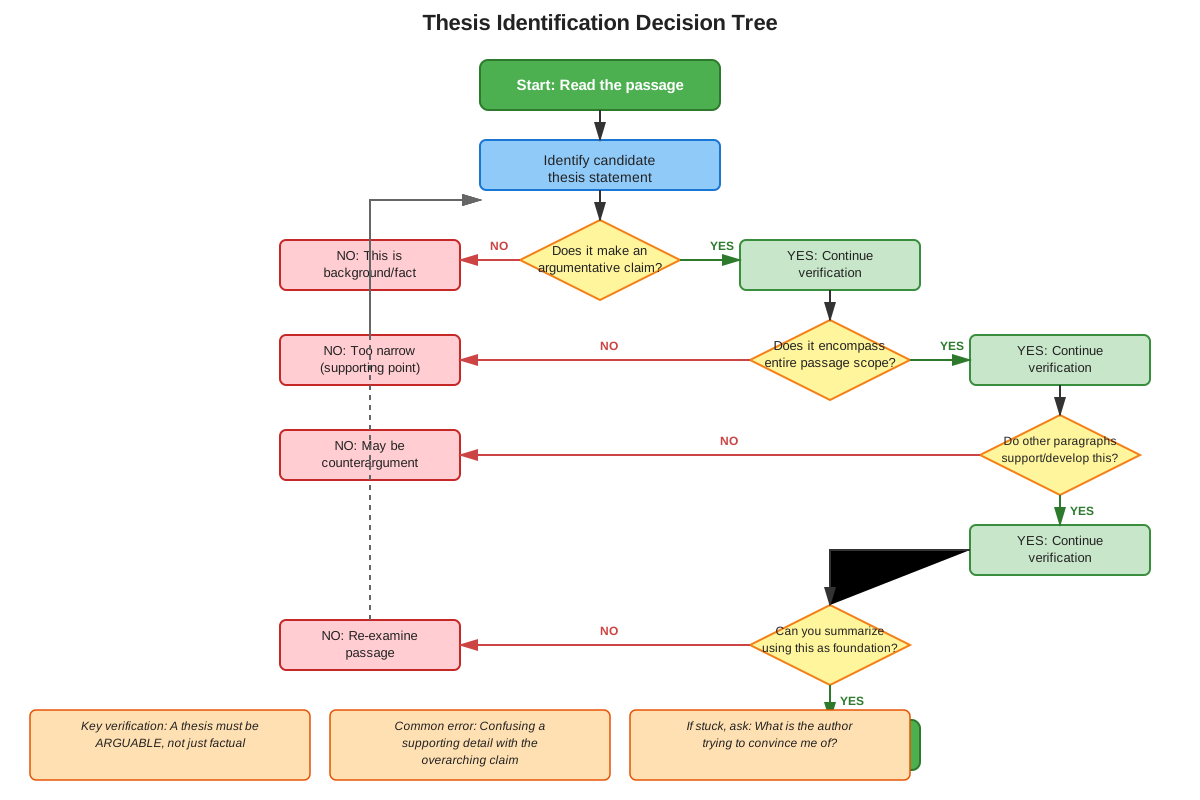
When approaching any LSAT Reading Comprehension passage, follow this systematic process:
- Read the first paragraph carefully: Note the topic introduction and watch for contrast markers that signal the thesis
- Identify the author's voice: Distinguish between describing others' views and presenting the author's own argument
- Track structural signals: Mark contrast words, emphasis phrases, and conclusion indicators
- Synthesize as you read: After each paragraph, mentally note how it relates to the emerging thesis
- Confirm with the conclusion: Check whether the final paragraph restates or extends your identified thesis
Trigger Words and Phrases
Thesis introduction signals:
- "However," "But," "Yet," "Nevertheless" (contrast with previous view)
- "In fact," "Actually," "Indeed" (emphasis on author's position)
- "The key point," "Most importantly," "Fundamentally" (highlighting central claim)
- "This suggests," "This indicates," "This demonstrates" (drawing conclusions)
Others' views signals (thesis likely follows):
- "Traditional approaches," "Conventional wisdom," "It is often assumed"
- "Some scholars argue," "Critics contend," "Proponents claim"
- "At first glance," "On the surface," "Initially"
Process of Elimination for Main Point Questions
When evaluating answer choices for main point questions:
- Eliminate answers that are too broad: If the answer could apply to passages with different arguments on the same topic, it's too general
- Eliminate answers that are too narrow: If the answer focuses on only one paragraph or one supporting detail, it's too specific
- Eliminate answers that describe the topic without the argument: Answers that say what the passage discusses without stating what it argues are wrong
- Eliminate answers inconsistent with the author's tone: If the author is critical but an answer is neutral, or vice versa, eliminate it
- Confirm the remaining answer encompasses the whole passage: The correct answer should account for all major components of the passage
Exam Tip: If you're stuck between two answers, ask: "Which answer would better help me predict what the passage contains?" The correct thesis should enable you to anticipate the passage's content, structure, and examples.
Time Allocation
- Initial read with thesis focus: 3-4 minutes (slightly slower, but saves time on questions)
- Thesis confirmation: 15-30 seconds (mentally articulate the thesis before moving to questions)
- Main point questions: 30-45 seconds (should be quick if thesis is clear)
- Other questions using thesis: Use thesis as anchor for eliminating wrong answers (saves 10-15 seconds per question)
Investing extra time in accurate thesis identification during the initial read pays dividends across all questions for that passage.
Memory Techniques
The THESIS Acronym
Topic vs. Thesis: Remember that the thesis is not just what the passage discusses, but what it argues
However signals: Contrast markers like "however" frequently introduce the thesis
Encompasses all: The thesis must account for the entire passage, not just one part
Specific stance: The thesis includes the author's specific position or argument
Implicit or explicit: The thesis may be stated directly or require synthesis
Supporting details subordinate: All examples and evidence support the thesis; they aren't the thesis itself
Visualization Strategy
Picture the passage as a tree:
- Roots = Topic and background context
- Trunk = Thesis (the central support structure)
- Branches = Supporting paragraphs and arguments
- Leaves = Specific details, examples, and evidence
Just as the trunk is the essential structure that everything else connects to, the thesis is the central element that all other passage components support and develop.
The "So What?" Test
When you think you've identified the thesis, ask yourself: "So what is the author actually arguing?" If your answer is just a topic ("This passage is about mirror neurons"), you haven't reached the thesis. Keep asking "So what?" until you reach a specific claim or argument ("Mirror neurons are one component of social cognition, not a complete explanation").
Contrast Pattern Recognition
Remember the common pattern: Background → "However" → Thesis
Many LSAT passages follow this structure:
- Introduce topic and traditional/common view
- Signal contrast with "however," "but," or "yet"
- Present the author's thesis that challenges or qualifies the traditional view
Training yourself to recognize this pattern accelerates thesis identification.
Summary
The passage thesis represents the author's central argument or main claim about the passage topic—the specific position developed and supported throughout the text. Mastering thesis identification is essential for LSAT Reading Comprehension success because it serves as the foundation for answering both direct main point questions and virtually all other question types. The thesis differs from related concepts: the topic (general subject matter), scope (specific aspect addressed), and purpose (author's goal). Effective thesis identification requires distinguishing the author's argument from supporting details, recognizing structural signals like contrast markers, and synthesizing information across multiple paragraphs when the thesis is distributed or implicit. The thesis most commonly appears in the first paragraph after topic introduction or in the concluding paragraph, often signaled by words like "however," "in fact," or "therefore." Correct main point answers must be specific enough to capture the author's actual argument while remaining broad enough to encompass the entire passage, avoiding the common traps of being too general (topic only) or too narrow (supporting detail).
Key Takeaways
- The passage thesis is the author's specific argument about the topic, not merely what the passage discusses or describes
- Approximately 60-70% of Reading Comprehension questions either directly test or implicitly require accurate thesis identification
- Contrast markers ("however," "but," "yet") frequently signal the transition to the author's thesis, especially when contrasting with traditional views
- The thesis must encompass the entire passage while remaining specific enough to capture the author's actual position
- Distinguishing between topic, scope, thesis, and purpose is crucial for eliminating wrong answers on main point questions
- Supporting details, examples, and evidence are subordinate to the thesis; they develop it but are not themselves the thesis
- Investing time in accurate thesis identification during the initial read significantly improves speed and accuracy across all questions for that passage
Related Topics
Passage Structure and Organization: Understanding how passages are organized (problem-solution, cause-effect, comparison-contrast) helps predict where the thesis will appear and how it will be developed. Mastering thesis identification provides the foundation for analyzing how authors structure arguments to support their central claims.
Author's Tone and Attitude: The author's tone directly reflects their stance on the thesis. After mastering thesis identification, studying tone helps confirm thesis accuracy and answer attitude questions that test whether you understand the author's perspective.
Supporting Evidence and Examples: Once you can reliably identify the thesis, the next step is analyzing how authors use evidence, examples, and reasoning to support their central claims. This skill is essential for strengthening/weakening questions and inference questions.
Paragraph Function: Understanding the specific role each paragraph plays relative to the thesis (introduction, support, counterargument, conclusion) builds on thesis identification skills and enables more sophisticated passage analysis.
Main Point Question Types: After mastering thesis identification conceptually, focused practice on the various ways main point questions are phrased ("primary purpose," "main idea," "central claim") ensures you can apply this skill under timed conditions.
Practice CTA
Now that you understand the critical role of passage thesis identification in LSAT Reading Comprehension, it's time to apply these concepts to actual LSAT passages. Work through the practice questions and flashcards for this topic, focusing on distinguishing the thesis from the topic, recognizing structural signals, and eliminating wrong answers that are too broad or too narrow. Remember: every minute invested in mastering thesis identification pays dividends across every Reading Comprehension question you'll encounter. The thesis is your anchor—master it, and you'll navigate passages with confidence and accuracy. Begin your practice now, and watch your Reading Comprehension performance transform.
Sign up free to keep reading
Create a free AnvayaPrep account to finish this LSAT guide on Passage thesis — plus flashcards and practice questions.