Overview
The primary argument is the central claim or thesis that an author advances throughout a passage in LSAT reading comprehension. Identifying this argument is fundamental to understanding any passage, as it represents the author's main point—the overarching assertion they seek to establish or defend. Unlike supporting details, examples, or subsidiary claims, the primary argument encapsulates what the author most wants readers to accept. On the LSAT, recognizing the primary argument is not merely about finding a topic sentence; it requires synthesizing information across multiple paragraphs, distinguishing between main claims and supporting evidence, and understanding how various components of a passage work together to advance a central thesis.
Mastering the identification and analysis of primary arguments is essential for LSAT success because it forms the foundation for answering the most common question types in reading comprehension. "Main point" questions directly test this skill, but understanding the primary argument also enables students to answer questions about author's purpose, passage structure, and the function of specific details. When students can quickly and accurately identify what an author is fundamentally arguing, they gain a strategic advantage: they can predict answer choices, eliminate distractors more efficiently, and maintain focus on what truly matters in dense, complex passages.
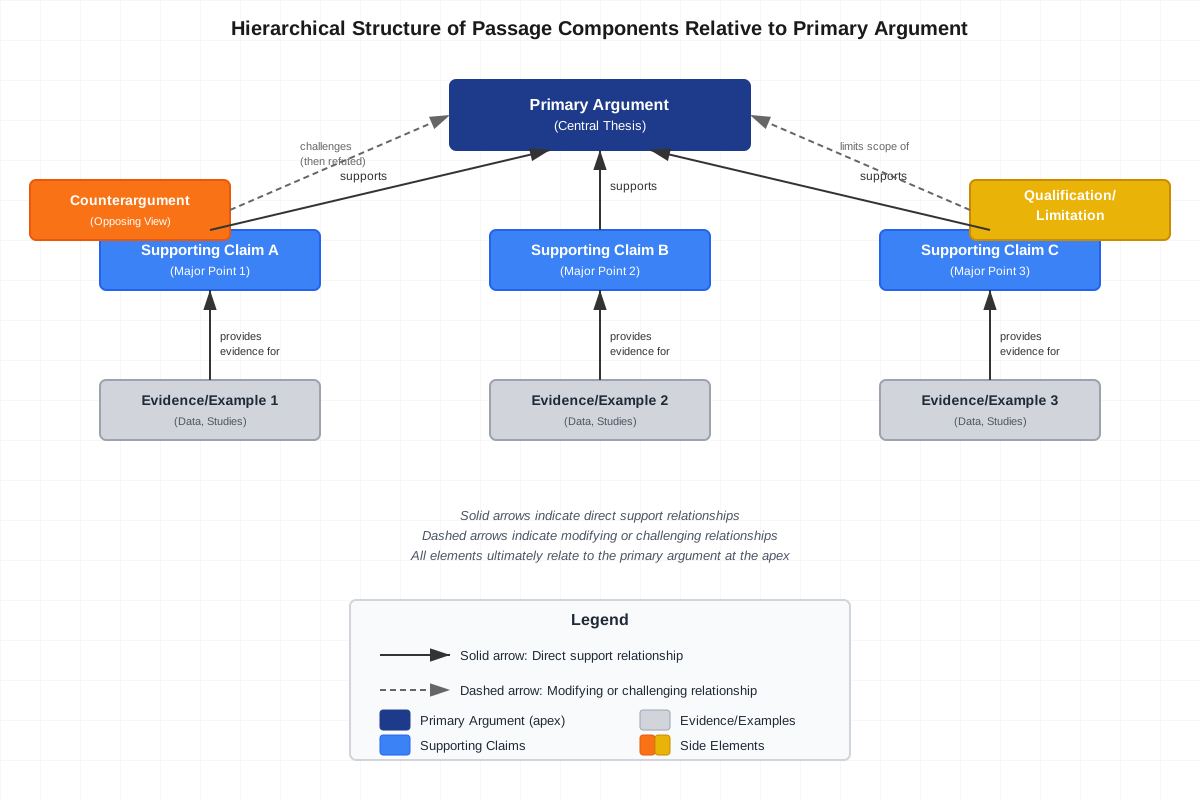
Within passage fundamentals, the primary argument serves as the organizing principle around which all other elements revolve. Supporting evidence, counterarguments, examples, and qualifications all exist in relation to the primary argument. Understanding this hierarchical relationship allows test-takers to construct mental maps of passages, distinguishing between essential content and peripheral details. This skill connects directly to other reading comprehension competencies such as identifying passage structure, recognizing author's tone and attitude, and evaluating the strength of reasoning—all of which depend on first understanding what the author is fundamentally trying to prove or explain.
Learning Objectives
- [ ] Identify how Primary argument appears in LSAT questions
- [ ] Explain the reasoning pattern behind Primary argument
- [ ] Apply Primary argument to solve LSAT-style problems accurately
- [ ] Distinguish between a primary argument and supporting claims within complex passages
- [ ] Recognize common structural patterns that signal where primary arguments appear
- [ ] Evaluate answer choices by determining which best captures the scope and emphasis of the primary argument
- [ ] Synthesize information from multiple paragraphs to construct an accurate statement of the primary argument
Prerequisites
- Basic reading comprehension skills: The ability to understand complex academic prose is necessary before analyzing argumentative structure
- Understanding of claims vs. evidence: Distinguishing between assertions and the support offered for them underlies the ability to identify primary arguments
- Familiarity with passage structure: Recognizing how passages are organized (introduction, body, conclusion) helps locate where primary arguments typically appear
- Vocabulary appropriate for graduate-level reading: LSAT passages use sophisticated language that must be comprehensible for argument identification
Why This Topic Matters
The primary argument represents the single most important element to identify in any LSAT reading comprehension passage. In real-world contexts, the ability to identify central claims is essential for legal practice, academic research, policy analysis, and any profession requiring critical evaluation of complex texts. Lawyers must identify the central arguments in legal briefs, judicial opinions, and statutes. Researchers must discern the main thesis of academic articles. Policy analysts must understand what positions various stakeholders are fundamentally advocating. The LSAT tests this skill because it is foundational to success in law school and legal practice.
From an exam statistics perspective, primary argument identification is tested with extraordinary frequency. Approximately 20-25% of all reading comprehension questions are "main point" or "primary purpose" questions that directly assess this skill. However, the true importance extends far beyond these explicit question types. Understanding the primary argument is prerequisite to answering questions about passage structure (10-15% of questions), author's attitude (8-12% of questions), and the function of specific details (15-20% of questions). In essence, nearly every reading comprehension question becomes easier when the primary argument has been correctly identified.
The lsat primary argument appears in passages across all content domains—law, humanities, natural sciences, and social sciences. It may be explicitly stated in a thesis sentence, or it may need to be inferred from the cumulative weight of multiple paragraphs. Common manifestations include: arguments advocating for a new interpretation of historical events, claims that a scientific theory should be revised or rejected, assertions that a particular legal or ethical framework is superior to alternatives, or explanations of why a phenomenon occurs in a particular way. Regardless of subject matter, the primary argument always represents the author's central intellectual contribution—what they most want readers to understand or accept.
Core Concepts
Defining the Primary Argument
The primary argument is the central claim, thesis, or main point that an author advances throughout a passage. It represents the author's fundamental position—the overarching assertion they seek to establish through reasoning, evidence, and explanation. The primary argument is not simply the topic of the passage (what the passage is about), but rather the author's specific stance or conclusion regarding that topic (what the author believes or wants to prove about it).
For example, a passage might have "climate change mitigation strategies" as its topic, but the primary argument could be "market-based carbon pricing mechanisms are more effective than regulatory mandates for reducing greenhouse gas emissions." The topic identifies the subject matter; the primary argument expresses the author's evaluative or explanatory claim about that subject.
Characteristics of Primary Arguments
Primary arguments possess several distinguishing features that separate them from supporting claims, background information, or illustrative examples:
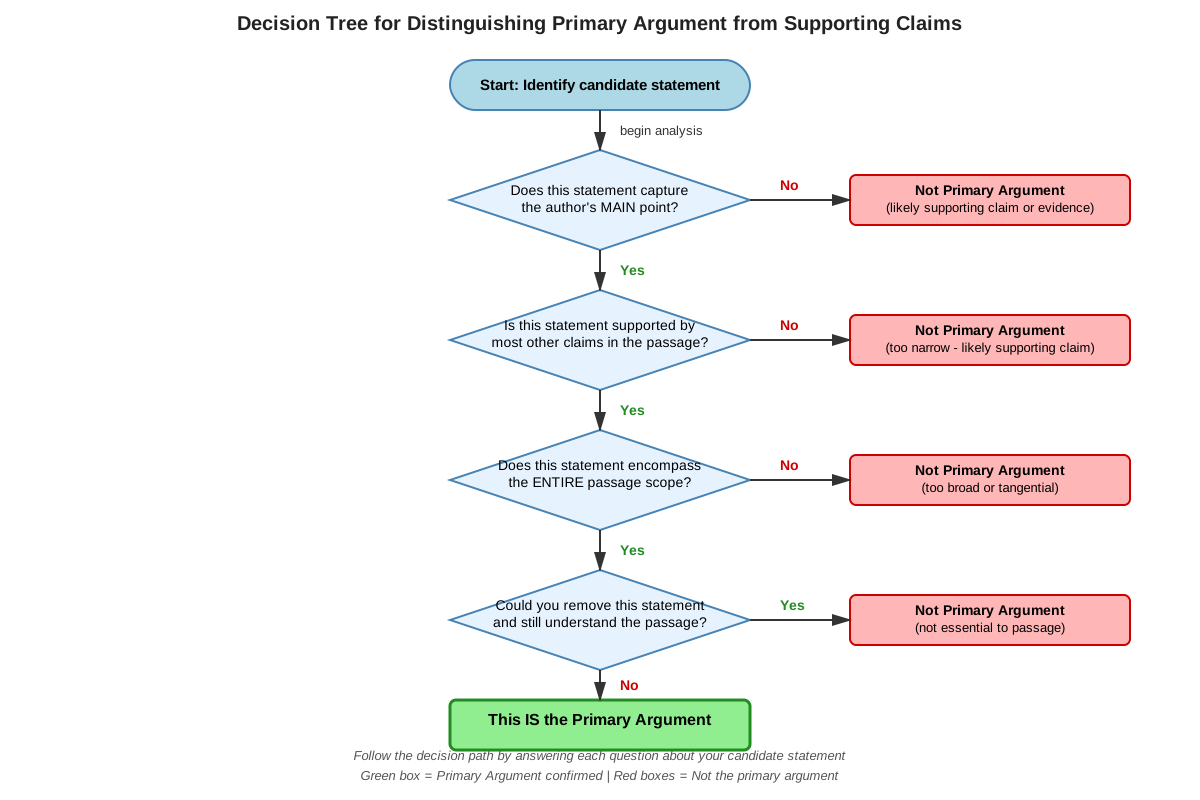
Scope: The primary argument encompasses the entire passage or the majority of it. Supporting claims are narrower, addressing specific aspects or components of the broader thesis.
Emphasis: Authors devote the most attention to establishing their primary argument, either through direct assertion or cumulative reasoning. Details that receive extensive elaboration often support the primary argument.
Generality: Primary arguments tend to be more general or abstract than supporting evidence. They make claims about categories, principles, or patterns rather than specific instances.
Independence: While supporting claims depend on the primary argument for their relevance, the primary argument can be understood (though perhaps not fully justified) without every supporting detail.
Author's Purpose: The primary argument directly reflects why the author wrote the passage—what they wanted to convince readers to believe or understand.
Locating Primary Arguments in Passage Structure
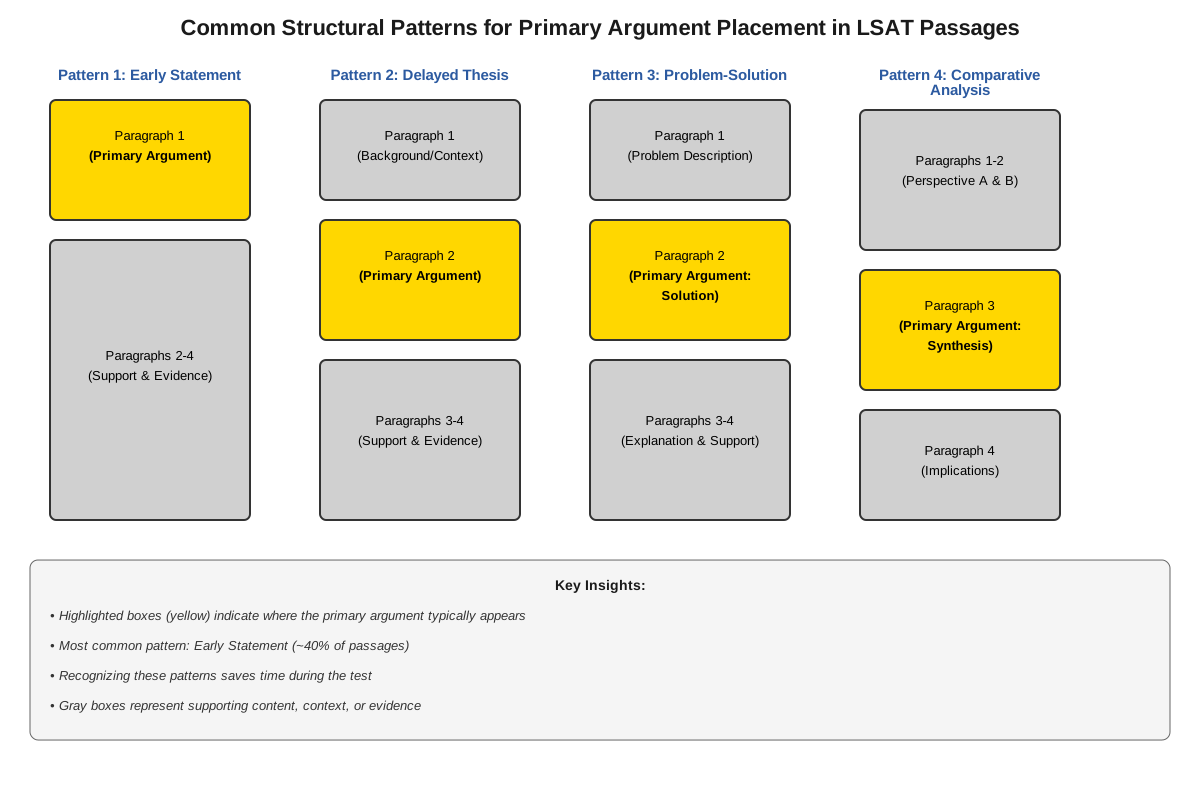
LSAT passages follow recognizable structural patterns, and understanding these patterns helps identify where primary arguments typically appear:
| Passage Structure | Primary Argument Location | Characteristics |
|---|---|---|
| Classical/Direct | First or second paragraph | Author states thesis early, then supports it |
| Inductive/Building | Final paragraph or late in passage | Author presents evidence first, then draws conclusion |
| Problem-Solution | Middle to late passage | Author identifies problem, then argues for specific solution |
| Comparative | Throughout, synthesized at end | Author compares positions, then advocates for one |
| Explanatory | Early statement, elaborated throughout | Author explains a phenomenon, with thesis being the explanation itself |
However, test-takers must remain flexible. Some passages embed the primary argument across multiple locations, requiring synthesis. Others present what appears to be the main point early, only to qualify or revise it later. The most reliable approach combines structural awareness with attention to emphasis, repetition, and explicit argumentative language.
Distinguishing Primary Arguments from Related Elements
Primary Argument vs. Topic: The topic is the subject matter; the primary argument is the author's claim about that subject. Topic: "judicial interpretation methods." Primary argument: "originalist interpretation is incompatible with evolving social values."
Primary Argument vs. Supporting Claims: Supporting claims are subsidiary assertions that provide evidence or reasoning for the primary argument. If the primary argument is "urban density reduces environmental impact," a supporting claim might be "dense cities require less transportation infrastructure per capita."
Primary Argument vs. Background Information: Background provides context but makes no claim. It describes existing situations, historical developments, or established facts without advancing the author's thesis.
Primary Argument vs. Counterarguments: Authors often present opposing views to refute them. These counterarguments are not the primary argument, even if discussed extensively. The primary argument is what the author ultimately defends.
Primary Argument vs. Implications: Some passages conclude by discussing implications or applications of the primary argument. These consequences follow from the main claim but are not themselves the central thesis.
Reasoning Patterns in Primary Arguments
LSAT passages employ various reasoning patterns to establish primary arguments:
Causal Arguments: The author claims that X causes Y or explains why a phenomenon occurs. Example: "The decline in bee populations is primarily attributable to neonicotinoid pesticides rather than habitat loss."
Evaluative Arguments: The author assesses something as good/bad, effective/ineffective, or superior/inferior. Example: "Restorative justice programs produce better outcomes than traditional punitive approaches."
Interpretive Arguments: The author offers a new understanding or reading of texts, events, or data. Example: "The Harlem Renaissance should be understood as a political movement rather than merely an artistic one."
Prescriptive Arguments: The author advocates for a course of action or policy. Example: "Universities should eliminate standardized testing requirements for admission."
Descriptive/Explanatory Arguments: The author explains how something works or why something is the case. Example: "Quantum entanglement occurs because particles share wave functions that remain correlated regardless of distance."
Recognizing these patterns helps predict what kind of support the author will provide and what the primary argument's structure will be.
Synthesis and Implicit Primary Arguments
Not all primary arguments are explicitly stated in a single sentence. Some require synthesis—combining information from multiple paragraphs to construct the central claim. In these cases, test-takers must:
- Identify the common thread connecting different paragraphs
- Determine what overall point these connected ideas support
- Formulate a statement that captures the author's central position
- Verify that this synthesized statement accounts for the passage's emphasis and scope
For example, a passage might discuss three different historical examples in separate paragraphs without explicitly stating a thesis. However, if all three examples illustrate how technological innovation disrupts existing power structures, the primary argument is likely: "Technological innovation consistently undermines established hierarchies."
Concept Relationships
The primary argument functions as the central node in a network of passage elements. Supporting claims branch directly from the primary argument, providing evidence, reasoning, or elaboration that makes the main thesis more credible or comprehensible. These supporting claims may themselves be supported by specific examples, data, or expert testimony, creating a hierarchical structure with the primary argument at the apex.
Background information and context typically precede the primary argument, establishing the framework necessary for readers to understand why the argument matters or what problem it addresses. This relationship flows: Context → Primary Argument → Support. However, in inductive structures, the flow reverses: Evidence → Evidence → Evidence → Primary Argument (as conclusion).
Counterarguments and alternative views exist in tension with the primary argument. Authors present these opposing positions to refute them, thereby strengthening their own primary argument through contrast. The relationship is dialectical: Counterargument → Refutation → Primary Argument (reinforced).
The primary argument also connects to author's purpose and tone. If the primary argument is prescriptive (advocating change), the author's purpose is persuasive and the tone may be urgent or critical. If the primary argument is explanatory, the purpose is informative and the tone more neutral. Understanding the primary argument thus illuminates these other passage elements.
Within the broader framework of passage fundamentals, primary argument identification enables understanding of passage structure (how the passage is organized to advance the main claim), paragraph function (what role each paragraph plays in supporting the primary argument), and detail function (why specific examples or data points are included). The relationship map flows: Primary Argument → determines → Passage Structure → determines → Paragraph Function → determines → Detail Selection.
High-Yield Facts
⭐ The primary argument is the author's central claim or thesis, not merely the passage topic
⭐ Approximately 20-25% of reading comprehension questions directly test primary argument identification
⭐ Primary arguments can be explicitly stated or must be synthesized from multiple paragraphs
⭐ The primary argument encompasses the scope of the entire passage, while supporting claims address narrower components
⭐ Authors typically devote the most space and emphasis to establishing their primary argument
- Primary arguments often appear in the first paragraph (classical structure) or final paragraph (inductive structure)
- Supporting claims provide evidence for the primary argument but are not themselves the main point
- Counterarguments presented in passages are positions the author opposes, not the primary argument
- The primary argument reflects the author's purpose for writing the passage
- Correct answers to main point questions must match both the scope and emphasis of the primary argument
- Background information provides context but does not constitute the primary argument
- Implications or applications discussed at the end of passages follow from the primary argument but are not the central thesis
- Primary arguments in LSAT passages are typically evaluative, causal, interpretive, or prescriptive
- Recognizing repeated concepts or themes across paragraphs helps identify implicit primary arguments
- The primary argument is what the author most wants readers to accept or understand
Quick check — test yourself on Primary argument so far.
Try Flashcards →Common Misconceptions
Misconception: The primary argument is always explicitly stated in a single sentence.
Correction: While some passages contain clear thesis statements, many require synthesis of information across multiple paragraphs. Test-takers must be prepared to construct the primary argument from cumulative evidence and recurring themes.
Misconception: The primary argument is whatever appears in the first paragraph.
Correction: Although classical structures often present the thesis early, inductive passages build toward a conclusion stated late. Additionally, first paragraphs sometimes contain only background or context. Location is a clue, not a guarantee.
Misconception: The longest or most detailed section of the passage contains the primary argument.
Correction: Extensive detail often supports the primary argument rather than stating it. Authors may spend considerable space on examples or evidence while expressing the main claim concisely. Length indicates emphasis on support, not necessarily the argument itself.
Misconception: If a passage discusses multiple viewpoints, it has multiple primary arguments.
Correction: Passages presenting multiple perspectives still have one primary argument—typically the author's evaluation of these perspectives or advocacy for one over others. The primary argument is the author's position, not the various positions described.
Misconception: The primary argument is the same as the passage's conclusion.
Correction: While conclusions often restate or emphasize the primary argument, they may instead discuss implications, applications, or future directions. The primary argument is the central claim defended throughout, which may or may not be repeated in the conclusion.
Misconception: Identifying the topic is sufficient for answering main point questions.
Correction: The topic identifies what the passage is about; the primary argument expresses what the author claims about that topic. Main point questions require the specific claim, not just the subject matter. "The passage discusses judicial interpretation" is a topic; "The passage argues that originalism is incompatible with modern values" is a primary argument.
Misconception: Primary arguments are always controversial or argumentative.
Correction: Some primary arguments are explanatory rather than evaluative. A passage explaining how photosynthesis works has a primary argument (the explanation itself), even though it's not advocating a controversial position. The primary argument is the central intellectual contribution, whether persuasive or informative.
Worked Examples
Example 1: Explicitly Stated Primary Argument
Passage Excerpt:
"For decades, economists have debated whether minimum wage increases reduce employment. Recent empirical studies, however, provide compelling evidence that moderate minimum wage increases do not significantly decrease employment levels. Analysis of employment data from fifteen states that raised minimum wages between 2010 and 2020 reveals no correlation between wage increases and job losses in affected sectors. Furthermore, these studies account for confounding variables such as regional economic growth and industry-specific trends. The traditional economic model predicting job losses from wage floors appears to oversimplify labor market dynamics. Employers respond to wage increases through multiple mechanisms—reducing turnover, improving productivity, and accepting slightly lower profit margins—rather than simply cutting jobs. These findings suggest that policymakers can raise minimum wages to improve worker welfare without the employment consequences that critics have long predicted."
Question: Which one of the following most accurately expresses the main point of the passage?
Analysis Process:
- Identify the topic: Minimum wage increases and their effect on employment
- Locate potential thesis statements: The second sentence ("Recent empirical studies... provide compelling evidence that moderate minimum wage increases do not significantly decrease employment levels") and the final sentence both express strong claims.
- Evaluate scope: The entire passage discusses evidence against employment losses and explains alternative employer responses. This matches the claim in sentence two.
- Check emphasis: The author devotes most space to evidence supporting the claim that minimum wages don't reduce employment, and to explaining why traditional models are wrong.
- Distinguish from supporting claims:
- "Analysis of employment data... reveals no correlation" = supporting evidence
- "Employers respond through multiple mechanisms" = supporting explanation
- "Traditional economic model... oversimplifies" = supporting critique
- Synthesize: The primary argument is that empirical evidence demonstrates minimum wage increases do not significantly reduce employment, contrary to traditional economic predictions.
Correct Answer Characteristics: Must include (1) minimum wage increases, (2) lack of significant employment reduction, (3) empirical evidence basis, (4) contrast with traditional predictions.
Connection to Learning Objectives: This example demonstrates how to identify an explicitly stated primary argument (Objective 1), recognize the reasoning pattern (empirical/evaluative argument challenging conventional wisdom—Objective 2), and apply systematic analysis to distinguish the main claim from supporting elements (Objective 3).
Example 2: Synthesized Primary Argument
Passage Excerpt:
"The discovery of cave paintings in Indonesia dating to 44,000 years ago challenges long-held assumptions about the geographic origins of symbolic art. Previously, scholars believed that sophisticated artistic expression emerged exclusively in Europe, with the famous Lauveaux cave paintings representing humanity's first aesthetic achievements. The Indonesian findings, however, demonstrate that complex symbolic representation developed independently in Southeast Asia at approximately the same time.
Moreover, recent analysis of ochre fragments in South African caves suggests that symbolic marking practices may have existed even earlier, perhaps 70,000 years ago. These fragments show evidence of intentional grinding and mixing, indicating purposeful creation of pigments for representational use.
Taken together, these discoveries from multiple continents indicate that the capacity for symbolic thought and artistic expression was not a localized innovation but rather a fundamental cognitive capability that emerged across different human populations as they reached similar developmental stages. The traditional Eurocentric narrative of art history must be substantially revised."
Question: The primary purpose of the passage is to
Analysis Process:
- Identify the topic: Origins and development of early human artistic expression
- Note the structure:
- Paragraph 1: Indonesian discovery challenges European-origin theory
- Paragraph 2: South African evidence suggests even earlier symbolic practices
- Paragraph 3: Synthesis and conclusion
- Look for explicit thesis: The final two sentences of paragraph 3 provide the clearest statement, but this comes after building evidence.
- Recognize the reasoning pattern: This is an interpretive argument—offering a new understanding of art history based on accumulated evidence.
- Synthesize across paragraphs: Each paragraph presents evidence from a different geographic region, all pointing toward the same conclusion: symbolic art was not a European innovation but a widespread human capability.
- Formulate the primary argument: Archaeological evidence from multiple continents demonstrates that symbolic artistic expression was a fundamental human cognitive capacity that emerged independently in different populations, not a localized European innovation.
- Verify scope and emphasis: The passage emphasizes geographic diversity of evidence and consistently contrasts new findings with the old Eurocentric view. The synthesized argument accounts for all major elements.
Correct Answer Characteristics: Must include (1) challenge to Eurocentric art history, (2) evidence from multiple geographic regions, (3) conclusion that symbolic art was a widespread human capacity, (4) independent emergence rather than single origin.
Connection to Learning Objectives: This example illustrates how to synthesize a primary argument from multiple paragraphs (Objective 4), recognize structural patterns that signal building toward a conclusion (Objective 5), and apply systematic analysis to implicit arguments (Objectives 2 and 3).
Exam Strategy
Approaching Primary Argument Questions
When encountering questions that ask for the "main point," "primary purpose," or "central claim," follow this systematic approach:
- Before reading answer choices, formulate your own statement of the primary argument based on passage analysis
- Predict key elements that must appear in the correct answer (scope, emphasis, author's position)
- Eliminate answers that are too narrow (supporting claims), too broad (beyond passage scope), or off-topic
- Compare remaining choices to your prediction and the passage's emphasis
- Verify the winner by checking that it accounts for the majority of the passage content
Trigger Words and Phrases
Certain linguistic markers frequently signal primary arguments or main points:
Explicit thesis indicators:
- "This paper argues that..."
- "The central claim is..."
- "The evidence demonstrates that..."
- "It is clear that..."
- "The most important point is..."
Conclusion markers (often in final paragraphs):
- "Therefore..."
- "Thus..."
- "Consequently..."
- "These findings suggest..."
- "In sum..."
Emphasis markers:
- "Most importantly..."
- "The key issue is..."
- "Fundamentally..."
- "Primarily..."
- "Above all..."
Contrast markers (often introducing author's position against alternatives):
- "However..."
- "In contrast..."
- "Rather..."
- "Instead..."
- "Contrary to..."
Process of Elimination Strategies
Eliminate answers that:
- Are too narrow: If an answer choice describes only one paragraph or one example, it's likely a supporting claim rather than the primary argument
- Are too broad: If an answer choice could apply to multiple passages on the same general topic, it's probably just identifying the subject matter, not the specific argument
- Mismatch the author's tone: If the passage is critical but an answer is neutral, or vice versa, eliminate it
- Include content not in the passage: Even one word that introduces new information disqualifies an answer
- Focus on background or context: Answers emphasizing historical background or problem setup rather than the author's solution or claim are incorrect
- Describe counterarguments: If the answer states a position the author opposes, it's wrong regardless of how much space the passage devotes to that opposing view
Time Allocation
- Spend 3-4 minutes on initial passage reading, actively identifying the primary argument as you read
- Allocate 30-45 seconds to main point questions once you've identified the primary argument during initial reading
- If uncertain, mark the question and return after answering detail questions, which may clarify the passage's emphasis
- Don't overthink: Main point questions should be among the quickest to answer if you've correctly understood the passage structure
Strategic Reading for Primary Arguments
During initial passage reading:
- Pay special attention to the first and last paragraphs, where primary arguments most frequently appear
- Note repeated concepts or phrases across paragraphs—these often signal the central theme
- Identify the author's voice versus described positions—the primary argument is what the author believes, not what they report others believing
- Mark transition words that signal shifts from background to argument, or from counterargument to author's position
- Ask yourself after each paragraph: "How does this relate to what the author is trying to prove?"
Memory Techniques
The SCOPE Acronym
Use SCOPE to remember what distinguishes primary arguments from other passage elements:
- Sweeping: Covers the entire passage or majority of it
- Central: The main intellectual contribution, not peripheral
- Opinion: Represents the author's position or claim
- Purpose: Reflects why the author wrote the passage
- Emphasized: Receives the most attention or support
The "Elevator Pitch" Visualization
Imagine the author has 30 seconds in an elevator to convince someone of their main point. What would they say? This mental exercise forces synthesis and helps distinguish the essential claim from supporting details. The primary argument is what fits in that 30-second pitch.
The "Headline" Technique
If this passage were a newspaper article, what would the headline be? Headlines capture main points, not supporting details. Practice mentally writing headlines for passages to train primary argument identification.
The "Because" Test
The primary argument is the claim that everything else in the passage supports. Try this formula: "The author believes [PRIMARY ARGUMENT] because [supporting claim 1], [supporting claim 2], and [supporting claim 3]." If the formula works with a particular claim in the primary argument slot, you've likely identified it correctly.
Structural Pattern Memory
Remember common patterns with this mnemonic: "CIPE" (pronounced "sipe")
- Classical: Thesis first, then support
- Inductive: Evidence first, conclusion last
- Problem-solution: Problem described, then argued solution
- Explanatory: Explanation is the argument itself
Summary
The primary argument represents the central claim or thesis that an author advances throughout an LSAT reading comprehension passage. It is the most important element to identify because it serves as the organizing principle around which all other passage components revolve. Unlike the passage topic (which identifies subject matter), the primary argument expresses the author's specific position, evaluation, or explanation regarding that topic. Primary arguments may be explicitly stated in clear thesis sentences or may require synthesis of information across multiple paragraphs. They are distinguished from supporting claims by their scope (encompassing the entire passage), emphasis (receiving the most authorial attention), and independence (other elements exist to support them, not vice versa). Successful identification requires understanding common passage structures, recognizing linguistic markers that signal main claims, and systematically distinguishing between central arguments and peripheral elements such as background information, counterarguments, and illustrative examples. Mastering primary argument identification is essential not only for answering main point questions directly but also for understanding passage structure, author's purpose, and the function of specific details—skills tested across the full range of reading comprehension question types.
Key Takeaways
- The primary argument is the author's central claim or thesis, representing what they most want readers to accept or understand
- Approximately 20-25% of reading comprehension questions directly test primary argument identification, but understanding it aids all question types
- Primary arguments are distinguished from supporting claims by scope (passage-wide), emphasis (most attention), and purpose (why the author wrote)
- Common structures include classical (thesis first), inductive (conclusion last), and problem-solution (argued solution as thesis)
- Effective identification requires distinguishing the primary argument from topics, background, counterarguments, supporting claims, and implications
- Synthesis across multiple paragraphs is often necessary when primary arguments are not explicitly stated in single sentences
- Strategic reading involves noting repeated themes, identifying author's voice versus reported positions, and asking how each paragraph supports the overall claim
Related Topics
Passage Structure and Organization: Understanding how passages are organized (classical, inductive, comparative structures) builds directly on primary argument identification, as structure determines where and how the main claim appears. Mastering primary arguments enables analysis of how authors arrange supporting elements.
Author's Purpose and Tone: The primary argument directly determines the author's purpose (to persuade, explain, critique, etc.) and influences tone (urgent, neutral, skeptical). These topics are natural extensions of primary argument analysis.
Supporting Claims and Evidence: Once the primary argument is identified, analyzing how supporting claims and evidence function to establish that argument becomes possible. This hierarchical understanding is essential for detail function questions.
Counterargument Recognition and Refutation: Many passages present opposing views before establishing the primary argument. Understanding this dialectical structure requires first identifying what the author ultimately argues, then recognizing how counterarguments are used to strengthen that position.
Main Point and Primary Purpose Questions: These question types directly test primary argument identification and represent the immediate application of this skill in exam contexts.
Practice CTA
Now that you understand the fundamental concepts of primary argument identification, it's time to apply these skills to actual LSAT passages. The practice questions and flashcards have been specifically designed to reinforce the strategies and techniques covered in this guide. As you work through practice materials, focus on actively identifying primary arguments during your initial reading, distinguishing them from supporting elements, and predicting answer choices before reviewing options. Remember that primary argument identification is a skill that improves dramatically with deliberate practice—each passage you analyze strengthens your ability to quickly recognize main claims and understand passage structure. Approach practice with confidence, knowing that mastering this foundational skill will improve your performance across all reading comprehension question types.
Sign up free to keep reading
Create a free AnvayaPrep account to finish this LSAT guide on Primary argument — plus flashcards and practice questions.