Overview
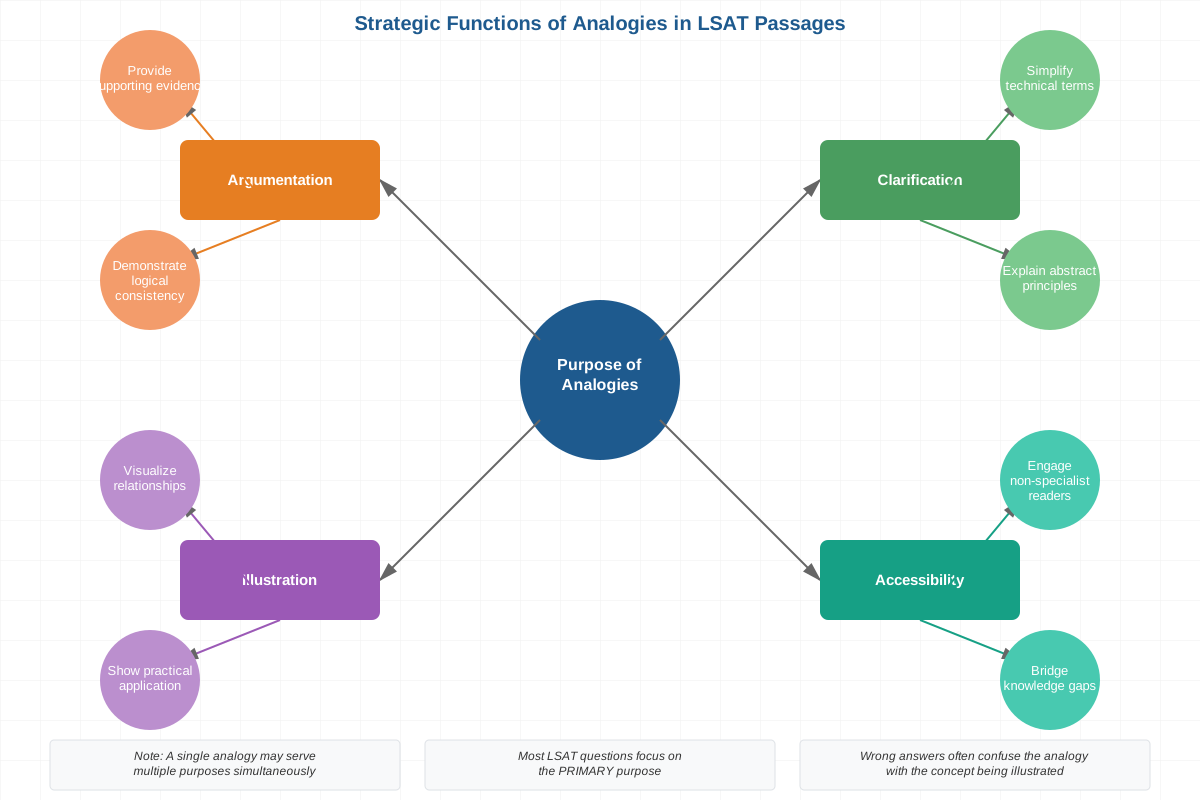
Analogies are one of the most powerful rhetorical devices authors employ in LSAT Reading Comprehension passages, and understanding their purpose of analogies is crucial for achieving a high score. When an author introduces an analogy—comparing an unfamiliar concept to something more familiar—they do so with specific strategic intentions that test-takers must recognize and analyze. The LSAT purpose of analogies extends beyond simple comparison; these devices serve to clarify complex ideas, strengthen arguments, illustrate abstract principles, or make theoretical concepts more accessible to readers. Recognizing why an author chooses to use an analogy, rather than merely identifying that an analogy exists, separates high-scoring test-takers from those who struggle with reading comprehension questions.
In the context of passage fundamentals, understanding the purpose of analogies represents a critical analytical skill that intersects with multiple question types. LSAT passages frequently contain analogies in scientific, legal, philosophical, and humanities contexts, and questions about these analogies test whether students can distinguish between the analogy itself and the underlying concept it illustrates. The test-makers deliberately craft questions that require students to understand not just what is being compared, but why the comparison matters to the author's overall argument or explanation.
Mastering the purpose of analogies connects directly to broader Reading Comprehension skills including identifying main ideas, understanding author's purpose, recognizing argumentative structure, and distinguishing between primary and supporting content. This topic serves as a bridge between literal comprehension and deeper analytical reasoning, requiring students to move beyond surface-level reading to understand the strategic choices authors make when constructing their arguments. The ability to quickly identify and analyze analogies will improve performance across multiple question types, including function questions, purpose questions, and inference questions.
Learning Objectives
- [ ] Identify how Purpose of analogies appears in LSAT questions
- [ ] Explain the reasoning pattern behind Purpose of analogies
- [ ] Apply Purpose of analogies to solve LSAT-style problems accurately
- [ ] Distinguish between the analogy itself and the concept being illustrated
- [ ] Recognize the different strategic purposes analogies serve in passage structure
- [ ] Evaluate whether an analogy strengthens, clarifies, or merely decorates an argument
- [ ] Predict common wrong answer choices in questions about analogical reasoning
Prerequisites
- Basic passage structure recognition: Understanding how LSAT passages are organized helps identify where analogies typically appear and what function they serve within the overall argument
- Ability to identify main ideas vs. supporting details: Analogies are almost always supporting devices, so distinguishing their subordinate role is essential
- Familiarity with author's purpose questions: Many analogy questions ask about authorial intent, requiring baseline understanding of how to analyze why authors make specific rhetorical choices
- Understanding of argument structure: Recognizing premises, conclusions, and supporting evidence helps contextualize how analogies function within logical reasoning
Why This Topic Matters
Understanding the purpose of analogies has significant real-world applications beyond the LSAT. Legal writing frequently employs analogies to precedent cases, scientific communication uses analogies to explain complex phenomena to non-specialists, and philosophical arguments often rely on thought experiments that function as extended analogies. The analytical skill of recognizing why a comparison is being made—rather than simply what is being compared—represents sophisticated critical thinking applicable to law school case analysis, legal brief writing, and oral argumentation.
On the LSAT specifically, questions about analogies appear with high frequency across all Reading Comprehension passage types. Approximately 15-20% of Reading Comprehension questions involve some aspect of analogical reasoning, whether directly asking about the purpose of a specific analogy or requiring students to understand an analogy to answer inference or application questions. These questions appear most commonly as "function" questions (asking what role the analogy plays), "purpose" questions (asking why the author included it), and occasionally as "parallel reasoning" questions (asking students to identify similar analogical structures).
Common manifestations in LSAT passages include: scientific passages using everyday analogies to explain technical processes (e.g., comparing DNA replication to a zipper), legal passages drawing analogies between different areas of law, humanities passages comparing artistic movements or philosophical positions, and social science passages using historical analogies to illuminate contemporary issues. The test-makers favor analogies because they create multiple layers of meaning that can be tested through various question types, making them exceptionally high-yield for both passage construction and question development.
Core Concepts
The Fundamental Nature of Analogies in LSAT Passages
An analogy in LSAT Reading Comprehension is a comparison between two different things that highlights specific similarities for a particular purpose. Unlike metaphors or similes used for purely stylistic effect, LSAT analogies serve functional roles within the passage's argumentative or explanatory structure. The critical distinction for test-takers is recognizing that the LSAT tests understanding of the analogy's purpose—its strategic function—rather than merely testing whether students noticed the comparison.
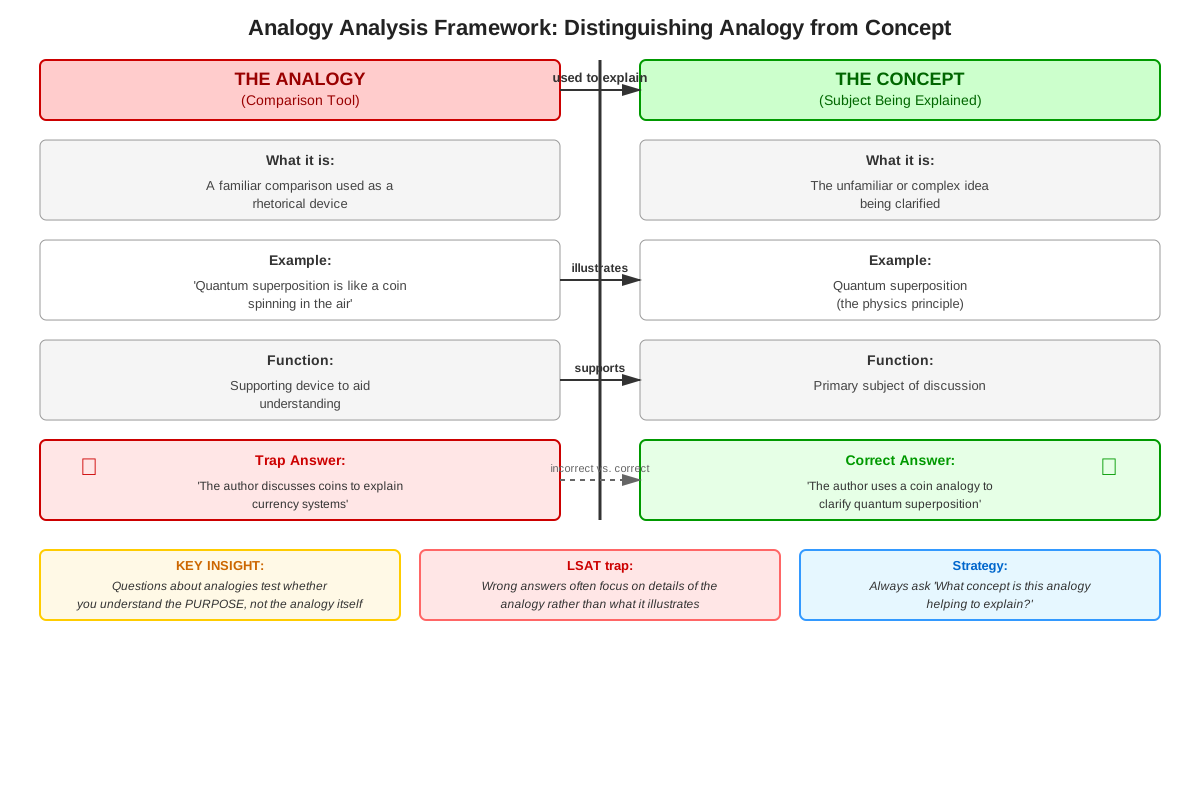
Analogies in LSAT passages typically involve comparing something complex, abstract, or unfamiliar (the target concept) to something simpler, concrete, or familiar (the source domain). For example, an author might compare the structure of legal precedent to the branches of a tree, or compare quantum superposition to a coin spinning in the air. The target concept is what the author actually wants to discuss; the source domain is the tool used to illuminate it.
Primary Strategic Purposes of Analogies
Clarification and Simplification
The most common purpose of analogies in LSAT passages is to clarify a complex or abstract concept by relating it to something more familiar. When an author introduces a difficult scientific principle, legal theory, or philosophical argument, an analogy can make the concept accessible without requiring extensive technical explanation. For instance, a passage about neural networks might compare them to telephone switchboards, allowing readers to grasp the basic concept of information routing without understanding the underlying neuroscience.
Questions testing this purpose often ask: "The author mentions X primarily in order to..." or "The author's discussion of X serves mainly to..." The correct answer will indicate that the analogy helps explain, illustrate, or clarify the target concept. Wrong answers often confuse the analogy with the main point or suggest the analogy introduces a new argument rather than supporting an existing explanation.
Strengthening Arguments
Analogies can serve an argumentative function by suggesting that if two things are similar in known respects, they may be similar in other respects as well. This type of analogy supports the author's position by drawing parallels to accepted principles or successful precedents. For example, an author arguing for regulation of artificial intelligence might draw an analogy to historical regulation of other transformative technologies, suggesting that similar approaches should yield similar benefits.
When analogies serve this purpose, they function as evidence or support for a claim. Questions might ask about the role the analogy plays in the author's argument or how the analogy relates to the author's main conclusion. The key is recognizing that these analogies are not merely illustrative but are doing argumentative work—they're meant to persuade, not just explain.
Illustrating Abstract Principles
Some analogies serve to demonstrate how an abstract principle operates by providing a concrete example. This differs from simple clarification because the focus is on showing the principle in action rather than just making it understandable. For instance, a passage discussing game theory might use the Prisoner's Dilemma analogy not just to explain what game theory is, but to demonstrate how rational actors can produce collectively suboptimal outcomes.
These analogies often appear in philosophical or theoretical passages where the author needs to show the practical implications or applications of abstract ideas. Questions testing this purpose might ask how the analogy relates to the broader principle or what the analogy demonstrates about the theory being discussed.
Highlighting Limitations or Contrasts
Less commonly, authors use analogies to emphasize limitations by showing where a comparison breaks down. An author might introduce an analogy, acknowledge its usefulness, but then explain its limitations to make a more nuanced point. For example, a passage might compare the brain to a computer but then carefully explain why this analogy fails in certain respects, using those failures to highlight unique properties of biological cognition.
Questions about these analogies often include language about limitations, qualifications, or contrasts. The correct answer will recognize that the author is using the analogy critically rather than straightforwardly.
Structural Positions of Analogies
Analogies appear in predictable locations within passage structure, and their position often signals their purpose:
| Position | Typical Purpose | Question Focus |
|---|---|---|
| Early in passage | Introduce main concept accessibly | What role does the analogy play in the passage structure? |
| After complex explanation | Clarify or summarize technical content | Why does the author mention the analogy? |
| Within argument | Support or strengthen a claim | How does the analogy relate to the author's argument? |
| Near objection/counterargument | Illustrate a limitation or contrast | What does the analogy suggest about the theory? |
| Conclusion section | Synthesize or apply main ideas | What is the function of the analogy in context? |
The Analogy vs. The Concept: A Critical Distinction
The most important analytical skill for LSAT purposes is distinguishing between the analogy itself (the source domain) and the concept being illustrated (the target domain). Test-makers exploit this distinction by creating wrong answer choices that discuss the analogy as if it were the main point, or that make claims about the source domain that aren't relevant to the target concept.
For example, if a passage uses the analogy of a chess game to explain strategic legal maneuvering, wrong answers might discuss chess strategy in detail or make claims about games generally, while the correct answer will focus on what the analogy reveals about legal strategy. Students must constantly ask: "Is this answer about the analogy itself, or about what the analogy is meant to illustrate?"
Common Analogy Patterns in LSAT Passages
Certain analogical patterns recur frequently:
- Scientific process → everyday mechanism: Complex scientific processes compared to familiar mechanical or natural phenomena
- Abstract theory → concrete scenario: Philosophical or theoretical concepts illustrated through specific situations
- Legal principle → non-legal parallel: Legal concepts explained through analogies to other domains
- Historical precedent → current situation: Past events used to illuminate contemporary issues
- Natural phenomenon → human creation: Natural processes compared to human-made systems or vice versa
Recognizing these patterns helps students quickly identify the analogy's likely purpose and anticipate how it might be tested.
Concept Relationships
The purpose of analogies connects intimately with several other passage fundamentals. Understanding main idea is prerequisite to recognizing that analogies are supporting devices rather than primary content—the analogy serves the main idea, not vice versa. This relationship flows as: Main Idea → requires support/explanation → Analogy provides that support.
The connection to author's purpose is direct: determining why an author includes an analogy is a specific application of the broader skill of understanding authorial intent. This relationship is bidirectional: Author's Purpose ↔ Purpose of Analogies, as understanding one reinforces understanding of the other.
Passage structure analysis enables students to predict where analogies will appear and what functions they'll likely serve. The relationship flows: Passage Structure → creates context for → Purpose of Analogies → which reinforces understanding of → Passage Structure.
Understanding argument structure is essential for recognizing when analogies serve argumentative versus explanatory purposes. This relationship is hierarchical: Argument Structure (broader concept) → contains → Analogies as evidence/support (specific element).
The skill of distinguishing primary vs. secondary content directly applies to analogy analysis, as analogies are almost always secondary content supporting primary claims. This creates a filtering relationship: Primary/Secondary Distinction → helps identify → Analogies as secondary → which clarifies → Overall passage hierarchy.
Finally, the purpose of analogies connects forward to inference questions and application questions, as understanding an analogy's purpose often enables students to make valid inferences or apply concepts to new situations. This relationship is enabling: Understanding Purpose of Analogies → enables → More sophisticated inference and application.
High-Yield Facts
⭐ Analogies in LSAT passages are almost never the main point—they are supporting devices that clarify, illustrate, or strengthen claims about something else.
⭐ The most common purpose of analogies is clarification—making complex or abstract concepts more accessible through familiar comparisons.
⭐ Questions about analogies typically ask about function or purpose, not about the details of the analogy itself.
⭐ Wrong answers often confuse the analogy (source domain) with the concept being illustrated (target domain), treating the comparison as if it were the primary subject.
⭐ The position of an analogy within passage structure provides clues about its purpose—early analogies typically introduce concepts, while later analogies often clarify or apply them.
- Analogies can serve multiple purposes simultaneously—clarifying while also strengthening an argument—and correct answers may need to capture this dual function.
- Authors sometimes introduce analogies only to highlight their limitations, using the breakdown of the comparison to make a more sophisticated point.
- Scientific passages use analogies more frequently than other passage types, particularly when explaining technical processes to general audiences.
- The LSAT favors analogies that create testable ambiguities—comparisons complex enough to generate multiple plausible interpretations that must be resolved through careful reading.
- Recognizing that an analogy is present is only the first step; the critical skill is determining why the author chose to include it at that specific point in the passage.
- Analogies in LSAT passages are typically explicit and signaled with language like "similar to," "like," "analogous to," "comparable to," or "can be thought of as."
- The strength or weakness of an analogy is often less important than understanding what purpose it serves in the author's overall presentation.
- Questions may ask students to identify what an analogy "illustrates," "demonstrates," "serves to," or "is intended to" do—all variations on purpose questions.
Quick check — test yourself on Purpose of analogies so far.
Try Flashcards →Common Misconceptions
Misconception: The analogy is what the passage is primarily about.
Correction: Analogies are supporting devices, not main topics. The passage is about the target concept (what's being explained), not the source domain (what it's being compared to). If a passage compares DNA to a zipper, it's about DNA, not zippers.
Misconception: All analogies serve the same purpose—to make things easier to understand.
Correction: While clarification is common, analogies serve multiple distinct purposes including strengthening arguments, demonstrating principles in action, highlighting limitations, and providing evidence for claims. Recognizing the specific purpose in context is essential.
Misconception: If an analogy appears in a passage, there will definitely be a question about it.
Correction: Not every analogy generates a direct question, but understanding all analogies is still important because they contribute to overall comprehension and may be relevant to inference or application questions.
Misconception: The correct answer to an analogy question will discuss the details of the comparison.
Correction: Correct answers focus on the function or purpose of the analogy—what work it does in the passage—rather than elaborating on the comparison itself. Answers that get lost in the details of the source domain are typically wrong.
Misconception: Analogies are always helpful and strengthen the author's argument.
Correction: Authors sometimes introduce analogies to critique them or show their limitations. Some analogies are presented as common but flawed ways of thinking about a concept. Always check whether the author endorses or questions the analogy.
Misconception: Understanding an analogy means understanding both things being compared equally well.
Correction: You need to understand the target concept (what's being explained) thoroughly, but you only need to understand the source domain (the comparison) well enough to see how it illuminates the target. Deep knowledge of the source domain is usually unnecessary.
Misconception: Longer, more elaborate analogies are more important than brief ones.
Correction: Length doesn't determine importance. A single-sentence analogy can be just as functionally significant as a paragraph-long comparison. Focus on purpose, not length.
Worked Examples
Example 1: Scientific Passage with Clarifying Analogy
Passage Excerpt:
"The process by which ribosomes synthesize proteins can be understood through an analogy to a factory assembly line. Just as an assembly line receives instructions in the form of blueprints and uses those instructions to assemble component parts into finished products, ribosomes receive instructions in the form of messenger RNA and use those instructions to assemble amino acids into proteins. The ribosome moves along the mRNA strand, 'reading' each codon and adding the corresponding amino acid to the growing protein chain, much as a worker might move along an assembly line, consulting instructions and adding parts at each station."
Question: The author's discussion of a factory assembly line serves primarily to:
(A) Argue that biological processes are essentially mechanical in nature
(B) Illustrate the complexity of protein synthesis
(C) Clarify how ribosomes use genetic information to build proteins
(D) Suggest that ribosomes operate more efficiently than human-made systems
(E) Introduce a debate about whether biological processes can be fully understood through mechanical analogies
Analysis:
First, identify the target concept (what's being explained): protein synthesis by ribosomes. The source domain (what it's compared to): factory assembly line.
Next, determine the analogy's purpose by examining its context and function. The author introduces the analogy immediately when beginning to explain protein synthesis, using language like "can be understood through." This signals a clarifying purpose. The analogy breaks down a complex biological process into familiar terms (blueprints, workers, assembly lines) that make the process more accessible.
Evaluate each answer:
(A) Makes a claim about the nature of biological processes generally—this goes far beyond what the analogy is meant to do. The analogy is a tool for explanation, not an argument about the essential nature of biology. Eliminate.
(B) Focuses on complexity, but the analogy actually simplifies rather than emphasizing complexity. The purpose is to make protein synthesis more understandable, not to stress how complex it is. Eliminate.
(C) Directly states the clarifying purpose: the analogy helps explain how ribosomes use mRNA (genetic information) to build proteins. This matches the function of making a complex process understandable. Strong contender.
(D) Makes a comparative claim about efficiency that doesn't appear in the passage. The analogy isn't evaluative—it doesn't suggest one system is better than the other. Eliminate.
(E) Introduces a debate that doesn't exist in the passage. The author uses the analogy straightforwardly without questioning whether such analogies are valid. Eliminate.
Correct Answer: (C)
The analogy serves to clarify the mechanism of protein synthesis by relating it to a familiar process. This example demonstrates the most common purpose of analogies in LSAT passages: making complex concepts accessible through familiar comparisons.
Example 2: Legal Passage with Argumentative Analogy
Passage Excerpt:
"Critics of the proposed data privacy regulations argue that they impose undue burdens on technology companies. However, this objection ignores relevant precedent. When automobile safety regulations were first proposed in the mid-twentieth century, manufacturers similarly complained about excessive costs and implementation challenges. Yet these regulations ultimately proved both feasible and beneficial, reducing traffic fatalities while allowing the automotive industry to continue thriving. The parallel to data privacy is clear: initial resistance to protective regulations often gives way to successful implementation once industries adapt to new standards."
Question: The author mentions automobile safety regulations primarily in order to:
(A) Demonstrate that all industry objections to regulation are unfounded
(B) Provide historical context for understanding current debates about technology regulation
(C) Suggest that data privacy regulations will reduce harm in ways analogous to how safety regulations reduced traffic deaths
(D) Support the argument that objections to data privacy regulations may prove unfounded, as similar objections to automotive regulations did
(E) Argue that the technology industry should follow the same regulatory model as the automotive industry
Analysis:
Identify the target concept: data privacy regulations and objections to them. The source domain: automobile safety regulations and historical objections to them.
Determine the analogy's purpose by examining its argumentative context. The author is responding to critics who claim the regulations impose undue burdens. The analogy to automotive regulations serves as a counterexample—a precedent where similar objections proved unfounded. The phrase "the parallel is clear" signals that the author is drawing an argumentative connection, not just explaining a concept.
Evaluate each answer:
(A) Uses absolute language ("all industry objections") that's too strong. The author makes a specific argument about these particular objections based on one precedent, not a universal claim. Eliminate.
(B) Suggests the purpose is merely to provide context, but the analogy does more—it actively supports the author's argument against the critics. This understates the analogy's argumentative function. Eliminate.
(C) Focuses on the parallel between reducing traffic deaths and reducing data privacy harms. While the passage mentions benefits, the primary purpose is addressing the objections about feasibility and burden, not comparing the specific types of harm prevented. Eliminate.
(D) Captures the argumentative purpose: the analogy supports the author's position by showing that similar objections in a parallel case proved unfounded. This directly addresses the critics' concerns using historical precedent. Strong contender.
(E) Suggests the author advocates for the same regulatory model, but the passage focuses on the pattern of objections and adaptation, not on specific regulatory approaches. Eliminate.
Correct Answer: (D)
This analogy serves an argumentative purpose—strengthening the author's position by providing a precedent where similar objections proved unfounded. This example demonstrates how analogies can function as evidence within an argument, not merely as explanatory devices.
Exam Strategy
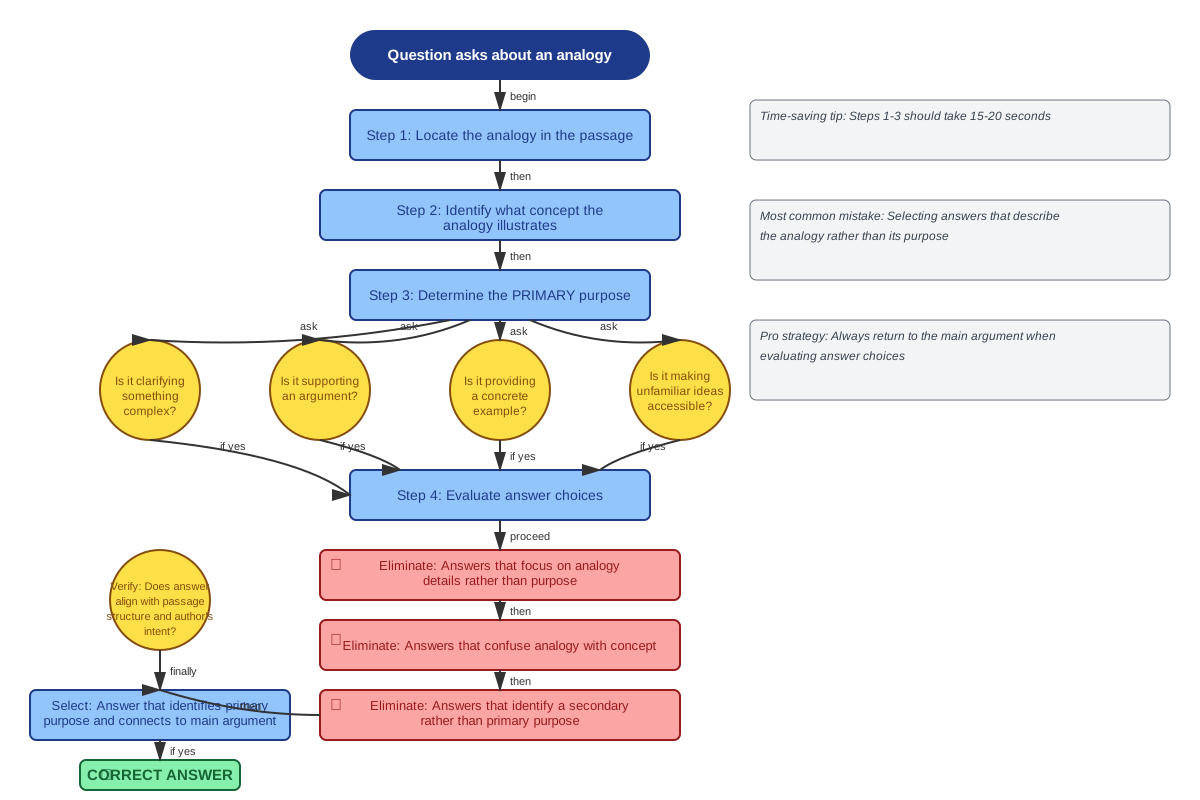
When approaching questions about the purpose of analogies, follow this systematic process:
Step 1: Identify the Analogy Structure
Quickly determine what is being compared to what. Ask: "What is the target concept (what the author actually wants to discuss)?" and "What is the source domain (what it's being compared to)?" This prevents confusion between the analogy and the concept.
Step 2: Locate the Analogy in Passage Structure
Note where the analogy appears. Is it introducing a new concept? Following a complex explanation? Supporting an argument? Responding to an objection? Position provides strong clues about purpose.
Step 3: Examine Surrounding Language
Look for purpose-indicating phrases: "can be understood as," "similar to," "like," "illustrates," "demonstrates," "analogous to." Also note whether the author endorses the analogy or qualifies it with limitations.
Step 4: Determine the Primary Function
Ask: "What would be lost if this analogy were removed?" If the answer is "clarity" or "understanding," the purpose is explanatory. If the answer is "support for the argument" or "evidence," the purpose is argumentative.
Trigger Words and Phrases to Watch For:
In questions:
- "serves primarily to"
- "functions mainly to"
- "is intended to"
- "the author mentions X in order to"
- "the purpose of the discussion of X"
- "the author's reference to X serves to"
In passages:
- "can be thought of as"
- "analogous to"
- "similar to"
- "like"
- "comparable to"
- "parallels"
- "mirrors"
Process of Elimination Tips:
Eliminate answers that treat the analogy as the main point. If an answer focuses extensively on the source domain without connecting it to the target concept, it's likely wrong.
Eliminate answers that overstate the analogy's scope. Analogies support specific points; answers suggesting they prove universal claims are typically incorrect.
Eliminate answers that confuse explanation with argument. If the analogy clarifies rather than persuades, answers using argumentative language ("argues," "proves," "demonstrates that") are wrong.
Eliminate answers that introduce purposes not evident in the passage. If the passage doesn't suggest limitations or criticisms of the analogy, answers discussing these are likely wrong.
Time Allocation Advice:
Purpose of analogy questions are typically medium difficulty and should take 45-60 seconds once you've read the passage. Don't spend excessive time re-reading the analogy itself; instead, focus on its context and function. If you've understood the passage structure during your initial read, these questions should be relatively quick. If you find yourself struggling, you may need to briefly review the paragraph containing the analogy to understand its role in the author's overall presentation.
Memory Techniques
The PACES Framework for Analogy Purpose:
- Purpose: What is the author trying to accomplish?
- Audience: What does the analogy assume the reader knows?
- Concept: What is the target concept being explained or supported?
- Evidence: Is the analogy serving as evidence for a claim?
- Structure: Where does the analogy appear in the passage organization?
Visualization Strategy:
Picture analogies as bridges connecting two islands. One island (the source domain) is familiar territory where the reader feels comfortable. The other island (the target concept) is unfamiliar territory the author wants the reader to explore. The bridge (the analogy) allows the reader to use their knowledge of the familiar island to understand the unfamiliar one. When answering questions, ask: "Which island is the passage really about?" The answer is always the target concept, not the source domain.
The "Target vs. Tool" Mnemonic:
Remember: Target is the Topic; the analogy is just a Tool. This triple-T reminder helps prevent the common error of treating the analogy as if it were the main subject.
Purpose Categories Acronym: CASH
Most analogies serve to:
- Clarify complex concepts
- Argue for a position
- Show principles in action
- Highlight limitations or contrasts
When evaluating answer choices, check which CASH category fits the analogy's function.
Summary
Understanding the purpose of analogies is a high-yield skill for LSAT Reading Comprehension that requires distinguishing between what is being compared (the analogy itself) and what the comparison is meant to accomplish (its strategic purpose). Analogies serve multiple functions including clarifying complex concepts, strengthening arguments, illustrating abstract principles, and highlighting limitations. The most critical analytical skill is recognizing that analogies are supporting devices, not main points—they illuminate target concepts rather than being the primary subject of discussion. Questions about analogies typically focus on function and purpose, asking why the author included the comparison at that specific point in the passage. Success requires identifying the target concept, determining the analogy's position in passage structure, examining surrounding language for purpose indicators, and eliminating wrong answers that confuse the source domain with the target concept or that overstate the analogy's scope. The ability to quickly analyze analogical reasoning improves performance across multiple question types and represents sophisticated critical thinking applicable throughout law school and legal practice.
Key Takeaways
- Analogies are supporting devices that serve specific strategic purposes—clarifying concepts, strengthening arguments, illustrating principles, or highlighting limitations—not decorative language or main points
- Always distinguish between the target concept (what's being explained) and the source domain (what it's compared to); passages are about targets, not sources
- The position of an analogy within passage structure provides strong clues about its purpose: early analogies typically introduce, middle analogies clarify, and later analogies apply or synthesize
- Questions about analogies focus on function and purpose using language like "serves to," "functions to," or "is intended to"—correct answers explain what work the analogy does
- Wrong answers commonly treat the analogy as the main point, focus excessively on source domain details, overstate the analogy's scope, or confuse explanatory with argumentative purposes
- The most common purpose is clarification, but recognizing when analogies serve argumentative functions (as evidence or support) is essential for higher-level questions
- Understanding analogy purpose enables better performance on inference and application questions by clarifying the relationships between concepts in the passage
Related Topics
Author's Purpose and Tone: Understanding why authors include specific elements like analogies connects directly to broader analysis of authorial intent and attitude. Mastering analogy purpose strengthens the ability to answer global purpose questions and recognize subtle shifts in tone.
Argument Structure and Reasoning: Recognizing when analogies serve argumentative versus explanatory functions requires understanding how premises support conclusions. This topic enables deeper analysis of logical relationships within passages.
Inference Questions: Many inference questions require understanding analogies to draw valid conclusions about concepts. Mastering analogy purpose provides the foundation for making sophisticated inferences about relationships between ideas.
Function Questions: Questions asking about the function of specific passage elements (paragraphs, sentences, examples) use the same analytical framework as analogy purpose questions. Skills transfer directly between these question types.
Comparative Reading: In comparative passages, authors sometimes use analogies to highlight similarities or differences between perspectives. Understanding analogy purpose enhances the ability to analyze relationships between paired passages.
Practice CTA
Now that you understand the purpose of analogies in LSAT Reading Comprehension, it's time to apply these concepts to actual practice questions. Work through the practice problems focusing specifically on identifying target concepts, determining analogical purposes, and eliminating wrong answers that confuse source domains with target concepts. Pay special attention to the position of analogies within passage structure and the language authors use to signal purpose. Each practice question you complete strengthens your ability to quickly and accurately analyze analogical reasoning under timed conditions. Remember: recognizing that an analogy exists is just the beginning—understanding why the author included it is what separates good scores from great ones. You've built the conceptual foundation; now build the execution skills through deliberate practice!
Sign up free to keep reading
Create a free AnvayaPrep account to finish this LSAT guide on Purpose of analogies — plus flashcards and practice questions.