Overview
The purpose of concessions is a critical rhetorical device that appears frequently in LSAT Reading Comprehension passages. A concession occurs when an author acknowledges a point that appears to contradict or weaken their main argument before explaining why their position remains valid despite this acknowledgment. Understanding why authors make concessions—and how these concessions function within the broader argumentative structure—is essential for accurately interpreting passage tone, identifying the author's main point, and answering questions about argumentative strategy.
On the LSAT, recognizing concessions helps test-takers distinguish between what an author genuinely believes and what they acknowledge merely to address potential objections. Authors use concessions strategically to demonstrate intellectual honesty, preempt counterarguments, and ultimately strengthen their position by showing they have considered alternative viewpoints. This rhetorical move appears in approximately 60-70% of LSAT Reading Comprehension passages, making it one of the most frequently tested passage fundamentals concepts.
Mastering the lsat purpose of concessions connects directly to other essential reading comprehension skills, including identifying main points, understanding author attitude, recognizing argumentative structure, and evaluating the strength of reasoning. When students can identify concessions and understand their strategic purpose, they gain a significant advantage in answering questions about why an author mentions specific information, how different parts of a passage relate to each other, and what the author's true position is on contested issues.
Learning Objectives
- [ ] Identify how Purpose of concessions appears in LSAT questions
- [ ] Explain the reasoning pattern behind Purpose of concessions
- [ ] Apply Purpose of concessions to solve LSAT-style problems accurately
- [ ] Distinguish between genuine concessions and statements that represent the author's actual position
- [ ] Recognize common linguistic markers that signal concessions in passages
- [ ] Analyze how concessions function to strengthen rather than weaken an author's argument
- [ ] Predict the type of information that typically follows a concession statement
Prerequisites
- Basic argument structure: Understanding claims, evidence, and conclusions is necessary because concessions function as specific components within larger arguments
- Author's tone and attitude: Recognizing whether an author supports, opposes, or remains neutral about ideas helps distinguish concessions from endorsed positions
- Passage organization: Familiarity with how passages are structured enables students to see where concessions typically appear and what function they serve
- Counterarguments: Understanding opposing viewpoints is essential because concessions often acknowledge these alternative perspectives before refuting them
Why This Topic Matters
Understanding concessions has real-world significance beyond the LSAT. In legal writing, attorneys must acknowledge opposing arguments before distinguishing their client's case. In academic discourse, scholars demonstrate intellectual rigor by addressing potential objections to their theories. In policy debates, effective advocates acknowledge legitimate concerns before explaining why their proposal remains sound. The ability to recognize and evaluate concessions is fundamental to critical thinking and persuasive communication.
On the LSAT specifically, questions about the purpose of concessions appear in multiple forms across Reading Comprehension sections. Approximately 15-20% of Reading Comprehension questions directly or indirectly test understanding of concessions. These questions may ask about the author's purpose in mentioning specific information, the function of a particular paragraph, the relationship between different claims, or the author's attitude toward a viewpoint. Additionally, understanding concessions is crucial for eliminating wrong answer choices that mischaracterize the author's position by treating acknowledged objections as if they were the author's own views.
Common manifestations in LSAT passages include: authors in science passages acknowledging limitations of a new theory while arguing for its overall validity; legal scholars recognizing traditional interpretations before proposing alternative readings; historians admitting gaps in evidence while maintaining their thesis; and critics conceding positive aspects of a work before explaining why it ultimately fails. The ability to identify these patterns and understand their strategic purpose directly impacts performance on some of the highest-yield question types in Reading Comprehension.
Core Concepts
What Constitutes a Concession
A concession is a statement in which an author acknowledges a point that appears to undermine, contradict, or complicate their main argument. Concessions typically involve admitting that an opposing viewpoint has some merit, that evidence exists which doesn't perfectly support the author's position, or that the author's argument has limitations. Crucially, concessions are not the author's primary position—they are acknowledgments made in service of a larger argumentative goal.
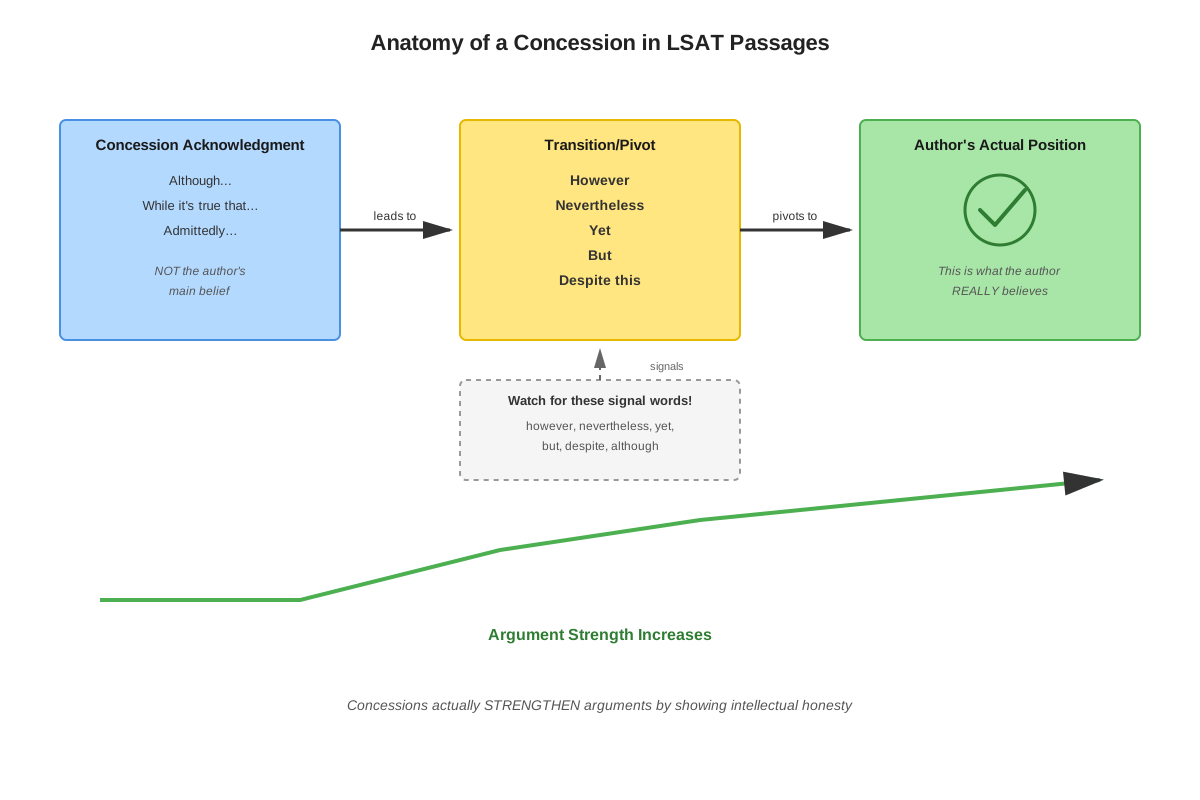
The structure of a concession typically follows this pattern: acknowledgment of opposing point + transition + reassertion or refinement of main argument. For example: "While critics correctly note that the new policy has implementation challenges, these obstacles are surmountable and do not undermine the policy's fundamental soundness." The first clause concedes a point to critics; the second clause uses that concession to strengthen the overall argument by showing the author has considered and addressed objections.
Why Authors Make Concessions
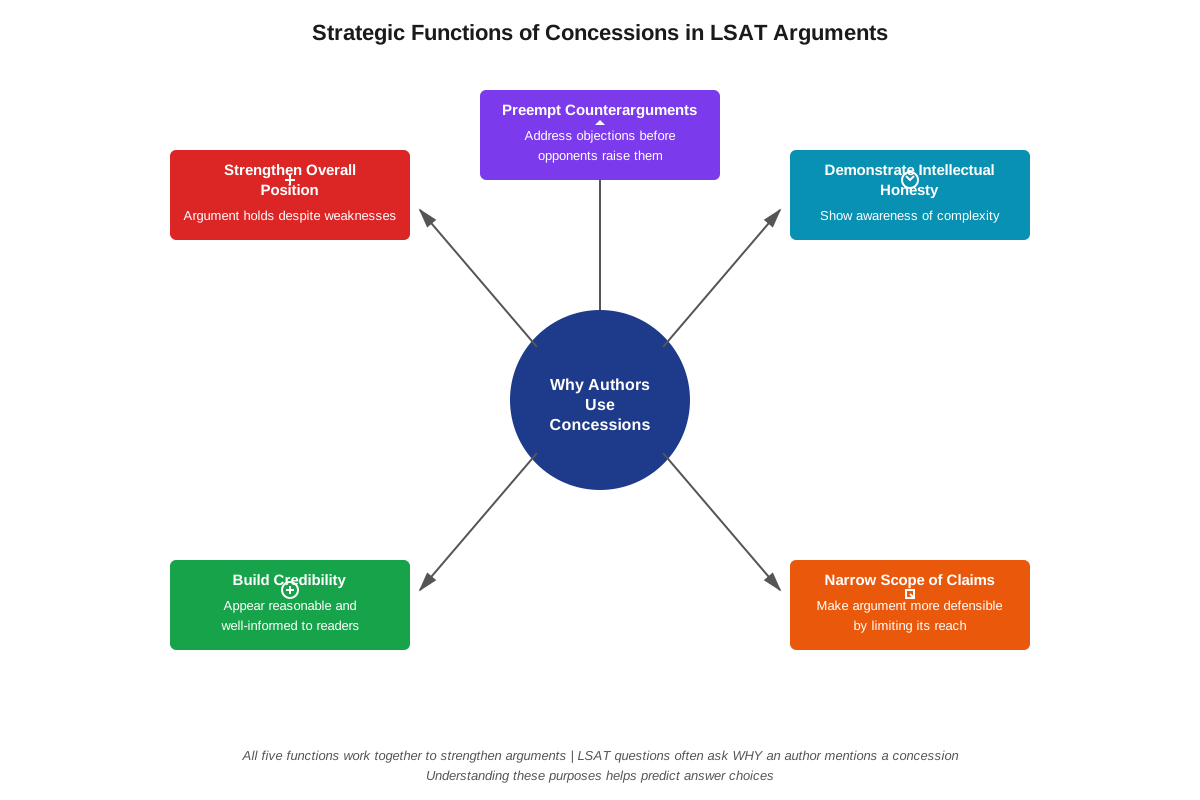
Authors employ concessions for several strategic purposes, all of which ultimately serve to strengthen their arguments:
Establishing credibility: By acknowledging legitimate objections or limitations, authors demonstrate they have thoroughly considered the issue and are not ignoring inconvenient facts. This intellectual honesty makes their overall argument more persuasive.
Preempting counterarguments: Addressing potential objections before critics can raise them allows authors to control the framing of these issues and provide their own interpretation of seemingly contradictory evidence.
Narrowing the scope of disagreement: Concessions can identify areas of agreement with opponents, allowing authors to focus debate on the specific points where they genuinely differ. This makes arguments more precise and harder to dismiss.
Creating contrast: By explicitly stating what they are NOT arguing, authors can more clearly define what they ARE arguing. The concession serves as a foil that highlights the author's actual position.
Demonstrating nuance: Complex issues rarely have simple answers. Concessions show that authors recognize complexity and are making sophisticated, qualified claims rather than oversimplified assertions.
Linguistic Markers of Concessions
LSAT passages use predictable language patterns to signal concessions. Recognizing these markers helps test-takers quickly identify when an author is making a concession:
Concessive conjunctions and phrases:
- Although, though, even though, while
- Despite, in spite of, notwithstanding
- Granted, admittedly, to be sure, certainly
- It is true that, one cannot deny that
Qualified acknowledgments:
- May, might, could, possibly
- Some, certain, particular
- To some extent, in some cases, partially
Contrast indicators that follow concessions:
- However, nevertheless, nonetheless, yet, still
- But, even so, all the same
- That said, having said that, be that as it may
The Concession-Refutation Pattern
The most common structure involving concessions follows a predictable pattern:
- Concession: Author acknowledges an opposing point, limitation, or complicating factor
- Transition: Signal word indicating a shift back to the author's position
- Refutation or Qualification: Author explains why their argument remains valid despite the concession
This pattern appears so frequently in LSAT passages that recognizing it becomes a powerful comprehension tool. When students identify a concession, they should immediately anticipate that the author's actual position will follow shortly, often introduced by a contrast word.
Concessions vs. Author's Position
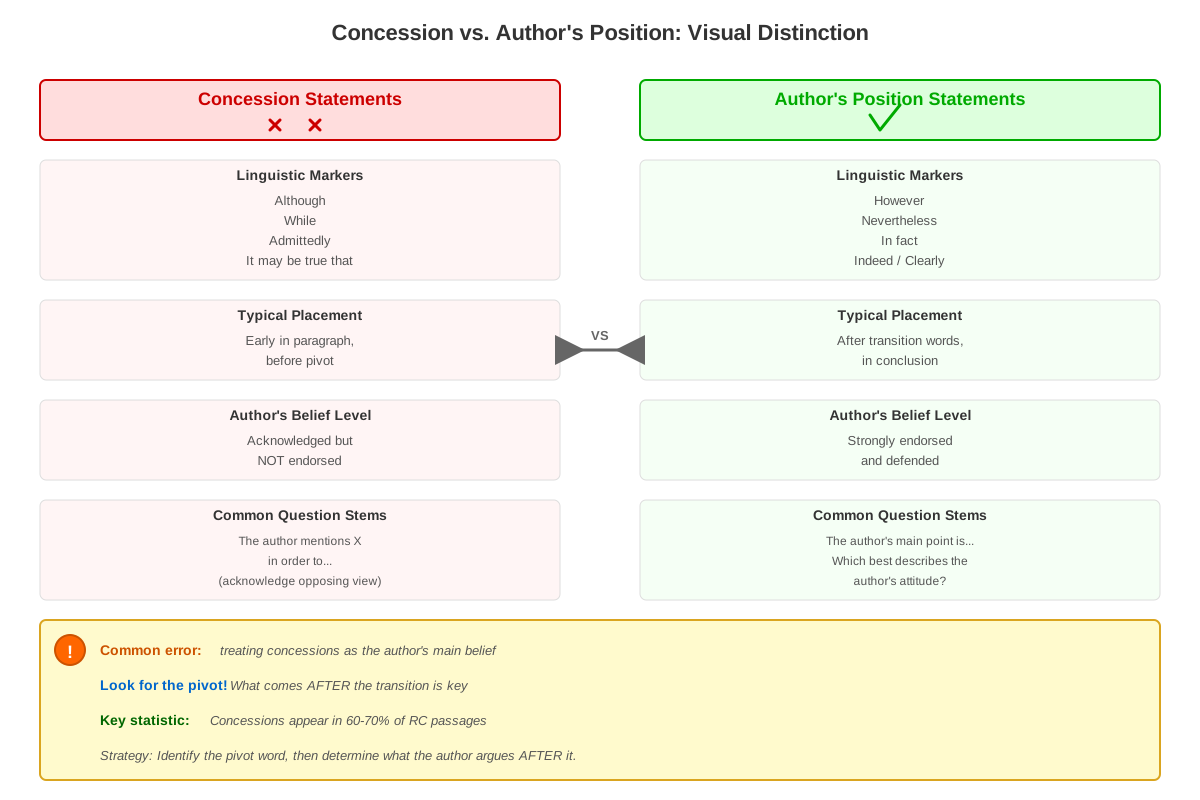
A critical skill is distinguishing between points the author concedes and points the author actually endorses. Wrong answer choices frequently exploit this distinction by presenting conceded points as if they were the author's main argument, or by suggesting the author opposes something they merely acknowledge as having some validity.
| Concession | Author's Actual Position |
|---|---|
| Acknowledged but not endorsed | Endorsed and supported |
| Often preceded by "although," "while," "granted" | Often follows contrast words like "however," "but," "nevertheless" |
| Represents opposing viewpoint or limitation | Represents author's thesis or main point |
| Typically receives less development | Receives more extensive explanation and evidence |
| May be accurate but not central to author's argument | Central to what author wants readers to accept |
Function Within Passage Structure
Concessions typically appear at specific locations within passages, and their placement reveals their function:
In introductory paragraphs: Concessions may acknowledge traditional views or common assumptions that the passage will challenge or complicate.
Before major claims: Authors often concede potential objections immediately before or after stating controversial positions, addressing doubts preemptively.
In transitional paragraphs: When shifting between topics or perspectives, authors may concede points about one aspect before focusing on another.
In concluding sections: Final concessions often acknowledge limitations of the author's argument while maintaining that the core thesis remains valid despite these limitations.
Concept Relationships
The purpose of concessions connects intimately with multiple other reading comprehension concepts. Understanding author's attitude is prerequisite to identifying concessions because students must recognize when an author is distancing themselves from a viewpoint they're describing. The concession itself then feeds into understanding argumentative structure—concessions typically appear at predictable points in arguments, often immediately before the author's main claim or counterargument.
Concessions also relate directly to point-counterpoint structure, where passages present multiple perspectives on an issue. In these passages, concessions help readers track which viewpoint belongs to whom and what the author's actual position is among competing views. Additionally, understanding concessions enhances comprehension of tone and purpose questions, as recognizing that an author is making a strategic concession rather than expressing genuine agreement affects interpretation of the author's overall attitude.
The relationship map flows as follows: Recognition of concessive language markers → Identification of concession → Anticipation of contrast/refutation → Understanding of author's actual position → Accurate answers to purpose, function, and attitude questions. Each step builds on the previous one, making the initial recognition of concessions the crucial first move in a chain of comprehension.
High-Yield Facts
⭐ Concessions are strategic moves that ultimately strengthen rather than weaken an author's argument by demonstrating intellectual honesty and preempting objections
⭐ The most common concession pattern is: concession + contrast word (however, but, nevertheless) + author's actual position
⭐ Words like "although," "while," "granted," and "admittedly" are high-frequency markers that signal concessions
⭐ Wrong answer choices frequently mischaracterize concessions as the author's main position or primary argument
⭐ When an author concedes a point, the information immediately following (usually after a contrast word) reveals what the author actually believes
- Concessions typically acknowledge opposing viewpoints, limitations of the author's argument, or complicating factors
- Authors use concessions to narrow the scope of disagreement and focus debate on specific contested points
- Recognizing concessions helps distinguish between what an author mentions and what an author endorses
- Concessions appear in approximately 60-70% of LSAT Reading Comprehension passages
- Questions asking about "the author's purpose in mentioning" specific information often test understanding of concessions
- Concessions demonstrate nuance and sophistication in argumentation, showing authors recognize complexity
- The amount of text devoted to a point indicates its importance; concessions typically receive less development than the author's main claims
Quick check — test yourself on Purpose of concessions so far.
Try Flashcards →Common Misconceptions
Misconception: If an author mentions a viewpoint, they must agree with it → Correction: Authors frequently mention viewpoints they disagree with, especially when making concessions. The key is identifying whether the author endorses the viewpoint or merely acknowledges it before refuting or qualifying it.
Misconception: Concessions weaken an author's argument by admitting flaws → Correction: Concessions strategically strengthen arguments by demonstrating the author has considered objections and can address them. An argument that acknowledges and responds to limitations is more credible than one that ignores them.
Misconception: The first viewpoint mentioned in a passage is always the author's position → Correction: Passages often begin by describing traditional views or common assumptions that the author will challenge. These opening descriptions may be concessions to conventional wisdom before the author presents their contrasting perspective.
Misconception: Words like "however" and "but" always signal the author's main point → Correction: While contrast words often introduce the author's position after a concession, they can also signal other types of transitions. The context and overall structure determine whether a contrast word is introducing the author's view or another shift in the argument.
Misconception: If an author concedes that an opposing view has merit, they are being inconsistent or contradictory → Correction: Acknowledging that opposing views have some validity while maintaining an overall different position is a sign of sophisticated argumentation, not inconsistency. Complex issues often involve legitimate points on multiple sides.
Misconception: Concessions only appear at the beginning of passages → Correction: While concessions often appear early when authors acknowledge traditional views, they can occur anywhere in a passage—before major claims, in transitional paragraphs, or even in conclusions when authors acknowledge limitations while maintaining their thesis.
Worked Examples
Example 1: Science Passage Concession
Passage excerpt: "While critics of the new climate model correctly point out that it relies on incomplete historical data and makes certain simplifying assumptions about atmospheric dynamics, these limitations do not undermine the model's utility for predicting broad temperature trends. The model's projections align closely with observed warming patterns over the past three decades, and its simplified approach actually makes it more computationally efficient than more complex alternatives without sacrificing meaningful accuracy."
Question: The author mentions the "incomplete historical data" and "simplifying assumptions" primarily in order to:
(A) Argue that the climate model is fundamentally flawed
(B) Acknowledge limitations while maintaining the model's overall validity
(C) Suggest that critics have misunderstood the model's methodology
(D) Demonstrate that all climate models face similar challenges
(E) Introduce technical details that will be explained later in the passage
Analysis:
Step 1: Identify the concession. The phrase "While critics...correctly point out" signals that the author is acknowledging an opposing viewpoint. The author admits that critics are "correct" about the incomplete data and simplifying assumptions.
Step 2: Locate the transition. The word "these limitations do not undermine" serves as the pivot point where the author moves from concession to their actual position.
Step 3: Identify the author's actual position. After the transition, the author argues that despite these acknowledged limitations, the model remains useful and accurate. The author provides evidence (alignment with observed patterns, computational efficiency) to support this position.
Step 4: Evaluate answer choices. (A) contradicts the author's position—they defend the model despite acknowledging limitations. (C) is incorrect because the author agrees critics are correct about these points. (D) may be true but isn't the purpose of mentioning these specific limitations. (E) is incorrect because the author doesn't develop these technical details further; they're mentioned to be dismissed as non-fatal flaws.
Answer: (B) The author uses the classic concession pattern: acknowledge critics' valid points, then explain why the overall argument (the model's validity) remains sound despite these points.
Example 2: Legal Theory Passage Concession
Passage excerpt: "Admittedly, the originalist approach to constitutional interpretation has the advantage of constraining judicial discretion and providing a seemingly objective standard for decision-making. However, this apparent objectivity is illusory. Historical evidence about the framers' intentions is often ambiguous, incomplete, or contradictory, requiring judges to make subjective choices about which historical sources to privilege and how to interpret them. Moreover, originalism fails to account for how constitutional principles should apply to technologies and social arrangements that the framers could not have anticipated."
Question: The author's attitude toward the "advantage" of originalism mentioned in the first sentence can best be described as:
(A) Enthusiastic endorsement
(B) Qualified acceptance
(C) Skeptical acknowledgment
(D) Hostile rejection
(E) Neutral description
Analysis:
Step 1: Identify the concession marker. "Admittedly" is a clear signal that the author is conceding a point rather than endorsing it.
Step 2: Determine what is being conceded. The author acknowledges that originalism has "the advantage" of constraining discretion and providing an objective standard.
Step 3: Locate the author's actual position. "However, this apparent objectivity is illusory" directly contradicts the conceded advantage. The author then provides two reasons why the advantage is more apparent than real.
Step 4: Assess the author's attitude. The author mentions the advantage only to dismiss it as illusory. This is acknowledgment (the author recognizes that proponents claim this advantage) combined with skepticism (the author doesn't believe the advantage is real).
Answer: (C) The author skeptically acknowledges what originalism's proponents claim as an advantage, but the overall passage structure makes clear the author doesn't genuinely accept this as a real advantage. (B) is tempting but incorrect because "qualified acceptance" suggests the author thinks there's some validity to the advantage, whereas the author argues it's "illusory."
Exam Strategy
When approaching LSAT Reading Comprehension questions involving concessions, employ this systematic strategy:
During initial passage reading: Mark concessive language markers (although, while, granted, admittedly) and the contrast words that follow them (however, but, nevertheless). This creates a visual map of where the author concedes points versus where they state their actual position. Many test-takers benefit from using different notation for concessions (perhaps "C") versus main points (perhaps "MP") in the margin.
Trigger words to watch for: Train yourself to slow down and pay extra attention when encountering concessive language. The most common triggers are "although," "while," "granted," "admittedly," "to be sure," "certainly," and "it is true that." When you see these phrases, immediately anticipate that the author's actual position will follow, usually after a contrast word.
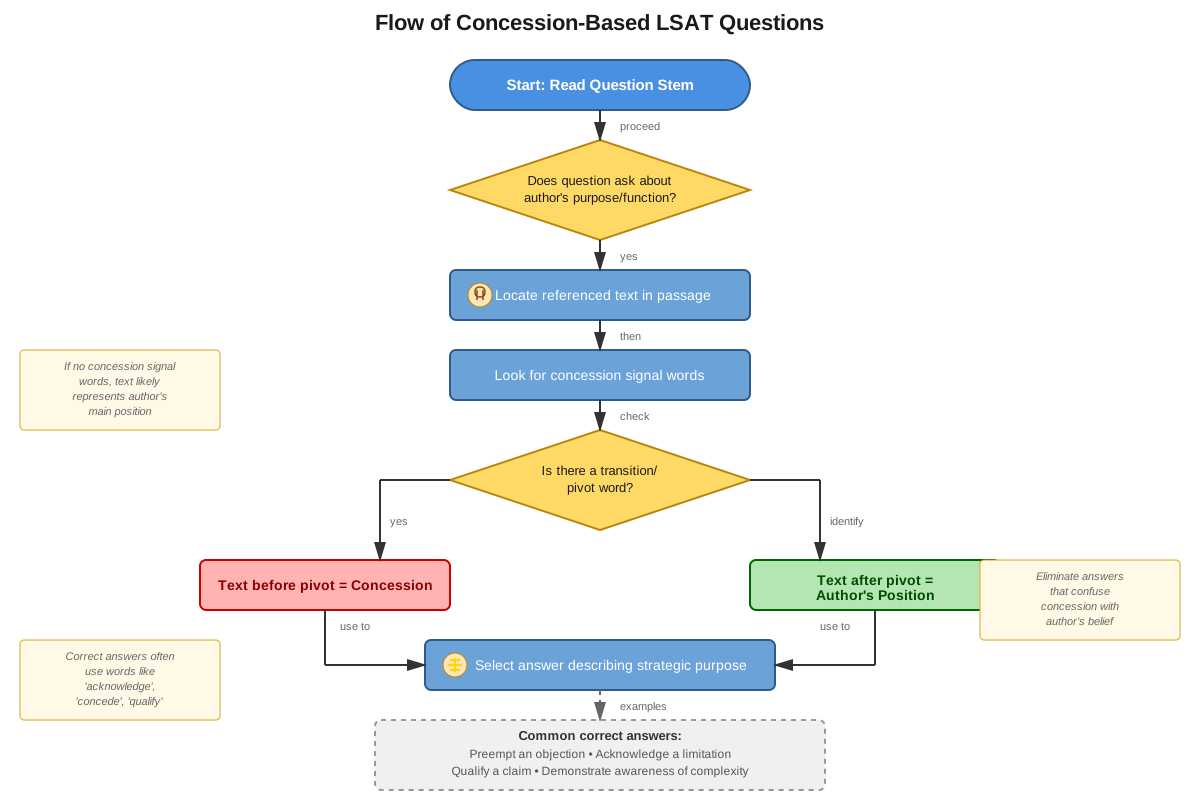
For "purpose" questions: When a question asks why the author mentions specific information, consider whether that information is a concession. If it is, the correct answer will typically indicate that the author is acknowledging an opposing view, addressing a potential objection, or recognizing a limitation before explaining why their argument remains valid. Wrong answers will often suggest the author endorses the conceded point.
Process of elimination strategy: Eliminate answer choices that:
- Treat concessions as the author's main argument
- Suggest the author strongly endorses points they merely acknowledge
- Ignore the contrast and refutation that follow concessions
- Mischaracterize acknowledgment of complexity as inconsistency or confusion
Time allocation: Don't spend excessive time on concessions during initial reading, but do mark them clearly. The payoff comes when answering questions—your notation allows you to quickly relocate concessions and understand their function without re-reading large sections.
For attitude questions: Remember that the author's attitude toward a conceded point is typically neutral-to-negative acknowledgment, not endorsement. If an author concedes that "critics correctly note" something, the author's attitude is "acknowledging" or "recognizing," not "agreeing with" or "supporting."
Exam Tip: If you're stuck between two answer choices on a purpose or function question, check whether one choice treats a concession as the author's position. This is one of the most common wrong answer traps in Reading Comprehension.
Memory Techniques
The "ACR" Pattern: Remember that concessions follow the Acknowledge-Contrast-Refute pattern. When you see an acknowledgment (concession), expect a Contrast word, followed by the Refutation or refinement of the author's actual position.
The "WAGA" Mnemonic: Common concession markers can be remembered as While-Although-Granted-Admittedly. When you see WAGA words, you're likely reading a concession.
The "HBN" Mnemonic: After concessions, look for However-But-Nevertheless to signal the author's actual position.
Visualization Strategy: Picture concessions as speed bumps in the road of an argument. The author slows down briefly to acknowledge an obstacle (the concession), but then continues forward in their original direction (their actual argument). The concession doesn't change the destination; it just shows the author has noticed potential problems and can navigate around them.
The "Not-But" Framework: Many concessions can be mentally translated into "Not [conceded point], but [author's actual position]." For example: "While the theory has limitations" = "Not perfect, but still valid." This framework helps distinguish what the author is distancing themselves from versus what they're endorsing.
Spatial Memory Technique: Concessions typically appear in predictable locations—often in the first paragraph (acknowledging traditional views), immediately before major claims (preempting objections), or in conclusions (acknowledging limitations). Visualizing these typical locations helps you anticipate when concessions are likely to appear.
Summary
The purpose of concessions is a high-yield concept in LSAT Reading Comprehension that appears in the majority of passages and underlies many question types. Concessions occur when authors acknowledge points that appear to contradict or weaken their arguments, but they serve the strategic purpose of strengthening those arguments by demonstrating intellectual honesty, preempting counterarguments, and establishing credibility. The typical pattern involves a concessive marker (although, while, granted), followed by the acknowledged point, then a contrast word (however, but, nevertheless), and finally the author's actual position. Success on LSAT questions requires distinguishing between what authors concede and what they genuinely endorse—a distinction that wrong answer choices frequently exploit. By recognizing linguistic markers of concessions, understanding their strategic function, and tracking the contrast that follows them, test-takers can accurately identify author's positions, understand argumentative structure, and eliminate trap answers that mischaracterize concessions as the author's main claims.
Key Takeaways
- Concessions are strategic acknowledgments that ultimately strengthen arguments by addressing potential objections and demonstrating nuanced thinking
- The standard pattern is: concession marker + acknowledged point + contrast word + author's actual position
- Common concession markers include "although," "while," "granted," "admittedly," and "to be sure"
- The author's true position typically follows contrast words like "however," "but," or "nevertheless"
- Wrong answer choices frequently mischaracterize concessions as the author's main argument or primary position
- Recognizing concessions is essential for correctly answering purpose, function, and attitude questions
- Concessions appear in 60-70% of LSAT Reading Comprehension passages, making this one of the most frequently tested passage fundamentals
Related Topics
Author's Tone and Attitude: Understanding concessions deepens comprehension of how authors signal their attitudes toward different viewpoints, distinguishing between neutral acknowledgment, qualified agreement, and outright opposition.
Argumentative Structure: Concessions are key components of argument structure, typically appearing at predictable points where authors address potential weaknesses or opposing views.
Point-Counterpoint Passages: In passages presenting multiple perspectives, identifying concessions helps track which viewpoints belong to whom and what the author's position is among competing views.
Function Questions: Many function questions specifically test whether students understand that certain information serves as a concession rather than a main point.
Inference Questions: Understanding what authors concede versus what they endorse is crucial for making valid inferences about their positions and avoiding unsupported inferences.
Practice CTA
Now that you understand the purpose of concessions and how they function in LSAT Reading Comprehension passages, it's time to apply this knowledge. Work through the practice questions to test your ability to identify concessions, distinguish them from the author's actual positions, and understand their strategic function. Use the flashcards to reinforce recognition of concessive language markers and the typical patterns that follow them. Remember: recognizing concessions is a skill that improves rapidly with deliberate practice, and mastering this concept will give you a significant advantage on test day. Each practice passage you analyze with attention to concessions strengthens your ability to see through wrong answer traps and identify correct answers efficiently.
Sign up free to keep reading
Create a free AnvayaPrep account to finish this LSAT guide on Purpose of concessions — plus flashcards and practice questions.