Overview
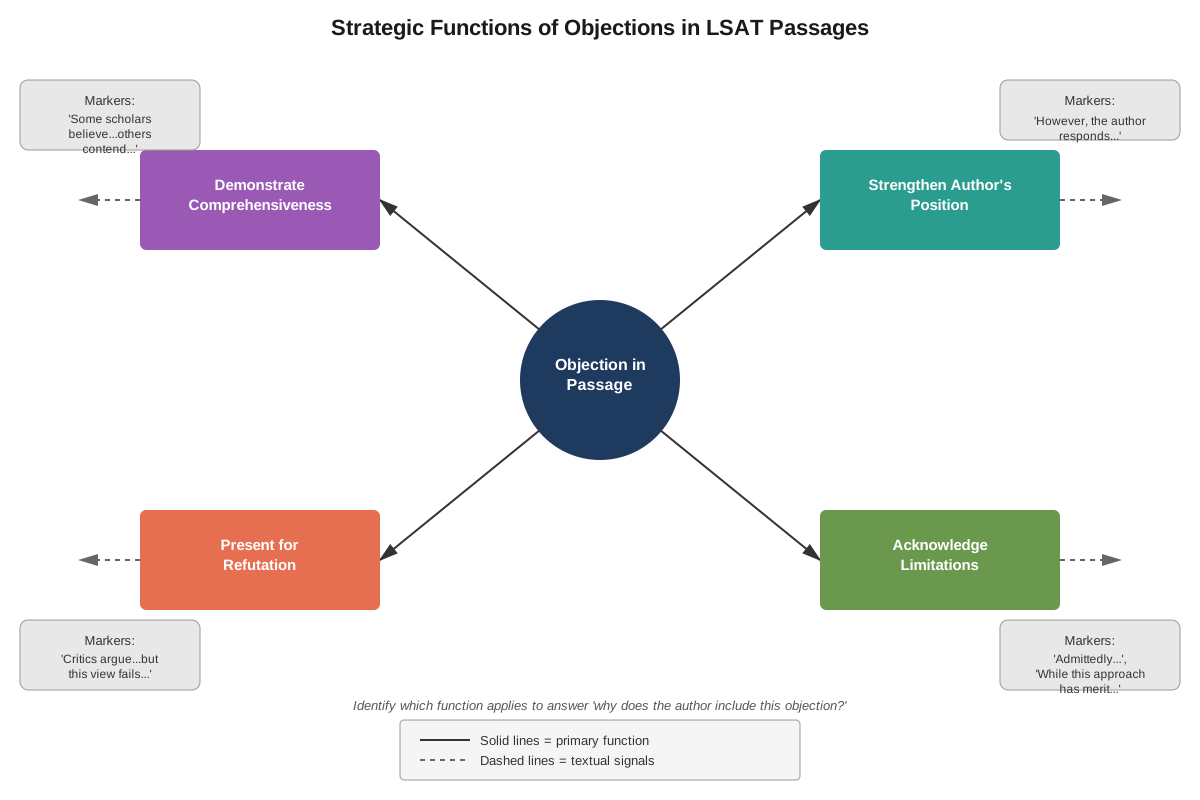
In LSAT Reading Comprehension passages, authors rarely present ideas in isolation. Instead, they construct arguments by introducing claims, supporting them with evidence, and addressing potential challenges to their reasoning. The purpose of objections refers to the strategic role that counterarguments, criticisms, or opposing viewpoints play within a passage's argumentative structure. Understanding why authors include objections—whether to refute them, acknowledge limitations, or strengthen their own position—is crucial for accurately interpreting passage structure and answering questions about authorial intent, passage organization, and argumentative function.
The LSAT purpose of objections concept appears frequently in reading comprehension questions that ask students to identify why specific information appears in a passage, what role a particular paragraph serves, or how an author uses opposing views to advance their thesis. Recognizing objections and their purposes allows test-takers to distinguish between the author's own position and views the author is merely presenting for strategic reasons. This skill directly impacts performance on function questions, structure questions, and inference questions that require understanding the relationship between different viewpoints within a passage.
As part of passage fundamentals, the purpose of objections connects intimately with other core reading skills: identifying main ideas, tracking viewpoint shifts, recognizing argumentative structure, and understanding how authors build and support claims. Mastering this topic enables students to navigate complex passages where multiple perspectives interact, particularly in comparative passages and passages discussing theoretical debates. The ability to quickly identify objections and understand their strategic function saves valuable time and prevents misreading authorial intent—a common trap in wrong answer choices.
Learning Objectives
- [ ] Identify how Purpose of objections appears in LSAT questions
- [ ] Explain the reasoning pattern behind Purpose of objections
- [ ] Apply Purpose of objections to solve LSAT-style problems accurately
- [ ] Distinguish between objections the author endorses versus those the author refutes
- [ ] Recognize the structural markers that signal objections in passages
- [ ] Evaluate how objections strengthen or weaken the author's main argument
- [ ] Predict question types most likely to test understanding of objections' purposes
Prerequisites
- Basic argument structure: Understanding claims, evidence, and conclusions is necessary because objections function as counterarguments within larger argumentative frameworks.
- Viewpoint tracking: The ability to distinguish whose perspective is being presented (author, critics, theorists) is essential since objections typically represent non-authorial viewpoints.
- Passage mapping skills: Familiarity with noting structural elements while reading enables quick reference when questions ask about the function of specific paragraphs or sentences.
- Main idea identification: Recognizing the author's central thesis allows students to understand how objections relate to and potentially challenge that thesis.
Why This Topic Matters
Understanding the purpose of objections has profound real-world applications beyond standardized testing. Legal reasoning—the foundation of law school and legal practice—constantly involves anticipating counterarguments, addressing opposing positions, and strengthening claims by acknowledging their limitations. Attorneys must recognize when opposing counsel raises objections to undermine their case versus when objections serve procedural functions. Academic discourse, policy analysis, and persuasive writing all require the sophisticated ability to incorporate opposing views strategically.
On the LSAT specifically, questions testing the purpose of objections appear in approximately 15-20% of Reading Comprehension questions. These questions most commonly take the following forms:
- Function questions: "The author mentions X in order to..." or "The primary purpose of the second paragraph is to..."
- Structure questions: "Which one of the following most accurately describes the organization of the passage?"
- Reasoning questions: "The author discusses the critics' view primarily to..."
- Inference questions: "The passage suggests that the author would be most likely to agree with which one of the following?"
This topic appears across all passage types but is especially prevalent in passages discussing scientific theories (where competing hypotheses are evaluated), legal or philosophical debates (where multiple schools of thought are contrasted), and passages analyzing artistic or literary movements (where traditional and revisionist interpretations clash). Passages in the humanities and social sciences frequently present an established view, introduce objections or alternative perspectives, and then position the author's view relative to these competing positions.
Core Concepts
What Constitutes an Objection in LSAT Passages
An objection in LSAT reading comprehension refers to any counterargument, criticism, alternative explanation, limitation, or opposing viewpoint that challenges or qualifies a claim presented in the passage. Objections can be explicit (directly stated as disagreements) or implicit (alternative theories that compete with the main view). They may come from named critics, unnamed skeptics, competing schools of thought, or even the author acknowledging weaknesses in their own position.
Objections differ from mere alternative perspectives in that they specifically challenge, contradict, or limit the scope of another claim. For example, if a passage describes two different artistic movements without suggesting conflict between them, those are parallel perspectives rather than objections. However, if the passage presents one movement as a reaction against or criticism of another, the second movement functions as an objection to the first.
Primary Purposes of Objections
Authors include objections in passages for several strategic reasons, and recognizing which purpose applies is essential for answering function questions correctly:
1. To Refute or Rebut: The most common purpose is introducing an objection specifically to demonstrate its flaws. The author presents a counterargument, then provides evidence or reasoning showing why that objection fails. This strengthens the author's position by preemptively addressing potential criticisms.
2. To Acknowledge Limitations: Authors may present objections to demonstrate intellectual honesty and nuance. By acknowledging legitimate limitations or complications, the author appears more credible and prevents readers from dismissing the argument for ignoring obvious counterpoints.
3. To Provide Context or Background: Sometimes objections represent previously dominant views that the passage's main argument challenges. Understanding the traditional position helps readers appreciate why the new perspective matters.
4. To Qualify or Refine a Claim: Objections may force the author to narrow the scope of their argument, adding necessary qualifications. Rather than completely refuting the objection, the author adjusts their claim to accommodate valid concerns.
5. To Present Balanced Analysis: In some passages, particularly those in law or policy, the author presents multiple perspectives without strongly endorsing one, allowing readers to understand the complexity of an issue.
6. To Strengthen Through Contrast: By showing what the author's position is NOT, objections help clarify what it IS. The contrast makes the author's actual view more precise and understandable.
Structural Markers of Objections
Recognizing objections quickly while reading requires attention to specific linguistic signals:
Contrast indicators: however, but, yet, nevertheless, nonetheless, although, despite, in contrast, on the other hand
Attribution phrases: critics argue, skeptics contend, opponents claim, some scholars believe, traditional views hold, it has been suggested
Concession language: admittedly, granted, to be sure, certainly, it is true that
Questioning language: one might object, it could be argued, a potential criticism, this raises the question
Negation and limitation: not everyone agrees, this view has been challenged, recent evidence contradicts, this explanation fails to account for
The Objection-Response Pattern
LSAT passages frequently follow a predictable pattern when incorporating objections:
- Presentation of main claim or theory (author's view or a view the author will evaluate)
- Introduction of objection (signaled by markers above)
- Author's response (refutation, qualification, acknowledgment, or synthesis)
This pattern may occur multiple times within a single passage, creating a dialectical structure where ideas develop through the interaction of claims and counterclaims. Recognizing this pattern helps students predict where the passage is heading and understand the logical flow of the argument.
Distinguishing Author's View from Presented Objections
A critical skill is determining whether the author endorses, rejects, or remains neutral toward an objection. Key indicators include:
| Author's Stance | Typical Language | Example |
|---|---|---|
| Rejection | "This criticism fails to consider...", "However, this objection overlooks...", "This view is mistaken because..." | "Critics argue the theory lacks evidence, but recent studies demonstrate..." |
| Endorsement | "This objection is well-founded...", "Indeed, this criticism reveals...", "This limitation is significant..." | "Skeptics rightly point out that the model cannot explain..." |
| Neutral Presentation | "Some argue...", "Another perspective holds...", "It has been suggested..." (without subsequent evaluation) | "Traditional scholars view the text as allegorical, while revisionists interpret it literally." |
| Qualified Acceptance | "While this objection has merit...", "This criticism is partially valid...", "To some extent..." | "Although critics correctly identify this limitation, the theory remains useful for..." |
Function vs. Content
A crucial distinction for LSAT success is separating what an objection says (content) from why the author includes it (function). Questions about purpose of objections test function, not content. For example:
- Content: "The objection states that the economic model fails to account for irrational behavior."
- Function: "The author presents this objection to acknowledge a limitation before arguing that the model remains useful despite this constraint."
Wrong answers often describe the content of the objection accurately but misidentify its purpose within the passage's argumentative structure.
Concept Relationships
The purpose of objections concept connects to multiple other reading comprehension skills in an integrated network:
Viewpoint Tracking → Purpose of Objections: Before understanding why an objection appears, students must first identify that a different viewpoint is being presented. Viewpoint tracking enables recognition of objections, which then requires analysis of purpose.
Purpose of Objections → Main Idea: Understanding how objections function helps clarify the author's main argument. If the author refutes objections, the main idea is strengthened; if the author acknowledges limitations, the main idea may be more nuanced than initially apparent.
Passage Structure → Purpose of Objections → Function Questions: Recognizing overall passage organization (problem-solution, theory-critique-revision, etc.) helps predict where objections will appear and what purposes they'll serve, directly enabling accurate answers to function questions.
Purpose of Objections ↔ Author's Tone/Attitude: The way an author treats objections reveals their attitude. Dismissive treatment of objections suggests strong confidence in the main view; careful consideration of objections suggests a more measured, analytical tone.
Evidence and Support → Purpose of Objections: Objections often introduce alternative evidence or interpretations of evidence. Understanding how evidence functions in arguments enables better analysis of how objections challenge or support claims.
Purpose of Objections → Inference Questions: Knowing whether the author endorses or rejects an objection allows accurate inferences about what the author would likely agree with in hypothetical scenarios.
This web of relationships means that mastering the purpose of objections simultaneously strengthens multiple other reading comprehension skills, making it a high-leverage topic for overall score improvement.
High-Yield Facts
⭐ Objections appear in approximately 70-80% of LSAT Reading Comprehension passages, making recognition of their purpose essential for consistent performance.
⭐ The most common purpose of objections is to refute them, strengthening the author's main argument by preemptively addressing counterarguments.
⭐ Contrast words (however, but, yet, nevertheless) are the most reliable signals that an objection or shift in viewpoint is being introduced.
⭐ Function questions about objections frequently include wrong answers that accurately describe content but misidentify purpose, making the content-function distinction critical.
⭐ When authors use phrases like "critics argue" or "skeptics contend" without subsequent rebuttal, they are typically presenting objections for context rather than endorsing them.
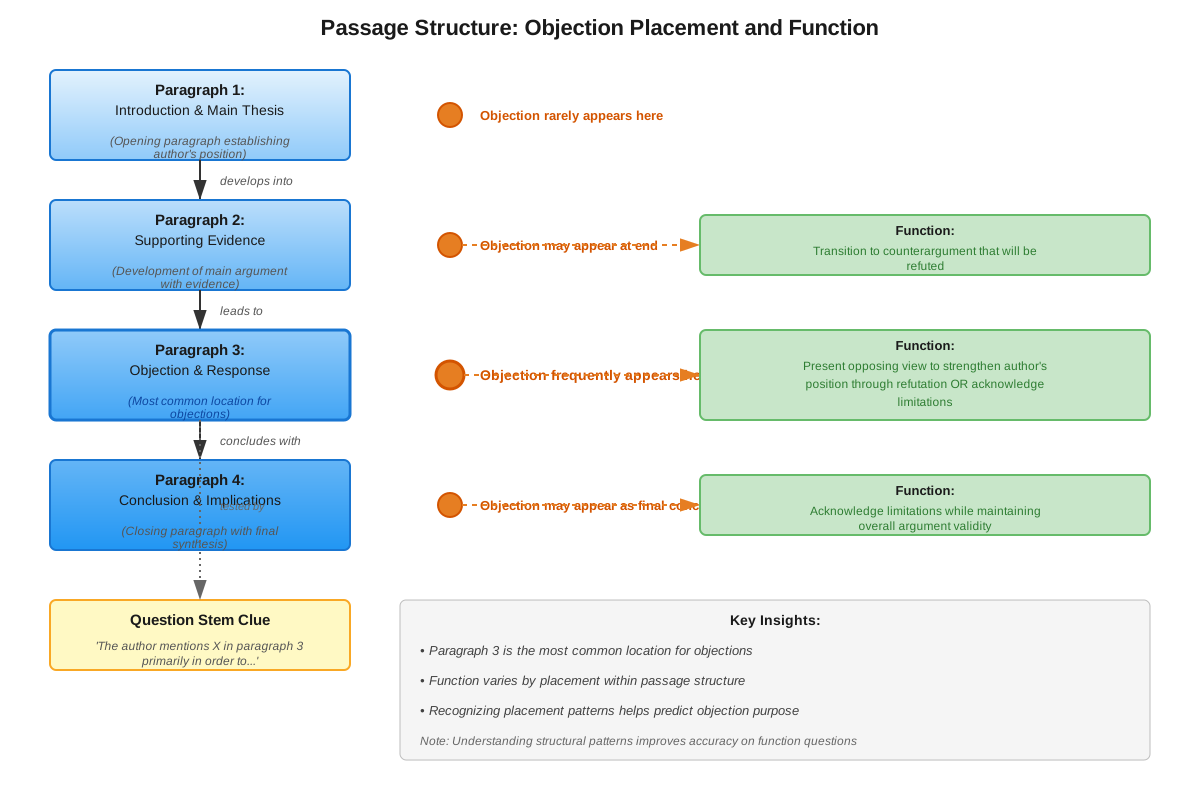
- Objections that appear early in passages often represent traditional or established views that the passage will challenge or complicate.
- Objections introduced with concession language ("admittedly," "granted") typically precede the author's main argument, which will outweigh the conceded point.
- Passages presenting multiple objections without clear authorial preference usually aim to demonstrate complexity rather than advocate a position.
- The author's response to an objection is typically more important for main idea questions than the objection itself.
- Objections that acknowledge limitations often appear near the end of passages, after the main argument has been established, to demonstrate intellectual honesty without undermining the central claim.
- When an objection is presented in detail with supporting evidence, the author is more likely to engage with it seriously rather than dismiss it outright.
- Comparative passages frequently structure each passage around objections to the other passage's perspective, making purpose of objections central to understanding the relationship between passages.
Quick check — test yourself on Purpose of objections so far.
Try Flashcards →Common Misconceptions
Misconception: Any alternative viewpoint mentioned in a passage is an objection that the author disagrees with.
Correction: Not all alternative perspectives function as objections. Some passages present multiple valid approaches without privileging one over others. An objection specifically challenges or limits another claim, and the author may actually endorse some objections while rejecting others.
Misconception: If the author mentions an objection, they must believe it's wrong.
Correction: Authors frequently acknowledge valid objections to demonstrate nuance and intellectual honesty. Phrases like "this criticism has merit" or "this limitation is real" indicate the author accepts the objection while still maintaining their overall position, perhaps with qualifications.
Misconception: The purpose of an objection is always stated explicitly in the passage.
Correction: While sometimes authors explicitly state why they're introducing an objection ("To address this potential criticism..."), more often the purpose must be inferred from context, the author's response, and the objection's position within the passage structure.
Misconception: Objections only appear in passages about debates or controversies.
Correction: Even passages describing scientific processes, historical events, or artistic movements include objections when they present alternative explanations, acknowledge limitations of theories, or contrast different interpretations. Objections are a fundamental feature of analytical writing, not just explicitly argumentative passages.
Misconception: The longest or most detailed objection in a passage must be the most important one.
Correction: Length doesn't determine importance. Sometimes authors spend more time on objections they plan to refute thoroughly, while briefly mentioning more significant objections they accept. The author's response and the objection's relationship to the main idea determine importance, not word count.
Misconception: If an objection appears in the conclusion of a passage, the author must be ending on a note of uncertainty.
Correction: Objections in conclusions often serve to acknowledge scope limitations while reaffirming the main argument's validity within appropriate bounds. This demonstrates sophistication rather than uncertainty. The author is essentially saying, "My argument holds within these parameters, though I acknowledge it doesn't explain everything."
Worked Examples
Example 1: Scientific Theory Passage
Passage Excerpt:
"The endosymbiotic theory explains the origin of mitochondria and chloroplasts by proposing that these organelles were once free-living bacteria that were engulfed by ancestral eukaryotic cells. Evidence supporting this theory includes the fact that both organelles contain their own DNA and reproduce independently of the cell. Critics have argued, however, that the genetic material in modern mitochondria is too limited to support the theory, as free-living bacteria possess far more extensive genomes. This objection, while initially compelling, fails to account for the process of genome reduction that occurs when organisms transition from free-living to symbiotic existence. Numerous examples of genome streamlining in obligate symbionts demonstrate that genetic material unnecessary for the symbiotic relationship is systematically lost over evolutionary time."
Question: The author discusses the critics' objection regarding mitochondrial DNA primarily in order to:
(A) acknowledge a limitation that undermines the endosymbiotic theory
(B) present an alternative explanation for the origin of mitochondria
(C) introduce evidence that will be refuted in the remainder of the passage
(D) address and rebut a potential challenge to the endosymbiotic theory
(E) demonstrate that the endosymbiotic theory remains controversial
Analysis:
Step 1: Identify the objection. The critics' objection is that mitochondrial DNA is too limited compared to free-living bacteria.
Step 2: Identify the author's response. The author states the objection "fails to account for" genome reduction and provides evidence (genome streamlining in symbionts) that explains why the objection doesn't undermine the theory.
Step 3: Determine the purpose. The author introduces the objection specifically to refute it, thereby strengthening the endosymbiotic theory by showing it can withstand criticism.
Step 4: Evaluate answer choices:
- (A) is incorrect because the author doesn't accept that this limitation undermines the theory
- (B) is incorrect because the objection doesn't propose an alternative theory, just challenges the existing one
- (C) is incorrect because the objection itself isn't evidence, and it's refuted immediately, not "in the remainder of the passage"
- (D) is correct because it accurately captures both the nature of the objection (a challenge) and its purpose (to be addressed and rebutted)
- (E) is incorrect because the author's successful rebuttal suggests the theory is well-supported, not controversial
Key Takeaway: When an author presents an objection followed by phrases like "fails to account for" or "overlooks," the purpose is almost always to refute the objection and strengthen the main argument.
Example 2: Legal Philosophy Passage
Passage Excerpt:
"Proponents of legal formalism argue that judges should decide cases by mechanically applying established legal rules to facts, without considering broader social consequences or policy implications. This approach, they contend, ensures predictability and constrains judicial discretion, preventing judges from imposing their personal values on society. Legal realists, however, have challenged this view, arguing that legal rules are often indeterminate and that judges inevitably exercise discretion in interpreting and applying them. The realist critique has considerable force. As numerous case studies demonstrate, even seemingly clear rules require interpretation when applied to novel factual situations, and judges' background assumptions inevitably influence how they understand both rules and facts. Yet the formalist concern about unconstrained judicial discretion remains valid. A purely realist approach, taken to its logical conclusion, could undermine the rule of law by making judicial decisions appear arbitrary. The most defensible position recognizes that while complete formalism is impossible, judges should strive for rule-based decision-making while acknowledging the interpretive discretion inherent in legal reasoning."
Question: The author's discussion of the realist critique serves primarily to:
(A) demonstrate that legal formalism is an untenable position
(B) provide context for a synthesis that incorporates insights from both perspectives
(C) argue that judges should prioritize social consequences over legal rules
(D) illustrate the superiority of legal realism to legal formalism
(E) acknowledge a criticism before dismissing it as irrelevant
Analysis:
Step 1: Identify the objection. The realist critique objects to formalism by arguing that rules are indeterminate and judges inevitably exercise discretion.
Step 2: Identify the author's response. The author states the critique "has considerable force" and provides supporting evidence, but then introduces a counter-objection ("Yet the formalist concern...remains valid") before proposing a synthesis.
Step 3: Determine the purpose. The author presents the realist objection not to fully endorse it or completely reject it, but to incorporate its insights into a more nuanced position that also preserves formalist concerns.
Step 4: Evaluate answer choices:
- (A) is incorrect because the author ultimately defends a modified version of formalism
- (B) is correct because the realist critique is presented as having "considerable force," then balanced against formalist concerns, leading to the synthesis in the final sentence
- (C) is incorrect because the author's conclusion emphasizes "rule-based decision-making," not prioritizing consequences
- (D) is incorrect because the author finds value in both perspectives, not superiority of one
- (E) is incorrect because the author explicitly states the critique "has considerable force" rather than dismissing it
Key Takeaway: When an author acknowledges an objection's validity ("has considerable force," "raises important concerns") but then introduces a counter-objection ("yet," "however"), the purpose is typically to set up a synthesis or qualified position that incorporates insights from multiple perspectives.
Exam Strategy
Approaching Purpose of Objections Questions
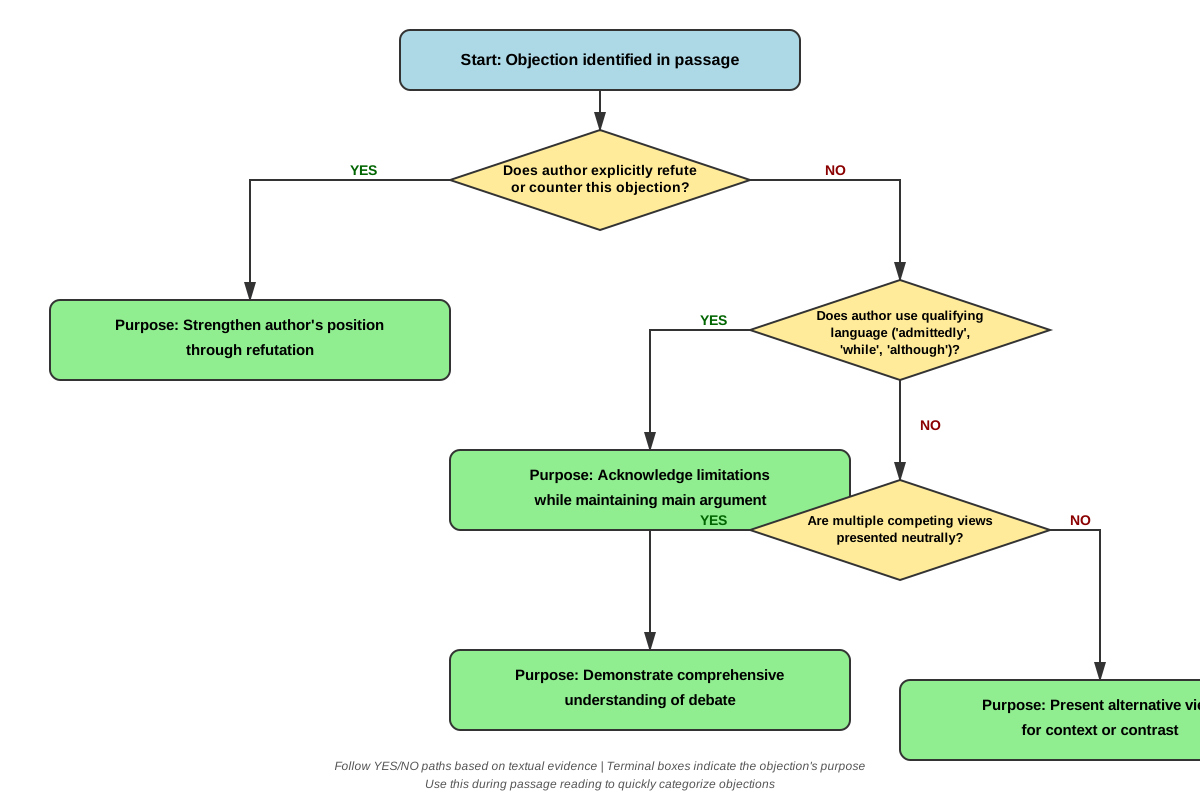
Step 1: Identify the objection in the passage. Before looking at answer choices, locate the specific objection referenced in the question stem and mark it in your passage map. Note who presents the objection (critics, skeptics, traditional scholars, etc.).
Step 2: Read before and after the objection. The sentences immediately preceding the objection often establish what claim is being challenged. The sentences following the objection reveal the author's response and thus the objection's purpose.
Step 3: Classify the author's response. Determine whether the author: refutes the objection, endorses it, acknowledges it while maintaining their position, uses it for context, or remains neutral. This classification directly indicates purpose.
Step 4: Predict the answer in your own words before reading choices. For example: "The author brings up this objection to knock it down and strengthen their main point."
Step 5: Eliminate answers that confuse content with function. Wrong answers often accurately describe what the objection says but misidentify why the author includes it.
Trigger Words and Phrases
In question stems, watch for:
- "The author mentions X in order to..."
- "The primary purpose of [paragraph/sentence] is to..."
- "The author discusses [objection] primarily to..."
- "The function of [objection] in the passage is to..."
In passages, objection markers include:
- Contrast: however, but, yet, nevertheless, nonetheless, although, despite
- Attribution: critics argue, skeptics contend, some believe, it has been suggested
- Concession: admittedly, granted, to be sure, certainly
- Questioning: one might object, it could be argued, this raises the question
In answer choices, correct answers often include:
- "address and refute"
- "acknowledge a limitation"
- "provide context for"
- "qualify the main claim"
- "demonstrate the complexity of"
Wrong answers often include:
- "prove" or "establish" (too strong for objections)
- "introduce the main argument" (objections are rarely the main point)
- "provide the primary evidence" (objections challenge rather than support)
Process of Elimination Tips
Eliminate answers that:
- Suggest the objection is the author's main point (unless the passage is explicitly structured as a critique)
- Claim the author fully endorses an objection that is later qualified or rebutted
- Describe the content of the objection rather than its function
- Mischaracterize the author's response (e.g., saying the author dismisses an objection they actually acknowledge as valid)
- Use extreme language ("completely undermines," "definitively proves") for objections that play supporting roles
Favor answers that:
- Match the author's tone toward the objection (dismissive, respectful, neutral)
- Accurately describe the relationship between the objection and the main argument
- Use appropriately qualified language ("address," "acknowledge," "consider")
- Reflect the objection's position in the passage structure (early objections often provide context; later objections often acknowledge limitations)
Time Allocation
Purpose of objections questions typically require 60-90 seconds:
- 15-20 seconds: Re-read the relevant portion of the passage
- 10-15 seconds: Classify the author's response and predict the answer
- 30-45 seconds: Evaluate answer choices and eliminate wrong answers
- 5-10 seconds: Confirm your selection
If you've effectively mapped the passage during your initial read, you should be able to locate objections quickly. If a question asks about an objection's purpose and you can't immediately recall the author's response, that's a signal to return to the passage rather than guessing based on answer choices alone.
Memory Techniques
The RADAR Mnemonic
Remember the five primary purposes of objections with RADAR:
- Refute: Introduce to knock down and strengthen main argument
- Acknowledge: Show intellectual honesty by recognizing limitations
- Demonstrate: Illustrate complexity or provide balanced analysis
- Adjust: Qualify or refine the main claim in response
- Reference: Provide context or background for the main argument
The "But Test"
When you encounter an objection, look for "but" or equivalent contrast words in the following sentences. If you find them, the author is likely refuting the objection. If you don't find contrast words, the author may be acknowledging the objection or using it for context.
Visualization Strategy: The Argument Arena
Picture the passage as an arena where ideas compete:
- The main argument is the champion in the center
- Objections are challengers entering the arena
- The author is the referee who decides the outcome
When an objection enters:
- Does the author let the champion defeat it? (Refutation)
- Does the author acknowledge the challenger scored a point? (Acknowledgment)
- Does the author show both fighters have strengths? (Balanced analysis)
- Does the author use the challenger to train the champion? (Refinement)
This visualization helps you quickly categorize the author's treatment of objections and predict their purpose.
The Three-Question Framework
For any objection, ask:
- Who says it? (Author, critics, traditional view, etc.)
- What happens next? (Refutation, acknowledgment, qualification, etc.)
- Why include it? (Purpose based on the answer to question 2)
This framework ensures you don't confuse content with function and keeps you focused on the author's strategic choices.
Summary
The purpose of objections is a high-yield LSAT Reading Comprehension concept that tests students' ability to understand why authors include counterarguments, criticisms, and opposing viewpoints in passages. Objections serve multiple strategic purposes: refuting them to strengthen the main argument, acknowledging limitations to demonstrate nuance, providing context for new theories, qualifying claims to increase precision, or presenting balanced analysis of complex issues. Success on questions testing this concept requires distinguishing between what an objection says (content) and why the author includes it (function), recognizing structural markers that signal objections, and accurately classifying the author's response. The most common pattern involves presenting an objection followed by refutation, but sophisticated passages may acknowledge valid objections while maintaining qualified versions of the main argument. Mastering this topic enables accurate answers to function questions, structure questions, and inference questions while simultaneously strengthening overall passage comprehension and viewpoint tracking skills.
Key Takeaways
- Objections appear in 70-80% of LSAT Reading Comprehension passages, making their recognition and analysis essential for consistent high performance.
- The purpose of an objection is determined by the author's response, not by the objection's content—always read the sentences following an objection to understand its function.
- The most common purpose is refutation: authors introduce objections specifically to demonstrate their flaws and thereby strengthen the main argument.
- Contrast words (however, but, yet) are the most reliable signals that an objection or the author's response to an objection is being introduced.
- Function questions require distinguishing content from purpose—wrong answers often accurately describe what an objection says while misidentifying why the author includes it.
- Objections that appear early typically provide context; objections that appear late typically acknowledge limitations without undermining the main argument.
- The RADAR mnemonic (Refute, Acknowledge, Demonstrate, Adjust, Reference) captures the five primary purposes objections serve in LSAT passages.
Related Topics
Viewpoint Tracking: Understanding whose perspective is being presented at any moment in a passage is prerequisite to identifying objections and analyzing their purposes. Mastering purpose of objections deepens viewpoint tracking skills by requiring attention to subtle shifts between the author's voice and other perspectives.
Passage Structure and Organization: Recognizing common organizational patterns (problem-solution, theory-critique-revision, chronological with evaluation) helps predict where objections will appear and what purposes they'll serve. Purpose of objections is a key component of understanding overall passage architecture.
Author's Tone and Attitude: The way an author treats objections—dismissively, respectfully, neutrally—reveals their attitude toward the subject matter and confidence in their position. Analyzing purpose of objections strengthens the ability to infer authorial tone.
Function Questions: This question type explicitly tests understanding of why specific information appears in passages. Purpose of objections is one of the most frequently tested functions, making it essential preparation for this question category.
Comparative Passages: In paired passages, each passage often functions as an implicit objection to the other's perspective. Understanding purpose of objections is crucial for analyzing the relationship between comparative passages and answering questions about how the authors would respond to each other's arguments.
Practice CTA
Now that you've mastered the core concepts of purpose of objections, it's time to apply this knowledge to authentic LSAT passages. The practice questions and flashcards for this topic will challenge you to identify objections quickly, classify their purposes accurately, and eliminate wrong answers that confuse content with function. Remember: every objection you encounter is an opportunity to demonstrate your analytical skills and move closer to your target score. Approach each practice question strategically, using the RADAR mnemonic and the three-question framework to guide your analysis. Your investment in mastering this high-yield topic will pay dividends across multiple question types and passage structures. Begin practicing now to transform your understanding into consistent, confident performance on test day.
Sign up free to keep reading
Create a free AnvayaPrep account to finish this LSAT guide on Purpose of objections — plus flashcards and practice questions.