Overview
Secondary arguments are supporting claims, subsidiary points, or alternative perspectives that authors present alongside their main thesis in LSAT Reading Comprehension passages. While the primary argument represents the author's central claim or the passage's dominant viewpoint, secondary arguments serve to bolster, qualify, contextualize, or contrast with that main position. Understanding how to identify and analyze these supporting structures is crucial for success on the LSAT, as test-makers frequently design questions that require students to distinguish between primary and secondary claims, recognize the function of supporting evidence, and understand how different argumentative layers interact within a passage.
Mastering lsat secondary arguments enables students to navigate the complex argumentative architecture that characterizes LSAT passages. These passages rarely present simple, linear arguments; instead, they typically weave together multiple threads of reasoning, including counterarguments, qualifications, historical context, and supporting examples. The ability to recognize which elements constitute secondary support versus primary claims directly impacts performance on question types including main point questions, function questions, organization questions, and inference questions. Students who can accurately map the hierarchical structure of arguments—identifying what supports what—gain a significant advantage in both comprehension speed and answer accuracy.
Within the broader framework of passage fundamentals in reading comprehension, secondary arguments represent an intermediate-level skill that builds upon basic comprehension abilities while preparing students for advanced analytical tasks. This topic connects directly to understanding passage structure, author's purpose, and the relationship between different parts of a text. The capacity to identify secondary arguments also enhances critical reading skills applicable beyond the LSAT, including the ability to evaluate complex legal reasoning, academic discourse, and policy arguments—all of which appear regularly in law school and legal practice.
Learning Objectives
- [ ] Identify how Secondary arguments appears in LSAT questions
- [ ] Explain the reasoning pattern behind Secondary arguments
- [ ] Apply Secondary arguments to solve LSAT-style problems accurately
- [ ] Distinguish between primary arguments and secondary arguments within a single passage
- [ ] Analyze the functional relationship between secondary arguments and the main thesis
- [ ] Evaluate how secondary arguments strengthen, qualify, or provide context for primary claims
- [ ] Recognize common structural patterns that signal the presence of secondary arguments
Prerequisites
- Basic passage comprehension skills: The ability to understand literal meaning and follow the flow of ideas is necessary before analyzing argumentative hierarchy
- Understanding of main point identification: Recognizing secondary arguments requires first being able to identify what the primary argument is
- Familiarity with argument structure: Knowledge of how claims and evidence relate helps distinguish supporting material from main claims
- Recognition of transition words and structural signals: These linguistic markers often indicate shifts between primary and secondary argumentative elements
Why This Topic Matters
Secondary arguments appear in virtually every LSAT Reading Comprehension passage, making this one of the most consistently tested concepts on the exam. According to analysis of recent LSAT administrations, approximately 60-70% of passages contain explicit secondary arguments that are directly tested through specific questions. Moreover, even when not directly questioned, understanding secondary arguments improves overall passage comprehension and speeds up question-answering across all question types.
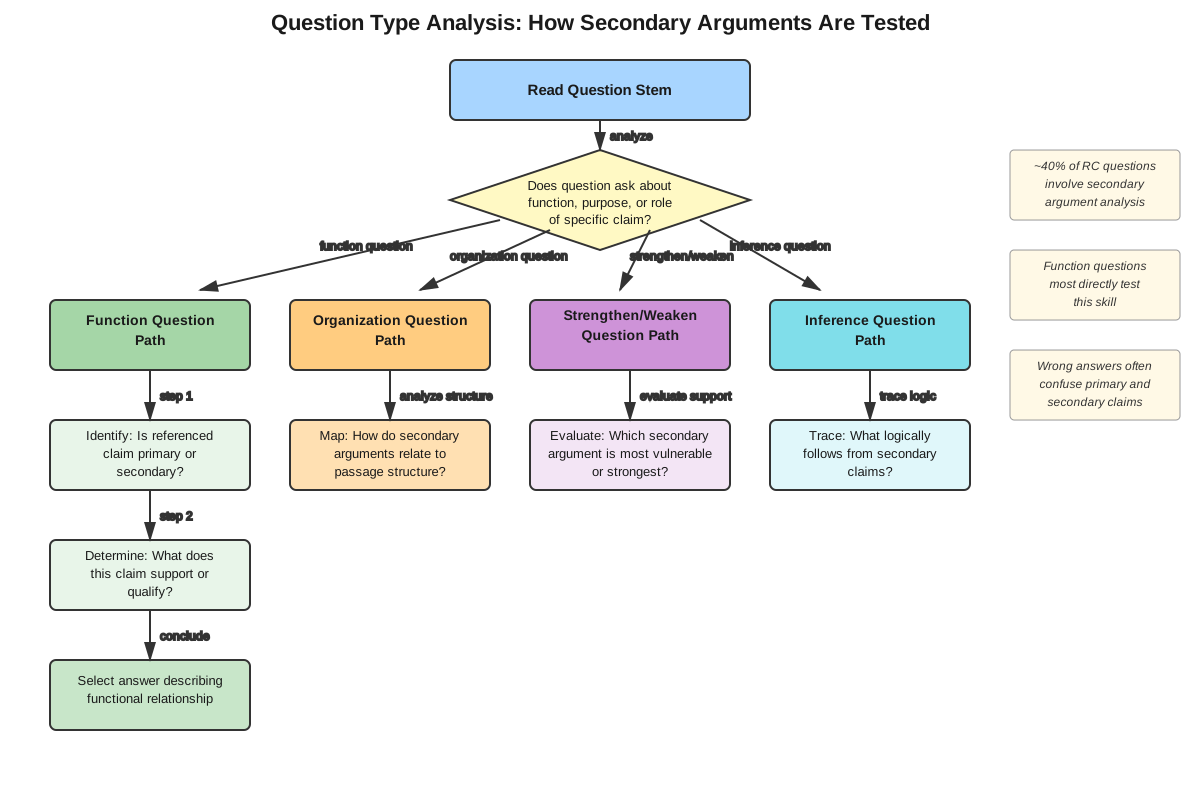
The LSAT tests secondary arguments through multiple question formats. Function questions frequently ask about the role a particular paragraph or sentence plays in relation to the overall argument—requiring students to recognize whether that element constitutes primary or secondary support. Organization questions test whether students can map the structural relationship between different argumentative components. Inference questions often require understanding how secondary arguments qualify or limit the scope of primary claims. Strengthen/Weaken questions in comparative reading passages may ask students to identify which secondary argument from one passage would affect claims in another passage.
In real-world legal contexts, the ability to distinguish primary holdings from secondary reasoning (dicta) is fundamental to legal analysis. Court opinions typically contain a main holding supported by various subsidiary arguments, alternative rationales, and contextual discussions. Law students and attorneys must constantly evaluate which parts of judicial reasoning are binding precedent versus persuasive but non-binding commentary. This same analytical skill—distinguishing argumentative hierarchy—is what the LSAT tests through secondary argument questions.
Common manifestations in LSAT passages include: historical background that contextualizes a main claim, alternative explanations that the author considers but ultimately rejects, qualifications that limit the scope of the primary thesis, supporting examples that illustrate a broader principle, and counterarguments that the author addresses to strengthen their position. Recognizing these patterns enables faster, more accurate passage mapping and question answering.
Core Concepts
Definition and Characteristics of Secondary Arguments
A secondary argument is any claim, reasoning chain, or evidentiary element that supports, qualifies, contextualizes, or contrasts with the primary argument of a passage without itself being the main point. Secondary arguments are subordinate to the primary thesis in the hierarchical structure of the passage's reasoning. They answer questions like "Why should we believe the main claim?" or "Under what conditions does the main claim apply?" or "What alternative views exist?" rather than stating what the passage is fundamentally about.
Key characteristics that distinguish secondary arguments include their functional relationship to the main thesis. While primary arguments represent the author's central claim or the passage's ultimate conclusion, secondary arguments serve instrumental purposes: providing evidence, offering qualifications, acknowledging limitations, presenting historical context, or addressing potential objections. The removal of a secondary argument would weaken or incompletely support the main point, but the main point itself would remain identifiable. In contrast, removing the primary argument would leave the passage without a clear central purpose.
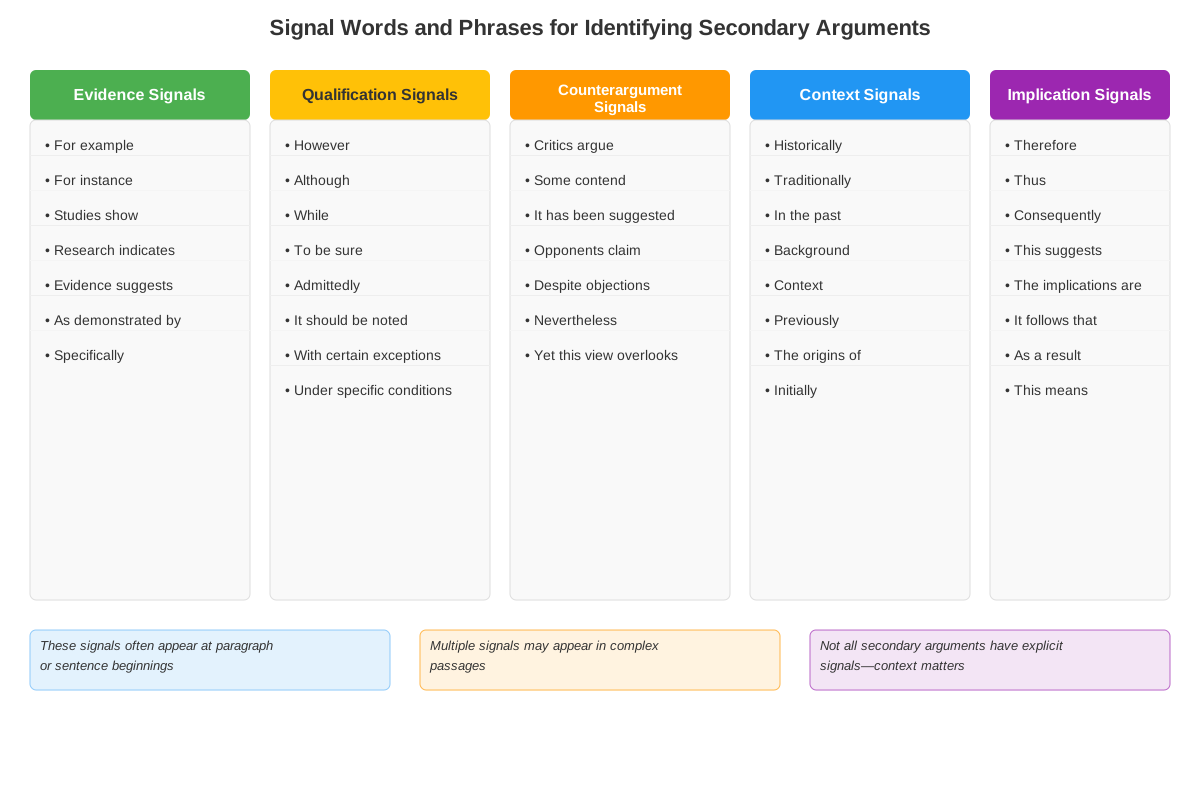
Secondary arguments typically exhibit certain structural markers in LSAT passages. They often appear in specific locations: introductory paragraphs that provide background before stating the thesis, middle paragraphs that develop supporting points, or concluding sections that acknowledge limitations. Linguistically, they may be introduced by phrases such as "For example," "Additionally," "One reason for this is," "However, it should be noted that," or "This is supported by." These signals indicate that what follows serves a supporting rather than primary function.
Types of Secondary Arguments
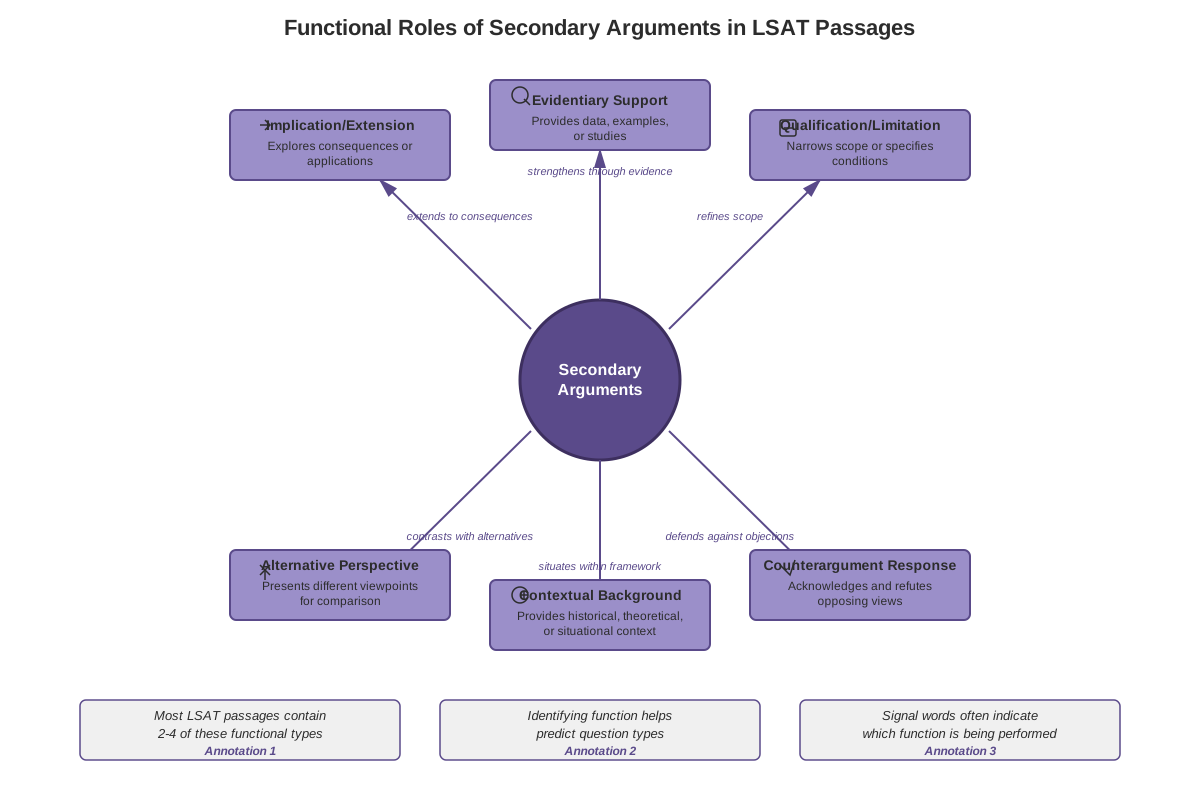
Evidentiary support represents the most common type of secondary argument. These are facts, data, studies, or examples that the author presents to substantiate their main claim. For instance, if a passage argues that a particular legal doctrine should be reformed (primary argument), the author might cite statistics showing the doctrine's negative effects, present case studies illustrating its problems, or reference expert opinions supporting reform. Each piece of evidence constitutes a secondary argument supporting the primary thesis.
Qualifications and limitations function as secondary arguments that define the scope or boundaries of the primary claim. Authors use these to prevent overgeneralization and demonstrate nuanced thinking. For example, a passage might argue that judicial activism is generally problematic (primary argument) while acknowledging that in certain civil rights contexts, activist judging has produced beneficial outcomes (qualification). This qualification is secondary because it refines rather than replaces the main claim.
Contextual background provides historical, theoretical, or situational information that helps readers understand why the primary argument matters or how it developed. A passage about a contemporary legal theory might spend a paragraph explaining the historical circumstances that gave rise to that theory. This background is secondary—it sets the stage but doesn't constitute the main point.
Counterarguments and rebuttals represent a sophisticated type of secondary argument where the author presents opposing views before refuting them. This "although X, actually Y" structure strengthens the primary argument by demonstrating that the author has considered alternatives. The counterargument itself and its rebuttal are both secondary to the main thesis they ultimately support.
Alternative rationales occur when an author provides multiple independent reasons supporting the same conclusion. If a passage argues that a law should be changed (primary argument) and offers three separate justifications—economic efficiency, fairness concerns, and administrative simplicity—each justification is a secondary argument. Any one alone could support the conclusion, but together they create a more robust case.
Functional Relationships Between Primary and Secondary Arguments
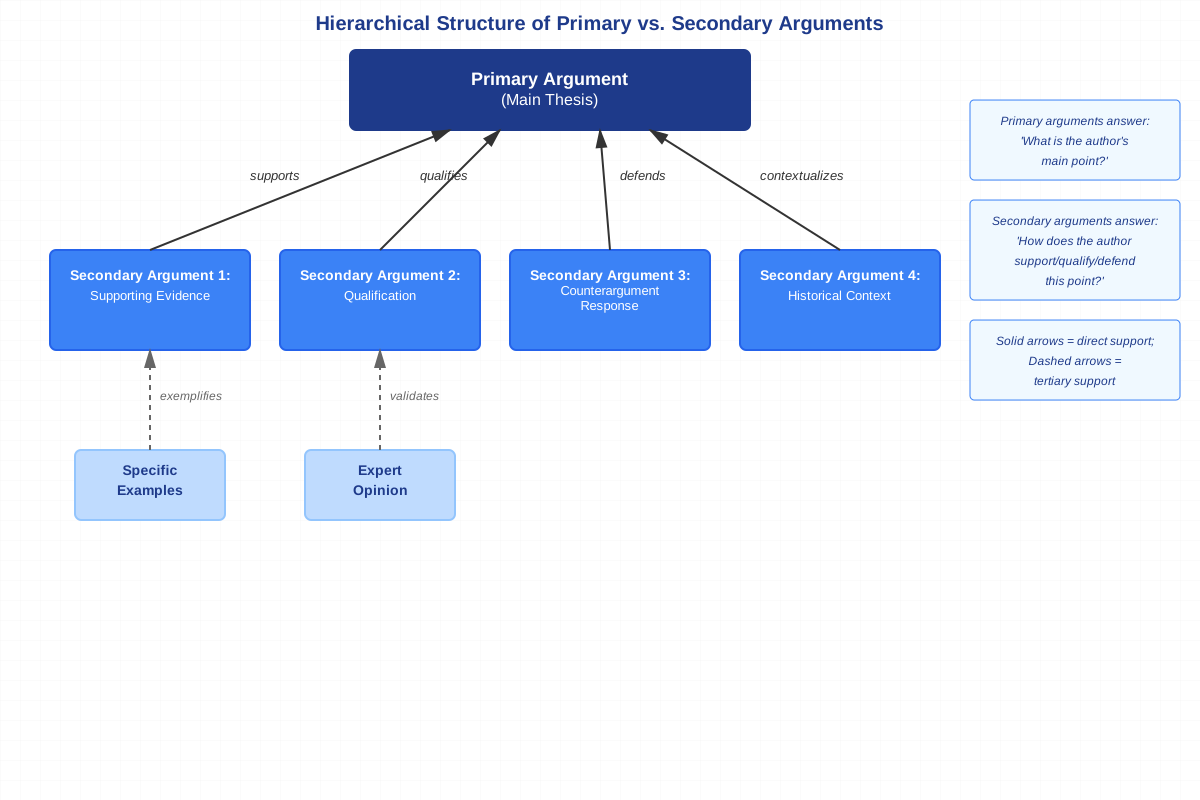
The relationship between primary and secondary arguments follows predictable logical patterns. The most common is the support relationship, where secondary arguments provide reasons or evidence for accepting the primary claim. This creates a hierarchical structure: the primary argument sits at the top, with secondary arguments beneath it providing foundational support.
A qualification relationship exists when secondary arguments modify or limit the primary claim's scope. Rather than simply supporting the main point, these secondary arguments define when, where, or under what conditions the primary argument applies. This relationship is crucial for LSAT questions that ask about the author's degree of certainty or the scope of their claims.
The contrast relationship appears when secondary arguments present alternative views, competing theories, or opposing positions that the author ultimately rejects in favor of their primary argument. This relationship is particularly important in comparative reading passages and in questions asking about the author's attitude toward different perspectives.
Contextual relationships exist when secondary arguments provide background information, historical development, or theoretical frameworks that help explain why the primary argument matters or how it emerged. These secondary arguments don't directly prove the main claim but make it more comprehensible and situate it within a broader intellectual landscape.
Identifying Secondary Arguments in Passage Structure
LSAT passages typically follow recognizable organizational patterns that help identify secondary arguments. The "thesis-support" structure presents the main claim early (often in the first or second paragraph) followed by multiple paragraphs of supporting secondary arguments. The "problem-solution" structure describes an issue (secondary) before proposing a resolution (primary). The "comparison-contrast" structure may present multiple perspectives (secondary) before endorsing one (primary) or synthesizing them into a new position (primary).
Paragraph function provides crucial clues for identifying secondary arguments. Opening paragraphs often contain contextual secondary arguments that set up the main claim. Middle paragraphs typically develop secondary arguments that support, illustrate, or qualify the thesis. Concluding paragraphs may contain secondary arguments that acknowledge limitations or suggest implications. However, these are tendencies, not rules—LSAT passages deliberately vary their structures to test flexible reading skills.
Proportionality and emphasis also signal argumentative hierarchy. The primary argument typically receives explicit statement and may be repeated or rephrased throughout the passage. Secondary arguments, while important, usually receive less emphasis and may be presented more briefly. However, students should avoid the misconception that length equals importance—a single sentence can state the primary argument while multiple paragraphs develop secondary support.
Concept Relationships
Secondary arguments exist in a hierarchical relationship with primary arguments, where the primary argument represents the apex of the passage's reasoning and secondary arguments provide the supporting structure beneath it. This relationship is foundational to understanding passage organization: Primary Argument ← supported by ← Secondary Arguments ← supported by ← Evidence/Examples.
The connection to main point identification (a prerequisite skill) is direct and reciprocal: identifying the main point helps distinguish what is secondary, while recognizing secondary arguments confirms what must be primary. These skills reinforce each other in a feedback loop that improves with practice.
Secondary arguments connect to author's purpose because understanding why an author includes particular supporting points reveals their rhetorical strategy and overall goals. An author who includes extensive counterarguments and rebuttals (secondary) demonstrates a purpose of persuading skeptical readers, while an author who focuses on contextual background (secondary) may aim to educate or reframe understanding.
The relationship to passage structure is intimate: secondary arguments are the building blocks that create structure. Recognizing patterns like "background → thesis → support → qualification → conclusion" requires identifying which elements are secondary and how they function. This connects forward to advanced skills like comparative reading, where students must track how secondary arguments in one passage relate to claims in another.
Within the topic itself, the different types of secondary arguments (evidentiary, contextual, qualifying, etc.) relate to each other through their distinct functions. A single passage might contain contextual background (secondary) that sets up the main claim, evidentiary support (secondary) that proves it, and qualifications (secondary) that limit it. Understanding how these different secondary elements work together creates a complete picture of the passage's argumentative architecture.
High-Yield Facts
⭐ Secondary arguments support, qualify, or contextualize the primary argument but are not themselves the main point of the passage.
⭐ Approximately 60-70% of LSAT Reading Comprehension passages contain explicitly testable secondary arguments.
⭐ Function questions frequently test whether students can identify the role of secondary arguments in relation to the main thesis.
⭐ Common structural signals for secondary arguments include "For example," "Additionally," "However," "One reason," and "This is supported by."
⭐ The removal of a secondary argument weakens support for the main point but doesn't eliminate the main point itself.
- Secondary arguments can include evidence, qualifications, counterarguments, contextual background, and alternative rationales.
- Multiple secondary arguments can independently support the same primary argument, creating redundant support structures.
- Qualifications (a type of secondary argument) define the scope and limitations of primary claims.
- Counterarguments presented by the author are secondary arguments even when the author disagrees with them.
- The hierarchical relationship between primary and secondary arguments mirrors the structure of legal reasoning in case law.
- Secondary arguments in opening paragraphs often provide historical or theoretical context rather than direct evidentiary support.
- Comparative reading passages may contain secondary arguments in one passage that directly challenge primary arguments in another.
- Understanding secondary arguments improves performance on inference questions by clarifying the scope of supportable conclusions.
Quick check — test yourself on Secondary arguments so far.
Try Flashcards →Common Misconceptions
Misconception: The longest or most detailed section of a passage must contain the primary argument. → Correction: Length doesn't determine argumentative hierarchy. Authors often spend more space developing secondary support (evidence, examples, context) than stating their main claim, which may appear in just one or two sentences.
Misconception: Everything that isn't the main point is equally secondary and unimportant. → Correction: Secondary arguments have different functions and importance levels. Some directly support the main claim (high importance), while others provide tangential context (lower importance). Understanding these distinctions is crucial for answering function and organization questions.
Misconception: If the author presents a counterargument, it must be a primary argument because it receives substantial discussion. → Correction: Counterarguments are secondary arguments regardless of how much space they receive. Their function is to strengthen the primary argument by showing the author has considered and can refute alternatives.
Misconception: Secondary arguments always appear after the primary argument in passage structure. → Correction: LSAT passages use varied organizational structures. Contextual secondary arguments often appear before the primary argument is stated, and qualifying secondary arguments frequently appear after the main claim to refine its scope.
Misconception: If a claim is supported by evidence, that claim must be the primary argument. → Correction: Secondary arguments can themselves be supported by evidence. The hierarchical structure can have multiple levels: Primary Argument ← Secondary Argument ← Evidence supporting that secondary argument. What matters is the functional relationship to the passage's ultimate main point.
Misconception: Authors always explicitly signal which arguments are primary versus secondary. → Correction: While structural signals help, LSAT passages deliberately test whether students can determine argumentative hierarchy through logical analysis rather than relying solely on transition words. The functional relationship must be inferred from context.
Misconception: Secondary arguments are always factual statements while primary arguments are always opinions. → Correction: Both primary and secondary arguments can be factual or evaluative. What distinguishes them is their functional role in the passage's reasoning structure, not their content type.
Worked Examples
Example 1: Identifying Secondary Arguments in a Legal Theory Passage
Passage excerpt: "The doctrine of stare decisis, which requires courts to follow precedent, has long been considered fundamental to the American legal system. Historically, this principle emerged from English common law traditions in the 18th century, where consistency in judicial decisions was valued for promoting predictability. Proponents argue that stare decisis provides stability, allows citizens to plan their affairs with confidence, and prevents arbitrary judicial decision-making. However, critics contend that rigid adherence to precedent can perpetuate unjust outcomes and prevent legal evolution. Despite these concerns, the doctrine remains essential because the benefits of legal predictability outweigh the occasional need for doctrinal revision, which can be accomplished through the established process of overruling precedent when truly necessary."
Analysis:
Step 1: Identify the primary argument. The main claim appears in the final sentence: "the doctrine remains essential because the benefits of legal predictability outweigh the occasional need for doctrinal revision." This is what the passage is fundamentally arguing.
Step 2: Identify secondary arguments and their functions.
- "Historically, this principle emerged from English common law traditions..." = Contextual secondary argument providing background that helps readers understand the doctrine's origins but doesn't prove it should be retained.
- "Proponents argue that stare decisis provides stability, allows citizens to plan their affairs..." = Evidentiary secondary argument providing reasons that support the primary claim about the doctrine's value.
- "However, critics contend that rigid adherence to precedent can perpetuate unjust outcomes..." = Counterargument secondary argument presenting an opposing view that the author acknowledges but ultimately rejects.
- "which can be accomplished through the established process of overruling precedent when truly necessary" = Qualifying secondary argument that limits the scope of the primary claim by acknowledging that the doctrine isn't absolute.
Step 3: Map the relationships. The contextual background sets the stage → the evidentiary support provides reasons for the main claim → the counterargument is acknowledged but refuted → the qualification defines the scope of the main claim. All secondary elements work together to support and refine the primary argument.
Connection to learning objectives: This example demonstrates how to identify secondary arguments (Objective 1), explains their reasoning patterns (Objective 2), and shows how they function in relation to the primary argument (Objective 5).
Example 2: Applying Secondary Argument Analysis to a Question
Passage excerpt: "Recent scholarship has challenged the traditional view that medieval European guilds primarily served to restrict competition and maintain monopolies. While it is true that guilds controlled entry into trades through apprenticeship requirements, this regulatory function served important quality-control purposes. Guild standards ensured that consumers received reliable products and that craftsmen maintained professional competence. Moreover, guilds provided social insurance functions, supporting members during illness and their families after death. The monopolistic interpretation, though containing some truth, overlooks these broader social and economic roles that made guilds essential institutions in medieval urban life."
Question: "The author mentions that guilds 'controlled entry into trades through apprenticeship requirements' primarily in order to:"
(A) Present the main argument of the passage
(B) Acknowledge a point that supports the traditional view before qualifying it
(C) Provide evidence that guilds were monopolistic institutions
(D) Illustrate the most important function of medieval guilds
(E) Contrast medieval practices with modern regulatory approaches
Analysis:
Step 1: Identify the primary argument. The passage argues that the traditional monopolistic view of guilds is incomplete and that guilds served important quality-control and social insurance functions (a revisionist interpretation).
Step 2: Analyze the function of the mentioned claim. "Guilds controlled entry into trades through apprenticeship requirements" is presented with "While it is true that..." This structure signals a concession—acknowledging a point that supports the opposing view before the author qualifies or refutes it.
Step 3: Determine the type of secondary argument. This is a counterargument acknowledgment (secondary) that the author concedes before providing alternative interpretations (also secondary) that support the primary revisionist argument.
Step 4: Eliminate wrong answers.
- (A) is incorrect because this claim is not the main point; it's a concession to the traditional view the author is challenging.
- (C) is incorrect because the author doesn't present this to prove guilds were monopolistic; rather, the author acknowledges this point before arguing it's incomplete.
- (D) is incorrect because the author argues that quality control and social insurance were important functions, not entry restriction.
- (E) is incorrect because no modern comparison appears in the passage.
Step 5: Select the correct answer. (B) correctly identifies that this is a secondary argument acknowledging a point supporting the traditional view ("controlled entry") before the author qualifies it ("this regulatory function served important quality-control purposes").
Connection to learning objectives: This example shows how secondary arguments appear in LSAT questions (Objective 1), demonstrates the reasoning pattern of counterargument acknowledgment (Objective 2), and applies this understanding to solve an LSAT-style problem accurately (Objective 3).
Exam Strategy
When approaching LSAT Reading Comprehension questions involving secondary arguments, begin by mapping the passage structure during your initial read. Create a mental or marginal note outline identifying the main point and the function of each paragraph (context, support, qualification, counterargument, etc.). This structural map becomes your reference for answering questions about argumentative relationships.
Trigger words and phrases that signal secondary arguments include:
- Evidentiary support: "For example," "For instance," "This is evidenced by," "Studies show," "Research indicates"
- Contextual background: "Historically," "Traditionally," "The origins of," "Background on"
- Qualifications: "However," "Although," "It should be noted," "With the exception of," "In certain cases"
- Counterarguments: "Critics argue," "Opponents contend," "Some believe," "An alternative view"
- Additional support: "Moreover," "Additionally," "Furthermore," "Another reason"
When you encounter these phrases, immediately ask: "What is this supporting, qualifying, or contrasting with?" This question helps you identify the functional relationship to the primary argument.
For function questions specifically asking about the role of a paragraph or sentence, use the process of elimination by first determining whether the element in question is primary or secondary. Eliminate any answer choice that misidentifies this basic distinction. Then, among remaining choices, identify the specific type of secondary argument (evidentiary, contextual, qualifying, etc.) and eliminate choices that mischaracterize this function.
Time allocation for passages with complex secondary arguments should include an extra 15-30 seconds during the initial read to map the structure. This upfront investment pays dividends by making questions faster to answer. If a passage seems to have multiple competing viewpoints or extensive supporting evidence, it likely contains testable secondary arguments, so invest in careful structural mapping.
When questions ask about the "primary purpose" or "main point," eliminate any answer choice that describes a secondary argument, no matter how much space that secondary argument received in the passage. Conversely, when questions ask about "supporting evidence" or "the author's reason for mentioning X," the correct answer will typically describe a secondary argument's function.
For comparative reading passages, track how secondary arguments in one passage relate to claims in the other. A secondary argument in Passage A might directly challenge the primary argument of Passage B, or vice versa. Questions frequently test these cross-passage relationships.
Memory Techniques
S.E.C.Q.A. Mnemonic for types of secondary arguments:
- Supporting evidence
- Examples and illustrations
- Context and background
- Qualifications and limitations
- Alternative views and counterarguments
Visualization strategy: Picture the passage as a building where the primary argument is the roof (the highest point, what everything supports) and secondary arguments are the supporting pillars beneath it. Some pillars (evidentiary support) hold up the roof directly, while others (contextual background) form the foundation that the pillars rest on. Qualifications are like safety railings that define the building's boundaries.
Hierarchical acronym - P.S.E.:
- Primary argument (the main point)
- Secondary arguments (support, qualify, contextualize)
- Evidence (supports secondary arguments)
This reminds you that argumentative structure has multiple levels, and what's secondary at one level might be primary at another.
Function phrase memory: Remember "S.Q.C." - Secondary arguments Support, Qualify, or Contextualize the primary argument. If an element does one of these three things, it's secondary.
The "Although-Actually" pattern: Many LSAT passages follow this structure: "Although [secondary counterargument], actually [primary argument]." Recognizing this pattern helps you quickly identify both primary and secondary elements and their relationship.
Summary
Secondary arguments are supporting claims, subsidiary points, or alternative perspectives that authors use to bolster, qualify, contextualize, or contrast with their primary thesis in LSAT Reading Comprehension passages. These arguments are subordinate to the main point in the passage's hierarchical structure but are essential for understanding the full scope and support of the author's reasoning. Secondary arguments appear in multiple forms: evidentiary support that proves claims, contextual background that situates arguments historically or theoretically, qualifications that limit scope, counterarguments that the author acknowledges before refuting, and alternative rationales that provide multiple paths to the same conclusion. Identifying secondary arguments requires analyzing functional relationships—determining what supports what—rather than relying solely on structural position or length. This skill is tested extensively on the LSAT through function questions, organization questions, and inference questions, appearing in approximately 60-70% of passages. Mastering secondary arguments enables students to map passage structure efficiently, distinguish between primary and supporting claims, and answer questions about argumentative relationships with accuracy and confidence. The ability to recognize and analyze secondary arguments is fundamental not only for LSAT success but also for the legal reasoning required in law school and practice.
Key Takeaways
- Secondary arguments support, qualify, or contextualize the primary argument without themselves being the main point of the passage
- Common types include evidentiary support, contextual background, qualifications, counterarguments, and alternative rationales
- Functional relationship to the main thesis, not structural position or length, determines whether an argument is secondary
- Structural signals like "For example," "However," "Additionally," and "Critics argue" often introduce secondary arguments
- Understanding secondary arguments is essential for function questions, organization questions, and inference questions
- The hierarchical structure of arguments can have multiple levels: primary arguments supported by secondary arguments, which may themselves be supported by evidence
- Mapping passage structure during the initial read—identifying primary and secondary elements—improves both speed and accuracy on questions
Related Topics
Passage Structure and Organization: Understanding how LSAT passages are organized builds directly on recognizing secondary arguments, as these arguments form the building blocks of common organizational patterns like problem-solution, comparison-contrast, and thesis-support structures.
Author's Purpose and Tone: Analyzing why authors include particular secondary arguments reveals their rhetorical strategies and attitudes, connecting secondary argument analysis to questions about author's purpose, tone, and perspective.
Comparative Reading: This advanced topic requires tracking how arguments in one passage (whether primary or secondary) relate to arguments in another passage, making secondary argument identification essential for comparative analysis.
Inference Questions: Understanding the scope and limitations established by secondary arguments (particularly qualifications) is crucial for determining what can and cannot be validly inferred from a passage.
Strengthen/Weaken Questions: Though more common in Logical Reasoning, these question types occasionally appear in Reading Comprehension and require understanding which secondary arguments provide crucial support for primary claims.
Practice CTA
Now that you've mastered the fundamentals of identifying and analyzing secondary arguments, it's time to apply these skills to actual LSAT passages. Work through the practice questions and flashcards for this topic, paying special attention to mapping the hierarchical structure of arguments and identifying the functional relationships between primary and secondary claims. Remember that recognizing secondary arguments is a skill that improves dramatically with deliberate practice—each passage you analyze strengthens your ability to quickly identify argumentative structure and answer questions with confidence. Your investment in mastering this high-yield topic will pay dividends across all Reading Comprehension question types. You've got this!
Sign up free to keep reading
Create a free AnvayaPrep account to finish this LSAT guide on Secondary arguments — plus flashcards and practice questions.