Overview
Topic shifts represent one of the most critical structural elements tested in LSAT Reading Comprehension passages. A topic shift occurs when an author transitions from discussing one subject, perspective, or aspect of an argument to another within a passage. These shifts serve as organizational signposts that reveal the passage's architecture and the author's rhetorical strategy. Understanding where and why these transitions occur enables test-takers to map passage structure efficiently, predict upcoming content, and quickly locate information needed to answer questions.
The LSAT consistently tests students' ability to recognize and interpret topic shifts because these transitions often mark crucial turning points in an argument, introduce contrasting viewpoints, or signal the author's main thesis after presenting background information. Passages typically contain 3-5 significant topic shifts, and questions frequently hinge on understanding what happens at these transition points. Students who master topic shift identification can navigate complex passages more efficiently, reducing reading time while improving comprehension accuracy.
Within the broader framework of passage fundamentals, topic shifts connect intimately with other structural elements such as paragraph purpose, author's tone, and argument structure. While paragraph breaks provide visual cues for potential shifts, the actual topic transition may occur mid-paragraph or span multiple paragraphs. Recognizing these shifts requires attention to transition words, changes in subject matter, shifts in perspective, and alterations in the author's purpose. This skill forms the foundation for more advanced reading comprehension techniques, including mapping passage structure and predicting question types based on passage organization.
Learning Objectives
- [ ] Identify how topic shifts appear in LSAT questions
- [ ] Explain the reasoning pattern behind topic shifts
- [ ] Apply topic shifts to solve LSAT-style problems accurately
- [ ] Recognize common transition markers that signal topic shifts in passages
- [ ] Distinguish between major topic shifts and minor elaborations within a single topic
- [ ] Predict the types of questions likely to target specific topic shift locations
- [ ] Create accurate passage maps that highlight key topic shifts and their relationships
Prerequisites
- Basic paragraph structure comprehension: Understanding how paragraphs organize ideas is essential because topic shifts often (but not always) align with paragraph boundaries, and recognizing when they don't is crucial for advanced comprehension.
- Familiarity with transition words and phrases: Knowledge of common transitional language (however, moreover, in contrast, etc.) provides the linguistic foundation for detecting when authors signal shifts in their discussion.
- Ability to identify main ideas: Recognizing the central point of a paragraph or section is necessary because topic shifts represent movement from one main idea to another, requiring baseline skill in main idea identification.
Why This Topic Matters
Topic shifts appear in virtually every LSAT Reading Comprehension passage, making this one of the highest-yield skills for test preparation. According to LSAT patterns, approximately 60-70% of passages contain at least one question that directly or indirectly tests understanding of where and why topic shifts occur. These questions may ask about passage organization, the purpose of a specific paragraph, the relationship between different sections, or the author's rhetorical strategy—all of which require precise understanding of topic transitions.
In real-world applications, the ability to track topic shifts translates directly to legal reading skills. Legal documents, case opinions, and scholarly articles frequently shift between presenting facts, analyzing precedents, introducing counterarguments, and stating conclusions. Lawyers must navigate these transitions efficiently to extract relevant information and construct persuasive arguments. The LSAT tests this skill because it predicts success in law school reading assignments and legal practice.
Common manifestations of topic shift testing include: Structure questions asking "Which of the following best describes the organization of the passage?"; Purpose questions inquiring about why the author includes a particular paragraph or section; Relationship questions exploring how different parts of the passage connect; and Location questions requiring test-takers to identify where specific information appears. Additionally, many inference and detail questions become significantly easier when students understand the structural context provided by recognizing topic shifts. Missing a key topic shift often leads to misunderstanding the passage's overall argument, resulting in multiple incorrect answers.
Core Concepts
Definition and Function of Topic Shifts
A topic shift occurs when an author transitions from discussing one subject, aspect, perspective, or purpose to another within a passage. Unlike simple elaboration or additional examples supporting the same point, a genuine topic shift represents a meaningful change in what the passage addresses. These shifts serve multiple rhetorical functions: they organize complex information into digestible segments, signal changes in the author's purpose (from describing to evaluating, for example), introduce contrasting viewpoints, or mark progression through an argument's logical structure.
The LSAT specifically tests topic shifts because they reveal passage architecture. Understanding where shifts occur allows readers to create mental or physical passage maps—structural outlines showing how different sections relate. This mapping skill proves invaluable for efficiently answering questions, as it enables test-takers to quickly locate relevant information without re-reading entire passages.
Types of Topic Shifts
lsat topic shifts manifest in several distinct patterns, each serving different rhetorical purposes:
| Shift Type | Description | Common Markers | Example Context |
|---|---|---|---|
| Subject Shift | Movement from one topic to a different topic | "Turning to...", "Another aspect...", paragraph breaks | Shifting from discussing one scientific theory to a competing theory |
| Perspective Shift | Change from one viewpoint to another | "Critics argue...", "Proponents claim...", "However..." | Moving from the author's view to opposing scholars' positions |
| Temporal Shift | Transition between time periods | "Historically...", "In recent years...", "Subsequently..." | Discussing past practices before analyzing current approaches |
| Purpose Shift | Change in what the author aims to accomplish | "To illustrate...", "More importantly...", "The significance..." | Moving from description to evaluation or analysis |
| Scope Shift | Narrowing or broadening focus | "Specifically...", "More broadly...", "In particular..." | Zooming from general principles to specific applications |
Markers and Signals of Topic Shifts
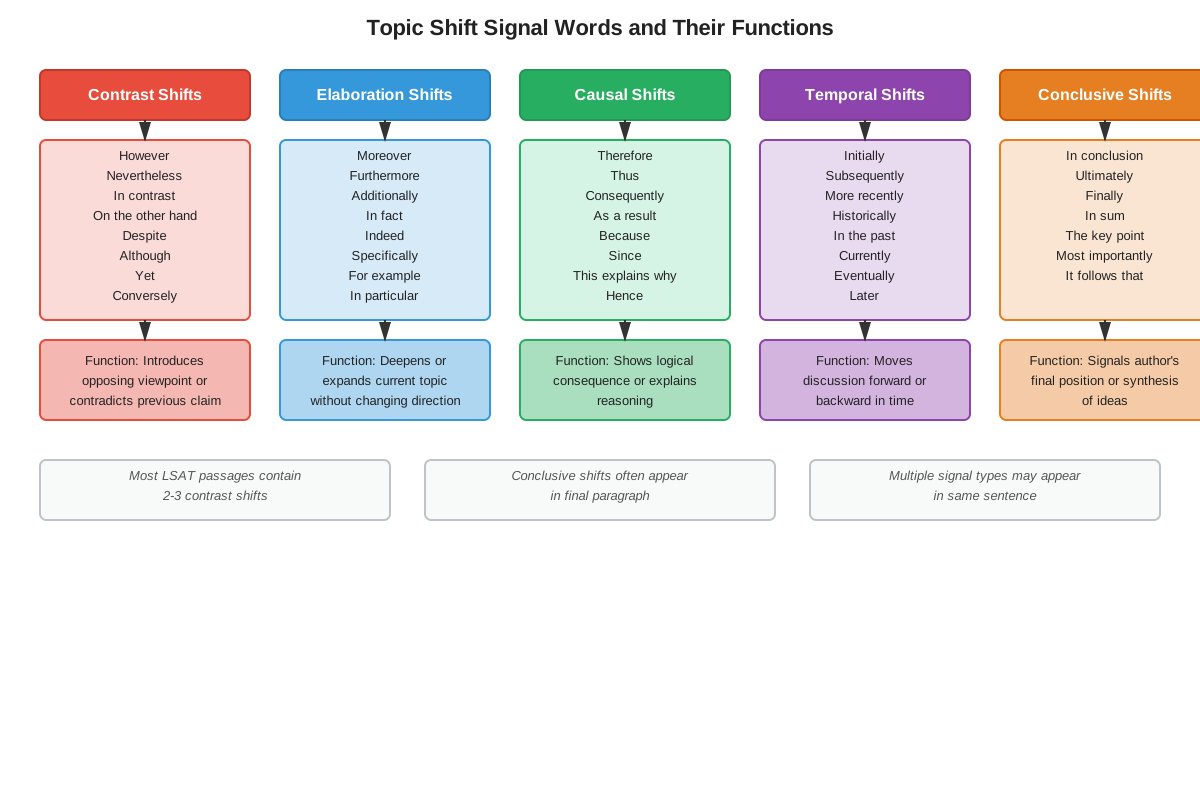
Effective identification of topic shifts requires attention to multiple textual cues. Transition words provide the most explicit signals: contrastive transitions (however, nevertheless, conversely, in contrast) often indicate perspective or subject shifts; additive transitions (moreover, furthermore, additionally) may signal continued discussion or sometimes introduce a new aspect; and conclusive transitions (therefore, thus, consequently) frequently mark shifts to implications or conclusions.
Paragraph breaks offer visual cues but require careful interpretation. While new paragraphs often coincide with topic shifts, not all paragraph breaks represent significant shifts—some paragraphs merely continue developing the previous topic. Conversely, significant topic shifts sometimes occur mid-paragraph, particularly in dense academic writing typical of LSAT passages.
Changes in subject matter provide content-based evidence of shifts. When the nouns, concepts, or entities being discussed change substantially, a topic shift has likely occurred. For example, a passage might shift from discussing "judicial precedent" to "legislative reform"—different subjects requiring different analytical frameworks.
Rhetorical purpose changes signal functional shifts. An author might shift from describing a phenomenon to explaining its causes, then to evaluating proposed solutions, and finally to arguing for a particular approach. Each purpose change represents a topic shift even if the general subject remains constant.
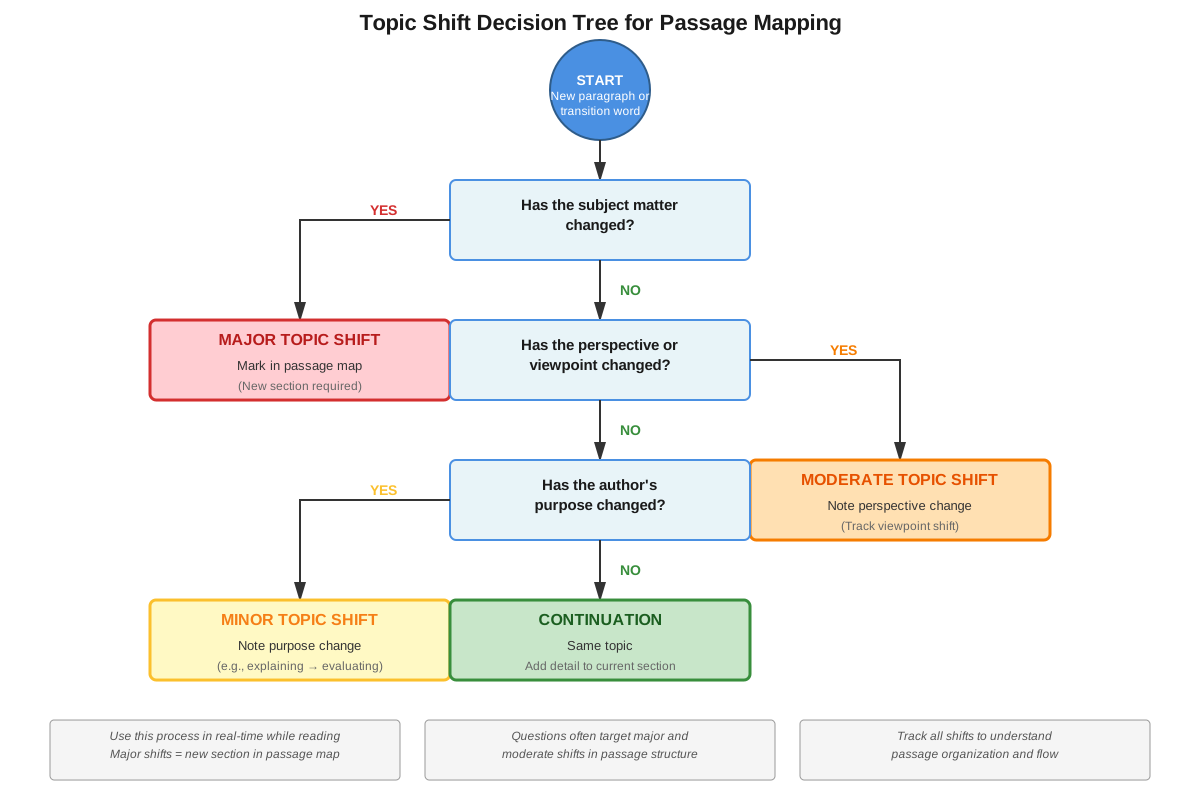
Distinguishing Major from Minor Shifts
Not all transitions carry equal weight. Major topic shifts fundamentally change what the passage discusses or the author's purpose, typically marking boundaries between the passage's main structural sections. These shifts often introduce new paragraphs and significantly alter the passage's focus. Questions frequently target these major transitions, asking about passage organization or the relationship between large sections.
Minor shifts represent smaller transitions within a broader topic—moving from one example to another, from one aspect of a theory to a related aspect, or from a general statement to its specific illustration. While these transitions help organize information, they don't fundamentally change the passage's focus. Recognizing this distinction prevents over-mapping passages with excessive detail while ensuring major structural elements aren't missed.
Strategic Reading for Topic Shifts
Effective reading comprehension requires active attention to topic shifts during initial passage reading. Rather than passively absorbing information, strategic readers mentally note (or physically mark) where significant shifts occur, creating a structural framework. This approach involves asking: "What is the author doing in this section?" and "How does this section relate to what came before?"
When a topic shift is detected, strategic readers pause briefly to consolidate understanding of the previous section and predict what might follow. This metacognitive practice enhances comprehension and retention while building the passage map that facilitates efficient question answering. The goal is not to memorize details but to understand the passage's organizational logic—where different types of information appear and how sections connect.
Concept Relationships
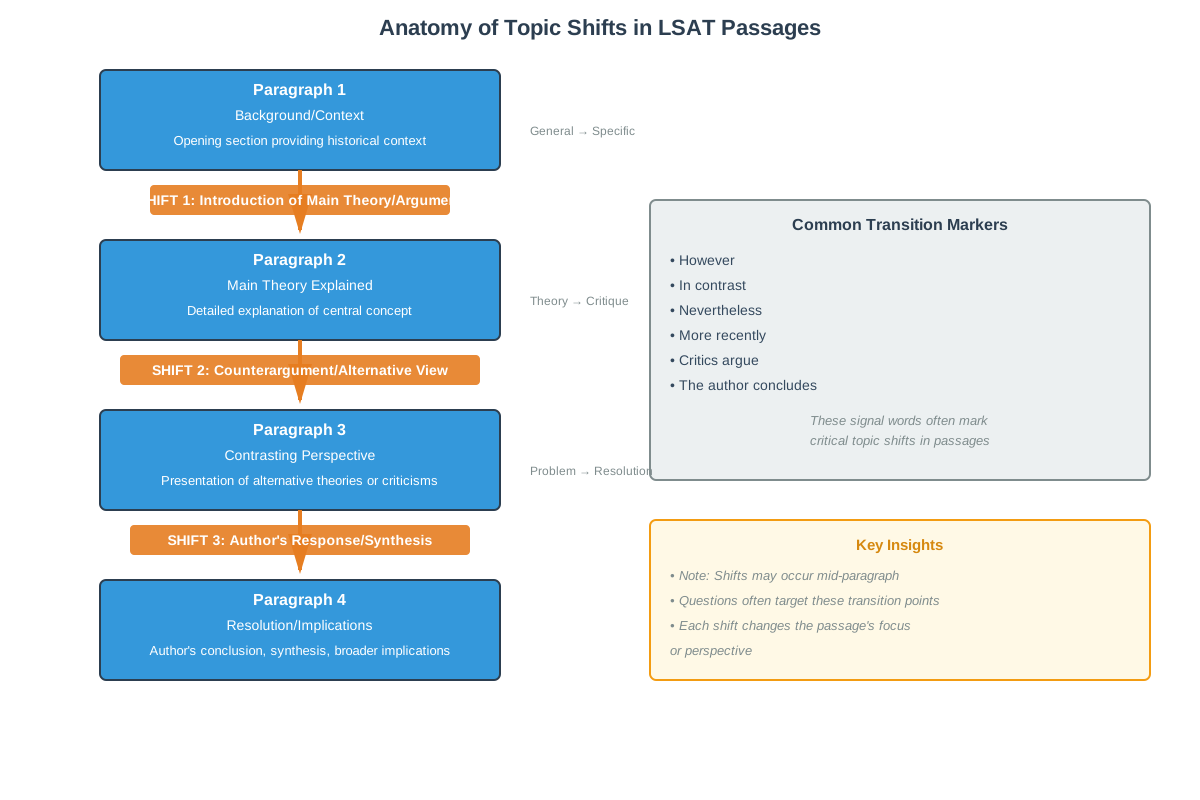
Topic shifts function as the organizational skeleton connecting all other passage fundamentals. The relationship flows as follows:
Paragraph Purpose → Topic Shifts → Passage Structure → Question Types
Each paragraph serves a specific purpose (introducing a theory, presenting evidence, offering criticism, etc.), and topic shifts mark transitions between these purposes. Multiple paragraphs with related purposes form larger structural sections, and the pattern of topic shifts reveals the overall passage structure (problem-solution, chronological development, compare-contrast, etc.).
Topic shifts connect directly to main idea identification because the passage's thesis often appears immediately before or after a major topic shift—frequently when the author shifts from presenting background information or others' views to stating their own position. Similarly, author's tone and attitude often shift at topic transition points, moving from neutral description to critical evaluation or from presenting one view to advocating another.
The relationship to detail questions is equally important: understanding topic shifts enables efficient location of specific information. When a question asks about a particular concept, knowing which section discusses that concept (based on topic shift mapping) allows direct navigation to the relevant passage portion without re-reading.
Textual relationship map:
Background Information → [SHIFT] → Theory Introduction → [SHIFT] → Criticism/Alternative View → [SHIFT] → Author's Position/Synthesis
This pattern, with variations, appears repeatedly in LSAT passages, and recognizing it enables prediction of both passage content and likely question types.
High-Yield Facts
⭐ Topic shifts occur at approximately 3-5 major points in typical LSAT Reading Comprehension passages, marking boundaries between the passage's main structural sections.
⭐ Contrastive transition words (however, nevertheless, yet, but) signal the highest-yield topic shifts, often introducing opposing viewpoints or the author's critique of previously presented ideas.
⭐ The most common major topic shift occurs between the first and second paragraphs, where passages frequently transition from background/context to introducing the main theory or issue under discussion.
⭐ Questions asking about "passage organization" or "structure" directly test topic shift recognition, requiring identification of how different sections relate and what purpose each serves.
⭐ Mid-paragraph topic shifts are deliberately included to test careful reading, as they're easier to miss than shifts coinciding with paragraph breaks.
- Topic shifts often coincide with changes in the types of evidence presented (from historical examples to scientific data, for example).
- The author's main thesis frequently appears immediately after a major topic shift, particularly when shifting from presenting others' views to stating their own position.
- Passages discussing multiple theories or perspectives typically shift between them in a predictable pattern, often presenting each view before offering synthesis or evaluation.
- Temporal markers (historically, recently, subsequently) signal chronological topic shifts that organize information by time period.
- Purpose shifts (from description to evaluation, from explanation to prescription) represent functional topic shifts even when the subject matter remains constant.
- Questions asking "why does the author mention X?" often target information appearing near topic shifts, where its structural role is most significant.
- Recognizing topic shifts reduces reading time by enabling strategic skimming of familiar patterns while focusing attention on transition points where meaning changes.
Quick check — test yourself on Topic shifts so far.
Try Flashcards →Common Misconceptions
Misconception: Every paragraph break represents a significant topic shift.
Correction: While paragraph breaks often coincide with topic shifts, many paragraphs continue developing the previous topic through additional examples, elaboration, or supporting evidence. Conversely, significant topic shifts sometimes occur mid-paragraph. The content and purpose must be evaluated, not just the visual formatting.
Misconception: Topic shifts always involve completely different subjects.
Correction: Many topic shifts involve the same general subject but represent changes in perspective, purpose, or aspect being discussed. A passage might discuss the same legal doctrine throughout but shift from describing it to critiquing it to proposing modifications—each representing a genuine topic shift despite the consistent subject matter.
Misconception: Transition words always signal topic shifts.
Correction: While transition words provide important clues, not all transitions indicate topic shifts. Words like "furthermore" or "additionally" often signal continued development of the same topic rather than a shift. Additionally, some topic shifts occur without explicit transition markers, requiring attention to content changes.
Misconception: Minor details and examples represent topic shifts.
Correction: Moving from one example to another within the same discussion, or from a general statement to its specific illustration, represents elaboration rather than a topic shift. True topic shifts change what the passage fundamentally addresses or the author's purpose, not merely the specific details being discussed.
Misconception: Topic shifts are only important for structure questions.
Correction: While structure questions explicitly test topic shift recognition, understanding these transitions aids virtually all question types. Detail questions become easier when you know which section discusses what; inference questions require understanding how different sections relate; and main idea questions depend on recognizing where the author's thesis appears relative to background information or opposing views.
Worked Examples
Example 1: Identifying Topic Shifts in a Science Passage
Passage Excerpt (simplified for illustration):
"For decades, scientists believed that neural development concluded in early adulthood, with the brain's structure remaining essentially fixed thereafter. This view dominated neuroscience throughout the twentieth century, shaping both research priorities and clinical approaches to brain injury.
However, research beginning in the 1990s challenged this orthodoxy. Studies demonstrated that the adult brain retains significant plasticity—the ability to form new neural connections and even generate new neurons in certain regions. This discovery revolutionized neuroscience, opening new avenues for treating neurological conditions.
Despite these advances, the mechanisms underlying adult neuroplasticity remain incompletely understood. Current research focuses on identifying the molecular signals that promote or inhibit neural regeneration, with the goal of developing therapeutic interventions."
Analysis:
First major topic shift (between paragraphs 1 and 2): Signaled by "However," this shift moves from the traditional view to the challenging new research. The shift type is both temporal (from past to recent research) and perspective (from old consensus to new findings). This represents a classic LSAT pattern: presenting established view before introducing the development that challenges it.
Second major topic shift (between paragraphs 2 and 3): Signaled by "Despite these advances," this shift moves from describing the discovery to discussing current research directions and remaining questions. The shift type is purpose-based—from explaining what was discovered to identifying what remains unknown and what researchers now pursue.
Application to questions: A structure question might ask: "Which of the following best describes the organization of the passage?" The correct answer would identify the pattern: traditional view → challenging research → current questions and directions. A detail question asking "According to the passage, what did twentieth-century scientists believe about neural development?" would be answered in the first section, before the first major shift. Understanding these shifts enables efficient navigation.
Example 2: Recognizing Mid-Paragraph Shifts
Passage Excerpt:
"The doctrine of precedent, or stare decisis, requires courts to follow earlier decisions when ruling on similar cases. This principle promotes consistency and predictability in legal outcomes, allowing citizens and businesses to plan their conduct with reasonable certainty about legal consequences. However, rigid adherence to precedent can perpetuate outdated or unjust rules, particularly when social conditions have changed substantially since the original decision. Critics argue that courts must balance respect for precedent against the need for legal evolution, though they disagree about where that balance should lie."
Analysis:
This single paragraph contains two topic shifts:
First shift (mid-paragraph, at "However"): Moves from the benefits of precedent to its potential drawbacks. This is a perspective shift within the same subject—still discussing stare decisis but shifting from positive to negative aspects. The contrastive "However" provides an explicit signal.
Second shift (at "Critics argue"): Introduces a third perspective—not just benefits or drawbacks, but the debate about balancing them. This represents a scope shift, zooming out from specific pros and cons to the broader question of how to reconcile them.
Application to questions: A question asking "The author mentions the principle of stare decisis primarily in order to" would require understanding that it's introduced to set up the subsequent discussion of its limitations and the debate about balancing consistency with evolution. Missing the mid-paragraph shifts would lead to incomplete understanding of the paragraph's purpose. A question about "critics" would require recognizing that they appear after the shift introducing the balancing debate, not in the earlier discussion of benefits and drawbacks.
Exam Strategy
Approaching Topic Shift Questions
When encountering questions that test topic shift recognition (structure, organization, or purpose questions), follow this systematic approach:
- Identify the question type: Recognize that structure/organization questions directly test topic shifts, while many other question types indirectly benefit from topic shift awareness.
- Consult your passage map: If you've marked major topic shifts during initial reading, reference these marks to understand the passage's overall organization before evaluating answer choices.
- Verify shift locations: For questions asking about specific paragraphs or sections, identify what comes immediately before and after to understand the transition's nature.
- Match pattern to answer choices: Structure questions typically present answer choices describing organizational patterns (chronological development, problem-solution, compare-contrast, etc.). Match the pattern of topic shifts you've identified to these descriptions.
Trigger Words and Phrases
High-Yield Exam Tip: Questions containing these phrases almost always test topic shift recognition: - "The organization of the passage can best be described as..." - "The author discusses X primarily in order to..." - "The relationship between the second and third paragraphs is..." - "The passage proceeds by..." - "Which of the following best describes the structure..."
During passage reading, mark or mentally note these transition signals:
Contrastive: however, nevertheless, yet, but, although, despite, in contrast, on the other hand, conversely
Additive/Progressive: moreover, furthermore, additionally, in addition, also, similarly
Causal: therefore, thus, consequently, as a result, accordingly
Temporal: historically, traditionally, recently, subsequently, initially, ultimately
Illustrative: for example, for instance, to illustrate, specifically
Emphatic: indeed, in fact, notably, significantly, more importantly
Process of Elimination Tips
When evaluating answer choices for structure questions:
- Eliminate answers that reverse the order of topics or perspectives presented in the passage.
- Eliminate answers that describe shifts that don't occur. If a choice mentions "comparing two theories" but the passage only discusses one theory, eliminate it.
- Eliminate answers that miss major shifts. If a choice describes the passage as presenting a single unified argument but you've identified a major shift from presenting others' views to the author's critique, that choice is incorrect.
- Eliminate answers using incorrect transition language. If a choice says the passage "contrasts" two views but the passage actually presents one view then builds upon it, the choice is wrong despite potentially correct content identification.
Time Allocation
Invest 15-20 seconds during initial passage reading to identify and mark major topic shifts. This upfront investment saves 30-60 seconds during question answering by enabling efficient navigation and preventing re-reading. For structure questions specifically, spend 20-30 seconds reviewing your passage map before evaluating answer choices, ensuring you have the overall organization clear before committing to an answer.
Memory Techniques
The SHIFT Acronym
Remember the five main types of topic shifts using SHIFT:
- Subject: Different topic entirely
- Historical/temporal: Different time period
- Intent/purpose: Different authorial goal
- Focus/scope: Broader or narrower discussion
- Takedown/perspective: Different viewpoint
Visualization Strategy
Imagine passages as buildings with distinct floors. Each major topic shift represents moving to a different floor, with each floor serving a different function (lobby = introduction, second floor = theory presentation, third floor = criticism, penthouse = author's conclusion). This spatial metaphor helps organize passage structure mentally and facilitates quick navigation when answering questions.
The "However" Rule
Create a strong mental association: "However" = High-yield shift. Contrastive transitions, especially "however," mark the most frequently tested topic shifts in LSAT passages. When you encounter "however," mentally flag it as a critical transition point likely to be tested.
The Three-Part Pattern
Most LSAT passages follow a three-part structure with two major shifts:
Part 1: Background/Traditional View/Problem Statement
[SHIFT 1]
Part 2: New Development/Alternative View/Proposed Solution
[SHIFT 2]
Part 3: Complications/Author's Position/Synthesis
Memorizing this pattern enables quick structural recognition and prediction of where information will appear.
Summary
Topic shifts represent the organizational architecture of LSAT Reading Comprehension passages, marking transitions between different subjects, perspectives, purposes, or scopes of discussion. Mastering topic shift recognition enables efficient passage mapping, quick information location, and accurate answering of structure questions while supporting performance on virtually all question types. The most critical shifts occur at contrastive transitions (particularly "however"), between major structural sections (often but not always at paragraph breaks), and when the author's purpose changes from description to evaluation or from presenting others' views to stating their own position. Effective test-takers actively identify 3-5 major topic shifts during initial reading, creating mental or physical passage maps that reveal how different sections relate. This structural understanding transforms reading comprehension from passive absorption to strategic navigation, reducing time pressure while improving accuracy. The key distinction lies between major shifts that fundamentally change what the passage addresses and minor transitions that merely elaborate the same topic with additional examples or details.
Key Takeaways
- Topic shifts mark the boundaries between a passage's main structural sections, typically occurring 3-5 times in LSAT passages and providing the organizational framework for efficient navigation.
- Contrastive transitions (however, nevertheless, yet) signal the highest-yield topic shifts, often introducing opposing viewpoints or the author's critique and frequently appearing in test questions.
- Not all paragraph breaks represent topic shifts, and not all topic shifts align with paragraph breaks—content and purpose changes matter more than visual formatting.
- Structure questions directly test topic shift recognition, requiring identification of how different sections relate and what organizational pattern the passage follows.
- The most common pattern involves two major shifts: from background to main development, then from development to complications/author's position.
- Strategic readers actively mark topic shifts during initial passage reading, investing 15-20 seconds to create a passage map that saves significantly more time during question answering.
- Understanding topic shifts aids all question types, not just structure questions, by enabling quick location of relevant information and clarifying how different passage elements relate.
Related Topics
Paragraph Purpose and Function: Building directly on topic shift recognition, this topic explores how to identify what each paragraph accomplishes within the passage's overall argument, using topic shifts as boundaries between different functional units.
Passage Structure and Organization: This advanced topic synthesizes topic shift recognition with other structural elements to identify common LSAT passage patterns (problem-solution, chronological development, compare-contrast, theory-criticism-synthesis) and predict question types based on structure.
Author's Tone and Attitude: Topic shifts often coincide with changes in authorial tone, particularly when shifting from neutral presentation of others' views to critical evaluation or advocacy of the author's own position.
Main Idea and Primary Purpose: Understanding topic shifts clarifies where the author's main thesis appears, typically after shifting from background information or others' perspectives to stating their own position.
Detail and Inference Questions: Mastering topic shifts enables efficient location of specific information needed for detail questions and provides the structural context necessary for making valid inferences about relationships between passage elements.
Practice CTA
Now that you understand how topic shifts structure LSAT Reading Comprehension passages, it's time to apply this knowledge. Attempt the practice questions to test your ability to identify topic shifts in real passage contexts, and use the flashcards to reinforce recognition of transition markers and shift types. Remember: recognizing topic shifts isn't just about answering structure questions—it's about transforming how you read passages, enabling strategic navigation that improves performance across all question types. Each practice passage you map strengthens your structural recognition skills, building the foundation for top-tier Reading Comprehension performance. You've got this!
Sign up free to keep reading
Create a free AnvayaPrep account to finish this LSAT guide on Topic shifts — plus flashcards and practice questions.