Overview
Biology passages represent one of the most frequently tested natural science topics in the LSAT Reading Comprehension section. These passages typically explore concepts from evolutionary biology, ecology, genetics, neuroscience, animal behavior, and related fields. Unlike undergraduate biology exams that test memorized facts, LSAT biology passages assess a test-taker's ability to comprehend complex scientific arguments, identify logical structures, and apply reasoning skills to unfamiliar content. The LSAT does not require prior knowledge of biology; instead, it evaluates how well students can extract meaning from dense scientific prose and answer questions about the passage's structure, purpose, and implications.
Understanding how to approach biology passages is critical because natural science passages appear in nearly every LSAT administration, and biology is the most common natural science subject tested. These passages often feature technical vocabulary, hierarchical explanations of phenomena, and discussions of competing scientific theories or research findings. Success with biology passages requires developing specific reading comprehension strategies that help students navigate specialized terminology, track multiple viewpoints, and distinguish between evidence and conclusions. The skills developed through mastering biology passages transfer directly to other passage types, making this topic foundational for overall Reading Comprehension performance.
Biology passages connect to broader passage subjects and strategies by exemplifying how the LSAT tests analytical reading across diverse content areas. The reasoning patterns in biology passages—such as hypothesis-evidence relationships, comparative analysis of theories, and evaluation of experimental design—mirror structures found in law passages, humanities passages, and social science passages. Mastering biology passages strengthens a student's ability to identify author's purpose, recognize logical structure, and make valid inferences regardless of subject matter, which is precisely what the LSAT demands from future law students.
Learning Objectives
- [ ] Identify how Biology passages appears in LSAT questions
- [ ] Explain the reasoning pattern behind Biology passages
- [ ] Apply Biology passages to solve LSAT-style problems accurately
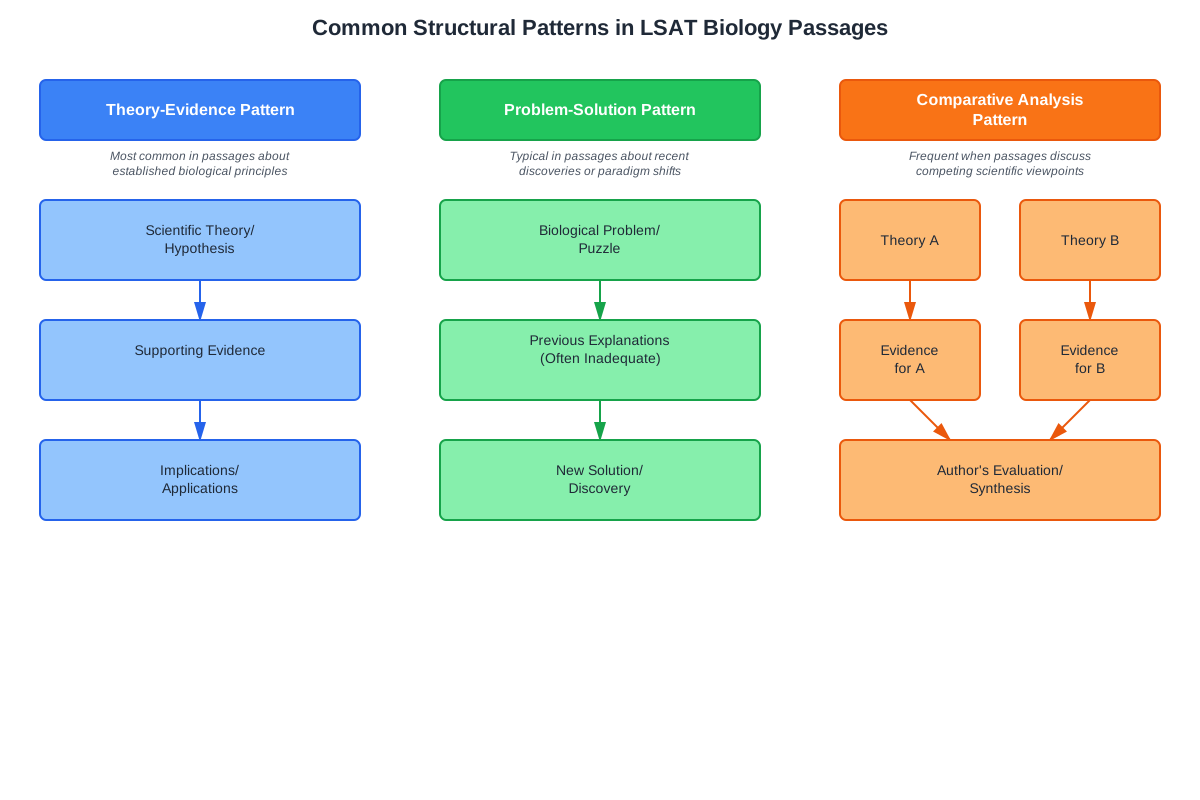
- [ ] Recognize common structural patterns in biology passages (theory-evidence, problem-solution, comparative analysis)
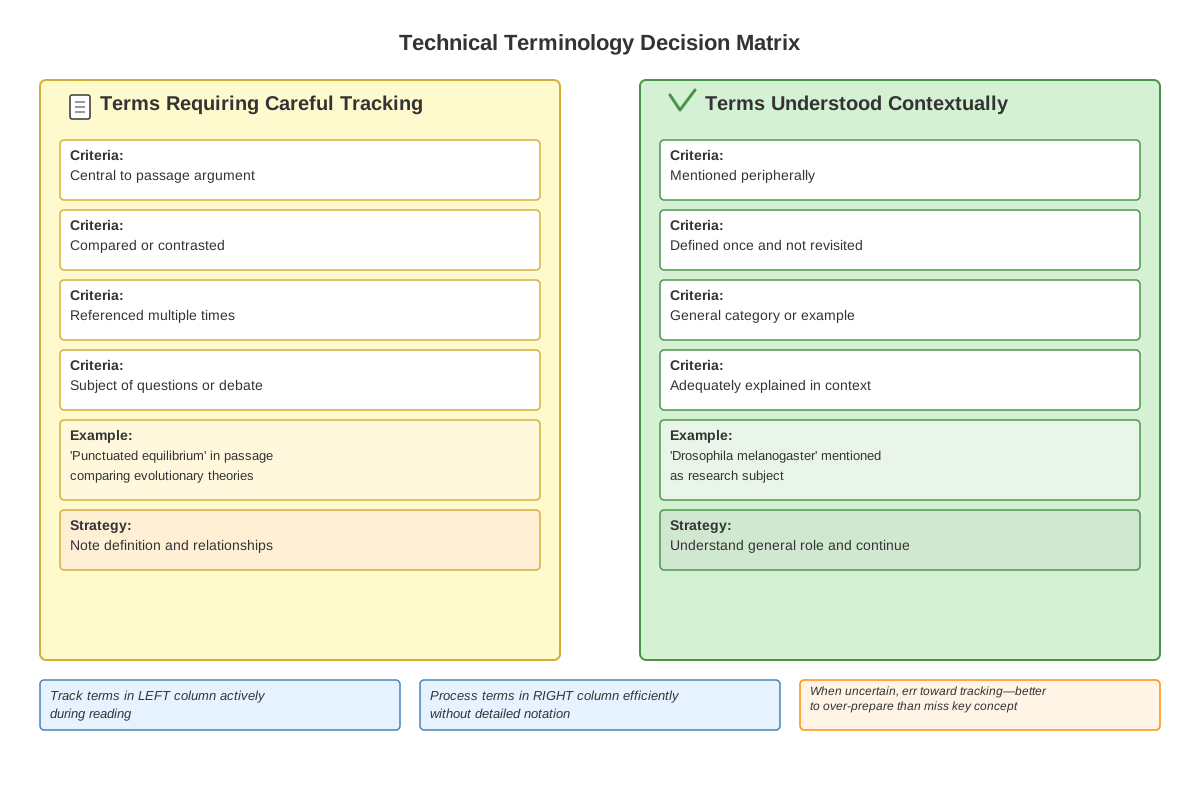
- [ ] Distinguish between technical terminology that requires careful tracking versus terms that can be understood contextually
- [ ] Evaluate the strength of evidence presented in biological arguments and identify gaps in reasoning
Prerequisites
- Basic reading comprehension skills: Ability to identify main ideas, supporting details, and paragraph structure in academic prose—essential for processing any LSAT passage efficiently
- Familiarity with argument structure: Understanding of premises, conclusions, and evidence—necessary because biology passages present scientific arguments that follow logical patterns
- Comfort with abstract reasoning: Capacity to work with unfamiliar concepts and apply general principles—critical since LSAT biology passages deliberately introduce novel scientific content
- Time management fundamentals: Basic pacing strategies for the Reading Comprehension section—important because biology passages can be time-intensive due to technical density
Why This Topic Matters
Biology passages matter because they test the core analytical skills that law schools value: the ability to comprehend complex specialized material, extract relevant information under time pressure, and apply logical reasoning to novel situations. Legal practice regularly requires attorneys to quickly master unfamiliar technical subjects—from medical malpractice cases to environmental regulations—making the skills tested by biology passages directly applicable to legal work. The LSAT uses biology passages specifically because they allow test-makers to present genuinely new information that levels the playing field; no test-taker can rely on prior coursework, forcing everyone to demonstrate pure reading comprehension and reasoning ability.
Exam statistics reveal that natural science passages appear in approximately 25% of Reading Comprehension sections, with biology representing roughly 60-70% of those natural science passages. This translates to biology passages appearing in about 15-18% of all Reading Comprehension sections—making them one of the most frequent passage types. Biology passages typically generate 5-8 questions per passage, and these questions span all major question types: main point, purpose, detail, inference, application, and structure questions. Test-takers who struggle with biology passages often lose 3-5 points per exam, a significant score differential.
Common manifestations of biology passages include: discussions of evolutionary adaptations and natural selection mechanisms; presentations of competing theories about animal cognition or behavior; explanations of ecological relationships and ecosystem dynamics; analyses of genetic inheritance patterns or molecular biology processes; examinations of neuroscience research and brain function; and evaluations of conservation biology strategies. These passages frequently feature a scientist or research team proposing a hypothesis, presenting evidence, and addressing counterarguments or alternative explanations—a structure that mirrors legal argumentation.
Core Concepts
Structure of Biology Passages
Biology passages on the LSAT follow predictable organizational patterns that, once recognized, dramatically improve comprehension speed and accuracy. The most common structure is the theory-evidence pattern, where the passage introduces a biological phenomenon, presents one or more explanatory theories, and provides supporting or contradicting evidence. For example, a passage might describe unusual mating behavior in a species, present two competing evolutionary explanations, and then discuss research findings that support one theory over another. Recognizing this pattern helps students anticipate where key information will appear and how questions will test their understanding.
Another frequent structure is the problem-solution pattern, particularly common in ecology and conservation biology passages. These passages identify an environmental or biological challenge (species decline, ecosystem disruption, disease spread) and then explore proposed solutions, often evaluating their effectiveness or limitations. The LSAT tests whether students can identify the problem's scope, understand the proposed mechanisms of solutions, and recognize potential weaknesses in the approaches discussed.
The comparative analysis pattern appears when passages contrast different species, biological processes, or research methodologies. These passages require careful tracking of which characteristics belong to which subject of comparison. Students must create mental or physical comparison charts to avoid confusion when questions ask about specific differences or similarities. The LSAT deliberately makes these comparisons complex, often involving three or more elements being compared across multiple dimensions.
Technical Vocabulary Management
One of the most challenging aspects of LSAT biology passages is managing technical vocabulary without prior subject knowledge. The LSAT employs two types of technical terms: those that are explicitly defined or contextually explained within the passage, and those that function as labels requiring only general understanding. Successful students distinguish between these types and allocate attention accordingly.
Explicitly defined terms often appear when the passage introduces a specialized concept central to the argument. For example, a passage might define "kin selection" as "evolutionary strategy where organisms promote the reproductive success of relatives, even at cost to their own survival." These definitions must be tracked carefully because questions will test precise understanding. Students should mark these definitions in the passage and note the paragraph location.
Label terms function as placeholders for concepts that don't require deep understanding. If a passage discusses "cytochrome oxidase" as an enzyme measured in an experiment, students need only remember "an enzyme that was measured"—not what cytochrome oxidase actually does biochemically. The LSAT provides sufficient context to answer questions without requiring outside knowledge. Recognizing label terms prevents students from wasting time trying to fully comprehend every technical detail.
Reasoning Patterns in Scientific Arguments
Biology passages exemplify scientific reasoning patterns that appear throughout the LSAT. The hypothesis-testing pattern presents a proposed explanation for a phenomenon, describes experiments or observations designed to test it, and evaluates results. Students must identify: (1) what hypothesis is being tested, (2) what evidence would support or refute it, (3) what the actual findings were, and (4) what conclusions the author draws. Questions frequently ask about alternative explanations, potential weaknesses in methodology, or what additional evidence would strengthen or weaken the argument.
The causal reasoning pattern appears when passages discuss cause-and-effect relationships in biological systems. For example, a passage might explore whether a specific gene causes a particular behavior, or whether environmental factors cause population changes. The LSAT tests whether students can distinguish between correlation and causation, identify confounding variables, and recognize when causal claims are overstated. This reasoning pattern directly parallels legal reasoning about causation in tort law and other legal contexts.
The analogical reasoning pattern occurs when passages compare biological phenomena to explain unfamiliar concepts through familiar ones, or when they draw parallels between different species or systems. Students must evaluate whether analogies are apt and identify where they break down. Questions often ask what the analogy illustrates or what limits its applicability.
Author's Purpose and Perspective
Understanding author's purpose is crucial for biology passages because the LSAT frequently asks why the author included specific information or what function a paragraph serves. Biology passages typically adopt one of several authorial stances: neutral presentation of competing theories, advocacy for a particular scientific viewpoint, critique of prevailing assumptions, or explanation of recent research developments.
When authors present competing theories neutrally, they typically give roughly equal treatment to each perspective before potentially indicating which has stronger support. Questions test whether students can identify each theory's main claims and distinguish the author's view from the views being described. Signal phrases like "proponents argue," "critics contend," or "some researchers believe" indicate the author is presenting others' views rather than endorsing them.
When authors advocate for a position, they use evaluative language ("convincingly demonstrates," "fails to account for," "overlooks crucial evidence") and structure the passage to build toward their preferred conclusion. Recognizing advocacy helps students predict which answer choices will align with the author's perspective on attitude and tone questions.
Evidence Evaluation
Biology passages require students to evaluate the strength and relevance of evidence presented for scientific claims. The LSAT tests this skill through questions asking what would strengthen or weaken an argument, what assumptions underlie a conclusion, or what additional information would be most useful. Strong evidence in biology passages typically includes: controlled experimental results, large sample sizes, replication across multiple studies, and mechanisms explaining observed patterns. Weak evidence includes: anecdotal observations, small samples, correlation without mechanism, or alternative explanations not ruled out.
Students must also recognize different types of biological evidence: experimental data (controlled manipulation of variables), observational data (field studies without manipulation), comparative data (differences between species or populations), and theoretical models (mathematical or conceptual frameworks). Each evidence type has characteristic strengths and limitations that the LSAT exploits in questions.
Concept Relationships
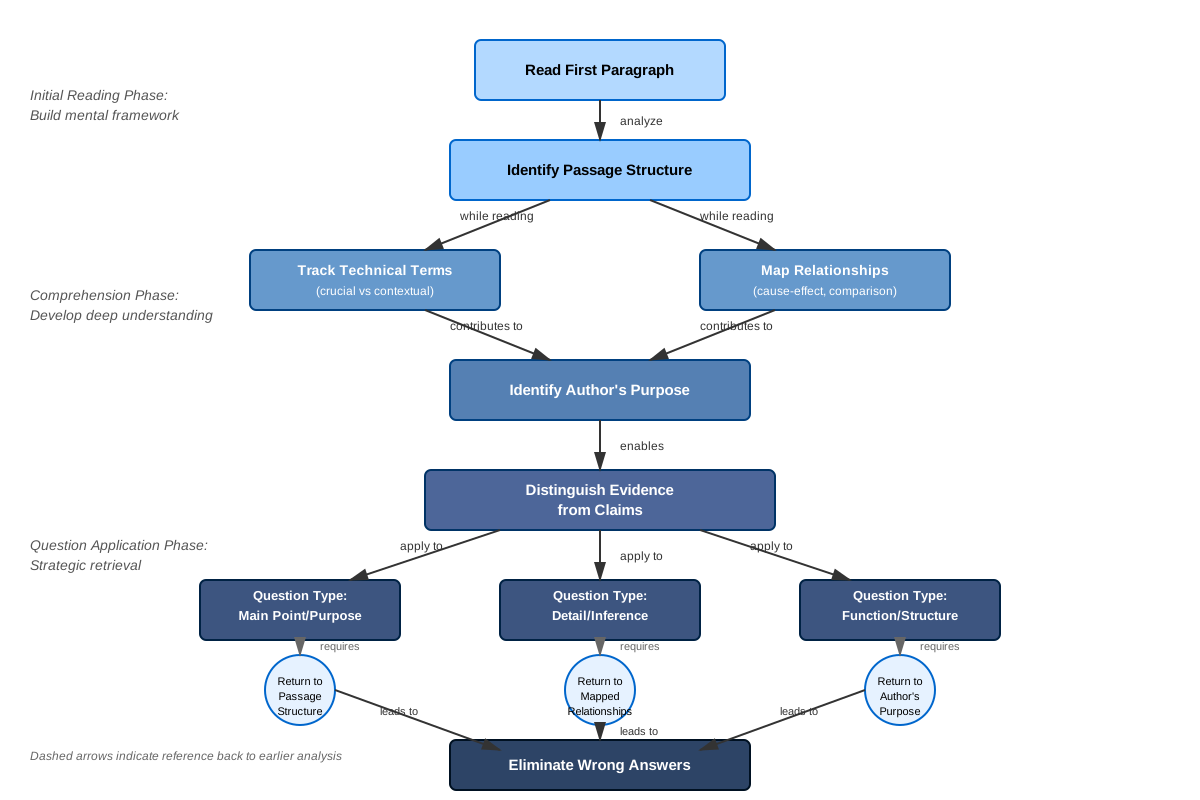
The concepts within biology passages form an interconnected system where structural recognition enables vocabulary management, which in turn facilitates reasoning pattern identification, ultimately supporting accurate evidence evaluation and purpose determination. Structure recognition serves as the foundation: identifying whether a passage follows theory-evidence, problem-solution, or comparative analysis patterns provides a framework for organizing all subsequent information. This structural understanding guides vocabulary management by helping students predict where technical terms will be defined and which terms require careful tracking versus general understanding.
Vocabulary management connects directly to reasoning pattern identification because understanding key terms allows students to follow the logical flow of scientific arguments. When students accurately track which evidence supports which hypothesis, they can better identify hypothesis-testing, causal reasoning, or analogical reasoning patterns. These reasoning patterns then inform evidence evaluation: recognizing that a passage employs causal reasoning alerts students to watch for confounding variables and alternative explanations, while identifying analogical reasoning prompts consideration of where analogies might break down.
Evidence evaluation and author's purpose are reciprocally related: understanding what evidence the author emphasizes reveals their purpose (advocacy, neutral presentation, or critique), while recognizing the author's purpose helps predict which evidence they'll present as strongest. All these concepts ultimately serve the goal of answering questions accurately and efficiently, with each concept providing tools for different question types.
The relationship to prerequisite knowledge flows logically: basic reading comprehension skills enable structure recognition, familiarity with argument structure supports reasoning pattern identification, comfort with abstract reasoning facilitates vocabulary management, and time management fundamentals allow efficient application of all these strategies under test conditions.
Quick check — test yourself on Biology passages so far.
Try Flashcards →High-Yield Facts
⭐ Biology passages appear in approximately 15-18% of LSAT Reading Comprehension sections, making them one of the most frequent passage types
⭐ The LSAT never requires outside biology knowledge; all necessary information appears in the passage itself
⭐ Technical terms that are explicitly defined in the passage are almost always tested in questions
⭐ The most common biology passage structure is theory-evidence, where competing explanations are presented and evaluated
⭐ Questions about author's purpose frequently hinge on distinguishing the author's view from views the author is merely describing
- Biology passages typically generate 5-8 questions covering all major question types
- Comparative analysis passages require tracking multiple elements across several dimensions simultaneously
- Signal phrases like "however," "surprisingly," or "contrary to expectations" often introduce key turning points in biological arguments
- Evidence evaluation questions often test whether students can identify confounding variables or alternative explanations
- The problem-solution structure is particularly common in ecology and conservation biology passages
- Analogical reasoning in biology passages often compares different species or biological systems to explain unfamiliar concepts
- Questions asking what would "strengthen" or "weaken" an argument test understanding of evidence quality and relevance
- Author attitude in biology passages ranges from neutral presentation to strong advocacy, affecting how information should be interpreted
- Passages discussing experimental research typically follow a pattern: background → hypothesis → methodology → results → interpretation
- The LSAT deliberately uses biology passages to test pure reasoning ability by introducing genuinely novel scientific content
Common Misconceptions
Misconception: Students need prior biology knowledge to succeed on biology passages → Correction: The LSAT is designed to test reading comprehension and reasoning, not content knowledge. All information needed to answer questions appears in the passage. Students who try to apply outside biology knowledge often introduce incorrect information or miss what the passage actually says. The key is trusting the passage as the sole source of information.
Misconception: Every technical term must be fully understood before proceeding → Correction: Many technical terms function as labels requiring only general understanding. Students should distinguish between terms that are explicitly defined (which require careful attention) and terms that serve as placeholders (which need only rough comprehension). Attempting to fully understand every technical detail wastes time and mental energy without improving accuracy.
Misconception: Biology passages are inherently harder than other passage types → Correction: Biology passages follow the same logical structures and test the same reasoning skills as other passages. They may feel harder due to unfamiliar vocabulary, but the underlying reasoning patterns are identical. Students who struggle with biology passages typically need to improve their structural reading and vocabulary management strategies, not their biology knowledge.
Misconception: The author's view is always explicitly stated → Correction: Authors often present multiple perspectives without clearly stating their own position until late in the passage, or they indicate their view only through subtle evaluative language. Students must track signal phrases and tone to distinguish the author's perspective from views being described. Questions frequently test this distinction.
Misconception: Experimental results presented in a passage are always conclusive → Correction: The LSAT often presents research with limitations, alternative explanations, or methodological weaknesses. Students must evaluate evidence critically rather than accepting all presented findings as definitive. Questions frequently ask about what would strengthen or weaken arguments, testing whether students recognize that evidence can be provisional or incomplete.
Misconception: Comparative passages require memorizing all details about each element being compared → Correction: Effective comparison tracking involves noting key distinguishing features and knowing where to find details in the passage, not memorizing everything. Students should create simple comparison frameworks (mental or physical) that capture essential differences, then refer back to the passage for specific details when questions require them.
Worked Examples
Example 1: Theory-Evidence Structure
Passage Summary: A biology passage discusses why certain bird species engage in "mobbing behavior," where small birds collectively harass predators. The passage presents two theories: (1) the "move-along hypothesis," which suggests mobbing functions to drive predators away from nesting areas, and (2) the "cultural transmission hypothesis," which proposes mobbing teaches young birds to recognize predators. The passage then describes research showing that mobbing occurs even when no nests are present and that young birds who observe mobbing later recognize those predator species more readily.
Question: The passage suggests that the research findings provide support for which of the following?
Step 1 - Identify the structure: This is a classic theory-evidence pattern with two competing hypotheses and research findings that favor one over the other.
Step 2 - Track what each theory predicts: The move-along hypothesis predicts mobbing should occur primarily when nests are present (to protect offspring). The cultural transmission hypothesis predicts mobbing should help young birds learn predator recognition regardless of nest presence.
Step 3 - Evaluate the evidence: The research shows mobbing occurs without nests present (contradicts move-along hypothesis) and that young birds learn predator recognition through observation (supports cultural transmission hypothesis).
Step 4 - Match to answer choices: The correct answer will indicate that the cultural transmission hypothesis receives support while the move-along hypothesis is weakened or called into question.
Connection to learning objectives: This example demonstrates how to identify the theory-evidence reasoning pattern, track competing explanations, and evaluate which evidence supports which theory—core skills for biology passages.
Example 2: Technical Vocabulary and Evidence Evaluation
Passage Summary: A biology passage discusses research on "magnetoreception" in sea turtles—the ability to detect Earth's magnetic field for navigation. The passage explains that scientists tested whether turtles use magnetoreception by placing hatchlings in tanks surrounded by magnetic coils that simulated magnetic fields from different ocean locations. The turtles oriented themselves in directions appropriate for the simulated locations, suggesting they can detect and respond to magnetic field variations.
Question: The experimental design described in the passage assumes which of the following?
Step 1 - Identify the technical term: "Magnetoreception" is explicitly defined as the ability to detect Earth's magnetic field. This is a key term requiring careful tracking.
Step 2 - Understand the experimental logic: The experiment manipulates magnetic fields (independent variable) and measures turtle orientation (dependent variable). If turtles orient appropriately to simulated fields, this suggests they detect those fields.
Step 3 - Identify the assumption: For this experiment to be valid, it must assume that the magnetic coils accurately simulate natural magnetic fields and that turtle orientation is a reliable indicator of magnetic field detection. It also assumes no other cues (visual, chemical) are influencing orientation.
Step 4 - Evaluate answer choices: The correct answer will identify one of these necessary assumptions—likely that the simulated magnetic fields are comparable to natural ones, or that orientation behavior reflects magnetic field detection rather than other factors.
Connection to learning objectives: This example shows how to manage technical vocabulary by focusing on defined terms, how to analyze experimental reasoning in biology passages, and how to identify assumptions underlying scientific arguments—all essential skills for LSAT biology passages.
Exam Strategy
When approaching LSAT biology passages, begin with a structural preview: quickly scan paragraph openings to identify whether the passage follows theory-evidence, problem-solution, or comparative analysis structure. This 10-15 second investment provides a framework for organizing information as you read. During the initial read-through, focus on understanding the logical flow and main purpose rather than memorizing details. Mark locations of key information (theory statements, evidence, author's evaluative language) so you can efficiently return when questions require specific details.
Trigger words and phrases signal important structural elements in biology passages. Watch for: "hypothesis," "theory," "proposes," or "suggests" (indicating explanatory claims); "however," "surprisingly," "contrary to," or "challenges" (indicating contrasts or complications); "evidence," "research shows," "studies indicate," or "experiments demonstrate" (marking supporting data); "critics argue," "alternative explanation," or "some researchers contend" (presenting opposing views); and "therefore," "thus," "indicates," or "suggests that" (marking conclusions or inferences).
For process-of-elimination, biology passage questions often include wrong answers that: (1) confuse which theory or species a characteristic belongs to (check your comparison tracking), (2) make claims too strong for the evidence presented (watch for "proves," "establishes definitively," or "completely explains"), (3) introduce outside information not stated in the passage (trust only what's written), (4) confuse the author's view with views the author describes (check for signal phrases), or (5) misrepresent the relationship between evidence and conclusion (verify the logical connection).
Time allocation for biology passages should mirror other passage types: approximately 3-4 minutes for the initial read and 5-6 minutes for questions, totaling 8-10 minutes per passage. If technical vocabulary slows your initial read, don't panic—the time investment in careful reading pays off through faster, more accurate question answering. However, if you find yourself re-reading the same sentence multiple times, move forward and trust that questions will direct you back to important information. The LSAT rewards efficient reading that captures structure and main ideas over slow reading that attempts to master every detail.
When stuck between two answer choices on biology passage questions, return to the specific passage text referenced in the question. The correct answer will have direct textual support, while the wrong answer will typically require an inference the passage doesn't support or will contradict passage information. For inference questions specifically, the correct answer follows necessarily from passage statements, while wrong answers go beyond what can be concluded or contradict passage information.
Memory Techniques
STEM - Remember the four key elements to track in theory-evidence biology passages:
- Statement of the phenomenon or question
- Theories or explanations proposed
- Evidence presented for each theory
- Main conclusion or author's position
PROVE - For evaluating experimental evidence in biology passages:
- Prediction: What does the hypothesis predict?
- Results: What were the actual findings?
- Other explanations: What alternative causes might explain results?
- Variables: What was controlled vs. manipulated?
- Evaluation: Does evidence support or weaken the hypothesis?
Visualization strategy: When encountering comparative biology passages (comparing species, theories, or processes), create a mental T-chart or Venn diagram. Visualize one subject on the left, another on the right, and note distinguishing characteristics in each column. This mental organization prevents confusion when questions ask about specific differences or similarities.
The "Label vs. Learn" technique: When encountering technical terms, mentally categorize them as either "Label" (just a placeholder requiring general understanding) or "Learn" (explicitly defined and likely to be tested). Draw a small "L" next to Learn terms in the passage. This prevents wasting mental energy on unimportant terminology while ensuring attention to key concepts.
The "Author's Voice" technique: As you read, imagine the author speaking with a particular tone—neutral reporter, enthusiastic advocate, or skeptical critic. This personification helps track author's purpose and attitude, making it easier to answer questions about the author's perspective or why certain information was included.
Summary
Biology passages on the LSAT test reading comprehension and reasoning skills through scientific content that requires no prior knowledge. Success depends on recognizing common structural patterns (theory-evidence, problem-solution, comparative analysis), managing technical vocabulary by distinguishing terms requiring careful attention from those serving as labels, and identifying reasoning patterns including hypothesis-testing, causal reasoning, and analogical reasoning. Students must evaluate evidence quality, track author's purpose and perspective, and distinguish the author's views from views being described. The key to mastering biology passages is developing systematic strategies for structural reading, comparison tracking, and evidence evaluation rather than attempting to understand every technical detail. These passages appear frequently on the LSAT and generate questions across all major types, making them high-yield for score improvement. The analytical skills developed through biology passages—comprehending specialized material, extracting relevant information, and applying logical reasoning to novel content—directly parallel skills required in legal practice and law school, which is why the LSAT emphasizes them.
Key Takeaways
- Biology passages test reading comprehension and reasoning, never outside biology knowledge—trust the passage as your sole information source
- Recognizing structural patterns (theory-evidence, problem-solution, comparative analysis) provides a framework for organizing information efficiently
- Distinguish between technical terms that are explicitly defined (requiring careful tracking) and label terms (requiring only general understanding)
- Track the author's purpose and perspective by noting evaluative language and distinguishing the author's view from views being described
- Evidence evaluation questions test whether you can identify confounding variables, alternative explanations, and limitations in research findings
- Biology passages appear in approximately 15-18% of Reading Comprehension sections and generate 5-8 questions spanning all major question types
- The skills developed for biology passages—structural reading, comparison tracking, evidence evaluation—transfer directly to other passage types and improve overall Reading Comprehension performance
Related Topics
Natural Science Passages (General): While biology is the most common natural science subject, the LSAT also features passages on physics, astronomy, geology, and chemistry. The strategies developed for biology passages apply broadly to all natural science content, with similar emphasis on hypothesis-testing, evidence evaluation, and technical vocabulary management.
Social Science Passages: These passages share structural similarities with biology passages, particularly when discussing research studies, competing theories, or causal relationships in psychology, sociology, or economics. Mastering biology passages strengthens skills for social science content.
Comparative Reading Passages: Some Reading Comprehension sections include paired passages presenting different perspectives on the same topic. Biology comparative passages require tracking two authors' views simultaneously, building on the comparison skills developed in single biology passages.
Strengthen/Weaken Question Types: Biology passages frequently generate questions asking what would strengthen or weaken an argument. Mastering evidence evaluation in biology passages directly improves performance on these question types across all passage subjects.
Practice CTA
Now that you've mastered the core concepts and strategies for LSAT biology passages, it's time to apply these skills to actual practice questions. Work through the practice problems systematically, using the structural reading techniques and evidence evaluation strategies you've learned. Pay special attention to how questions test your understanding of reasoning patterns and author's purpose. Review the flashcards to reinforce technical vocabulary management and common structural patterns. Remember: biology passages become significantly easier with practice as you internalize these strategies and build confidence with scientific content. Each passage you complete strengthens your analytical reading skills and brings you closer to your target LSAT score. You've got this!
Sign up free to keep reading
Create a free AnvayaPrep account to finish this LSAT guide on Biology passages — plus flashcards and practice questions.