Overview
Economics passages represent one of the most frequently tested subject areas in LSAT Reading Comprehension sections. These passages typically explore economic theories, market behaviors, policy debates, regulatory frameworks, or historical economic developments. Unlike technical economics courses that require mathematical modeling, LSAT economics passages focus on conceptual reasoning, argumentation structure, and the logical relationships between economic principles and their applications or consequences.
Understanding how to approach economics passages is essential for LSAT success because they appear in approximately 15-20% of Reading Comprehension sections and often challenge test-takers with dense terminology, abstract concepts, and complex causal relationships. These passages test not your prior knowledge of economics, but your ability to comprehend sophisticated arguments, track multiple viewpoints, identify logical structures, and draw warranted inferences from the text. The LSAT deliberately selects economics topics that are accessible to general readers while maintaining intellectual rigor—you might encounter passages on behavioral economics, trade policy, market failures, economic history, or debates about regulation.
Within the broader framework of passage subjects and strategies, economics passages share characteristics with other social science passages but present unique challenges. They frequently employ specialized vocabulary (elasticity, externalities, market equilibrium), present competing theoretical frameworks, and require careful attention to conditional reasoning and causal claims. Mastering economics passages strengthens your overall reading comprehension skills by developing your ability to navigate technical language, distinguish between descriptive and normative claims, and evaluate the logical structure of policy arguments—skills that transfer directly to law passages, science passages, and humanities passages.
Learning Objectives
- [ ] Identify how Economics passages appears in LSAT questions
- [ ] Explain the reasoning pattern behind Economics passages
- [ ] Apply Economics passages to solve LSAT-style problems accurately
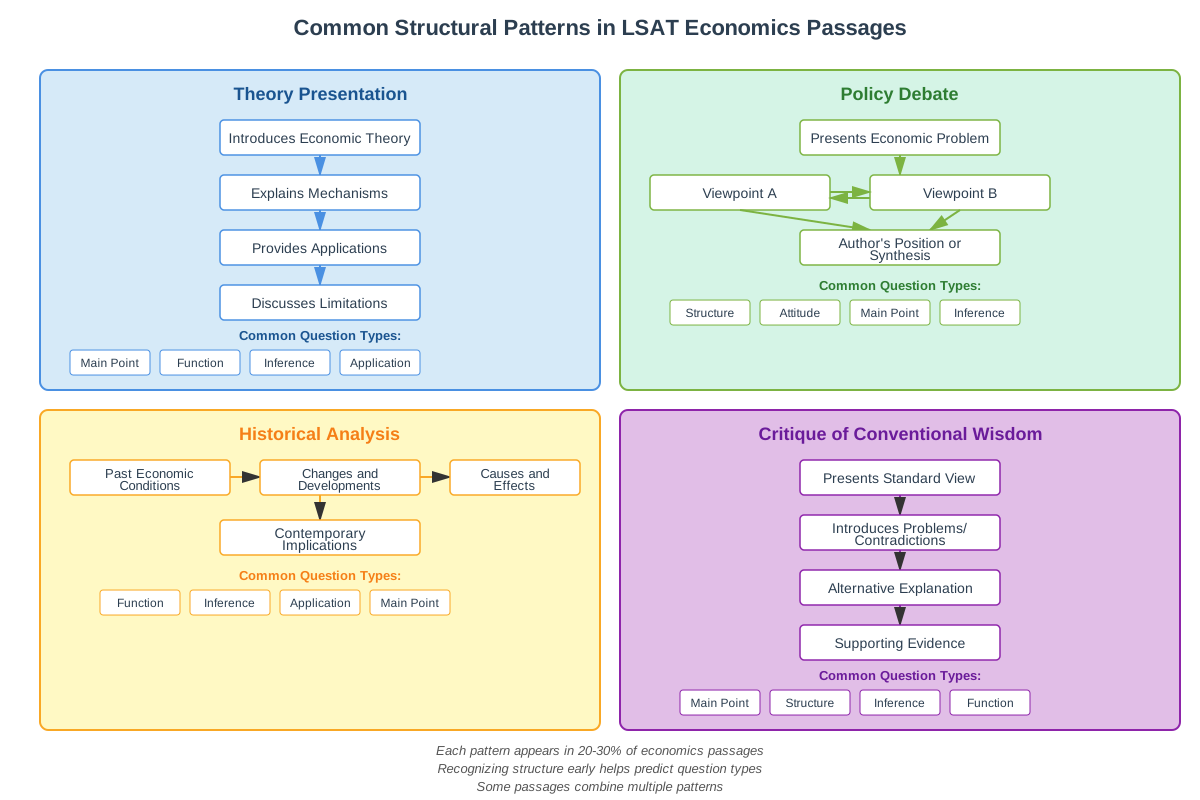
- [ ] Recognize common structural patterns in economics passages (theory presentation, policy debate, historical analysis, critique of conventional wisdom)
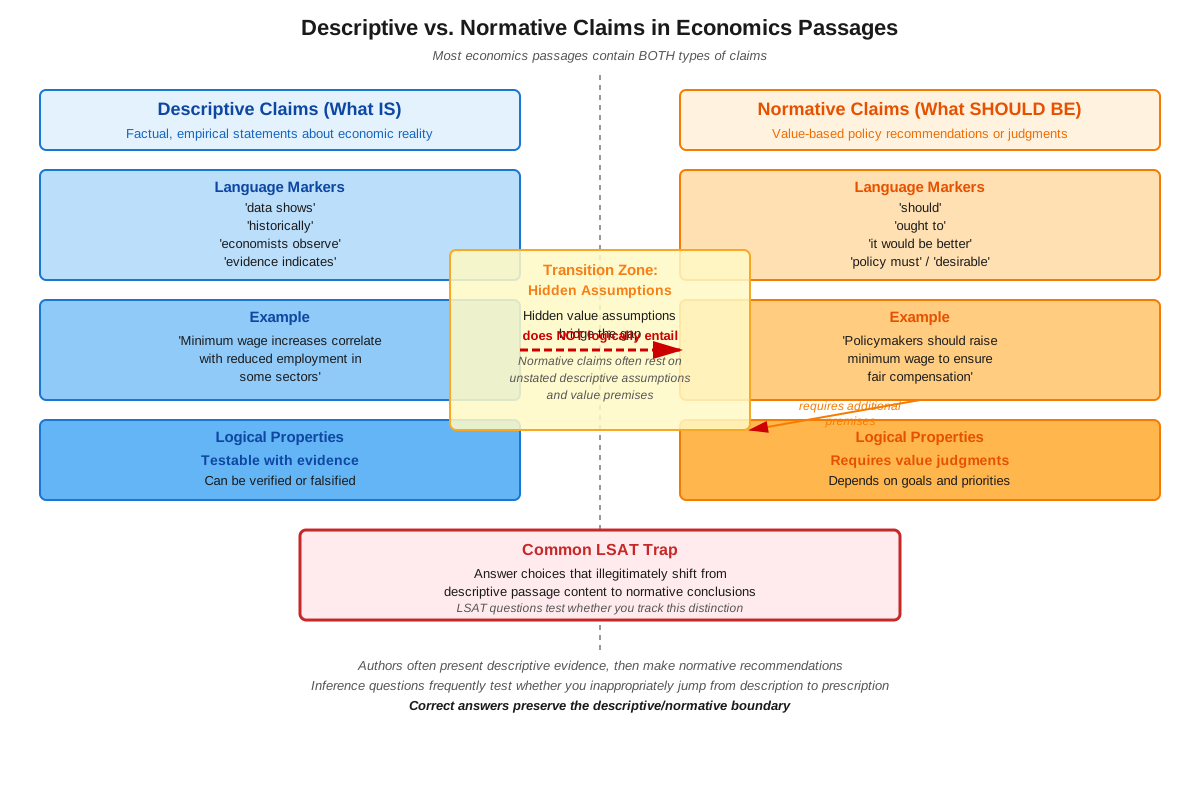
- [ ] Distinguish between descriptive economic claims and normative policy recommendations
- [ ] Evaluate the strength of economic arguments by identifying assumptions, evidence types, and logical connections
- [ ] Navigate technical economic terminology without prior specialized knowledge by using context clues
Prerequisites
- Basic reading comprehension skills: Ability to identify main ideas, supporting details, and author's purpose—essential for processing any LSAT passage
- Understanding of argument structure: Recognition of premises, conclusions, and logical connections—economics passages frequently present arguments about causes, effects, and policy implications
- Familiarity with LSAT question types: Knowledge of main point, inference, function, and attitude questions—these question types apply consistently across all passage subjects
- Comfort with abstract reasoning: Ability to work with theoretical concepts and hypothetical scenarios—economics passages often discuss models and principles rather than concrete events
Why This Topic Matters
Economics passages matter profoundly for LSAT success because they test core analytical skills that law schools value: the ability to comprehend complex policy arguments, evaluate evidence, distinguish between correlation and causation, and recognize unstated assumptions. Legal practice frequently involves economic reasoning—antitrust law, regulatory compliance, tax policy, contract disputes, and legislative analysis all require understanding economic concepts and arguments.
On the LSAT, economics passages appear with high frequency, typically constituting one passage per test (out of four Reading Comprehension passages). These passages generate questions across all standard types: main point questions (testing whether you grasp the passage's central thesis), inference questions (requiring you to draw logical conclusions from economic principles), function questions (asking why the author includes specific examples or theories), attitude questions (testing your understanding of the author's perspective on economic debates), and application questions (requiring you to extend economic reasoning to new scenarios).
Common manifestations include passages that present a new economic theory and contrast it with traditional approaches, passages that debate the merits of specific policies (minimum wage laws, trade restrictions, environmental regulations), passages exploring behavioral economics findings that challenge rational actor models, historical passages examining economic developments (the Great Depression, industrialization, monetary policy evolution), and passages critiquing economic methodologies or assumptions. The LSAT favors passages that involve intellectual debate, methodological innovation, or challenges to conventional wisdom—areas where economic discourse is particularly rich.
Core Concepts
Structure of Economics Passages
Economics passages on the LSAT follow several predictable structural patterns. The theory-presentation structure introduces an economic concept or model, explains its mechanisms, and often discusses its implications or applications. For example, a passage might explain the concept of information asymmetry in markets, describe how it leads to market failures, and discuss potential regulatory responses. The comparative structure presents two or more competing economic theories or policy approaches, contrasting their assumptions, predictions, or normative implications. A passage might compare Keynesian and monetarist approaches to managing recessions, outlining each theory's causal claims and policy recommendations.
The critique structure presents a conventional economic view and then challenges it, either by introducing contradictory evidence, exposing flawed assumptions, or offering an alternative framework. Many behavioral economics passages follow this pattern: they describe traditional rational choice theory, present experimental findings that contradict its predictions, and propose revised models incorporating psychological insights. The historical-development structure traces the evolution of economic thought or policy, often explaining how new circumstances or intellectual innovations led to paradigm shifts.
Economic Reasoning Patterns
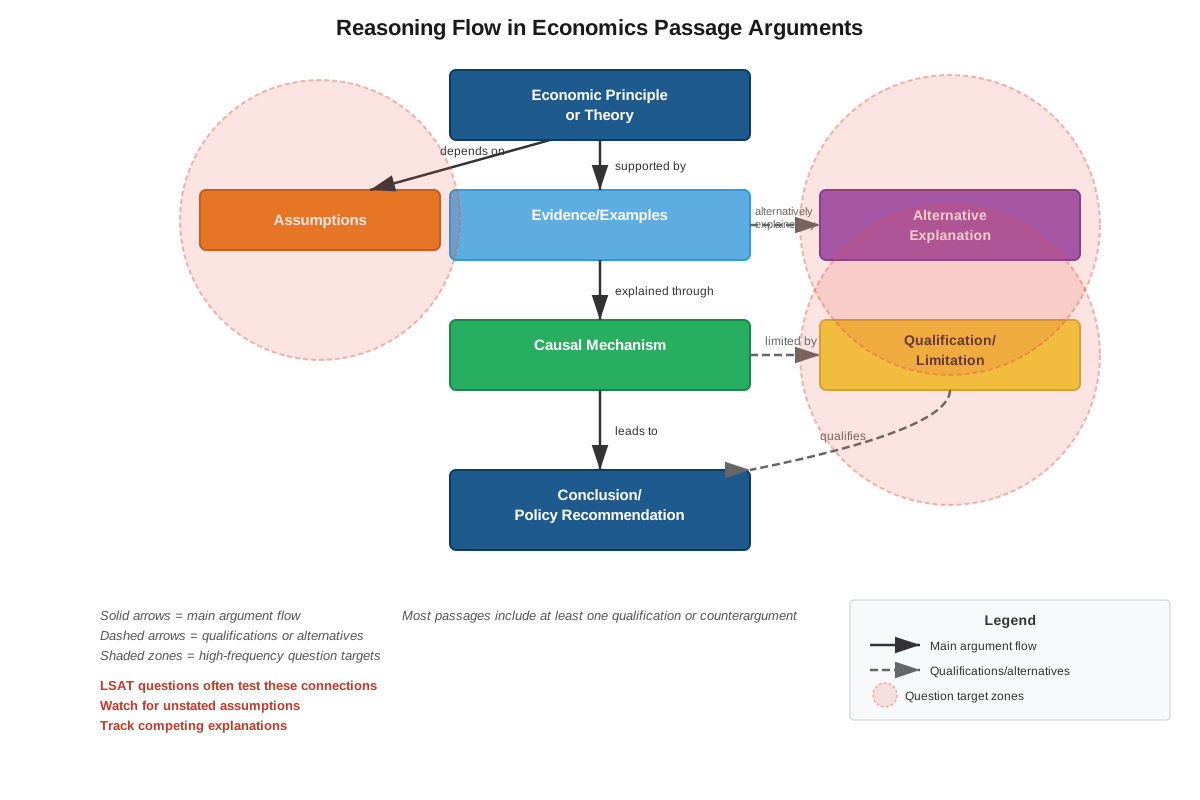
Economics passages employ distinctive reasoning patterns that test-takers must recognize. Causal reasoning is ubiquitous—passages explain how changes in one economic variable (interest rates, tax rates, trade barriers) produce effects in others (investment, employment, consumer prices). The LSAT tests whether you can accurately track these causal chains and distinguish between necessary conditions, sufficient conditions, and contributing factors.
Comparative reasoning appears when passages contrast different market structures, policy regimes, or theoretical predictions. You must track which characteristics belong to which system and understand the basis for comparison. Conditional reasoning emerges in discussions of economic models: "If markets are perfectly competitive, then prices will equal marginal costs" presents a conditional relationship that may be questioned by introducing real-world complications like monopoly power or transaction costs.
Normative versus descriptive reasoning represents a crucial distinction. Descriptive claims describe how economies actually function ("Minimum wage increases reduce employment in affected sectors"), while normative claims make value judgments about policy goals ("Governments should prioritize full employment over price stability"). The LSAT frequently tests whether you recognize this distinction and understand that descriptive economic analysis doesn't automatically justify normative conclusions.
Common Economic Concepts in LSAT Passages
While the LSAT doesn't require prior economics knowledge, certain concepts appear frequently enough that familiarity aids comprehension. Market mechanisms include supply and demand dynamics, price signals, equilibrium concepts, and market failures (externalities, public goods, information problems). Passages explain these concepts sufficiently for comprehension, but recognizing the terminology accelerates processing.
Regulatory frameworks and policy debates constitute major passage topics. Passages might discuss rationales for government intervention (correcting market failures, redistributing income, protecting consumers), debates about regulatory approaches (command-and-control versus market-based mechanisms), or analyses of specific policies (antitrust enforcement, environmental regulation, financial oversight).
Economic methodologies sometimes become passage subjects. Passages might discuss how economists construct models, the role of assumptions in economic reasoning, debates about empirical methods, or critiques of mainstream economic approaches. These passages test your ability to understand methodological arguments—claims about how knowledge should be generated and validated.
Behavioral economics has become increasingly prominent in LSAT passages. These passages typically contrast traditional rational choice models with findings from psychology and experimental economics, showing how cognitive biases, social preferences, or bounded rationality affect economic behavior. Understanding the basic pattern—traditional model assumes X, but evidence shows Y, therefore revised model incorporates Z—helps navigate these passages efficiently.
Vocabulary and Terminology Management
LSAT economics passages introduce specialized terminology but always provide sufficient context for comprehension. The key skill is extracting meaning from context rather than relying on prior knowledge. When a passage introduces a term like "elasticity," it will explain or demonstrate the concept: "Price elasticity of demand measures how responsive consumers are to price changes—when demand is elastic, small price increases cause large decreases in quantity purchased."
Effective readers create mental glossaries as they read, noting definitions and tracking how terms relate to the passage's argument. When encountering unfamiliar terminology, look for appositive phrases (set off by commas or dashes), explicit definitions ("X is defined as..."), or functional explanations ("X occurs when..."). The LSAT never requires you to know technical definitions beforehand, but it does test whether you can accurately apply definitions provided in the passage.
Identifying Author's Purpose and Perspective
Understanding the author's purpose and attitude is crucial for answering many questions about economics passages. Authors might aim to explain a theory or phenomenon (neutral, informative tone), advocate for a policy or approach (evaluative, persuasive tone), critique a conventional view (skeptical, argumentative tone), or synthesize multiple perspectives (balanced, analytical tone).
Recognizing the author's perspective requires attention to evaluative language, concessions and rebuttals, and the passage's overall argumentative structure. If an author presents a traditional economic view in paragraph one, introduces contradictory evidence in paragraph two, and proposes an alternative framework in paragraph three, the author's purpose is clearly to challenge and replace the traditional view. Question stems frequently ask about the author's attitude toward specific theories, policies, or claims, requiring you to distinguish between views the author endorses, views the author merely describes, and views the author criticizes.
Concept Relationships
The concepts within economics passages form an interconnected web. Economic reasoning patterns (causal, comparative, conditional, normative/descriptive) provide the logical structure through which economic concepts (market mechanisms, regulatory frameworks, behavioral findings) are presented and analyzed. The passage structure determines how these reasoning patterns unfold—a critique structure uses causal reasoning to show how a traditional theory fails to explain observed phenomena, then employs comparative reasoning to contrast the old and new frameworks.
Vocabulary management enables comprehension of both reasoning patterns and economic concepts—you cannot track causal arguments if you misunderstand key terms. Author's purpose emerges from the interaction of structure, reasoning, and content—a passage structured as a critique, employing causal reasoning to show policy failures, and introducing behavioral economics concepts reveals an author whose purpose is to challenge conventional policy approaches using insights from psychology.
These economics passage concepts connect to broader reading comprehension skills: identifying main ideas, tracking supporting details, making warranted inferences, and understanding rhetorical function. They also connect to passage subjects and strategies by exemplifying how subject-specific features (economic terminology, policy debates, theoretical frameworks) require adapted approaches while maintaining core comprehension principles. Mastering economics passages strengthens skills applicable to science passages (handling technical terminology, understanding theoretical debates) and law passages (analyzing policy arguments, distinguishing normative from descriptive claims).
Relationship Map: Passage Structure → determines how → Reasoning Patterns → organize → Economic Concepts → expressed through → Specialized Vocabulary → all revealing → Author's Purpose → which guides → Question Answering Strategy
High-Yield Facts
- ⭐ Economics passages appear in approximately 15-20% of LSAT Reading Comprehension sections, typically one passage per test
- ⭐ The LSAT never requires prior economics knowledge; all necessary information is provided in the passage
- ⭐ Economics passages frequently employ causal reasoning, testing whether you can accurately track cause-effect relationships and distinguish correlation from causation
- ⭐ The distinction between descriptive claims (how economies function) and normative claims (how they should function) is frequently tested
- ⭐ Behavioral economics passages typically follow a critique structure: present traditional rational choice model → introduce contradictory evidence → propose revised model
- Economics passages often present competing theories or policy approaches, requiring careful tracking of which claims belong to which framework
- Author's attitude questions are common in economics passages, requiring you to distinguish between views the author endorses versus merely describes
- Technical economic terminology always receives sufficient contextual explanation for comprehension
- Policy debate passages typically present multiple perspectives before revealing the author's position (if any)
- Function questions frequently ask why authors include specific examples, theories, or counterarguments in economics passages
- Inference questions often require applying economic principles from the passage to new scenarios
- Economics passages favor topics involving intellectual debate, methodological innovation, or challenges to conventional wisdom
- Historical economics passages typically explain how changing circumstances or new ideas led to shifts in economic thought or policy
- Market failure concepts (externalities, information asymmetry, public goods) appear frequently as rationales for government intervention
- Regulatory passages often contrast different policy approaches (market-based versus command-and-control mechanisms)
Quick check — test yourself on Economics passages so far.
Try Flashcards →Common Misconceptions
Misconception: Prior economics knowledge provides an advantage on LSAT economics passages → Correction: The LSAT is designed to test reading comprehension, not subject knowledge. Relying on outside knowledge can actually harm performance if it conflicts with passage content or leads you to make unwarranted assumptions. Always answer based solely on what the passage states or implies, even if you believe the passage oversimplifies or misrepresents economic concepts.
Misconception: Economics passages are inherently more difficult than other passage types → Correction: Economics passages are no more difficult than law, science, or humanities passages—they simply present different subject matter. Test-takers who struggle with economics passages typically have difficulty with technical vocabulary or complex causal reasoning, skills that can be developed through practice. The same core comprehension strategies apply across all passage types.
Misconception: You must understand every technical term to answer questions correctly → Correction: LSAT questions focus on main ideas, logical relationships, and warranted inferences, not technical definitions. You can often answer questions correctly with only a general understanding of specialized terms. Focus on grasping how concepts relate to the passage's argument rather than memorizing precise definitions.
Misconception: Economics passages always present the author's own views → Correction: Many economics passages describe theories, debates, or historical developments without the author taking a clear position. The author might neutrally present competing perspectives, leaving their own view implicit or unstated. Don't assume the passage advocates for every view it describes—track carefully which claims the author endorses versus merely explains.
Misconception: Longer, more complex sentences contain more important information → Correction: Sentence complexity doesn't correlate with importance. A short, simple sentence might state the passage's main conclusion, while a long, complex sentence might provide supporting detail or qualification. Focus on logical function (is this a main claim, supporting evidence, counterargument, or qualification?) rather than sentence length.
Misconception: Economics passages require mathematical reasoning → Correction: LSAT economics passages focus on conceptual reasoning and argumentation, not quantitative analysis. While passages might reference economic data or numerical relationships, they never require calculations or mathematical problem-solving. Any numerical information serves to support conceptual arguments.
Worked Examples
Example 1: Behavioral Economics Critique Passage
Passage Summary: Traditional economic theory assumes consumers make rational decisions by carefully weighing costs and benefits. However, experimental research reveals systematic deviations from rationality. For instance, consumers exhibit "loss aversion"—they feel losses more intensely than equivalent gains. A consumer who loses $100 experiences more displeasure than the pleasure gained from winning $100. This asymmetry contradicts traditional utility theory, which predicts symmetric responses to gains and losses. Behavioral economists argue that incorporating psychological insights produces more accurate predictions of consumer behavior and better policy recommendations.
Question: The passage suggests that traditional economic theory would predict which of the following?
(A) Consumers experience gains and losses with equal intensity
(B) Consumers are more motivated by potential gains than potential losses
(C) Consumers make systematic errors in economic decision-making
(D) Psychological factors influence consumer behavior
(E) Loss aversion affects consumer choices
Worked Solution:
Step 1: Identify what the question asks. This is an inference question about traditional economic theory's predictions.
Step 2: Locate relevant passage content. The passage states traditional theory assumes "rational decisions by carefully weighing costs and benefits" and that loss aversion "contradicts traditional utility theory, which predicts symmetric responses to gains and losses."
Step 3: Analyze the logical relationship. The passage contrasts traditional theory (symmetric responses) with behavioral findings (asymmetric responses/loss aversion). Traditional theory is presented as what behavioral economics challenges.
Step 4: Evaluate answer choices:
- (A) Matches the passage's statement that traditional theory "predicts symmetric responses to gains and losses"—equal intensity is symmetry. CORRECT
- (B) Contradicts the passage—traditional theory predicts symmetry, not greater motivation by gains
- (C) Describes behavioral economics findings, not traditional theory's predictions
- (D) Describes behavioral economics' approach, not traditional theory's predictions
- (E) Loss aversion is the behavioral finding that contradicts traditional theory
Step 5: Confirm the answer. Choice (A) accurately captures what traditional theory predicts according to the passage, making it the correct inference.
Connection to Learning Objectives: This example demonstrates how to identify the reasoning pattern (critique structure contrasting traditional and behavioral approaches), explain the logical relationship (behavioral findings contradict traditional predictions), and apply this understanding to answer an inference question accurately.
Example 2: Policy Debate Passage
Passage Summary: Economists debate whether minimum wage laws benefit or harm low-wage workers. Proponents argue that minimum wages increase earnings for the working poor without significantly reducing employment, citing studies showing minimal job losses after wage increases. Opponents contend that minimum wages create unemployment by pricing low-skilled workers out of the labor market—employers hire fewer workers when required to pay higher wages. They argue that alternative policies like earned income tax credits better assist low-wage workers without distorting labor markets. Recent empirical research has produced mixed results, with some studies finding negligible employment effects and others finding significant job losses, particularly among teenagers and less-educated workers.
Question: Based on the passage, opponents of minimum wage laws would most likely agree with which of the following statements?
(A) Minimum wage laws effectively reduce poverty among working families
(B) Empirical research consistently demonstrates that minimum wages reduce employment
(C) Policies that supplement wages without mandating employer payments are preferable to minimum wages
(D) Recent studies have resolved the debate about minimum wage effects
(E) Minimum wage increases have no effect on employer hiring decisions
Worked Solution:
Step 1: Identify the question type and scope. This is a perspective question asking what opponents would agree with.
Step 2: Locate the passage's description of opponents' views. The passage states opponents "contend that minimum wages create unemployment" and "argue that alternative policies like earned income tax credits better assist low-wage workers without distorting labor markets."
Step 3: Analyze the opponents' reasoning. They believe minimum wages harm employment and prefer alternative policies that help workers without requiring employers to pay higher wages.
Step 4: Evaluate answer choices:
- (A) Contradicts opponents' view—they believe minimum wages harm workers through unemployment
- (B) Overstates opponents' position—the passage says "recent empirical research has produced mixed results," not consistent findings
- (C) Matches opponents' argument that "earned income tax credits better assist low-wage workers"—tax credits supplement wages without mandating employer payments. CORRECT
- (D) Contradicts the passage—research has produced "mixed results," not resolution
- (E) Contradicts opponents' view—they believe minimum wages affect hiring by creating unemployment
Step 5: Confirm by checking that the answer reflects opponents' stated position without overgeneralizing or contradicting passage content.
Connection to Learning Objectives: This example shows how to identify competing perspectives in policy debates, track which claims belong to which position, and accurately apply a perspective to answer questions—demonstrating mastery of economics passage reasoning patterns.
Exam Strategy
Pre-Reading Strategy
Before diving into an economics passage, quickly scan for structural signals. Look for transition words indicating contrast ("however," "nevertheless," "critics argue"), theory names or proper nouns (identifying competing frameworks), and paragraph breaks (suggesting structural divisions). This 10-15 second preview helps you anticipate whether the passage follows a critique structure, comparative structure, or explanatory structure.
Active Reading Approach
As you read economics passages, create a mental map of the argument structure. Note when the author introduces a theory (paragraph 1), presents evidence or applications (paragraph 2), introduces complications or criticisms (paragraph 3), and offers conclusions or implications (paragraph 4). Mark or mentally note the function of each paragraph—this roadmap enables efficient question answering.
Pay special attention to trigger words that signal important logical relationships:
- Causal language: "causes," "leads to," "results in," "produces," "because," "therefore"
- Contrast markers: "however," "but," "nevertheless," "in contrast," "whereas," "unlike"
- Evidence indicators: "studies show," "research demonstrates," "evidence suggests," "data reveal"
- Qualification language: "may," "might," "could," "sometimes," "in certain circumstances"
- Strength indicators: "always," "never," "must," "cannot," "inevitably"
Question-Answering Strategy
For main point questions, identify the passage's primary thesis—usually the claim the author most wants you to accept. In critique-structure passages, the main point is typically the challenge to conventional wisdom. In comparative passages, it's often the author's evaluation of competing approaches.
For inference questions, stay close to the text. Correct inferences follow necessarily or very probably from passage content. Eliminate answers that require outside knowledge, contradict passage content, or overstate what the passage supports. Economics inference questions often ask you to apply a principle to a new scenario—ensure the scenario matches the principle's conditions.
For function questions (why does the author mention X?), consider how X relates to the passage's argument structure. Does it provide evidence for a claim? Illustrate a concept? Present a view the author will critique? Acknowledge a counterargument? The correct answer describes X's role in the passage's logical development.
For attitude questions, distinguish between views the author endorses (indicated by positive evaluative language, placement in concluding paragraphs, or defense against objections), views the author merely describes neutrally, and views the author criticizes (indicated by negative evaluative language, presentation of counterevidence, or exposure of flawed assumptions).
Process of Elimination Tips
Eliminate answers that:
- Introduce concepts not mentioned in the passage (unless the question explicitly asks for an application to new scenarios)
- Reverse the passage's causal claims (if the passage says X causes Y, eliminate answers saying Y causes X)
- Confuse the perspectives (attributing opponents' views to proponents or vice versa)
- Use extreme language unsupported by the passage ("always," "never," "impossible," "certain" when the passage is more qualified)
- Contradict explicit passage statements (the most reliably wrong answers)
Time Management
Allocate approximately 3.5 minutes for reading an economics passage and 5-6 minutes for answering its questions (typically 6-8 questions per passage). If you encounter dense technical terminology, don't slow down excessively—remember that you can return to specific sections when answering questions. It's more efficient to read at a steady pace, grasping the overall structure and main ideas, then locate specific details as needed for questions.
If a question seems particularly difficult, mark it and move on. Answer the more straightforward questions first (often main point, explicit detail, and function questions), then return to challenging inference or application questions. This approach ensures you capture points from accessible questions before time pressure increases.
Memory Techniques
PACE Acronym for Economics Passage Structure
Present the theory or conventional view
Analyze through evidence, examples, or applications
Challenge with complications, criticisms, or alternative views
Evaluate or conclude with implications
This acronym helps you anticipate the typical flow of economics passages and identify where you are in the argument structure.
The "Two-Theory Tracker"
When passages compare competing economic theories or policies, visualize a two-column table:
| Theory A | Theory B |
|---|---|
| Assumptions | Assumptions |
| Predictions | Predictions |
| Evidence | Evidence |
| Strengths | Strengths |
| Weaknesses | Weaknesses |
Mentally populate this table as you read, ensuring you don't confuse which claims belong to which theory.
CAEN for Reasoning Types
Causal: X causes Y
Analogy: X is like Y
Evidence: Data supports claim
Normative: Should/ought claims
This acronym helps you quickly categorize the type of reasoning in each paragraph, enabling more accurate question answering.
The "Author's Voice" Technique
Distinguish between the author's own views and views the author describes by listening for the "author's voice." When the author uses phrases like "importantly," "in fact," "clearly," "unfortunately," or "surprisingly," they're typically expressing their own perspective. When they use phrases like "proponents argue," "critics contend," or "traditional theory holds," they're describing others' views. This auditory metaphor helps you track perspective shifts.
Visualization for Market Mechanisms
When passages discuss supply and demand, market failures, or regulatory effects, visualize simple diagrams even if the passage doesn't provide them. Picture supply and demand curves, imagine how a tax or regulation shifts them, or visualize how information asymmetry creates problems. These mental images make abstract economic concepts more concrete and memorable.
Summary
Economics passages on the LSAT test reading comprehension skills through the lens of economic theories, policy debates, and market analyses. These passages require no prior economics knowledge but demand careful attention to argument structure, causal reasoning, and the distinction between descriptive and normative claims. Successful readers recognize common passage structures (theory presentation, critique, comparison, historical development), track competing perspectives accurately, manage technical terminology through context clues, and identify the author's purpose and attitude. The key to mastering economics passages lies in understanding that they test logical reasoning and comprehension skills, not economics expertise. By focusing on how arguments are constructed—identifying premises, conclusions, evidence, and assumptions—rather than memorizing economic concepts, test-takers can approach these passages with confidence. The most important skills are tracking causal relationships accurately, distinguishing between what different theories or perspectives claim, recognizing when the author endorses versus merely describes a view, and making only those inferences that follow necessarily or very probably from passage content.
Key Takeaways
- Economics passages test reading comprehension and logical reasoning, never prior economics knowledge—all necessary information appears in the passage
- Recognize the four common structures: theory presentation, critique (traditional view challenged by new evidence/theory), comparison (competing theories or policies), and historical development
- Track causal reasoning carefully, distinguishing between causes, effects, necessary conditions, sufficient conditions, and mere correlations
- Distinguish descriptive claims (how economies function) from normative claims (how they should function)—this distinction is frequently tested
- In policy debates, carefully track which claims belong to proponents versus opponents, and identify whether the author takes a position
- Manage technical terminology by extracting meaning from context rather than relying on outside knowledge
- For inference questions, stay close to the text—correct answers follow necessarily or very probably from passage content without requiring outside knowledge or unsupported leaps
Related Topics
Science Passages: Like economics passages, science passages present technical concepts, theoretical debates, and methodological discussions. Mastering economics passages develops skills in handling specialized terminology and understanding how evidence supports or challenges theories—skills directly applicable to science passages.
Law Passages: Legal passages frequently involve policy arguments, regulatory frameworks, and normative reasoning—all common in economics passages. The ability to distinguish descriptive from normative claims and track competing perspectives transfers directly from economics to law passages.
Comparative Passages: Some LSAT Reading Comprehension sections include paired passages presenting different perspectives on the same topic. Skills developed through economics passages—tracking competing theories, comparing assumptions and conclusions, identifying points of agreement and disagreement—prepare you for comparative passage sets.
Argument Structure in Logical Reasoning: The causal reasoning, conditional logic, and assumption identification practiced in economics passages strengthen performance on Logical Reasoning questions, particularly those involving causal arguments, policy recommendations, and evaluation of evidence.
Practice CTA
Now that you've mastered the core concepts and strategies for economics passages, it's time to apply this knowledge to actual LSAT-style practice questions. Work through the practice questions systematically, using the strategies outlined in this guide. Pay special attention to identifying passage structure, tracking reasoning patterns, and distinguishing between perspectives. Review the flashcards to reinforce key concepts and terminology. Remember: economics passages become significantly more manageable with practice. Each passage you work through strengthens your ability to navigate technical content, track complex arguments, and answer questions accurately. Your investment in mastering this high-yield topic will pay dividends on test day—economics passages appear on virtually every LSAT, and the skills you develop transfer to other passage types. Approach practice with confidence, knowing that you now have the conceptual framework and strategic tools to excel.
Sign up free to keep reading
Create a free AnvayaPrep account to finish this LSAT guide on Economics passages — plus flashcards and practice questions.