Overview
History passages represent one of the most frequently tested passage types in the LSAT Reading Comprehension section, appearing in virtually every administration of the exam. These passages typically explore historical events, movements, figures, or interpretations, requiring test-takers to navigate complex narratives, evaluate competing historical theories, and understand how historians construct arguments about the past. Unlike casual historical reading, LSAT history passages demand critical analysis of historiographical methods, the evaluation of evidence, and the recognition of how authors position their arguments within broader scholarly debates.
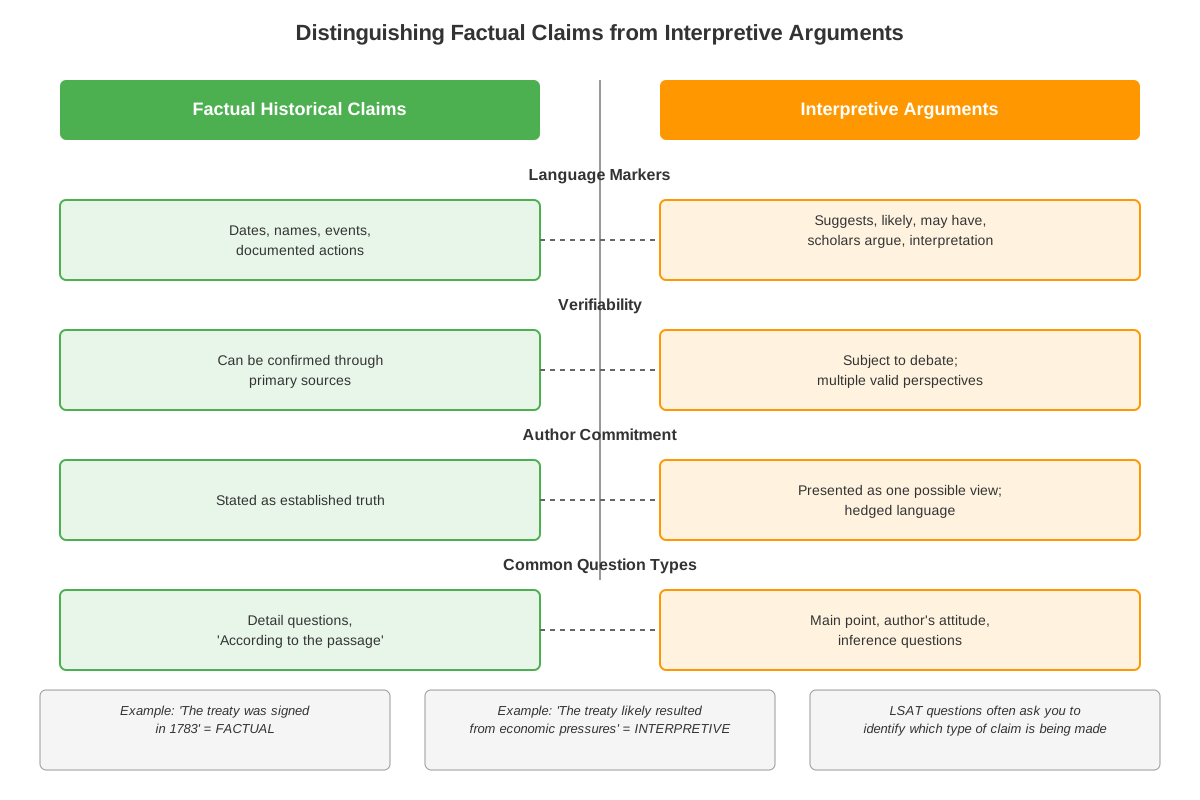
Mastering history passages is essential for LSAT success because they test core analytical skills that extend beyond mere content comprehension. These passages frequently involve multiple perspectives on historical events, the evolution of historical interpretation over time, or debates about causation and significance. Test-takers must distinguish between factual claims and interpretive arguments, recognize the author's attitude toward competing theories, and understand how evidence supports or undermines historical conclusions. The ability to navigate these passages efficiently directly impacts overall Reading Comprehension scores, as history passages typically account for 25-30% of all reading passages on any given LSAT.
Within the broader framework of passage subjects and strategies, history passages share structural similarities with other humanities and social science passages but possess distinctive features. They often employ chronological organization, present revisionist arguments that challenge traditional interpretations, or explore how new evidence has reshaped historical understanding. Developing specific strategies for history passages—including recognizing common organizational patterns, identifying historiographical debates, and tracking multiple perspectives—provides transferable skills applicable to law passages, science passages, and comparative reading sets throughout the Reading Comprehension section.
Learning Objectives
- [ ] Identify how History passages appears in LSAT questions
- [ ] Explain the reasoning pattern behind History passages
- [ ] Apply History passages to solve LSAT-style problems accurately
- [ ] Distinguish between factual historical claims and interpretive arguments within passages
- [ ] Recognize common historiographical structures including revisionist arguments and debates between schools of thought
- [ ] Evaluate how authors use historical evidence to support claims and identify gaps in reasoning
- [ ] Anticipate question types most commonly associated with history passages and develop targeted approaches
Prerequisites
- Basic reading comprehension skills: Ability to identify main ideas, supporting details, and passage structure forms the foundation for analyzing complex historical arguments
- Understanding of passage structure: Recognition of introduction, thesis, body paragraphs, and conclusion enables efficient navigation of historical narratives
- Familiarity with author's purpose and tone: Distinguishing between descriptive, analytical, and argumentative writing helps identify the author's stance on historical debates
- Knowledge of question types: Understanding main idea, inference, detail, and application questions allows strategic reading focused on testable elements
Why This Topic Matters
History passages hold significant real-world relevance for legal practice and critical thinking. Legal reasoning frequently requires analyzing precedent, understanding how interpretations evolve over time, and evaluating competing narratives—skills directly parallel to those tested in historical passages. Attorneys must construct arguments from evidence, anticipate counterarguments, and position their interpretations within established frameworks, precisely the analytical work historians perform and LSAT passages test.
From an exam statistics perspective, history passages appear with remarkable consistency on the LSAT. Approximately 25-30% of Reading Comprehension passages focus on historical topics, making them one of the three most common passage types alongside law and science. Each LSAT Reading Comprehension section contains four passages (or three passages plus one comparative reading set), meaning test-takers can expect to encounter at least one history passage per exam, often accompanied by 5-8 questions worth 5-8 raw points toward the scaled score.
History passages commonly appear in several recognizable forms: biographical passages examining historical figures and their contributions; passages exploring social movements and their causes or consequences; passages presenting debates between competing historical interpretations (traditional versus revisionist); passages analyzing how new evidence or methodologies have changed historical understanding; and passages examining the historiography of specific events—how the interpretation of those events has evolved over time. Each format tests slightly different analytical skills while maintaining core competencies in evidence evaluation, argument analysis, and perspective tracking.
Core Concepts
Characteristics of LSAT History Passages
LSAT history passages differ fundamentally from textbook historical writing or popular history. These passages prioritize analytical complexity over narrative storytelling, typically presenting arguments about historical interpretation rather than simply recounting events. The passages assume no prior historical knowledge—all necessary information appears within the text—but demand sophisticated analytical skills to navigate competing claims, evaluate evidence, and understand authorial perspective.
Most history passages range from 450-550 words and follow predictable organizational patterns. They typically open with context-setting information or a traditional interpretation, then introduce a central argument or debate that structures the remainder of the passage. The body paragraphs develop this argument through evidence, examples, or comparison with alternative interpretations. Conclusions often synthesize the argument or suggest implications for broader historical understanding.
Common Structural Patterns
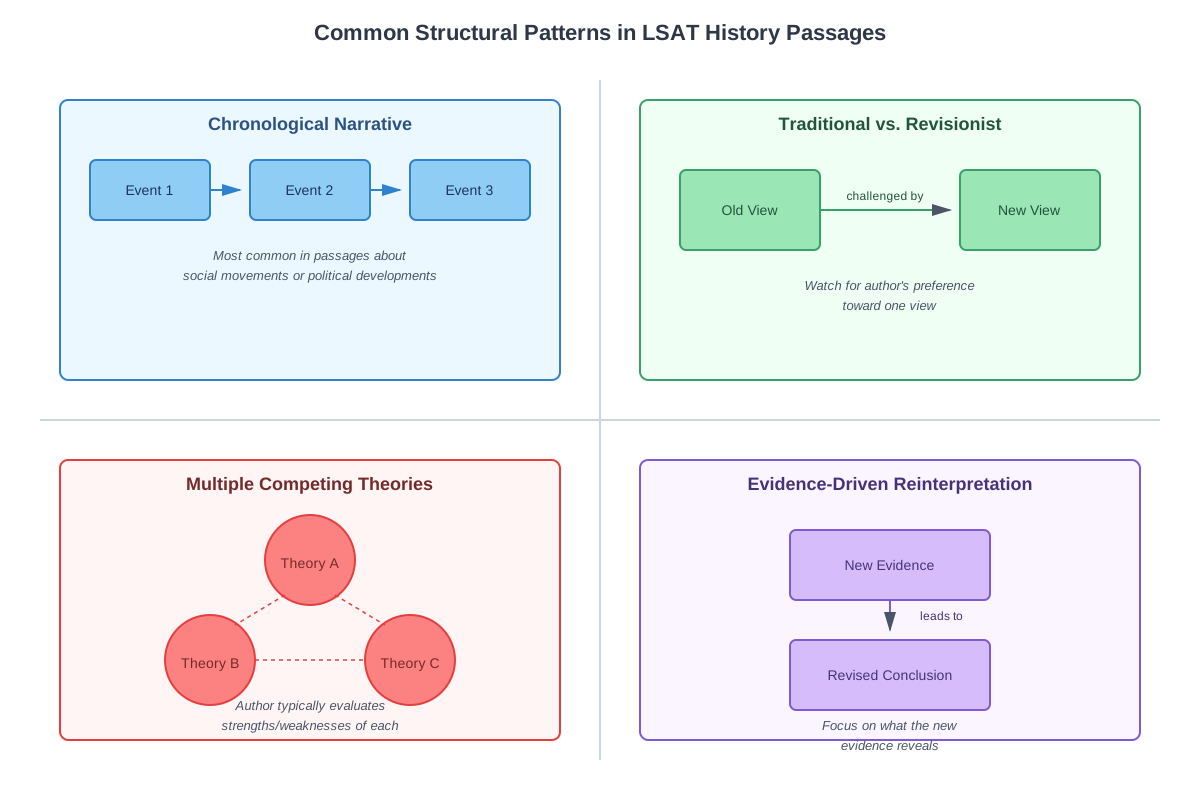
History passages employ several recurring organizational frameworks that, once recognized, dramatically improve comprehension efficiency:
The Revisionist Pattern: This extremely common structure presents a traditional or widely-held historical interpretation in the opening paragraph(s), then introduces a revisionist scholar or new interpretation that challenges this traditional view. The passage develops by explaining why the revisionist interpretation is superior, often citing new evidence, different analytical frameworks, or previously overlooked factors. Questions frequently test understanding of both interpretations and the evidence supporting the revisionist challenge.
The Debate Pattern: These passages present two or more competing interpretations of historical events or phenomena, often associated with different schools of historical thought. The author may remain neutral, presenting both sides fairly, or may subtly favor one interpretation. Critical reading requires tracking which evidence supports which interpretation and recognizing the author's attitude toward each position.
The Evolution of Understanding Pattern: These passages trace how historical interpretation of an event or figure has changed over time, often moving through multiple phases (initial interpretation → mid-century revision → contemporary understanding). The chronological progression of interpretations becomes crucial for answering questions about what different time periods believed or how understanding has developed.
The New Evidence Pattern: These passages explain how recently discovered documents, archaeological findings, or analytical techniques have transformed understanding of historical topics. The structure typically contrasts what historians believed before the new evidence with what they now understand, emphasizing the significance of the discovery.
Historiographical Elements
Understanding historiography—the study of how history is written and interpreted—provides crucial advantages for LSAT history passages. Test-takers must recognize that passages often focus not on historical events themselves but on how historians have interpreted those events.
Key historiographical concepts include:
- Primary versus secondary sources: Passages may distinguish between original historical documents and later scholarly interpretations
- Schools of thought: References to "social historians," "economic determinists," "cultural historians," or other scholarly approaches signal competing analytical frameworks
- Periodization: How historians divide history into periods reflects interpretive choices that passages may examine or challenge
- Causation debates: Competing explanations for why historical events occurred represent a frequent focus of passage arguments
Evidence and Argumentation in History Passages
History passages test the ability to evaluate how authors use evidence to support claims. Strong LSAT performance requires distinguishing between:
| Element | Definition | LSAT Testing Focus |
|---|---|---|
| Factual claims | Statements about what happened, when, or who was involved | Detail questions; accuracy of paraphrase |
| Interpretive claims | Arguments about why events occurred, their significance, or their meaning | Main idea; author's purpose; inference |
| Evidence | Specific examples, data, or sources cited to support interpretations | Strengthen/weaken; role of detail |
| Assumptions | Unstated premises underlying historical arguments | Inference; logical reasoning |
Passages frequently present evidence that could support multiple interpretations, testing whether readers can recognize how the same facts might be used differently by competing theories. Questions may ask which piece of evidence most supports a particular interpretation or what additional evidence would strengthen or weaken a historical argument.
Author's Perspective and Tone
Identifying the author's attitude toward historical debates proves essential for answering inference and tone questions. Authors may:
- Advocate for a particular interpretation while critiquing alternatives
- Remain neutral while presenting multiple perspectives fairly
- Express qualified support for an interpretation while acknowledging limitations
- Critique traditional interpretations while proposing alternatives
Tone indicators include evaluative language ("convincingly demonstrates," "fails to account for," "overlooks"), hedging language ("suggests," "may indicate," "appears to"), and structural choices (how much space devoted to each perspective, placement of strongest arguments).
Temporal Complexity
History passages inherently involve multiple time frames that test-takers must track simultaneously:
- The historical period being discussed (when events occurred)
- When different interpretations were proposed (historiographical timeline)
- The present moment of the passage (when the author is writing)
- Hypothetical or counterfactual scenarios (what might have happened)
Questions frequently test whether readers can distinguish these temporal layers, asking about what was believed at different times or how understanding has evolved.
Concept Relationships
The core concepts within history passages interconnect systematically. Structural patterns determine how historiographical elements are presented, which in turn shapes how evidence and argumentation function within the passage. For example, the revisionist pattern inherently involves historiographical debate, presenting traditional interpretation as evidence to be challenged by new evidence or alternative frameworks.
Author's perspective emerges from and influences all other elements—the structural pattern chosen reflects argumentative goals, the historiographical elements included reveal scholarly positioning, and the evidence selected demonstrates interpretive priorities. Understanding author's perspective enables prediction of passage development and anticipation of question types.
Temporal complexity underlies all history passages, affecting how structural patterns unfold (chronological versus thematic organization), how historiographical debates are presented (tracking evolution of interpretation), and how evidence functions (distinguishing contemporary sources from later analysis).
These concepts connect to prerequisite knowledge of general passage subjects and strategies by applying universal reading comprehension skills to the specific domain of historical writing. The ability to identify main ideas transfers directly to recognizing central historical arguments; understanding passage structure applies to recognizing historiographical patterns; and inference skills enable evaluation of historical evidence and argumentation.
Relationship map: Structural Pattern Recognition → enables → Efficient Navigation → leads to → Accurate Identification of Historiographical Elements → supports → Evidence Evaluation → combined with → Author's Perspective Analysis → produces → Comprehensive Understanding → enables → Accurate Question Answering
High-Yield Facts
⭐ History passages appear in approximately 25-30% of LSAT Reading Comprehension sections, making them one of the three most common passage types
⭐ The revisionist pattern—traditional interpretation challenged by new perspective—represents the single most common organizational structure in history passages
⭐ LSAT history passages test interpretation and argumentation rather than historical knowledge; all necessary information appears within the passage
⭐ Questions frequently ask about the author's attitude toward competing interpretations, requiring careful attention to evaluative language and structural emphasis
⭐ Evidence in history passages often supports multiple interpretations; questions test whether readers recognize how the same facts can be used differently
- History passages typically range from 450-550 words and generate 5-8 questions worth equal raw points
- Temporal complexity—tracking multiple time frames simultaneously—represents a distinctive challenge of history passages
- Historiographical terms like "traditional view," "revisionist scholars," or "recent interpretation" signal competing perspectives that will be tested
- The amount of space devoted to each interpretation often indicates the author's preferred position, even when explicit advocacy is absent
- New evidence patterns frequently appear, testing understanding of how discoveries change historical interpretation
- Biographical history passages focus on reassessing historical figures' significance or challenging traditional characterizations
- Social movement passages often explore causes, consequences, or debates about interpretation and significance
Quick check — test yourself on History passages so far.
Try Flashcards →Common Misconceptions
Misconception: History passages require prior knowledge of historical events or periods to answer questions correctly.
Correction: LSAT history passages are entirely self-contained; all information needed to answer questions appears within the passage. Prior historical knowledge may actually create confusion if it contradicts passage content, as questions must be answered based solely on passage information.
Misconception: The author's position is always explicitly stated in history passages.
Correction: Authors frequently convey their perspective through subtle cues—structural emphasis (more space devoted to preferred interpretation), evaluative language ("convincingly argues" versus "claims"), and evidence selection—rather than explicit statements. Recognizing these implicit indicators is essential for inference and tone questions.
Misconception: All evidence presented in a passage equally supports the main argument.
Correction: History passages often present evidence associated with competing interpretations or include evidence that the author subsequently critiques or reinterprets. Questions frequently test whether readers can distinguish evidence supporting the main argument from evidence associated with alternative views being challenged.
Misconception: Chronological organization means passages simply recount events in time order.
Correction: Even when history passages include chronological elements, they organize information to support analytical arguments about interpretation, causation, or significance. The chronology serves argumentative purposes rather than functioning as mere narrative.
Misconception: "Traditional" or "conventional" interpretations presented in passages are always wrong or outdated.
Correction: While revisionist patterns often challenge traditional views, passages may present traditional interpretations that retain validity, offer partial truth, or represent reasonable positions despite limitations. Questions test nuanced understanding of competing views rather than simple rejection of traditional perspectives.
Misconception: History passages focus primarily on famous events or well-known figures.
Correction: LSAT history passages frequently explore obscure topics, lesser-known figures, or specialized historiographical debates precisely because they test analytical skills rather than prior knowledge. Unfamiliarity with the topic should not disadvantage prepared test-takers.
Worked Examples
Example 1: Revisionist Pattern Passage
Passage Summary: A passage discusses traditional interpretations of the Industrial Revolution as driven primarily by technological innovation, then introduces social historians who argue that labor organization and worker resistance played equally important roles in shaping industrial development. The author presents evidence supporting the social history perspective, including examples of how worker actions influenced technological adoption and factory organization.
Question: The author's attitude toward the traditional interpretation of the Industrial Revolution can best be described as:
(A) Unqualified rejection based on superior evidence
(B) Respectful disagreement emphasizing overlooked factors
(C) Neutral presentation of an outdated perspective
(D) Conditional acceptance pending further research
(E) Strong advocacy for its continued relevance
Worked Solution:
Step 1: Identify the structural pattern. This is a classic revisionist pattern—traditional view followed by challenge.
Step 2: Locate language indicating the author's attitude toward the traditional interpretation. The passage likely uses phrases like "while technological innovation certainly played a role" (acknowledging validity) followed by "social historians have demonstrated that" (introducing preferred alternative).
Step 3: Evaluate the strength of the author's position. Does the author completely reject the traditional view or suggest it's incomplete? The presence of evidence supporting the social history perspective combined with acknowledgment of technology's role suggests the author views the traditional interpretation as partial rather than wrong.
Step 4: Eliminate answers:
- (A) is too extreme—"unqualified rejection" contradicts acknowledgment of technology's role
- (C) mischaracterizes the author's engagement—"neutral presentation" doesn't match the advocacy for social history
- (D) suggests uncertainty the passage doesn't demonstrate
- (E) contradicts the passage's support for the revisionist view
Step 5: Select (B). "Respectful disagreement emphasizing overlooked factors" captures the author's acknowledgment that traditional interpretation has merit while arguing it's incomplete—the hallmark of revisionist historical argument.
Connection to Learning Objectives: This example demonstrates how to identify the revisionist reasoning pattern and apply understanding of author's perspective to solve LSAT-style problems accurately.
Example 2: Evidence Evaluation Question
Passage Summary: A passage discusses competing explanations for the decline of a historical civilization. Interpretation A attributes decline to environmental factors (drought, soil depletion). Interpretation B emphasizes internal political conflict. The author presents archaeological evidence of both environmental stress and signs of warfare, then argues that the two factors likely interacted rather than operating independently.
Question: Which of the following, if true, would most strengthen the author's position regarding the civilization's decline?
(A) Evidence that the drought preceded political conflicts by several decades
(B) Archaeological findings showing that political conflicts intensified during periods of environmental stress
(C) Historical records indicating that neighboring civilizations experienced similar droughts without declining
(D) Analysis suggesting that soil depletion resulted from agricultural practices rather than climate change
(E) Documentation that internal political conflicts existed before environmental problems emerged
Worked Solution:
Step 1: Identify the author's position. The author argues for interaction between environmental and political factors rather than a single cause.
Step 2: Determine what type of evidence would strengthen an interaction argument. Evidence showing the two factors operating together, influencing each other, or combining effects would support this position.
Step 3: Evaluate each answer:
- (A) suggests environmental factors preceded political ones, supporting a causal sequence rather than interaction
- (B) directly demonstrates interaction—political conflicts intensifying during environmental stress shows the factors operating together
- (C) might weaken environmental explanations by showing drought alone wasn't sufficient
- (D) addresses the source of environmental problems but doesn't address interaction with political factors
- (E) establishes temporal sequence but doesn't demonstrate interaction
Step 4: Select (B). This answer provides evidence of the specific interaction the author proposes—environmental stress and political conflict operating together rather than independently.
Connection to Learning Objectives: This example demonstrates how to explain the reasoning pattern behind history passages (competing interpretations resolved through synthesis) and apply this understanding to evaluate evidence in LSAT-style problems.
Exam Strategy
Pre-Reading Strategy
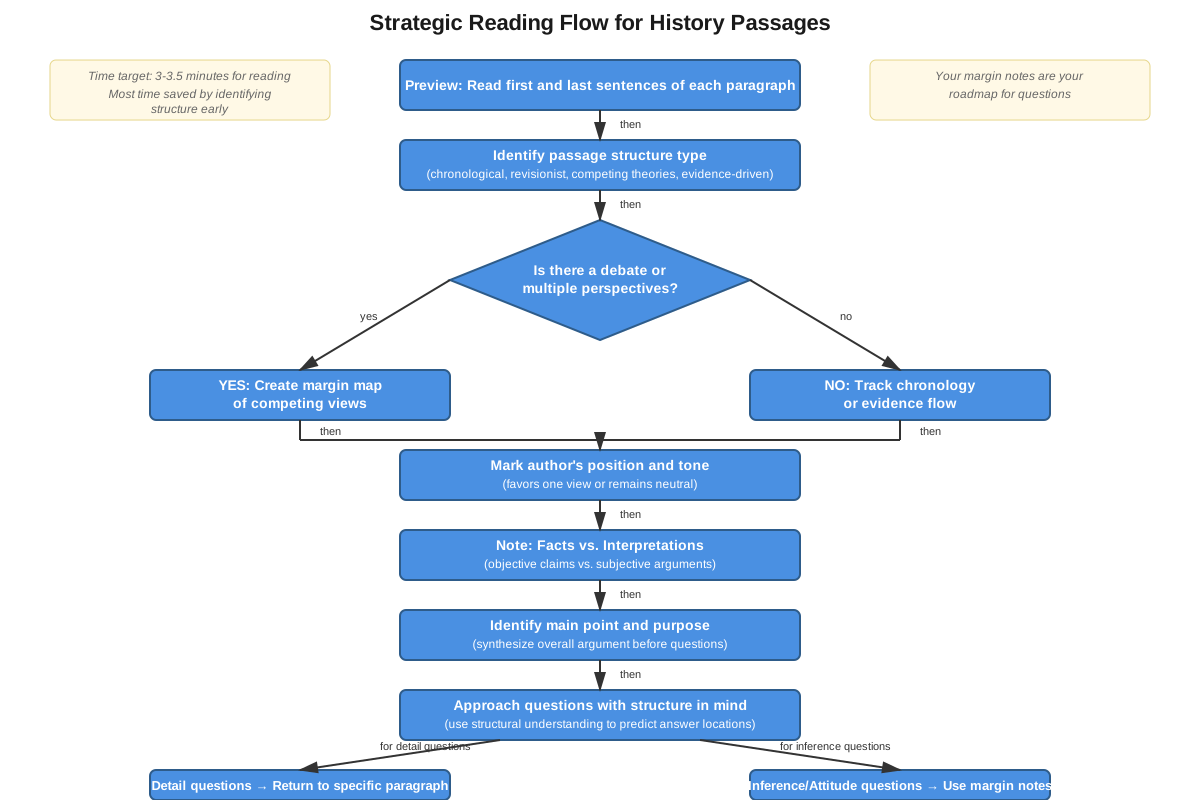
Before engaging with history passages, quickly scan for historiographical markers: words like "traditional," "revisionist," "recent scholarship," "conventional wisdom," or "new interpretation" signal competing perspectives that will structure the passage and generate questions. Identifying the structural pattern in the first 30 seconds of reading enables more efficient comprehension and better anticipation of question types.
Active Reading Approach
While reading history passages, maintain awareness of three critical elements:
- Competing interpretations: Mark or mentally note each distinct perspective presented, including who holds it and what evidence supports it
- Author's position: Track evaluative language and structural emphasis to determine the author's attitude toward each interpretation
- Evidence function: Note whether each piece of evidence supports the main argument, represents a view being challenged, or serves another purpose
Exam Tip: When passages present "Historian A argues X, while Historian B argues Y," immediately anticipate questions asking about points of agreement/disagreement, evidence supporting each view, or the author's attitude toward each position.
Question Approach by Type
Main Idea Questions: Focus on the author's central argument about historical interpretation rather than the historical events themselves. Correct answers typically reference the historiographical debate or the author's position on competing interpretations.
Detail Questions: Distinguish between details about historical events and details about historical interpretations. Questions asking "according to the passage" require precise textual support, while questions asking about historians' views require tracking which interpretation each detail supports.
Inference Questions: Look for implicit attitudes revealed through evaluative language, structural emphasis, and evidence selection. The author's unstated assumptions about historical causation, significance, or methodology frequently appear in inference questions.
Application Questions: These often ask how the author would respond to new evidence or alternative scenarios. Apply the author's stated reasoning pattern and methodological commitments rather than general historical knowledge.
Trigger Words and Phrases
Watch for these high-yield indicators:
- Temporal markers: "traditionally," "recently," "initially," "subsequently" signal evolution of interpretation
- Contrast markers: "however," "nevertheless," "by contrast," "alternatively" introduce competing views
- Evidence indicators: "demonstrates," "suggests," "indicates," "reveals" show how authors use evidence
- Qualification language: "may," "appears to," "seems to," "possibly" indicate uncertainty or nuanced positions
- Evaluation terms: "convincingly," "fails to account for," "overlooks," "successfully demonstrates" reveal author's attitude
Time Allocation
Allocate approximately 3.5-4 minutes for initial reading of history passages, slightly longer than average due to temporal complexity and multiple perspectives. This investment pays dividends through more accurate question answering. Spend 45-60 seconds per question, returning to the passage for specific textual support rather than relying on memory.
Process of Elimination
For history passages specifically:
- Eliminate answers that confuse which interpretation holds which position
- Eliminate answers that attribute to the author positions actually held by historians being discussed
- Eliminate answers using extreme language ("completely," "entirely," "never") unless the passage explicitly supports such strength
- Eliminate answers that require outside historical knowledge not provided in the passage
- Eliminate answers that confuse temporal frames (what was believed then versus what is understood now)
Memory Techniques
The REVISE Acronym for Revisionist Patterns
Recognize traditional interpretation in opening
Expect challenge or alternative view
Verify new evidence or reasoning supporting challenge
Identify author's attitude toward each view
Structure understanding around the debate
Evaluate which interpretation receives more support
Visualization Strategy: The Timeline Technique
For passages involving evolution of interpretation, visualize a horizontal timeline with three levels:
- Top level: Historical events being discussed
- Middle level: When different interpretations were proposed
- Bottom level: Evidence or discoveries prompting reinterpretation
This mental model helps track temporal complexity and prevents confusion between what happened historically and what historians later believed.
The HEAP Framework for Evidence Evaluation
How does this evidence function in the argument?
Evidence supports which interpretation?
Author's attitude toward this evidence?
Purpose of including this specific detail?
Apply HEAP to each significant piece of evidence while reading to maintain clear understanding of argumentative structure.
Mnemonic for Common Question Types
DIMA predicts the most frequent history passage questions:
Debate between interpretations
Inference about author's view
Main idea of historiographical argument
Application of reasoning to new scenarios
Anticipating these question types during reading improves efficiency and accuracy.
Summary
History passages represent a high-frequency, high-value component of LSAT Reading Comprehension, testing analytical skills essential for legal reasoning through the lens of historical interpretation and argumentation. Success requires recognizing common structural patterns—particularly the revisionist pattern where traditional interpretations are challenged by new perspectives—and understanding that passages test historiographical analysis rather than historical knowledge. The core competencies for history passages include distinguishing factual claims from interpretive arguments, tracking multiple temporal frames simultaneously, evaluating how evidence supports competing interpretations, and identifying the author's attitude toward historical debates through structural emphasis and evaluative language. Effective strategy involves active reading that maps competing perspectives, evidence supporting each view, and authorial positioning, combined with question approaches that distinguish between historical events and interpretations of those events. Mastery of history passages transfers directly to other Reading Comprehension passage types and develops critical analytical skills applicable throughout the LSAT and legal practice.
Key Takeaways
- History passages appear in 25-30% of Reading Comprehension sections and test interpretation of historical arguments rather than historical knowledge
- The revisionist pattern—traditional view challenged by new perspective—is the most common organizational structure and generates predictable question types
- Successful reading requires simultaneously tracking historical events, competing interpretations, evidence supporting each view, and the author's attitude
- Temporal complexity distinguishes history passages; questions frequently test ability to distinguish what happened, what was believed at different times, and current understanding
- Evidence evaluation is central—the same facts often support multiple interpretations, and questions test recognition of how evidence functions in competing arguments
- Author's perspective emerges through structural emphasis, evaluative language, and evidence selection rather than explicit statements
- Strategic reading involves identifying historiographical markers early, mapping competing perspectives, and anticipating question types based on structural patterns
Related Topics
Law Passages: History passages share structural similarities with law passages, particularly when discussing evolution of legal interpretation or competing judicial philosophies. Mastering historiographical analysis in history passages provides transferable skills for tracking legal precedent and interpretive debates.
Science Passages: Both history and science passages frequently present competing theories and debates about evidence interpretation. The skills developed for evaluating historical evidence and argumentation apply directly to assessing scientific hypotheses and experimental support.
Comparative Reading Sets: History passages often appear in comparative reading format, pairing two perspectives on the same historical topic. Understanding single history passages provides the foundation for analyzing relationships between paired passages.
Argument Structure in Logical Reasoning: The reasoning patterns in history passages—particularly how evidence supports interpretive claims and how assumptions underlie historical arguments—connect directly to Logical Reasoning skills in identifying assumptions, strengthening/weakening arguments, and evaluating reasoning.
Practice CTA
Now that you've mastered the core concepts, structural patterns, and strategic approaches for history passages, it's time to apply this knowledge through deliberate practice. Attempt the practice questions associated with this topic, focusing on identifying structural patterns quickly, tracking competing interpretations accurately, and evaluating evidence systematically. Use the flashcards to reinforce high-yield facts and common question types until pattern recognition becomes automatic. Remember that history passages reward analytical thinking over historical knowledge—trust the strategies you've learned and the skills you've developed. Each practice passage strengthens your ability to navigate complex arguments and temporal relationships, building the confidence and competence needed for test-day success. Your investment in mastering history passages will pay dividends throughout the Reading Comprehension section and beyond.
Sign up free to keep reading
Create a free AnvayaPrep account to finish this LSAT guide on History passages — plus flashcards and practice questions.