Overview
Indigenous studies passages represent a significant and recurring category within LSAT Reading Comprehension sections. These passages typically explore topics related to Native American, First Nations, Aboriginal, or other Indigenous peoples' histories, cultures, legal rights, artistic traditions, or contemporary issues. The LSAT frequently includes passages that examine Indigenous perspectives on land rights, cultural preservation, traditional knowledge systems, sovereignty, or the intersection of Indigenous and Western legal frameworks. Understanding how to approach these passages is crucial because they often present complex arguments involving multiple viewpoints, historical context, and nuanced cultural considerations that require careful analytical reading.
The importance of LSAT Indigenous studies passages extends beyond simple content familiarity. These passages test a reader's ability to navigate culturally specific material while maintaining analytical objectivity, to understand arguments that may challenge Western assumptions, and to track how authors present Indigenous perspectives alongside or in contrast to dominant cultural narratives. The LSAT uses these passages to assess whether test-takers can comprehend sophisticated arguments about cultural identity, legal frameworks, and historical interpretation without allowing personal biases to interfere with accurate comprehension.
Within the broader framework of Reading Comprehension and passage subjects and strategies, Indigenous studies passages function similarly to other humanities and social science passages but often incorporate unique structural elements. They may present traditional Indigenous knowledge alongside Western scientific perspectives, discuss legal cases involving tribal sovereignty, or analyze artistic works through both Indigenous and Western critical lenses. Mastering these passages requires developing specific strategies for tracking multiple cultural frameworks, understanding historical context quickly, and recognizing how authors signal shifts between different perspectives or interpretive approaches.
Learning Objectives
- [ ] Identify how Indigenous studies passages appears in LSAT questions
- [ ] Explain the reasoning pattern behind Indigenous studies passages
- [ ] Apply Indigenous studies passages to solve LSAT-style problems accurately
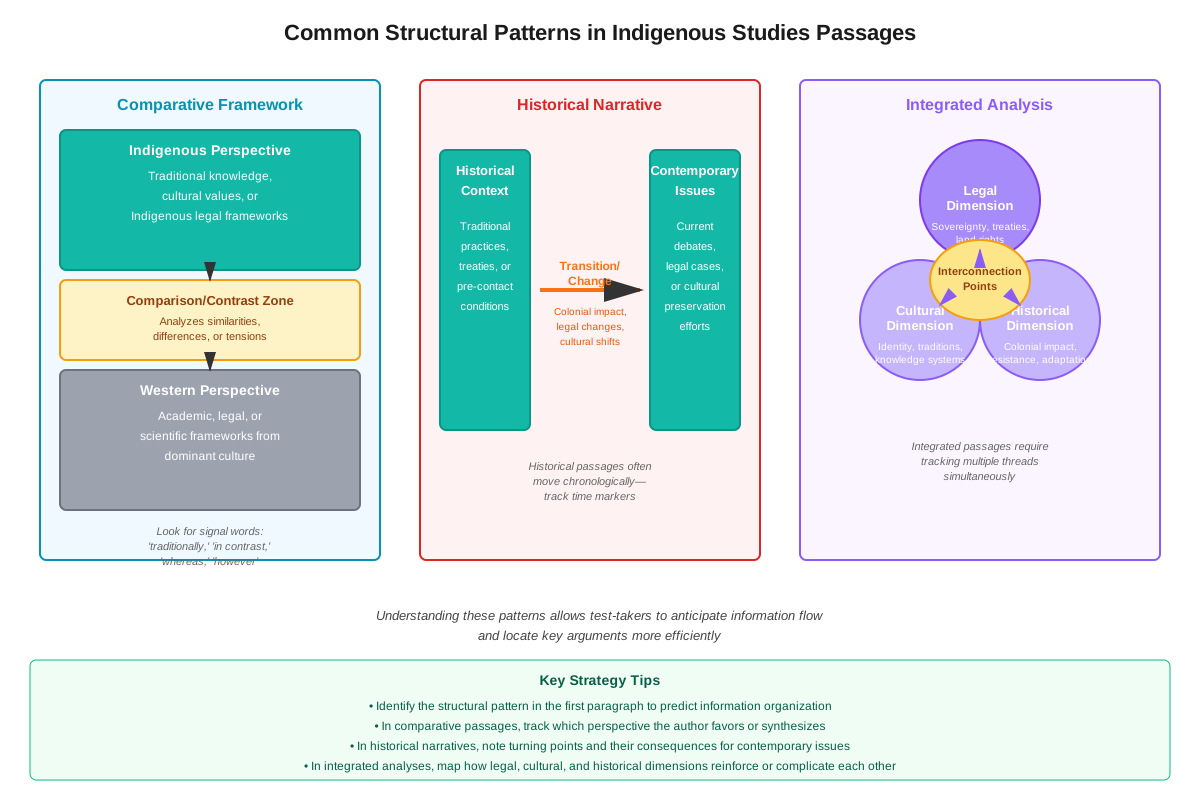
- [ ] Recognize common structural patterns in Indigenous studies passages, including comparative frameworks and historical narratives
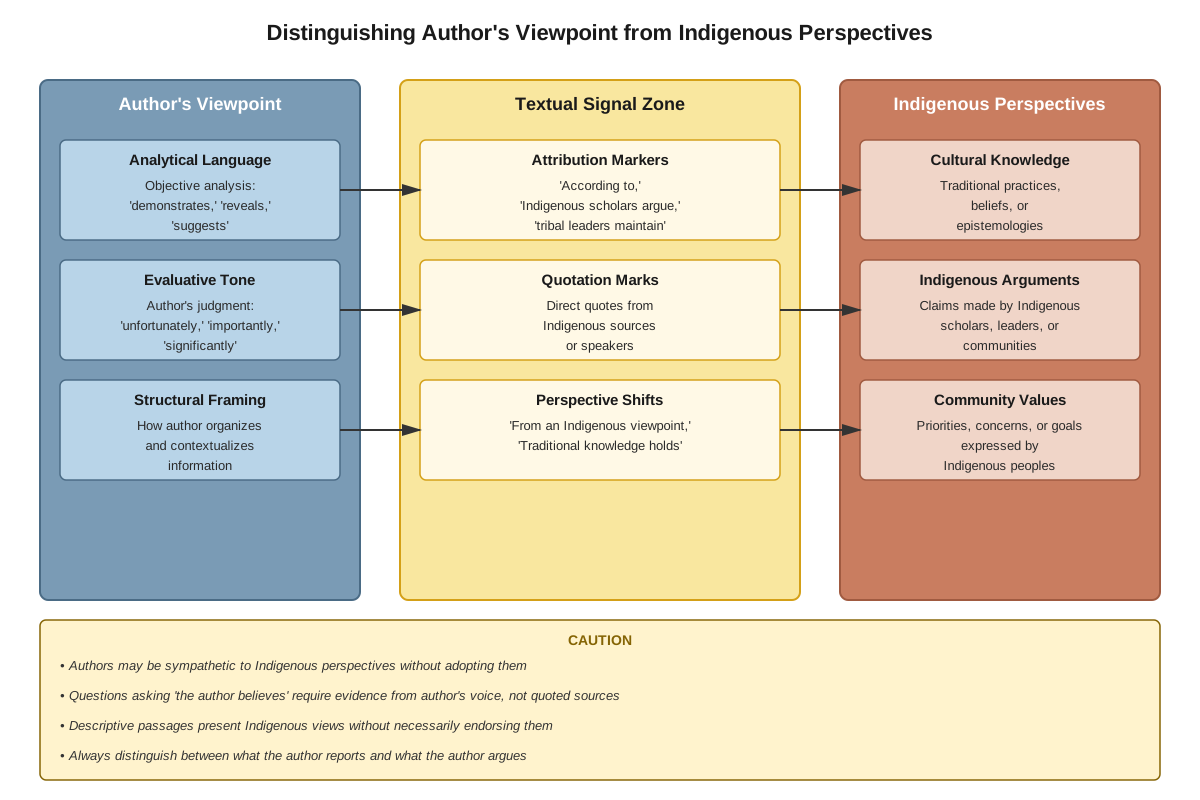
- [ ] Distinguish between author's viewpoint and Indigenous perspectives presented within passages
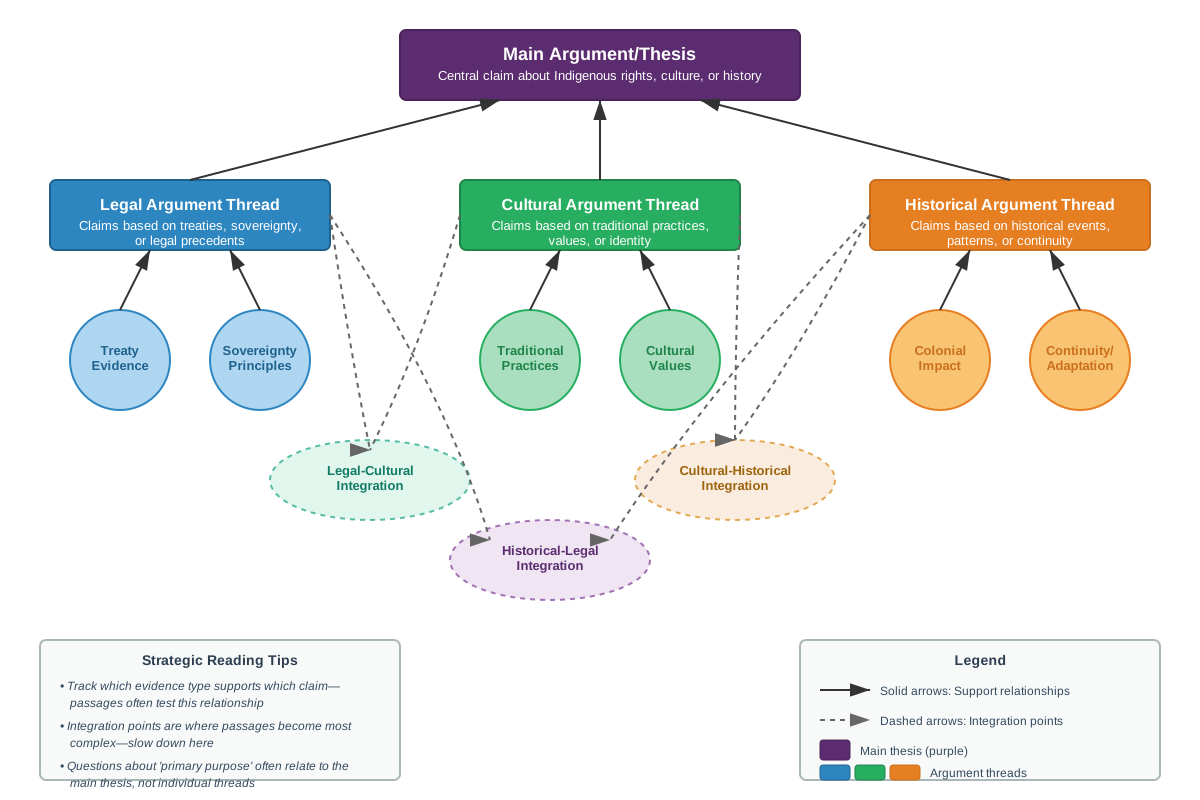
- [ ] Evaluate how Indigenous studies passages integrate legal, cultural, and historical arguments
- [ ] Analyze the relationship between traditional Indigenous knowledge and Western academic or legal frameworks as presented in passages
Prerequisites
- Basic LSAT Reading Comprehension skills: Understanding how to identify main points, author's tone, and passage structure is essential before tackling subject-specific strategies.
- Familiarity with comparative passage structures: Indigenous studies passages often compare Indigenous and Western perspectives, requiring comfort with tracking multiple viewpoints.
- Understanding of legal reasoning basics: Many Indigenous studies passages involve legal rights, treaties, or sovereignty issues that assume basic legal reasoning comprehension.
- Ability to identify author's purpose and tone: Distinguishing between descriptive, analytical, and advocacy-oriented writing is crucial for these passages.
Why This Topic Matters
Indigenous studies passages appear with notable frequency on the LSAT, typically showing up in approximately 10-15% of Reading Comprehension sections. These passages serve multiple testing purposes: they assess cultural literacy, the ability to handle specialized vocabulary in context, and the capacity to navigate arguments that may be unfamiliar to test-takers from dominant cultural backgrounds. The LSAT uses these passages to ensure that future lawyers can comprehend diverse perspectives and complex cultural-legal issues they will encounter in practice.
In real-world legal practice, attorneys regularly encounter cases involving Indigenous rights, treaty interpretation, cultural property disputes, land claims, and sovereignty issues. Understanding how to read and analyze arguments about Indigenous perspectives is essential for environmental law, property law, constitutional law, and human rights law. The analytical skills developed through mastering these passages—particularly the ability to understand multiple cultural frameworks simultaneously—transfer directly to legal practice.
On the exam, Indigenous studies passages commonly appear in several formats: passages discussing specific legal cases or treaties involving Indigenous peoples; analyses of Indigenous artistic or literary traditions; examinations of traditional ecological knowledge and its relationship to Western science; discussions of cultural preservation and repatriation issues; or explorations of Indigenous sovereignty and self-determination. Question types frequently test understanding of the passage's main purpose, the relationship between Indigenous and Western perspectives, the author's attitude toward different viewpoints, and the application of passage principles to new scenarios.
Core Concepts
Structural Patterns in Indigenous Studies Passages
Indigenous studies passages on the LSAT typically follow several recognizable structural patterns. The most common is the comparative framework, where the passage presents Indigenous perspectives alongside Western academic, legal, or scientific viewpoints. This structure requires readers to track which perspective is being discussed at any given moment and how the author positions these perspectives relative to each other. The passage may present these views as complementary, contradictory, or as part of an evolving synthesis.
Another frequent structure is the historical narrative with contemporary implications. These passages begin with historical context—often involving colonization, treaty-making, or cultural disruption—then transition to contemporary issues or debates. The LSAT tests whether readers can connect historical information to present-day arguments and understand how authors use historical context to support contemporary claims.
A third pattern involves traditional knowledge validation, where passages discuss how Indigenous knowledge systems (particularly regarding ecology, medicine, or resource management) are being recognized, studied, or integrated into Western scientific or legal frameworks. These passages often explore tensions between different ways of knowing and the politics of knowledge validation.
Multiple Perspective Navigation
Successfully reading LSAT Indigenous studies passages requires distinguishing between several layers of perspective. First, there is the Indigenous perspective or perspectives being discussed—the passage may present views from specific Indigenous communities, scholars, or traditions. Second, there is often a Western academic or legal perspective that may be presented as dominant, challenged, or evolving. Third, there is the author's perspective, which may be analytical, sympathetic to Indigenous viewpoints, critical of Western approaches, or attempting to synthesize multiple views.
The LSAT frequently tests whether readers can accurately identify which perspective is being presented in specific portions of the passage. Questions may ask about "the author's attitude toward X" versus "the Indigenous scholars mentioned in the passage believe that X" versus "traditional Western approaches to X." Confusing these perspectives is a common error that leads to incorrect answers.
Legal and Sovereignty Themes
Many Indigenous studies passages on the LSAT involve legal frameworks and sovereignty issues. These passages may discuss treaty rights, land claims, cultural property repatriation, or the legal status of Indigenous nations within larger nation-states. Understanding these passages requires recognizing several key concepts:
- Sovereignty: The right of Indigenous nations to self-governance and self-determination
- Treaty rights: Legal obligations arising from historical agreements between Indigenous nations and colonial or national governments
- Fiduciary duty: The legal responsibility of governments to act in the best interests of Indigenous peoples
- Cultural property: Objects, knowledge, or practices with special significance to Indigenous communities
These passages often explore tensions between Indigenous legal traditions and Western legal systems, or they may discuss how courts have interpreted Indigenous rights over time.
Cultural Knowledge and Epistemology
A significant subset of Indigenous studies passages examines traditional knowledge systems and how they relate to Western academic disciplines. These passages may discuss:
- Traditional ecological knowledge (TEK): Indigenous understanding of ecosystems, species relationships, and resource management developed over generations
- Oral traditions: How Indigenous communities preserve and transmit knowledge through storytelling, ceremony, and other non-written forms
- Holistic versus reductionist approaches: Contrasts between Indigenous worldviews that emphasize interconnection and Western scientific methods that isolate variables
The LSAT uses these passages to test whether readers can understand arguments about different ways of knowing without dismissing unfamiliar epistemological frameworks or uncritically accepting all claims.
Artistic and Literary Analysis
Some Indigenous studies passages focus on artistic or literary works by Indigenous creators. These passages may discuss how Indigenous artists navigate between traditional forms and contemporary media, how their work challenges Western artistic categories, or how critics should approach Indigenous art. Key concepts include:
- Cultural authenticity debates: Questions about what constitutes "authentic" Indigenous art and who decides
- Appropriation versus appreciation: Distinctions between respectful engagement with Indigenous culture and exploitative borrowing
- Decolonizing interpretation: Approaches to understanding Indigenous art that center Indigenous perspectives rather than imposing Western critical frameworks
Author's Purpose and Tone Recognition
Understanding the author's purpose in Indigenous studies passages is crucial for answering many LSAT questions. Authors may be:
- Advocating for recognition of Indigenous rights or perspectives
- Analyzing how Indigenous and Western frameworks interact or conflict
- Describing Indigenous traditions, legal cases, or scholarly debates neutrally
- Critiquing Western approaches to Indigenous issues
- Synthesizing multiple perspectives to propose new understandings
The author's tone may range from objective and analytical to sympathetic, critical, or cautiously optimistic. Recognizing subtle tone indicators helps answer questions about the author's attitude and primary purpose.
Concept Relationships
The core concepts within Indigenous studies passages are deeply interconnected. Structural patterns determine how multiple perspectives are presented and organized within passages. For example, a comparative framework structure naturally requires navigation between Indigenous and Western viewpoints, while a historical narrative structure often moves from past injustices to contemporary sovereignty claims.
Legal and sovereignty themes frequently intersect with cultural knowledge and epistemology when passages discuss how legal systems should recognize or protect traditional knowledge. A passage might argue that Western intellectual property law inadequately protects Indigenous traditional ecological knowledge because it assumes individual ownership rather than communal stewardship.
Artistic and literary analysis passages often incorporate multiple perspective navigation by presenting how Indigenous artists view their own work differently from Western critics. These passages may also connect to sovereignty themes by discussing artistic production as an assertion of cultural autonomy and self-determination.
All of these concepts depend on accurate author's purpose and tone recognition. Understanding whether an author is advocating, analyzing, or describing shapes how readers interpret every other element of the passage. An advocacy-oriented passage about treaty rights will present legal frameworks differently than an analytical passage examining the same topic.
The relationship map flows as follows: Structural patterns → organize → Multiple perspectives → which include → Legal/sovereignty themes, Cultural knowledge, and Artistic analysis → all requiring → Author's purpose recognition → which guides → Question answering strategies.
High-Yield Facts
⭐ Indigenous studies passages appear in approximately 10-15% of LSAT Reading Comprehension sections, making them a regular feature of the exam.
⭐ The most common structure is the comparative framework, presenting Indigenous perspectives alongside Western viewpoints.
⭐ Questions frequently test the ability to distinguish between the author's view, Indigenous perspectives presented, and Western approaches discussed.
⭐ Legal themes in these passages often involve sovereignty, treaty rights, or cultural property repatriation.
⭐ Traditional ecological knowledge (TEK) passages typically argue for the validity and value of Indigenous environmental understanding.
- Passages may discuss specific Indigenous nations, communities, or scholars, but the LSAT tests analytical skills, not prior cultural knowledge.
- Author's tone in Indigenous studies passages ranges from neutral analysis to sympathetic advocacy, rarely hostile to Indigenous perspectives.
- Historical context in these passages is typically used to support contemporary arguments about rights, recognition, or cultural preservation.
- Passages often explore tensions between communal Indigenous values and individualistic Western legal or economic frameworks.
- Questions about "primary purpose" frequently have answers involving "challenging assumptions," "advocating for recognition," or "analyzing the relationship between" different frameworks.
⭐ The LSAT never requires prior knowledge of Indigenous cultures; all necessary information is contained within the passage.
- Passages may use specialized terminology (sovereignty, fiduciary duty, repatriation) but always provide sufficient context for comprehension.
- Comparative passages (two shorter passages) sometimes pair Indigenous and Western perspectives on the same topic.
- Questions about "which statement would the author most likely agree with" often test whether readers can extend passage principles to new scenarios.
- Time period shifts (historical to contemporary) are common and frequently tested through questions about the function of specific paragraphs.
Quick check — test yourself on Indigenous studies passages so far.
Try Flashcards →Common Misconceptions
Misconception: Indigenous studies passages require prior knowledge of specific Indigenous cultures or histories to answer questions correctly.
Correction: The LSAT is designed to test analytical reading skills, not background knowledge. Every piece of information needed to answer questions is contained within the passage itself. While cultural literacy may help with reading speed, it is never required for correct answers.
Misconception: The author's perspective and the Indigenous perspectives presented in the passage are always the same.
Correction: Authors may present Indigenous perspectives while maintaining analytical distance. The author might describe Indigenous arguments without necessarily endorsing them, or might present multiple Indigenous viewpoints while analyzing their differences. Questions specifically test the ability to distinguish these layers.
Misconception: Passages about traditional knowledge are arguing that Indigenous knowledge is superior to Western science.
Correction: Most passages argue for the validity and value of Indigenous knowledge systems, often as complementary to Western approaches rather than superior. They typically advocate for recognition and integration, not replacement of scientific methods.
Misconception: Legal passages about Indigenous rights always advocate for Indigenous positions.
Correction: While many passages are sympathetic to Indigenous perspectives, some are purely analytical, examining how courts have interpreted rights or how different legal frameworks interact. The author's purpose may be to analyze rather than advocate.
Misconception: If a passage discusses historical injustices, the correct answers will emphasize those injustices.
Correction: Historical information in LSAT passages typically serves a structural purpose—providing context for contemporary arguments. Questions usually focus on how the author uses historical information, not on the historical facts themselves.
Misconception: Indigenous studies passages are "easier" because they involve humanities topics rather than dense science.
Correction: These passages can be quite complex, requiring navigation of multiple perspectives, unfamiliar conceptual frameworks, and nuanced arguments. They test sophisticated analytical skills and should not be underestimated.
Misconception: Passages about Indigenous art are primarily descriptive rather than argumentative.
Correction: Even passages discussing artistic works typically make arguments about interpretation, cultural authenticity, critical approaches, or the relationship between Indigenous and Western artistic traditions. They require the same analytical reading as other argumentative passages.
Worked Examples
Example 1: Traditional Ecological Knowledge Passage
Passage Summary: A passage discusses how Indigenous communities in the Pacific Northwest have managed salmon populations for thousands of years using traditional ecological knowledge (TEK). The passage explains that Western fisheries management, based on maximizing short-term yields, led to population crashes in the 20th century. Recently, fisheries scientists have begun consulting with Indigenous knowledge-keepers, finding that traditional practices like selective harvesting and habitat protection align with contemporary conservation biology. The author argues that integrating TEK with Western science offers the best approach to sustainable fisheries management, while noting that such integration must respect Indigenous sovereignty and intellectual property rights.
Question: The author's primary purpose in the passage is most likely to:
(A) Advocate for replacing Western fisheries science with traditional ecological knowledge
(B) Describe the historical development of Indigenous salmon management practices
(C) Argue that traditional and scientific approaches to fisheries management can be productively integrated
(D) Criticize Western fisheries management for ignoring Indigenous perspectives
(E) Explain why Indigenous communities should maintain exclusive control over salmon management
Analysis:
First, identify the author's purpose by examining the passage structure and tone. The passage presents both TEK and Western science, discusses their historical relationship, and concludes by arguing for integration while noting important caveats about sovereignty and rights.
Eliminate (A): The passage argues for integration, not replacement. The author presents Western science as valuable when combined with TEK.
Eliminate (B): While the passage mentions historical practices, description is not the primary purpose—the passage makes an argument about contemporary management.
Consider (C): This matches the passage's argumentative structure. The author presents both approaches, shows their complementarity, and argues for integration.
Eliminate (D): While the passage notes problems with past Western management, criticism is not the primary purpose. The passage is forward-looking, focusing on integration rather than dwelling on past failures.
Eliminate (E): The passage discusses respecting sovereignty but doesn't argue for exclusive Indigenous control. The integration argument suggests shared approaches.
Correct Answer: (C). This question tests the learning objective of explaining the reasoning pattern behind Indigenous studies passages—specifically, recognizing when passages argue for synthesis rather than advocating for one perspective over another.
Example 2: Cultural Property Repatriation Passage
Passage Summary: A passage examines debates over repatriating Indigenous cultural objects held in museums. It presents the perspective of some museum curators who argue that museums preserve objects that might otherwise be lost and make them accessible to researchers and the public. The passage then presents Indigenous community perspectives, emphasizing that certain objects have spiritual significance and that their removal from communities represents ongoing colonial harm. The author analyzes recent legal frameworks, including the Native American Graves Protection and Repatriation Act (NAGPRA), which require museums to return certain objects. The passage concludes by discussing how some museums and Indigenous communities have developed collaborative relationships, with objects sometimes remaining in museums under Indigenous guidance or being digitally documented before return.
Question: Based on the passage, the author would most likely agree with which of the following statements about museum collections of Indigenous cultural objects?
(A) Museums should immediately return all Indigenous objects without exception
(B) The preservation and research functions of museums outweigh Indigenous communities' claims to cultural objects
(C) Legal frameworks like NAGPRA represent appropriate mechanisms for addressing repatriation issues
(D) Indigenous spiritual beliefs about objects should not influence decisions about museum collections
(E) Collaborative approaches between museums and Indigenous communities are impossible given their conflicting interests
Analysis:
This question requires distinguishing between perspectives presented in the passage and the author's own view, addressing the learning objective of identifying how Indigenous studies passages appear in LSAT questions.
Eliminate (A): The passage presents repatriation sympathetically but discusses collaborative approaches and legal frameworks, suggesting nuance rather than absolute positions.
Eliminate (B): This represents the museum curator perspective presented in the passage, not the author's view. The author presents this view but then discusses Indigenous perspectives and legal requirements, suggesting the author doesn't fully endorse the curator position.
Consider (C): The author discusses NAGPRA as part of the legal framework and doesn't criticize it. The passage's analytical tone suggests the author views such frameworks as reasonable approaches to complex issues.
Eliminate (D): The passage treats Indigenous spiritual perspectives seriously and discusses how they inform repatriation claims. The author doesn't dismiss these beliefs.
Eliminate (E): The passage explicitly discusses collaborative approaches in the final section, presenting them as viable solutions rather than impossibilities.
Correct Answer: (C). The author's analytical tone and discussion of legal frameworks without criticism suggests approval of structured approaches to repatriation. This question tests the ability to apply Indigenous studies passage strategies to solve LSAT-style problems accurately by distinguishing the author's measured analytical perspective from the more extreme positions presented by various stakeholders.
Exam Strategy
When approaching Indigenous studies passages on the LSAT, begin by quickly identifying the passage structure. Look for signals that indicate whether the passage follows a comparative framework (words like "in contrast," "whereas," "traditional Western approaches"), a historical-to-contemporary structure (dates, phrases like "historically" followed by "today" or "recently"), or a knowledge validation structure (phrases like "increasingly recognized," "scientists have begun to acknowledge").
Trigger words and phrases to watch for include:
- Perspective indicators: "Indigenous scholars argue," "from a Western perspective," "traditional views hold that," "the author suggests"
- Sovereignty language: "self-determination," "tribal sovereignty," "treaty rights," "nation-to-nation relationships"
- Knowledge framework terms: "traditional ecological knowledge," "oral traditions," "holistic approaches," "Western scientific method"
- Legal terminology: "repatriation," "fiduciary duty," "cultural property," "intellectual property rights"
- Tone indicators: "unfortunately," "importantly," "merely," "significantly"
Exam Tip: Create a simple notation system while reading. Use "I" for Indigenous perspectives, "W" for Western perspectives, and "A" for author's own views. This helps track perspective shifts and prevents confusion when answering questions.
For process-of-elimination, be particularly alert for answer choices that:
- Confuse the author's view with perspectives the author merely presents
- Use extreme language ("all," "never," "only") when the passage takes a nuanced position
- Attribute to Indigenous perspectives ideas that actually represent Western viewpoints
- Mischaracterize the author's tone (making analytical passages seem advocacy-oriented or vice versa)
- Focus on minor details rather than main arguments
Time allocation for Indigenous studies passages should follow standard Reading Comprehension timing: approximately 3-4 minutes for the initial read and 5-6 minutes for questions. However, if the passage involves complex legal frameworks or multiple Indigenous perspectives, consider spending an extra 30-60 seconds on the initial read to ensure clear understanding of the structure. This investment pays off through faster, more accurate question answering.
When encountering unfamiliar cultural concepts or terminology, don't panic. The LSAT always provides sufficient context. Read the surrounding sentences carefully to understand how the term functions in the passage's argument, even if you don't have prior knowledge of the concept.
For questions asking about the author's primary purpose, eliminate answers that focus on description when the passage is argumentative, or that suggest advocacy when the tone is analytical. The correct answer will match both the passage's content and its rhetorical approach.
Memory Techniques
LSAT Indigenous Passages Mnemonic - "COMPASS":
- Comparative frameworks (Indigenous vs. Western perspectives)
- Origins and history (historical context for contemporary issues)
- Multiple perspectives (author, Indigenous, Western, scholarly)
- Purpose identification (advocacy, analysis, description, critique)
- Author's tone (sympathetic, analytical, critical, neutral)
- Sovereignty and legal themes (treaties, rights, repatriation)
- Structure tracking (how the passage organizes its argument)
Visualization Strategy: Picture Indigenous studies passages as having three "layers" like a sandwich. The top layer is the author's perspective and purpose. The middle layer contains the various viewpoints presented (Indigenous, Western, scholarly). The bottom layer is the structural foundation (comparative, historical, analytical). When answering questions, visualize which layer the question is asking about.
Perspective Tracking Acronym - "AWI":
- Author's view (what the passage writer thinks)
- Western perspective (dominant cultural/legal/scientific views)
- Indigenous perspective (traditional or contemporary Indigenous views)
When reading, mentally tag each paragraph or major section with AWI notation to track which perspectives are being presented.
Legal Theme Acronym - "STRF":
- Sovereignty (self-governance and self-determination)
- Treaties (historical agreements and obligations)
- Repatriation (return of cultural property or remains)
- Fiduciary duty (government obligations to Indigenous peoples)
These four concepts appear repeatedly in legally-focused Indigenous studies passages.
Summary
Indigenous studies passages on the LSAT test sophisticated analytical reading skills through content involving Native American, First Nations, and other Indigenous peoples' perspectives, rights, and knowledge systems. These passages typically follow recognizable structural patterns—comparative frameworks, historical narratives with contemporary implications, or traditional knowledge validation—and require readers to navigate multiple perspectives while accurately identifying the author's purpose and tone. Success with these passages depends on distinguishing between the author's view, Indigenous perspectives presented, and Western approaches discussed, rather than on prior cultural knowledge. Common themes include legal frameworks involving sovereignty and treaty rights, traditional ecological knowledge and its relationship to Western science, cultural property repatriation, and artistic or literary analysis. The LSAT uses these passages to assess whether test-takers can comprehend complex arguments involving unfamiliar cultural frameworks, track multiple viewpoints simultaneously, and apply passage principles to new scenarios—all essential skills for legal practice. Mastering Indigenous studies passages requires developing specific strategies for perspective tracking, recognizing structural patterns, and accurately identifying author's purpose while avoiding common misconceptions about the relationship between different viewpoints presented.
Key Takeaways
- Indigenous studies passages appear regularly on the LSAT (10-15% of Reading Comprehension sections) and test analytical skills, never prior cultural knowledge
- The most critical skill is distinguishing between the author's perspective, Indigenous viewpoints presented, and Western approaches discussed
- Common structures include comparative frameworks (Indigenous vs. Western), historical-to-contemporary narratives, and traditional knowledge validation
- Legal themes frequently involve sovereignty, treaty rights, cultural property repatriation, and fiduciary duties
- Author's purpose ranges from neutral analysis to sympathetic advocacy but rarely dismisses Indigenous perspectives
- Questions often test the ability to extend passage principles to new scenarios or identify the function of historical information in supporting contemporary arguments
- Success requires tracking multiple perspectives simultaneously while maintaining analytical objectivity and recognizing subtle tone indicators
Related Topics
Comparative Passages in Reading Comprehension: Indigenous studies content sometimes appears in the comparative passage format, where two shorter passages present different perspectives on related topics. Mastering Indigenous studies passages provides excellent preparation for comparative passages generally, as both require tracking multiple viewpoints and analyzing relationships between perspectives.
Legal Reasoning and Argumentation: Many Indigenous studies passages involve legal frameworks, making them excellent practice for the Logical Reasoning section and for understanding how legal arguments are constructed and evaluated. The skills developed in analyzing sovereignty and treaty rights arguments transfer directly to other legal reasoning contexts.
Science Passages with Multiple Perspectives: Traditional ecological knowledge passages share structural similarities with science passages that present competing theories or evolving scientific understanding. The ability to navigate between different knowledge frameworks developed through Indigenous studies passages enhances performance on complex science passages.
Humanities Passages on Cultural Topics: Indigenous studies passages are part of the broader category of humanities passages. Mastering these passages builds skills applicable to passages on art history, literary criticism, philosophy, and cultural studies, all of which require similar attention to perspective, interpretation, and argumentation.
Practice CTA
Now that you've mastered the core concepts and strategies for Indigenous studies passages, it's time to apply this knowledge to actual LSAT-style practice questions. The flashcards will help reinforce key concepts, terminology, and strategic approaches, while the practice questions will allow you to test your ability to navigate multiple perspectives, identify author's purpose, and apply passage principles accurately. Remember that these passages test analytical reading skills you already possess—your task is simply to apply those skills systematically to culturally specific content. Approach each practice passage with confidence, using the COMPASS framework and AWI perspective tracking to guide your reading. With focused practice, Indigenous studies passages can become one of your strongest areas in Reading Comprehension!
Sign up free to keep reading
Create a free AnvayaPrep account to finish this LSAT guide on Indigenous studies passages — plus flashcards and practice questions.