Overview
Physics passages represent one of the most challenging and frequently appearing passage types in the LSAT Reading Comprehension section. These passages typically explore topics from classical mechanics, quantum theory, thermodynamics, relativity, particle physics, or the philosophy of physics. Unlike undergraduate physics courses that emphasize mathematical problem-solving, LSAT physics passages focus on conceptual understanding, theoretical debates, historical developments in physics, and the philosophical implications of physical theories. Students often encounter passages discussing scientific paradigm shifts, competing theoretical frameworks, or the relationship between observation and theory in physics.
The LSAT does not test mathematical calculations or formula manipulation. Instead, physics passages assess a student's ability to comprehend complex abstract reasoning, follow multi-layered arguments about physical phenomena, understand analogies between physical concepts and everyday experiences, and evaluate the logical structure of scientific explanations. These passages frequently present counterintuitive ideas—such as wave-particle duality, time dilation, or quantum entanglement—that challenge common-sense assumptions about reality. Success requires the ability to temporarily suspend everyday intuitions and follow the internal logic of sophisticated theoretical frameworks.
Mastering physics passages is essential for achieving a competitive LSAT score because they exemplify the exam's core competencies: reading comprehension of dense technical material, identification of argument structure, recognition of authorial purpose and tone, and application of passage information to novel scenarios. Physics passages connect directly to broader passage subjects and strategies by demonstrating how the LSAT tests analytical reasoning across diverse academic disciplines. The skills developed through physics passage practice—tracking complex causal chains, distinguishing between observation and interpretation, and recognizing the limits of theoretical models—transfer directly to legal reasoning tasks that law students will encounter throughout their careers.
Learning Objectives
- [ ] Identify how Physics passages appears in LSAT questions
- [ ] Explain the reasoning pattern behind Physics passages
- [ ] Apply Physics passages to solve LSAT-style problems accurately
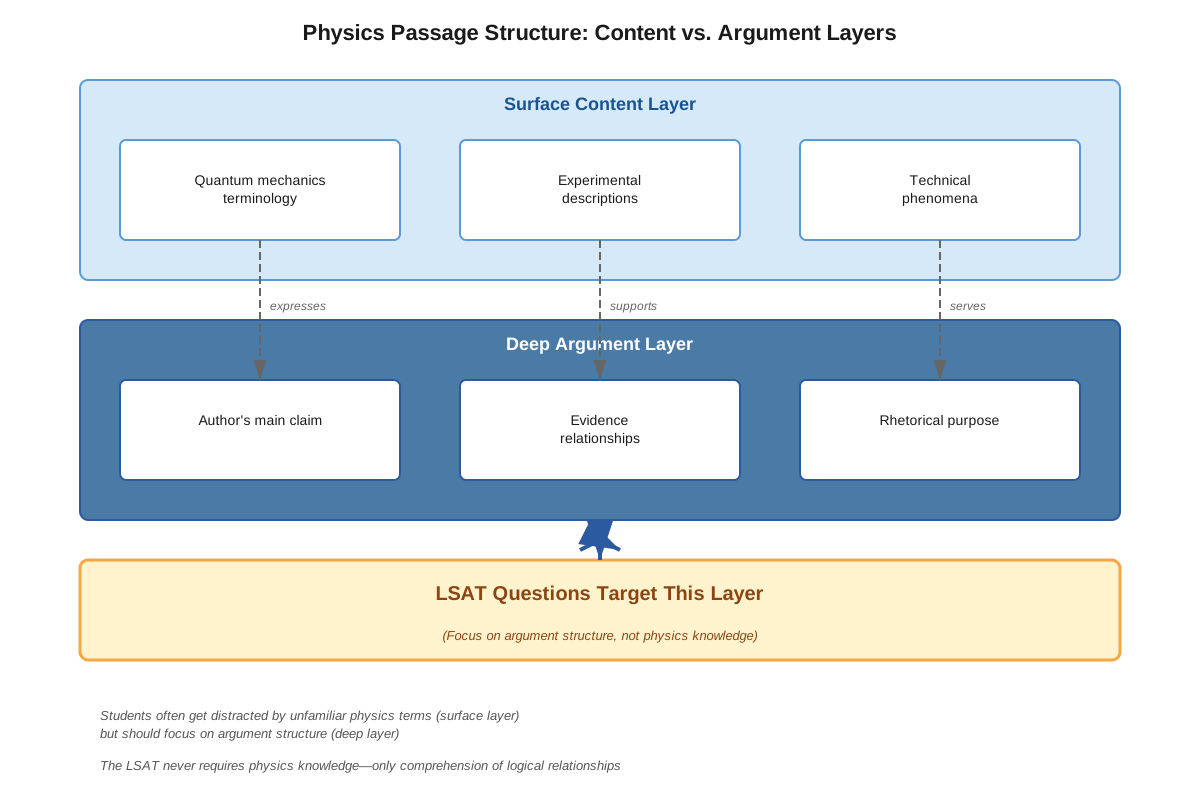
- [ ] Distinguish between descriptive content and argumentative structure in physics passages
- [ ] Recognize common organizational patterns in scientific explanation passages
- [ ] Evaluate the relationship between evidence and theoretical claims in physics contexts
- [ ] Anticipate question types most frequently associated with physics passages
Prerequisites
- Basic reading comprehension skills: Ability to identify main ideas, supporting details, and passage structure forms the foundation for tackling specialized content
- Familiarity with argument structure: Understanding premises, conclusions, and logical relationships enables recognition of how scientific claims are supported
- Comfort with abstract reasoning: Physics passages often discuss non-observable phenomena requiring mental flexibility with theoretical concepts
- Experience with LSAT passage formats: Knowledge of typical passage length, question types, and time constraints allows strategic approach to challenging content
Why This Topic Matters
Physics passages appear with remarkable consistency on the LSAT, typically constituting 15-25% of all Reading Comprehension passages across test administrations. The LSAT deliberately includes scientific passages to assess whether prospective law students can comprehend technical expert testimony, understand complex regulatory frameworks involving scientific concepts, and evaluate arguments that rely on specialized knowledge. Legal practice frequently requires attorneys to quickly master unfamiliar technical domains—from patent law to environmental regulation to medical malpractice—making the ability to comprehend physics passages a proxy for professional competency.
In real-world legal contexts, attorneys regularly encounter scientific evidence in litigation, must understand technical standards in regulatory compliance, and need to translate complex scientific concepts for judges and juries. The analytical skills tested through physics passages—distinguishing between established facts and theoretical interpretations, recognizing the scope and limitations of scientific models, and understanding how evidence supports or undermines theoretical claims—directly parallel the reasoning required in legal argumentation.
Physics passages commonly appear in several formats on the LSAT: historical accounts of paradigm shifts in physics (such as the transition from Newtonian to relativistic mechanics), explanations of counterintuitive phenomena (like quantum superposition or entropy), debates between competing theoretical frameworks, discussions of experimental methodology and interpretation, or explorations of the philosophical implications of physical theories. Questions following these passages typically test main idea identification, detail recognition, inference drawing, author's purpose or attitude, application of passage principles to new scenarios, and logical structure analysis. The combination of abstract content and precise reasoning makes physics passages among the highest-yield topics for score improvement through targeted practice.
Core Concepts
Characteristics of LSAT Physics Passages
LSAT physics passages differ fundamentally from physics textbooks or academic journal articles. These passages prioritize conceptual explanation over mathematical derivation, emphasize the historical or philosophical context of physical theories, and focus on the logical relationships between observations, hypotheses, and theoretical frameworks. The typical physics passage runs 450-550 words and presents information in a structured, hierarchical manner—often beginning with a general principle or historical context, then developing specific examples or applications, and concluding with implications or unresolved questions.
Physics passages on the LSAT rarely require prior knowledge of physics concepts. Instead, they provide all necessary information within the passage itself, testing whether students can extract meaning from technical exposition. The passages assume intelligent lay readers who can follow logical arguments but may be unfamiliar with specialized terminology. When technical terms appear, they are typically defined explicitly or implicitly through context. This self-contained nature means success depends on careful reading rather than background knowledge.
Common Content Areas in Physics Passages
Physics passages draw from several recurring content domains. Classical mechanics passages might discuss Newton's laws, conservation principles, or the concept of inertia, often exploring how these principles challenged earlier Aristotelian physics. Quantum mechanics passages frequently address wave-particle duality, the uncertainty principle, quantum entanglement, or the measurement problem—emphasizing the counterintuitive nature of quantum phenomena and their philosophical implications.
Relativity passages explore time dilation, length contraction, the relationship between mass and energy, or the equivalence principle, typically contrasting relativistic predictions with everyday intuitions about space and time. Thermodynamics passages may discuss entropy, the arrow of time, or the relationship between microscopic particle behavior and macroscopic thermal properties. Particle physics passages often describe the standard model, fundamental forces, or the search for unified theories.
Beyond specific physics content, many passages adopt a philosophy of science perspective, examining questions about scientific methodology, the relationship between theory and observation, the role of mathematical models in physics, or debates about scientific realism versus instrumentalism. These passages use physics as a case study for broader epistemological questions about how scientific knowledge is generated and validated.
Structural Patterns in Physics Passages
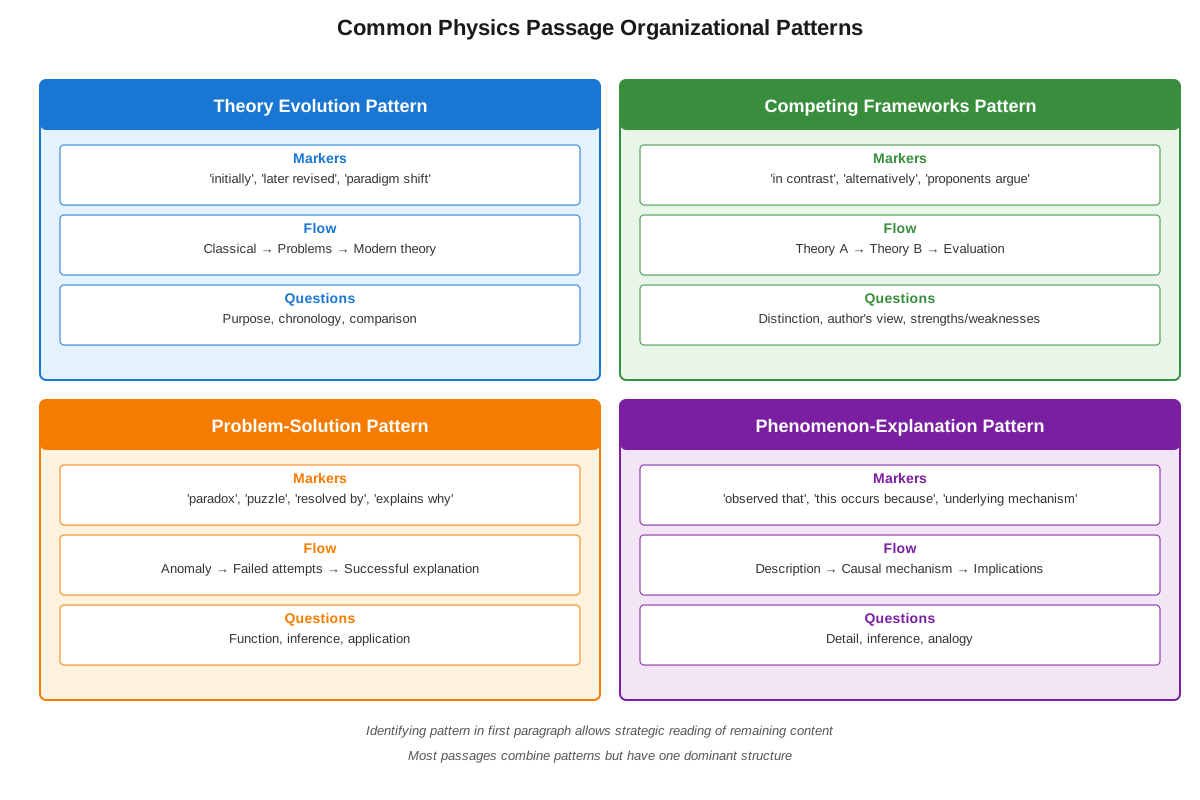
Physics passages typically follow predictable organizational patterns. The problem-solution structure presents a puzzle or anomaly in existing theory, then explains how a new theoretical framework resolves the difficulty. For example, a passage might describe how classical physics failed to explain blackbody radiation, then introduce Planck's quantum hypothesis as the solution.
The comparison-contrast structure presents two competing theories or interpretations, outlining their respective strengths and limitations. A passage might compare the Copenhagen interpretation of quantum mechanics with the many-worlds interpretation, examining how each handles the measurement problem.
The chronological development structure traces the historical evolution of physical understanding, showing how successive theories refined or replaced earlier frameworks. Such passages often emphasize paradigm shifts—moments when fundamental assumptions changed rather than merely accumulating new facts.
The general-to-specific structure begins with broad principles, then illustrates them through concrete examples or applications. A passage might introduce the concept of symmetry in physics, then demonstrate how various conservation laws derive from different symmetries.
Reasoning Patterns in Physics Passages
Physics passages employ distinctive reasoning patterns that recur across different content areas. Analogical reasoning uses familiar phenomena to illuminate abstract concepts—comparing quantum superposition to a coin spinning in the air, or explaining entropy through the example of a messy room. Recognizing these analogies helps students grasp the conceptual point without getting lost in technical details.
Causal explanation traces how specific conditions produce particular outcomes according to physical laws. These explanations often involve multiple steps in a causal chain, requiring careful tracking of relationships. For instance, a passage might explain how stellar fusion produces heavier elements, which then form planets, enabling the chemistry necessary for life.
Theoretical justification presents evidence and reasoning supporting a physical theory. This pattern requires distinguishing between direct observational evidence, indirect evidence requiring theoretical interpretation, and purely theoretical considerations like mathematical elegance or consistency with other established theories.
Limitation acknowledgment recognizes the boundaries of theoretical applicability. Physics passages frequently note that a theory works well within certain domains but breaks down under extreme conditions—as Newtonian mechanics fails at speeds approaching light or at quantum scales.
Author's Purpose and Tone in Physics Passages
Understanding authorial purpose proves crucial for answering LSAT questions correctly. Physics passages typically adopt one of several purposes: explaining a complex concept to non-specialist readers, arguing for a particular interpretation or theoretical approach, describing historical developments in physical understanding, or analyzing the philosophical implications of physical theories.
The tone in physics passages generally remains objective and explanatory, though subtle evaluative language often appears when discussing competing theories or unresolved questions. Authors may express cautious skepticism about certain interpretations, qualified enthusiasm for promising approaches, or measured acknowledgment of theoretical limitations. Detecting these tonal nuances helps answer questions about author's attitude or the passage's primary purpose.
Question Types Associated with Physics Passages
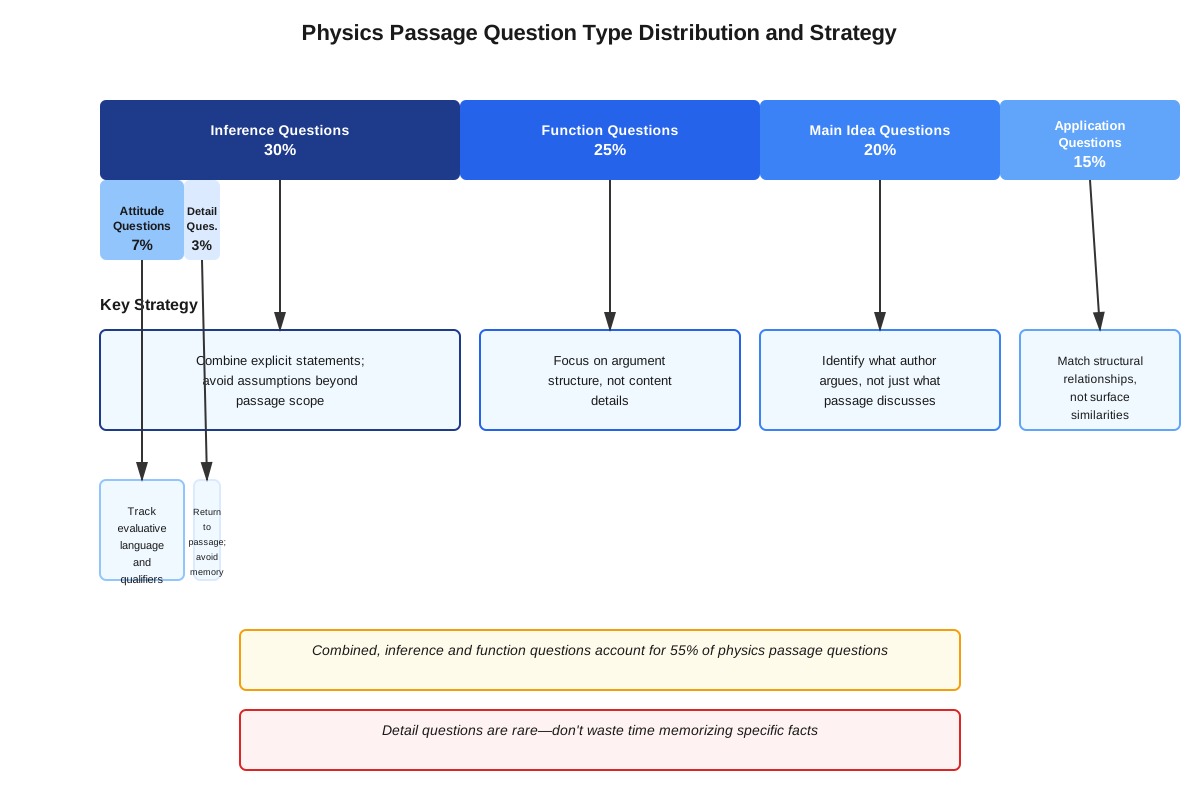
Physics passages generate predictable question types. Main idea questions test whether students can identify the passage's central purpose—often distinguishing between the specific topic discussed and the broader point being made about that topic. Detail questions require locating specific information, testing careful reading rather than prior knowledge.
Inference questions ask what must be true based on passage information, requiring logical deduction without importing outside assumptions. Application questions present novel scenarios and ask how passage principles would apply, testing conceptual understanding rather than memorization. Structure questions examine how the passage is organized or how specific paragraphs function within the overall argument.
Author's purpose or attitude questions assess understanding of why the author included certain information or how the author views particular theories or interpretations. Strengthening or weakening questions occasionally appear, asking what additional information would support or undermine claims made in the passage.
Concept Relationships
The concepts within physics passages form an interconnected web of relationships. Understanding structural patterns enables prediction of where key information will appear, which facilitates answering detail questions efficiently. Recognizing reasoning patterns like analogical explanation or causal chains helps students follow complex arguments, which directly supports answering inference questions and application questions.
The relationship between content areas and question types shows clear patterns: quantum mechanics passages frequently generate inference questions about counterintuitive implications, while historical development passages often produce structure questions about how the passage is organized. Philosophy of science passages typically include author's attitude questions, since these passages involve evaluative judgments about competing approaches.
Author's purpose connects to virtually every other concept—understanding why the author wrote the passage illuminates which details matter most, how the passage is structured, and what tone to expect. This central concept acts as an organizing principle for comprehension.
The progression flows: Structural patterns → provide framework for → Content comprehension → enables identification of → Reasoning patterns → supports answering → Question types → which test understanding of → Author's purpose and tone. Each element builds on previous understanding, creating a cumulative comprehension process.
Physics passages also connect to prerequisite knowledge of general argument structure. The premises and conclusions identified in logical reasoning transfer directly to recognizing how evidence supports theoretical claims in physics passages. The skill of distinguishing facts from interpretations applies equally to legal arguments and scientific explanations.
High-Yield Facts
⭐ Physics passages appear in approximately 15-25% of LSAT Reading Comprehension sections, making them one of the most frequent specialized passage types
⭐ The LSAT never requires prior knowledge of physics concepts—all necessary information appears within the passage itself
⭐ Physics passages typically emphasize conceptual understanding and theoretical reasoning rather than mathematical calculations
⭐ Analogies to everyday experiences frequently appear in physics passages to explain abstract or counterintuitive concepts
⭐ Author's tone in physics passages usually remains objective and explanatory, though subtle evaluative language appears when discussing competing theories
- Physics passages often contrast classical intuitions with modern theoretical understanding, highlighting counterintuitive aspects of contemporary physics
- Historical development passages frequently emphasize paradigm shifts—fundamental changes in theoretical frameworks rather than mere accumulation of facts
- Philosophy of science themes appear regularly, examining questions about scientific methodology, realism versus instrumentalism, or the relationship between theory and observation
- Limitation acknowledgment represents a crucial reasoning pattern—passages often specify the domains where theories apply and where they break down
- Application questions following physics passages test whether students can extend passage principles to novel scenarios not explicitly discussed
Quick check — test yourself on Physics passages so far.
Try Flashcards →Common Misconceptions
Misconception: Physics passages require background knowledge of physics to answer questions correctly → Correction: The LSAT deliberately designs physics passages to be self-contained, providing all necessary information within the passage. Success depends on careful reading and logical reasoning, not prior physics knowledge. Students who try to rely on outside knowledge often import incorrect assumptions that lead to wrong answers.
Misconception: Understanding every technical detail is necessary for answering questions → Correction: LSAT questions focus on main ideas, structural relationships, and key reasoning patterns rather than minor technical details. Students should prioritize understanding the passage's overall argument and purpose over memorizing every specific claim. Many details serve as examples supporting broader points rather than being directly tested.
Misconception: Physics passages are inherently harder than other passage types → Correction: While physics passages may feel intimidating due to unfamiliar terminology, they follow predictable patterns and test the same core reading comprehension skills as other passages. Students who master the structural and reasoning patterns specific to physics passages often find them more predictable than passages on less structured topics like literary criticism.
Misconception: Analogies in physics passages are merely decorative and can be skipped → Correction: Analogies serve crucial explanatory functions, often providing the clearest statement of a concept's essential features. Questions frequently test understanding of what the analogy illustrates or where the analogy breaks down. Careful attention to analogies often proves essential for answering inference and application questions correctly.
Misconception: The author's purpose in physics passages is always simply to explain a concept → Correction: While explanation is common, authors may also argue for particular interpretations, critique existing theories, trace historical developments to make a point about scientific progress, or explore philosophical implications. Distinguishing between mere explanation and more complex purposes proves crucial for answering main idea and author's purpose questions correctly.
Misconception: Physics passages present established facts that are universally accepted → Correction: Many physics passages discuss competing interpretations, unresolved questions, or the limitations of current theories. Recognizing when the passage presents contested claims versus established consensus helps answer questions about author's attitude and the strength of various claims.
Worked Examples
Example 1: Quantum Mechanics Passage
Passage excerpt: "The double-slit experiment reveals the fundamental strangeness of quantum mechanics. When individual photons pass through two slits, they create an interference pattern on a detector screen—a pattern that only makes sense if each photon somehow passes through both slits simultaneously, interfering with itself. Yet when we place detectors at the slits to determine which path each photon takes, the interference pattern disappears, and the photons behave like ordinary particles passing through one slit or the other. This suggests that the act of measurement fundamentally alters quantum behavior, collapsing the photon's wave-like superposition into a definite particle-like state."
Question: Based on the passage, which of the following most accurately describes the relationship between measurement and quantum behavior?
(A) Measurement reveals pre-existing properties that were always definite but unknown
(B) Measurement creates properties that did not exist in definite form before observation
(C) Measurement has no effect on quantum systems, merely recording their behavior
(D) Measurement destroys quantum systems, preventing accurate observation
(E) Measurement proves that quantum mechanics is fundamentally flawed
Solution: This question tests understanding of a key reasoning pattern in quantum mechanics passages—the relationship between observation and quantum states.
Step 1: Identify what the passage explicitly states about measurement. The passage says measurement "fundamentally alters quantum behavior" and causes "collapsing" from superposition to a definite state.
Step 2: Eliminate answers contradicting passage information. (C) contradicts the claim that measurement "alters" behavior. (D) goes too far—the passage doesn't say measurement destroys systems, just changes their behavior. (E) represents an evaluative judgment the passage doesn't make.
Step 3: Distinguish between remaining options. (A) suggests properties were always definite but hidden. However, the passage describes superposition—passing through "both slits simultaneously"—as the actual state before measurement, not merely unknown information about a definite state. (B) accurately captures the passage's claim that measurement "collapses" superposition "into a definite state," suggesting the definite property emerges through measurement rather than being revealed.
Answer: (B). This example demonstrates how physics passages test careful reading of theoretical claims rather than prior knowledge, and how elimination based on passage evidence leads to correct answers.
Example 2: Relativity Passage Structure
Passage excerpt: "Einstein's special relativity challenged fundamental assumptions about space and time. Classical physics treated time as absolute—a universal clock ticking at the same rate for all observers regardless of their motion. Special relativity revealed that time is relative: moving clocks run slower from the perspective of stationary observers, an effect called time dilation. This counterintuitive prediction has been confirmed through numerous experiments, including observations of unstable particles that live longer when moving at high speeds than when at rest. The implications extend beyond physics: if time itself is relative rather than absolute, our intuitive picture of a single, objective 'now' shared by all observers must be abandoned."
Question: The passage is primarily concerned with:
(A) Explaining the mathematical derivation of time dilation
(B) Describing experimental confirmations of special relativity
(C) Contrasting classical and relativistic conceptions of time
(D) Arguing that special relativity is superior to classical physics
(E) Analyzing the philosophical implications of relative simultaneity
Solution: This question tests understanding of author's purpose and passage structure—a high-yield skill for physics passages.
Step 1: Identify the passage's organizational pattern. The passage follows a comparison-contrast structure: classical view → relativistic view → evidence → implications.
Step 2: Determine what receives the most emphasis. The passage devotes most space to contrasting absolute versus relative time, with experimental evidence and philosophical implications serving as supporting elements.
Step 3: Evaluate each answer against the passage's actual focus. (A) is incorrect—no mathematical derivation appears. (B) is too narrow—experiments are mentioned but not the primary focus. (D) overstates the passage's evaluative stance—the passage presents relativity as different from classical physics but doesn't argue for superiority. (E) is too narrow—philosophical implications appear only in the final sentence.
Step 4: Confirm the best answer. (C) accurately captures the passage's central purpose: contrasting two different conceptions of time's nature. The passage structure supports this—moving from classical assumptions to relativistic revision.
Answer: (C). This example illustrates how recognizing structural patterns helps identify main purpose, and how wrong answers often focus on supporting details rather than the passage's central concern.
Exam Strategy
When approaching physics passages on the LSAT, implement a systematic reading strategy. First-pass reading should focus on understanding the passage's overall structure and main argument rather than memorizing details. Identify the passage's organizational pattern (problem-solution, comparison-contrast, chronological development, or general-to-specific) within the first paragraph, as this framework guides where to find information later.
Mark structural signposts as you read: words like "however," "in contrast," "for example," and "consequently" signal important logical relationships. Note where the passage introduces new concepts, presents evidence, acknowledges limitations, or draws implications. These structural markers help navigate the passage efficiently when answering questions.
Pay special attention to analogies and concrete examples, as these often provide the clearest statement of abstract concepts and frequently appear in questions. When an analogy appears, pause to ensure you understand what concept it illustrates and what features of the analogy map onto the physics concept.
Distinguish between established facts and contested claims. Physics passages often present some information as settled consensus while marking other claims as debated or speculative. This distinction proves crucial for answering questions about the strength of various claims or the author's attitude toward different theories.
Trigger words and phrases to watch for include: "counterintuitively," "paradoxically," "unlike classical physics," "the measurement problem," "competing interpretations," "within certain limits," "breaks down at," and "philosophical implications." These phrases signal important conceptual points likely to appear in questions.
For time allocation, spend approximately 3-4 minutes on the initial passage reading, ensuring solid comprehension of structure and main ideas. This investment pays dividends by making questions answerable more quickly and accurately. Avoid the temptation to rush through the passage to reach questions faster—this approach typically requires multiple re-readings that waste more time overall.
When answering questions, return to the passage to verify answers rather than relying on memory. Physics passages contain precise language where small differences in wording create significant meaning changes. The correct answer will have direct support in passage text, while wrong answers often distort passage claims in subtle ways.
For inference questions, the correct answer must be true based on passage information without requiring outside assumptions. Eliminate answers that could be true but aren't necessarily true, as well as answers that contradict passage information or require specialized physics knowledge not provided in the passage.
For application questions, identify the relevant principle in the passage, then carefully apply it to the new scenario. Wrong answers often misapply the principle or focus on superficial similarities rather than the relevant conceptual relationship.
Memory Techniques
SPACE acronym for physics passage elements to track:
- Structure: Identify organizational pattern
- Purpose: Determine author's main goal
- Analogies: Note concrete examples explaining abstract concepts
- Contrasts: Mark differences between theories or classical versus modern views
- Evidence: Identify what supports theoretical claims
Visualization strategy: When encountering counterintuitive physics concepts, create a mental image of the analogy or concrete example provided. For quantum superposition, visualize the spinning coin analogy. For time dilation, picture the moving clock running slower. These visual anchors help retain conceptual understanding.
The Three Questions to ask while reading physics passages:
- What problem or question does this passage address?
- What solution or answer does the passage provide?
- What limitations or implications does the passage acknowledge?
These questions capture the typical arc of physics passages and guide active reading.
Pattern recognition mnemonic: Physics passages follow PACE:
- Problem or phenomenon introduced
- Approach or theory explained
- Confirmation through evidence or examples
- Extensions or implications discussed
Not every passage includes all elements, but this sequence represents the typical flow.
Summary
Physics passages on the LSAT test reading comprehension and logical reasoning through scientific content, requiring no prior physics knowledge. These passages emphasize conceptual understanding over mathematical calculation, frequently exploring counterintuitive phenomena, theoretical debates, historical paradigm shifts, and philosophical implications of physical theories. Success requires recognizing common structural patterns (problem-solution, comparison-contrast, chronological development, general-to-specific) and reasoning patterns (analogical explanation, causal chains, theoretical justification, limitation acknowledgment). Questions test main idea identification, detail recognition, inference drawing, application of principles to novel scenarios, and understanding of author's purpose and attitude. The key to mastering physics passages lies in careful attention to passage structure, precise reading of theoretical claims, recognition of the relationship between evidence and theory, and systematic elimination of wrong answers based on passage support. Students should focus on understanding the passage's overall argument and purpose rather than memorizing technical details, use analogies as conceptual anchors, and distinguish between established facts and contested interpretations.
Key Takeaways
- Physics passages require no background physics knowledge—all necessary information appears within the passage itself, making careful reading more important than prior expertise
- Recognizing structural patterns (problem-solution, comparison-contrast, chronological, general-to-specific) enables efficient navigation and prediction of where key information appears
- Analogies and concrete examples serve crucial explanatory functions and frequently appear in questions, requiring careful attention rather than dismissal as decorative elements
- Author's purpose extends beyond simple explanation to include arguing for interpretations, critiquing theories, tracing historical developments, and exploring philosophical implications
- Success depends on distinguishing between established facts and contested claims, tracking the relationship between evidence and theoretical conclusions, and recognizing the scope and limitations of physical theories
- Questions test conceptual understanding through inference and application rather than detail memorization, rewarding comprehension of reasoning patterns over retention of specific facts
- Systematic strategy—identifying structure early, marking logical signposts, returning to passage text to verify answers—proves more effective than rushing through passages to reach questions quickly
Related Topics
Scientific Methodology Passages: These passages explore how scientific knowledge is generated and validated, often using physics as a case study. Mastering physics passages provides direct preparation for methodology passages, as both require understanding the relationship between observation, hypothesis, and theory.
Comparative Passages in Science: The LSAT sometimes presents paired passages offering different perspectives on scientific questions. Skills developed through single physics passages—tracking arguments, comparing theoretical frameworks, evaluating evidence—transfer directly to comparative passage analysis.
Law and Science Passages: Some passages examine legal or regulatory issues involving scientific concepts, such as standards for expert testimony or environmental regulations. Understanding how to comprehend technical scientific content prepares students for these interdisciplinary passages.
Philosophy Passages: Many physics passages incorporate philosophical themes about knowledge, reality, and scientific explanation. The analytical skills developed through physics passages—following abstract arguments, distinguishing between observation and interpretation—apply equally to pure philosophy passages.
Practice CTA
Now that you've mastered the core concepts and strategies for physics passages, it's time to apply this knowledge through deliberate practice. Attempt the practice questions associated with this topic, focusing on implementing the systematic reading strategy and elimination techniques discussed above. Use flashcards to reinforce recognition of structural patterns, reasoning patterns, and trigger words that signal important conceptual points. Remember that physics passages, despite their intimidating appearance, follow predictable patterns that become increasingly recognizable with practice. Each passage you work through builds pattern recognition and strategic skills that will serve you throughout the Reading Comprehension section. Your investment in mastering this high-yield topic will pay dividends on test day—physics passages represent an opportunity to demonstrate sophisticated analytical reasoning that distinguishes top scorers.
Sign up free to keep reading
Create a free AnvayaPrep account to finish this LSAT guide on Physics passages — plus flashcards and practice questions.