Overview
Psychology passages represent one of the most frequently tested subject areas in LSAT Reading Comprehension sections. These passages typically explore topics such as cognitive processes, behavioral theories, social psychology experiments, developmental psychology, neuropsychological research, and the philosophical foundations of psychological science. Unlike passages from law or humanities, lsat psychology passages often present empirical research findings, theoretical frameworks, and debates about methodology or interpretation within the field of psychology.
Understanding how to navigate psychology passages is essential for LSAT success because they appear in virtually every administration of the exam and often contain complex argumentative structures that test critical reasoning skills. These passages frequently present competing theories, describe experimental designs, or challenge established psychological paradigms. The LSAT uses psychology content to assess a test-taker's ability to identify main ideas, understand authorial purpose, recognize logical relationships between concepts, and evaluate the strength of evidence—all skills fundamental to legal reasoning.
Reading comprehension strategies for psychology passages must account for the unique characteristics of social science writing: the presentation of empirical data, the discussion of research methodology, the comparison of theoretical perspectives, and the evaluation of experimental validity. Mastering passage subjects and strategies specific to psychology content enables test-takers to efficiently process dense scientific information, distinguish between factual claims and interpretive conclusions, and accurately answer questions about passage structure, author's attitude, and logical inference.
Learning Objectives
- [ ] Identify how Psychology passages appears in LSAT questions
- [ ] Explain the reasoning pattern behind Psychology passages
- [ ] Apply Psychology passages to solve LSAT-style problems accurately
- [ ] Distinguish between empirical findings and theoretical interpretations in psychology passages
- [ ] Recognize common structural patterns in psychology research presentations
- [ ] Evaluate the strength of evidence and methodology claims in psychological studies
- [ ] Identify author's attitude toward competing psychological theories
Prerequisites
- Basic reading comprehension skills: Ability to identify main ideas, supporting details, and passage structure is foundational for analyzing any LSAT passage, including those on psychology topics.
- Understanding of argument structure: Recognition of premises, conclusions, and logical relationships enables test-takers to follow the reasoning in psychology passages that present theoretical debates or research findings.
- Familiarity with scientific method concepts: Basic knowledge of hypothesis testing, experimental design, and evidence evaluation helps students understand how psychology research is presented and critiqued in passages.
- General LSAT Reading Comprehension question types: Knowledge of question categories (main point, inference, author's attitude, function, etc.) provides the framework for applying psychology-specific strategies.
Why This Topic Matters
Psychology passages hold significant real-world relevance because they mirror the type of social science research that lawyers encounter in cases involving expert testimony, behavioral evidence, mental health issues, and social policy debates. Legal professionals must regularly evaluate psychological research in contexts ranging from criminal competency hearings to employment discrimination cases, making the analytical skills tested through psychology passages directly applicable to legal practice.
From an exam statistics perspective, psychology passages appear in approximately 20-30% of LSAT Reading Comprehension sections, making them one of the most common subject areas alongside law, humanities, and natural sciences. Test-takers can expect to encounter at least one psychology passage per exam, and sometimes two. These passages generate questions across all standard types: main point questions (15-20% of psychology passage questions), inference questions (25-30%), function questions (15-20%), author's attitude questions (10-15%), and application questions (10-15%).
Psychology content appears in several characteristic forms on the LSAT: passages describing landmark experiments and their implications (such as studies on memory, perception, or social behavior); passages comparing competing theoretical frameworks (behaviorism vs. cognitive psychology, nature vs. nurture debates); passages examining the relationship between brain structure and psychological function; passages critiquing research methodology or questioning the validity of psychological constructs; and passages exploring the historical development of psychological theories. Understanding these common manifestations enables test-takers to quickly orient themselves within a passage and anticipate the types of questions that will follow.
Core Concepts
Structure of Psychology Passages
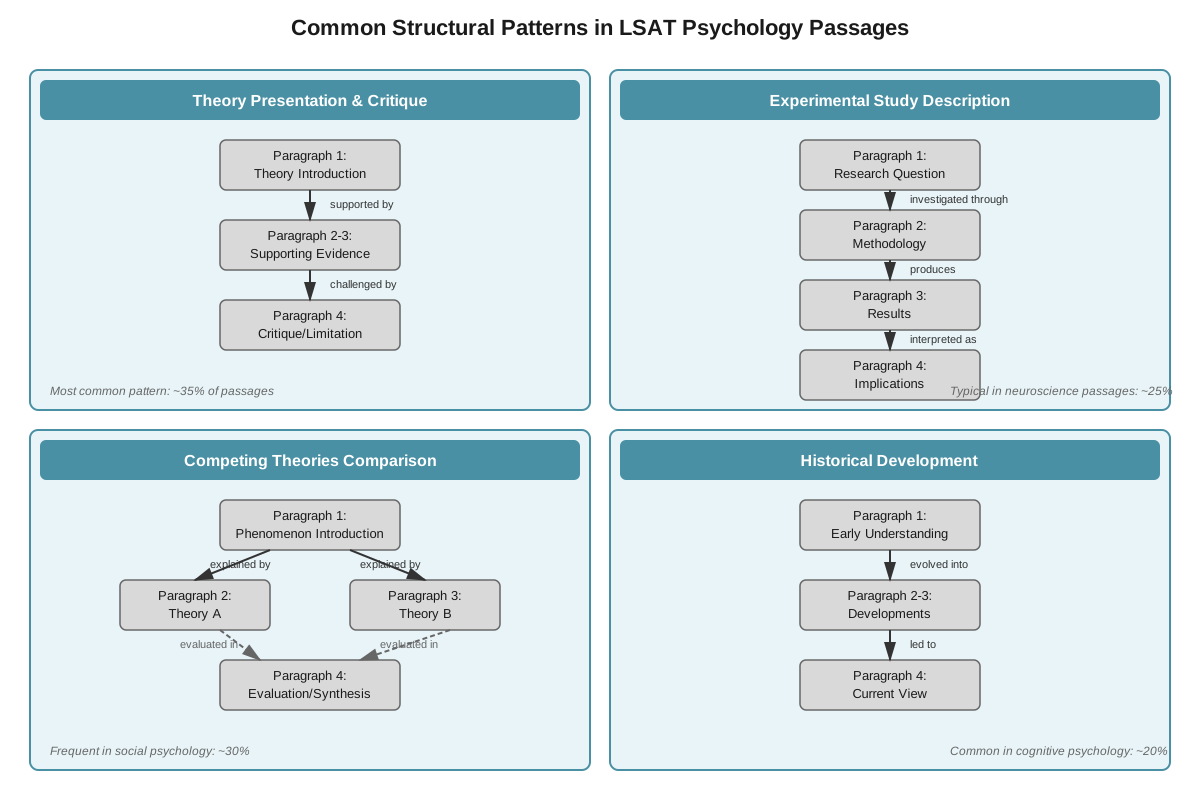
Psychology passages on the LSAT typically follow one of several predictable organizational patterns. The experimental study presentation structure begins with background on a psychological phenomenon, describes a specific experiment or series of experiments designed to investigate that phenomenon, presents the findings, and concludes with implications or limitations. The theoretical debate structure introduces competing explanations for psychological phenomena, presents evidence supporting each perspective, and often concludes with the author's evaluation of which theory has greater explanatory power. The critique or revision structure presents an established psychological theory or finding, introduces challenges or new evidence that questions the traditional view, and proposes modifications or alternative interpretations.
Recognizing these structural patterns immediately upon reading the first paragraph enables efficient passage mapping and accurate prediction of question types. For instance, experimental study presentations frequently generate function questions about why the author mentions specific experimental details, while theoretical debate passages commonly produce inference questions about what each theory would predict in hypothetical scenarios.
Common Content Areas in Psychology Passages
Cognitive psychology topics dominate LSAT psychology passages, including memory formation and retrieval, attention and perception, problem-solving strategies, decision-making processes, and language acquisition. These passages often present research findings that challenge intuitive assumptions about mental processes. For example, a passage might describe experiments showing that eyewitness memory is more reconstructive than reproductive, or that certain cognitive biases systematically distort judgment.
Social psychology content frequently appears in passages examining conformity, obedience, group dynamics, attribution theory, prejudice and stereotyping, and social influence. These passages typically describe classic experiments (though not always by name) and explore their implications for understanding human behavior in social contexts. The LSAT favors passages that present counterintuitive findings or challenge common-sense assumptions about social behavior.
Developmental psychology passages explore cognitive and emotional development across the lifespan, theories of moral development, attachment theory, and the interaction between biological maturation and environmental influence. These passages often involve debates about the relative contributions of innate factors versus experience in shaping psychological characteristics.
Neuropsychology and biological psychology content examines the relationship between brain structure and psychological function, the effects of brain damage on cognition and behavior, neuroplasticity, and the biological basis of mental disorders. These passages require careful attention to the distinction between correlation and causation, as well as the limitations of drawing psychological conclusions from biological data.
Reasoning Patterns in Psychology Passages
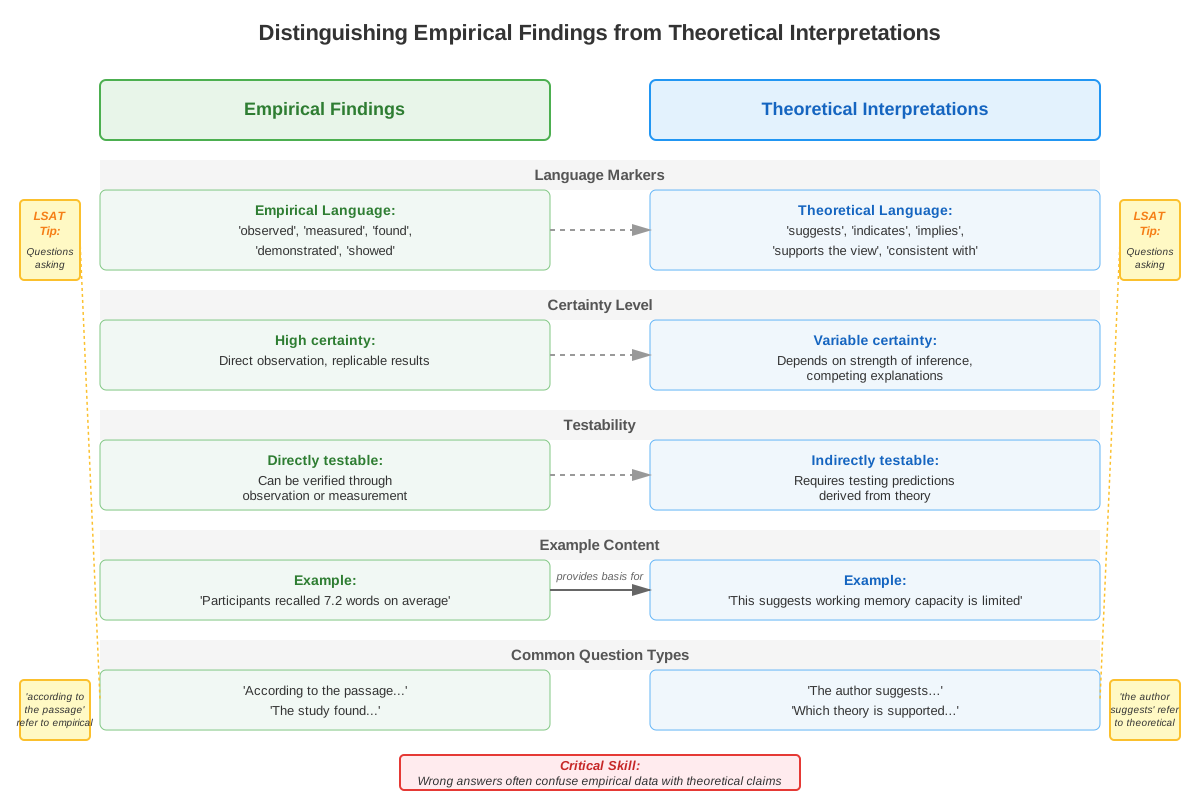
Psychology passages employ several characteristic reasoning patterns that test-takers must recognize. The evidence-to-theory pattern presents empirical findings and then discusses what theoretical conclusions can or cannot be drawn from those findings. This pattern tests the ability to distinguish between data and interpretation, a crucial skill for evaluating the strength of arguments.
The theory-to-prediction pattern describes a psychological theory and then explores what that theory would predict about behavior in specific situations. Questions following this pattern often ask test-takers to apply the theory to novel scenarios or to identify which observation would most strengthen or weaken the theory.
The methodological critique pattern presents research findings and then questions whether the methodology used actually supports the conclusions drawn. This pattern requires attention to issues such as sample selection, experimental controls, alternative explanations for results, and the generalizability of findings. LSAT passages using this pattern often highlight the gap between what a study actually demonstrates and what researchers claim it demonstrates.
The paradigm shift pattern describes how new evidence or theoretical insights have challenged and revised previously accepted psychological theories. These passages test the ability to understand how scientific fields evolve and to recognize the difference between incremental refinement and fundamental reconceptualization of a phenomenon.
Author's Attitude and Tone
Psychology passages exhibit a range of authorial attitudes that significantly impact question answering. Some passages present research in a neutral, expository manner, simply describing findings without evaluating them. Others adopt a critical or skeptical tone, questioning the validity of research methods or the interpretation of results. Still others are enthusiastic or supportive, highlighting the significance and implications of new findings.
Identifying the author's attitude requires attention to subtle linguistic cues: qualifying language ("may suggest," "appears to indicate"), evaluative adjectives ("surprising," "problematic," "compelling"), and the relative space devoted to supporting versus challenging a position. Questions about author's attitude are common in psychology passages, and incorrect answer choices often mischaracterize the degree or direction of the author's evaluation.
Technical Terminology and Jargon
Psychology passages contain specialized vocabulary that test-takers must interpret from context. Unlike highly technical scientific passages, psychology passages typically define or contextualize key terms, but students must still track these definitions carefully. Terms like operationalize (defining an abstract concept in measurable terms), confounding variable (a factor that might provide an alternative explanation for results), ecological validity (the extent to which findings apply to real-world settings), and replication (repeating a study to verify findings) appear frequently and carry specific meanings crucial to understanding arguments.
The LSAT does not require prior knowledge of psychological terminology, but recognizing when a term is being defined and tracking that definition throughout the passage is essential. Questions often hinge on precise understanding of how the passage uses specific technical terms.
Experimental Design Elements
Many psychology passages describe experiments, requiring test-takers to understand basic experimental design concepts. The independent variable is the factor manipulated by researchers, while the dependent variable is the outcome measured. Control groups provide a baseline for comparison, while experimental groups receive the treatment or manipulation being studied. Random assignment helps ensure that differences between groups result from the manipulation rather than pre-existing differences.
Passages may critique experiments by pointing out the absence of proper controls, the presence of confounding variables, or problems with how variables were operationalized. Understanding these design elements enables accurate answering of questions about what an experiment actually demonstrates versus what it claims to demonstrate.
Concept Relationships
The concepts within psychology passages form an interconnected web of relationships. Experimental design elements provide the foundation for understanding evidence-to-theory reasoning patterns, as the strength of theoretical conclusions depends on the quality of the experimental methodology. Methodological critique patterns directly engage with experimental design elements by questioning whether the design actually supports the conclusions drawn.
Author's attitude and tone influences how theoretical debates are presented—a skeptical author will emphasize weaknesses in a theory, while a supportive author will highlight its explanatory power. The common content areas (cognitive, social, developmental, neuropsychology) each tend to employ characteristic reasoning patterns: cognitive psychology passages often use evidence-to-theory patterns, social psychology passages frequently employ theory-to-prediction patterns, and neuropsychology passages commonly feature methodological critiques about inferring psychological processes from biological data.
Technical terminology serves as the precise language through which experimental design elements and reasoning patterns are expressed. Understanding terms like "operationalize" and "confounding variable" is essential for following methodological critique patterns. The structure of psychology passages determines how these various elements are organized and presented, with experimental study presentations emphasizing design elements and findings, while theoretical debate structures emphasize competing interpretations and their relative strengths.
This topic connects to broader Reading Comprehension skills by applying general strategies (identifying main ideas, tracking passage structure, recognizing author's purpose) to the specific context of social science writing. The analytical skills developed through psychology passages—distinguishing evidence from interpretation, evaluating methodological validity, understanding theoretical debates—transfer directly to other LSAT sections, particularly Logical Reasoning questions involving scientific studies and causal arguments.
High-Yield Facts
⭐ Psychology passages appear in approximately 20-30% of LSAT Reading Comprehension sections, making them one of the most frequently tested subject areas.
⭐ The most common structural patterns are: experimental study presentation, theoretical debate, and critique/revision of established theories.
⭐ Author's attitude questions are particularly common in psychology passages and require attention to subtle evaluative language and qualifying terms.
⭐ Psychology passages frequently test the distinction between empirical findings (what the data shows) and theoretical interpretations (what the findings mean).
⭐ Methodological critique is a dominant reasoning pattern, requiring test-takers to evaluate whether experimental design supports the conclusions drawn.
- Cognitive psychology topics (memory, perception, decision-making) are the most frequently appearing content area in psychology passages.
- Questions following psychology passages often ask test-takers to apply theories to novel scenarios not explicitly discussed in the passage.
- Technical terms in psychology passages are typically defined or contextualized within the passage itself; prior knowledge is not required.
- The distinction between correlation and causation is frequently tested, particularly in neuropsychology passages linking brain structure to behavior.
- Psychology passages often present counterintuitive findings that challenge common-sense assumptions about human behavior.
- Function questions commonly ask why the author mentions specific experimental details or examples.
- Inference questions frequently require understanding what competing theories would predict in hypothetical situations.
- The concept of ecological validity (whether lab findings apply to real-world settings) appears regularly as a limitation or critique.
- Passages may describe classic psychology experiments without naming them, focusing instead on the methodology and implications.
- The relative space devoted to different theories or perspectives often signals the author's attitude toward those positions.
Quick check — test yourself on Psychology passages so far.
Try Flashcards →Common Misconceptions
Misconception: Psychology passages require prior knowledge of psychological theories and terminology to answer questions correctly. → Correction: The LSAT is designed to test reading comprehension and reasoning skills, not content knowledge. All information needed to answer questions is contained within the passage itself. Technical terms are defined or can be understood from context, and no outside knowledge of psychology is required or advantageous.
Misconception: If a passage describes an experiment, the author necessarily endorses the experiment's conclusions. → Correction: Authors frequently describe experiments in order to critique them, question their methodology, or present them as one perspective in a theoretical debate. Careful attention to evaluative language and passage structure is necessary to determine the author's actual attitude toward the research presented.
Misconception: Longer, more detailed descriptions of experimental procedures are less important than theoretical discussions. → Correction: Experimental details are often crucial for answering questions about what the study actually demonstrates, what its limitations are, or what alternative explanations might exist for the findings. Function questions commonly ask why specific procedural details are mentioned.
Misconception: Psychology passages are easier than passages on law or natural sciences because psychology is more familiar. → Correction: While psychology topics may seem more accessible, LSAT psychology passages are carefully constructed to test sophisticated reasoning skills. They often present complex theoretical debates, subtle methodological critiques, and counterintuitive findings that require careful analysis regardless of familiarity with the general subject matter.
Misconception: The correct answer to inference questions will be explicitly stated somewhere in the passage. → Correction: Inference questions require drawing conclusions that are supported by but not directly stated in the passage. For psychology passages, this often means applying a theory to a new situation, recognizing what a finding implies about a broader phenomenon, or understanding what must be true given the experimental design described.
Misconception: Technical terminology in psychology passages should be memorized for future exams. → Correction: While recognizing common terms can speed up reading, each passage defines terms in its own specific way. The LSAT tests the ability to track how a passage uses terminology, not the ability to recall standard definitions. Focus on understanding how terms function within the specific passage context.
Misconception: If a passage presents two competing theories, the author must favor one over the other. → Correction: Some passages present theoretical debates in a balanced, neutral manner without indicating a preference. Other passages do signal authorial preference through evaluative language or unequal treatment. Distinguishing between these approaches requires careful attention to tone and structure rather than assuming a preference must exist.
Worked Examples
Example 1: Experimental Study Presentation
Passage Summary: A psychology passage describes research on memory consolidation. The first paragraph introduces the traditional view that memories are consolidated during sleep through a passive process. The second paragraph describes an experiment where participants learned a task, then either slept or remained awake, and were tested on the task later. The third paragraph presents findings showing that sleep improved performance, but only when participants were exposed to subtle cues related to the task during sleep. The final paragraph discusses implications, suggesting that memory consolidation is more active and selective than previously thought.
Question: The passage suggests that the traditional view of memory consolidation is problematic primarily because it:
Approach: This question asks about the author's critique of the traditional view. The key is identifying what the experimental findings reveal that contradicts or complicates the traditional view.
Step 1: Locate the traditional view (paragraph 1): memory consolidation during sleep is a passive process.
Step 2: Identify what the experimental findings show (paragraph 3): sleep improved memory, but only with task-related cues present during sleep.
Step 3: Determine what this finding implies about the traditional view: if cues are necessary for consolidation, the process cannot be entirely passive—it must involve some active, selective mechanism.
Step 4: Evaluate answer choices for one that captures this reasoning:
- (A) "fails to account for the role of environmental cues in determining which memories are strengthened" ✓ This matches our analysis
- (B) "overlooks the importance of sleep duration" ✗ The passage doesn't emphasize duration
- (C) "cannot explain why some people have better memory than others" ✗ Individual differences aren't discussed
- (D) "assumes that all types of memory are consolidated in the same way" ✗ Memory types aren't the focus of the critique
Answer: (A)
Connection to Learning Objectives: This example demonstrates how to identify the reasoning pattern (evidence-to-theory), recognize the author's critique of an established view, and apply passage information to answer questions about theoretical implications—all key skills for psychology passages.
Example 2: Theoretical Debate Structure
Passage Summary: A psychology passage discusses explanations for altruistic behavior. The first paragraph introduces the puzzle: why do people help others at cost to themselves? The second paragraph presents the kin selection theory, which explains altruism as promoting the survival of shared genes. The third paragraph presents the reciprocal altruism theory, which explains helping as an investment in future reciprocation. The fourth paragraph introduces evidence that people help strangers they'll never encounter again, which neither theory fully explains. The final paragraph suggests that cultural evolution may have created psychological mechanisms that extend kin-based and reciprocity-based helping beyond their original adaptive contexts.
Question: Based on the passage, proponents of kin selection theory would most likely predict that:
Approach: This is a theory-to-prediction question requiring application of one theory to a novel scenario.
Step 1: Locate and understand kin selection theory (paragraph 2): altruism promotes survival of shared genes, so helping should be directed toward genetic relatives.
Step 2: Identify the core principle: the closer the genetic relationship, the more helping should occur.
Step 3: Evaluate answer choices for predictions consistent with this principle:
- (A) "people would be more willing to help siblings than cousins" ✓ Siblings share more genes than cousins, so this follows from kin selection
- (B) "people would help strangers who promise future reciprocation" ✗ This follows from reciprocal altruism theory, not kin selection
- (C) "cultural factors would override genetic influences on helping behavior" ✗ This contradicts the genetic basis of kin selection theory
- (D) "helping behavior would be equally common across all cultures" ✗ Kin selection doesn't make predictions about cross-cultural uniformity
Answer: (A)
Connection to Learning Objectives: This example shows how to distinguish between competing theories, understand their core principles, and apply them to generate predictions—essential skills for theoretical debate passages in psychology.
Exam Strategy
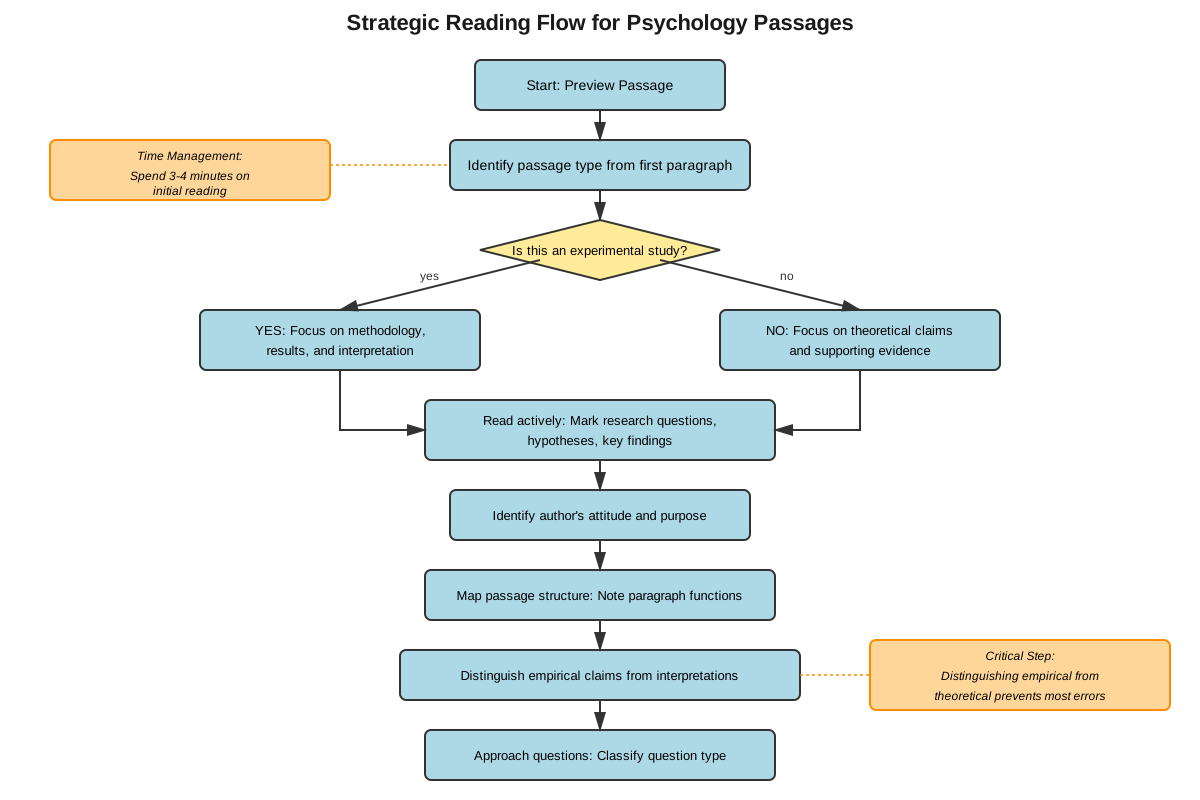
When approaching psychology passages on the LSAT, begin by identifying the passage structure within the first paragraph. Look for signals indicating whether the passage will present an experimental study, compare competing theories, or critique an established view. This initial classification enables efficient reading and accurate prediction of question types.
Trigger words and phrases to watch for include: "traditionally," "the prevailing view," or "it has long been thought" (signals that a challenge or revision is coming); "however," "yet," or "surprisingly" (indicates a contrast or unexpected finding); "suggests," "indicates," or "implies" (marks the transition from evidence to interpretation); "critics argue," "some researchers question," or "this view has been challenged" (introduces methodological or theoretical critique); and "one explanation," "an alternative account," or "another theory" (signals competing theoretical perspectives).
For process-of-elimination, be particularly alert to answer choices that confuse evidence with interpretation. Many incorrect answers will accurately describe findings but incorrectly characterize what those findings demonstrate or imply. Also eliminate answers that mischaracterize the author's attitude—if the passage is neutral, eliminate strongly evaluative answer choices; if the passage is critical, eliminate answers suggesting the author endorses the view being critiqued.
Watch for answer choices that introduce concepts not discussed in the passage or that require outside knowledge of psychology. The correct answer will always be supported by passage content, even for inference questions. Eliminate answers that go beyond what the passage supports, even if they seem plausible based on general knowledge.
Time allocation for psychology passages should follow the standard Reading Comprehension approach: approximately 3-4 minutes for initial reading and passage mapping, then 5-6 minutes for questions. However, if a passage contains detailed experimental procedures, invest slightly more time in the initial reading to ensure understanding of the methodology, as this will pay off in faster, more accurate question answering. Conversely, if a passage presents a straightforward theoretical debate, move quickly through the initial reading and allocate more time to questions requiring application of theories to novel scenarios.
For questions asking about experimental design or methodology, return to the passage to verify specific details rather than relying on memory. The LSAT often includes answer choices that subtly misrepresent procedural details, and these misrepresentations are difficult to catch without checking the passage text.
Memory Techniques
For remembering common passage structures, use the acronym ETC: Experimental study (describes research and findings), Theoretical debate (compares competing explanations), Critique (challenges established views). When you identify which structure a passage follows, you can anticipate question types and efficiently organize your passage map.
To remember key experimental design elements, visualize the acronym RICO: Random assignment (ensures groups are equivalent), Independent variable (what researchers manipulate), Control group (baseline for comparison), Operationalize (define abstract concepts measurably). This covers the most commonly tested design features in psychology passages.
For tracking author's attitude, use the spectrum N-S-E: Neutral (balanced presentation without evaluation), Skeptical (questions validity or interpretation), Enthusiastic (emphasizes significance and implications). Quickly categorizing the author's stance helps eliminate incorrect answer choices on attitude questions.
To remember the distinction between correlation and causation (frequently tested in neuropsychology passages), visualize two parallel lines (correlation: things occur together) versus an arrow (causation: one thing produces another). When a passage describes a relationship between brain structure and behavior, ask whether the evidence supports correlation or causation.
For remembering to distinguish evidence from interpretation, use the mnemonic DIME: Data (what was observed), Interpretation (what it means), Methodology (how it was studied), Evaluation (is the interpretation justified?). This framework helps organize information while reading and supports accurate answering of questions about what a study demonstrates versus what it claims.
Summary
Psychology passages represent a high-frequency, high-importance component of LSAT Reading Comprehension, appearing in approximately 20-30% of sections. These passages test the ability to understand experimental research, evaluate theoretical debates, distinguish evidence from interpretation, and assess methodological validity. The most common structural patterns are experimental study presentations, theoretical debates, and critiques of established views. Success requires recognizing these structures quickly, tracking the author's attitude through subtle linguistic cues, understanding basic experimental design concepts, and distinguishing between what data shows and what it means. Psychology passages employ characteristic reasoning patterns including evidence-to-theory, theory-to-prediction, methodological critique, and paradigm shift. Questions following these passages test main point identification, inference, function, author's attitude, and application of theories to novel scenarios. The key to mastering psychology passages is recognizing that they test reading comprehension and reasoning skills, not prior knowledge of psychology—all necessary information is contained within the passage itself.
Key Takeaways
- Psychology passages appear frequently on the LSAT and follow predictable structural patterns: experimental study presentation, theoretical debate, and critique/revision structures.
- The distinction between empirical findings and theoretical interpretations is central to most psychology passages and frequently tested through inference and main point questions.
- Author's attitude questions require attention to subtle evaluative language, qualifying terms, and the relative space devoted to different perspectives.
- Methodological critique is a dominant reasoning pattern, requiring evaluation of whether experimental design supports the conclusions drawn.
- Understanding basic experimental design elements (independent/dependent variables, control groups, confounding variables) is essential for following arguments about research validity.
- No prior knowledge of psychology is required or advantageous—all information needed to answer questions is contained within the passage.
- The most effective strategy is identifying passage structure early, tracking the author's attitude carefully, and distinguishing between what studies demonstrate versus what they claim to demonstrate.
Related Topics
Natural Science Passages: Psychology passages share methodological and structural features with natural science passages, including presentation of experimental research and evaluation of evidence. Mastering psychology passages builds skills directly applicable to passages on biology, physics, and other sciences.
Logical Reasoning - Causal Arguments: The reasoning patterns in psychology passages, particularly the distinction between correlation and causation and the evaluation of alternative explanations, directly parallel causal reasoning questions in the Logical Reasoning section.
Comparative Reading Passages: Psychology topics sometimes appear in comparative reading formats, where two shorter passages present competing perspectives on a psychological phenomenon. The skills developed for single psychology passages transfer directly to analyzing and comparing multiple viewpoints.
Humanities Passages on Philosophy of Mind: Some humanities passages explore philosophical questions about consciousness, mental states, and the nature of psychological explanation, creating overlap with psychology passage content and requiring similar analytical approaches.
Practice CTA
Now that you've mastered the core concepts and strategies for psychology passages, it's time to apply this knowledge to actual LSAT-style practice questions. Work through the practice questions systematically, referring back to the strategies and frameworks outlined in this guide. Pay particular attention to identifying passage structure, tracking author's attitude, and distinguishing evidence from interpretation. Use the flashcards to reinforce key concepts and terminology. Remember: psychology passages are highly learnable—consistent practice with strategic approaches will significantly improve your performance on this high-frequency question type. Your investment in mastering psychology passages will pay dividends across multiple Reading Comprehension sections on test day.
Sign up free to keep reading
Create a free AnvayaPrep account to finish this LSAT guide on Psychology passages — plus flashcards and practice questions.