Overview
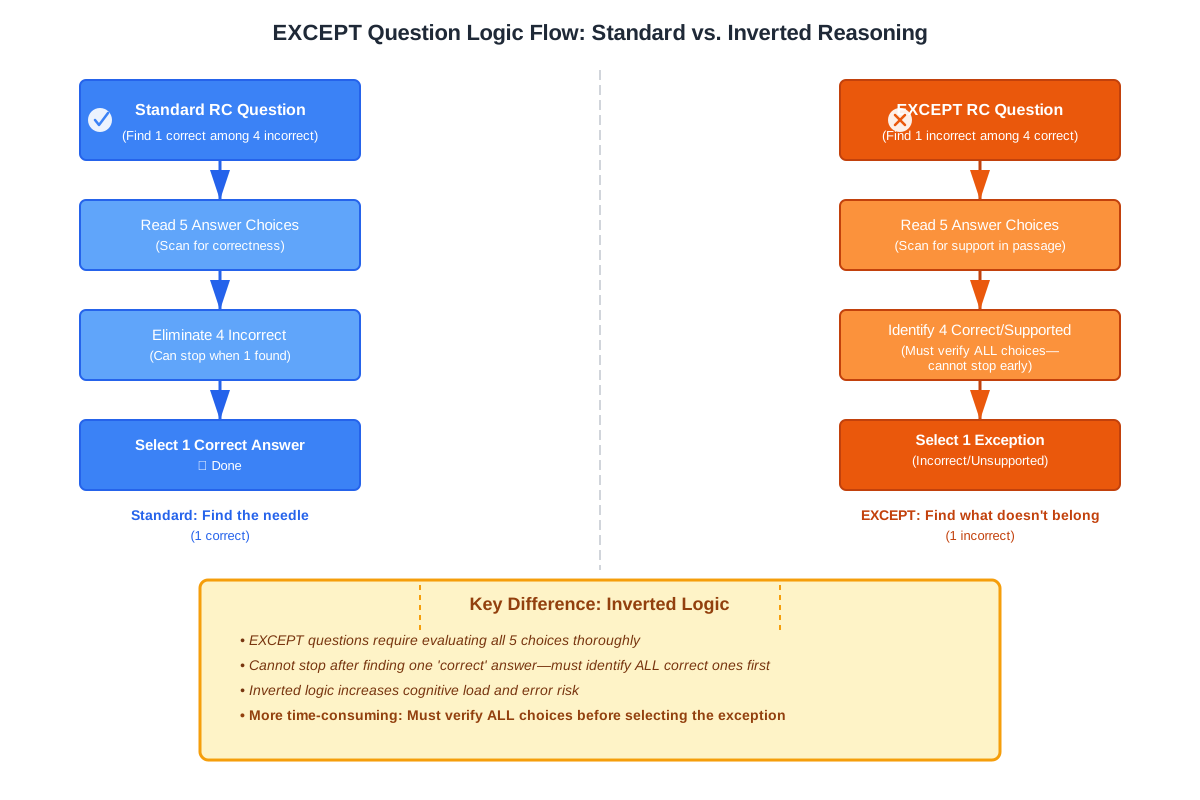
Except questions in RC represent a unique and challenging question type within LSAT reading comprehension that requires test-takers to identify the one answer choice that does NOT satisfy the question stem's criteria. Unlike standard questions that ask students to find what the passage supports or states, EXCEPT questions flip this logic, demanding that students eliminate four correct answers to find the single incorrect or unsupported option. This inverted reasoning pattern makes these questions particularly time-consuming and prone to careless errors, even among high-scoring test-takers.
These questions typically appear 2-4 times per LSAT Reading Comprehension section and are considered medium-to-high difficulty because they require comprehensive passage understanding rather than focused detail retrieval. Students must evaluate all five answer choices against passage content, making these questions more labor-intensive than standard question types. The cognitive demand is substantial: test-takers must maintain accuracy while processing negative logic under time pressure, a skill that requires deliberate practice and strategic approach.
Within the broader landscape of reading comprehension question types, EXCEPT questions test the same fundamental skills as other question categories—main idea comprehension, detail recognition, inference ability, and author's purpose understanding—but demand application of these skills across multiple answer choices simultaneously. Mastering EXCEPT questions strengthens overall passage analysis abilities and builds the mental stamina required for the LSAT's demanding time constraints, making this topic essential for achieving competitive scores.
Learning Objectives
- [ ] Identify how Except questions in RC appears in LSAT questions
- [ ] Explain the reasoning pattern behind Except questions in RC
- [ ] Apply Except questions in RC to solve LSAT-style problems accurately
- [ ] Distinguish between the four correct answer choices and the one exception in under 90 seconds
- [ ] Develop a systematic annotation method to track answer choice evaluation
- [ ] Recognize common trap patterns specific to EXCEPT question construction
- [ ] Implement time-saving strategies that prevent re-reading the passage multiple times
Prerequisites
- Basic passage comprehension skills: Understanding main ideas, paragraph structure, and author's tone is essential because EXCEPT questions require holistic passage knowledge rather than isolated detail recognition.
- Familiarity with standard RC question types: Knowledge of detail questions, inference questions, and main idea questions provides the foundation for understanding what EXCEPT questions test, as they combine elements from multiple question categories.
- Active reading and annotation techniques: The ability to mark key claims, transitions, and viewpoints while reading enables efficient answer choice evaluation without excessive re-reading.
- Logical reasoning fundamentals: Understanding how to evaluate whether statements are supported, contradicted, or unaddressed by passage content is critical for the elimination process EXCEPT questions require.
Why This Topic Matters
LSAT except questions in rc appear with reliable frequency on every administered LSAT, typically comprising 5-10% of all Reading Comprehension questions. This consistent presence means that mastering EXCEPT questions can directly impact your scaled score, particularly because these questions often separate mid-range scorers from high performers. Students who develop systematic approaches to EXCEPT questions gain 2-3 additional correct answers per section on average, translating to meaningful score improvements.
In real-world legal practice, attorneys must frequently identify which piece of evidence does NOT support a particular claim or which precedent does NOT apply to a current case. EXCEPT questions mirror this analytical pattern, training future law students to think comprehensively about what is absent or contradictory rather than simply confirming what is present. This skill proves invaluable during law school case analysis and legal writing.
On the LSAT, EXCEPT questions most commonly appear following comparative reading passages (Passage A/Passage B format) and longer, complex single passages with multiple viewpoints. They frequently test understanding of specific details mentioned in the passage, author's attitudes toward different theories, or examples that illustrate particular concepts. The LSAC uses EXCEPT questions strategically to assess whether students have achieved deep comprehension or merely superficial understanding, making these questions high-value targets for score improvement.
Core Concepts
The Inverted Logic Structure
Except questions in RC operate on inverted logic: instead of finding the answer choice that IS supported by the passage, test-takers must identify the one choice that is NOT supported, mentioned, or true according to the passage. This fundamental reversal requires a cognitive shift that many students find counterintuitive. The question stem typically includes language like "All of the following are mentioned EXCEPT," "The author discusses each of the following EXCEPT," or "The passage provides support for all of the following claims EXCEPT."
The critical distinction lies in understanding that four answer choices will be demonstrably correct based on passage content, while one choice will be either contradicted by the passage, unsupported by any passage information, or outside the scope of what the passage addresses. This means students must verify four answers as correct rather than simply finding one correct answer, fundamentally changing the elimination strategy.
Common Question Stem Formats
LSAT EXCEPT questions follow predictable patterns in their construction. Recognizing these formats immediately helps students activate the appropriate strategic approach:
| Question Stem Format | What It Tests | Strategic Focus |
|---|---|---|
| "The passage mentions all of the following EXCEPT" | Explicit details and examples | Scan for direct textual references |
| "According to the passage, each of the following is true EXCEPT" | Factual claims and statements | Verify each choice against passage facts |
| "The author discusses all of the following EXCEPT" | Topics and subjects covered | Check whether each topic appears anywhere |
| "The passage provides support for all of the following EXCEPT" | Inferences and implications | Evaluate logical support, not just mentions |
| "Each of the following is mentioned as an example of X EXCEPT" | Specific category membership | Confirm which items belong to the specified category |
The Four-Correct, One-Exception Pattern
Understanding the answer choice distribution is crucial for efficient processing. In every EXCEPT question, exactly four choices will satisfy one of these criteria: (1) directly stated in the passage, (2) strongly supported by passage content, or (3) reasonable inferences from passage information. The exception—the correct answer—will satisfy one of these criteria: (1) contradicted by passage information, (2) completely unmentioned and unsupported, or (3) outside the passage's scope.
This pattern means that students should approach EXCEPT questions with a verification mindset rather than an elimination mindset. Each answer choice requires active confirmation: "Can I point to where the passage supports this?" Rather than looking for what seems wrong, students should mark what is definitively right, leaving the unmarked choice as the answer.
The Annotation Strategy
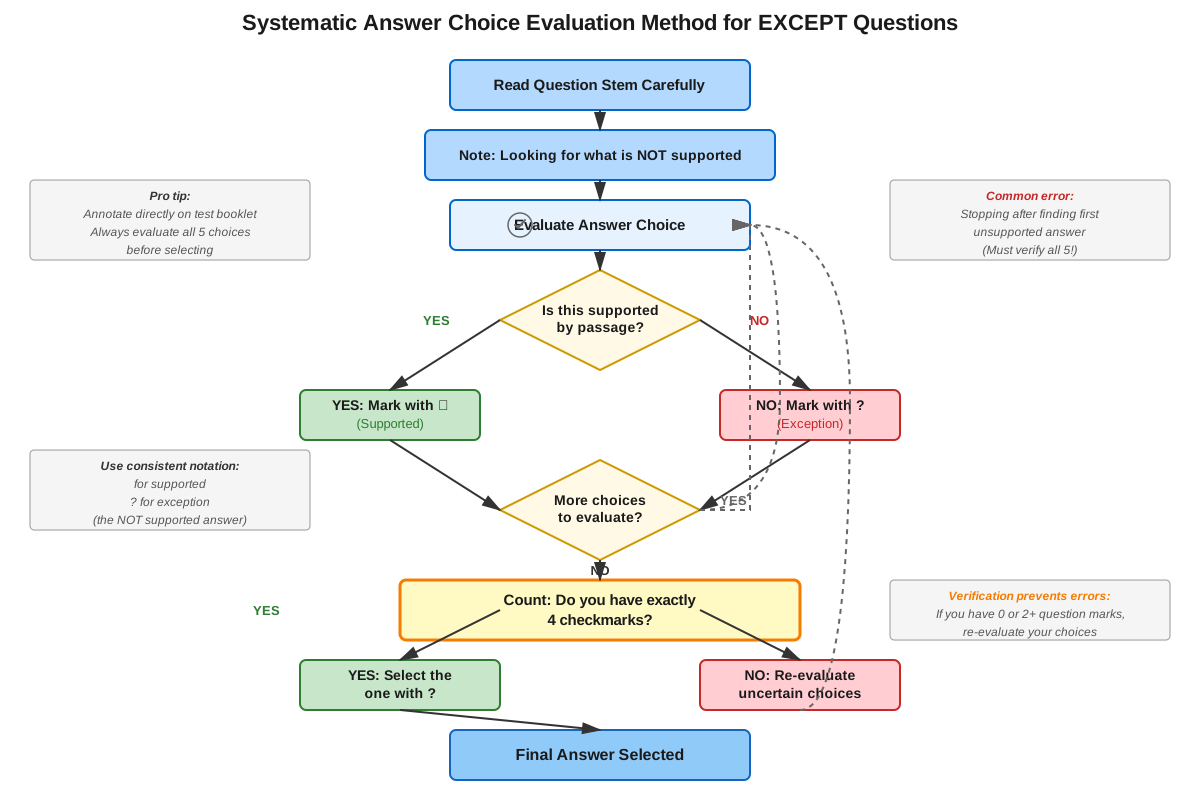
Effective EXCEPT question solving requires systematic tracking of answer choice evaluation. The recommended approach involves marking each answer choice with a clear symbol as you verify it against the passage:
- Checkmark (✓): Place next to answer choices that are clearly supported by or mentioned in the passage
- Question mark (?): Use for choices that seem possibly correct but require verification
- Leave blank: The choice that receives no mark becomes your answer
This visual tracking system prevents the common error of losing track of which choices have been evaluated, especially important given that EXCEPT questions require processing all five options. Students should physically mark their test booklet or scratch paper to maintain accuracy under time pressure.
Scope Traps and Out-of-Scope Answers
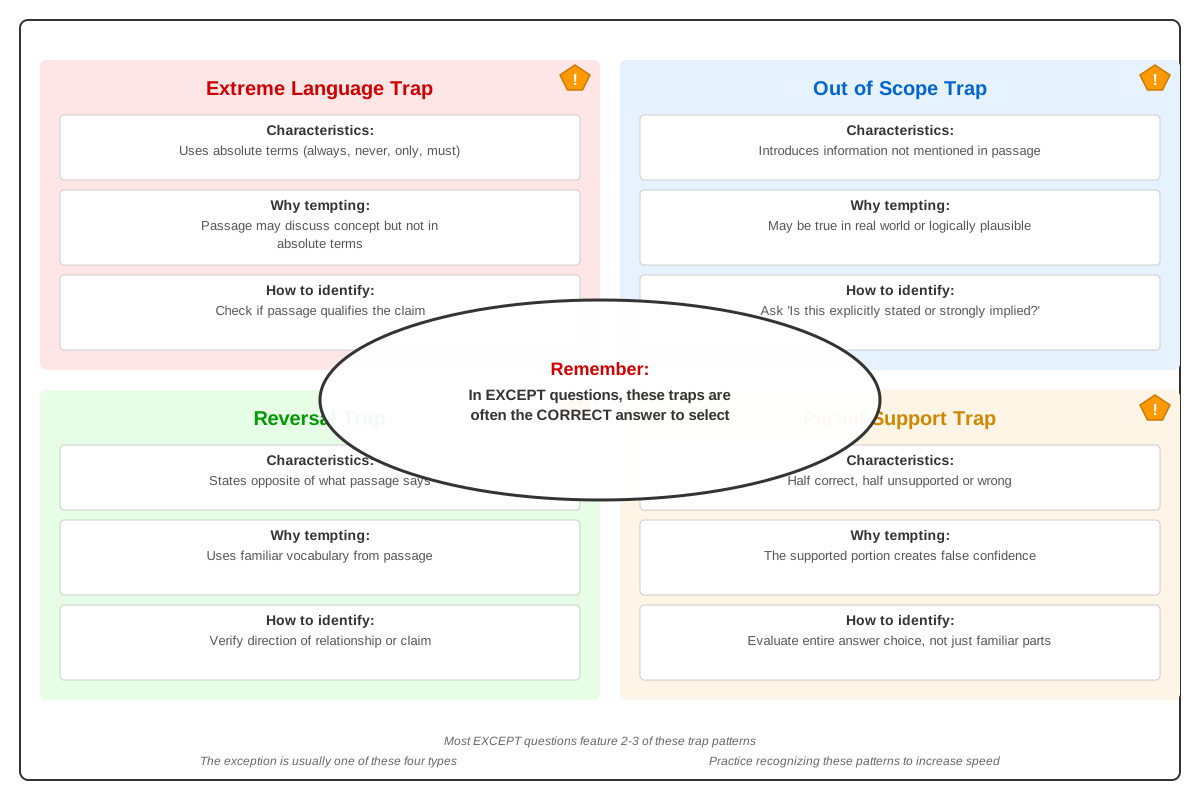
A frequent trap in EXCEPT questions involves answer choices that are factually true in the real world but not discussed or supported by the passage. These out-of-scope answers exploit students' tendency to bring outside knowledge to their reading. For example, if a passage discusses climate change impacts on polar bears without mentioning penguins, an answer choice about penguins would be the exception—not because it's false, but because the passage doesn't address it.
Distinguishing between "contradicted by the passage" and "not mentioned in the passage" is essential. Both types can serve as the correct answer to an EXCEPT question, but they require different verification processes. Contradicted answers require finding specific passage content that opposes the claim, while unmentioned answers simply require confirming the absence of supporting information.
Time Management Considerations
EXCEPT questions typically require 90-120 seconds to complete accurately, making them among the most time-intensive question types in Reading Comprehension. This extended time requirement stems from the need to evaluate all five answer choices rather than stopping at the first correct answer. Students must budget accordingly, recognizing that spending adequate time on EXCEPT questions is more efficient than rushing and making careless errors.
The strategic approach involves balancing thoroughness with efficiency: quickly eliminate obviously correct answers (those with clear textual support), then carefully evaluate remaining choices. If two choices remain uncertain after initial evaluation, return to the passage for targeted verification rather than relying on memory or intuition.
Concept Relationships
The inverted logic structure of EXCEPT questions builds directly on standard question type logic, requiring students to apply the same verification skills but in reverse. Where detail questions ask "Which of the following is mentioned?" EXCEPT questions ask "Which is NOT mentioned?"—the same skill applied through opposite logic.
The four-correct, one-exception pattern connects to the annotation strategy through a cause-and-effect relationship: because four answers are correct, systematic tracking becomes necessary to avoid confusion. This tracking strategy, in turn, enables effective time management by preventing redundant re-reading.
Scope traps relate to the broader concept of passage boundaries—understanding what the author chose to include versus exclude. This connects to main idea questions and purpose questions, as recognizing the passage's scope helps identify out-of-scope EXCEPT answers.
Relationship Map:
Standard question logic → Inverted for EXCEPT questions → Requires verification of four correct answers → Demands systematic annotation strategy → Enables efficient time management → Prevents scope trap errors → Strengthens overall passage comprehension
High-Yield Facts
⭐ EXCEPT questions require verifying four correct answers rather than finding one correct answer, fundamentally changing the elimination approach.
⭐ The correct answer to an EXCEPT question is either contradicted by the passage, unmentioned in the passage, or outside the passage's scope.
⭐ Answer choices that are factually true in the real world but not discussed in the passage are common correct answers to EXCEPT questions.
⭐ Systematic annotation (checkmarks for verified answers) prevents tracking errors and improves accuracy under time pressure.
⭐ EXCEPT questions typically appear 2-4 times per Reading Comprehension section and require 90-120 seconds each.
- The words "EXCEPT," "NOT," and "LEAST" typically appear in all capital letters in question stems to signal inverted logic.
- Comparative passages (Passage A/Passage B) frequently feature EXCEPT questions asking what is discussed in one passage but not the other.
- Detail-oriented EXCEPT questions are more common than inference-based EXCEPT questions, appearing in roughly 60% of cases.
- The exception answer is most frequently an out-of-scope choice (not mentioned) rather than a contradicted choice, in approximately 70% of questions.
- Students who skip EXCEPT questions initially and return to them after completing other questions often perform better due to stronger passage retention.
Quick check — test yourself on Except questions in RC so far.
Try Flashcards →Common Misconceptions
Misconception: The correct answer to an EXCEPT question must be false or contradicted by the passage.
Correction: The correct answer can simply be unmentioned or outside the passage's scope. Many correct EXCEPT answers are factually true statements that the passage never addresses, making them "exceptions" to what the passage discusses.
Misconception: If an answer choice seems partially correct, it should be eliminated as one of the four correct answers.
Correction: In EXCEPT questions, answer choices must be fully supported by the passage to count as one of the four correct options. Partially supported or ambiguous choices may be the exception you're looking for.
Misconception: EXCEPT questions test the same content as standard questions, just with reversed wording.
Correction: EXCEPT questions often test comprehensive passage understanding rather than specific details, requiring students to have processed the entire passage rather than just the relevant paragraph for a standard question.
Misconception: The fastest approach is to read all five answer choices first, then return to the passage.
Correction: The most efficient strategy involves reading each answer choice and immediately verifying it against the passage before moving to the next choice, preventing memory overload and reducing re-reading.
Misconception: If you can't find support for an answer choice after 15 seconds of searching, it must be the exception.
Correction: Absence of immediate evidence doesn't confirm an answer as the exception. You must verify that the other four choices ARE supported before confidently selecting an answer, as the information you're seeking might appear in an unexpected location.
Misconception: EXCEPT questions are inherently harder than other question types and should be skipped.
Correction: While EXCEPT questions are time-intensive, they're not necessarily more difficult. With systematic approach and practice, students often find them more straightforward than complex inference questions because they test explicit passage content.
Worked Examples
Example 1: Detail-Based EXCEPT Question
Passage Summary: A passage discusses the development of jazz music in New Orleans, mentioning Louis Armstrong's trumpet innovations, the influence of African rhythms, the role of brass bands in funeral processions, and the contribution of Creole musicians who could read musical notation.
Question: According to the passage, the development of jazz in New Orleans was influenced by all of the following EXCEPT:
(A) African rhythmic traditions
(B) The improvisational style of Louis Armstrong
(C) The musical literacy of Creole musicians
(D) The tradition of brass bands at funerals
(E) The migration of blues musicians from the Mississippi Delta
Solution Process:
Step 1: Recognize this as a detail-based EXCEPT question requiring verification of explicit mentions.
Step 2: Evaluate each choice systematically:
(A) African rhythmic traditions - The passage explicitly states "the influence of African rhythms" → Mark with ✓
(B) Louis Armstrong's improvisational style - The passage mentions "Louis Armstrong's trumpet innovations" which relates to his playing style → Mark with ✓
(C) Musical literacy of Creole musicians - The passage directly states "Creole musicians who could read musical notation" → Mark with ✓
(D) Brass bands at funerals - The passage explicitly mentions "brass bands in funeral processions" → Mark with ✓
(E) Migration of blues musicians from Mississippi Delta - Scanning the passage reveals no mention of Mississippi Delta or blues musician migration → Leave blank
Step 3: Choice (E) is the only option without passage support, making it the correct answer.
Key Insight: This example demonstrates the most common EXCEPT answer type: an out-of-scope choice that is historically accurate (blues musicians did migrate from the Delta) but not discussed in this particular passage. Students must resist the temptation to select answers based on outside knowledge.
Example 2: Inference-Based EXCEPT Question
Passage Summary: A passage argues that corporate social responsibility (CSR) programs benefit companies through improved employee morale, enhanced brand reputation, and increased customer loyalty. The author cites studies showing that companies with robust CSR programs experience lower employee turnover and higher customer retention rates. However, the passage notes that CSR programs require significant financial investment and dedicated personnel.
Question: The passage provides support for all of the following claims EXCEPT:
(A) CSR programs can reduce the rate at which employees leave a company
(B) Implementing CSR programs requires substantial financial resources
(C) Customer loyalty can be strengthened through CSR initiatives
(D) CSR programs generate higher profits than traditional marketing expenditures
(E) Companies benefit from improved public perception through CSR activities
Solution Process:
Step 1: Recognize this as an inference-based EXCEPT question requiring evaluation of logical support, not just explicit statements.
Step 2: Evaluate each choice:
(A) Lower employee turnover is explicitly mentioned as a benefit → Mark with ✓
(B) "Significant financial investment" is directly stated as a requirement → Mark with ✓
(C) "Increased customer loyalty" is explicitly listed as a benefit → Mark with ✓
(D) The passage discusses CSR benefits and costs but never compares CSR program effectiveness to traditional marketing expenditures → Potentially the exception, leave unmarked for now
(E) "Enhanced brand reputation" directly supports improved public perception → Mark with ✓
Step 3: Return to choice (D) for verification. Scanning the passage confirms no comparison between CSR and traditional marketing appears. This is the exception.
Key Insight: This example shows how EXCEPT questions can test inference by asking about logical support rather than explicit mentions. The correct answer (D) makes a comparative claim that, while possibly true, receives no support in the passage. Students must distinguish between "the passage supports this" and "this seems reasonable."
Exam Strategy
Immediate Recognition Protocol
When encountering an EXCEPT question, immediately implement these recognition steps:
- Identify the signal words: Look for "EXCEPT," "NOT," or "LEAST" in all capitals
- Circle or underline the negative word: This physical action reinforces the inverted logic
- Rephrase the question: Mentally convert "All of the following are mentioned EXCEPT" to "Four of these ARE mentioned; one is NOT"
- Adjust your mindset: Shift from "find the right answer" to "find the four right answers"
Systematic Evaluation Process
Exam Tip: Never rely on memory alone for EXCEPT questions. Always verify each answer choice against the passage, even if you're confident about certain choices.
Follow this step-by-step process for every EXCEPT question:
- Read the question stem twice to ensure you understand what's being asked
- Read answer choice (A) and immediately scan the passage for supporting evidence
- Mark (A) with a checkmark if supported, or leave blank if unsupported
- Repeat for choices (B) through (E) without skipping ahead
- Select the unmarked choice as your answer
- If multiple choices remain unmarked, return to the passage for targeted verification of only those choices
Trigger Words and Phrases
Recognize these common question stem constructions that signal EXCEPT questions:
- "All of the following... EXCEPT"
- "Each of the following... EXCEPT"
- "The passage mentions all of the following EXCEPT"
- "According to the passage, each of the following is true EXCEPT"
- "The author discusses all of the following EXCEPT"
- "Which of the following is NOT mentioned"
- "Which of the following is LEAST supported"
Time Allocation Strategy
Budget 90-120 seconds for EXCEPT questions, distributed as follows:
- 15-20 seconds: Read and understand the question stem
- 50-70 seconds: Evaluate all five answer choices (10-14 seconds each)
- 20-30 seconds: Verify the unmarked choice and confirm your selection
If you exceed 120 seconds, mark your best answer and flag the question for review if time permits at the section's end. Spending excessive time on a single EXCEPT question can compromise performance on remaining questions.
Process-of-Elimination Refinements
For EXCEPT questions, traditional process-of-elimination works in reverse:
- Eliminate answers you CAN support with passage evidence
- Keep answers you CANNOT support as potential correct answers
- When down to two choices, look for explicit passage content that supports one, making the other the exception
- Beware of "memory traps": If you remember reading something but can't locate it, it may not actually appear in the passage
Memory Techniques
The "Four Check, One Blank" Mnemonic
Remember: "Four Checks Find The Blank" - In EXCEPT questions, you're looking for the one blank (unmarked) answer after checking off four correct ones. Visualize physically checking off four boxes and leaving one empty.
The EXCEPT Acronym
Evaluate each choice
X-out (checkmark) what's supported
Confirm the passage location
Eliminate four correct answers
Pick the unmarked choice
Trust the process, not memory
Visualization Strategy
Picture the passage as a container and the five answer choices as objects. Four objects fit inside the container (they're mentioned or supported), while one object sits outside (the exception). Your task is identifying which object doesn't fit in the container.
The "Opposite Day" Reminder
When you see "EXCEPT" in all capitals, mentally declare "Opposite Day"—you're looking for what's NOT there rather than what IS there. This playful reminder helps maintain the cognitive shift required for inverted logic.
Summary
EXCEPT questions in Reading Comprehension represent a high-value question type that tests comprehensive passage understanding through inverted logic. These questions require students to identify the one answer choice that is NOT supported, mentioned, or true according to the passage, while four other choices ARE correct. Success depends on recognizing the inverted logic structure, implementing systematic annotation to track answer choice evaluation, and distinguishing between contradicted answers, unmentioned answers, and out-of-scope answers. The most effective approach involves verifying each answer choice against passage content rather than relying on memory, marking supported choices with checkmarks, and selecting the unmarked choice as the correct answer. Time management is critical, as EXCEPT questions typically require 90-120 seconds due to the need to evaluate all five options. Students must resist common traps including selecting answers based on outside knowledge, assuming the exception must be contradicted rather than simply unmentioned, and rushing through the verification process. Mastering EXCEPT questions strengthens overall reading comprehension skills and provides a reliable path to additional correct answers on test day.
Key Takeaways
- EXCEPT questions use inverted logic: four answers are correct, and you must identify the one exception that is NOT supported by the passage
- Systematic annotation (checkmarking verified answers) is essential for maintaining accuracy and preventing tracking errors under time pressure
- The correct answer is typically an out-of-scope choice (not mentioned) rather than a contradicted choice, appearing in approximately 70% of EXCEPT questions
- Budget 90-120 seconds per EXCEPT question and verify each answer choice against the passage rather than relying on memory
- Recognize trigger words like "EXCEPT," "NOT," and "LEAST" in all capitals, and immediately shift to verification mindset
- Out-of-scope answers that are factually true but not discussed in the passage are the most common trap in EXCEPT questions
- EXCEPT questions appear 2-4 times per Reading Comprehension section and represent high-value opportunities for score improvement with proper strategy
Related Topics
Detail Questions in Reading Comprehension: Understanding how to locate and verify specific information in passages provides the foundation for efficiently evaluating answer choices in EXCEPT questions. Mastering detail questions makes EXCEPT questions significantly more manageable.
Inference Questions: Since some EXCEPT questions ask what is "supported" rather than "mentioned," strong inference skills enable students to distinguish between logical implications and unsupported claims, critical for inference-based EXCEPT questions.
Scope and Purpose Questions: Recognizing what the author chose to include versus exclude helps identify out-of-scope answers in EXCEPT questions, as understanding passage boundaries is essential for determining what is "not mentioned."
Comparative Reading Passages: EXCEPT questions appear frequently in Passage A/Passage B formats, asking what is discussed in one passage but not the other. Mastering EXCEPT questions enhances comparative reading performance.
Time Management Strategies: Since EXCEPT questions are time-intensive, developing overall section timing strategies ensures adequate time allocation without compromising performance on other questions.
Practice CTA
Now that you understand the strategic approach to EXCEPT questions in Reading Comprehension, it's time to apply these concepts to actual LSAT-style practice questions. The systematic annotation method and verification process become automatic only through deliberate practice. Challenge yourself to complete the practice questions for this topic, focusing on implementing the "Four Check, One Blank" approach and resisting the temptation to rely on memory. Review the flashcards to reinforce trigger words and common trap patterns. Remember: EXCEPT questions are high-value opportunities for score improvement—students who master this question type consistently gain 2-3 additional correct answers per section. Your investment in practicing this systematic approach will pay dividends on test day!
Sign up free to keep reading
Create a free AnvayaPrep account to finish this LSAT guide on Except questions in RC — plus flashcards and practice questions.