Overview
Most strongly supported in RC questions represent one of the most frequently tested reading comprehension question types on the LSAT. These questions ask test-takers to identify which answer choice can be most reliably inferred or concluded based on the information explicitly stated in the passage. Unlike questions that ask for the main point or primary purpose, most strongly supported questions require careful attention to specific details, logical relationships, and the precise scope of what the passage actually establishes. Success on these questions demands the ability to distinguish between what the passage directly supports and what merely seems plausible or extends beyond the text's boundaries.
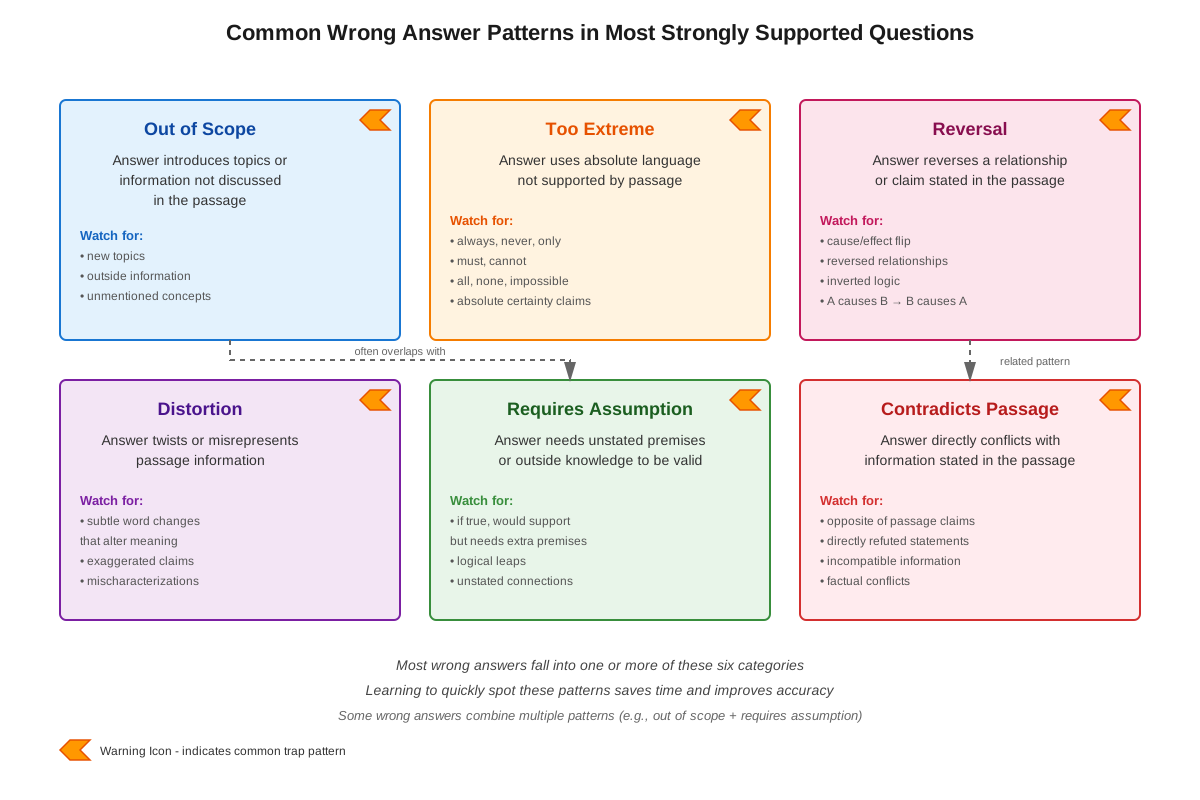
The critical skill tested by lsat most strongly supported in rc questions is the ability to make warranted inferences—conclusions that follow logically from the passage without requiring additional assumptions or outside knowledge. These questions assess whether students can recognize the difference between strong textual support and weak or speculative connections. They also test the ability to avoid common traps such as extreme answer choices, statements that reverse the passage's logic, or claims that introduce new information not grounded in the text. Mastering this question type requires developing a disciplined approach to evaluating evidence and understanding the relationship between premises and conclusions.
Within the broader landscape of reading comprehension on the LSAT, most strongly supported questions occupy a middle ground between detail-oriented questions (which ask about specific facts) and inference questions (which may require more interpretive reasoning). They connect closely to the fundamental skill of active reading—understanding not just what a passage says explicitly, but also what logically follows from those statements. This question type appears across all passage types, including single passages, comparative reading passages, and passages from various disciplines such as law, science, humanities, and social sciences.
Learning Objectives
- [ ] Identify how Most strongly supported in RC appears in LSAT questions
- [ ] Explain the reasoning pattern behind Most strongly supported in RC
- [ ] Apply Most strongly supported in RC to solve LSAT-style problems accurately
- [ ] Distinguish between strongly supported inferences and unsupported speculation
- [ ] Evaluate the degree of support each answer choice receives from the passage
- [ ] Recognize common wrong answer patterns in most strongly supported questions
- [ ] Apply systematic elimination strategies to identify the best-supported answer choice
Prerequisites
- Basic reading comprehension skills: The ability to understand complex academic prose is essential for extracting the information needed to evaluate answer choices.
- Understanding of inference vs. assumption: Recognizing the difference between what follows logically from stated information and what requires additional unstated premises is foundational to this question type.
- Familiarity with LSAT passage structure: Knowledge of how LSAT passages are organized helps locate relevant supporting evidence quickly.
- Logical reasoning fundamentals: Understanding how premises support conclusions enables evaluation of which answer choices are most warranted by the text.
Why This Topic Matters
Most strongly supported questions appear with remarkable frequency on the LSAT, typically comprising 15-25% of all reading comprehension questions. This translates to approximately 2-3 questions per test, making them one of the highest-yield question types to master. Unlike some specialized question types that appear only occasionally, most strongly supported questions are virtually guaranteed to appear on every LSAT administration, often multiple times across different passages.
In real-world legal practice, the skills tested by these questions directly parallel the analytical work attorneys perform daily. Lawyers must constantly evaluate what conclusions are warranted by available evidence, distinguish between strong and weak support for various claims, and avoid making assertions that exceed what the facts establish. The ability to recognize what is "most strongly supported" by a set of facts is fundamental to legal analysis, whether drafting memoranda, evaluating case law, or presenting arguments in court.
On the LSAT, most strongly supported questions typically appear with language such as "Which one of the following is most strongly supported by the passage?", "The passage most strongly suggests which one of the following?", "Based on the passage, the author would be most likely to agree with which one of the following?", or "The information in the passage most supports which one of the following?" These questions can appear after any passage type and may focus on specific details, relationships between concepts, authorial attitudes, or logical implications of the passage's claims. They require test-takers to move beyond surface-level comprehension to evaluate the logical strength of various potential inferences.
Core Concepts
The Nature of "Strong Support"
The phrase "most strongly supported" has a specific meaning in LSAT reading comprehension that differs from everyday usage. An answer choice is strongly supported when it follows logically and necessarily from information explicitly stated in the passage, requiring minimal additional inference. The support must be direct and clear, not speculative or dependent on assumptions beyond the text. Strong support means that if the passage's statements are true, the answer choice must be true or is highly likely to be true based solely on the passage content.
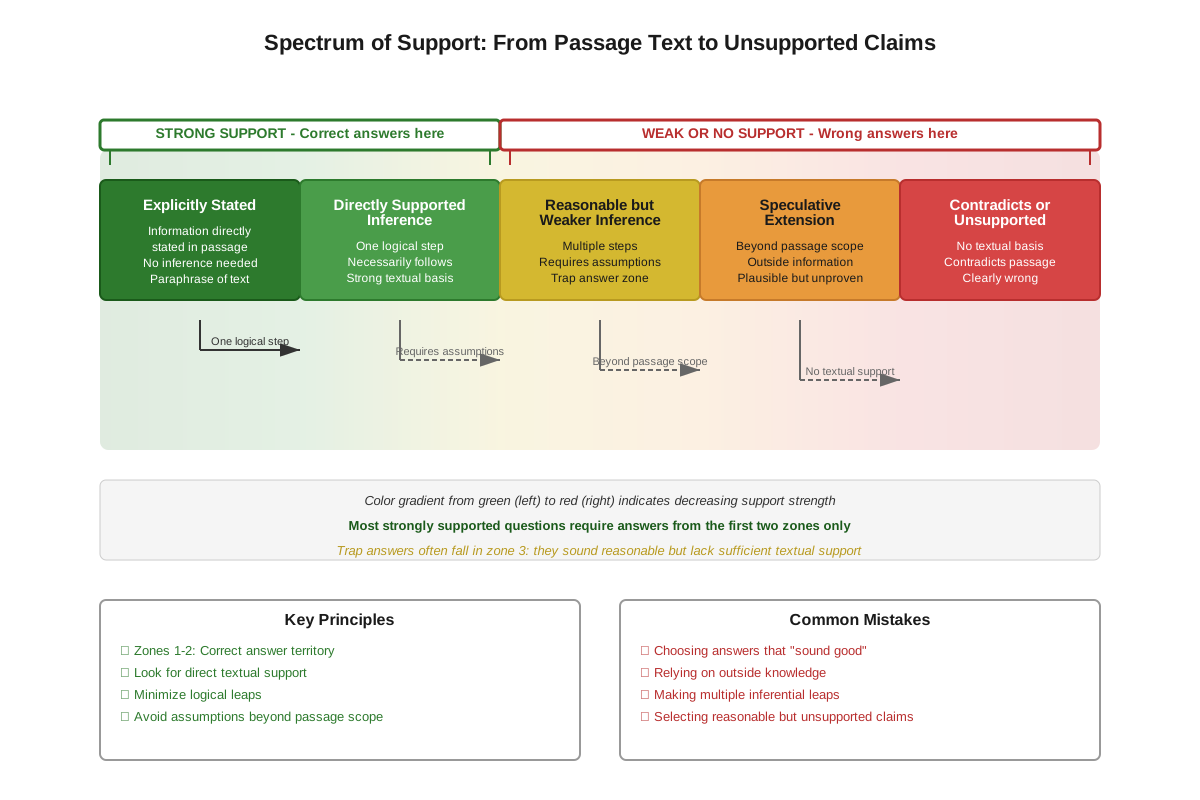
The LSAT tests the ability to calibrate the degree of support by presenting answer choices with varying levels of textual grounding. Some choices may be completely unsupported, others may have weak or tangential connections to the passage, while the correct answer will have the strongest evidentiary foundation. Understanding this spectrum of support is crucial because the correct answer doesn't need to be proven with absolute certainty—it simply needs to be better supported than the other four options.
Direct Textual Support vs. Inference
Most strongly supported questions require distinguishing between two types of support: direct textual support and warranted inference. Direct textual support occurs when the passage explicitly states something that matches or closely paraphrases an answer choice. Warranted inference involves drawing a conclusion that, while not explicitly stated, follows logically and necessarily from what is stated. Both types of support can lead to correct answers, but the key is that even inferences must be tightly bound to the passage's actual content.
The distinction matters because wrong answers often present plausible-sounding claims that would require unwarranted leaps in logic or additional assumptions. For example, if a passage states that "many scientists support Theory X," a warranted inference might be that "Theory X has significant support in the scientific community," but an unwarranted inference would be that "Theory X is correct" or "most scientists support Theory X." The first inference stays within the scope of what's stated; the latter two extend beyond it.
Scope and Degree
Scope refers to the breadth of a claim—what subjects, categories, or domains it covers. Degree refers to the strength or intensity of a claim—how absolute or qualified it is. Most strongly supported questions frequently test whether students can match the scope and degree of answer choices to what the passage actually establishes. A passage might discuss "some legal scholars" while a wrong answer refers to "legal scholars generally" (scope error) or might describe something as "influential" while a wrong answer calls it "revolutionary" (degree error).
Correct answers typically mirror the passage's scope and degree carefully. If the passage makes a qualified claim ("may contribute to"), the correct answer will likely maintain that qualification rather than strengthening it to certainty ("causes"). If the passage discusses a specific subset ("19th-century American poets"), the correct answer won't inappropriately generalize ("poets generally"). Attention to these nuances separates strongly supported answers from those that overreach.
The Comparison Framework
Because these questions ask for what is "most" strongly supported, they inherently require comparison among answer choices. The correct answer doesn't need to be perfectly supported or proven beyond doubt—it simply needs to be better supported than the alternatives. This comparative framework means that even if an answer choice seems somewhat uncertain or requires a small inferential step, it can still be correct if the other four choices are even less supported.
This comparative approach requires a systematic evaluation process. Rather than seeking an answer that feels absolutely certain, test-takers should evaluate each choice's degree of support and select the one with the strongest textual foundation. Sometimes this means choosing an answer that seems only moderately supported because all other options are clearly contradicted, unsupported, or require larger inferential leaps.
Common Support Patterns
Several recurring patterns indicate strong support in LSAT reading comprehension:
- Paraphrase and restatement: The answer choice restates passage content using different words while maintaining the same meaning
- Logical consequence: The answer follows as a necessary or highly probable result of stated facts
- Combination of details: The answer synthesizes multiple passage details into a coherent conclusion
- Contrapositive or logical equivalent: The answer expresses the same logical relationship as the passage but in different form
- Authorial attitude application: The answer applies the author's stated or clearly implied viewpoint to a specific claim
Recognizing these patterns helps identify correct answers more efficiently and builds confidence in answer selection.
Concept Relationships
The concepts within most strongly supported questions form an interconnected system. Understanding strong support requires first grasping the distinction between direct textual support and warranted inference, as both can provide the foundation for correct answers. This distinction then connects to scope and degree, because evaluating whether an inference is warranted requires checking whether it maintains appropriate scope and degree relative to the passage. All of these concepts feed into the comparison framework, which provides the methodology for selecting the best answer when multiple choices have some degree of support.
The relationship map flows as follows:
Passage Content → Direct Textual Support → Evaluation of Scope/Degree → Comparison Framework → Correct Answer
Passage Content → Warranted Inference → Evaluation of Scope/Degree → Comparison Framework → Correct Answer
These concepts connect to prerequisite knowledge of basic inference-making and logical reasoning. The ability to distinguish assumptions from inferences (prerequisite knowledge) directly enables the skill of identifying warranted versus unwarranted inferences in most strongly supported questions. Similarly, understanding passage structure (prerequisite) facilitates locating the specific textual support needed to evaluate answer choices.
Most strongly supported questions also relate closely to other reading comprehension question types. They share characteristics with inference questions but typically require less interpretive reasoning. They differ from main point questions by focusing on specific supportable claims rather than overall purpose. They connect to detail questions but require synthesis and inference rather than simple fact retrieval.
High-Yield Facts
⭐ Most strongly supported questions appear 2-3 times per LSAT test, making them one of the highest-frequency reading comprehension question types
⭐ The correct answer must be supported by the passage itself without requiring outside knowledge or additional assumptions
⭐ "Most strongly supported" means better supported than the other four choices, not necessarily proven with absolute certainty
⭐ Wrong answers frequently exceed the passage's scope by making claims that are too broad or too specific
⭐ Wrong answers often increase the degree of certainty beyond what the passage establishes (e.g., changing "may" to "will")
- Correct answers can be either direct restatements or warranted inferences, but both must stay within the passage's boundaries
- Extreme language in answer choices (always, never, only, all, none) is often—but not always—a sign of weak support
- The correct answer will not contradict any information stated or implied in the passage
- Comparative language in the passage ("more than," "less than," "unlike") often signals important relationships that appear in correct answers
- When two answer choices seem equally supported, re-examine the passage for subtle details that distinguish them
Quick check — test yourself on Most strongly supported in RC so far.
Try Flashcards →Common Misconceptions
Misconception: The correct answer must be explicitly stated in the passage word-for-word.
Correction: Correct answers can be warranted inferences that follow logically from the passage, not just direct quotations or paraphrases. The key is that the inference must be tightly supported by textual evidence.
Misconception: If an answer choice is true in the real world, it's the correct answer.
Correction: The correct answer must be supported specifically by the passage content, regardless of real-world truth. An answer could be factually accurate but still wrong if the passage doesn't support it.
Misconception: Extreme language (always, never, only) automatically makes an answer choice wrong.
Correction: While extreme language often signals unsupported claims, if the passage itself uses extreme language or clearly supports an absolute claim, an answer with extreme language can be correct. Evaluate based on passage support, not automatic rules.
Misconception: The longest or most complex answer choice is usually correct.
Correction: Answer length and complexity have no correlation with correctness. Some correct answers are simple and direct; others are complex. Focus on degree of support, not superficial features.
Misconception: If part of an answer choice is supported, the entire answer is correct.
Correction: Every component of an answer choice must be supported by the passage. If even one element is unsupported or contradicted, the entire answer is wrong, regardless of how well-supported other parts are.
Misconception: "Most strongly supported" questions are just asking for the main point of the passage.
Correction: These questions ask for specific claims that can be inferred or concluded from the passage, which may or may not relate to the main point. They test detailed understanding and inference-making, not just big-picture comprehension.
Worked Examples
Example 1: Scientific Passage
Passage excerpt: "Recent studies have demonstrated that certain species of deep-sea fish possess specialized photoreceptors that enable them to detect bioluminescent signals at wavelengths invisible to most other marine organisms. These adaptations appear to have evolved independently in at least three distinct fish lineages, suggesting that the ability to perceive these specific wavelengths confers significant survival advantages in deep-ocean environments. However, researchers have noted that not all deep-sea species have developed such capabilities, even among closely related species inhabiting similar depths."
Question: Which one of the following is most strongly supported by the passage?
Answer Choices:
(A) The ability to detect bioluminescent signals is essential for survival in all deep-ocean environments.
(B) Deep-sea fish with specialized photoreceptors have a competitive advantage over those without such adaptations.
(C) Most marine organisms cannot detect the wavelengths that certain deep-sea fish can perceive.
(D) The specialized photoreceptors evolved simultaneously in all three fish lineages.
(E) Closely related species always develop similar adaptations when inhabiting similar environments.
Analysis:
(A) is too extreme and contradicted by the passage. The passage states these adaptations "confer significant survival advantages" but also notes "not all deep-sea species have developed such capabilities," indicating the ability is not essential for all species.
(B) is strongly supported. The passage states the ability "confers significant survival advantages," which directly supports the idea of competitive advantage. This is a warranted inference that stays within the passage's scope and degree.
(C) distorts the passage's claim. The passage says these wavelengths are "invisible to most other marine organisms," but this doesn't establish that "most marine organisms" (which includes all ocean life, not just deep-sea species) cannot detect them. This is a scope error.
(D) directly contradicts the passage, which states the adaptations "evolved independently," not simultaneously.
(E) is contradicted by the passage's statement that "not all deep-sea species have developed such capabilities, even among closely related species inhabiting similar depths."
Correct Answer: (B)
This example demonstrates how the correct answer maintains appropriate scope and degree while making a warranted inference from the passage's explicit statements.
Example 2: Humanities Passage
Passage excerpt: "Art historian Maria Chen argues that the traditional interpretation of Renaissance portraiture as purely celebratory overlooks the subtle critiques embedded in many works. She points to several portraits in which artists included symbolic elements—wilting flowers, cracked mirrors, or shadowed backgrounds—that contemporary viewers would have recognized as commentary on the subject's character or circumstances. While these elements were subtle enough to avoid offending powerful patrons, Chen contends they reveal a more complex relationship between artist and subject than previously acknowledged."
Question: Based on the passage, Chen would most likely agree with which one of the following?
Answer Choices:
(A) Renaissance artists deliberately deceived their patrons by including critical symbolism.
(B) All Renaissance portraits contain hidden critiques of their subjects.
(C) Contemporary viewers were more sophisticated in interpreting symbolic elements than modern viewers.
(D) Some Renaissance portraits served purposes beyond simple celebration of the subject.
(E) The relationship between Renaissance artists and patrons was primarily adversarial.
Analysis:
(A) uses language ("deliberately deceived") that exceeds what Chen's argument supports. The passage indicates artists were subtle to "avoid offending" patrons, not that they engaged in deception.
(B) is too extreme ("All Renaissance portraits"). Chen's argument focuses on "many works" and "several portraits," not all portraits.
(C) makes a comparison the passage doesn't support. While the passage mentions what "contemporary viewers would have recognized," it doesn't compare their sophistication to modern viewers.
(D) is most strongly supported. Chen's argument that portraits included "subtle critiques" and revealed "a more complex relationship" directly supports the claim that some portraits served purposes beyond celebration. This maintains appropriate scope ("some") and degree.
(E) overstates Chen's position. "Primarily adversarial" is too strong; Chen describes a "more complex relationship," not necessarily an adversarial one.
Correct Answer: (D)
This example shows how correct answers often involve synthesizing the passage's main argument while maintaining careful attention to scope and avoiding overstatement.
Exam Strategy
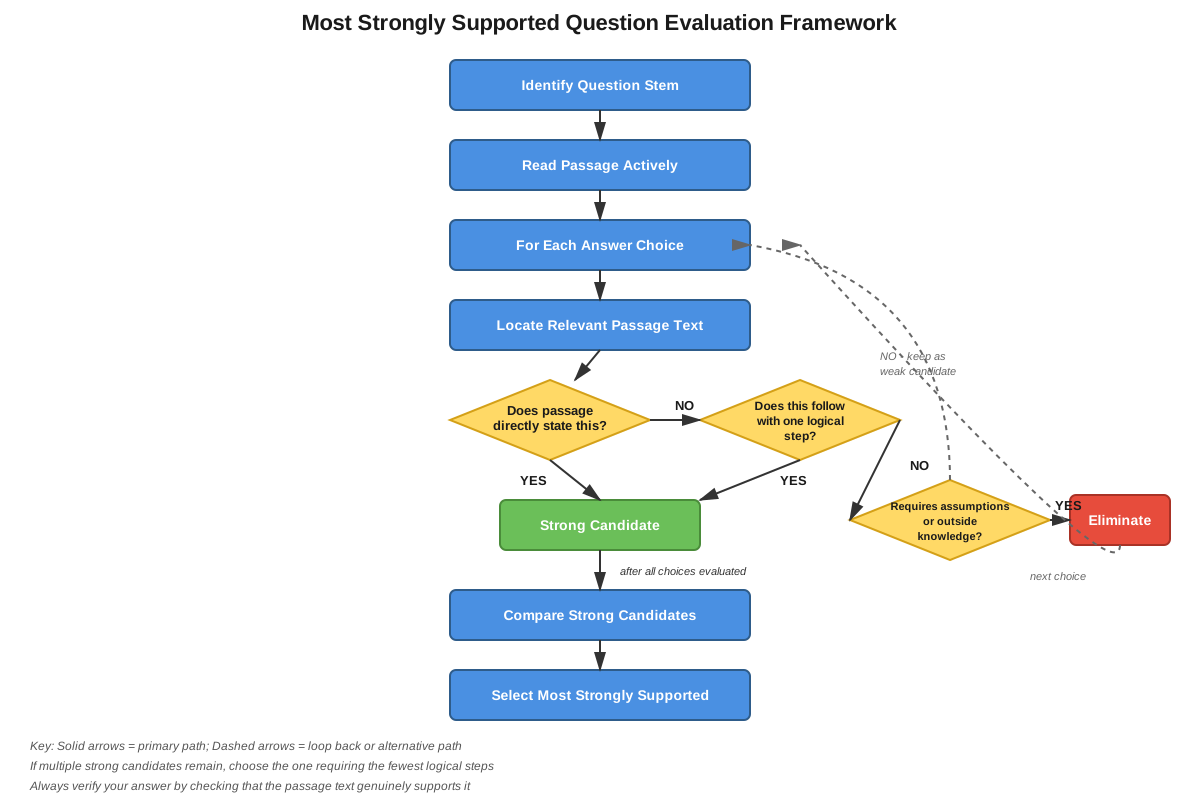
When approaching most strongly supported questions on the LSAT, begin by identifying the question type through trigger phrases: "most strongly supported," "most strongly suggests," "most likely to agree," or "information in the passage most supports." These phrases signal that you need to evaluate comparative degrees of support rather than find absolute proof.
Step-by-step approach:
- Read the question stem carefully to understand exactly what type of support is required (general inference, author's view, specific detail application)
- Review relevant passage sections before looking at answer choices, refreshing your memory of key claims and evidence
- Predict the general direction of the correct answer based on passage content
- Evaluate each answer choice systematically, asking: "What specific passage content supports this claim?"
- Eliminate answers that contradict the passage, exceed its scope, or require unsupported assumptions
- Compare remaining choices to identify which has the strongest textual foundation
Exam Tip: If you're torn between two answer choices, look for subtle scope or degree differences. The correct answer will typically be more conservative, staying closer to what the passage actually establishes.
Trigger words to watch for in answer choices:
- Red flags (often indicate weak support): always, never, only, all, none, must, impossible, essential, requires
- Green flags (often indicate appropriate scope): some, many, can, may, suggests, likely, often, typically
However, remember these are guidelines, not absolute rules. Always evaluate based on passage support.
Time allocation: Spend approximately 60-90 seconds per most strongly supported question. If you're spending more than 90 seconds, you may be overthinking. Make your best judgment and move forward, marking the question for review if time permits.
Process of elimination strategy: Actively look for reasons to eliminate answers rather than reasons to keep them. Wrong answers often reveal themselves through scope errors, degree mismatches, or contradictions. Once you've eliminated three choices with confidence, compare the remaining two carefully.
Memory Techniques
SCOPE Acronym for evaluating answer choices:
- Specificity: Does the answer match how specific or general the passage is?
- Certainty: Does the answer match the passage's degree of certainty?
- Origin: Is the claim grounded in passage content, not outside knowledge?
- Paraphrase: Does the answer accurately restate or follow from passage claims?
- Extreme: Does the answer avoid unsupported extreme language?
Visualization technique: Picture a "support bridge" connecting passage content to answer choices. The correct answer has the shortest, strongest bridge with no gaps requiring assumptions. Wrong answers have long, weak bridges or missing planks.
The "Three Degrees" mnemonic: Remember that support comes in three degrees:
- Direct (passage states it explicitly)
- Derivative (follows logically from what's stated)
- Distant (requires assumptions or leaps—usually wrong)
The "PASS" test for answer choices:
- Passage-based (not outside knowledge)
- Accurate in scope and degree
- Supported by specific textual evidence
- Stronger than other options
Summary
Most strongly supported questions in LSAT reading comprehension test the ability to identify which answer choice has the strongest foundation in passage content, whether through direct textual support or warranted inference. Success requires understanding that "most strongly supported" is a comparative standard—the correct answer must be better supported than alternatives, not necessarily proven with absolute certainty. The key skills involve maintaining careful attention to scope and degree, distinguishing between warranted inferences and unsupported speculation, and systematically evaluating the textual evidence for each answer choice. These questions appear frequently on every LSAT (2-3 times per test) and directly parallel the analytical reasoning lawyers use in practice. Mastery requires developing a disciplined approach that prioritizes passage content over outside knowledge, recognizes common wrong answer patterns, and applies systematic elimination strategies to identify the best-supported option.
Key Takeaways
- Most strongly supported questions require identifying the answer choice with the strongest textual foundation, using either direct support or warranted inference
- The correct answer must maintain appropriate scope and degree relative to what the passage actually establishes
- "Most strongly supported" is a comparative standard—the correct answer needs to be better supported than the other four choices
- Wrong answers typically fail through scope errors (too broad/narrow), degree errors (too strong/weak), contradictions, or unsupported assumptions
- Systematic evaluation and elimination based on specific passage evidence is more reliable than intuition or "feel"
- These questions appear 2-3 times per LSAT test, making them high-yield for score improvement
- Success requires distinguishing what the passage supports from what seems plausible based on outside knowledge
Related Topics
Inference Questions in Reading Comprehension: While similar to most strongly supported questions, pure inference questions may require slightly more interpretive reasoning and synthesis of multiple passage elements. Mastering most strongly supported questions provides the foundation for tackling more complex inference questions.
Main Point and Primary Purpose Questions: Understanding what is most strongly supported helps distinguish between central claims (main point) and supporting details, as main point questions require identifying the passage's overall argument rather than specific supportable claims.
Logical Reasoning Sufficient Assumption Questions: The skills of evaluating what follows logically from given premises transfer directly from most strongly supported questions to logical reasoning, where you must identify what additional premise would make an argument valid.
Author's Attitude and Tone Questions: Recognizing what the passage most strongly supports about the author's perspective builds directly on the same evidence-evaluation skills used in most strongly supported questions.
Practice CTA
Now that you've mastered the core concepts behind most strongly supported questions, it's time to put your knowledge into practice. Work through the practice questions and flashcards to reinforce these strategies and build the pattern recognition that leads to consistent success on test day. Remember: these questions appear on every LSAT, and each one you master brings you closer to your target score. The skills you're developing—careful evaluation of evidence, precise attention to scope and degree, and systematic comparison of options—will serve you not just on the LSAT but throughout your legal career. Start practicing now to transform understanding into performance!
Sign up free to keep reading
Create a free AnvayaPrep account to finish this LSAT guide on Most strongly supported in RC — plus flashcards and practice questions.