Overview
RC answer prediction is a critical strategic skill for LSAT Reading Comprehension that involves formulating an anticipated answer to a question before examining the answer choices. This proactive approach transforms test-takers from passive readers into active problem-solvers, significantly improving accuracy and efficiency. Rather than allowing the test writers' carefully crafted wrong answers to cloud judgment, students who master lsat rc answer prediction develop the ability to articulate what the correct answer must accomplish based solely on the passage content and question stem.
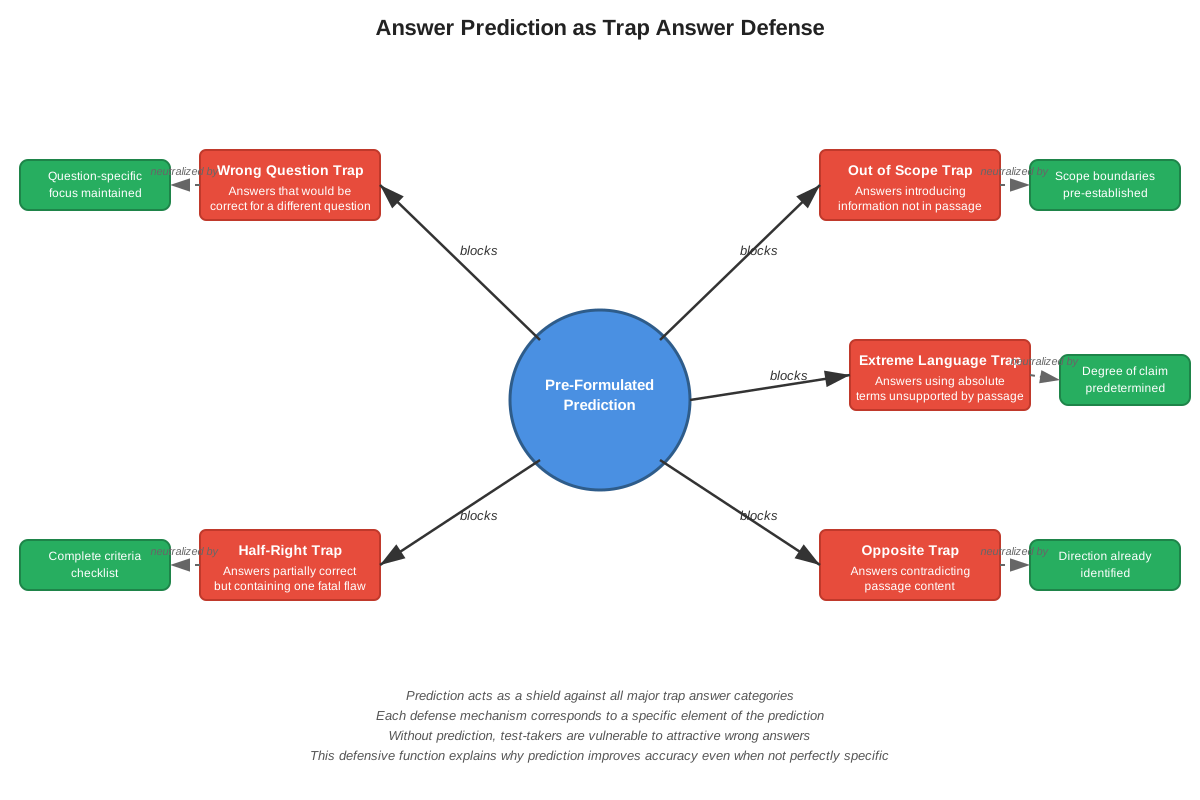
This technique serves as a defensive mechanism against one of the LSAT's most challenging features: highly attractive wrong answer choices. The test writers deliberately construct incorrect options that sound plausible, use passage vocabulary, and appeal to common misreadings. By predicting answers before exposure to these distractors, test-takers create a mental benchmark against which to evaluate each choice, dramatically reducing susceptibility to trap answers. This skill is particularly valuable for reading comprehension question types that test specific passage details, author's purpose, or logical structure—areas where precision matters most.
Within the broader reading comprehension framework, answer prediction connects directly to active reading strategies, question stem analysis, and passage mapping. It represents the bridge between comprehension and application, requiring students to synthesize their understanding of the passage with the specific demands of each question. Mastering this skill enhances performance across all RC question types while building the analytical discipline necessary for the LSAT's most challenging passages, including comparative reading and dense academic texts.
Learning Objectives
- [ ] Identify how RC answer prediction appears in LSAT questions
- [ ] Explain the reasoning pattern behind RC answer prediction
- [ ] Apply RC answer prediction to solve LSAT-style problems accurately
- [ ] Formulate specific, testable predictions for at least five different question types
- [ ] Distinguish between strong predictions (specific content) and weak predictions (general direction)
- [ ] Evaluate answer choices efficiently by comparing them against pre-formulated predictions
- [ ] Recognize when to adjust prediction strategies based on question difficulty and type
Prerequisites
- Active reading strategies: Essential for building the comprehension foundation that enables accurate predictions; without understanding passage structure and main ideas, predictions become guesswork
- Question stem classification: Necessary to identify what type of answer the question demands; different question types require different prediction approaches
- Passage mapping techniques: Provides the organizational framework for quickly locating relevant information when formulating predictions
- Basic logical reasoning skills: Enables recognition of argument structures, assumptions, and inferences that inform prediction content
- Understanding of wrong answer patterns: Helps distinguish between genuine predictions and trap answer characteristics
Why This Topic Matters
Answer prediction represents one of the highest-yield strategies for LSAT Reading Comprehension success. Research on test-taking behavior consistently shows that students who predict answers before reviewing choices score significantly higher than those who immediately scan options. This technique directly addresses the LSAT's design philosophy: the test rewards careful analysis and punishes hasty pattern-matching.
On the LSAT, Reading Comprehension constitutes approximately 27% of the scored questions (one full section of four). Within this section, virtually every question type benefits from answer prediction, though the technique proves especially valuable for specific detail questions (appearing 3-5 times per passage), inference questions (2-4 times per passage), and purpose/function questions (1-3 times per passage). These question types collectively represent 60-70% of all RC questions, making answer prediction applicable to roughly 15-18 questions per test—a substantial portion of the exam.
The LSAT presents answer prediction opportunities in multiple forms. Detail questions explicitly direct test-takers to specific passage content, enabling precise predictions. Inference questions require synthesizing passage information to predict logical conclusions. Purpose questions demand predictions about why authors include specific elements. Even main point questions benefit from prediction, as students can articulate the passage's central claim before evaluating answer choices. The consistent thread across all applications: formulating expectations before exposure to potentially misleading options.
Core Concepts
The Prediction Process
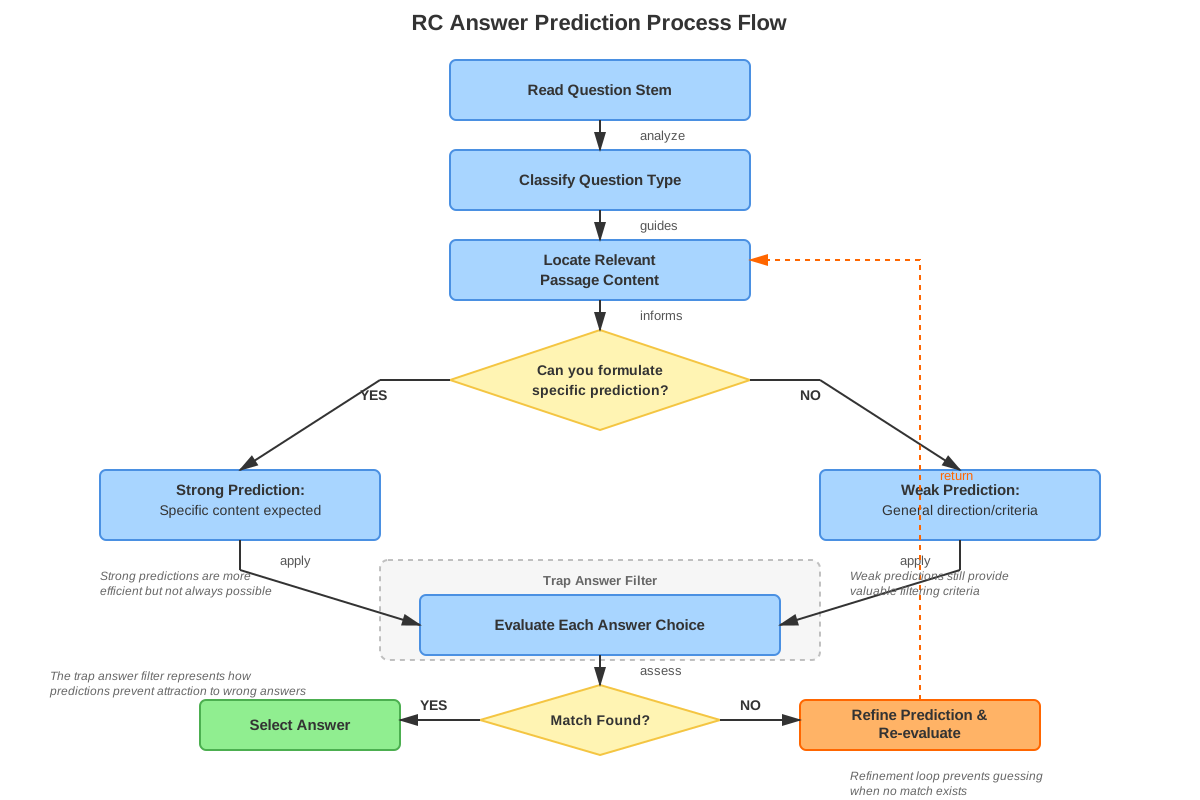
The answer prediction methodology follows a systematic four-step process that transforms question analysis into actionable expectations. First, carefully read and classify the question stem to determine exactly what the question asks. Second, return to the relevant passage section (using passage maps or line references) to locate the information needed. Third, formulate a specific prediction in your own words, articulating what the correct answer must say or accomplish. Fourth, evaluate each answer choice against this prediction, seeking the option that best matches your anticipated response.
This process differs fundamentally from the common but ineffective approach of reading the question and immediately scanning answer choices. The prediction-first method creates a cognitive anchor that resists manipulation by attractive wrong answers. When test-takers formulate predictions independently, they engage with passage content directly rather than through the distorting lens of answer choices designed to exploit common misreadings.
Types of Predictions
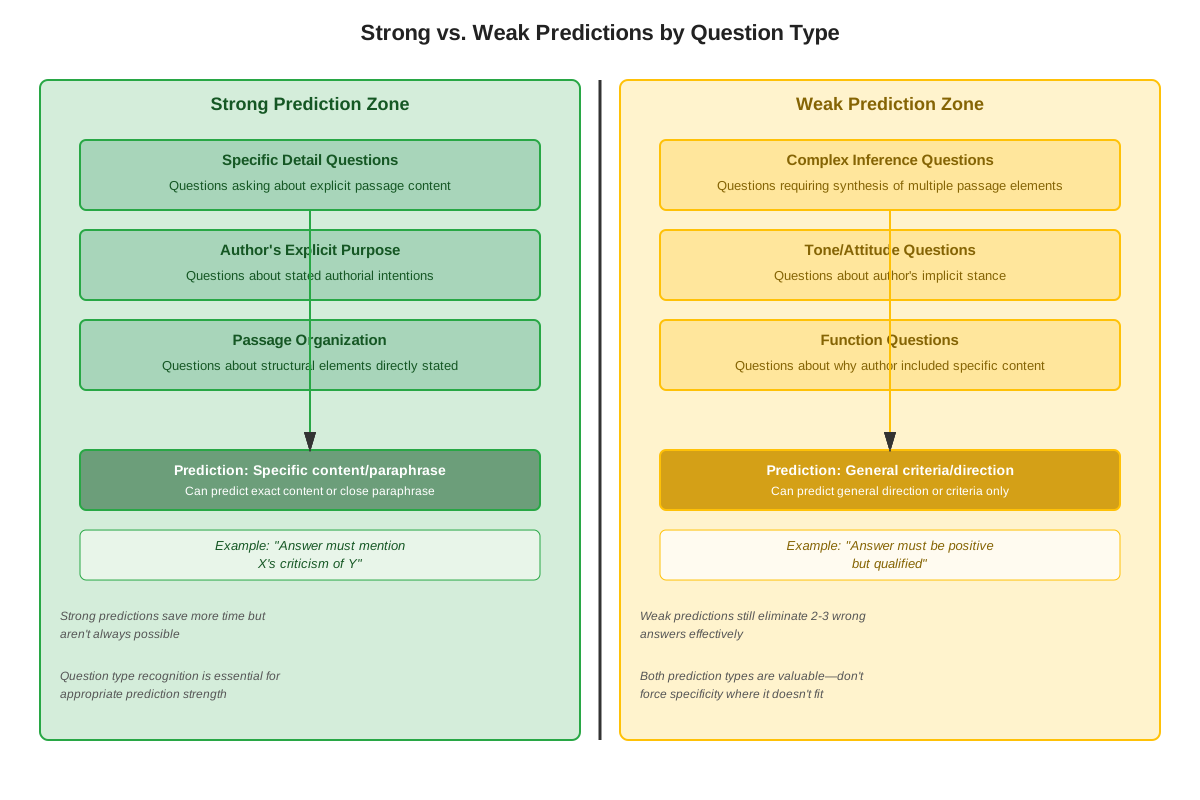
Not all predictions achieve the same level of specificity, and understanding prediction strength helps calibrate expectations appropriately. Strong predictions include specific content, terminology, or concepts that must appear in the correct answer. For example, when a question asks what the author says about "judicial restraint" in paragraph three, a strong prediction might be: "The author argues it limits courts' ability to address social problems." This prediction contains specific content (limiting ability, social problems) that enables precise answer evaluation.
Directional predictions establish the general orientation or tone the answer must have without specifying exact content. These prove valuable when questions ask about author attitude or comparative relationships. For instance, predicting "the author views this theory negatively" provides sufficient guidance even without knowing the exact criticism that will appear in the correct answer.
Structural predictions focus on the logical role or function an answer must fulfill rather than specific content. When questions ask why an author mentions a particular example, a structural prediction might be: "to illustrate the main theory discussed earlier" or "to present a counterexample that the author will refute." These predictions guide answer evaluation by establishing what purpose the correct answer must serve.
| Prediction Type | Specificity Level | Best Used For | Example |
|---|---|---|---|
| Strong | High - includes specific content | Detail questions, specific inference questions | "The author states that the policy reduced costs by 30%" |
| Directional | Medium - establishes orientation | Attitude questions, tone questions | "The author is skeptical but not entirely dismissive" |
| Structural | Medium - identifies function | Purpose questions, organization questions | "This example supports the theory introduced in paragraph 2" |
| Weak | Low - very general expectation | Complex inference questions, synthesis questions | "The answer will combine ideas from paragraphs 1 and 4" |
Question-Type Specific Prediction Strategies
Different reading comprehension question types demand tailored prediction approaches. Detail questions (identified by stems like "According to the passage..." or "The author states that...") enable the strongest predictions because they point directly to passage content. The prediction strategy involves locating the referenced information and paraphrasing it precisely before reviewing choices.
Inference questions (signaled by "The passage suggests..." or "It can be inferred that...") require synthesizing stated information to predict unstated conclusions. The prediction must remain tightly connected to passage evidence while extending slightly beyond explicit statements. Strong inference predictions identify the specific passage elements being combined and articulate the logical connection between them.
Purpose/Function questions (asking "The author mentions X in order to..." or "The primary purpose of the second paragraph is to...") benefit from structural predictions. These predictions should identify the rhetorical role the referenced element plays in the passage's overall argument or organization.
Main point questions allow for comprehensive predictions that synthesize the passage's central claim. The prediction should capture both the topic and the author's specific perspective or conclusion about that topic, distinguishing the main point from mere subject matter.
The Matching Process
After formulating a prediction, the matching process determines which answer choice best corresponds to the anticipated response. This process requires flexibility because correct LSAT answers rarely use identical language to passage content—they typically paraphrase or reframe ideas. Effective matching focuses on conceptual alignment rather than word-for-word correspondence.
The matching process follows a systematic evaluation: read each answer choice completely, compare its core meaning to the prediction, and classify it as a potential match, clear mismatch, or uncertain. Potential matches warrant careful consideration and passage verification. Clear mismatches can be eliminated immediately. Uncertain answers should be held for comparison against other choices.
Prediction Confidence and Adjustment
Not every question permits equally confident predictions, and recognizing when to adjust strategy prevents wasted time and frustration. High-confidence predictions occur when passage content directly addresses the question with clear, unambiguous information. These situations warrant spending extra time crafting precise predictions because the investment pays dividends in rapid, accurate answer selection.
Low-confidence situations arise when questions ask about subtle implications, require synthesizing distant passage sections, or involve complex comparative analysis. In these cases, formulate a directional or structural prediction to maintain strategic advantage without over-investing time in prediction specificity. The key principle: some prediction always beats no prediction, even when confidence is limited.
Concept Relationships
The answer prediction process builds directly on active reading and passage mapping skills. Without comprehension of passage structure and main ideas (developed through active reading), predictions become untethered speculation. Passage maps provide the organizational framework that enables quick location of relevant information during the prediction phase.
Question stem analysis serves as the immediate prerequisite to prediction. Accurate classification of question type determines which prediction strategy to employ: detail questions demand strong content predictions, while purpose questions require structural predictions. The relationship flows linearly: question classification → prediction strategy selection → prediction formulation → answer evaluation.
Within the prediction process itself, concepts connect sequentially: The prediction process (the overall framework) → Types of predictions (the specific forms predictions take) → Question-type specific strategies (tailored applications) → The matching process (using predictions to evaluate answers) → Prediction confidence (calibrating effort appropriately). Each concept builds on the previous, creating an integrated system rather than isolated techniques.
Answer prediction also connects forward to wrong answer pattern recognition. Predictions create a standard against which to identify common trap answers: predictions help recognize when answers are too extreme, out of scope, or distort passage content. This relationship is bidirectional—understanding wrong answer patterns also improves prediction quality by highlighting what to avoid including in predictions.
High-Yield Facts
⭐ Answer prediction should occur before reading any answer choices to prevent contamination by attractive wrong answers
⭐ Strong predictions include specific content or concepts that must appear in the correct answer
⭐ Detail questions enable the most specific predictions because they reference explicit passage content
⭐ Correct LSAT answers typically paraphrase rather than quote passage language, so predictions should focus on concepts rather than exact wording
⭐ Even directional predictions (establishing general orientation) significantly improve accuracy compared to no prediction
- Inference questions require predictions that extend slightly beyond stated information while remaining tightly connected to passage evidence
- Purpose/function questions benefit most from structural predictions identifying rhetorical roles
- The matching process should prioritize conceptual alignment over vocabulary overlap
- Low-confidence predictions should be directional or structural rather than attempting false specificity
- Prediction time investment should scale with question difficulty and prediction confidence
- Main point predictions must capture both topic and the author's specific perspective
- Comparative reading passages require predictions that account for relationships between passages
- When predictions don't match any answer choice perfectly, the closest conceptual match is typically correct
- Predictions help identify out-of-scope answers by establishing what content is relevant
- Attitude/tone questions require directional predictions about the author's perspective intensity and valence
Quick check — test yourself on RC answer prediction so far.
Try Flashcards →Common Misconceptions
Misconception: Predictions must match the correct answer word-for-word to be useful → Correction: Effective predictions focus on concepts and ideas rather than specific vocabulary. LSAT correct answers almost always paraphrase passage content, so predictions should capture meaning rather than exact language. A prediction about "economic benefits" successfully matches an answer discussing "financial advantages."
Misconception: If no answer choice matches the prediction exactly, the prediction was wrong → Correction: Predictions serve as conceptual benchmarks, not rigid templates. When no answer matches perfectly, identify the choice with the closest conceptual alignment. The prediction still provides value by establishing what to look for and helping eliminate clearly incorrect options.
Misconception: Prediction wastes time that could be spent evaluating answer choices → Correction: Research consistently shows prediction saves time overall by enabling rapid elimination of wrong answers and confident selection of correct ones. The 10-15 seconds invested in prediction typically saves 30-45 seconds during answer evaluation by preventing re-reading and second-guessing.
Misconception: Some question types don't benefit from prediction → Correction: While prediction specificity varies by question type, every RC question benefits from some form of prediction. Even complex synthesis questions benefit from directional predictions establishing which passage sections must be combined or what general relationship the answer must describe.
Misconception: Predictions should include passage vocabulary to be accurate → Correction: Effective predictions use your own words to paraphrase passage ideas. This approach actually improves matching accuracy because it forces conceptual understanding rather than surface-level word recognition. Using your own language also makes it easier to recognize correct answers that paraphrase passage content.
Misconception: Strong predictions are always better than directional predictions → Correction: Prediction strength should match question type and available information. Forcing overly specific predictions when passage content is ambiguous or complex wastes time and can lead to tunnel vision. Directional predictions are appropriate and effective for attitude questions, tone questions, and complex inferences.
Misconception: If the prediction seems obvious, it's probably wrong → Correction: LSAT Reading Comprehension rewards careful analysis of stated information. When detail questions point to clear passage content, the prediction should reflect that clarity. Obvious predictions are often correct—the difficulty lies in avoiding trap answers that seem equally obvious but distort passage meaning.
Worked Examples
Example 1: Detail Question with Strong Prediction
Passage excerpt: "The traditional view holds that medieval guilds restricted economic competition and innovation. However, recent scholarship by Epstein demonstrates that guilds actually facilitated technology transfer by requiring masters to train apprentices in current techniques and by enabling artisans to move between cities while maintaining professional credentials."
Question: According to the passage, Epstein's research indicates that medieval guilds:
Prediction Process:
- Classify question: This is a detail question ("According to the passage") asking specifically about Epstein's research findings
- Locate information: The second sentence explicitly states what Epstein's work demonstrates
- Formulate prediction: "Epstein found that guilds helped spread technology by requiring training and allowing artisans to move between cities while keeping their credentials"
- Evaluate choices:
(A) restricted economic competition among artisans
- Evaluation: This matches the "traditional view" that Epstein challenges, not Epstein's findings. Eliminate.
(B) facilitated the dissemination of technical knowledge
- Evaluation: "Dissemination of technical knowledge" closely matches "facilitated technology transfer" from the prediction. Strong match.
(C) prevented innovation by enforcing outdated methods
- Evaluation: Contradicts the prediction entirely. Eliminate.
(D) required extensive documentation of training procedures
- Evaluation: Documentation isn't mentioned in the prediction or passage excerpt. Out of scope. Eliminate.
(E) enabled artisans to avoid professional oversight
- Evaluation: The passage says guilds maintained professional credentials, suggesting oversight rather than avoiding it. Eliminate.
Answer: (B) - The prediction enabled immediate recognition of the correct answer and rapid elimination of distractors.
Example 2: Purpose Question with Structural Prediction
Passage excerpt: "Quantum entanglement presents a puzzle for classical physics. When two particles become entangled, measuring one particle's state instantaneously determines the other's state, regardless of distance. Einstein famously objected to this 'spooky action at a distance,' arguing it violated relativity's prohibition on faster-than-light communication. Modern physicists, however, point out that entanglement cannot transmit information faster than light because the measurement results appear random until compared."
Question: The author mentions Einstein's objection primarily in order to:
Prediction Process:
- Classify question: This is a purpose/function question ("in order to") asking about the rhetorical role of Einstein's objection
- Analyze structure: The passage introduces entanglement as puzzling, presents Einstein's objection, then shows how modern physicists resolve the concern
- Formulate structural prediction: "To present a historical concern or objection that modern physicists have addressed or resolved"
- Evaluate choices:
(A) demonstrate that quantum entanglement violates physical laws
- Evaluation: The passage shows modern physicists resolved Einstein's concern, so the author isn't using Einstein to prove a violation. Eliminate.
(B) illustrate why quantum entanglement initially seemed problematic
- Evaluation: This matches the structural prediction—Einstein's objection shows why entanglement was puzzling before modern physicists explained it. Strong match.
(C) prove that relativity theory is incompatible with quantum mechanics
- Evaluation: Too extreme and contradicts the passage's resolution. Eliminate.
(D) support the claim that entanglement enables faster-than-light communication
- Evaluation: The passage explicitly denies this in the final sentence. Eliminate.
(E) introduce Einstein's most important contribution to physics
- Evaluation: Out of scope—the passage isn't about Einstein's contributions generally. Eliminate.
Answer: (B) - The structural prediction correctly identified that Einstein's objection serves to illustrate a problem that gets resolved, enabling confident answer selection.
Exam Strategy
When approaching LSAT Reading Comprehension questions, implement answer prediction as a mandatory step between reading the question stem and evaluating answer choices. This discipline prevents the most common RC mistake: allowing answer choices to influence interpretation of the question or passage.
Trigger words for high-value prediction opportunities: "According to the passage," "The author states," "The passage indicates," and "The passage mentions" all signal detail questions where strong, specific predictions are possible. Invest 15-20 seconds formulating precise predictions for these questions because the time investment yields rapid, confident answer selection.
Process-of-elimination enhancement: Use predictions to create a two-pass elimination system. First pass: eliminate answers that clearly contradict or fail to address the prediction. Second pass: among remaining choices, identify the closest conceptual match to the prediction. This systematic approach prevents the common error of selecting the first answer that sounds reasonable.
Time allocation strategy: Spend approximately 20% of question time on prediction (10-15 seconds for most questions) and 80% on answer evaluation. This ratio may seem counterintuitive, but prediction dramatically accelerates answer evaluation by providing clear criteria for elimination. For particularly difficult questions, adjust to 30% prediction time, as investing in a strong prediction prevents time-consuming re-reading during answer evaluation.
Recognizing when to adjust: If 20 seconds of prediction effort yields only vague generalities, switch to a directional prediction and move to answer choices. Diminishing returns set in quickly—a mediocre prediction formed in 15 seconds provides more value than a marginally better prediction requiring 45 seconds.
Comparative reading adaptation: For comparative passages, predictions must explicitly account for both passages. When questions ask about relationships between passages, predict the specific nature of the relationship (agreement, disagreement, complementary perspectives) before reviewing choices. When questions reference only one passage, predict as normal but remain alert for wrong answers that import content from the other passage.
Exam Tip: If your prediction doesn't match any answer choice well, don't abandon it immediately. Re-read the question stem to ensure you understood what was being asked, then identify which answer comes closest to your prediction's core concept. Complete prediction failure is rare—usually, the issue is overly rigid matching rather than incorrect prediction.
Memory Techniques
PREDICT acronym for the prediction process:
- Pause before reading answer choices
- Read and classify the question stem
- Examine the relevant passage section
- Determine what the answer must say or do
- In your own words, articulate the prediction
- Compare each answer choice to your prediction
- Test the closest match against the passage
The "Anchor" visualization: Picture your prediction as a ship's anchor that keeps you from drifting toward attractive wrong answers. The anchor doesn't prevent movement entirely (you can still adjust your understanding), but it prevents being swept away by currents (trap answers).
SSD mnemonic for prediction types:
- Strong: Specific content predictions
- Structural: Function and purpose predictions
- Directional: Orientation and tone predictions
The "Paraphrase Principle": Remember that correct answers are "passage ideas in different clothes"—they wear new vocabulary but express the same concepts. This mental model helps avoid the trap of seeking word-for-word matches.
Summary
RC answer prediction is a systematic strategy that involves formulating anticipated answers before examining answer choices, thereby creating a cognitive benchmark that resists manipulation by attractive wrong answers. The technique applies across all reading comprehension question types, with prediction specificity varying based on question type: detail questions enable strong content predictions, purpose questions benefit from structural predictions, and attitude questions require directional predictions. The prediction process follows four steps—classify the question, locate relevant passage information, formulate a prediction in your own words, and evaluate choices against the prediction. Effective predictions focus on concepts rather than exact vocabulary because LSAT correct answers typically paraphrase passage content. Even when predictions don't match any answer perfectly, they provide substantial value by establishing evaluation criteria and enabling rapid elimination of clearly incorrect options. Mastering this skill requires understanding that prediction time investment (typically 10-20 seconds) accelerates overall question completion by preventing re-reading and second-guessing during answer evaluation.
Key Takeaways
- Answer prediction must occur before reading answer choices to prevent contamination by trap answers designed to exploit common misreadings
- Prediction strength should match question type: strong content predictions for detail questions, structural predictions for purpose questions, directional predictions for attitude questions
- Effective predictions focus on concepts and ideas rather than exact passage vocabulary because correct answers paraphrase rather than quote
- The prediction process (classify question → locate information → formulate prediction → evaluate choices) should become automatic through deliberate practice
- Even imperfect predictions provide significant strategic advantage by establishing evaluation criteria and accelerating elimination of wrong answers
- Time invested in prediction (10-20 seconds) saves time overall by enabling confident, rapid answer selection
- Flexibility in matching is essential—seek conceptual alignment rather than word-for-word correspondence between predictions and answer choices
Related Topics
Wrong Answer Pattern Recognition: Understanding common trap answer types (too extreme, out of scope, reversal, distortion) enhances prediction quality by helping identify what to avoid in predictions and how to use predictions to spot traps. Mastering answer prediction creates the foundation for recognizing these patterns.
Question Stem Analysis: Deep expertise in classifying question types and identifying exactly what each question asks enables more precise prediction strategy selection. This topic represents the immediate prerequisite to effective prediction.
Passage Mapping and Annotation: Advanced mapping techniques that track argument structure, tone shifts, and key details facilitate rapid location of information needed for prediction formulation. Strong mapping skills make prediction faster and more accurate.
Active Reading for Structure: Sophisticated structural reading that identifies rhetorical moves, argument components, and organizational patterns enables better structural predictions for purpose and function questions. This skill set supports prediction across all question types.
Comparative Reading Strategies: Specialized techniques for handling dual passages, including relationship tracking and perspective comparison, extend prediction methodology to the LSAT's most complex RC format.
Practice CTA
Now that you understand the systematic approach to RC answer prediction, it's time to build automaticity through deliberate practice. Begin with the practice questions provided, focusing on formulating predictions before looking at answer choices—even if this feels awkward initially. Use the flashcards to reinforce prediction strategies for different question types until the process becomes second nature. Remember that prediction is a skill that improves dramatically with conscious practice: your first attempts may feel slow and uncertain, but within 10-15 practice passages, the technique will accelerate your performance and boost your confidence. The investment you make now in mastering this high-yield strategy will pay dividends across every Reading Comprehension section you encounter.
Sign up free to keep reading
Create a free AnvayaPrep account to finish this LSAT guide on RC answer prediction — plus flashcards and practice questions.