Overview
Role of a paragraph questions represent a critical category within LSAT reading comprehension that tests a student's ability to understand how individual paragraphs function within the broader architecture of a passage. Unlike questions that focus on specific details or the author's main point, these questions require test-takers to step back and analyze the structural purpose that a particular paragraph serves in advancing the passage's overall argument or narrative. This question type demands both micro-level comprehension of what a paragraph says and macro-level understanding of why the author included it and how it relates to surrounding content.
These questions are essential for LSAT success because they assess sophisticated analytical skills that law schools value: the ability to recognize organizational patterns, understand argumentative structure, and see how individual components contribute to a larger whole. Students who master role of a paragraph questions demonstrate they can read actively and strategically, identifying not just content but function—a skill directly applicable to legal reading where understanding the purpose of statutory sections, case law paragraphs, and argumentative components is paramount.
Within the broader landscape of reading comprehension question types, role of a paragraph questions occupy a unique middle ground. They require more structural awareness than detail questions but less synthesis than main point questions. They connect closely to organization questions, author's purpose questions, and passage structure questions, forming part of a cluster of question types that reward students who read with an eye toward architecture rather than merely absorbing information passively. Mastering this question type strengthens overall passage comprehension and improves performance across multiple question categories.
Learning Objectives
- [ ] Identify how Role of a paragraph questions appears in LSAT questions
- [ ] Explain the reasoning pattern behind Role of a paragraph questions
- [ ] Apply Role of a paragraph questions to solve LSAT-style problems accurately
- [ ] Distinguish between content-focused and function-focused answer choices for paragraph role questions
- [ ] Map the structural relationships between paragraphs in complex LSAT passages
- [ ] Predict common paragraph functions before reviewing answer choices
- [ ] Evaluate answer choices by testing them against both the target paragraph and the passage as a whole
Prerequisites
- Basic passage comprehension skills: Understanding main ideas, supporting details, and author's tone is necessary before analyzing structural function
- Familiarity with argument structure: Recognizing premises, conclusions, evidence, and counterarguments helps identify why paragraphs appear where they do
- Knowledge of common passage types: Understanding that LSAT passages include argumentative, explanatory, and comparative texts helps predict paragraph roles
- Active reading strategies: The ability to annotate and track passage flow is essential for identifying structural relationships between paragraphs
Why This Topic Matters
Role of a paragraph questions appear with significant frequency on the LSAT, typically comprising 10-15% of all reading comprehension questions. Each reading comprehension section contains approximately 27 questions across four passages, meaning students can expect to encounter 2-4 role of a paragraph questions per section. Given that reading comprehension constitutes roughly one-third of the scored LSAT, mastering this question type directly impacts overall performance and can mean the difference between score bands.
In legal practice, attorneys constantly analyze how different sections of documents function: Does this paragraph establish jurisdiction? Does it present a counterargument that will be refuted? Does it provide background necessary for understanding the main claim? The analytical skills tested by role of a paragraph questions mirror the structural analysis lawyers perform daily when reading contracts, briefs, judicial opinions, and statutes. Law schools specifically value this skill because it demonstrates readiness for legal reasoning.
These questions commonly appear in passages discussing complex topics where authors employ sophisticated organizational strategies. They frequently target paragraphs that introduce theories, present objections, offer examples, provide historical context, or transition between major ideas. The LSAT particularly favors questions about paragraphs that serve non-obvious functions—not the straightforward introduction or conclusion, but rather the third paragraph that seems tangential but actually provides crucial support, or the second paragraph that appears to contradict the thesis but actually refines it.
Core Concepts
Understanding Paragraph Function vs. Content
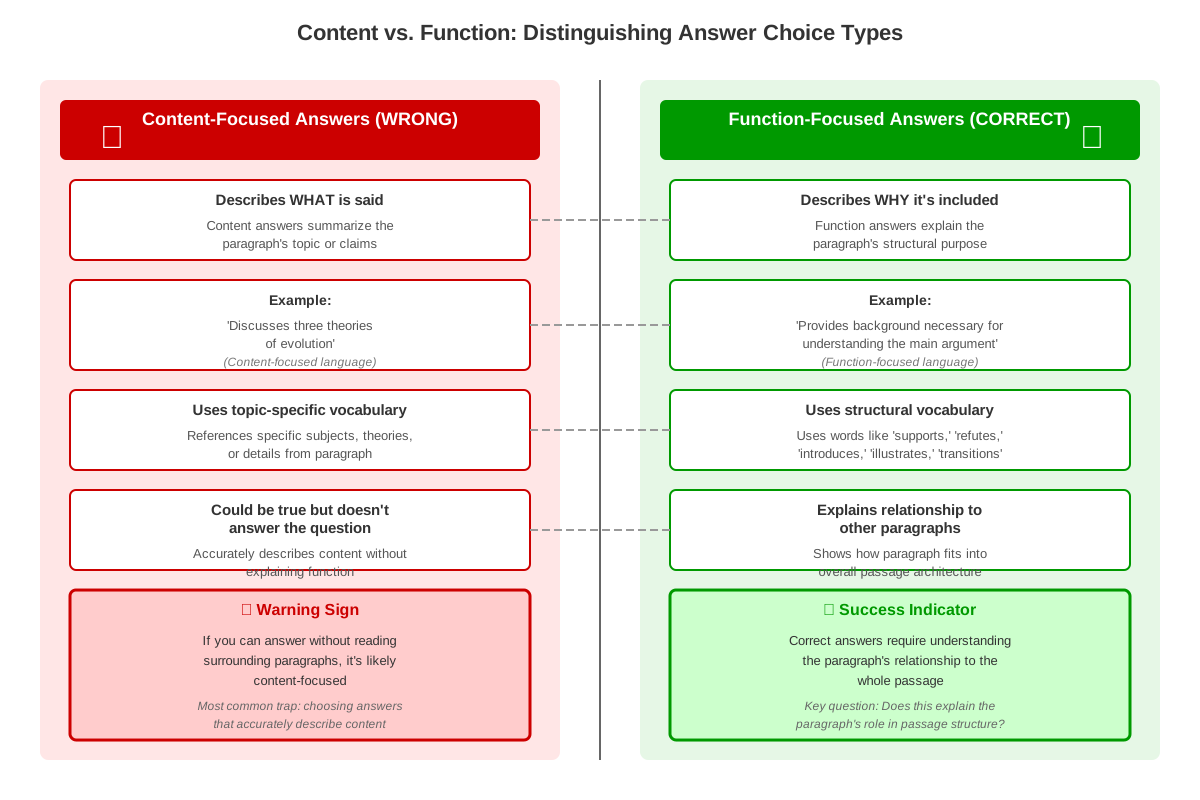
The fundamental distinction students must grasp is between what a paragraph says (its content) and what a paragraph does (its function). Content refers to the specific information, examples, theories, or arguments presented. Function refers to the structural role that information plays in the passage's overall architecture. A paragraph might discuss (content) the chemical composition of a particular enzyme, while its function is to provide an example supporting a broader claim about biological processes.
Role of a paragraph questions explicitly test function, not content. Wrong answer choices frequently describe the paragraph's content accurately but misidentify its purpose. For instance, if a paragraph describes three studies showing negative effects of a policy, a content-focused answer might say "describes three studies," while a function-focused answer would say "provides empirical evidence supporting the author's criticism of the policy." The LSAT rewards students who recognize that the studies exist to serve an argumentative purpose.
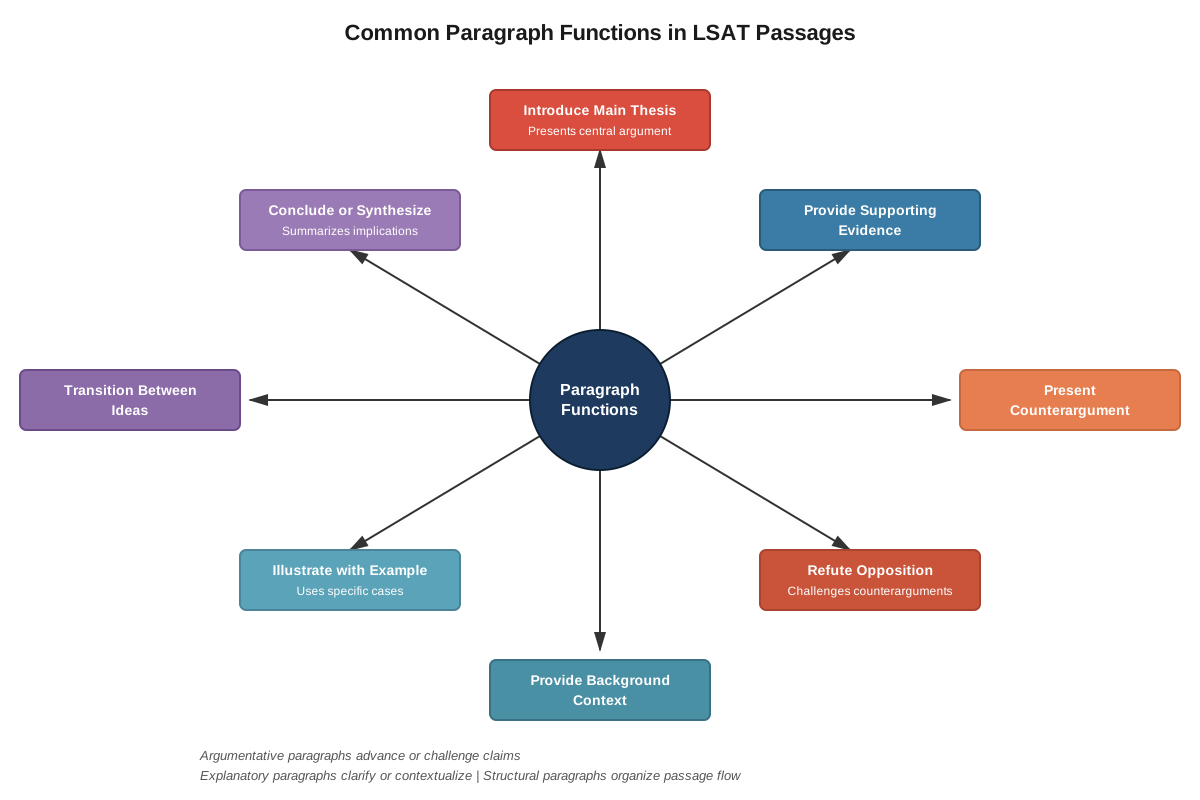
Common Paragraph Functions in LSAT Passages
LSAT passages employ paragraphs for predictable structural purposes. Understanding these common functions enables students to anticipate answer choices and eliminate options efficiently:
| Function | Description | Typical Location |
|---|---|---|
| Introduction/Context | Establishes background, defines terms, or presents the issue | First paragraph |
| Thesis Statement | Articulates the author's main argument or the passage's central claim | First or second paragraph |
| Supporting Evidence | Provides examples, data, studies, or reasoning that supports a claim | Middle paragraphs |
| Counterargument | Presents opposing views or alternative theories | Middle paragraphs |
| Refutation | Responds to and undermines counterarguments | Following counterargument |
| Qualification | Limits or refines a previous claim | Middle or late paragraphs |
| Application | Shows how a theory applies to specific cases | Middle or late paragraphs |
| Comparison/Contrast | Distinguishes between theories, approaches, or phenomena | Any location |
| Conclusion | Summarizes, restates implications, or suggests future directions | Final paragraph |
Identifying Question Stems
Lsat role of a paragraph questions use distinctive language that signals they're testing structural function. Recognizing these stems immediately helps students shift into the appropriate analytical mode:
- "The primary purpose of the second paragraph is to..."
- "The author's discussion of [topic] in paragraph 3 serves mainly to..."
- "Which one of the following most accurately describes the function of the third paragraph?"
- "The second paragraph is structured to..."
- "In the context of the passage, the fourth paragraph primarily serves to..."
- "The author mentions [specific content] in paragraph 2 in order to..."
The key markers include words like "purpose," "function," "serves to," "in order to," and "role." These signal that correct answers will describe what the paragraph accomplishes rather than merely what it contains.
The Relationship Between Paragraph and Passage
Effective analysis of paragraph role requires understanding the paragraph's relationship to the passage's overall structure. A paragraph never functions in isolation; its role is defined by how it advances, supports, qualifies, or complicates the passage's main argument. Students should ask:
- What came before? Does this paragraph continue the previous idea, shift to a new topic, or respond to what preceded it?
- What comes after? Does the next paragraph build on this one, contrast with it, or move to a different aspect of the topic?
- How does this relate to the main point? Does it support, qualify, illustrate, or challenge the passage's central claim?
For example, a paragraph describing limitations of a theory might function as a qualification if it follows paragraphs praising the theory, but it might function as supporting evidence if the passage's main point is that the theory is flawed. Context determines function.
Structural Markers and Transition Language
Authors use structural markers—transitional words and phrases—to signal paragraph function. Recognizing these markers helps students identify roles quickly:
- Addition/Support: "Furthermore," "Moreover," "Additionally," "In addition" → Likely providing more evidence or examples
- Contrast: "However," "Nevertheless," "On the other hand," "By contrast" → Likely presenting counterargument or qualification
- Causation: "Therefore," "Thus," "Consequently," "As a result" → Likely drawing conclusions or showing implications
- Example: "For instance," "For example," "To illustrate" → Likely providing concrete application of abstract principle
- Concession: "Although," "While," "Despite," "Admittedly" → Likely acknowledging counterargument before refuting it
The presence and placement of these markers within a paragraph provide clues about its structural function within the passage.
Multi-Paragraph Structures
Complex LSAT passages often employ multi-paragraph structures where several paragraphs work together to accomplish a single function. For instance:
- Two-paragraph counterargument-refutation: Paragraph 2 presents an opposing view; paragraph 3 explains why it's inadequate
- Three-paragraph evidence sequence: Paragraphs 2-4 each provide different types of support for the thesis in paragraph 1
- Problem-solution structure: Early paragraphs establish a problem; later paragraphs present and evaluate potential solutions
When answering role of a paragraph questions, students must consider whether the target paragraph is part of a larger structural unit. A paragraph that seems merely descriptive might actually be the second half of a comparison, or the setup for a refutation that follows.
Concept Relationships
The concepts within role of a paragraph questions form an interconnected analytical framework. Understanding paragraph function vs. content serves as the foundation—students must make this distinction before they can accurately identify any specific role. This foundational concept connects directly to identifying question stems, because recognizing function-focused language in questions triggers the appropriate analytical approach.
Common paragraph functions represents the content knowledge students apply once they've recognized a role question. This concept connects bidirectionally with structural markers and transition language: markers help identify functions, while knowing common functions helps students recognize which markers to look for. Both concepts feed into the relationship between paragraph and passage, which represents the highest level of analysis—understanding how individual components serve the whole.
Multi-paragraph structures builds on all previous concepts, representing advanced pattern recognition where students see how multiple paragraphs work together. This concept particularly connects to the relationship between paragraph and passage because multi-paragraph structures often define the passage's overall architecture.
The progression flows: Recognize question type → Distinguish function from content → Identify structural markers → Determine paragraph's function → Evaluate function in context of whole passage → Consider multi-paragraph patterns. Each step depends on the previous ones, creating a hierarchical analytical process.
High-Yield Facts
⭐ Role of a paragraph questions ask about function (what the paragraph does) not content (what the paragraph says)
⭐ Correct answers typically use verbs like "illustrate," "support," "refute," "qualify," "introduce," or "explain" to describe structural purpose
⭐ Wrong answers often accurately describe paragraph content but misidentify its structural function
⭐ The same content can serve different functions depending on context—a study might support, refute, or qualify depending on what surrounds it
⭐ Transition words at paragraph beginnings provide crucial clues: "However" signals contrast/refutation; "Furthermore" signals additional support
- Approximately 10-15% of reading comprehension questions test paragraph role, meaning 2-4 questions per section
- Role questions most frequently target middle paragraphs (2-3 in a four-paragraph passage) rather than introductions or conclusions
- Paragraphs that present counterarguments or alternative theories are disproportionately targeted by role questions
- The correct answer must be accurate for both the specific paragraph AND its relationship to the passage as a whole
- Comparative passages (Passage A and Passage B) often include role questions about how paragraphs in one passage relate to the other passage
- Authors rarely state paragraph function explicitly; students must infer it from context and structure
- Role questions reward students who create passage maps or structural outlines while reading
- The most challenging role questions target paragraphs with dual functions (e.g., providing an example while also introducing a qualification)
Quick check — test yourself on Role of a paragraph questions so far.
Try Flashcards →Common Misconceptions
Misconception: Role of a paragraph questions can be answered by simply summarizing what the paragraph discusses.
Correction: These questions require identifying structural function, not content summary. A paragraph might discuss three experiments, but its function could be "providing evidence that supports the author's thesis," "illustrating the limitations of a methodology," or "presenting data that the author will later refute." The summary "discusses three experiments" would be incorrect for all of these.
Misconception: The correct answer will use language that appears in the target paragraph.
Correction: Correct answers describe function using structural/analytical language that often doesn't appear in the paragraph itself. A paragraph might never use the word "refute," but if it undermines a previous claim, "refute" might appear in the correct answer. Students should match concepts, not words.
Misconception: Each paragraph has only one function.
Correction: Paragraphs can serve multiple functions simultaneously. A paragraph might provide an example (supporting a general claim) while also introducing a qualification (limiting the claim's scope). The correct answer will identify the PRIMARY or MAIN function, which requires weighing which purpose is more central to the passage's structure.
Misconception: Role questions are easier than other reading comprehension question types because they don't require understanding details.
Correction: Role questions are often more challenging because they require both understanding content AND analyzing structure. Students must comprehend what the paragraph says before they can determine what it does, then must understand how it relates to the entire passage—a multi-layered analytical task.
Misconception: The function of a paragraph is determined solely by what's in that paragraph.
Correction: Paragraph function is determined by context—what comes before and after, and how the paragraph relates to the passage's main point. The same content could serve different functions in different passages. A description of a scientific study might support the author's argument in one passage but serve as a counterargument the author will refute in another.
Misconception: Introductory paragraphs always just "introduce the topic" and concluding paragraphs always just "summarize."
Correction: While first and last paragraphs often serve these functions, they can also present the thesis, establish a problem, provide crucial context, offer qualifications, or suggest implications. Students should analyze each paragraph's specific function rather than assuming based on position.
Worked Examples
Example 1: Scientific Passage
Passage Structure (abbreviated):
Paragraph 1: Introduces the traditional view that mitochondria function solely as cellular power plants, generating ATP through respiration.
Paragraph 2: Describes recent research showing mitochondria also play crucial roles in cell signaling, calcium regulation, and apoptosis (programmed cell death).
Paragraph 3: Explains that this expanded understanding has led researchers to investigate mitochondrial dysfunction in diseases previously not associated with energy metabolism, such as neurodegenerative disorders.
Paragraph 4: Notes that while this research is promising, significant challenges remain in determining whether mitochondrial dysfunction is a cause or consequence of these diseases.
Question: The primary purpose of the third paragraph is to:
Answer Choices:
(A) Describe the methodology researchers use to study mitochondrial dysfunction
(B) Illustrate a practical application of the expanded understanding of mitochondrial function
(C) Present evidence that contradicts the traditional view of mitochondria
(D) Qualify the significance of recent research on mitochondrial signaling
(E) Introduce a new theory about the relationship between mitochondria and disease
Analysis:
First, identify what the paragraph says (content): It discusses how researchers are now investigating mitochondrial dysfunction in neurodegenerative disorders because of the expanded understanding of mitochondrial function.
Next, determine what the paragraph does (function): It shows how the new understanding (from paragraph 2) has led to practical research applications. It's not presenting the research itself but rather explaining how the conceptual shift has opened new avenues of investigation.
Evaluate each answer:
(A) Incorrect - The paragraph doesn't describe methodology; it describes which diseases are being investigated. This confuses content (mentions research) with function (doesn't explain how research is conducted).
(B) Correct - The paragraph shows how the expanded understanding (paragraph 2) applies practically (investigating new diseases). The function is to illustrate application/implication of the previous paragraph's content.
(C) Incorrect - While the passage overall challenges the traditional view, paragraph 3 specifically doesn't present evidence; it describes research directions. This answer might describe paragraph 2's function but not paragraph 3's.
(D) Incorrect - Qualification appears in paragraph 4 ("challenges remain"), not paragraph 3. This answer confuses the functions of adjacent paragraphs.
(E) Incorrect - The paragraph doesn't introduce a new theory; it describes how an existing expanded understanding (already introduced in paragraph 2) has influenced research directions.
Key Takeaway: The correct answer (B) identifies function ("illustrate a practical application") rather than merely describing content. Notice how wrong answers either describe content without identifying function (A), or misidentify which paragraph serves which function (C, D, E).
Example 2: Humanities Passage
Passage Structure (abbreviated):
Paragraph 1: Introduces the debate about whether abstract expressionism represented a genuine artistic revolution or merely a marketing phenomenon.
Paragraph 2: Presents the view of critics who argue that abstract expressionism's prominence resulted primarily from Cold War cultural politics and aggressive promotion by galleries and museums rather than artistic merit.
Paragraph 3: Describes specific examples of how government agencies and private institutions promoted abstract expressionism as a symbol of American freedom, including funding exhibitions and supporting particular artists.
Paragraph 4: Argues that while institutional support certainly helped abstract expressionism gain prominence, this doesn't diminish the genuine innovations in technique and artistic philosophy that the movement represented.
Question: In the context of the passage, the third paragraph primarily serves to:
Answer Choices:
(A) Provide concrete evidence supporting the critical view introduced in the second paragraph
(B) Present the author's own interpretation of abstract expressionism's significance
(C) Refute the claim that abstract expressionism lacked artistic merit
(D) Illustrate the techniques that made abstract expressionism innovative
(E) Explain why abstract expressionism became controversial among art historians
Analysis:
Content: Paragraph 3 gives specific examples of institutional promotion—government agencies, funded exhibitions, support for artists.
Function: These examples support the critical view from paragraph 2 (that promotion, not just merit, drove prominence). The paragraph provides concrete evidence for a claim made in the previous paragraph.
Structural context: Paragraph 2 presents a critical view; paragraph 3 elaborates with examples; paragraph 4 (starting with "while") acknowledges this view but qualifies it. This is a classic counterargument-evidence-refutation structure, where paragraph 3 is the evidence portion.
Evaluate each answer:
(A) Correct - The paragraph provides specific examples (concrete evidence) that support the critical view from paragraph 2. The function is evidential support for a previously stated position.
(B) Incorrect - The author's own view appears in paragraph 4 ("while institutional support certainly helped...this doesn't diminish"). Paragraph 3 presents evidence for a view the author will later qualify, not the author's own position.
(C) Incorrect - Paragraph 3 doesn't refute anything; it supports the critical view. The refutation (or qualification) comes in paragraph 4. This answer reverses the paragraph's actual function.
(D) Incorrect - The paragraph discusses promotion and institutional support, not artistic techniques. This answer confuses content entirely—it might describe what a different paragraph does.
(E) Incorrect - While the paragraph relates to controversy, its function isn't to explain why controversy exists but rather to provide evidence for one side of the controversy.
Key Takeaway: Understanding multi-paragraph structure is crucial. Paragraph 3 functions as the evidence component of a counterargument that the author will later qualify. Students must recognize that providing evidence for a view doesn't mean the author endorses that view—the paragraph can support a position the passage ultimately rejects or qualifies.
Exam Strategy
Pre-Reading Strategy
Before reading the passage, quickly scan for paragraph breaks and count them. Knowing whether you're dealing with a three-, four-, or five-paragraph passage helps you anticipate structural patterns. Four-paragraph passages often follow introduction-counterargument-refutation-conclusion structures, while five-paragraph passages might include additional evidence or qualification paragraphs.
Active Reading for Structure
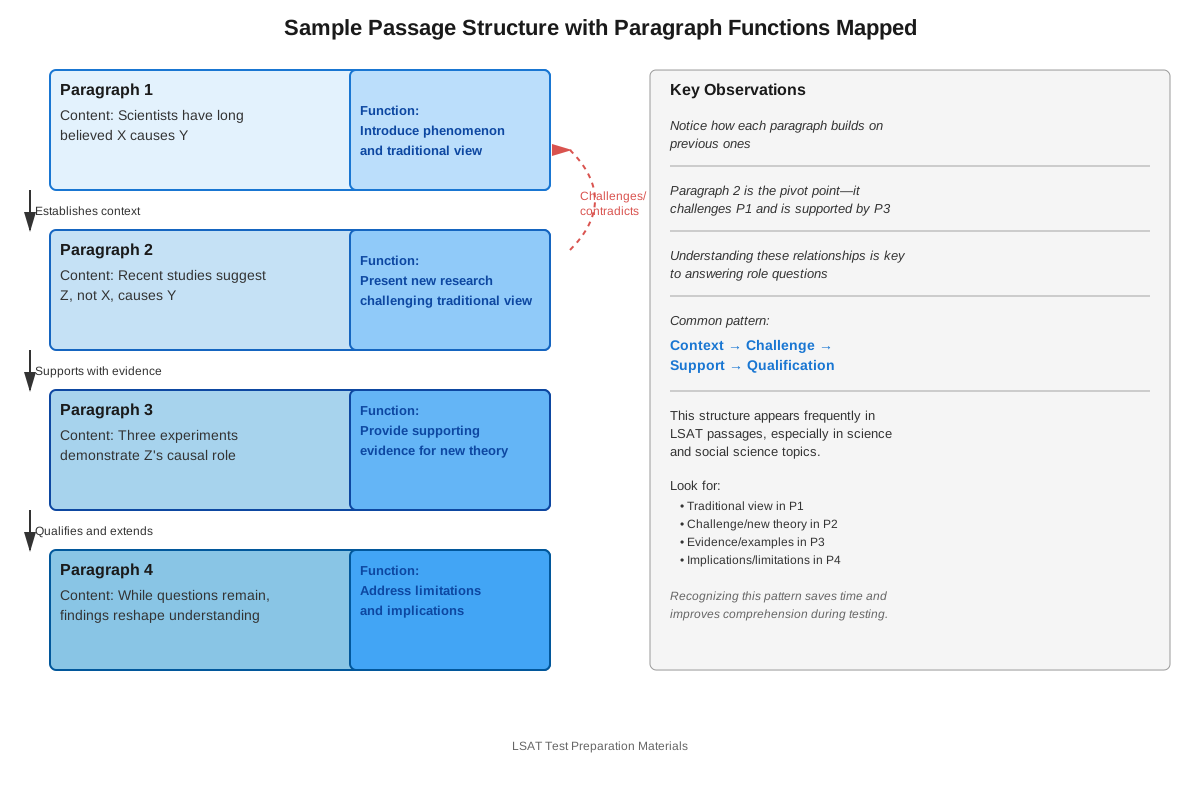
While reading, create a brief passage map noting each paragraph's function in 2-4 words. For example:
- P1: Intro traditional view
- P2: New research challenges
- P3: Example of new approach
- P4: Qualification/limitation
This map becomes invaluable when answering role questions because you've already identified function during your initial read. Spend 30-45 seconds creating this map; it saves time on questions.
Trigger Words in Question Stems
When you see these phrases, immediately recognize you're dealing with a role question:
- "primary purpose"
- "serves to"
- "function of"
- "in order to"
- "the author discusses X to"
- "the role of"
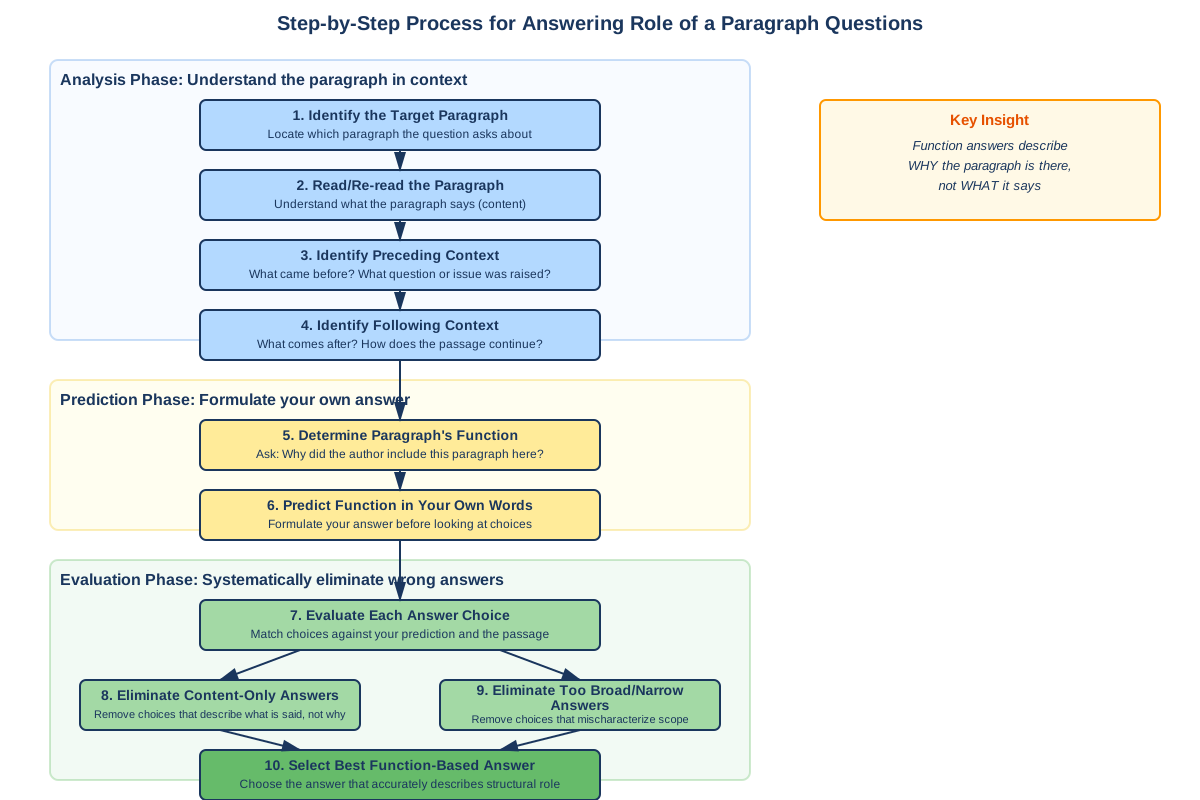
Shift your analytical mode from content recall to structural analysis. Ask: "What does this paragraph DO for the passage?"
Answering Process
- Re-read the target paragraph's first and last sentences - These often contain structural markers indicating function
- Check the sentences immediately before and after the paragraph - Context determines function
- Predict the answer before looking at choices - Ask yourself: "Does this paragraph support, refute, qualify, illustrate, introduce, or conclude?"
- Eliminate content-focused answers first - Any answer that merely describes what the paragraph discusses without identifying its structural purpose is wrong
- Test remaining answers against both the paragraph AND the passage as a whole - The correct answer must accurately describe the paragraph's role in the overall structure
Process of Elimination Tips
Eliminate answers that:
- Use language suggesting the paragraph is about a topic it doesn't discuss
- Describe functions performed by different paragraphs (check your passage map)
- Identify secondary rather than primary functions
- Are too broad (claiming the paragraph does what the entire passage does)
- Are too narrow (focusing on one sentence when the question asks about the whole paragraph)
Keep answers that:
- Use structural/functional verbs (support, illustrate, refute, qualify, introduce, explain)
- Accurately describe the paragraph's relationship to surrounding content
- Match your predicted answer
- Account for transition words at the paragraph's beginning
Time Management
Role of a paragraph questions typically take 45-75 seconds to answer—slightly longer than detail questions but shorter than main point questions. If you've created a passage map during reading, you can answer more quickly. Don't spend excessive time re-reading the entire passage; focus on the target paragraph and its immediate context.
Exam Tip: If you're stuck between two answers, check whether each describes what the paragraph SAYS or what it DOES. The answer describing function is almost always correct.
Memory Techniques
The "DICE" Acronym for Common Functions
Remember common paragraph functions with DICE:
- Define/Describe: Establishes terms, concepts, or background
- Illustrate: Provides examples or applications
- Contrast: Presents alternatives, counterarguments, or opposing views
- Explain: Clarifies mechanisms, provides reasoning, or shows implications
When analyzing a paragraph, ask which DICE function it primarily serves.
The "Before-During-After" Visualization
Visualize each paragraph as a bridge connecting what came before to what comes after. Ask:
- Before: What did the previous paragraph establish?
- During: What does this paragraph add?
- After: What does the next paragraph build on?
This spatial visualization helps identify function by emphasizing relationships rather than isolated content.
The "Job Interview" Analogy
Think of each paragraph as applying for a job in the passage. The question asks: "What job does this paragraph perform?" Answers like "discusses three studies" describe the paragraph's resume (content), while answers like "provides evidence supporting the author's claim" describe the job it performs (function). Always hire based on the job, not the resume.
Function Verb List
Memorize this list of common function verbs that appear in correct answers:
Support cluster: support, strengthen, bolster, provide evidence for, substantiate
Illustrate cluster: illustrate, exemplify, demonstrate, show application of
Challenge cluster: refute, undermine, challenge, contradict, question
Qualify cluster: qualify, limit, refine, nuance, modify
Introduce cluster: introduce, establish, present, set up
Explain cluster: explain, clarify, elaborate, account for
When predicting answers, use these verbs to articulate the paragraph's function.
Summary
Role of a paragraph questions test the ability to identify structural function rather than content summary, requiring students to understand what a paragraph does within a passage's overall architecture. These questions appear frequently on the LSAT (10-15% of reading comprehension questions) and reward active reading strategies that track how paragraphs relate to each other and to the passage's main argument. Success requires distinguishing between content (what the paragraph says) and function (what it accomplishes), recognizing common paragraph roles (supporting evidence, counterargument, qualification, illustration, etc.), and using structural markers like transition words to identify purpose. The most effective approach involves creating a passage map during initial reading, predicting answers before reviewing choices, and eliminating options that describe content without identifying function. Students must understand that paragraph function is determined by context—the same content can serve different purposes depending on what surrounds it and how it relates to the passage's central claim. Mastering this question type strengthens overall reading comprehension by encouraging structural awareness and strategic reading habits essential for law school success.
Key Takeaways
- Role of a paragraph questions ask "what does this paragraph DO?" not "what does this paragraph SAY?"—function, not content
- Correct answers use structural verbs (support, illustrate, refute, qualify, introduce) to describe purpose within the passage
- Create a passage map during reading that notes each paragraph's function in 2-4 words for quick reference
- Transition words at paragraph beginnings provide crucial clues: "However" signals contrast; "Furthermore" signals additional support
- Context determines function—analyze what comes before and after the target paragraph and how it relates to the main point
- Wrong answers often accurately describe content but misidentify structural purpose; eliminate content-focused options first
- The same content can serve different functions in different passages; never assume function based solely on content type
Related Topics
Organization Questions: These questions ask about the passage's overall structure rather than individual paragraph function, but mastering paragraph roles provides the foundation for understanding whole-passage organization. Students who can identify individual paragraph functions can more easily recognize patterns like problem-solution, chronological development, or thesis-evidence-qualification structures.
Author's Purpose Questions: While role of a paragraph questions focus on structural function, author's purpose questions ask why the author wrote the passage or included specific content. Understanding paragraph roles helps answer purpose questions because recognizing how components work together reveals the author's overall intent.
Comparative Passage Questions: In comparative passages (Passage A and Passage B), role questions often ask how a paragraph in one passage relates to content in the other passage. Mastering single-passage paragraph roles prepares students for these more complex cross-passage structural questions.
Main Point Questions: Identifying the main point requires understanding how all paragraphs work together, which depends on recognizing individual paragraph functions. Students who excel at role questions typically perform better on main point questions because they understand passage architecture.
Practice CTA
Now that you understand how to identify and analyze paragraph roles, it's time to apply these strategies to actual LSAT passages. Complete the practice questions associated with this topic, focusing on predicting paragraph functions before reviewing answer choices. Create passage maps for each practice passage, then check whether your functional labels match the correct answers to role questions. Use the flashcards to reinforce common paragraph functions and the structural markers that signal them. Remember: every practice passage you read is an opportunity to strengthen your structural awareness. The more you consciously identify paragraph roles during practice, the more automatic this analytical process becomes on test day. You're building the reading habits that will serve you throughout law school and legal practice—stay focused and trust the process!
Sign up free to keep reading
Create a free AnvayaPrep account to finish this LSAT guide on Role of a paragraph questions — plus flashcards and practice questions.