Overview
Viewpoint identification questions represent a critical category within LSAT reading comprehension that tests a student's ability to distinguish between different perspectives, opinions, and attitudes presented within a passage. These questions require test-takers to recognize not just what information is stated, but who holds particular beliefs, opinions, or positions on the issues discussed. Unlike questions that ask about the passage's main point or structural organization, viewpoint identification questions specifically target the attribution of ideas to their proper sources—whether that's the author, a person or group mentioned in the passage, or multiple parties with contrasting positions.
Mastering viewpoint identification questions is essential for LSAT success because they appear with high frequency across all reading comprehension passages and directly test the analytical reading skills that law schools value most. These questions assess whether students can track multiple perspectives simultaneously, understand nuanced differences between similar positions, and avoid conflating the author's views with those of individuals or groups discussed in the passage. This skill mirrors the critical reading demands of legal texts, where distinguishing between a court's holding, dissenting opinions, and commentary from legal scholars is fundamental to legal analysis.
Within the broader landscape of reading comprehension question types, viewpoint identification questions occupy a unique position. They build upon foundational comprehension skills—understanding what the passage says—but elevate the analysis to a meta-level where students must constantly ask "according to whom?" This question type connects closely to author's attitude questions, inference questions, and passage structure questions, as understanding viewpoint often requires synthesizing information from multiple locations within the passage and recognizing the rhetorical signals authors use to indicate agreement, disagreement, or neutral reporting.
Learning Objectives
- [ ] Identify how viewpoint identification questions appear in LSAT questions
- [ ] Explain the reasoning pattern behind viewpoint identification questions
- [ ] Apply viewpoint identification questions to solve LSAT-style problems accurately
- [ ] Distinguish between the author's viewpoint and the viewpoints of individuals or groups discussed in the passage
- [ ] Recognize textual markers and rhetorical signals that indicate attribution of ideas
- [ ] Evaluate answer choices by matching specific viewpoints to their correct sources within the passage
- [ ] Synthesize information from multiple paragraphs to construct a complete picture of a particular viewpoint
Prerequisites
- Basic passage comprehension skills: Understanding the literal content of complex passages is necessary before analyzing whose perspective is being presented
- Familiarity with LSAT passage structure: Recognizing how passages are organized helps locate where different viewpoints are introduced and developed
- Understanding of author's purpose: Distinguishing between when an author is presenting their own view versus reporting others' views requires recognizing authorial intent
- Ability to identify main ideas: Viewpoint questions often relate to the central claims or positions, so recognizing these is foundational
Why This Topic Matters
Viewpoint identification questions matter profoundly both for LSAT performance and for developing the analytical reading skills essential to legal practice. In law school and legal practice, professionals must constantly distinguish between their own analysis, their client's position, opposing counsel's arguments, judicial opinions, and scholarly commentary. The ability to track multiple perspectives without conflation is not merely an academic exercise—it's a core competency for legal reasoning.
On the LSAT, viewpoint identification questions appear in approximately 15-25% of all reading comprehension questions, making them one of the most frequently tested question types. They appear across all passage types—humanities, social sciences, natural sciences, and law—though they're particularly common in passages that present debates, historical developments of ideas, or critiques of theories. The LSAC (Law School Admission Council) consistently includes these questions because they directly measure skills predictive of law school success.
These questions commonly appear in passages that feature: (1) an author discussing and critiquing someone else's theory or position; (2) presentations of competing schools of thought or interpretations; (3) historical accounts where the author describes how views have evolved; (4) passages where the author remains neutral while presenting multiple perspectives; and (5) comparative passages where two authors take different stances on the same issue. The questions themselves typically use phrases like "according to the passage," "the author would most likely agree," "which of the following represents X's view," or "the passage suggests that Y believes."
Core Concepts
Understanding Viewpoint Attribution
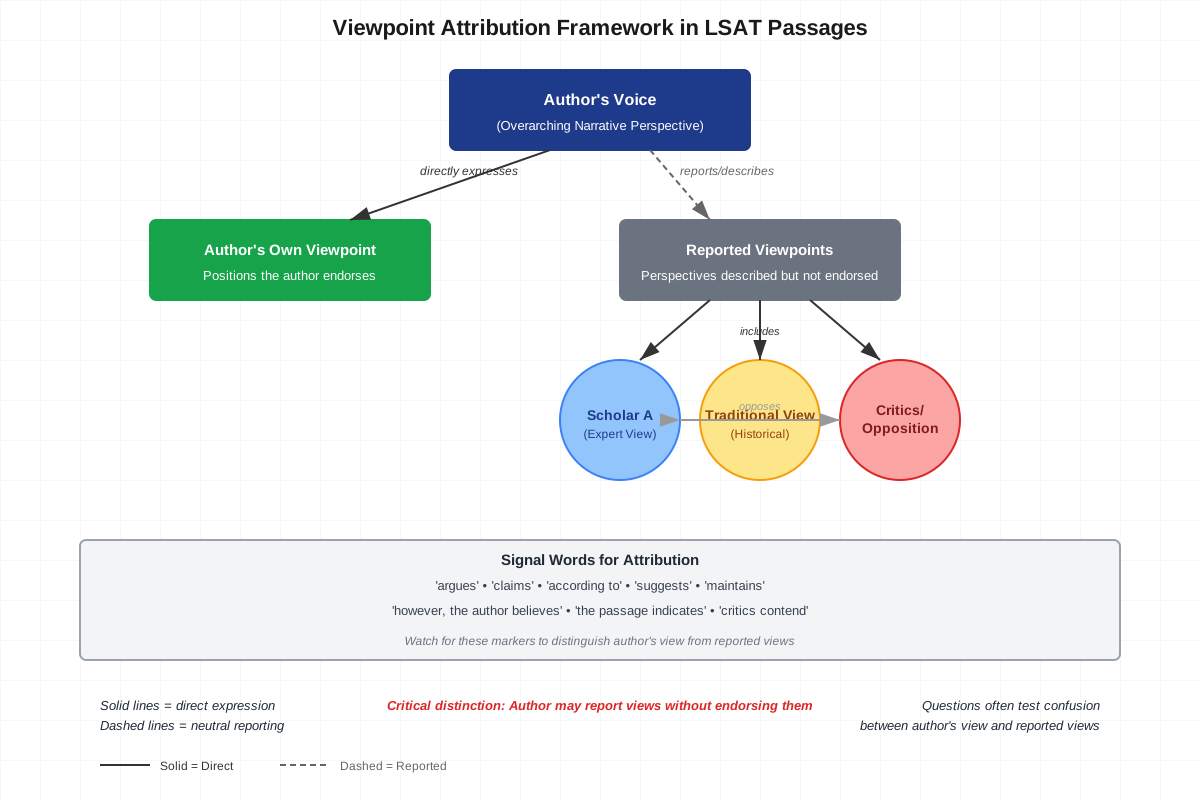
The fundamental skill underlying viewpoint identification questions is viewpoint attribution—the ability to correctly assign beliefs, opinions, claims, and attitudes to their proper sources within a passage. Every LSAT reading comprehension passage contains at least two potential sources of viewpoints: the author and the subjects discussed in the passage. More complex passages may include multiple theorists, competing schools of thought, historical figures, or groups with distinct perspectives.
Attribution requires careful attention to attribution markers—linguistic signals that indicate whose perspective is being presented. These include explicit markers like "Smith argues that," "according to the traditional view," "critics contend," or "the author believes." However, attribution is often more subtle, requiring readers to infer from context whose view is being presented. For example, when an author presents a theory without explicit disagreement, readers must determine whether the author endorses this view or merely reports it neutrally.
The Author's Viewpoint vs. Reported Viewpoints
A critical distinction in viewpoint identification questions is between what the author believes and what the author reports that others believe. This distinction is the source of many incorrect answers on the LSAT. Authors frequently present theories, arguments, or positions they do not personally endorse—they may be setting up a view they will later critique, providing historical context, or maintaining scholarly neutrality while presenting multiple perspectives.
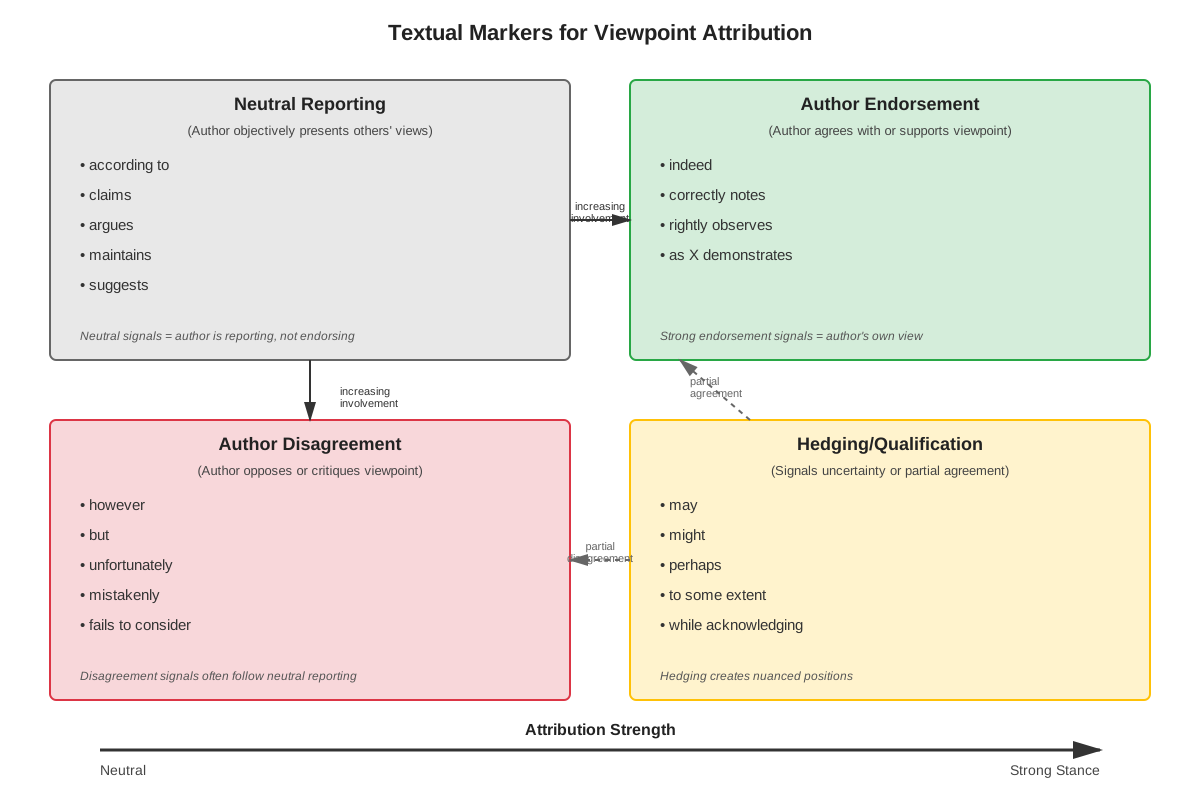
Several textual signals help distinguish the author's own viewpoint:
- Evaluative language: When authors use words like "unfortunately," "surprisingly," "correctly," or "mistakenly," they reveal their own judgment
- Explicit first-person statements: Phrases like "I argue" or "this essay contends" (though rare in LSAT passages)
- Rhetorical questions: Questions posed by the author often signal skepticism toward a view just presented
- Contrast markers: Words like "however," "but," or "in fact" often signal the author's disagreement with a previously stated view
- Concluding paragraphs: Authors often reserve their own position for the end of the passage
Conversely, reported viewpoints are typically introduced with phrases like "X claims," "according to Y," "the traditional interpretation holds," or "critics argue." The absence of authorial commentary following such statements often indicates the author is neutrally reporting rather than endorsing.
Multiple Viewpoint Tracking
Many LSAT passages present multiple distinct viewpoints that students must track simultaneously. A typical structure might include: (1) a traditional or mainstream view, (2) a critic or revisionist challenging that view, and (3) the author's own position, which may side with one party, synthesize both views, or propose a third alternative.
Effective multiple viewpoint tracking requires:
- Creating a mental map of who believes what as you read
- Noting points of agreement and disagreement between different parties
- Tracking the evolution of ideas through the passage
- Recognizing when the author shifts from discussing one viewpoint to another
- Identifying the author's stance relative to the other viewpoints presented
Implicit vs. Explicit Viewpoints
Viewpoint identification questions test both explicit viewpoints—those directly stated in the passage—and implicit viewpoints—those that can be inferred from what is stated. Explicit viewpoint questions are more straightforward: they ask students to identify what the passage directly attributes to a particular source. Implicit viewpoint questions require inference: based on what someone argues or believes, what else would they likely agree with?
For implicit viewpoint questions, students must:
- Understand the logical implications of stated positions
- Recognize what assumptions underlie particular arguments
- Identify what would be consistent or inconsistent with a stated viewpoint
- Apply the reasoning pattern of a particular perspective to new scenarios
Degrees of Certainty and Commitment
Sophisticated viewpoint identification requires recognizing degrees of certainty and commitment in how viewpoints are presented. The LSAT tests whether students can distinguish between:
| Strength of Commitment | Typical Language | Example |
|---|---|---|
| Strong endorsement | "proves," "demonstrates," "clearly shows" | "The evidence clearly demonstrates that X is correct" |
| Moderate support | "suggests," "indicates," "supports the view" | "The findings suggest that Y may be true" |
| Neutral presentation | "claims," "argues," "proposes" | "Smith proposes that Z explains the phenomenon" |
| Skepticism | "purports to," "allegedly," "supposedly" | "The theory purports to explain the data" |
| Rejection | "fails to," "incorrectly assumes," "overlooks" | "This interpretation fails to account for the evidence" |
Understanding these gradations prevents students from incorrectly attributing strong endorsement when an author is merely reporting a claim or expressing tentative support.
Comparative Passage Viewpoints
In comparative reading passages—where two shorter passages address the same topic—viewpoint identification becomes more complex. Students must track not only the viewpoints within each passage but also the relationship between the two authors' perspectives. Questions may ask about points of agreement, points of disagreement, or how one author would likely respond to the other's argument.
Key strategies for comparative passages include:
- Identifying each author's main claim or thesis
- Noting explicit areas of overlap or contrast
- Recognizing when authors use similar evidence but draw different conclusions
- Understanding when authors address different aspects of the same issue
- Inferring how one author would critique the other's reasoning
Concept Relationships
The concepts within viewpoint identification questions form an interconnected hierarchy. At the foundation lies viewpoint attribution—the basic skill of determining who holds what belief. This foundational skill enables distinguishing author's viewpoint from reported viewpoints, which is essential because conflating these is the most common error on viewpoint questions. Both of these skills support multiple viewpoint tracking, which is necessary when passages present three or more distinct perspectives.
The distinction between explicit and implicit viewpoints cuts across all other concepts—any viewpoint (author's, reported, or multiple) can be either directly stated or require inference. Similarly, degrees of certainty and commitment apply to all viewpoints, requiring students to recognize not just what someone believes but how strongly they hold that belief.
These concepts connect to prerequisite knowledge in important ways. Basic passage comprehension provides the content understanding necessary for viewpoint attribution—students must understand what is being said before determining who is saying it. Understanding author's purpose directly enables distinguishing the author's viewpoint from reported viewpoints, as recognizing whether the author's purpose is to argue, critique, or neutrally present determines how to interpret the passage's claims.
The relationship map flows as follows:
Basic Comprehension → enables → Viewpoint Attribution → enables → Author vs. Reported Distinction → enables → Multiple Viewpoint Tracking → combined with → Explicit/Implicit Analysis and Degrees of Certainty → produces → Mastery of Viewpoint Identification Questions
High-Yield Facts
⭐ Viewpoint identification questions appear in approximately 15-25% of all LSAT reading comprehension questions, making them one of the most frequently tested question types.
⭐ The most common error on viewpoint questions is conflating the author's viewpoint with viewpoints the author merely reports or discusses.
⭐ Attribution markers like "according to," "X argues," and "critics contend" explicitly signal whose viewpoint is being presented.
⭐ Evaluative language (unfortunately, surprisingly, correctly, mistakenly) reveals the author's own judgment and viewpoint.
⭐ When an author presents a theory without explicit commentary, the author is typically reporting neutrally rather than endorsing the view.
- Contrast markers (however, but, yet, nevertheless) often signal a shift from a reported viewpoint to the author's own perspective.
- Rhetorical questions in LSAT passages typically signal the author's skepticism toward a view just presented.
- In comparative passages, the two authors' viewpoints are always distinct in some meaningful way—finding that distinction is key.
- Implicit viewpoint questions require identifying what someone would logically agree with based on their stated position.
- The strength of language (proves vs. suggests vs. claims) indicates the degree of certainty or commitment to a viewpoint.
- Authors often present opposing viewpoints in early paragraphs before revealing their own position later in the passage.
- Viewpoint questions frequently use phrases like "would most likely agree," "according to the passage," or "the author's attitude toward X can best be described as."
Quick check — test yourself on Viewpoint identification questions so far.
Try Flashcards →Common Misconceptions
Misconception: If the author discusses a theory or argument in detail, the author must agree with it.
Correction: Authors frequently present theories they disagree with or remain neutral about. Detailed discussion indicates importance to the passage's topic, not authorial endorsement. Look for explicit evaluative language to determine the author's stance.
Misconception: The author's viewpoint is always stated explicitly in the passage.
Correction: While authors sometimes state their position explicitly, they often reveal their viewpoint through subtle cues like evaluative language, rhetorical questions, or the structure of their argument. The author's perspective may need to be inferred from how they present and respond to other viewpoints.
Misconception: If the passage says "according to the passage," it's asking about what the author believes.
Correction: "According to the passage" asks what is stated or supported by the passage content, which may include reported viewpoints of people discussed in the passage, not just the author's own beliefs. Always check whether the question asks specifically about the author or about content presented in the passage.
Misconception: In comparative passages, the two authors always disagree with each other.
Correction: While comparative passages always present distinct perspectives, the authors may agree on some points while disagreeing on others. They might address different aspects of an issue, use different methodologies, or draw different conclusions from shared premises. The relationship is often more nuanced than simple agreement or disagreement.
Misconception: Neutral presentation means the author has no viewpoint.
Correction: Even when authors present multiple perspectives neutrally, they often have a viewpoint about which approach is more valid, which questions are most important, or how the debate should be framed. The author's viewpoint may be about the nature of the debate itself rather than endorsing one side.
Misconception: The viewpoint presented first in the passage is the one the author supports.
Correction: LSAT passages frequently begin by presenting a traditional view, mainstream interpretation, or theory that the author will later critique or complicate. The initial viewpoint often serves as a foil for the author's own position, which typically appears later in the passage.
Worked Examples
Example 1: Distinguishing Author's View from Reported View
Passage Excerpt:
"Traditional art historians have long maintained that the Renaissance represented a complete break from medieval artistic conventions, marking the birth of modern individualism in art. This interpretation, championed by scholars like Burckhardt in the nineteenth century, emphasizes the Renaissance artist's newfound freedom from religious and guild constraints. However, recent scholarship has revealed significant continuities between medieval and Renaissance art, particularly in workshop practices and patronage systems. Rather than a revolutionary break, the Renaissance appears to have been a gradual evolution that retained many medieval structures while introducing new techniques and subjects."
Question: The author's view of the relationship between medieval and Renaissance art can best be described as:
Analysis:
Let's identify the viewpoints present:
- Traditional art historians' view (explicitly attributed): Renaissance was a complete break from medieval conventions
- Burckhardt's view (explicitly attributed): Emphasized newfound freedom from constraints
- Recent scholarship's view (explicitly attributed): Revealed significant continuities
- Author's view (signaled by "However" and "appears to have been"): Gradual evolution retaining medieval structures while introducing innovations
The key is recognizing that the author presents the traditional view in the first two sentences without endorsement—these are reported viewpoints. The contrast marker "However" signals the shift to more recent scholarship, and the author's own language ("appears to have been") in the final sentence indicates alignment with this revisionist interpretation.
Correct approach: The author views the relationship as one of gradual evolution with continuities, not revolutionary break. The author reports but does not endorse the traditional "complete break" interpretation.
Common trap: Selecting an answer that reflects the traditional view because it appears first and is discussed in detail. This conflates reported viewpoint with authorial viewpoint.
Example 2: Implicit Viewpoint Inference
Passage Excerpt:
"Economist Maria Santos argues that minimum wage increases inevitably lead to unemployment among low-skilled workers, as employers cannot afford to maintain the same workforce at higher wage rates. She supports this claim by citing studies showing job losses in sectors that experienced mandated wage increases. Santos concludes that well-intentioned minimum wage policies ultimately harm the very workers they aim to help."
Question: Based on the passage, Santos would most likely agree with which of the following?
Analysis:
Santos's explicit viewpoint includes:
- Minimum wage increases cause unemployment
- Employers cannot afford the same workforce at higher wages
- Minimum wage policies harm intended beneficiaries
To answer an implicit viewpoint question, we must identify what logically follows from Santos's stated position:
Would likely agree with:
- Policies should be evaluated by their actual effects, not intentions (implied by her conclusion about "well-intentioned" policies)
- Market forces constrain employers' ability to absorb wage increases (underlying assumption of her argument)
- Alternative approaches to helping low-wage workers might be more effective (implied by her critique)
Would likely disagree with:
- Government wage mandates improve outcomes for low-skilled workers
- Employers have sufficient flexibility to absorb wage increases without job cuts
- Good intentions are sufficient justification for economic policies
Correct approach: Select an answer that represents a logical extension or underlying assumption of Santos's stated position, even if not explicitly mentioned in the passage.
Common trap: Selecting an answer that sounds related to minimum wage but doesn't actually follow from Santos's specific reasoning pattern.
Exam Strategy
Approaching Viewpoint Identification Questions
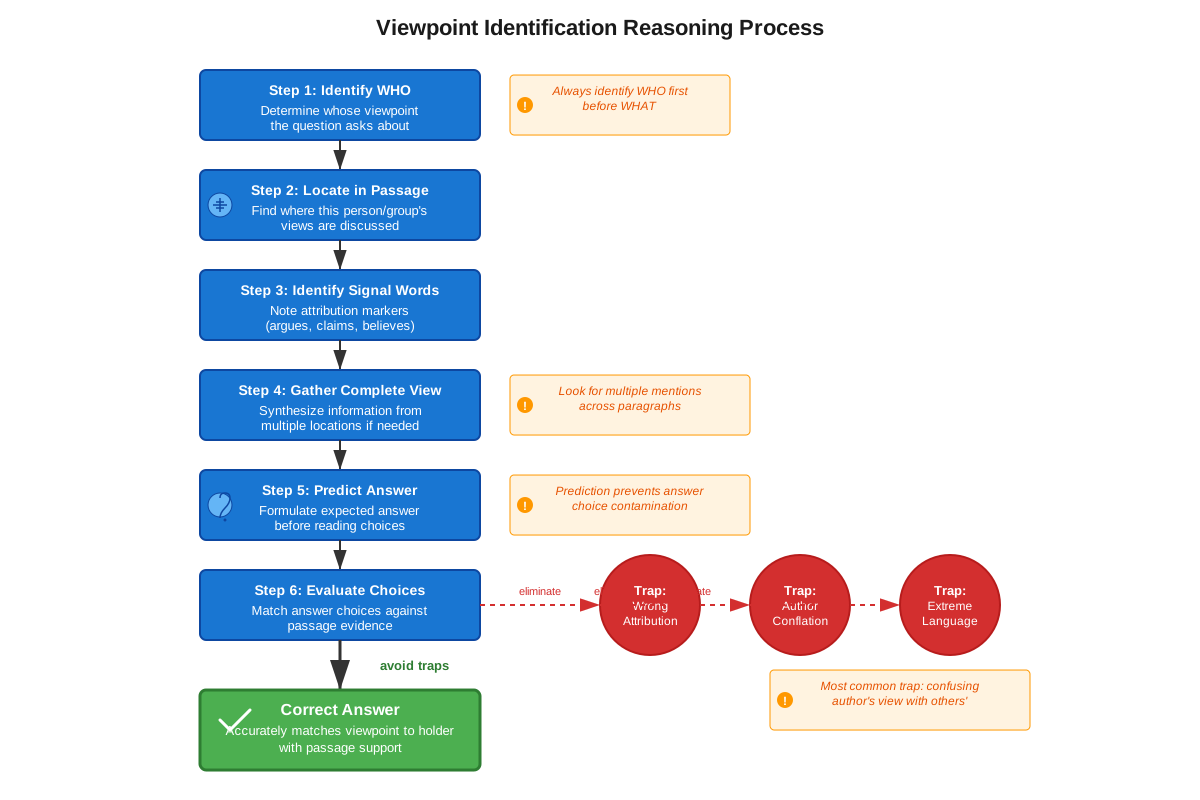
When encountering a viewpoint identification question, follow this systematic approach:
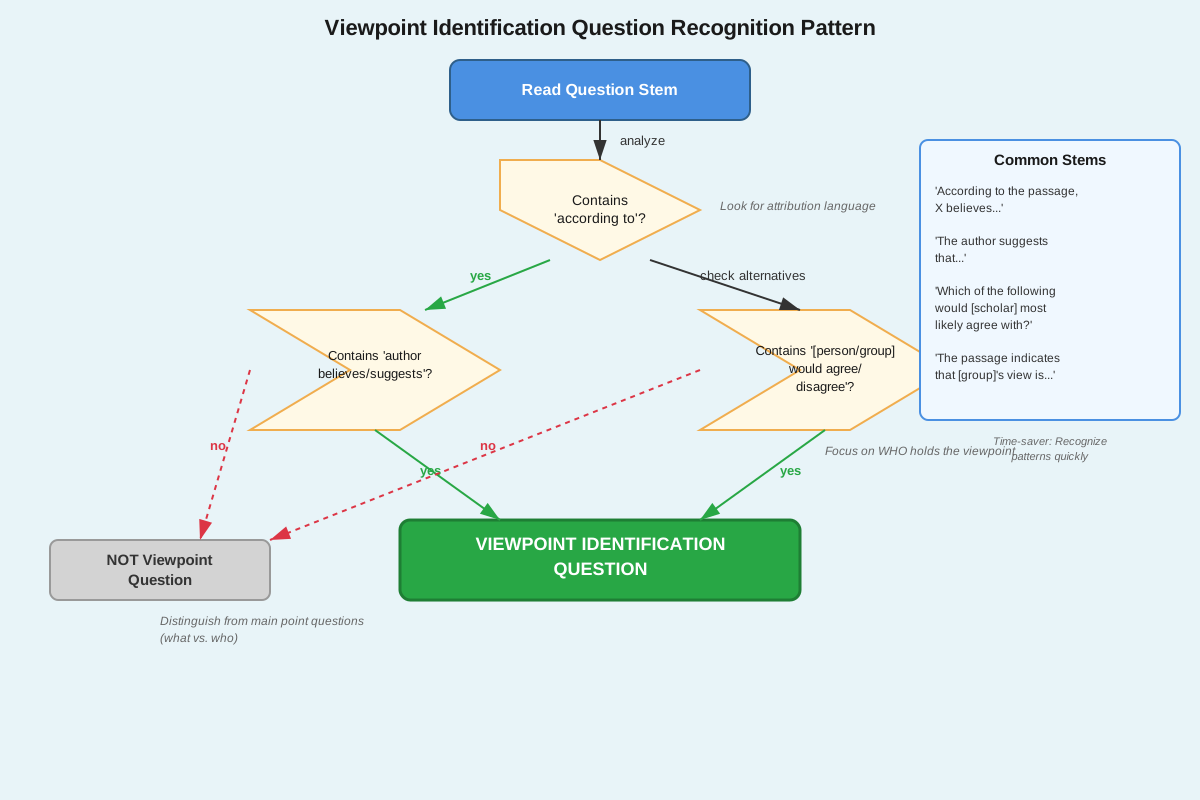
- Identify the question type immediately: Look for phrases like "according to," "the author would agree," "X's view," or "the passage suggests that Y believes"
- Determine whose viewpoint the question asks about: Is it the author, a specific person/group mentioned in the passage, or what the passage states generally?
- Return to the passage strategically: Don't rely on memory alone. Locate where that person's or group's views are discussed.
- Check for attribution markers: Identify the linguistic signals that indicate whose perspective is being presented.
- Distinguish reporting from endorsing: Determine whether the author is presenting their own view or reporting someone else's.
Trigger Words and Phrases
Question stem triggers that indicate viewpoint questions:
- "The author would most likely agree with..."
- "According to the passage, X believes..."
- "Which of the following best describes the author's attitude toward..."
- "The passage suggests that Y would..."
- "With which of the following would the author be most likely to agree?"
- "X's view, as described in the passage, is that..."
Passage triggers that signal viewpoint attribution:
- Explicit attribution: "argues," "claims," "contends," "maintains," "proposes," "suggests"
- Evaluative language: "unfortunately," "surprisingly," "correctly," "mistakenly," "wisely"
- Contrast markers: "however," "but," "yet," "nevertheless," "on the other hand"
- Skeptical language: "purports to," "allegedly," "supposedly," "so-called"
- Support language: "indeed," "in fact," "clearly," "demonstrates"
Process of Elimination Tips
When evaluating answer choices for viewpoint questions:
- Eliminate answers that confuse whose viewpoint is being asked about: If the question asks about the author's view, eliminate answers that reflect views the author only reports.
- Eliminate extreme answers for implicit viewpoint questions: If inferring what someone would believe, avoid answers that go too far beyond what's supported by their stated position.
- Check for scope mismatches: Eliminate answers that are too broad or too narrow relative to the viewpoint actually expressed.
- Watch for reversed attributions: Eliminate answers that correctly state something from the passage but attribute it to the wrong source.
- Verify with passage evidence: Before selecting an answer, locate specific passage support for the attribution.
Time Allocation Advice
Exam Tip: Viewpoint identification questions typically require 45-75 seconds to answer accurately. Spend the extra time locating precise passage support rather than rushing to an answer based on general memory.
Budget your time as follows:
- 15-20 seconds: Read and analyze the question stem to determine whose viewpoint is being asked about
- 20-30 seconds: Return to the passage and locate relevant content with attribution markers
- 20-25 seconds: Evaluate answer choices using process of elimination
Don't skip the passage review step—viewpoint questions have high error rates when students rely on memory rather than verifying attribution in the passage.
Memory Techniques
The RAVE Acronym for Viewpoint Analysis
Reported vs. Author's view
Attribution markers
Verify in passage
Evaluative language
Use RAVE to remember the key steps: distinguish Reported viewpoints from the Author's view by identifying Attribution markers, Verify your answer in the passage, and watch for Evaluative language that reveals the author's stance.
The "Who Said What" Margin Note System
As you read LSAT passages, develop a shorthand system for margin notes:
- A = Author's view
- T = Traditional/mainstream view
- C = Critic's view
- X = Person/group X's view (use initials)
- ? = Unclear or neutral presentation
This quick notation system helps you track multiple viewpoints and quickly locate them when answering questions.
The Contrast Marker Visualization
Visualize contrast markers (however, but, yet) as directional arrows pointing to the author's own view. When you see these markers, imagine an arrow pointing forward to signal "here comes what the author actually thinks" as opposed to what they've been reporting.
The Attribution Chain
For complex passages with multiple viewpoints, create a mental chain:
Traditional View → Critic's Challenge → Author's Synthesis
This three-part structure appears frequently in LSAT passages. Recognizing this pattern helps you anticipate where the author's view will appear (typically in the synthesis) and avoid conflating it with earlier reported views.
Summary
Viewpoint identification questions test the critical skill of distinguishing between different perspectives presented in LSAT reading comprehension passages—particularly between the author's own viewpoint and the viewpoints of individuals or groups the author discusses. Mastering these questions requires careful attention to attribution markers, evaluative language, and structural signals that indicate whose perspective is being presented. The most common error is conflating the author's viewpoint with viewpoints the author merely reports, which can be avoided by recognizing that detailed discussion does not equal endorsement. Success on these questions demands active reading that tracks multiple viewpoints simultaneously, distinguishes between explicit and implicit viewpoints, and recognizes degrees of certainty and commitment in how views are presented. By systematically identifying whose viewpoint is being asked about, locating relevant passage support with clear attribution, and carefully evaluating answer choices for proper attribution, students can consistently answer these high-frequency questions correctly.
Key Takeaways
- Viewpoint identification questions appear in 15-25% of reading comprehension questions and test the ability to distinguish between different perspectives in a passage
- The critical distinction is between the author's own viewpoint and viewpoints the author reports or discusses without endorsing
- Attribution markers (according to, X argues, critics contend) and evaluative language (unfortunately, correctly, mistakenly) are key textual signals for identifying viewpoints
- Detailed discussion of a theory or position does not indicate authorial agreement—look for explicit evaluative language to determine the author's stance
- Contrast markers (however, but, yet) often signal the transition from reported viewpoints to the author's own perspective
- Implicit viewpoint questions require identifying what someone would logically agree with based on their stated position
- Always verify viewpoint attribution by returning to the passage rather than relying on memory alone
Related Topics
Author's Attitude and Tone Questions: These questions focus specifically on the author's emotional or intellectual stance toward the subject matter, building directly on viewpoint identification skills by requiring students to characterize the author's perspective with greater precision.
Inference Questions: Many inference questions require understanding viewpoints to determine what can be logically concluded from stated positions, making viewpoint identification a foundational skill for inference mastery.
Function Questions: Understanding why an author includes particular viewpoints (to critique, support, provide context, etc.) requires first identifying whose viewpoint is being presented, connecting viewpoint identification to passage structure analysis.
Comparative Reading Analysis: Comparative passages intensify viewpoint identification demands by requiring students to track and compare the perspectives of two different authors on the same topic.
Argument Structure in Logical Reasoning: The skills developed in viewpoint identification transfer directly to Logical Reasoning, where distinguishing between an argument's conclusion, premises, and background information requires similar attribution analysis.
Practice CTA
Now that you understand the core concepts and strategies for viewpoint identification questions, it's time to put your knowledge into practice. Work through the practice questions and flashcards to reinforce these skills and build the pattern recognition that leads to consistent accuracy. Remember: viewpoint identification is a skill that improves dramatically with deliberate practice. Each question you analyze strengthens your ability to track multiple perspectives and avoid the common trap of conflating reported views with authorial views. Your investment in mastering this high-frequency question type will pay dividends across every reading comprehension passage you encounter on test day.
Sign up free to keep reading
Create a free AnvayaPrep account to finish this LSAT guide on Viewpoint identification questions — plus flashcards and practice questions.