Overview
Author neutrality is a critical concept in LSAT Reading Comprehension that tests a student's ability to distinguish between passages where the author presents information objectively versus those where the author advocates for a particular position. Understanding author neutrality is essential because the LSAT frequently asks questions about the author's attitude, tone, purpose, and degree of commitment to the ideas presented in a passage. Misidentifying whether an author is neutral or biased can lead to incorrect answers on multiple question types, including main point, author's attitude, and inference questions.
In LSAT passages, authors may adopt various stances: they might present multiple viewpoints without endorsing any particular one, they might describe a theory or phenomenon objectively, or they might actively argue for or against a position. Recognizing lsat author neutrality requires careful attention to language choices, qualifiers, and the structure of argumentation. A neutral author typically presents information in a balanced manner, acknowledges multiple perspectives, and avoids evaluative language that signals personal investment in the outcome of a debate.
This topic sits at the intersection of viewpoints and argumentation within Reading Comprehension. While understanding individual viewpoints helps identify what different parties believe, recognizing author neutrality helps determine whether the author is merely reporting these viewpoints or actively participating in the debate. This distinction fundamentally affects how students should interpret the passage's purpose and answer questions about the author's perspective, making it one of the highest-yield skills for maximizing Reading Comprehension scores.
Learning Objectives
- [ ] Identify how Author neutrality appears in LSAT questions
- [ ] Explain the reasoning pattern behind Author neutrality
- [ ] Apply Author neutrality to solve LSAT-style problems accurately
- [ ] Distinguish between neutral presentation and subtle advocacy in passage language
- [ ] Recognize the spectrum of author involvement from complete neutrality to strong advocacy
- [ ] Predict question types most likely to test author neutrality concepts
- [ ] Evaluate answer choices by matching them to the author's demonstrated level of commitment
Prerequisites
- Basic passage structure recognition: Understanding how LSAT passages are organized helps identify where authors typically reveal their stance (often in opening or closing paragraphs, or through transitional phrases).
- Vocabulary for tone and attitude: Familiarity with words describing authorial stance (skeptical, enthusiastic, ambivalent, critical) enables accurate assessment of neutrality.
- Distinguishing facts from opinions: The ability to separate objective statements from evaluative claims is foundational to recognizing when an author moves beyond neutral reporting.
- Understanding of argumentation basics: Recognizing claims, evidence, and conclusions helps identify when an author is building an argument versus merely describing one.
Why This Topic Matters
Author neutrality appears in approximately 15-20% of all LSAT Reading Comprehension questions, making it one of the most frequently tested concepts. Questions explicitly asking about the author's attitude, tone, or purpose directly test this skill, while inference and main point questions often require understanding the author's level of commitment to answer correctly. A student who misreads a neutral author as advocating for a position may select an answer choice that overstates the author's commitment, while misreading an advocate as neutral may lead to selecting answers that are too weak or hedged.
In real-world applications, the ability to assess author neutrality is crucial for legal professionals who must evaluate the objectivity of expert testimony, distinguish between factual reporting and advocacy in legal briefs, and assess the reliability of sources. Judges and attorneys constantly evaluate whether a writer is presenting information objectively or advancing a particular agenda, making this skill directly relevant to legal practice.
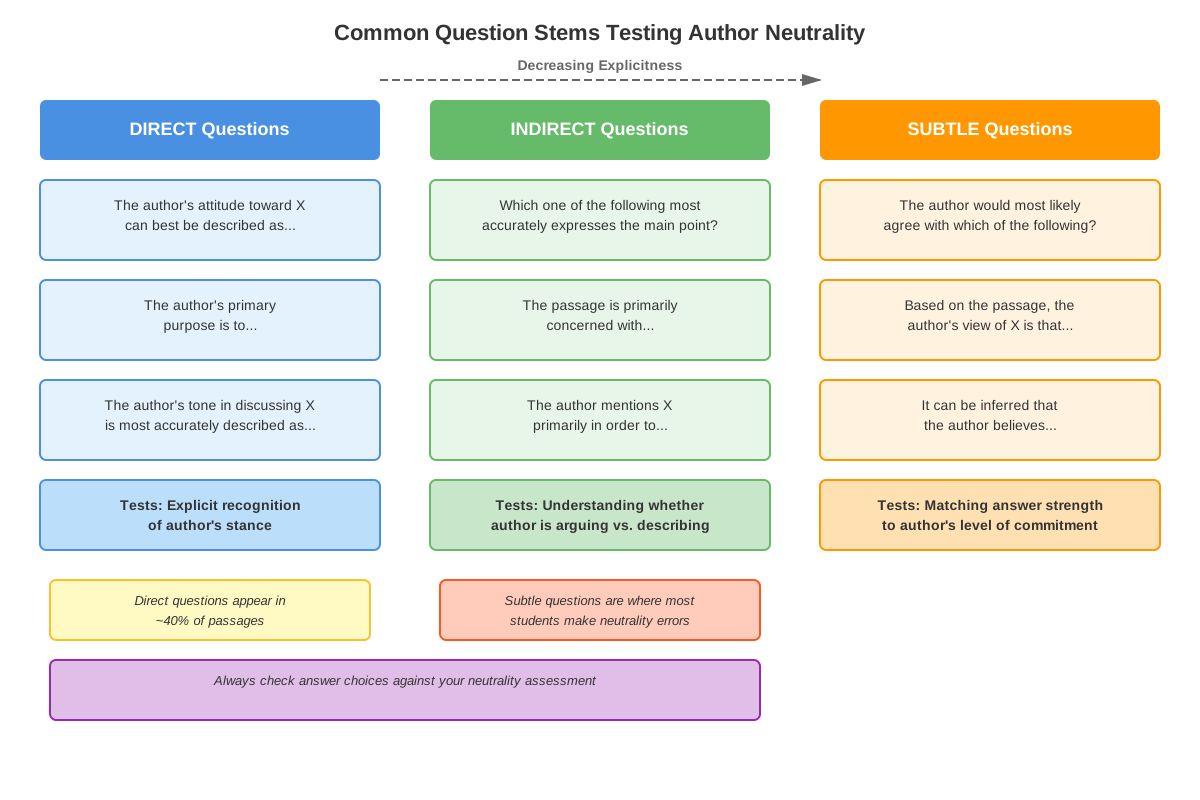
On the LSAT, author neutrality most commonly appears in passages from the humanities and social sciences, where authors might describe competing theories, present historical debates, or explain scientific controversies. Natural science passages occasionally feature neutral authors explaining phenomena, while law passages may present legal theories or court decisions with varying degrees of authorial commentary. Questions testing this concept typically include phrases like "the author's attitude toward X can best be described as," "the author's primary purpose is to," or "the author would most likely agree with which of the following."
Core Concepts
Defining Author Neutrality
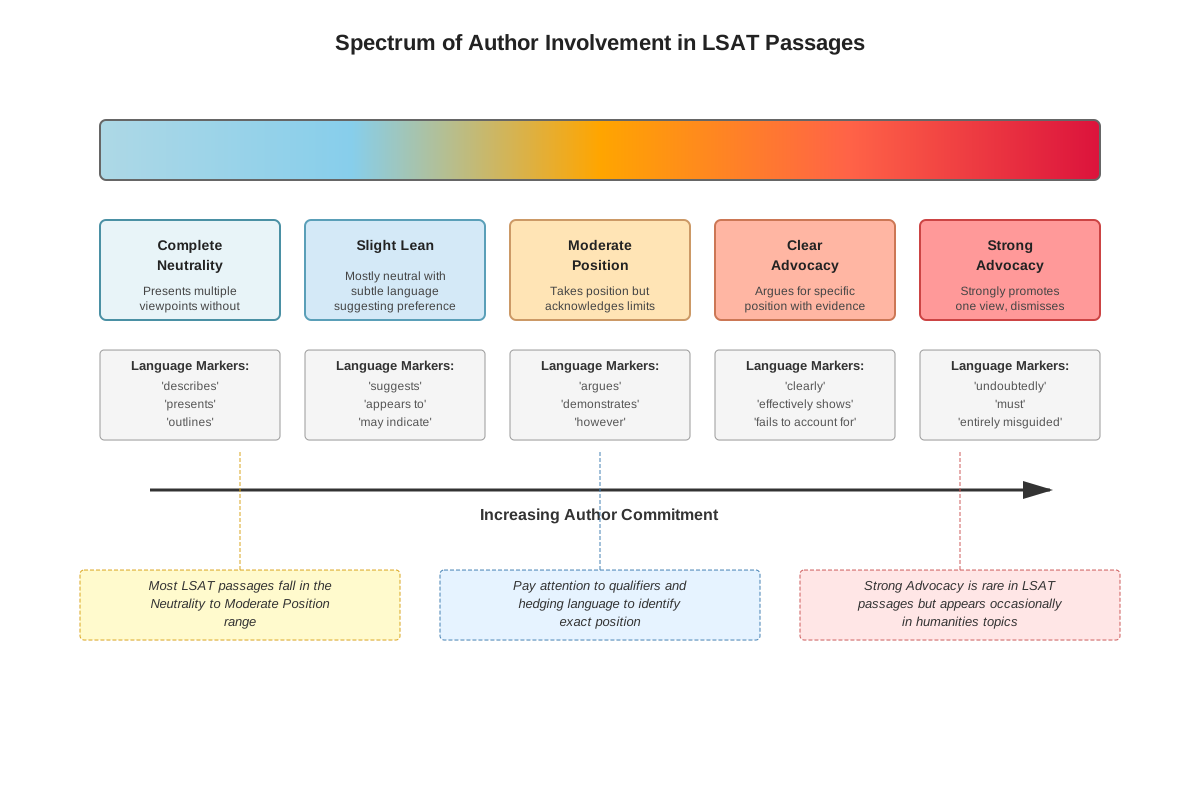
Author neutrality refers to the degree to which a passage's author refrains from taking a personal position on the subject matter being discussed. A truly neutral author acts as a reporter or explainer, presenting information, theories, or viewpoints without signaling personal agreement, disagreement, or preference. This neutrality exists on a spectrum rather than as a binary state—authors may be completely neutral, subtly biased, moderately committed, or strongly advocating.
The LSAT tests whether students can accurately place an author on this spectrum by examining textual evidence. A neutral author typically employs several characteristic features: balanced presentation of multiple viewpoints, absence of evaluative language, use of hedging qualifiers when making claims, and structural choices that give equal weight to different perspectives. Conversely, non-neutral authors reveal their positions through word choice (positive or negative connotations), structural emphasis (spending more time developing favored positions), explicit statements of agreement or disagreement, and rhetorical techniques designed to persuade rather than inform.
The Spectrum of Author Involvement
Understanding author neutrality requires recognizing that authors occupy different positions on a continuum of involvement:
| Level of Involvement | Characteristics | Typical Language Markers |
|---|---|---|
| Complete Neutrality | Pure description; no evaluation | "X argues," "The theory states," "Some believe" |
| Subtle Preference | Slight favor shown through emphasis or word choice | "Importantly," "merely," "surprisingly" |
| Moderate Advocacy | Clear position with acknowledgment of alternatives | "Although X claims..., Y's position is more compelling" |
| Strong Advocacy | Explicit argument for one position | "X is wrong," "clearly," "must," "undoubtedly" |
The LSAT most frequently tests the distinction between complete neutrality and subtle preference, as this requires the most careful reading. Students must learn to detect when an author moves from objective reporting into evaluation, even when that evaluation is understated.
Linguistic Markers of Neutrality
Neutral authors employ specific linguistic patterns that signal objectivity. Attribution language is perhaps the most reliable marker—neutral authors consistently attribute claims to their sources rather than presenting them as established facts. Phrases like "According to Smith," "Jones argues that," "The traditional view holds," and "Critics contend" indicate the author is reporting rather than endorsing.
Hedging language also signals neutrality or uncertainty. Words like "may," "might," "could," "possibly," "suggests," and "appears to" indicate the author is not fully committed to a claim. However, students must distinguish between hedging that reflects the author's uncertainty and hedging that reflects genuine scientific or scholarly uncertainty being reported neutrally.
Balanced structure provides another key indicator. Neutral authors typically devote roughly equal space to competing viewpoints and present them in parallel structures. If an author spends three paragraphs explaining Theory A and one sentence dismissing Theory B, this structural imbalance suggests non-neutrality, even if the language appears objective.
Linguistic Markers of Non-Neutrality
Non-neutral authors reveal their positions through several linguistic patterns. Evaluative adjectives and adverbs signal judgment: "unfortunately," "wisely," "mistakenly," "impressive," "flawed," "brilliant," or "misguided." These words move beyond description into assessment.
Absolute language often indicates strong commitment: "certainly," "undoubtedly," "clearly," "obviously," "must," or "cannot." While neutral authors might report that someone else uses such language, they avoid it in their own voice when discussing contested claims.
Rhetorical questions typically signal non-neutrality because they're persuasive devices rather than neutral reporting tools. When an author asks, "How could anyone seriously maintain that X?" they're not neutrally presenting information but rather arguing against position X.
Contrast markers with unequal treatment reveal preference. Phrases like "X claims... but in reality," "While X argues... the truth is," or "X mistakenly believes... when actually" show the author favoring one position over another.
Author Purpose and Neutrality
An author's primary purpose closely relates to neutrality. Neutral authors typically have purposes like "to describe," "to explain," "to present," "to compare," or "to trace the development of." These purposes involve conveying information without taking sides. Non-neutral authors have purposes like "to argue," "to advocate," "to criticize," "to defend," or "to refute." These purposes inherently involve taking a position.
However, students must recognize that an author can neutrally describe an argument without making that argument themselves. A passage might explain why some scholars advocate for Theory X, detailing their reasoning and evidence, while the author remains neutral about whether Theory X is correct. The LSAT frequently tests whether students can distinguish between "the author explains why some people believe X" (neutral) and "the author believes X" (non-neutral).
Context Clues for Assessing Neutrality
The passage source and subject matter provide context for assessing neutrality. LSAT passages drawn from academic journals often feature neutral authors explaining research or theories, while passages from opinion pieces or advocacy publications more likely contain non-neutral authors. However, students should never assume neutrality based solely on source—textual evidence must confirm it.
The presence of controversy in a passage doesn't determine author neutrality. An author can neutrally describe a heated debate, presenting both sides fairly, or can jump into that debate as a partisan. Similarly, an author can write non-neutrally about a topic with little controversy, advocating for a particular interpretation or approach.
Concept Relationships
Author neutrality connects intimately with other viewpoints and argumentation concepts. Understanding different viewpoints in a passage requires first determining whether the author is one of the viewpoint holders or merely reporting on others' views. This distinction affects how students map the passage's argumentative structure.
The relationship flows as follows: Passage structure analysis → Identification of viewpoints → Assessment of author neutrality → Understanding of author's purpose → Accurate answering of attitude and tone questions. Each step builds on the previous one, with author neutrality serving as the crucial bridge between identifying what positions exist in the passage and understanding the author's relationship to those positions.
Author neutrality also connects to inference questions in Reading Comprehension. Students can only make valid inferences about what an author believes by first accurately assessing the author's level of commitment to various claims in the passage. A neutral author who describes Theory X cannot be inferred to believe Theory X, while a non-neutral author who advocates for Theory X can be inferred to agree with its implications.
The concept relates to tone and attitude vocabulary as well. Neutral authors exhibit tones like "objective," "impartial," "detached," "analytical," or "descriptive," while non-neutral authors might be "critical," "enthusiastic," "skeptical," "approving," or "dismissive." Understanding these tone descriptors helps students both identify neutrality and select correct answers to attitude questions.
High-Yield Facts
⭐ Neutral authors consistently use attribution language (e.g., "Smith argues," "according to the theory") rather than presenting contested claims as facts.
⭐ The primary purpose of a neutral author is typically to describe, explain, or present rather than to argue, advocate, or criticize.
⭐ Evaluative language (unfortunately, wisely, flawed, impressive) signals non-neutrality even when the evaluation is subtle.
⭐ Structural balance—giving equal treatment to competing views—suggests neutrality, while disproportionate emphasis suggests preference.
⭐ An author can neutrally explain why others advocate for a position without endorsing that position themselves, a distinction the LSAT frequently tests.
- Hedging language (may, might, suggests, appears to) often indicates either author uncertainty or neutral reporting of uncertain claims.
- Rhetorical questions typically signal non-neutrality because they're persuasive rather than informative devices.
- Absolute language (certainly, clearly, must, obviously) in the author's own voice suggests strong commitment rather than neutrality.
- The presence of controversy in a passage doesn't determine author neutrality—neutral authors can describe heated debates objectively.
- Contrast markers with unequal treatment ("X claims... but in reality") reveal author preference for one position over another.
- An author's tone vocabulary (objective, impartial, critical, enthusiastic) directly reflects their level of neutrality.
- Questions asking about "the author's attitude" or "the author's primary purpose" directly test author neutrality assessment skills.
Quick check — test yourself on Author neutrality so far.
Try Flashcards →Common Misconceptions
Misconception: If an author presents multiple viewpoints, they must be neutral. → Correction: Authors can present multiple viewpoints while clearly favoring one through structural emphasis, evaluative language, or explicit statements of preference. Presenting alternatives doesn't guarantee neutrality—how those alternatives are presented determines neutrality.
Misconception: Neutral authors never use strong language or make definitive statements. → Correction: Neutral authors can make strong, definitive statements about uncontested facts or well-established findings. Neutrality concerns contested claims and debatable interpretations, not all statements. An author stating "DNA contains genetic information" uses definitive language but isn't being non-neutral because this is established fact.
Misconception: If an author explains the reasoning behind a theory, they must agree with that theory. → Correction: Neutral authors frequently explain the logic and evidence supporting theories they don't personally endorse. The LSAT tests whether students can distinguish "the author explains why proponents believe X" from "the author believes X." Explanation doesn't equal endorsement.
Misconception: Academic or scientific passages always feature neutral authors. → Correction: While academic passages often contain neutral authors, many feature scholars arguing for particular positions, critiquing others' work, or advocating for new approaches. Students must assess neutrality through textual evidence, not assumptions about passage type.
Misconception: An author who acknowledges weaknesses in their preferred position must be neutral. → Correction: Non-neutral authors often acknowledge limitations or counterarguments to strengthen their overall argument through apparent fairness. This rhetorical strategy doesn't make them neutral—their overall position and purpose remain advocacy-oriented.
Misconception: Neutral language throughout a passage means the author has no purpose beyond description. → Correction: Neutral authors often have sophisticated purposes beyond mere description, such as explaining why a debate has proven difficult to resolve, tracing how thinking on a topic has evolved, or clarifying distinctions between commonly confused positions. Neutrality describes the author's relationship to competing positions, not the sophistication of their purpose.
Worked Examples
Example 1: Distinguishing Neutral Description from Subtle Advocacy
Passage Excerpt: "Traditional approaches to urban planning emphasized automobile accessibility, designing cities around highway systems and parking infrastructure. More recently, urban theorists have advocated for pedestrian-centered design, arguing that walkable neighborhoods promote community interaction and reduce environmental impact. This shift reflects changing priorities in how planners conceptualize urban space, with implications for both social cohesion and sustainability."
Question: The author's attitude toward pedestrian-centered design can best be described as:
(A) Strongly supportive
(B) Cautiously optimistic
(C) Neutral and descriptive
(D) Mildly skeptical
(E) Openly critical
Analysis:
Step 1: Identify attribution and evaluative language. The author uses "urban theorists have advocated" (attribution) and "arguing that" (attribution), indicating these are others' positions being reported. The author doesn't use evaluative language like "wisely," "unfortunately," or "impressive."
Step 2: Examine structural balance. The passage gives roughly equal space to traditional and recent approaches without emphasizing one over the other. The final sentence describes implications neutrally ("with implications for") rather than evaluating them positively or negatively.
Step 3: Assess the author's own voice. The author's statements are descriptive: "emphasized," "have advocated," "reflects changing priorities." These describe what has happened without evaluating whether these changes are good or bad.
Step 4: Eliminate answers based on evidence. (A) requires positive evaluative language not present. (B) requires some positive language with hedging, also absent. (D) and (E) require negative language or criticism, which doesn't appear. (C) matches the neutral, descriptive approach throughout.
Answer: (C) Neutral and descriptive
Connection to Learning Objectives: This example demonstrates how to identify author neutrality through systematic analysis of attribution language, structural balance, and absence of evaluative terms—directly applying the reasoning pattern behind author neutrality to solve LSAT-style problems.
Example 2: Recognizing Subtle Non-Neutrality
Passage Excerpt: "While proponents of the efficient market hypothesis claim that stock prices reflect all available information, making consistent outperformance impossible, this view overlooks substantial evidence of market anomalies. Numerous studies have documented persistent patterns—such as momentum effects and value premiums—that contradict the hypothesis's predictions. More importantly, the hypothesis rests on unrealistic assumptions about investor rationality that behavioral economics has thoroughly undermined."
Question: The author's primary purpose in this passage is most likely to:
(A) Neutrally present two competing theories in finance
(B) Explain why the efficient market hypothesis gained acceptance
(C) Criticize the efficient market hypothesis using empirical and theoretical grounds
(D) Describe the evolution of thinking about market efficiency
(E) Compare the methodologies of traditional and behavioral economics
Analysis:
Step 1: Identify evaluative language. "Overlooks" is negative, suggesting the hypothesis fails to account for something important. "More importantly" signals the author's judgment about which point matters most. "Unrealistic assumptions" and "thoroughly undermined" are clearly negative evaluations.
Step 2: Examine structural balance. The passage gives minimal space to the efficient market hypothesis (one clause) and extensive space to criticisms (the remainder). This imbalance suggests the author favors the critical perspective.
Step 3: Assess contrast markers. "While proponents claim... this view overlooks" sets up an unequal contrast where the author sides with the criticism. This structure signals non-neutrality.
Step 4: Determine purpose based on neutrality assessment. The author isn't neutrally presenting theories (eliminating A) or merely describing evolution (eliminating D). The author is actively arguing against the efficient market hypothesis using both empirical evidence (market anomalies) and theoretical critique (behavioral economics).
Step 5: Match purpose to answer choices. (C) accurately captures the author's critical stance and the two types of grounds (empirical studies and theoretical assumptions) used in the criticism.
Answer: (C) Criticize the efficient market hypothesis using empirical and theoretical grounds
Connection to Learning Objectives: This example shows how to recognize subtle non-neutrality through evaluative language, structural imbalance, and unequal contrast markers, then apply that recognition to determine the author's purpose—demonstrating the complete reasoning pattern from identification to application.
Exam Strategy
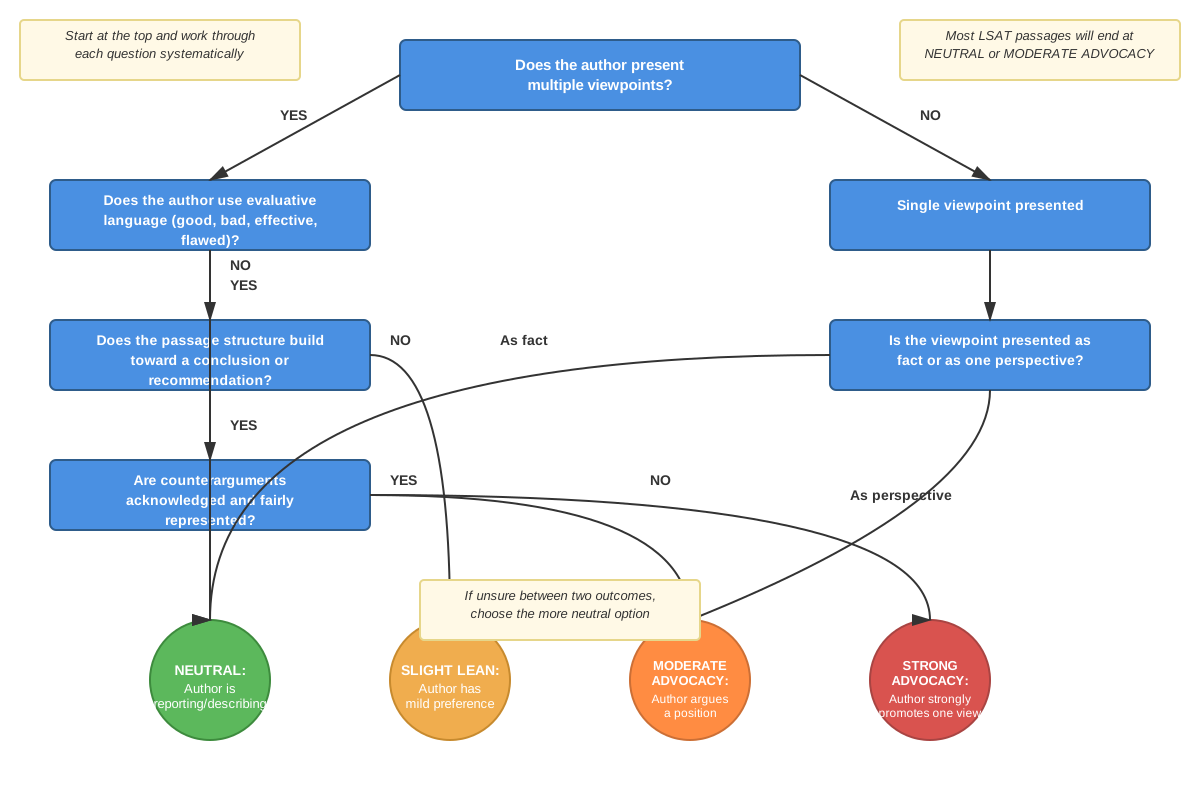
When approaching LSAT Reading Comprehension questions involving author neutrality, begin by actively reading for attribution. As you read the passage initially, mark or mentally note every instance where the author attributes claims to others versus making claims in their own voice. This creates a foundation for assessing neutrality.
Trigger words and phrases to watch for include:
- Neutrality indicators: "according to," "argues that," "claims," "the theory holds," "proponents believe," "critics contend," "some scholars maintain"
- Non-neutrality indicators: "unfortunately," "importantly," "merely," "clearly," "in fact," "actually," "however" (when introducing the author's preferred view), "mistakenly," "wisely," "impressive," "flawed"
When you encounter a question asking about the author's attitude, tone, or primary purpose, return to the passage systematically. Don't rely on memory alone. Scan for:
- How the author introduces competing viewpoints (equally or unequally?)
- What language the author uses in their own voice (descriptive or evaluative?)
- How the passage concludes (with a neutral summary or a position statement?)
For process of elimination, use these strategies specific to author neutrality:
- Eliminate answers that are too strong if the author uses hedging language or balanced structure
- Eliminate answers that are too weak if the author uses evaluative language or structural emphasis
- Eliminate answers describing attitudes toward topics the author only reports on without endorsing
- Eliminate answers that confuse explaining someone else's reasoning with agreeing with that reasoning
Time allocation: Spend approximately 30-45 seconds on initial passage reading specifically noting author stance markers. This investment pays off by making attitude and purpose questions answerable in 30-45 seconds each rather than requiring full passage re-reading. For a typical 4-question passage set, this strategy saves 1-2 minutes overall.
When predicting answers before looking at choices, formulate your prediction in terms of the neutrality spectrum: "The author is completely neutral, just describing the debate" or "The author subtly favors Theory B through positive language and structural emphasis" or "The author strongly advocates against Position X." This prediction framework helps you quickly identify matching answer choices.
Memory Techniques
NEUTRAL mnemonic for identifying neutral authors:
- No evaluative language in author's voice
- Equal treatment of competing views
- Uses attribution consistently
- Tone is descriptive, not persuasive
- Refrains from absolute claims about contested issues
- Avoids rhetorical questions
- Language is hedged when appropriate
The Attribution Test: When uncertain about neutrality, apply this quick test: Could you replace "the author states X" with "the author reports that others state X" without changing the passage's meaning? If yes, the author is likely neutral on that point.
Visualization strategy: Picture the author as either a reporter (neutral—standing outside the debate, microphone in hand, interviewing participants) or a participant (non-neutral—standing in the debate, making arguments). This mental image helps quickly categorize the author's role.
The "Says Who?" technique: As you read, mentally ask "Says who?" after each claim. If the answer is "the author," note whether they're stating a fact, reporting someone else's view, or making an argument. This running internal dialogue builds awareness of attribution patterns.
Summary
Author neutrality represents one of the highest-yield concepts in LSAT Reading Comprehension, appearing in 15-20% of questions and fundamentally affecting how students should interpret passages and answer questions. Neutral authors present information objectively, using consistent attribution language, balanced structure, and descriptive rather than evaluative terms. Non-neutral authors reveal their positions through evaluative language, structural emphasis, absolute claims, and rhetorical devices. The LSAT most frequently tests the subtle distinction between complete neutrality and slight preference, requiring careful attention to linguistic markers. Students must distinguish between authors who neutrally explain others' reasoning and authors who endorse that reasoning themselves—a distinction that affects main point, purpose, attitude, and inference questions. Success requires systematic analysis of attribution patterns, evaluative language, structural balance, and contrast markers, combined with careful elimination of answer choices that mischaracterize the author's level of commitment to positions discussed in the passage.
Key Takeaways
- Author neutrality exists on a spectrum from complete objectivity to strong advocacy; accurately placing the author on this spectrum is essential for answering multiple question types correctly
- Neutral authors consistently use attribution language ("Smith argues," "according to the theory") rather than presenting contested claims as established facts
- Evaluative language (unfortunately, wisely, flawed, impressive) and structural imbalance (disproportionate emphasis on one view) signal non-neutrality even when subtle
- Explaining why others hold a position is not the same as endorsing that position—the LSAT frequently tests this distinction
- Questions about the author's attitude, tone, or primary purpose directly test author neutrality assessment and require systematic textual evidence rather than assumptions
- The most common error is confusing neutral description of an argument with agreement with that argument
- Successful author neutrality assessment requires noting attribution patterns during initial reading and returning to specific textual evidence when answering questions
Related Topics
Tone and Attitude Vocabulary: Mastering the specific words used to describe author attitudes (skeptical, enthusiastic, ambivalent, critical, objective) builds on author neutrality concepts by providing precise language for characterizing the author's stance. Understanding neutrality provides the foundation for distinguishing between similar tone descriptors.
Primary Purpose Questions: These questions directly test author neutrality by asking whether the author's goal is to describe/explain (neutral) or argue/advocate (non-neutral). Mastering neutrality assessment makes purpose questions significantly more approachable.
Inference Questions: Valid inferences about author beliefs depend on accurate neutrality assessment. Students who master author neutrality can avoid the common error of inferring that authors believe everything they describe.
Comparative Reading Passages: These paired passages often feature authors with different levels of neutrality on the same topic, making neutrality assessment crucial for answering relationship questions between the passages.
Practice CTA
Now that you understand the concept of author neutrality and how it appears throughout LSAT Reading Comprehension, you're ready to apply these skills to practice questions. Work through the practice problems systematically, using the attribution test and neutrality indicators you've learned. Pay special attention to questions asking about the author's attitude or primary purpose—these directly test your mastery of this high-yield concept. Review the flashcards to reinforce the linguistic markers of neutrality and non-neutrality until recognizing them becomes automatic. Remember: every passage you read is an opportunity to practice assessing author neutrality, and this skill will pay dividends across multiple question types. You've built a strong foundation—now strengthen it through deliberate practice!
Sign up free to keep reading
Create a free AnvayaPrep account to finish this LSAT guide on Author neutrality — plus flashcards and practice questions.