Overview
Understanding the author's argument is a cornerstone skill for success in LSAT reading comprehension passages. On the LSAT, every passage presents information through a particular lens, and the author's argument represents the central claim, position, or thesis that the author advances and supports throughout the text. Unlike simply identifying what a passage discusses, recognizing the author's argument requires students to distinguish between mere description and advocacy, between presenting others' views and advancing one's own position.
The ability to identify and analyze an lsat author's argument directly impacts performance on approximately 30-40% of reading comprehension questions. These questions may ask students to identify the main point, recognize how evidence supports the conclusion, understand the author's attitude toward competing viewpoints, or determine what would strengthen or weaken the author's position. Mastering this skill enables students to navigate the complex interplay of viewpoints and argumentation that characterizes LSAT passages, particularly in passages that present multiple perspectives on controversial issues.
Within the broader framework of reading comprehension, the author's argument serves as the organizing principle that gives structure and purpose to a passage. It connects to other essential skills such as identifying supporting evidence, recognizing counterarguments, understanding passage structure, and evaluating logical reasoning. Students who can quickly and accurately identify the author's argument gain a significant strategic advantage, as this understanding provides a framework for predicting question types, eliminating wrong answers, and efficiently navigating complex passages under time pressure.
Learning Objectives
- [ ] Identify how Author's argument appears in LSAT questions
- [ ] Explain the reasoning pattern behind Author's argument
- [ ] Apply Author's argument to solve LSAT-style problems accurately
- [ ] Distinguish between the author's argument and other viewpoints presented in a passage
- [ ] Recognize the structural markers and language cues that signal the author's position
- [ ] Evaluate how evidence and examples function to support the author's central claim
- [ ] Predict question types based on the nature and strength of the author's argument
Prerequisites
- Basic passage comprehension skills: The ability to understand literal meaning is necessary before analyzing argumentative structure and authorial intent.
- Understanding of claim vs. evidence: Recognizing the difference between assertions and supporting material provides the foundation for identifying argumentative components.
- Familiarity with passage structure: Knowledge of how LSAT passages are organized helps locate where authors typically state their positions.
- Vocabulary at college reading level: Technical and academic terminology appears frequently in passages discussing the author's scholarly or professional arguments.
Why This Topic Matters
The author's argument represents one of the most frequently tested concepts in LSAT reading comprehension. Approximately 35-45% of reading comprehension questions either directly ask about the author's argument or require understanding it to answer correctly. Question stems such as "Which one of the following most accurately expresses the main point of the passage?" or "The author's attitude toward the theory discussed in the passage is most accurately described as..." explicitly test this skill.
Beyond direct main point questions, understanding the author's argument proves essential for answering questions about passage structure, the function of specific paragraphs, the author's purpose in mentioning certain details, and inference questions that require distinguishing what the author believes from what the passage merely reports. Students who misidentify the author's argument often select wrong answers that confuse supporting points with the main claim, or that attribute to the author positions that the passage only describes without endorsing.
In real-world applications, the ability to identify and analyze arguments prepares students for legal practice, where distinguishing between a judge's holding and dicta, or between an attorney's position and the opposing counsel's arguments, proves crucial. This skill also enhances critical reading in academic contexts, professional communications, and media literacy. On the LSAT specifically, passages from law, humanities, natural sciences, and social sciences all require this analytical capability, making it universally applicable across all passage types.
Core Concepts
Defining the Author's Argument
The author's argument is the central claim, thesis, or position that the author advances and defends throughout a passage. It represents what the author wants readers to believe or accept, supported by evidence, reasoning, and analysis. Critically, the author's argument differs from the passage's topic (what the passage is about) and from claims the author merely reports without endorsing.
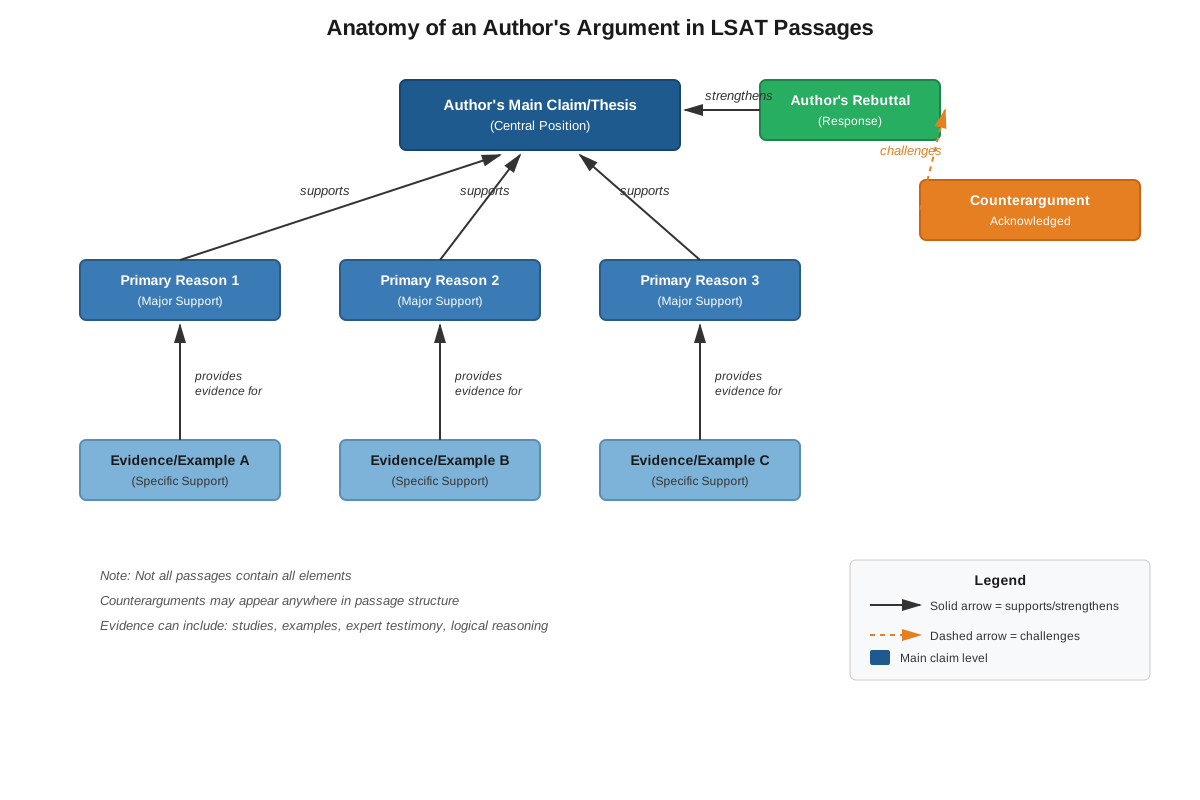
An author's argument typically contains two essential components: a conclusion (the main claim being advanced) and premises (the reasons, evidence, or support offered for that conclusion). In LSAT passages, authors may argue for interpretations of historical events, evaluations of scientific theories, critiques of legal doctrines, or assessments of artistic movements. The argument may be explicitly stated in a thesis sentence or may need to be inferred from the author's treatment of the subject matter.
Explicit vs. Implicit Arguments
LSAT passages vary in how directly they state the author's position. Explicit arguments feature clear thesis statements, often appearing in the first or last paragraph, using language such as "I argue that," "This essay demonstrates," or "The evidence suggests that." These passages make the author's position unmistakable through direct assertion.
Implicit arguments, by contrast, require readers to infer the author's position from contextual clues: the selection and presentation of evidence, the tone used when discussing different viewpoints, the amount of space devoted to supporting versus opposing positions, and the overall trajectory of the passage. An author might implicitly argue for a position by systematically refuting alternatives, by presenting one theory with neutral language while describing another with skeptical terminology, or by structuring the passage to build toward a particular conclusion without stating it directly.
Distinguishing Author's Argument from Other Viewpoints
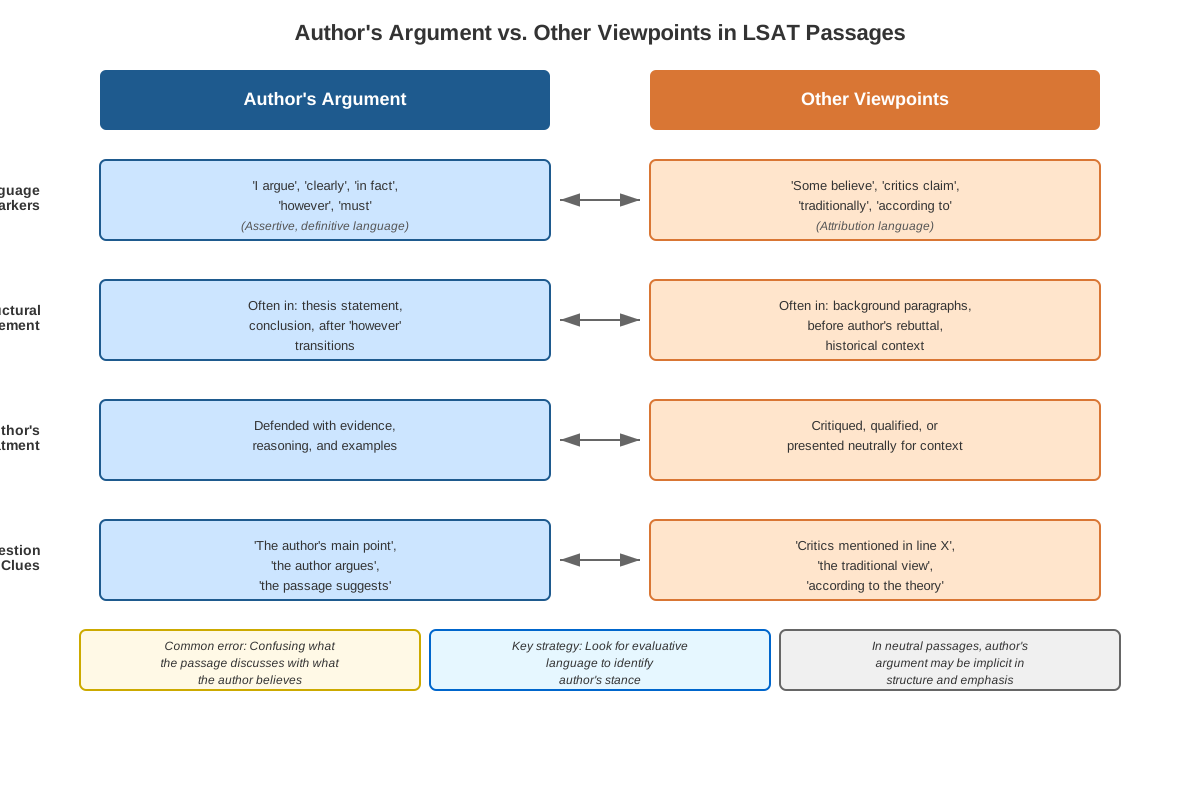
LSAT passages frequently present multiple perspectives, making it essential to distinguish the author's argument from other viewpoints discussed in the passage. A passage might describe a traditional theory, present a challenger's critique, and then offer the author's own assessment. Students must track these different voices and identify which position the author endorses.
Key distinguishing features include:
| Feature | Author's Argument | Other Viewpoints |
|---|---|---|
| Language markers | "Indeed," "In fact," "Clearly," "However" (when introducing author's view) | "According to X," "Some scholars claim," "Traditionally," "It has been argued" |
| Tone | Confident, assertive, evaluative | Neutral reporting, or critical when author disagrees |
| Evidence treatment | Evidence presented as supporting the claim | Evidence presented as what others believe or as requiring reinterpretation |
| Structural position | Often in opening thesis or concluding synthesis | Typically in middle paragraphs as context or foil |
Structural Markers of the Author's Argument
LSAT passages employ predictable structural patterns that signal where and how the author's argument appears. Common patterns include:
- Thesis-first structure: The author states the main argument in the opening paragraph, then develops supporting points in subsequent paragraphs
- Thesis-last structure: The passage presents background, evidence, and analysis, building toward the author's conclusion in the final paragraph
- Problem-solution structure: The author identifies an issue or puzzle, evaluates inadequate responses, then presents their own solution
- Comparative evaluation structure: The author presents multiple theories or approaches, then argues for the superiority of one over others
Transition words and phrases serve as crucial markers. Words like "however," "nevertheless," "in fact," and "actually" often signal the author's own position, especially when contrasting it with previously described views. Phrases such as "more importantly," "the key point is," and "what this reveals" typically introduce central elements of the author's argument.
The Role of Evidence in Supporting Arguments
Understanding how evidence functions within the author's argument proves essential for LSAT success. Authors use various types of support:
- Empirical evidence: Data, studies, observations, and experimental results
- Expert testimony: Citations of authorities or specialists in the field
- Logical reasoning: Deductive or inductive chains of reasoning
- Examples and illustrations: Specific cases that demonstrate general principles
- Analogies: Comparisons that clarify or support the argument
The LSAT tests whether students recognize how specific details function within the argumentative structure. A paragraph describing a scientific experiment might serve to support the author's argument, to present a view the author will critique, or to provide necessary background without directly supporting any argumentative claim. Questions frequently ask about the "function" or "purpose" of specific information, requiring students to understand its relationship to the author's overall argument.
Author's Tone and Attitude
The author's tone and attitude provide crucial evidence for identifying their argument, especially in passages where the thesis remains implicit. Tone refers to the author's emotional stance or manner of expression, while attitude refers to their evaluative position toward the subject matter.
LSAT passages exhibit tones ranging from neutral and objective to critical, enthusiastic, cautious, or skeptical. An author describing a theory with words like "purportedly," "supposedly," or "allegedly" signals skepticism, suggesting their argument involves critiquing that theory. Conversely, language such as "convincingly demonstrates," "successfully challenges," or "illuminating analysis" indicates approval and likely alignment with the author's position.
Argument Strength and Qualification
Authors vary in how strongly they advance their arguments. Some make categorical claims ("This theory is incorrect"), while others offer qualified positions ("This approach has significant limitations" or "The evidence suggests, though does not definitively prove"). Recognizing the degree of certainty or qualification in the author's argument helps students avoid wrong answers that overstate or understate the author's position.
Qualifying language includes terms like "may," "might," "suggests," "appears to," "in some cases," and "to a certain extent." Strong language includes "must," "clearly," "undoubtedly," "always," and "never." LSAT wrong answers frequently trap students by presenting the author's qualified argument in absolute terms or by weakening a strong authorial claim with unnecessary hedging.
Concept Relationships
The author's argument serves as the central organizing concept within reading comprehension passages, connecting to virtually every other analytical skill tested on the LSAT. Understanding this web of relationships enhances both comprehension and strategic test-taking.
Author's Argument → Passage Structure: The author's argument determines how a passage is organized. The structural pattern (thesis-first, thesis-last, problem-solution) exists to present and support the author's central claim effectively. Recognizing the argument helps predict where key information will appear.
Evidence and Examples → Author's Argument: All supporting details, data, examples, and citations function in relation to the author's argument. They either support it, provide necessary background for understanding it, present alternative views for the author to critique, or illustrate its implications. Questions about why the author mentions specific details require understanding this functional relationship.
Other Viewpoints → Author's Argument: LSAT passages frequently present multiple perspectives, creating a dialogue between different positions. The author's argument often emerges through contrast with these other viewpoints—either by critiquing them, synthesizing them, or positioning itself as superior. The relationship might be oppositional (author argues against a traditional view), complementary (author builds on previous work), or evaluative (author assesses relative merits of competing theories).
Tone and Attitude → Author's Argument: The author's evaluative stance toward different ideas signals their argumentative position. Skeptical language toward one theory combined with approving language toward another reveals the author's argument even without explicit thesis statements.
Main Point Questions → Author's Argument: These questions directly test identification of the author's central claim, requiring students to distinguish it from supporting points, background information, and other viewpoints discussed.
Function Questions → Author's Argument: Questions asking why the author mentions specific information or what role a paragraph plays require understanding how that element relates to the overall argument.
Inference Questions → Author's Argument: Many inference questions ask what the author would likely agree with, requiring extrapolation from the stated argument to unstated implications.
This interconnected network means that accurately identifying the author's argument provides a foundation for answering multiple question types efficiently and accurately.
High-Yield Facts
⭐ The author's argument is the central claim the author advances and supports, distinct from the passage topic or other viewpoints merely described.
⭐ Approximately 35-45% of reading comprehension questions require identifying or understanding the author's argument.
⭐ Transition words like "however," "nevertheless," and "in fact" often signal the author's own position, especially when contrasting with other views.
⭐ The author's argument may appear explicitly in a thesis statement or implicitly through tone, evidence selection, and structural emphasis.
⭐ Main point questions ask for the author's central claim, not the most frequently discussed topic or a supporting detail.
- Authors may present multiple viewpoints without endorsing any, making neutral reporting distinct from argumentation.
- The structural position of information (opening thesis, concluding synthesis, middle background) provides clues about its relationship to the author's argument.
- Qualifying language ("may," "suggests," "in some cases") versus absolute language ("must," "always," "clearly") indicates the strength of the author's claim.
- Evidence functions differently depending on whether it supports the author's argument, provides background, or represents a view the author critiques.
- The author's tone toward different theories or approaches reveals their argumentative position even without explicit statements.
- Wrong answers to main point questions often confuse supporting points with the central claim or attribute to the author positions they only describe.
- Passages in all subject areas (law, science, humanities, social sciences) require identifying the author's argument, making this a universal skill.
- The amount of passage space devoted to different ideas often indicates their importance to the author's argument.
- Authors may implicitly argue by systematically refuting alternatives rather than directly stating their preferred position.
- Understanding the author's argument enables prediction of likely question types and efficient elimination of wrong answers.
Quick check — test yourself on Author's argument so far.
Try Flashcards →Common Misconceptions
Misconception: The author's argument is whatever the passage discusses most frequently or in greatest detail.
Correction: The most-discussed topic may be background information, a theory the author critiques, or context for understanding the argument. The author's argument is specifically the position the author advances, which may receive less space than the background needed to understand it.
Misconception: If the passage describes a theory or viewpoint, the author must be arguing for it.
Correction: LSAT passages frequently describe theories, historical positions, or scholarly debates without the author endorsing any particular view. Phrases like "according to," "scholars have argued," and "the traditional view holds" signal reporting rather than argumentation. The author's argument emerges from how they evaluate or respond to these described positions.
Misconception: The author's argument always appears in the first paragraph as an explicit thesis statement.
Correction: While many passages follow thesis-first structure, others build toward a conclusion in the final paragraph, and some present the argument implicitly through tone and emphasis rather than direct statement. Students must be prepared to identify arguments regardless of structural position.
Misconception: Strong, confident language always indicates the author's position, while qualified language indicates uncertainty or disagreement.
Correction: Authors may use qualified language ("suggests," "may indicate") when making their own carefully nuanced arguments, especially in scientific or scholarly contexts where certainty is inappropriate. Conversely, they may report others' views using strong language ("X argues definitively that") without endorsing those views.
Misconception: The author's argument is the same as the passage's main idea or primary purpose.
Correction: While related, these concepts differ. The main idea encompasses what the passage is about; the primary purpose describes what the author aims to accomplish (inform, critique, propose); the author's argument is the specific claim or position advanced. A passage's main idea might be "theories of planetary formation," its purpose might be "to evaluate competing theories," and the author's argument might be "the nebular hypothesis better explains the evidence than alternative theories."
Misconception: If a passage presents both sides of a debate, the author must be neutral and not arguing for either position.
Correction: Presenting multiple viewpoints is a common rhetorical strategy for building toward the author's own argument. Authors often describe alternative positions to provide context, demonstrate their knowledge of the debate, or set up contrasts that highlight the superiority of their own position. Careful attention to tone, emphasis, and structural position reveals which view the author endorses.
Misconception: The author's argument must be a single sentence that can be quoted directly from the passage.
Correction: While some passages contain quotable thesis statements, others develop the argument across multiple sentences or paragraphs. The author's argument may need to be synthesized from several related claims, or inferred from the overall trajectory and emphasis of the passage.
Worked Examples
Example 1: Identifying Explicit vs. Implicit Arguments
Passage excerpt: "For decades, linguists accepted the theory that language acquisition in children follows a universal pattern determined by innate biological structures. Recent research, however, has revealed significant cross-cultural variations in the timing and sequence of language development. Children in some cultures begin producing multi-word utterances months earlier than previously thought typical, while others follow dramatically different developmental trajectories. These findings challenge the universalist assumption. Rather than a single biological blueprint, language acquisition appears to involve complex interactions between innate capacities and cultural-linguistic environments. The evidence suggests that theories of language development must account for both biological and cultural factors to adequately explain the observed diversity."
Question: Which one of the following most accurately expresses the main point of the passage?
Analysis:
Step 1: Identify the topic vs. the argument. The topic is theories of language acquisition in children. But what is the author arguing about this topic?
Step 2: Track the structural development. The passage begins with a traditional view ("linguists accepted"), introduces contrasting evidence ("however, has revealed"), and builds toward a conclusion ("appears to involve," "evidence suggests").
Step 3: Identify transition markers. "However" signals a shift from the traditional view to new evidence. "Rather than" explicitly contrasts the old theory with a new understanding. "The evidence suggests" introduces the author's conclusion.
Step 4: Distinguish reporting from arguing. The first sentence reports what linguists previously accepted—this is background, not the author's position. The author's own argument emerges in the final sentences: language acquisition involves both biological and cultural factors, and theories must account for both.
Step 5: Recognize the argument pattern. This follows a problem-solution structure: traditional theory (problem) → new evidence challenging it → author's proposed understanding (solution).
The author's argument: Theories of language development must account for both biological and cultural factors to explain the diversity in children's language acquisition patterns.
This example demonstrates how the author's argument often appears in the concluding portion of a passage, following presentation of background and evidence. The transition words and phrases signal the shift from reporting others' views to advancing the author's own position.
Example 2: Distinguishing Author's Argument from Other Viewpoints
Passage excerpt: "Art historians have long debated whether Renaissance painters deliberately incorporated mathematical principles into their compositions. Traditionalists maintain that such mathematical precision was conscious and central to Renaissance artistic theory. Revisionist scholars, however, argue that apparent mathematical relationships in Renaissance paintings result from aesthetic intuition rather than deliberate calculation. Both positions, while containing insights, overlook crucial evidence from artists' notebooks and treatises. These primary sources reveal that Renaissance painters indeed studied mathematical principles extensively, but applied them flexibly rather than rigidly. The mathematical knowledge informed their aesthetic judgment without constraining it. This synthesis better explains both the mathematical sophistication evident in Renaissance art and the creative variations that pure calculation could not produce."
Question: The author's argument can most accurately be described as:
Analysis:
Step 1: Identify all viewpoints presented. Three positions appear: (1) traditionalists' view—mathematical precision was conscious and central; (2) revisionists' view—mathematical relationships resulted from intuition, not calculation; (3) author's view—needs to be distinguished from the first two.
Step 2: Identify language markers for each viewpoint. "Traditionalists maintain" and "Revisionist scholars argue" signal reporting of others' positions. "Both positions...overlook" signals the author's critique of these views. "These primary sources reveal" and "This synthesis better explains" signal the author's own position.
Step 3: Recognize the author's argumentative strategy. The author presents two opposing views, critiques both as incomplete, then offers a synthesis that incorporates insights from each while going beyond both.
Step 4: Identify the author's specific claim. Renaissance painters studied mathematical principles extensively (agreeing with traditionalists that mathematical knowledge was important) but applied them flexibly (agreeing with revisionists that rigid calculation doesn't explain the art), resulting in a synthesis: mathematical knowledge informed aesthetic judgment without constraining it.
Step 5: Verify by checking tone and emphasis. The author treats both previous positions as partially correct but incomplete ("while containing insights, overlook"). The author's own position receives approving language ("better explains") and is supported by evidence ("primary sources reveal").
The author's argument: Renaissance painters' mathematical knowledge informed their aesthetic judgment without rigidly constraining it, explaining both the mathematical sophistication and creative variation in their work.
This example illustrates how authors often position their arguments in relation to existing scholarly debates, requiring students to track multiple viewpoints and identify which represents the author's own position. The author's synthesis of competing views represents a common argumentative pattern in LSAT passages.
Exam Strategy
Approaching Author's Argument Questions
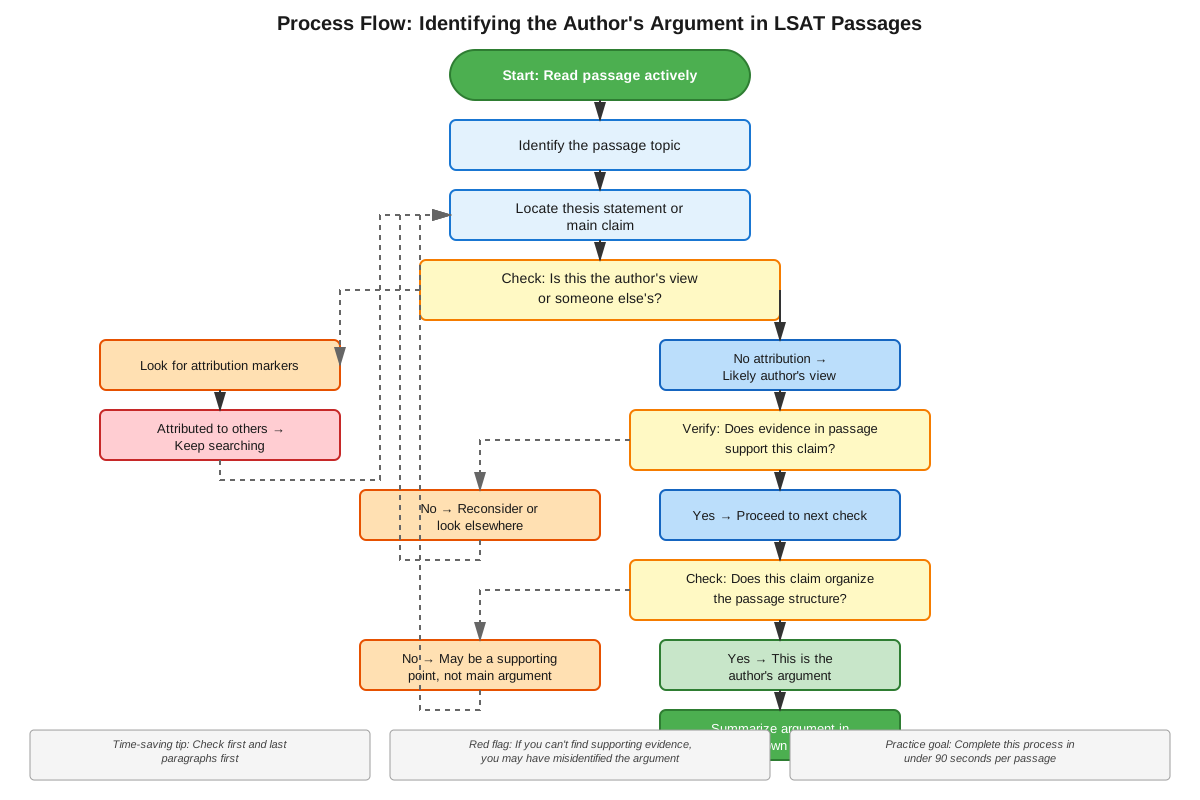
When encountering questions about the author's argument, follow this systematic approach:
- Read the question stem carefully to determine exactly what it asks. Distinguish between questions asking for the main point, the author's attitude, the primary purpose, or the function of specific details—each requires slightly different analysis.
- Return to your passage map (mental or written notes about passage structure). Locate where the author's position appears most clearly—often in opening or closing paragraphs, or following transition words like "however" or "in fact."
- Eliminate answers that describe other viewpoints presented in the passage but not endorsed by the author. Wrong answers frequently confuse the author's argument with theories or positions the passage merely describes.
- Check for scope and strength mismatches. Eliminate answers that are too broad (going beyond what the passage argues), too narrow (capturing only a supporting point), or mismatched in strength (making absolute claims when the author qualifies, or vice versa).
Trigger Words and Phrases
Certain language patterns reliably signal the author's argument or shifts toward it:
Author's position indicators:
- "In fact," "Indeed," "Clearly," "Undoubtedly"
- "More importantly," "The key point is," "What this reveals"
- "However," "Nevertheless," "Yet" (when introducing author's view after describing others')
- "Rather," "Instead," "Actually" (signaling correction or contrast)
Other viewpoints indicators:
- "According to," "Some scholars argue," "It has been claimed"
- "Traditionally," "The conventional view," "Previously thought"
- "Purportedly," "Allegedly," "Supposedly" (signaling skepticism)
Evidence supporting author's argument:
- "For example," "This is illustrated by," "Consider"
- "Studies show," "Research demonstrates," "Evidence indicates"
Process of Elimination Tips
When evaluating answer choices for author's argument questions:
Eliminate answers that:
- Describe the passage topic without stating a position or claim
- Present views the author describes but doesn't endorse
- Focus on supporting details rather than the central claim
- Use stronger or weaker language than the author employs
- Include information not discussed in the passage
- Confuse the author's purpose (what they aim to do) with their argument (what they claim)
Favor answers that:
- Capture the author's evaluative stance or position
- Match the scope of the entire passage rather than one paragraph
- Reflect the author's tone and degree of certainty
- Synthesize the main claim with its essential support
- Use language consistent with the passage's terminology
Time Allocation
For questions about the author's argument:
- Spend 15-20 seconds reviewing your understanding of the passage structure and locating the author's position before reading answer choices
- Allocate 30-40 seconds for evaluating all five answer choices, eliminating clear mismatches quickly
- Reserve 10-15 seconds for comparing remaining contenders and selecting the best answer
- Total time per question: approximately 60-75 seconds
Main point questions deserve slightly more time than detail questions because they require synthesizing the entire passage. However, students who accurately identify the author's argument during initial passage reading can answer these questions more quickly and confidently.
Exam Tip: If two answer choices seem equally plausible, return to the passage and locate the sentence or paragraph where the author's position appears most clearly. The correct answer will align with that specific textual evidence, while the wrong answer will typically introduce subtle distortions or scope shifts.
Memory Techniques
The AUTHOR Acronym
Remember the key elements for identifying the author's argument using AUTHOR:
- Attitude: What is the author's evaluative stance toward different ideas?
- Understand structure: Where does the argument appear in the passage organization?
- Transitions: What words signal shifts to the author's own position?
- However matters: Contrast words often introduce the author's view
- Others vs. author: Distinguish reporting from arguing
- Reasons and evidence: How does support connect to the central claim?
The Three-Question Test
When uncertain about the author's argument, ask these three questions:
- What is the author trying to convince me of? (Not just inform me about, but persuade me to believe)
- What position would the author defend in a debate? (Not just describe, but advocate for)
- What claim does all the evidence in the passage support? (The conclusion, not just a premise)
Visualization Strategy
Picture the passage as a courtroom:
- Background information = case context
- Other viewpoints = opposing counsel's arguments
- Author's argument = your attorney's closing statement
- Evidence and examples = exhibits supporting your attorney's case
This visualization helps distinguish between information the passage presents (like evidence in a trial) and the position the author advocates (like an attorney's argument).
The "So What?" Technique
After reading each paragraph, ask "So what is the author arguing?" If the answer is "nothing yet, just providing background" or "describing what others think," you haven't reached the author's argument. When you can answer "The author is arguing that [specific claim]," you've identified the argument.
Summary
The author's argument represents the central claim, position, or thesis that the author advances and supports throughout an LSAT reading comprehension passage. Mastering this concept requires distinguishing between the passage topic (what it's about), other viewpoints presented (what others believe), and the author's own position (what the author argues). The argument may appear explicitly through thesis statements or implicitly through tone, evidence selection, and structural emphasis. Approximately 35-45% of reading comprehension questions test this skill directly or require understanding it to answer correctly. Success depends on recognizing structural markers (thesis-first, thesis-last, problem-solution patterns), identifying transition words that signal the author's position ("however," "in fact," "nevertheless"), and understanding how evidence functions to support the central claim. Students must avoid common traps such as confusing supporting details with main points, attributing to the author positions merely described in the passage, or mismatching the strength and scope of the author's actual argument. Strategic approaches include mapping passage structure during initial reading, using process of elimination to remove answers describing other viewpoints, and verifying answer choices against specific textual evidence of the author's position.
Key Takeaways
- The author's argument is the specific claim or position the author advances, distinct from the passage topic or other viewpoints described
- Structural markers, transition words, and tone provide crucial clues for identifying where and how the author's argument appears
- Approximately 35-45% of reading comprehension questions require identifying or understanding the author's argument
- Main point questions ask for the author's central claim, not the most-discussed topic or a supporting detail
- Authors may present their arguments explicitly through thesis statements or implicitly through emphasis, tone, and evidence selection
- Distinguishing between reporting others' views and advancing one's own position is essential for avoiding wrong answers
- The author's argument serves as the organizing principle connecting all other passage elements—structure, evidence, and alternative viewpoints
Related Topics
Supporting Evidence and Examples: Understanding how specific details, data, and illustrations function to support the author's argument enables students to answer questions about why the author mentions particular information and how different passage elements relate to the central claim.
Passage Structure and Organization: Recognizing common organizational patterns (thesis-first, problem-solution, comparative evaluation) helps predict where the author's argument will appear and how it develops throughout the passage.
Author's Tone and Attitude: Analyzing the author's evaluative stance toward different ideas provides crucial evidence for identifying their argument, especially in passages where the thesis remains implicit.
Counterarguments and Alternative Viewpoints: Understanding how authors present and respond to opposing positions illuminates their own argumentative strategy and helps distinguish the author's claims from other perspectives discussed.
Inference and Implication Questions: Many inference questions ask what the author would likely agree with or how they would respond to new information, requiring extrapolation from the stated argument to unstated implications.
Primary Purpose Questions: While distinct from main point questions, primary purpose questions (asking what the author aims to accomplish) connect closely to understanding the author's argument and overall rhetorical strategy.
Practice CTA
Now that you've mastered the core concepts of identifying and analyzing the author's argument, it's time to apply these skills to authentic LSAT-style passages and questions. The practice questions and flashcards will reinforce your ability to distinguish the author's position from other viewpoints, recognize structural and linguistic markers of argumentation, and efficiently eliminate wrong answers. Remember: understanding the author's argument unlocks success on multiple question types, making this one of the highest-yield skills you can develop. Approach each practice passage systematically, map the structure, identify transition words, and verify your understanding before attempting questions. With consistent practice, recognizing the author's argument will become automatic, giving you a significant advantage on test day. You've got this!
Sign up free to keep reading
Create a free AnvayaPrep account to finish this LSAT guide on Author's argument — plus flashcards and practice questions.