Overview
The critic's argument is a fundamental pattern of reasoning that appears frequently in LSAT Reading Comprehension passages and Logical Reasoning questions. This pattern involves one party presenting a position, claim, or argument, followed by another party—the critic—who challenges, refutes, or offers an alternative perspective on that original position. Understanding how to identify and analyze critic's arguments is essential for success on the LSAT because these argumentative structures form the backbone of many passage questions, particularly those testing your ability to understand viewpoints and argumentation.
On the LSAT, critic's arguments rarely appear in isolation. Instead, they function as part of the broader discourse within passages, where multiple perspectives interact, clash, or build upon one another. The test makers use critic's arguments to assess whether you can distinguish between different viewpoints, understand the logical relationship between positions, identify the specific points of disagreement, and evaluate the strength of competing claims. Mastering this topic requires developing the ability to track multiple voices within a text, understand what each party is claiming, and precisely identify where and how the critic challenges the original argument.
The lsat critic's argument pattern connects directly to other essential reading comprehension skills, including identifying main points, understanding author's purpose, recognizing logical structure, and evaluating evidence. When you encounter a critic's argument in a passage, you're not just reading two different opinions—you're analyzing a structured logical relationship where one argument responds to and engages with another. This skill transfers directly to Logical Reasoning sections and helps you navigate complex passages in Reading Comprehension where multiple scholars, theories, or perspectives are presented and debated.
Learning Objectives
- [ ] Identify how Critic's argument appears in LSAT questions
- [ ] Explain the reasoning pattern behind Critic's argument
- [ ] Apply Critic's argument to solve LSAT-style problems accurately
- [ ] Distinguish between different types of critical responses (refutation, qualification, alternative explanation)
- [ ] Recognize the specific point of disagreement between an original argument and its critic
- [ ] Evaluate the logical strength of a critic's response relative to the original claim
- [ ] Predict likely question types that will follow passages containing critic's arguments
Prerequisites
- Basic argument structure: Understanding premises, conclusions, and how claims are supported is essential because critic's arguments involve analyzing how one argument responds to another's logical structure.
- Identifying main points and supporting details: This skill is necessary because critics typically target specific elements of an argument rather than rejecting everything wholesale.
- Understanding inference and implication: Critics often challenge not just what is explicitly stated but what is implied or assumed by the original argument.
- Recognizing author's tone and purpose: Distinguishing between neutral reporting of a critic's view versus the author endorsing that criticism requires understanding authorial stance.
Why This Topic Matters
In real-world contexts, critic's arguments represent how knowledge advances through scholarly debate, how legal arguments are challenged and refined, and how scientific theories are tested and improved. The ability to understand and evaluate critical responses is fundamental to legal reasoning, where attorneys must anticipate and respond to opposing arguments. This skill directly translates to law school case analysis, where students must track how different judges or legal scholars critique precedents and each other's reasoning.
On the LSAT, critic's arguments appear with remarkable frequency. Approximately 60-70% of Reading Comprehension passages contain at least one instance where a critic challenges a position, theory, or interpretation. These passages often generate multiple questions, including:
- Point-at-issue questions: "The critic and the original theorist would be most likely to disagree about which one of the following?"
- Reasoning structure questions: "The critic responds to the argument by..."
- Strengthening/weakening questions: "Which of the following, if true, would most strengthen the critic's position?"
- Function questions: "The author mentions the critic's view primarily in order to..."
- Inference questions: "Based on the passage, the critic would be most likely to agree with which statement?"
Common manifestations include: a traditional theory challenged by new evidence; a legal interpretation questioned by dissenting judges; a scientific hypothesis critiqued by researchers proposing alternative explanations; an artistic movement criticized by later commentators; or a historical interpretation disputed by revisionist scholars. The LSAT particularly favors passages where the critic doesn't simply reject the original argument but offers a nuanced response—perhaps accepting some elements while challenging others, or proposing an alternative framework that accounts for the same evidence differently.
Core Concepts
The Basic Structure of Critic's Arguments
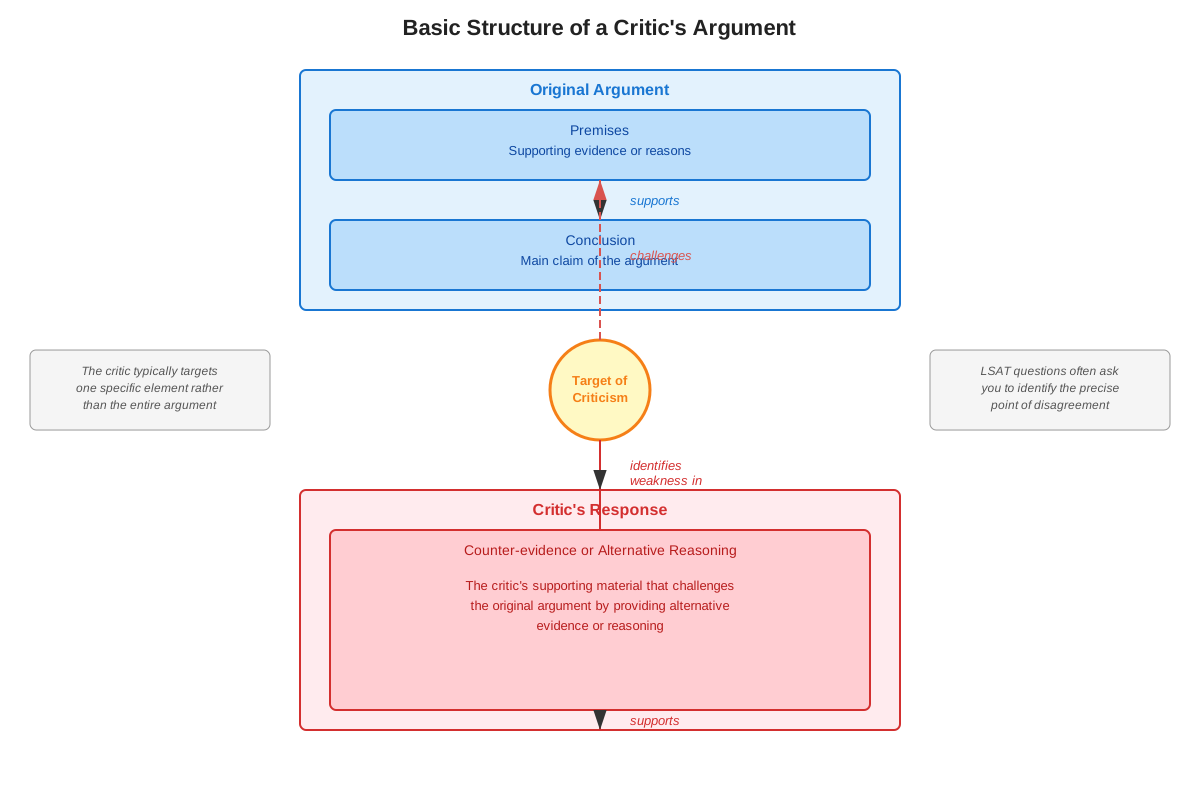
A critic's argument follows a predictable logical structure that appears consistently across LSAT passages. The pattern begins with an original position or initial argument—this might be a theory, interpretation, claim, or explanation presented by a scholar, group, or school of thought. The original position typically includes both a main claim and supporting reasoning or evidence. Following this, the critic enters the discourse to challenge some aspect of the original position.
The critic's response can take several forms, but it always involves engaging with the original argument rather than simply presenting an unrelated alternative view. The critic might:
- Challenge the evidence: Questioning whether the facts or data cited actually support the conclusion
- Identify a logical flaw: Pointing out that the reasoning doesn't validly lead from premises to conclusion
- Offer counterevidence: Presenting facts that contradict or complicate the original claim
- Propose an alternative explanation: Suggesting that the same evidence could be interpreted differently
- Question underlying assumptions: Revealing unstated premises that the original argument depends upon
- Limit the scope: Accepting the argument in some cases but denying its universal application
Types of Critical Responses
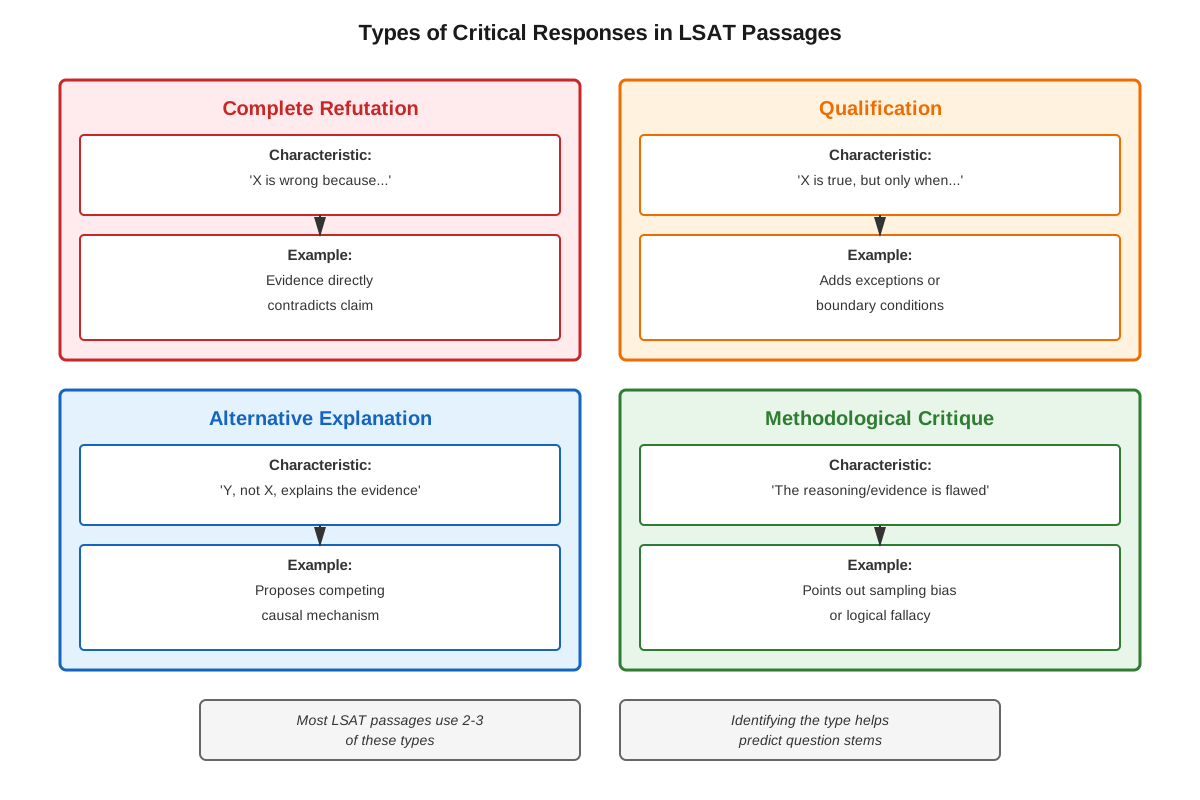
Understanding the different types of critical responses helps you predict what questions will follow and how to answer them accurately.
| Type of Criticism | Characteristics | Example Signal Phrases |
|---|---|---|
| Direct Refutation | Argues the original claim is false or unsupported | "However, this view is mistaken because..." |
| Qualification | Accepts the claim in limited circumstances but denies broader application | "While this may be true in some cases, it fails to account for..." |
| Alternative Explanation | Doesn't deny the facts but offers different interpretation | "A more plausible explanation is..." |
| Methodological Critique | Challenges how the original argument was developed or tested | "This approach overlooks..." |
| Assumption Challenge | Reveals and questions hidden premises | "This argument presupposes that..." |
The Point of Disagreement
A critical skill in analyzing critic's arguments is identifying the precise point of disagreement. The LSAT frequently tests whether you can distinguish between:
- What both parties agree on: Often, the critic accepts certain facts or premises but disputes the conclusion or interpretation
- The specific contested claim: The exact proposition where their views diverge
- What is not at issue: Claims that neither party addresses or that both would accept
For example, an original argument might claim: "Archaeological evidence shows extensive trade networks existed in ancient civilization X; therefore, this civilization must have had a centralized government to coordinate such trade." A critic might respond: "While the trade networks are well-documented, decentralized systems of independent merchants could equally account for this pattern." Here, both parties agree on the existence of trade networks (not at issue), but disagree on whether centralized government is necessary to explain them (point of disagreement).
Strength of Critical Responses
Not all critical responses are equally strong, and the LSAT tests your ability to evaluate their logical force. A strong critical response:
- Directly addresses the core claim rather than peripheral points
- Provides specific evidence or reasoning rather than mere assertion
- Accounts for the evidence the original argument cited rather than ignoring it
- Identifies genuine logical problems rather than simply expressing disagreement
A weak critical response might:
- Attack a straw man version of the argument
- Commit logical fallacies itself
- Fail to engage with the strongest evidence for the original position
- Confuse correlation with causation or make other reasoning errors
Signal Language for Critic's Arguments
LSAT passages use specific language patterns to introduce critical responses. Recognizing these trigger phrases helps you immediately identify when a critic's argument is being presented:
- "However, critics argue that..."
- "This view has been challenged by..."
- "In contrast, [Scholar X] contends..."
- "Yet this interpretation overlooks..."
- "A competing explanation suggests..."
- "Skeptics point out that..."
- "This account has been questioned on the grounds that..."
- "More recent scholarship disputes..."
The Author's Relationship to the Critic
A sophisticated aspect of critic's arguments involves understanding the passage author's stance toward both the original argument and the critic. The author might:
- Neutrally report both positions without endorsing either
- Favor the critic's view and use it to undermine the original argument
- Defend the original argument against the critic's challenges
- Synthesize both views into a more nuanced position
- Present the critic's view as one of several competing alternatives
Questions frequently test whether you can distinguish between what the critic believes, what the original theorist believes, and what the passage author endorses.
Concept Relationships
The critic's argument pattern connects to multiple other LSAT concepts in a hierarchical and functional relationship. At the foundation, basic argument structure (premises supporting conclusions) enables you to analyze both the original argument and the critic's response as distinct logical units. This foundational skill → leads to → identifying the critic's argument pattern, which → enables → understanding viewpoints and argumentation more broadly.
Within the critic's argument itself, several concepts interact dynamically. The original position establishes the baseline claim → which triggers → the critical response → which creates → a point of disagreement → which generates → specific question types on the exam. Understanding the type of critical response (refutation, qualification, alternative explanation) → determines → how you should approach questions about the relationship between the views.
The critic's argument pattern also connects forward to more advanced skills. Mastering this topic → enables → better performance on comparative reading passages where two authors present contrasting views → and supports → complex inference questions where you must determine what each party would accept or reject → and strengthens → application questions where you must predict how a critic would respond to new scenarios.
Horizontally, critic's arguments relate to author's purpose (why is the critic's view included?), passage structure (how does the critical response function in the overall organization?), and tone and attitude (what language reveals the author's stance toward the criticism?). These concepts form an interconnected web where improvement in one area reinforces understanding in others.
High-Yield Facts
⭐ Critic's arguments appear in 60-70% of LSAT Reading Comprehension passages, making them one of the most frequently tested patterns.
⭐ The point of disagreement is often narrower than it initially appears—critics frequently accept many premises of the original argument while challenging only specific conclusions or interpretations.
⭐ Signal phrases like "however," "yet," "critics argue," and "in contrast" reliably indicate the introduction of a critical response and should trigger heightened attention to the logical relationship being established.
⭐ Questions asking what the critic and original theorist would "most likely disagree about" require identifying claims that one accepts and the other rejects—not merely different topics they discuss.
⭐ The passage author's view may differ from both the original argument and the critic's response—always distinguish between reporting a view and endorsing it.
- Critics often challenge unstated assumptions rather than explicit claims, requiring you to identify what the original argument takes for granted.
- Alternative explanations are a particularly common form of criticism on the LSAT because they demonstrate sophisticated reasoning—accepting the evidence while disputing the interpretation.
- When a critic offers counterevidence, the strength of the criticism depends on whether this evidence is more representative, more recent, or more directly relevant than the original evidence.
- Methodological critiques (challenging how research was conducted or how conclusions were drawn) appear frequently in science and social science passages.
- The LSAT favors critics who engage substantively with the original argument over those who simply assert disagreement without reasoning—this models the kind of analytical thinking required in law school.
Quick check — test yourself on Critic's argument so far.
Try Flashcards →Common Misconceptions
Misconception: A critic's argument means complete rejection of the original position. → Correction: Critics often accept significant portions of the original argument while challenging specific claims, interpretations, or conclusions. The LSAT frequently tests whether you can identify what both parties agree on versus where they diverge.
Misconception: The critic's view is always presented after the original argument in the passage. → Correction: While this is the most common structure, passages sometimes present the critic's view first, then explain what traditional view is being challenged, or interweave multiple rounds of argument and response.
Misconception: If the passage presents a critic's argument, the author must agree with the critic. → Correction: Authors often present critical responses neutrally as part of scholarly debate without endorsing either position. The author might even present the critic's view in order to refute it later in the passage.
Misconception: Point-at-issue questions can be answered by finding any topic both parties discuss. → Correction: Both parties must take opposing stances on the specific claim—merely discussing the same general topic is insufficient. One must affirm what the other denies.
Misconception: Stronger language (like "completely wrong" or "entirely misguided") indicates a stronger critical argument. → Correction: The logical strength of a criticism depends on the quality of reasoning and evidence, not the confidence or intensity of the language used. A measured, well-supported qualification may be logically stronger than an emphatic but poorly reasoned refutation.
Misconception: All critics are external to the field or discipline being discussed. → Correction: Critics are often fellow scholars, researchers, or practitioners within the same field who offer competing interpretations or identify limitations in prevailing views.
Misconception: The critic's argument is always explicitly labeled as such. → Correction: Sometimes the critical response is attributed to "some scholars," "recent research," or "alternative interpretations" without using the word "critic" at all. You must recognize the logical pattern regardless of the specific terminology.
Worked Examples
Example 1: Scientific Theory Passage
Passage excerpt: "For decades, paleontologists attributed the extinction of large mammals at the end of the Pleistocene epoch to climate change resulting from glacial retreat. The timing of extinctions closely correlates with warming temperatures, and many species that disappeared were adapted to cold environments. However, recent archaeological evidence has led some researchers to propose an alternative explanation. These critics point out that the extinctions coincide not only with climate change but also with the arrival and spread of human populations across continents. Moreover, they note that species on islands where humans arrived later survived longer, even though these islands experienced similar climate changes. The critics argue that human hunting pressure, rather than climate change, was the primary driver of these extinctions."
Question: The critics mentioned in the passage and the traditional paleontologists would be most likely to disagree about which one of the following?
Analysis:
Step 1: Identify the original argument and its key claims.
- Original position: Climate change from glacial retreat caused Pleistocene extinctions
- Evidence cited: Timing correlation, species were cold-adapted
Step 2: Identify the critic's response and its key claims.
- Critical position: Human hunting was the primary cause
- Evidence cited: Correlation with human arrival, island survival patterns
- Type of criticism: Alternative explanation (doesn't deny climate change occurred, but disputes its causal role)
Step 3: Determine what both parties agree on.
- Both accept that extinctions occurred at the end of the Pleistocene
- Both accept that climate change occurred during this period
- Both accept that there is a timing correlation between extinctions and climate change
Step 4: Identify the precise point of disagreement.
- They disagree about the PRIMARY CAUSE of the extinctions
- Traditional view: climate change was the main driver
- Critics' view: human hunting was the main driver
Answer approach: The correct answer will present a claim about causation that one group affirms and the other denies. Wrong answers might state facts both groups accept (that extinctions occurred, that climate changed) or introduce issues neither group addresses.
Example 2: Legal Interpretation Passage
Passage excerpt: "The majority opinion in the 1952 case held that the statute's phrase 'reasonable accommodation' requires employers to make significant modifications to workplace policies when necessary to accommodate religious practices, unless doing so would impose undue hardship on business operations. Justice Morrison, writing in dissent, challenged this interpretation on textual grounds. She argued that the word 'reasonable' itself limits the scope of required accommodations, and that 'significant modifications' cannot be considered 'reasonable' by definition. According to Morrison, the majority's reading effectively writes the word 'reasonable' out of the statute, treating 'reasonable accommodation' as if it meant simply 'accommodation.' She contended that the proper interpretation would require only minor, easily implemented adjustments."
Question: Which one of the following best describes the relationship between Justice Morrison's argument and the majority opinion?
Analysis:
Step 1: Identify the structure of the critic's argument.
- Original position (majority): "Reasonable accommodation" can include significant modifications
- Critical response (Morrison): This interpretation contradicts the limiting force of "reasonable"
- Type of criticism: Textual/interpretive challenge to the logical coherence of the majority's reading
Step 2: Analyze Morrison's reasoning strategy.
- She identifies an internal contradiction in the majority's interpretation
- She argues the majority's reading makes part of the statutory language superfluous
- She offers an alternative interpretation that gives effect to all terms
Step 3: Evaluate the strength of the criticism.
- Morrison directly addresses the core interpretive question
- She provides a principle (don't render statutory terms meaningless) that supports her reading
- She offers a specific alternative that avoids the problem she identifies
Answer approach: The correct answer will accurately describe Morrison's method—she challenges the majority's interpretation by arguing it fails to give proper weight to the limiting term "reasonable" and renders it superfluous. Wrong answers might mischaracterize her as rejecting accommodation requirements entirely, or as merely disagreeing without providing reasoning.
Exam Strategy
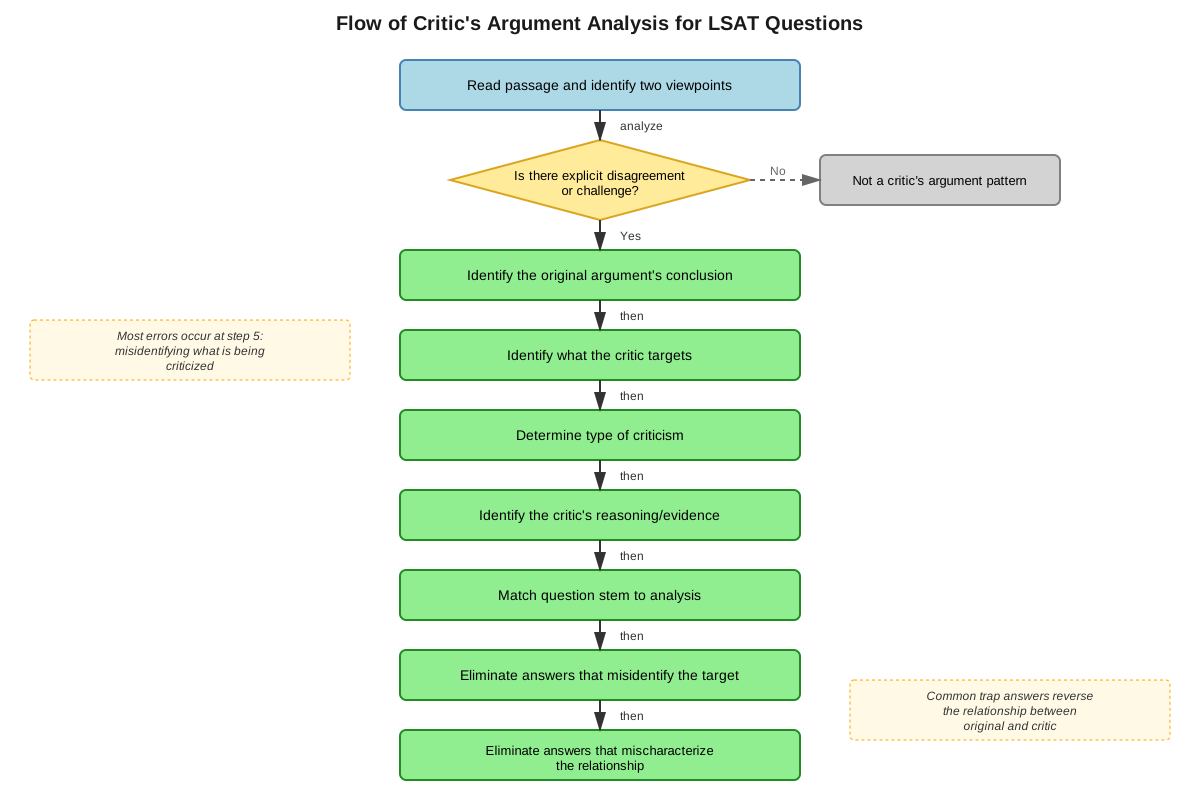
When approaching LSAT questions involving critic's arguments, employ a systematic process that maximizes accuracy while managing time effectively:
Step 1: Identify the pattern immediately (5-10 seconds). As you read, watch for signal language indicating a critical response. When you spot phrases like "however, critics argue" or "this view has been challenged," mentally flag that you're entering a critic's argument structure. This primes you for the types of questions likely to follow.
Step 2: Map the logical relationship (20-30 seconds). Create a mental or marginal note structure:
- Original claim: [brief summary]
- Critic's response: [brief summary]
- Type of criticism: [refutation/qualification/alternative explanation]
- Point of disagreement: [specific contested claim]
Step 3: Note what's NOT disputed (10-15 seconds). Explicitly identify facts or claims both parties accept. This prevents errors on point-at-issue questions where wrong answers often state areas of agreement.
Step 4: Assess the author's stance (10-15 seconds). Determine whether the author is neutrally reporting, endorsing the critic, defending the original view, or synthesizing. Look for evaluative language or subsequent development of one view over the other.
Exam Tip: When facing point-at-issue questions, use the "one yes, one no" test. The correct answer must be something one party would clearly affirm and the other would clearly deny. If both would agree, both would disagree, or either would say "that's not what I'm talking about," eliminate that choice.
Trigger words for critic's arguments:
- Contrast markers: however, yet, nevertheless, nonetheless, but
- Attribution to critics: critics argue, skeptics contend, opponents claim
- Alternative framing: in contrast, alternatively, another view, competing explanation
- Challenge language: questioned, disputed, challenged, undermined, refuted
Process of elimination strategies:
For "point of disagreement" questions:
- Eliminate choices stating facts both parties accept
- Eliminate choices about topics neither party addresses
- Eliminate choices that are too broad or too narrow relative to the actual dispute
- Keep choices where you can clearly identify opposing positions
For "critic's reasoning" questions:
- Eliminate choices that describe the original argument instead of the response
- Eliminate choices that mischaracterize the type of criticism (e.g., saying the critic offers counterevidence when they actually identify a logical flaw)
- Keep choices that accurately describe both what the critic challenges AND how they challenge it
Time allocation: In a passage containing a critic's argument, expect to spend:
- 3-4 minutes on initial reading (slightly longer due to tracking multiple viewpoints)
- 45-60 seconds per question
- Extra 10-15 seconds on point-at-issue questions to carefully verify the logical relationship
If you're running short on time, prioritize questions asking about the critic's reasoning or point of disagreement, as these are often more straightforward than complex inference questions.
Memory Techniques
CRITIC acronym for analyzing critical responses:
- Claim being challenged (identify the specific target)
- Reasoning of the critic (how do they challenge it?)
- Issue in dispute (the precise point of disagreement)
- Type of criticism (refutation, qualification, alternative, etc.)
- Implications (what follows if the critic is right?)
- Context (author's stance toward the criticism)
The "Two-Column Visualization": When you encounter a critic's argument, visualize two columns in your mind:
ORIGINAL ARGUMENT          |  CRITIC'S RESPONSE
---------------------------|---------------------------
Main claim                 |  Challenges X aspect
Evidence A, B, C           |  Accepts A, B; disputes C
Assumes X                  |  Questions assumption X
Concludes Y                |  Concludes Z instead
This mental model helps you track parallel elements and identify exactly where the views diverge.
Signal phrase memory device: "HYC-CAQ"
- However / Yet (contrast markers)
- Critics / Challenged (attribution)
- Alternatively (alternative framing)
- Questioned (challenge language)
When you see these words, immediately shift into "critic's argument mode" and heighten your attention to the logical relationship being established.
The "Agreement-Disagreement Spectrum": For point-at-issue questions, visualize a spectrum:
[Both Agree] ←→ [Not Addressed] ←→ [Point of Disagreement] ←→ [Different Topics]The correct answer must fall precisely in the "Point of Disagreement" zone—one party on the "yes" side, the other on the "no" side of that specific claim.
Summary
Critic's arguments represent a fundamental pattern of reasoning on the LSAT where one party challenges, qualifies, or offers an alternative to another party's position. Success with this topic requires identifying the original argument and the critical response, determining the precise point of disagreement, recognizing the type of criticism being offered, and understanding the passage author's relationship to both views. The LSAT tests this pattern extensively because it mirrors the argumentative structure central to legal reasoning—understanding how positions are challenged and defended. Strong performance requires distinguishing between what parties agree on versus where they diverge, recognizing that critics often accept significant portions of original arguments while challenging specific elements, and accurately characterizing the logical relationship between competing views. The most common question types involve identifying points of disagreement, describing the critic's reasoning strategy, and determining what each party would accept or reject. Mastering critic's arguments provides a foundation for handling complex passages with multiple viewpoints and strengthens overall analytical reading skills essential for LSAT success.
Key Takeaways
- Critic's arguments appear in 60-70% of Reading Comprehension passages and generate multiple high-value questions, making this pattern essential for LSAT success
- The point of disagreement is typically narrower than the overall topic—critics often accept many premises while challenging specific conclusions or interpretations
- Signal phrases like "however," "critics argue," and "in contrast" reliably indicate critical responses and should trigger systematic analysis of the logical relationship
- Strong point-at-issue answers require one party to affirm what the other denies—mere discussion of the same topic is insufficient
- Always distinguish between the passage author's view and the views being reported; authors may present critical responses without endorsing them
- The type of criticism matters: direct refutation, qualification, alternative explanation, methodological critique, and assumption challenges each create different logical relationships
- Effective strategy involves mapping the structure (original claim → critical response → point of disagreement) and explicitly noting what both parties accept
Related Topics
Comparative Reading Passages: Building on critic's arguments, comparative reading presents two complete passages with related but distinct perspectives, requiring you to analyze similarities, differences, and points of agreement or disagreement across longer texts. Mastering critic's arguments provides the foundational skill for tracking multiple viewpoints.
Author's Purpose and Function Questions: Understanding why an author includes a critic's argument (to refute it, support it, present balanced coverage, or introduce complications) connects directly to broader questions about passage structure and authorial intent.
Assumption Identification: Since critics frequently challenge unstated assumptions in original arguments, developing skill with critic's arguments enhances your ability to identify what arguments take for granted—a crucial skill for Logical Reasoning sections.
Strengthening and Weakening Questions: In Logical Reasoning, you'll often need to identify what would strengthen or weaken an argument, which requires understanding how evidence and reasoning can support or undermine claims—the same analytical skill used in evaluating critic's arguments.
Complex Inference Questions: Advanced inference questions often require determining what a critic would accept or reject in new scenarios, building on your ability to understand the logical boundaries of their position.
Practice CTA
Now that you've mastered the conceptual framework for critic's arguments, it's time to apply this knowledge to actual LSAT passages and questions. The practice questions and flashcards will help you recognize these patterns instantly, distinguish between different types of critical responses, and accurately identify points of disagreement under timed conditions. Remember: understanding the theory is just the first step—consistent practice with real LSAT material transforms this knowledge into the automatic pattern recognition and analytical skill that produces top scores. Challenge yourself to identify the critic's argument structure in every passage you read, and you'll find these questions becoming some of the most predictable and manageable on the exam.
Sign up free to keep reading
Create a free AnvayaPrep account to finish this LSAT guide on Critic's argument — plus flashcards and practice questions.