Overview
Identifying rebuttals is a critical skill within LSAT reading comprehension that tests a student's ability to recognize when an author or speaker challenges, refutes, or responds to an opposing viewpoint. This skill sits at the heart of viewpoints and argumentation, as LSAT passages frequently present multiple perspectives on complex issues, with authors either defending their own positions or dismantling alternative theories. The ability to spot rebuttals requires careful attention to argumentative structure, rhetorical signals, and logical relationships between claims.
On the LSAT, passages often follow a dialectical structure where the author introduces a prevailing view, then presents evidence or reasoning that undermines it, or conversely, where the author defends a position against anticipated objections. Questions testing rebuttal identification may ask students to recognize which claim the author is challenging, identify the evidence used to refute a position, or determine the relationship between different viewpoints presented in the passage. This skill directly impacts performance on questions about author's purpose, passage structure, and the function of specific paragraphs or sentences.
Mastering LSAT identifying rebuttals connects to broader reading comprehension competencies including tracking multiple viewpoints, understanding argumentative structure, recognizing evidence types, and analyzing logical relationships. Students who excel at identifying rebuttals can more easily navigate complex passages, anticipate question types, and eliminate incorrect answer choices that mischaracterize the relationships between competing claims. This foundational skill in viewpoints and argumentation enables success across numerous question types, from inference questions to those testing understanding of passage organization.
Learning Objectives
- [ ] Identify how identifying rebuttals appears in LSAT questions
- [ ] Explain the reasoning pattern behind identifying rebuttals
- [ ] Apply identifying rebuttals to solve LSAT-style problems accurately
- [ ] Distinguish between direct rebuttals and implicit counterarguments in passage text
- [ ] Recognize common linguistic markers and structural patterns that signal rebuttals
- [ ] Evaluate the strength and scope of rebuttals relative to the claims they challenge
- [ ] Predict likely question stems that test rebuttal identification skills
Prerequisites
- Basic argument structure: Understanding premises, conclusions, and evidence is essential because rebuttals target specific components of arguments
- Identifying main ideas and supporting details: Necessary to distinguish between primary claims and the objections raised against them
- Recognizing author's tone and attitude: Critical for determining whether the author supports or opposes a particular viewpoint
- Understanding logical relationships: Required to trace how one claim responds to or undermines another
- Familiarity with passage structure: Helps locate where rebuttals typically appear within LSAT reading passages
Why This Topic Matters
In legal reasoning and academic discourse—the domains the LSAT is designed to assess—the ability to identify and evaluate rebuttals is fundamental. Lawyers must recognize when opposing counsel challenges their arguments, academics must engage with competing theories, and critical thinkers must distinguish between claims and counterclaims. The LSAT tests this skill because law school success depends on understanding how arguments interact, clash, and evolve through dialectical exchange.
Statistically, rebuttal-related questions appear in approximately 15-20% of LSAT reading comprehension questions, making this a high-yield topic. These questions manifest in several forms: identifying the purpose of a paragraph (often to rebut a previous claim), determining what view the author opposes, recognizing evidence that undermines a theory, or understanding the relationship between two perspectives. Passages in law, science, humanities, and social sciences all employ rebuttals, though they're particularly common in passages presenting theoretical debates or historical controversies.
Common manifestations include: passages where paragraph 1 presents a traditional view and paragraph 2 begins with "However" or "Yet" to introduce a challenge; passages where the author systematically addresses and refutes multiple objections to their thesis; comparative passages where Passage B responds to claims made in Passage A; and passages where new evidence is presented that contradicts an established theory. Recognizing these patterns allows students to anticipate question types and navigate passages more efficiently.
Core Concepts
What Constitutes a Rebuttal
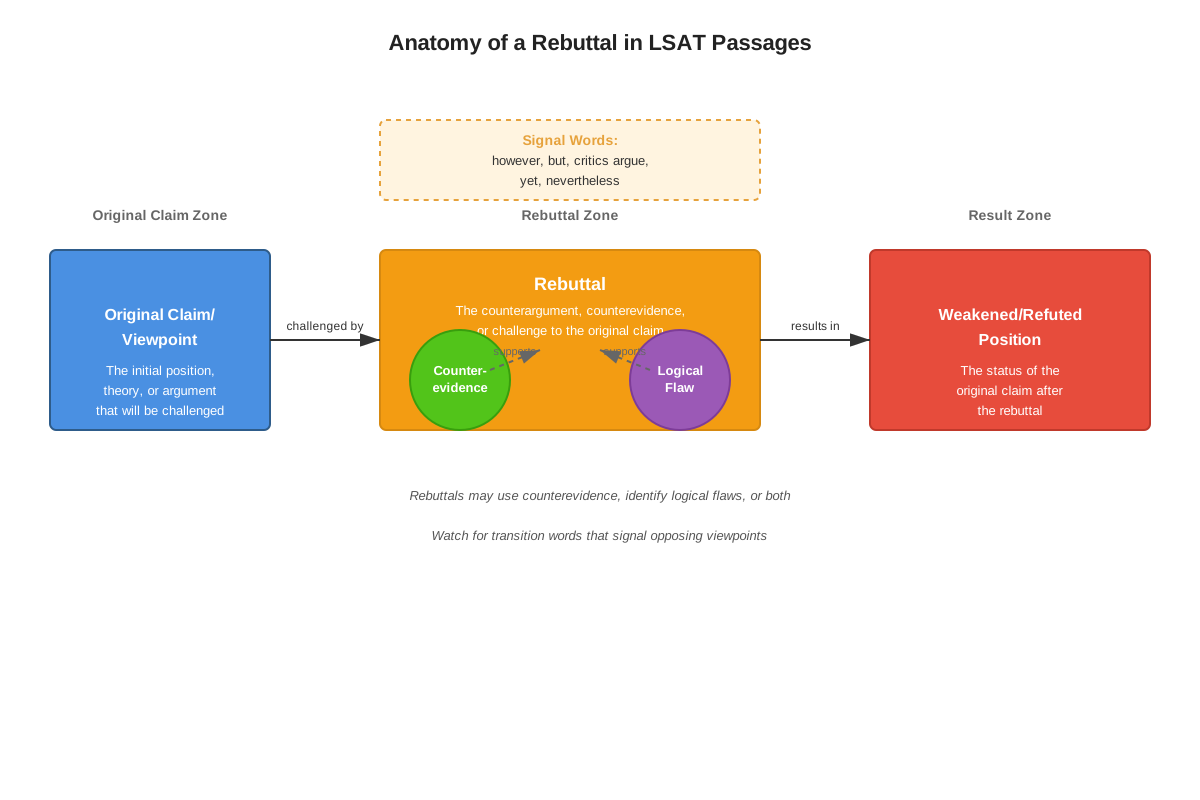
A rebuttal is a response that challenges, refutes, contradicts, or undermines a claim, argument, theory, or viewpoint. Unlike mere disagreement or alternative perspectives, rebuttals actively engage with specific claims and provide reasons or evidence for why those claims are flawed, incomplete, or incorrect. Rebuttals can be explicit (directly stating opposition) or implicit (presenting evidence that contradicts without explicitly announcing disagreement).
Rebuttals operate at different levels of argumentative structure. They may challenge:
- Factual premises: Disputing the accuracy of evidence or data
- Logical inferences: Questioning whether conclusions follow from premises
- Underlying assumptions: Exposing unstated beliefs that, if false, undermine the argument
- Scope or applicability: Arguing that a claim is too broad or doesn't apply to certain cases
- Alternative explanations: Showing that different interpretations better account for the evidence
Structural Patterns of Rebuttals in LSAT Passages
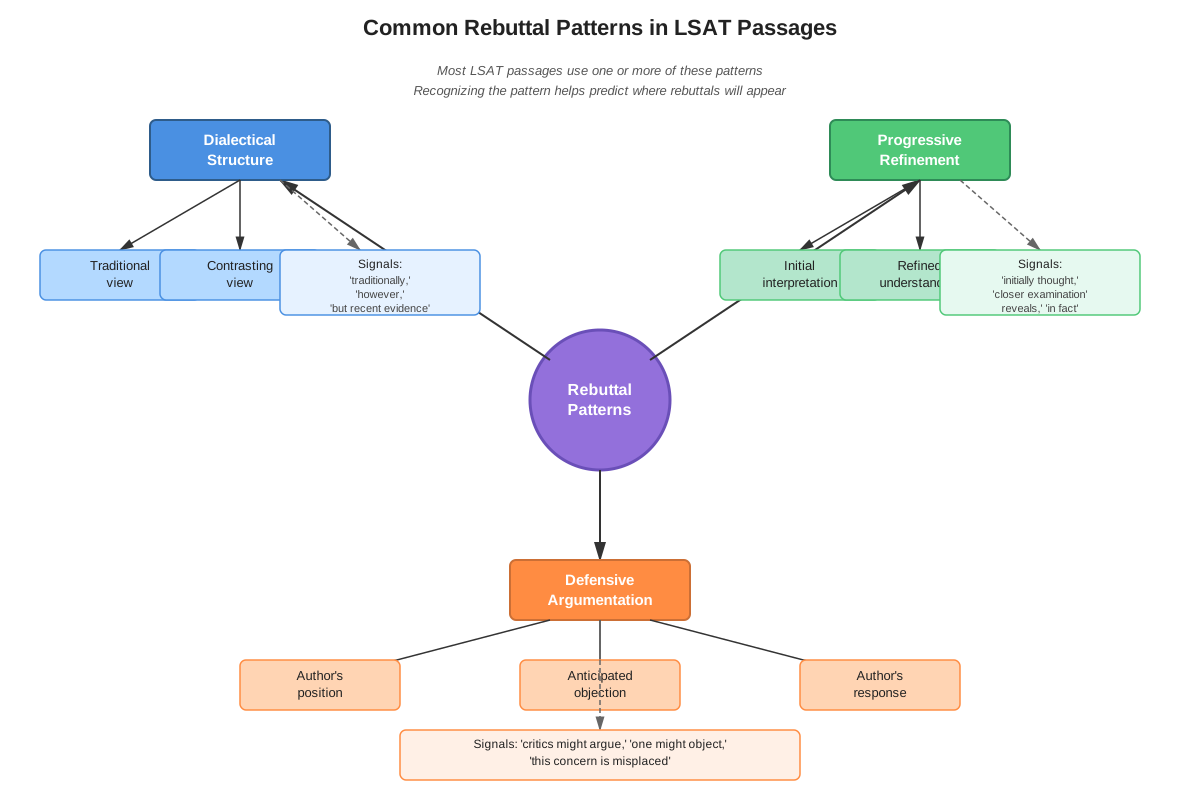
LSAT passages employ predictable organizational patterns when presenting rebuttals. The most common structure follows a claim-counterclaim format:
- Introduction of initial position: The passage presents a theory, interpretation, or viewpoint (often attributed to "traditional scholars," "most critics," or "conventional wisdom")
- Transition to rebuttal: Linguistic markers signal the shift (discussed below)
- Presentation of counterevidence or counterargument: The author or another party provides reasons to doubt the initial position
- Development of alternative view: Often, the rebuttal leads to a new interpretation or theory
Another common pattern is the objection-response structure, where:
- The author presents their main thesis
- The author anticipates potential objections ("One might argue that...")
- The author rebuts these objections to strengthen their position
A third pattern involves progressive refinement, where multiple scholars or theories are presented sequentially, with each responding to limitations in the previous view, creating a chain of rebuttals that advances understanding.
Linguistic Markers of Rebuttals
Certain words and phrases reliably signal that a rebuttal is being introduced. Recognizing these transition markers allows rapid identification:
Contrast indicators:
- However, yet, but, nevertheless, nonetheless
- On the contrary, conversely, in contrast
- Despite, although, while, whereas
Challenge indicators:
- Critics argue, opponents contend, skeptics question
- This view has been challenged, recent evidence contradicts
- Problematically, unfortunately, the flaw in this reasoning
Refutation indicators:
- In fact, actually, rather
- Far from, instead of
- This interpretation fails to account for
- A closer examination reveals
Evidence-based contradiction:
- Recent discoveries show, new data indicates
- Contrary to this claim, evidence suggests
- Studies have demonstrated otherwise
Types of Rebuttals
| Rebuttal Type | Mechanism | Example Context |
|---|---|---|
| Direct refutation | Explicitly states a claim is wrong and provides contrary evidence | "This theory is incorrect because archaeological findings show..." |
| Qualification | Accepts part of a claim but limits its scope or applicability | "While this may be true in some cases, it fails to account for..." |
| Alternative explanation | Doesn't directly deny a claim but offers a better interpretation | "Rather than X causing Y, the evidence better supports Z as the cause" |
| Undermining assumptions | Challenges unstated premises on which an argument depends | "This argument assumes markets are rational, but behavioral economics shows..." |
| Counterexample | Provides specific cases that contradict a general claim | "The theory predicts X, but in the case of Y, we observe the opposite" |
| Methodological critique | Questions how evidence was gathered or interpreted | "These conclusions rest on flawed statistical analysis that..." |
Implicit vs. Explicit Rebuttals
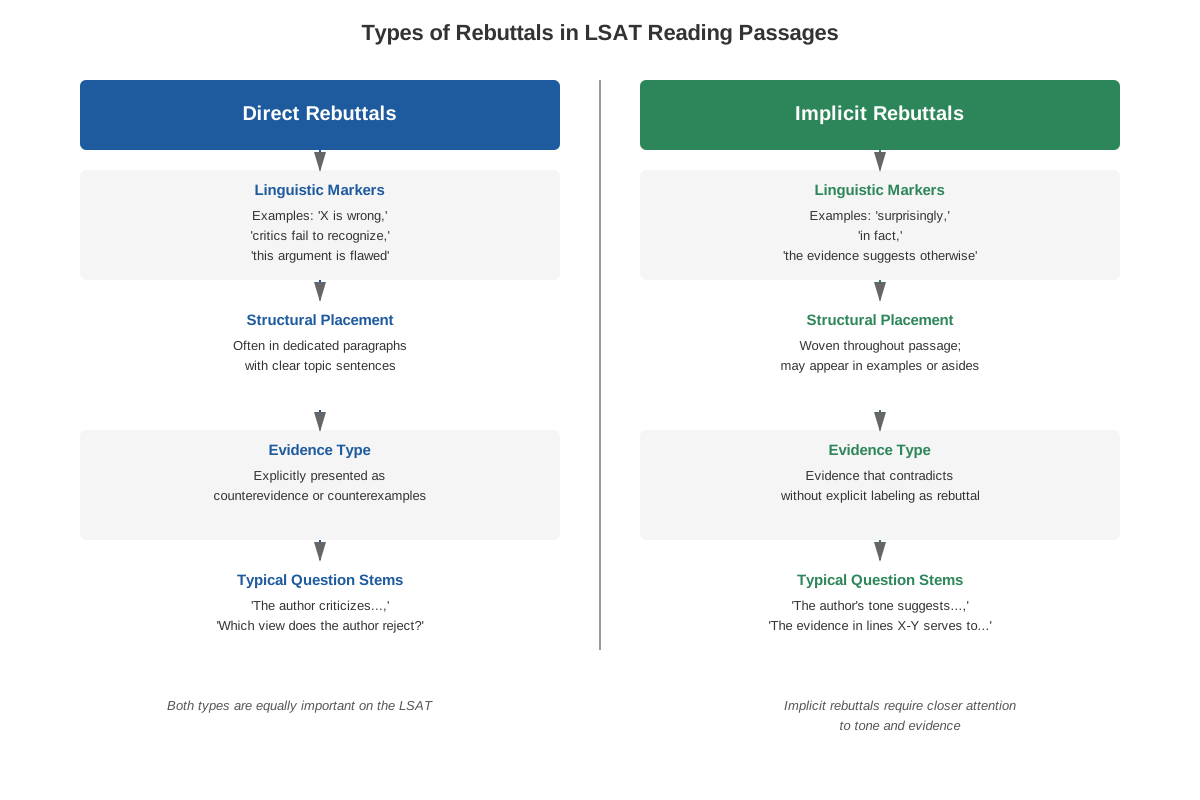
Explicit rebuttals clearly announce their oppositional stance using direct language: "Smith's interpretation is mistaken," "This view cannot be sustained," or "Recent scholarship has refuted this claim." These are easier to identify but less common on the LSAT, which favors subtlety.
Implicit rebuttals present contradictory information or alternative interpretations without explicitly stating opposition. The author might simply present new evidence that happens to contradict an earlier claim, or describe a theory that, by its nature, conflicts with a previously mentioned view. Identifying implicit rebuttals requires understanding the logical relationships between claims and recognizing when new information undermines previous assertions.
For example, if a passage states "Traditional historians believed the treaty was signed in 1847" and later mentions "Recent archival research has established that the treaty was actually signed in 1848," the second statement implicitly rebuts the first, even without words like "however" or "contrary to."
The Function of Rebuttals in Passage Structure
Understanding why authors include rebuttals helps predict their placement and purpose. Rebuttals serve several functions:
- Advancing the author's thesis: By refuting alternative views, the author strengthens their own position
- Demonstrating scholarly engagement: Showing awareness of competing perspectives establishes credibility
- Creating narrative tension: The back-and-forth of claim and counterclaim makes passages more dynamic
- Explaining theoretical evolution: Rebuttals show how fields of study progress through criticism and refinement
Questions often ask about the function of a paragraph or sentence that contains a rebuttal. The correct answer typically involves phrases like "challenges a previously mentioned view," "presents evidence that undermines," or "responds to a potential objection."
Concept Relationships
The skill of identifying rebuttals connects to multiple reading comprehension competencies in a hierarchical and interactive way:
Foundation level: Understanding basic argument structure (premises → conclusion) provides the groundwork, as rebuttals target specific components of arguments. Recognizing main ideas versus supporting details enables students to distinguish between primary claims and the rebuttals directed at them.
Intermediate level: Identifying rebuttals directly builds on and reinforces the ability to track multiple viewpoints within a passage. When a rebuttal appears, it necessarily introduces at least two perspectives: the original claim and the challenge to it. This skill also connects to understanding author's purpose—recognizing that an author includes a rebuttal helps determine whether they're defending a position, critiquing others, or presenting a balanced overview.
Advanced level: Rebuttal identification enables more sophisticated skills like evaluating argument strength, recognizing logical fallacies, and predicting how arguments might be extended. The relationship flows: Basic argument structure → Identifying claims and evidence → Recognizing rebuttals → Evaluating argumentative effectiveness → Synthesizing multiple perspectives.
Laterally, identifying rebuttals connects to understanding passage organization (rebuttals often mark structural transitions), recognizing tone and attitude (rebuttals reveal what the author opposes), and making inferences (understanding what's been rebutted helps predict what the author will support).
Quick check — test yourself on Identifying rebuttals so far.
Try Flashcards →High-Yield Facts
⭐ Rebuttals most commonly appear at paragraph transitions, particularly when a new paragraph begins with contrast markers like "however," "yet," or "nevertheless."
⭐ The phrase "one might argue" or "critics contend" typically introduces a view the author will rebut, not a view the author supports.
⭐ When an author presents evidence that contradicts an earlier claim, this constitutes an implicit rebuttal even without explicit oppositional language.
⭐ Questions asking about the "function" or "purpose" of a paragraph often have answers involving rebuttals when that paragraph challenges a previous view.
⭐ Rebuttals can target assumptions, evidence, logic, or scope—identifying which component is being challenged is crucial for answering questions accurately.
- Comparative passages frequently feature Passage B rebutting claims made in Passage A, making rebuttal identification essential for these question sets.
- Authors sometimes present rebuttals to their own earlier claims, refining their position as they introduce new considerations.
- The strongest rebuttals provide both a critique of the original claim and positive evidence for an alternative view.
- Rebuttals appearing early in a passage often set up the author's main thesis, which will be developed in subsequent paragraphs.
- Scientific passages commonly use rebuttals when describing how new experimental evidence contradicts previous theories.
- Legal and philosophical passages often employ the objection-response pattern, where the author anticipates and rebuts counterarguments.
- The absence of rebuttal language doesn't mean no rebuttal exists—logical contradiction between claims is sufficient.
Common Misconceptions
Misconception: Any disagreement or alternative view constitutes a rebuttal.
Correction: A rebuttal must actively challenge or undermine a specific claim with reasons or evidence. Simply presenting a different perspective without engaging the original claim is not a rebuttal but rather an alternative viewpoint.
Misconception: Rebuttals always use explicit oppositional language like "wrong" or "incorrect."
Correction: Many LSAT rebuttals are implicit, presenting contradictory evidence or alternative interpretations without directly announcing opposition. The logical relationship between claims, not the language used, determines whether a rebuttal exists.
Misconception: If the author presents someone else's rebuttal, the author endorses that rebuttal.
Correction: Authors often present rebuttals made by others for context or to subsequently rebut those rebuttals themselves. Always track whose view is being presented and whether the author signals agreement or disagreement.
Misconception: Rebuttals only appear in passages with obvious debates or controversies.
Correction: Even passages presenting a single author's thesis often include rebuttals to anticipated objections or alternative interpretations. Rebuttals are a standard feature of academic and legal argumentation, not just explicit debates.
Misconception: A rebuttal completely invalidates the original claim.
Correction: Rebuttals vary in strength and scope. Some rebuttals qualify or limit a claim rather than completely refuting it. Others challenge only one aspect of an argument while accepting other components. Understanding the scope of a rebuttal is as important as identifying its presence.
Misconception: The word "however" always signals a rebuttal.
Correction: While "however" often introduces rebuttals, it can also signal other types of contrast, such as introducing a different aspect of the same topic or presenting an exception that doesn't undermine the general claim. Context determines whether contrast constitutes rebuttal.
Worked Examples
Example 1: Identifying an Implicit Rebuttal
Passage excerpt:
"For decades, art historians attributed the painting to Vermeer based on stylistic similarities to his known works. The brushwork, use of light, and compositional elements all aligned with Vermeer's distinctive technique. Recent chemical analysis of the pigments, however, has revealed compounds that were not commercially available until thirty years after Vermeer's death. This finding has prompted scholars to reconsider the painting's provenance."
Question: The author's discussion of chemical analysis primarily serves to:
Analysis:
First, identify the claims: The initial claim is that art historians attributed the painting to Vermeer based on stylistic evidence. The second claim presents chemical analysis showing pigments unavailable during Vermeer's lifetime.
Next, recognize the relationship: The chemical evidence logically contradicts the attribution to Vermeer. If the pigments weren't available when Vermeer was alive, he couldn't have painted it. This is an implicit rebuttal—the author doesn't explicitly say "the attribution is wrong," but the evidence presented undermines the original claim.
The transition marker "however" signals the shift from the traditional view to the challenging evidence. The final sentence confirms the rebuttal by noting scholars are reconsidering—they're questioning the original attribution because of the contradictory evidence.
Answer approach: The correct answer will describe the chemical analysis as challenging, undermining, or casting doubt on the traditional attribution. Wrong answers might describe it as "supporting" the attribution, "providing additional evidence" for Vermeer's authorship, or "explaining" his technique—all of which mischaracterize the rebuttal relationship.
Connection to learning objectives: This example demonstrates how identifying rebuttals appears in function questions and requires recognizing implicit contradictions through logical relationships rather than explicit oppositional language.
Example 2: Distinguishing Between Views in a Complex Rebuttal Chain
Passage excerpt:
"Early theorists proposed that language acquisition in children resulted primarily from imitation and reinforcement. Behaviorist psychologists argued that children learned language by mimicking adult speech and receiving positive feedback for correct usage. Chomsky challenged this view, arguing that the speed and uniformity of language acquisition across cultures suggested an innate biological capacity for language. He pointed to the fact that children produce novel sentences they've never heard, indicating they're applying rules rather than simply imitating. More recently, usage-based theorists have questioned Chomsky's emphasis on innate structures, proposing instead that children extract patterns from the linguistic input they receive through powerful statistical learning mechanisms. While acknowledging that imitation alone cannot explain language acquisition, these theorists argue that Chomsky underestimated the richness of children's linguistic environment and their ability to learn from it."
Question: Which one of the following most accurately describes the relationship between the usage-based theorists and Chomsky?
Analysis:
This passage presents a chain of rebuttals:
- Behaviorists: Language comes from imitation and reinforcement
- Chomsky: Rebuts behaviorists—language acquisition is too fast and creative for pure imitation; innate capacity must exist
- Usage-based theorists: Rebut Chomsky's emphasis on innate structures—statistical learning from input is sufficient
The key is recognizing that usage-based theorists occupy a middle position. They agree with Chomsky's rebuttal of pure behaviorism ("acknowledging that imitation alone cannot explain language acquisition") but rebut his solution by proposing an alternative mechanism (statistical learning rather than innate structures).
The phrase "questioned Chomsky's emphasis" and "argue that Chomsky underestimated" are explicit rebuttal markers. The usage-based theorists aren't returning to behaviorism; they're offering a third option that accepts some of Chomsky's critique while rejecting his positive theory.
Answer approach: The correct answer will indicate that usage-based theorists partially agree with Chomsky (rejecting pure behaviorism) but challenge his explanation of how language acquisition works. Wrong answers might suggest they completely reject Chomsky's views, fully support his theory, or return to behaviorist explanations.
Connection to learning objectives: This example shows how rebuttals can form chains where each new theory responds to previous ones, and how identifying the specific scope of each rebuttal (what's accepted vs. what's challenged) is crucial for understanding complex argumentative structures.
Exam Strategy
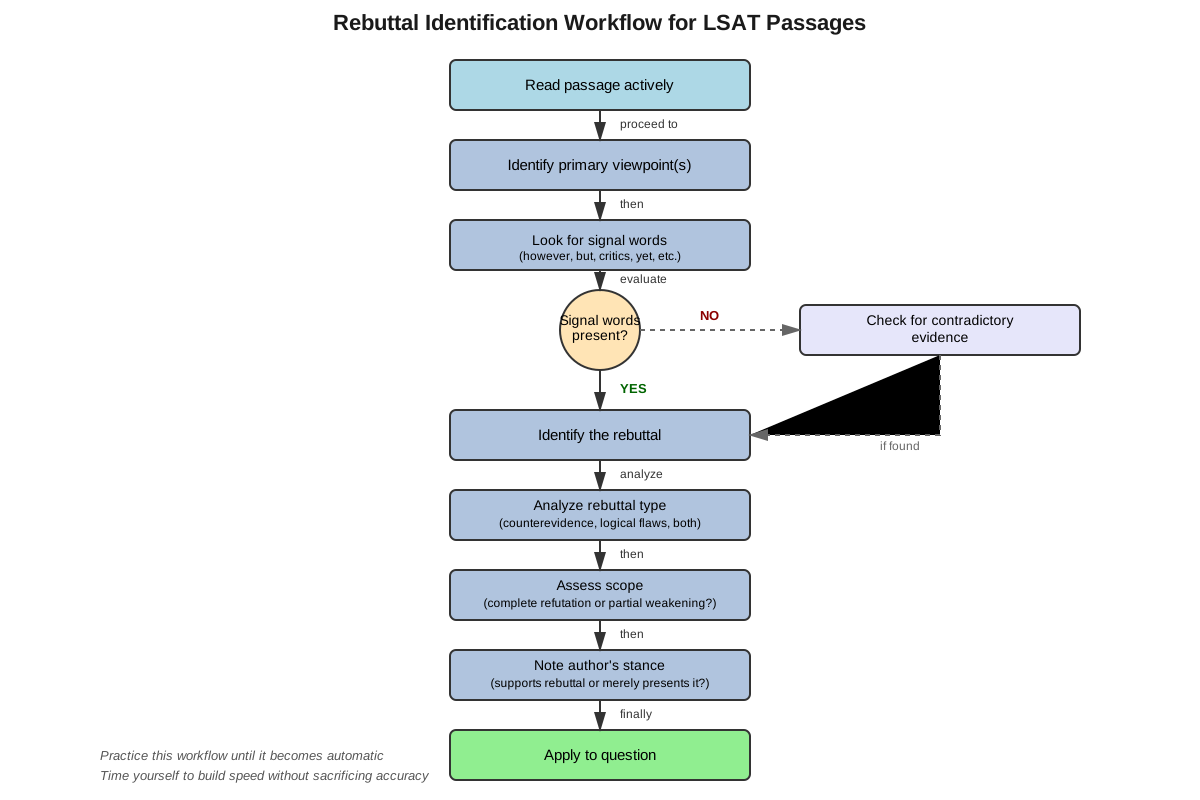
When approaching LSAT reading comprehension questions involving rebuttals, employ this systematic process:
During initial passage reading:
- Mark contrast transitions (however, yet, but) as potential rebuttal signals
- Note when new evidence contradicts earlier claims, even without explicit markers
- Track whose view is being presented—author, other scholars, critics
- Identify the specific claim being challenged and the grounds for the challenge
Trigger words in question stems that indicate rebuttal identification:
- "The author mentions X in order to..." (often to rebut or challenge)
- "The function of the third paragraph is to..." (may be to present a rebuttal)
- "The author's attitude toward [theory/view] is..." (requires identifying whether author rebuts it)
- "Which of the following, if true, would most weaken..." (tests understanding of what would rebut the argument)
- "The author would most likely agree with which characterization of [view]..." (requires knowing if author rebuts or supports it)
Process of elimination strategies:
- Eliminate answers that reverse the rebuttal relationship (claiming the author supports a view they actually challenge)
- Eliminate answers that overstate the scope of a rebuttal (claiming complete refutation when the author only qualifies)
- Eliminate answers that attribute rebuttals to the wrong party (confusing what critics say with what the author endorses)
- Eliminate answers that describe rebuttals as "providing additional support" or "further evidence for"—rebuttals challenge, not support
Time allocation: Spend extra time on paragraphs following contrast markers, as these often contain rebuttals that generate multiple questions. When a question asks about relationships between views, quickly scan for the relevant claims and the language connecting them before evaluating answer choices.
Exam Tip: If you're unsure whether a rebuttal exists, ask: "If both claims are true, is there a logical contradiction or tension?" If yes, a rebuttal relationship likely exists, even without explicit oppositional language.
Memory Techniques
Mnemonic for rebuttal markers - "CHADY":
- Contrast words (however, yet, but)
- However-type transitions
- Alternative explanations (rather, instead)
- Direct challenges (critics argue, this view fails)
- Yet and nevertheless
Visualization strategy: Picture arguments as buildings. A rebuttal is someone pointing out cracks in the foundation or walls. The rebuttal might target the foundation (assumptions), the walls (evidence), or the roof (conclusions). Visualizing which part of the "building" is being challenged helps identify what component of the argument the rebuttal addresses.
The "Two-Voice" technique: When reading passages with rebuttals, imagine two people in conversation. Voice 1 makes a claim, Voice 2 responds with a challenge. This mental model helps track whose view is whose and prevents confusion about what the author actually believes versus what they're reporting others believe.
Acronym for rebuttal functions - "SCREW":
- Strengthen author's position
- Challenge alternative views
- Refine earlier claims
- Explain theoretical evolution
- Weaken opposing arguments
Summary
Identifying rebuttals is a foundational skill in LSAT reading comprehension that requires recognizing when one claim challenges, refutes, or undermines another. Rebuttals appear through both explicit oppositional language and implicit logical contradictions, often marked by transition words like "however" or "yet" but sometimes present only through the presentation of contradictory evidence. Successful rebuttal identification depends on tracking multiple viewpoints, understanding argumentative structure, and recognizing the specific component of an argument being challenged—whether assumptions, evidence, logic, or scope. This skill directly impacts performance on questions about passage structure, author's purpose, and relationships between views, appearing in approximately 15-20% of reading comprehension questions. Mastery requires distinguishing between different types of rebuttals (direct refutation, qualification, alternative explanation), understanding their function in advancing the author's thesis, and accurately tracking whose view is being presented and whether the author endorses or opposes it.
Key Takeaways
- Rebuttals challenge specific claims with reasons or evidence, not merely present alternative views
- Contrast markers like "however" and "yet" frequently signal rebuttals, but implicit rebuttals through logical contradiction are equally important
- Always track whose view is being presented—authors often describe rebuttals made by others without endorsing them
- Rebuttals can target different components of arguments: assumptions, evidence, logical inferences, or scope
- Questions about paragraph function or purpose often involve identifying rebuttals when those paragraphs challenge previous claims
- Understanding the scope of a rebuttal (complete refutation vs. qualification) is crucial for accurate answer selection
- Rebuttal chains, where multiple theories respond to each other sequentially, require careful tracking of what each view accepts versus challenges
Related Topics
Analyzing Author's Purpose and Tone: Mastering rebuttal identification enables deeper understanding of why authors include certain information and what their attitude is toward different views. Authors who rebut a view typically oppose it, affecting tone analysis.
Understanding Passage Structure and Organization: Rebuttals often mark major structural transitions in passages, so this skill connects directly to questions about how passages are organized and why paragraphs appear in particular sequences.
Evaluating Argument Strength: Once rebuttals are identified, the next level involves assessing whether they successfully undermine the original claims or whether the original claims withstand the challenge.
Comparative Passage Analysis: In comparative passages, identifying how Passage B responds to or rebuts claims in Passage A is essential for questions about the relationship between passages.
Making Inferences and Drawing Conclusions: Understanding what views have been rebutted helps predict what the author likely believes and what conclusions they would support or oppose.
Practice CTA
Now that you've mastered the core concepts of identifying rebuttals, it's time to apply these skills to authentic LSAT passages. Work through the practice questions carefully, paying special attention to contrast markers, implicit contradictions, and the scope of rebuttals. Use the flashcards to reinforce recognition of rebuttal markers and types. Remember: identifying rebuttals is not just about spotting oppositional language—it's about understanding the logical relationships between claims. With focused practice, you'll develop the instinct to recognize rebuttals quickly and accurately, giving you a significant advantage on test day. Every passage you analyze strengthens your ability to navigate complex argumentation with confidence.
Sign up free to keep reading
Create a free AnvayaPrep account to finish this LSAT guide on Identifying rebuttals — plus flashcards and practice questions.