Overview
Scientific reasoning in passages is a critical component of LSAT reading comprehension that appears with remarkable frequency on test day. These passages present scientific theories, experimental findings, research methodologies, and debates within scientific communities. Unlike casual science writing, LSAT scientific passages require test-takers to analyze how scientists construct arguments, evaluate evidence, reconcile competing hypotheses, and draw conclusions from empirical data. The LSAT doesn't test scientific knowledge itself—rather, it assesses the ability to understand how scientific claims are justified, how evidence supports or undermines theories, and how researchers respond to challenges within their fields.
Mastering scientific reasoning passages is essential because they constitute approximately 25-30% of all reading comprehension passages on the LSAT. These passages often prove challenging for students from non-science backgrounds, yet they follow predictable patterns once the underlying structure is understood. Scientific passages typically present a phenomenon requiring explanation, introduce one or more competing theories, describe evidence supporting or challenging these theories, and conclude with implications or remaining questions. The questions accompanying these passages focus on viewpoints and argumentation—asking test-takers to identify the author's attitude, distinguish between competing explanations, recognize the role of specific evidence, and predict how scientists would respond to new information.
Within the broader Reading Comprehension framework, scientific reasoning passages represent a specialized application of general analytical skills. They connect directly to understanding author purpose, identifying logical structure, evaluating evidence strength, and tracking multiple perspectives—all fundamental LSAT competencies. However, scientific passages add layers of complexity through technical terminology, abstract concepts, and the unique conventions of scientific discourse. Success requires not just reading comprehension but also the ability to navigate specialized vocabulary, understand cause-and-effect relationships in complex systems, and appreciate the tentative, evidence-based nature of scientific knowledge.
Learning Objectives
- [ ] Identify how scientific reasoning in passages appears in LSAT questions
- [ ] Explain the reasoning pattern behind scientific reasoning in passages
- [ ] Apply scientific reasoning in passages to solve LSAT-style problems accurately
- [ ] Distinguish between competing scientific theories and the evidence supporting each
- [ ] Recognize the function of specific paragraphs and sentences within scientific arguments
- [ ] Evaluate the strength and relevance of evidence presented in scientific contexts
- [ ] Predict how scientists would respond to new evidence or challenges to their theories
Prerequisites
- Basic argument structure recognition: Understanding premises, conclusions, and supporting evidence is fundamental to analyzing how scientists build their cases
- Ability to identify main ideas and supporting details: Scientific passages contain dense information; distinguishing central claims from illustrative examples is essential
- Familiarity with author's tone and purpose: Recognizing whether an author is advocating, critiquing, or neutrally presenting theories shapes interpretation
- Understanding of logical relationships: Cause-and-effect, comparison-contrast, and problem-solution structures pervade scientific writing
Why This Topic Matters
Scientific reasoning passages appear in virtually every LSAT administration, typically comprising one of the four reading comprehension passages in each section. These passages draw from diverse fields including biology, physics, astronomy, psychology, anthropology, and earth sciences. The LSAT deliberately selects passages that require no specialized scientific knowledge—all necessary information is provided within the text. However, the passages do require comfort with scientific thinking: understanding how hypotheses are tested, how evidence accumulates, and how scientific consensus evolves.
In real-world applications, the skills tested through scientific reasoning passages extend far beyond academic science. Legal professionals regularly encounter expert testimony, scientific evidence in cases involving medical malpractice or environmental law, and technical reports requiring careful analysis. Attorneys must evaluate the credibility of scientific claims, identify weaknesses in research methodologies, and explain complex technical concepts to judges and juries. The analytical framework developed through studying scientific reasoning passages—questioning assumptions, demanding evidence, considering alternative explanations—forms the foundation of effective legal reasoning.
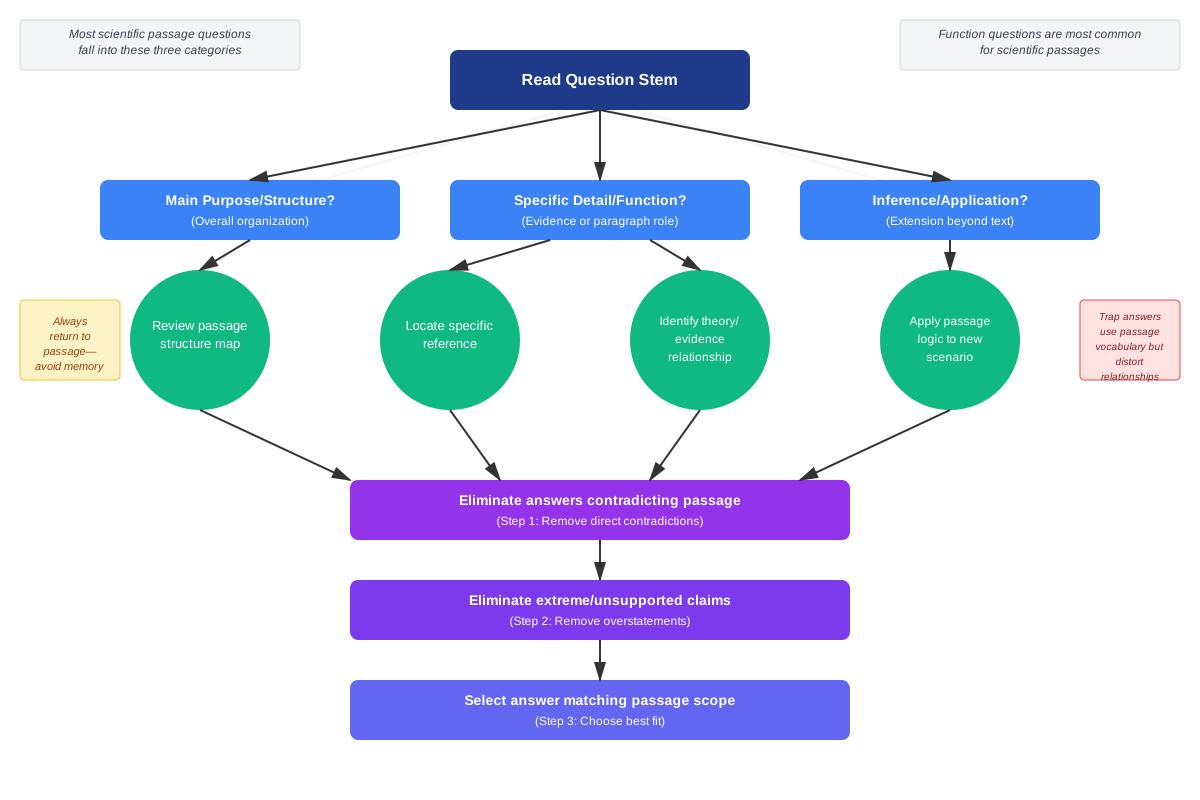
On the LSAT, scientific reasoning passages generate several predictable question types. Main point questions ask test-takers to identify the primary purpose or central claim of the passage. Function questions require understanding why the author included specific information—often experimental results or theoretical objections. Inference questions test the ability to draw logical conclusions from scientific evidence. Attitude questions assess recognition of the author's stance toward competing theories. Application questions present new scenarios and ask how the passage's theories would apply. Understanding the common patterns in scientific reasoning dramatically improves accuracy and speed on these high-value questions.
Core Concepts
The Structure of Scientific Arguments
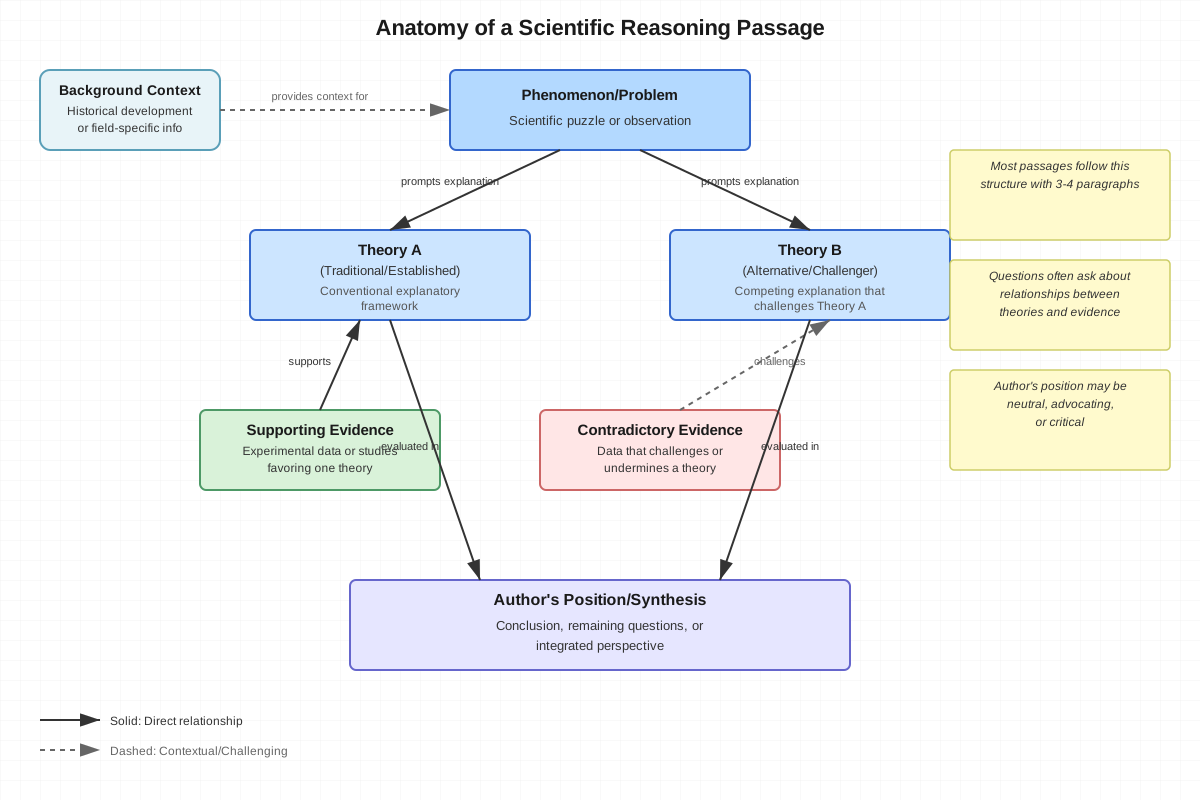
Scientific reasoning in passages follows a characteristic architecture that, once recognized, makes comprehension significantly easier. Most scientific passages begin by presenting a phenomenon requiring explanation—an observed pattern, experimental result, or natural occurrence that scientists seek to understand. The passage then introduces one or more competing theories or hypotheses proposed to explain this phenomenon. Each theory receives support from certain types of evidence, which may include experimental data, observational studies, mathematical models, or logical reasoning. The passage typically concludes by evaluating these theories, noting their strengths and limitations, or indicating which explanation the scientific community currently favors.
This structure reflects how science actually progresses: through the proposal, testing, and refinement of explanatory frameworks. LSAT passages capture this dynamic process, often presenting scientific debates rather than settled facts. Test-takers must track multiple viewpoints simultaneously—understanding not just what each theory claims, but also what evidence supports it, what challenges it faces, and how it differs from alternative explanations.
Evidence Types and Their Functions
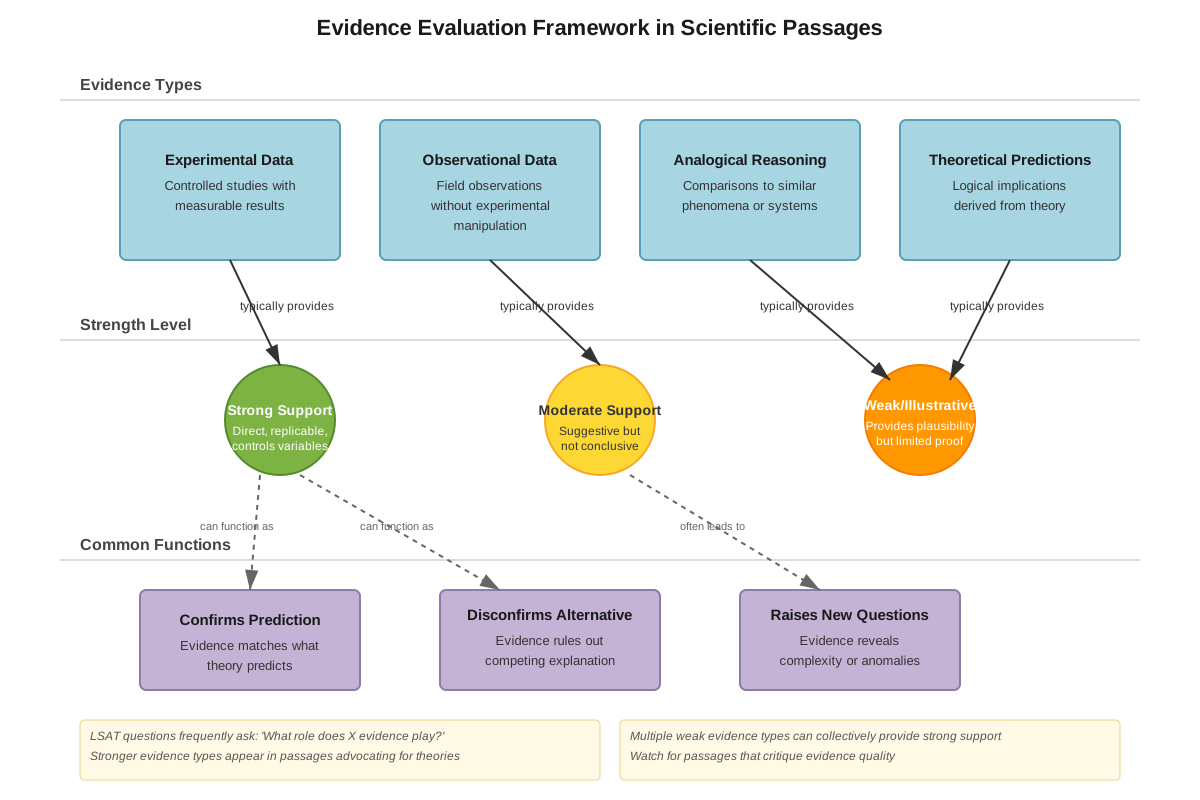
Scientific passages employ various forms of evidence, each serving distinct argumentative purposes. Experimental evidence describes controlled studies where researchers manipulate variables and observe outcomes. These passages often detail experimental design, including control groups, measured variables, and statistical results. Observational evidence presents patterns noticed in natural settings without experimental manipulation—common in astronomy, paleontology, and field biology. Comparative evidence draws parallels between different systems or organisms to support broader principles. Theoretical evidence uses logical reasoning or mathematical modeling to demonstrate that a theory is internally consistent or makes accurate predictions.
Understanding evidence function is crucial for LSAT scientific reasoning in passages questions. The LSAT frequently asks why the author mentions specific evidence—is it to support a theory, challenge an alternative explanation, illustrate a concept, or acknowledge a limitation? Recognizing these functions enables accurate answers to detail and purpose questions.
| Evidence Type | Typical Indicators | Common Function in Passage |
|---|---|---|
| Experimental | "Researchers tested," "controlled study," "results showed" | Directly support or challenge specific hypotheses |
| Observational | "Scientists observed," "patterns indicate," "field studies reveal" | Establish phenomena requiring explanation |
| Comparative | "Similarly," "by analogy," "parallels between" | Extend theories to new domains or strengthen plausibility |
| Theoretical | "Models predict," "logically follows," "mathematical analysis" | Demonstrate internal consistency or make testable predictions |
Theory Comparison and Evaluation
Many scientific passages present competing theories without definitively endorsing one. This structure mirrors real scientific discourse, where multiple explanations often coexist until evidence accumulates favoring one approach. Test-takers must carefully track what distinguishes competing theories—do they explain different aspects of the phenomenon, make different predictions, or rely on different types of evidence?
The passage structure often follows this pattern:
- Introduce phenomenon requiring explanation
- Present Theory A with supporting evidence
- Acknowledge limitations or challenges to Theory A
- Present Theory B as alternative explanation
- Evaluate relative strengths of each theory
- Conclude with current scientific consensus or remaining questions
Questions frequently test whether students can distinguish what each theory claims, identify evidence supporting each, and recognize what would strengthen or weaken each explanation. This requires active reading—creating a mental map of the theoretical landscape rather than passively absorbing information.
The Role of Anomalies and Challenges
Scientific passages often highlight anomalies—observations that don't fit existing theories. These anomalies serve multiple functions: they motivate the search for new explanations, test the robustness of current theories, and drive scientific progress. When a passage mentions an unexpected finding or exception to a general pattern, this information is almost always tested. Questions may ask what problem the anomaly creates for a theory, how scientists might respond to the challenge, or what additional evidence would resolve the discrepancy.
Understanding how scientists handle anomalies reveals the self-correcting nature of scientific reasoning. Rather than ignoring contradictory evidence, scientists modify theories, propose new mechanisms, or acknowledge the limits of current understanding. LSAT passages reward test-takers who recognize this dynamic, evidence-responsive character of scientific thinking.
Author's Perspective and Tone
Unlike some reading comprehension passages where the author strongly advocates a position, scientific passages often adopt a more neutral, explanatory tone. The author's role is typically to present scientific debates fairly, explaining what different researchers believe and why. However, subtle indicators often reveal the author's assessment: phrases like "the more plausible explanation," "convincing evidence," or "remains controversial" signal evaluative judgments.
Questions about author attitude require careful attention to these markers. Does the author present both theories as equally viable, or does the passage suggest one explanation is better supported? Is the author optimistic about resolving current debates, or skeptical that existing approaches will succeed? These nuances, though subtle, are consistently tested and reward close reading.
Technical Terminology and Concept Explanation
Scientific passages necessarily include specialized vocabulary, but the LSAT always provides sufficient context to understand key terms. Often, the passage explicitly defines technical concepts or illustrates them through examples. Test-takers should note these definitions carefully, as questions frequently test whether students understood specialized terminology.
When encountering unfamiliar terms, effective readers use context clues: Is the term presented as a type of something more familiar? Does the passage provide examples? Is the term contrasted with something else? Rather than panicking over technical language, successful test-takers recognize that all necessary information appears within the passage itself.
Concept Relationships
The core concepts in scientific reasoning passages form an interconnected system. The structure of scientific arguments provides the overall framework within which other elements operate. This structure determines where evidence types appear and what functions they serve—experimental evidence typically supports specific theories, while observational evidence often establishes the phenomenon requiring explanation. Theory comparison depends on understanding both the structure and the evidence, as distinguishing theories requires recognizing what evidence supports each and where they make different predictions.
Anomalies and challenges create tension within the argumentative structure, motivating theory revision or the proposal of alternative explanations. They represent points where evidence and theory don't align, driving the scientific process forward. The author's perspective emerges from how the passage presents this entire landscape—which theories receive more attention, which evidence is characterized as "strong" or "suggestive," and whether the passage concludes with confidence or uncertainty.
Technical terminology threads through all these elements, providing the precise language scientists use to articulate theories, describe evidence, and identify phenomena. Understanding these terms enables comprehension of the specific claims being made and the distinctions between competing explanations.
This relationship map captures the flow:
Phenomenon → motivates → Competing Theories → supported/challenged by → Evidence Types → evaluated through → Theory Comparison → complicated by → Anomalies → all presented through → Author's Perspective → expressed using → Technical Terminology
These concepts also connect to broader reading comprehension skills. Identifying main ideas requires understanding the overall argumentative structure. Recognizing supporting details means distinguishing evidence from claims. Understanding viewpoints and argumentation involves tracking multiple theories and the author's assessment of each. Scientific reasoning passages thus represent a specialized application of general analytical reading skills.
Quick check — test yourself on Scientific reasoning in passages so far.
Try Flashcards →High-Yield Facts
⭐ Scientific passages always provide all necessary information—no outside scientific knowledge is required or advantageous
⭐ Approximately 25-30% of reading comprehension passages involve scientific reasoning, making this a high-frequency topic
⭐ Most scientific passages present competing theories or explanations rather than a single accepted view
⭐ Evidence mentioned in the passage almost always appears in questions—note what each piece of evidence supports or challenges
⭐ Anomalies and exceptions to theories are heavily tested—pay special attention to unexpected findings or limitations
- The author's tone in scientific passages is typically neutral-explanatory rather than strongly argumentative
- Technical terms are always defined or explained through context within the passage
- Questions frequently ask about the function of specific paragraphs or sentences within the overall argument
- "New information" questions often present additional evidence and ask how it affects competing theories
- The conclusion of scientific passages often indicates current scientific consensus or acknowledges remaining uncertainties
- Comparative evidence (analogies to other systems) often appears to make abstract theories more concrete
- Experimental design details (control groups, variables measured) are included because they're relevant to evaluating evidence strength
- Passages may present theories chronologically (older theory first, then newer alternative) or by prominence (dominant theory first, then challenger)
- Author attitude questions require distinguishing between presenting a view and endorsing it
- Scientific passages frequently discuss implications or applications of theories in their final paragraphs
Common Misconceptions
Misconception: Scientific passages require background knowledge in the relevant field to answer questions correctly.
Correction: The LSAT deliberately selects passages that are self-contained. All information needed to answer questions appears within the passage itself. In fact, outside knowledge can sometimes mislead test-takers who rely on what they know rather than what the passage states.
Misconception: When a passage presents two theories, one must be correct and the other incorrect.
Correction: Scientific passages often present theories that each explain different aspects of a phenomenon, or that remain genuinely contested within the scientific community. The passage may indicate that both have merit, that evidence is currently insufficient to decide between them, or that they're complementary rather than contradictory.
Misconception: Technical terminology is included to confuse test-takers and should be skipped over.
Correction: Technical terms are always relevant to the passage's argument and are consistently tested in questions. The passage provides sufficient context to understand these terms, and questions often specifically ask about their meaning or application.
Misconception: The theory presented first or discussed most extensively is the one the author supports.
Correction: Passage organization doesn't necessarily indicate author preference. The author may present a dominant theory extensively before introducing a challenger, or may give equal treatment to competing views. Author attitude must be determined from evaluative language, not from space allocation.
Misconception: Experimental evidence is always stronger than observational or theoretical evidence.
Correction: Different types of evidence serve different purposes, and their strength depends on context. Observational evidence may be the only option for phenomena that can't be experimentally manipulated (like astronomical events), while theoretical evidence may provide crucial predictions that guide future research.
Misconception: Scientific passages are harder than other reading comprehension passages.
Correction: While scientific passages may seem intimidating due to technical content, they follow highly predictable structures. Once these patterns are recognized, scientific passages often become easier than passages on law, humanities, or social sciences, which may have more subtle arguments and less clear organizational frameworks.
Worked Examples
Example 1: Competing Theories Passage
Passage Summary: A passage discusses why certain bird species migrate enormous distances while others don't. Theory A suggests migration evolved because it allows birds to exploit seasonal food resources unavailable to non-migratory species. Theory B proposes that migration evolved as a response to glacial cycles, with birds following retreating ice sheets to newly available habitats. The passage notes that Theory A explains why tropical birds migrate short distances (following seasonal rains and food availability), while Theory B better explains why arctic-breeding birds migrate such extreme distances. Recent genetic evidence suggests migration evolved independently multiple times in different bird lineages.
Question: The passage suggests that the genetic evidence mentioned in the final paragraph most directly challenges which aspect of the theories discussed?
Analysis Process:
- Identify what the genetic evidence shows: Migration evolved independently multiple times
- Consider what this implies: If migration evolved independently, it's not a single trait inherited from a common ancestor
- Evaluate each theory: Both Theory A and Theory B are presented as general explanations for why migration evolved
- Recognize the challenge: If migration evolved multiple times independently, this suggests different factors may have driven its evolution in different lineages, rather than a single universal explanation
- Connect to the theories: The evidence challenges the assumption that either theory alone explains all migration—instead, different selective pressures may have operated in different contexts
Answer Reasoning: The genetic evidence most directly challenges the idea that a single explanation accounts for all bird migration. Both theories are presented as general explanations, but the independent evolution of migration suggests that different factors (perhaps Theory A's food resources in some cases, Theory B's glacial cycles in others, or entirely different factors) drove migration's evolution in different bird groups. This exemplifies how new evidence can complicate existing theoretical frameworks without necessarily disproving them entirely.
Connection to Learning Objectives: This example demonstrates how to identify the function of evidence (the genetic findings), explain the reasoning pattern (independent evolution suggests multiple causal factors), and apply this understanding to evaluate theories—all core objectives for scientific reasoning passages.
Example 2: Anomaly and Theory Modification
Passage Summary: A passage describes the theory that Earth's magnetic field is generated by convection currents in the liquid iron outer core. This "dynamo theory" successfully explains most magnetic field properties. However, recent measurements show the magnetic field is weakening faster than the theory predicts, and the magnetic poles are moving more rapidly than expected. Some scientists propose that these anomalies indicate an impending magnetic field reversal (which geological evidence shows has occurred many times in Earth's history). Others argue that the current changes fall within normal variation and don't necessarily signal a reversal.
Question: Based on the passage, which of the following, if true, would most strengthen the position of scientists who believe the anomalies indicate an impending reversal?
Analysis Process:
- Identify the competing positions: Some scientists think anomalies signal reversal; others think they're normal variation
- Understand what would strengthen the "reversal" position: Evidence that current changes resemble patterns preceding past reversals
- Consider what the passage tells us: Geological evidence shows reversals have occurred before
- Recognize what's missing: The passage doesn't describe what happens before a reversal
- Evaluate answer choices (hypothetically):
- Evidence that past reversals were preceded by rapid pole movement and field weakening would strongly support the "reversal" interpretation
- Evidence that the field has weakened this much before without reversing would weaken the "reversal" position
- Evidence about what causes reversals wouldn't directly address whether current changes indicate one is coming
Answer Reasoning: The strongest support for the "reversal" position would be evidence that the current anomalies match patterns observed before previous reversals. This would transform the anomalies from unexplained deviations into expected precursors, directly supporting the interpretation that a reversal is approaching. This type of question tests the ability to recognize what evidence would strengthen a particular interpretation of anomalous data.
Connection to Learning Objectives: This example illustrates how anomalies function in scientific reasoning (challenging existing predictions), how scientists respond to anomalies (proposing different interpretations), and how to evaluate what evidence would support competing explanations—all essential skills for LSAT scientific reasoning passages.
Exam Strategy
When approaching scientific reasoning passages on the LSAT, begin by identifying the passage structure during the initial read. Ask: What phenomenon needs explanation? What theories are proposed? What evidence supports each? This active reading creates a mental framework that makes questions significantly easier.
Trigger words and phrases signal important structural elements:
- "However," "but," "yet": Indicate contrasts between theories or evidence contradicting expectations
- "Some scientists believe," "others argue": Mark competing viewpoints requiring careful tracking
- "Evidence suggests," "studies show," "researchers found": Introduce evidence that will likely appear in questions
- "Surprisingly," "unexpectedly," "anomalous": Highlight findings that challenge theories—heavily tested
- "This explains," "accounts for," "is consistent with": Connect evidence to theories
- "Remains unclear," "controversial," "debated": Indicate areas of scientific uncertainty
Process-of-elimination strategies specific to scientific passages:
- Eliminate answers that confuse which evidence supports which theory
- Eliminate answers that attribute views to the wrong scientists or to the author incorrectly
- Eliminate answers that overstate certainty (saying something is "proven" when the passage says "suggests")
- Eliminate answers that introduce outside scientific knowledge not mentioned in the passage
- Eliminate answers that reverse cause and effect relationships
Time allocation: Scientific passages often require slightly more time during the initial read due to technical content and complex structure. However, this investment pays off through faster, more accurate question answering. Aim to spend approximately 3.5-4 minutes on the initial read, leaving 5-6 minutes for questions. If a passage seems particularly dense, don't panic—the questions will often clarify what's most important.
Exam Tip: When a question asks about "the author's attitude" toward a theory, distinguish between presenting and endorsing. Authors often present theories neutrally while subtly indicating which has stronger support through phrases like "more convincing evidence" or "remains speculative."
For "new information" questions presenting additional evidence, systematically consider how this evidence affects each theory mentioned in the passage. Does it support one theory's predictions? Challenge another theory's assumptions? Resolve an anomaly? These questions test the ability to extend the passage's reasoning to new scenarios.
Memory Techniques
PEST - Remember the four common components of scientific passages:
- Phenomenon (what needs explaining)
- Evidence (data supporting or challenging theories)
- Scientific theories (competing explanations)
- Tensions (anomalies, limitations, or debates)
CAFE - Types of evidence to watch for:
- Comparative (analogies to other systems)
- Anomalous (unexpected findings)
- Field/observational (natural patterns)
- Experimental (controlled studies)
Visualization strategy: Picture scientific passages as a courtroom where competing theories are on trial. Evidence is testimony supporting or challenging each theory. The author is the judge, sometimes neutral, sometimes indicating which case is stronger. Anomalies are surprise witnesses that complicate the proceedings. This metaphor helps track multiple viewpoints and evaluate evidence strength.
The "Theory Tracker" technique: As you read, create a mental two-column table:
| Theory A | Theory B |
|---|---|
| Claims X | Claims Y |
| Supported by evidence 1 | Supported by evidence 2 |
| Challenged by anomaly A | Explains anomaly A |
This mental organization makes comparison questions and "which theory would predict" questions much easier.
Acronym for author attitude words: NCES (Nice!)
- Neutral (presenting without judgment)
- Cautious (acknowledging limitations)
- Enthusiastic (positive about a theory or finding)
- Skeptical (doubtful about claims)
Most scientific passage authors fall into the first two categories, occasionally the last, rarely the third.
Summary
Scientific reasoning in passages represents a high-frequency, high-value component of LSAT reading comprehension. These passages present scientific debates, theories, and evidence in predictable structural patterns: introducing phenomena requiring explanation, presenting competing theories, describing supporting and challenging evidence, and evaluating relative strengths of different explanations. Success requires tracking multiple viewpoints simultaneously, understanding how different types of evidence function within arguments, recognizing the role of anomalies in challenging theories, and identifying the author's perspective through subtle evaluative language. The LSAT tests not scientific knowledge but rather the ability to analyze how scientific claims are justified, how evidence supports or undermines theories, and how scientists respond to challenges. Mastering these passages requires recognizing their characteristic structure, actively tracking theories and evidence during reading, and systematically evaluating how new information affects competing explanations. The skills developed through scientific reasoning passages—demanding evidence, considering alternative explanations, and evaluating argument strength—extend far beyond the LSAT to legal practice and critical thinking generally.
Key Takeaways
- Scientific passages follow predictable structures: phenomenon → competing theories → evidence → evaluation
- All necessary information appears within the passage; no outside scientific knowledge is required or helpful
- Track what evidence supports which theory and what challenges each explanation faces
- Anomalies and unexpected findings are heavily tested—note what problems they create for theories
- Author attitude is typically neutral-explanatory but may subtly favor one theory through evaluative language
- Questions frequently ask about evidence function: why did the author include specific information?
- "New information" questions test the ability to extend the passage's reasoning to novel scenarios
Related Topics
Comparative Reading Passages: Many scientific passages appear in comparative format, presenting two related passages with different perspectives on the same phenomenon. Mastering single scientific passages provides the foundation for analyzing how two authors approach the same topic differently.
Logical Reasoning - Strengthen/Weaken Questions: The skills developed through scientific reasoning passages—evaluating what evidence would support or challenge a theory—directly transfer to Logical Reasoning questions asking what would strengthen or weaken an argument.
Main Point and Primary Purpose Questions: Understanding the overall structure of scientific arguments enables accurate identification of the passage's main point and the author's primary purpose in writing.
Inference Questions Across Passage Types: The ability to draw logical conclusions from scientific evidence strengthens inference skills applicable to all reading comprehension passages, not just scientific ones.
Practice CTA
Now that you've mastered the core concepts of scientific reasoning in passages, it's time to apply this knowledge to actual LSAT-style questions. The practice questions and flashcards will reinforce your understanding of passage structure, evidence evaluation, and theory comparison. Each practice problem is an opportunity to strengthen your analytical skills and build the confidence needed for test day. Remember: scientific passages become significantly easier once you recognize their predictable patterns. Your investment in understanding these structures will pay dividends across multiple passages on every LSAT you encounter. Approach the practice materials actively, consciously applying the strategies and frameworks you've learned. You're building expertise that will serve you not just on the LSAT, but throughout your legal career.
Sign up free to keep reading
Create a free AnvayaPrep account to finish this LSAT guide on Scientific reasoning in passages — plus flashcards and practice questions.